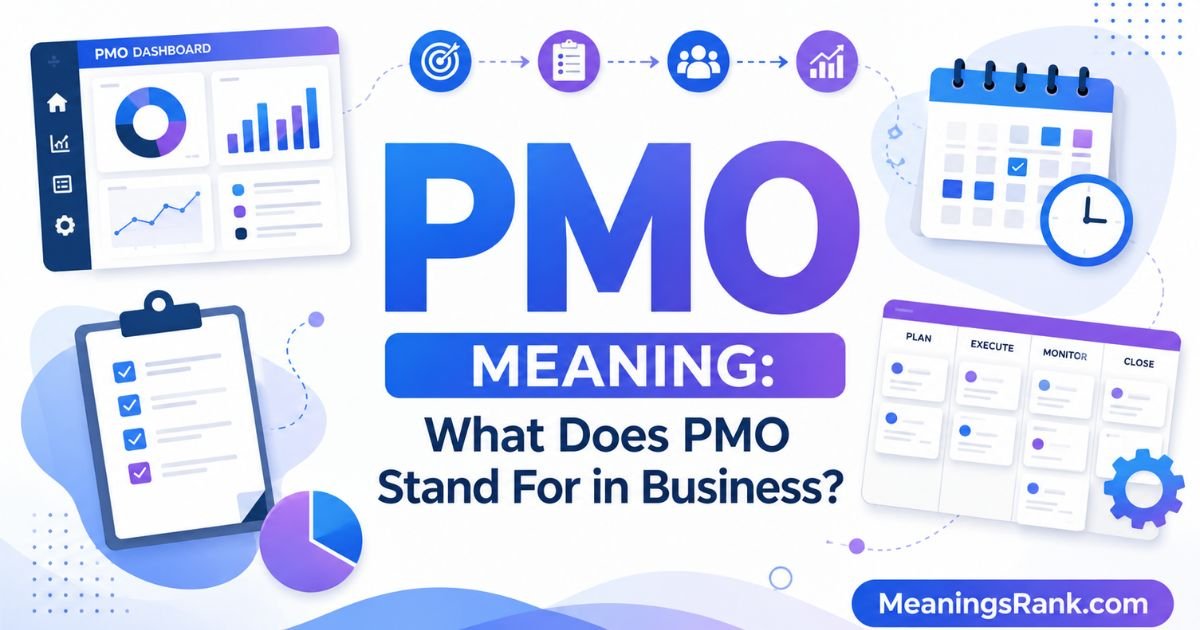

If you’ve come across “PMO” in a work email or a text message, you might be scratching your head about which meaning applies. The PMO meaning actually changes depending on where you see it. In business, PMO usually refers to a Project Management Office, a team that keeps projects organized and on track.
In texting and social media, though, PMO often stands for something completely different, like “Put Me On” or “Pissing Me Off.” That’s a big difference, and mixing them up can cause real confusion. This guide breaks down both meanings clearly, shows you real examples, and helps you understand exactly how PMO is used in business settings and everyday chats.
What Does PMO Mean?
PMO is one of those short forms that carries more than one meaning, and the right one depends entirely on context.
In a business or corporate setting, PMO almost always refers to a Project Management Office.
This is a team or department that helps organize, plan, and track projects across a company.
In texting or social media, PMO usually means something casual, like “Put Me On” (asking to be included in something) or “Pissing Me Off” (expressing frustration).
Here’s a quick way to tell them apart:
- If it’s used in a work email, meeting, or LinkedIn post, it’s almost certainly the business meaning.
- If it’s used in a text, Instagram comment, or group chat, it’s usually the slang meaning.
Example of the business meaning:
Person A: “Who approved the new project timeline?”
Person B: “The PMO reviewed it last week and signed off.”
Example of the slang meaning:
Person A: “Ugh, my Wi-Fi keeps cutting out.”
Person B: “That would PMO too, that’s so annoying.”
Both meanings are correct, but they belong to very different worlds. This guide focuses mainly on the business meaning since that’s the more widely searched and professionally relevant version, but it also explains the texting meaning so you’re never caught off guard.
Knowing both versions helps you read messages accurately, whether you’re in a boardroom or a group chat.
What Does PMO Stand For?
In business, PMO stands for “Project Management Office.” This is the most common and widely recognized meaning across companies, industries, and professional settings.
A Project Management Office is a formal team within an organization. Its main job is to set standards, track progress, and support project managers as they lead different initiatives.
In casual texting, PMO can stand for a few different things depending on the conversation:
- “Put Me On”
Also Read: OFC Meaning in Text: What It Means, How People Use It & How to Reply (2026 Guide)
Asking someone to include you in an opportunity, event, or plan.
- “Pissing Me Off”
Expressing annoyance or frustration about something.
Here’s a simple breakdown:
| Meaning | Context | Example |
| Project Management Office | Business, corporate emails, LinkedIn | “The PMO approved the budget.” |
| Put Me On | Texting, social media, gaming | “Yo PMO to that new game everyone’s playing.” |
| Pissing Me Off | Texting, casual chats | “This traffic is PMO fr.” |
The business meaning tends to show up in formal writing, job titles, and workplace conversations. The slang meanings show up almost exclusively in casual digital spaces like texting, Instagram, or Discord.
Since PMO isn’t capitalized differently between meanings, context is really the only way to tell which one someone means. A message that says “PMO” during a work call means something totally different than one sent in a group chat with friends.
Understanding both origins helps prevent awkward misunderstandings, especially if you use PMO in professional writing without realizing it has a casual slang version too.
What Is a PMO in Business?
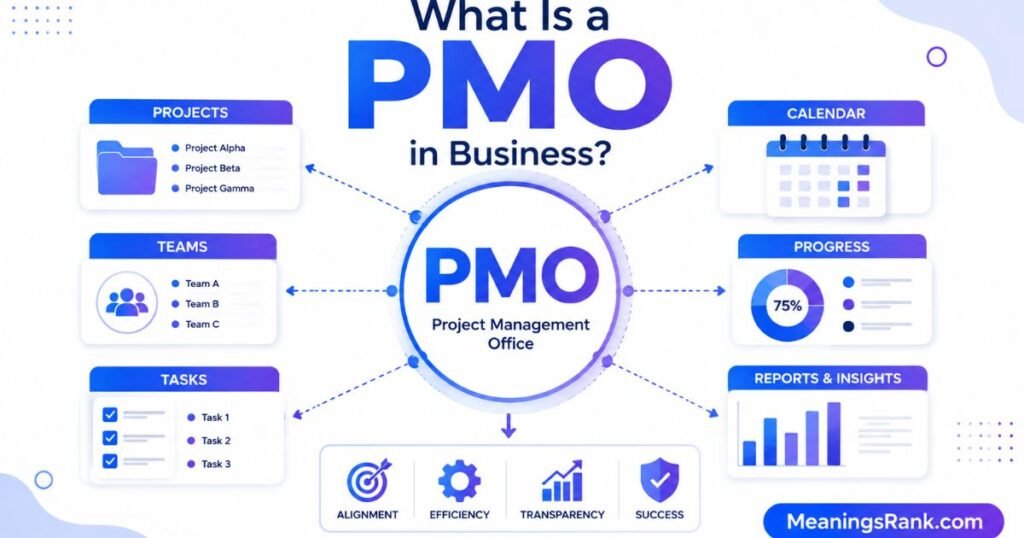
A Project Management Office, or PMO, is a team inside a company that oversees how projects are planned, executed, and completed. Think of it as the group that keeps everything organized behind the scenes.
Most mid-sized to large companies have some form of a PMO, especially if they run multiple projects at once. Without one, projects can easily become disorganized, miss deadlines, or go over budget.
What a PMO Typically Does:
- Sets project management standards and best practices
- Tracks project timelines, budgets, and progress
- Supports project managers with tools, templates, and training
- Reports project status to company leadership
- Helps prioritize which projects get resources first
Why Companies Use a PMO:
Without a centralized team, different departments often manage projects in their own way, which can lead to inconsistent results. A PMO creates a shared system that everyone follows, making it easier to compare progress across projects.
For example, imagine a company running five different projects at the same time. Without a PMO, each project manager might track progress differently, using different tools and reporting styles. A PMO steps in to standardize this process, so leadership can easily see which projects are on track and which need attention.
Who Works in a PMO?
- PMO Director or Manager
- Project Coordinators
- Portfolio Managers
- Business Analysts
- Project Management Specialists
A well-run PMO doesn’t just track numbers. It also helps teams avoid repeating the same mistakes across different projects by sharing lessons learned and improving processes over time.
This is why understanding PMO meaning matters beyond just knowing the acronym. It’s a functional part of how many businesses operate and stay organized.
Types of PMO
Not every PMO works the same way. Companies usually choose a structure based on how much control they want the PMO to have over individual projects.
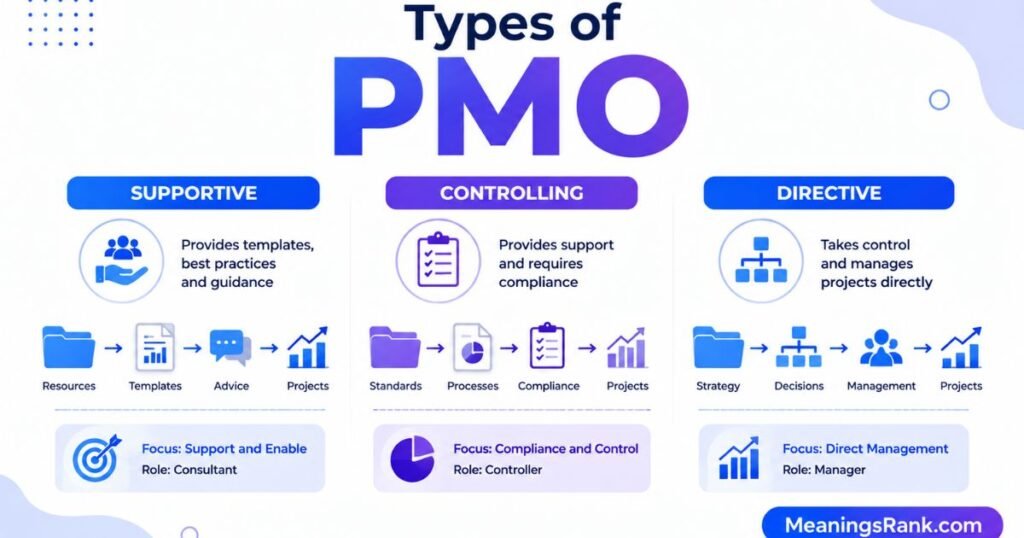
There are generally three main types of PMO, each with a different level of authority and involvement.
Supportive PMO
This type acts mostly as a resource center. It provides templates, training, and best practices, but doesn’t directly control how projects are run.
- Best for companies that want guidance without strict oversight
- Project managers have more independence
- Lower level of control
Controlling PMO
This type requires project managers to follow specific processes and standards. It checks in regularly to make sure projects stay compliant.
- Requires regular reporting and reviews
- Enforces specific project management methods
- Medium level of control
Also Read: SFS Meaning in Text & Social Media: What Does SFS Mean?
Directive PMO
This type takes full control over projects. The PMO actually manages the projects directly, rather than just supporting or monitoring them.
- PMO staff often act as the project managers themselves
- Highest level of control
- Common in large corporations with complex projects
Here’s a quick comparison:
| PMO Type | Level of Control | Best For |
| Supportive | Low | Companies wanting flexibility |
| Controlling | Medium | Companies needing consistency |
| Directive | High | Large organizations with complex projects |
Choosing the right type depends on company size, project complexity, and how much consistency leadership wants across different teams. Smaller companies often start with a supportive PMO, then shift to a controlling or directive model as they grow and take on more complicated projects.
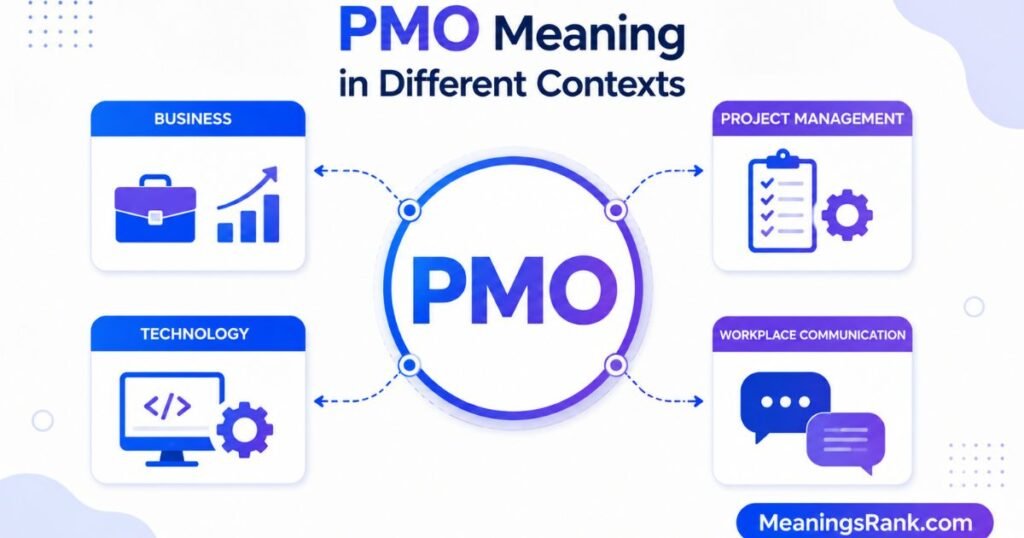
PMO Meaning in Different Contexts
PMO’s meaning shifts a lot depending on where you see it. Recognizing the setting helps you understand which version applies instantly.
In Business Emails:
“The PMO will finalize the project charter by Friday.” Here, PMO clearly refers to the Project Management Office.
In LinkedIn Posts:
“Excited to join the PMO team at my new company!” Again, this refers to the professional department, not slang.
In Text Messages:
“lol this homework is PMO right now” Here, PMO means “Pissing Me Off.”
In Instagram Comments:
“PMO to this concert, I need to go!” This usage means “Put Me On,” asking to be included.
In Gaming Chats:
“Yo PMO to the next match, I wanna play too.” Again, this is the “Put Me On” slang meaning, common in gaming communities.
In Discord Servers:
“This lag is so PMO, I keep dying.” This reflects frustration, matching the “Pissing Me Off” meaning.
In Workplace Slack Messages:
“PMO approved the new budget request.” This is the business meaning once again.
In TikTok Comments:
“Not the wifi cutting out again, that’s PMO.” This is the frustrated, casual slang version.
As you can see, the setting almost always signals which meaning applies. Formal writing and workplace conversations point to the business meaning, while casual texting and social media almost always mean one of the slang versions.
This pattern makes PMO a great example of how the same acronym can live two completely different lives depending on where it shows up.
Examples of PMO in Conversations
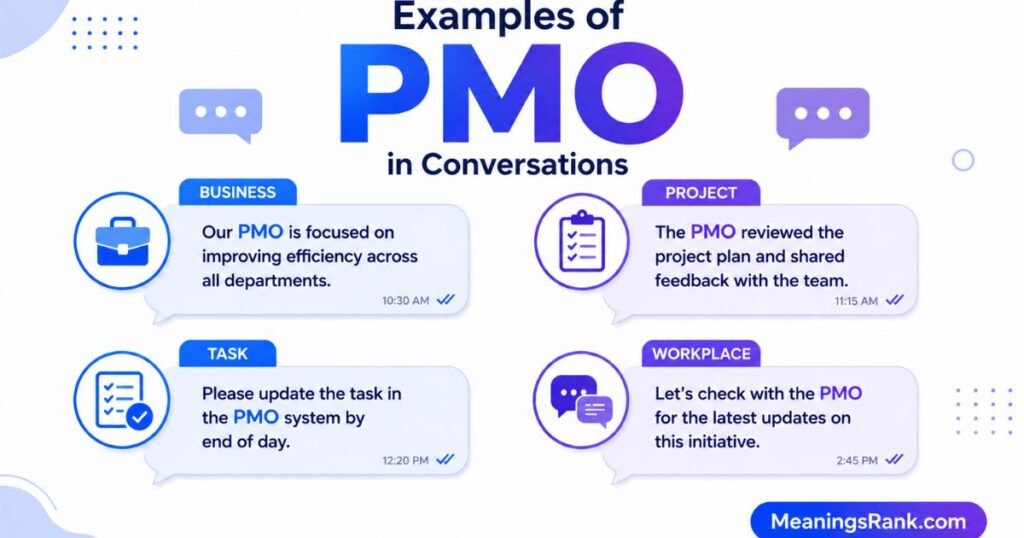
Seeing PMO used in different real-life conversations makes the meaning even clearer. Below are realistic examples covering both business and casual use.
Text Message (Slang):
Person A: “Why do you look annoyed?”
Person B: “My brother keeps taking my charger, it’s PMO.”
WhatsApp (Slang):
Person A: “Are you still mad about yesterday?”
Person B: “Kinda, ngl it PMO a little.”
Instagram Comment (Slang):
“PMO to this trip next month, please!”
Snapchat (Slang):
“this weather is so PMO, I wanted to go outside”
TikTok Comment (Slang):
“the way she talked to him was PMO ngl”
Gaming Chat (Slang):
“PMO to the next round, I’ve been waiting forever.”
Discord Message (Slang):
“This bug in the game is PMO, it keeps crashing.”
Workplace Chat (Business):
Person A: “Who’s tracking the budget for this project?”
Person B: “The PMO handles all budget tracking now.”
Business Email (Business):
“Please coordinate with the PMO before finalizing the project scope.”
LinkedIn Post (Business):
“Proud to share that our PMO improved project delivery times by 20% this year.”
These examples highlight just how differently PMO functions depending on the platform. In every casual example, PMO expresses either frustration or a request to be included. In every business example, it refers strictly to the Project Management Office.
Recognizing this pattern quickly helps you avoid confusion, especially if you regularly switch between professional and casual conversations throughout the day.
How to Use “PMO” Correctly
Using PMO correctly comes down to knowing your audience and setting. Since the term has two very different meanings, using the wrong one in the wrong place can cause real confusion.
In Business Settings:
- Use PMO only when referring to the Project Management Office
- Spell it out the first time you mention it in a document (“Project Management Office (PMO)”)
- Avoid using PMO as slang in any professional writing, even casually
Example: “The PMO will review all project proposals next week.”
In Casual Texting or Social Media:
- PMO can be used to express frustration (“This traffic is PMO”)
- PMO can be used to ask for inclusion (“PMO to the group chat”)
- Keep it limited to informal conversations with friends or on social platforms
Example: “This homework load is PMO fr.”
General Tips for Using PMO Correctly:
- Always consider your audience before using PMO in either sense
- Avoid mixing both meanings in the same conversation, since it can confuse readers
- When in doubt, especially in professional writing, spell out the full phrase instead of using the acronym alone
- Pay attention to platform norms, since slang PMO rarely appears in formal writing
A simple rule of thumb: if you’re writing something that could be read by a manager, client, or coworker, stick to the business meaning or avoid the acronym altogether. If you’re texting friends or commenting on social media, the casual meaning is perfectly fine.
This small awareness prevents miscommunication and helps your writing sound appropriate no matter where it’s being read.
Also Read: What Does WDYM Mean in Text? Meaning, Uses & Examples
Common Mistakes or Misinterpretations of PMO
Even though PMO seems simple, a few common mistakes happen regularly, especially when people aren’t familiar with both meanings.
Mistake 1:
Using Slang PMO in Professional Writing Some people accidentally use “PMO” to mean “Pissing Me Off” in a work email or Slack message, which can come across as inappropriate or confusing.
Mistake 2:
Assuming PMO Always Means Project Management Office Younger users or people unfamiliar with corporate terms might not recognize the business meaning at all, leading to confusion in workplace conversations.
Mistake 3:
Confusing “Put Me On” With “Pissing Me Off” Since both slang meanings use the same three letters, context is essential. Misreading tone can lead to awkward replies.
Example of confusion:
Person A: “PMO to that job opportunity!”
Person B (misunderstanding): “Why are you mad about a job opportunity?”
Mistake 4:
Not Spelling Out PMO in Formal Documents In official business writing, failing to define PMO the first time it’s used can confuse readers unfamiliar with the term, especially outside project management circles.
Mistake 5:
Overusing PMO in Casual Writing Using PMO too often in texts can make messages harder to read, especially for people less familiar with newer slang trends.
Mistake 6:
Ignoring Regional or Generational Differences Older professionals may only recognize the business meaning, while younger users might only know the slang version. This gap can lead to real misunderstandings in mixed-age conversations.
Being aware of these common mix-ups helps you use PMO more confidently and avoid unnecessary confusion, whether you’re writing a business report or texting a friend.
Similar or Related Terms
PMO isn’t the only acronym with multiple meanings depending on context. Here are a few related terms worth knowing.
| Term | Meaning | Context |
| PM | Project Manager / Private Message | Business or texting |
| PMP | Project Management Professional | Business certification |
| SMH | Shaking My Head | Casual texting |
| FR | For Real | Casual texting |
| KPI | Key Performance Indicator | Business |
| PPM | Project Portfolio Management | Business |
PMO vs PM:
PM can mean “Project Manager” in business or “Private Message” in casual texting, similar to how PMO shifts meaning based on setting.
PMO vs PMP:
PMP refers to a specific project management certification, while PMO refers to an entire department or team overseeing projects.
PMO vs KPI:
These terms often appear together in business settings. A PMO frequently tracks KPIs to measure how well projects are performing.
Understanding these related terms helps build a clearer picture of how project management language works, especially if you’re new to corporate environments or trying to understand workplace conversations more fully.
FAQs About PMO Meaning
What does PMO mean in business terms?
PMO stands for Project Management Office, a team that oversees and standardizes project management across a company.
What does PMO mean in texting?
In texting, PMO usually means “Put Me On” or “Pissing Me Off,” depending on the conversation’s tone.
Is PMO the same as a project manager?
No, a PMO is a team or department, while a project manager is an individual role that may work closely with the PMO.
How do I know which PMO meaning is being used?
Context matters most. Business settings usually mean Project Management Office, while texting or social media usually means slang.
Can PMO be used in formal writing?
Yes, but only for the business meaning. Always spell it out first to avoid confusion for readers unfamiliar with the term.
Conclusion
The PMO meaning really depends on where you see it. In business, PMO refers to a Project Management Office, a team responsible for keeping projects organized, on budget, and on schedule. In texting and social media, PMO usually means something completely different, like expressing frustration or asking to be included in something.
Throughout this guide, we’ve covered what PMO stands for, the different types of PMOs in business, common mistakes people make, and how context shapes its meaning. Whether you’re reading a corporate email or a group chat message, you now have a clear way to tell the two meanings apart.
Next time you spot “PMO” in a conversation, you’ll know exactly which meaning fits, and you’ll be able to respond with confidence in any setting.