
You are typing a restaurant review, a product comparison, or a quick message to a friend. The word you want means “costs a lot,” and your fingers freeze. Is it pricy or pricey? Both look natural. Both seem to belong. One of them might get a red squiggle from your spell checker, and you do not want to publish a typo.
Here is the good news: this is one of the friendliest spelling puzzles in English. Neither form is a mistake, but one is far more common than the other, and knowing which one to choose will make your writing look polished and consistent. This guide gives you the verdict, the history, the rules, and a full practice session so the answer sticks for good.
Pricy vs Pricey: Quick Answer
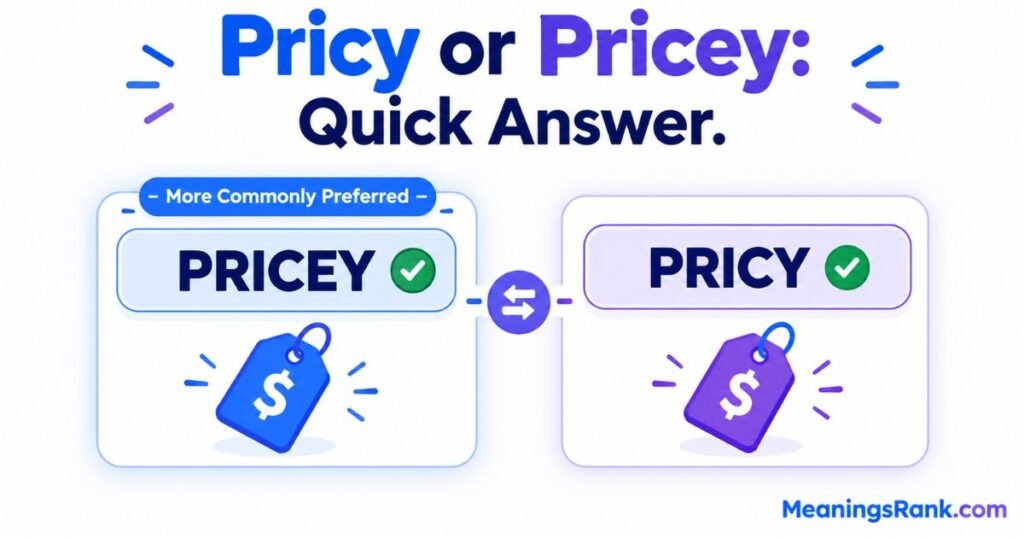
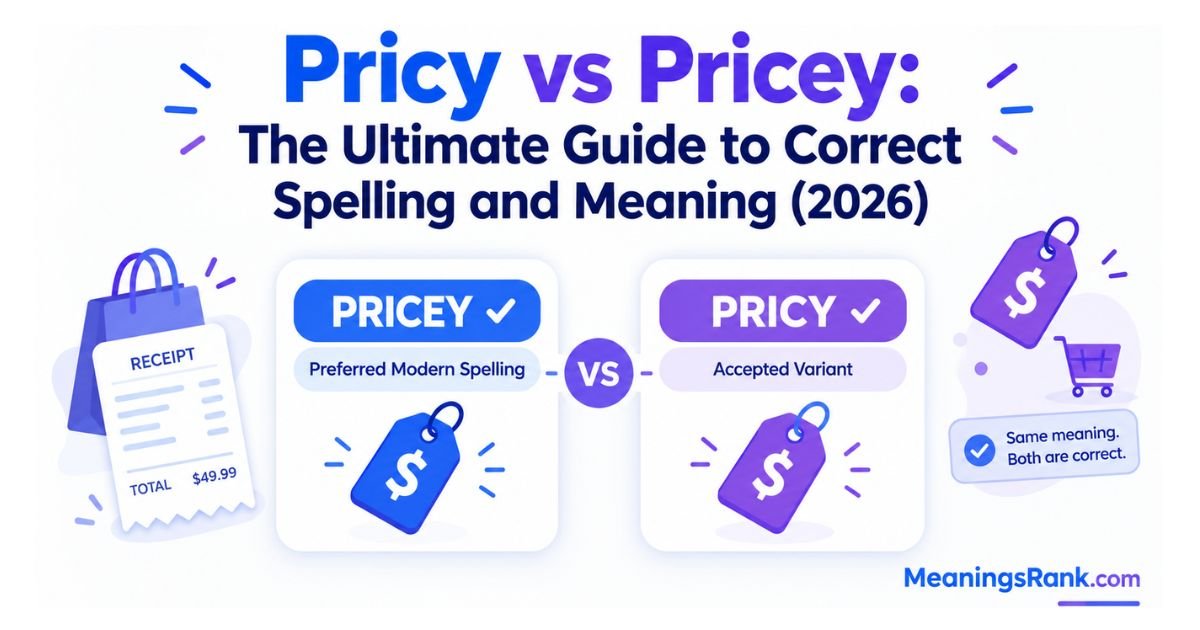
Quick Summary: Pricey is the standard, preferred spelling in both American and British English. Pricy is a legitimate but much less common variant. Both words mean “expensive” and are pronounced identically, so pick one spelling and use it consistently. When in doubt, choose pricey.
| Feature | Pricey | Pricy |
| Part of speech | Adjective | Adjective |
| Meaning | Costing a lot; expensive | Costing a lot; expensive |
| Pronunciation | /ˈpraɪsi/ | /ˈpraɪsi/ |
| Status | Preferred, mainstream spelling | Accepted variant, rarer |
| Safe for formal writing? | Yes (informal tone, standard spelling) | Yes, but looks unusual to many readers |
| Best choice | Use this one | Use only if a style guide requires it |
That table is the whole answer in miniature. The rest of this article explains why it works this way, so you can defend your choice to an editor, a teacher, or a curious colleague.
Pricey Meaning and Pricy Meaning Explained
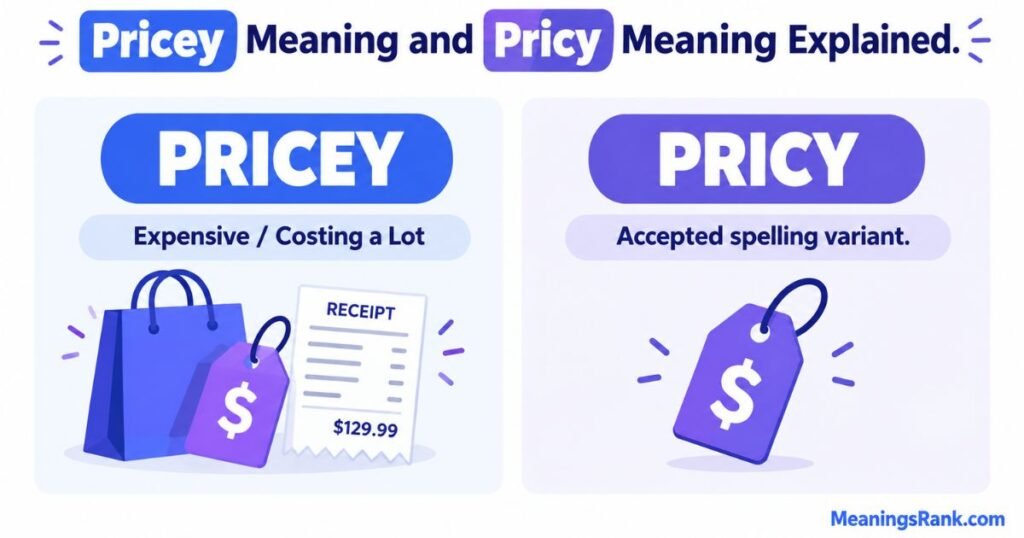
Pricey is an adjective that describes something with a high price, usually one that feels a bit more than it should. It is built from the noun price plus the suffix -y, which turns a noun into an adjective meaning “having the quality of.” Think of salty, sunny, or bumpy. Something pricey has the quality of carrying a steep price tag.
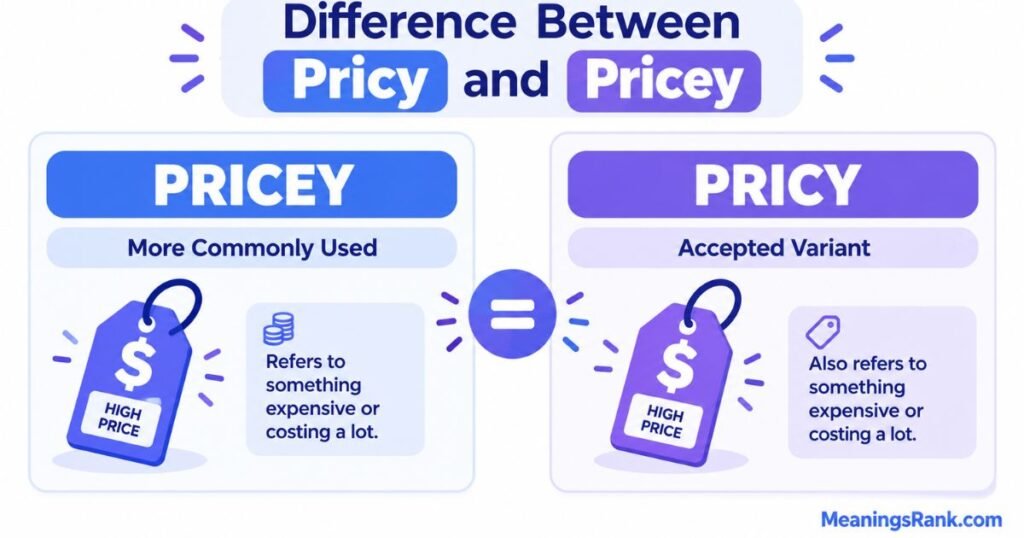
Pricy means exactly the same thing. There is no hidden shade of meaning, no regional twist, no formal-versus-casual split. The two words are spelling variants of a single word, much like judgment and judgement or grey and gray.
Here is the subtle point that makes pricey more useful than a plain synonym. The word carries a tone of mild complaint or hesitation. Calling a handbag “expensive” states a fact. Calling it “pricey” suggests that the speaker winced slightly at the number. That small emotional flavor is why the word thrives in conversation, reviews, and travel writing.
Examples:
- The hotel was lovely, but the rooftop bar was pricey.
- Organic strawberries are pricey in winter.
- “A bit pricey, isn’t it?” she whispered, eyeing the menu.
Notice that in each case the adjective sits comfortably in the sentence structure. It can appear before a noun (“a pricey dinner”) or after a linking verb (“the dinner was pricey”), which is how most descriptive adjectives behave.
Read More: Cancellation vs Cancelation: Discover the Correct Spelling, Meaning & Usage (2026)
Is “Pricy” a Real Word?
Yes. Pricy is a real, recognized English word. Major dictionaries list it, usually as a variant spelling of pricey rather than as a separate entry with its own definition. If you have ever worried that using it would make you look careless, you can relax. It is not an error, a typo, or a “wrong” spelling in any strict sense.
The confusion comes from how dictionaries present the two forms. When a dictionary lists pricey first and labels pricy as a variant, it is signaling frequency and preference, not correctness. Lexicographers record how real writers use the language, and in this case writers have overwhelmingly favored pricey while a minority have used pricy.
So where does that leave you? Think of it like a road with a wide main lane and a narrow side lane. Both lead to the same place. Most traffic takes the main lane, and you will get there with fewer odd looks if you join it.
One practical caution: some spell checkers, autocorrect tools, and older editing programs treat pricy with suspicion or underline it. That does not make the word wrong. It simply reflects how their built-in word lists were compiled. If your editor flags it, switching to pricey removes the problem entirely.
Difference Between Pricy and Pricey
The difference is purely one of spelling, or what linguists call orthography. There is no difference in meaning, grammar, pronunciation, or formality. Both are adjectives. Both have the same comparative and superlative forms. Both behave the same way in a clause.
Here is a side-by-side look at how the two spellings inflect:
| Form | Pricey | Pricy |
| Base adjective | pricey | pricy |
| Comparative | pricier | pricier |
| Superlative | priciest | priciest |
| Noun form | priciness | priciness |
Look closely at the middle rows. The comparative and superlative forms (pricier, priciest) are the same for both spellings. This is a clue about how the word works: when you add -er or -est, the final y changes to i under standard English spelling rules, and the extra e in pricey quietly disappears. You will almost never see priceyer or priceyest in good writing.
So the only real fork in the road is the base adjective. One has an e before the y, the other does not. Everything else about the word is identical, which is why you can swap one for the other without changing a single word of meaning.
Why “Pricey” Became the Preferred Modern Spelling
Spelling preferences are shaped by habit, visual familiarity, and the pressure of large writing communities such as newspapers, publishers, and dictionary makers. Several forces pushed pricey into the lead.
1. Visual clarity. The extra e makes the root word price visible inside the longer word. Readers instantly see price + y. In pricy, the root is slightly hidden, because the silent e has been dropped. Humans read by recognizing whole word shapes, and the more transparent form tends to win.
2. Pattern matching with similar words. English has a handful of adjectives that keep the silent e before the -y suffix: dicey, cagey, horsey, mousey, and pricey. When writers see these around, pricey feels normal.
3. Dictionary and style guide influence. When major dictionaries and newsroom style guides list pricey first, writers follow. Editors then favor it, and the cycle reinforces itself. Over decades, the more common form becomes the default, and the minority form begins to look like a slip even though it is not.
None of this makes pricy illegitimate. It simply explains why most modern writers, editors, and tutors, myself included, steer people toward the e version.
British English vs. American English Usage
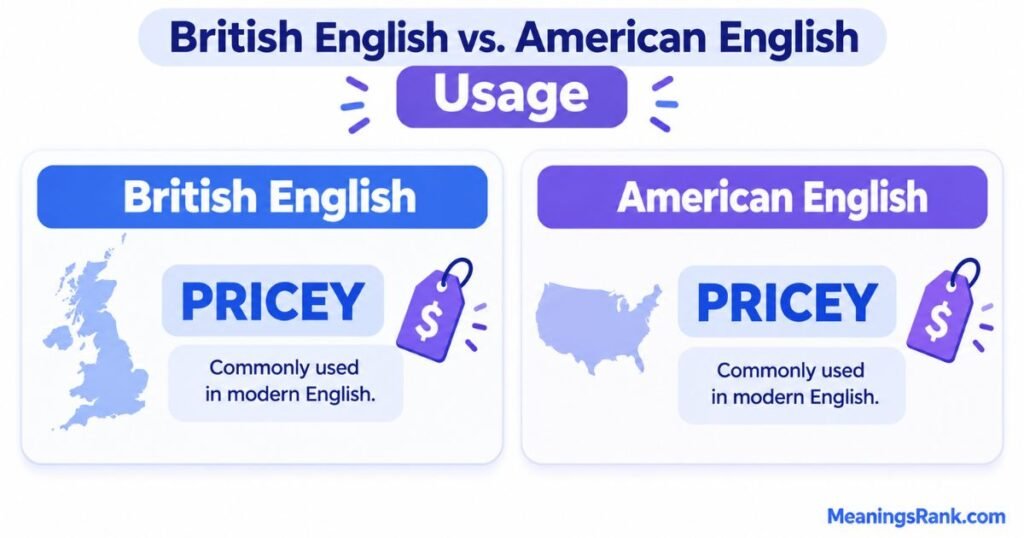
Here is where many spelling guides get it wrong. Learners often assume that one spelling is “American” and the other “British,” as with color and colour. That is not the case here.
Both American and British English prefer pricey. Neither dialect has adopted pricy as its regional standard. If you write for a US audience, use pricey. If you write for a UK, Australian, Canadian, or Indian audience, use pricey as well.
| Region | Preferred spelling | Acceptable variant |
| United States | pricey | pricy |
| United Kingdom | pricey | pricy |
| Canada | pricey | pricy |
| Australia / New Zealand | pricey | pricy |
This makes the choice easier than most spelling decisions. Your style guide rules only need one line: “Use pricey.”
Read More: Excited vs Exited: Discover the Correct Meaning, Spelling & Usage (2026)
Why Confusion Happens Between Pricy and Pricey
If both words are fine, why does anyone get confused? Several reasons stack up.
The silent-e rule is inconsistent. Most English writers learn that a silent e is dropped before a suffix beginning with a vowel: make becomes making, ice becomes icy, spice becomes spicy. By that rule, price + y should give pricy. Yet pricey exists and dominates. The rule is real, but English spelling is full of exceptions, and this is one.
Soft c and hard c sounds. The letter c sounds like s before e, i, or y. In both spellings, the c is soft, so the sound does not help you decide. Your ear gives you no clue.
Mixed signals from dictionaries. One dictionary lists both forms equally. Another lists pricey first. A third marks pricy as “also.” Readers who check two sources can walk away thinking the sources disagree.
The takeaway: confusion here is a product of English orthography being messy, not of anything you did wrong.
Pricey vs. Expensive: What’s the Difference?
These two adjectives overlap, but they are not perfect twins. Choosing between them is a matter of register, tone, and emphasis.
Expensive is neutral and formal. It works in a legal contract, a financial report, and a school essay. It states that something costs a lot without commenting on whether the cost is fair.
Pricey is informal and slightly evaluative. It tends to carry a personal reaction: “this costs more than I would like.” It fits blog posts, reviews, conversations, and social media.
| Aspect | Expensive | Pricey |
| Register | Neutral to formal | Informal to conversational |
| Tone | Objective | Slightly subjective, often a mild complaint |
| Intensity | Can describe very high costs | Often used for moderately high costs |
| Typical settings | Reports, essays, news, business writing | Reviews, travel blogs, casual speech |
| Example | “The new aircraft is expensive to maintain.” | “That coffee shop is pricey for what you get.” |
Is Pricey Slang?
Not quite, though it sits close to the border. Pricey is best described as informal or colloquial, not slang. Slang usually refers to very recent, group-specific, or short-lived vocabulary, such as a word that teenagers invent and abandon within a few years. Pricey has been part of standard English for roughly a century and appears in respectable newspapers, magazines, and published books.
That said, you should match your word choice to your audience:
- Academic essays and formal reports: Prefer expensive, costly, or high-priced.
- Journalism and feature writing: Pricey is welcome, especially in headlines and lifestyle sections.
- Product reviews and blogs: Pricey is ideal because it sounds like a real person talking.
If you are unsure whether informal vocabulary suits your assignment, check the style guide rules for your publication or class. Many editors accept pricey in lighter pieces and ask for expensive in formal ones.
Pricey Synonyms and Related Words
English offers a wide range of words for “costing a lot.” Each one has its own flavor, so the best choice depends on the tone you want.
| Word | Tone | Example |
| Expensive | Neutral, formal | The repair was expensive. |
| Costly | Formal, serious | A costly mistake cost the company its contract. |
| Steep | Informal, emphatic | A hundred dollars for a T-shirt is steep. |
| High-priced | Neutral, descriptive | The store sells high-priced designer goods. |
| Overpriced | Negative, judgmental | The popcorn was overpriced. |
| Exorbitant | Strong, formal | They charged exorbitant fees. |
| Extravagant | Describes lavish spending | An extravagant gift for her birthday. |
Opposites (antonyms): cheap, inexpensive, affordable, budget-friendly, economical, reasonable, low-cost.
Pay attention to the difference between pricey and overpriced. A pricey item may be worth the money. An overpriced item is not. The first is a statement about cost, the second is a judgment about value.
How to Use Pricey in a Sentence
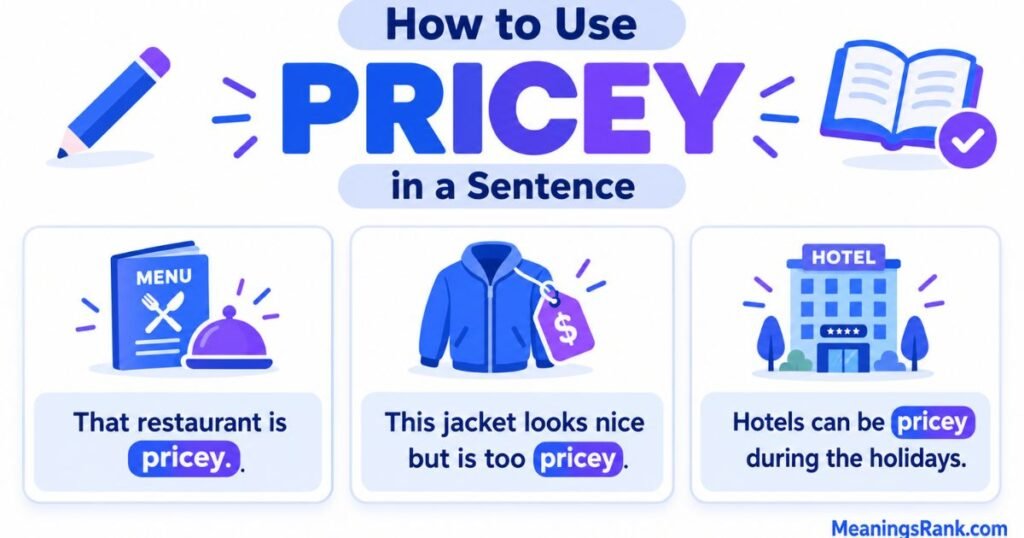
Pricey is a straightforward adjective, so its syntax is simple. It can function in several positions within a clause.
1. Before a noun (attributive use):
- We stayed at a pricey hotel near the harbor.
2. After a linking verb (predicative use):
- The tickets were pricey, but the show was worth it.
3. With intensifiers:
- That brand is very pricey. / The shop is a little pricey. / It’s way too pricey for me.
4. In comparisons:
- This model is pricier than the last one.
- It was the priciest item on the menu.
Subject-verb agreement works exactly as you would expect. Because the adjective does not change for singular or plural subjects, you only need to match the verb: “The seat is pricey” and “The seats are pricey.”
A small punctuation tip: when pricey comes before a noun along with another adjective, use a comma only if both adjectives independently describe the noun. “A pricey, cramped apartment” takes a comma. “A pricey downtown apartment” usually does not, because downtown is closely tied to apartment.
Pricy vs. Pricey: Examples in Everyday Writing
Here are realistic sentences showing how both spellings appear. Each pair uses the same structure and meaning. Remember, the standard spelling is pricey.
| Context | With “pricey” (recommended) | With “pricy” (variant) |
| Restaurant review | The steak was delicious but pricey. | The steak was delicious but pricy. |
| Travel blog | Hotels in the city center can be pricey. | Hotels in the city center can be pricy. |
| Shopping | I love the jacket, though it’s pricey. | I love the jacket, though it’s pricy. |
| Comparison | Her phone is pricier than mine. | Her phone is pricier than mine. |
| Everyday chat | That concert ticket is too pricey. | That concert ticket is too pricy. |
Formal vs. informal transformations:
| Informal | Formal rewrite |
| The tuition is pretty pricey. | The tuition is considerably high. |
| That gadget is way too pricey. | That gadget is prohibitively expensive. |
Notice how the formal versions often avoid the informal flavor of pricey altogether. If your piece is academic or official, a rewrite like these keeps the tone steady.
Common Mistakes With Pricy and Pricey
Even careful writers slip here. Watch for these frequent errors.
Mistake 1: Treating one spelling as “wrong.”
Calling pricy a typo is not accurate. It is a recognized variant. The better advice is “prefer pricey.”
Mistake 2: Mixing both spellings in one document.
Consistency matters more than which form you pick. If your article uses pricey in paragraph one and pricy in paragraph six, editors will notice. Choose one and stick to it.
Mistake 3: Misspelling the comparative.
Incorrect: priceyer, priceyest. Correct: pricier, priciest.
Read More: Encorporate vs Incorporate: Correct Spelling, Meaning & Usage (2026)
Pricy vs. Pricey: Pronunciation and Word Usage
Both spellings are pronounced the same way: /ˈpraɪsi/, which rhymes with icy and sounds like “PRY-see.” The stress falls on the first syllable. There is no audible difference between the two spellings, so you cannot hear whether someone has written pricy or pricey.
This is why the spelling debate exists only on the page. In speech, nobody can tell. In writing, readers notice.
Usage notes:
- Pricey is chiefly a spoken-language word that crossed into print. It sounds like something you would say to a friend.
- It pairs naturally with words like bit, little, rather, very, and way: “a bit pricey,” “rather pricey.”
- It often appears in sentences with contrast words like but, though, and however, because the speaker is balancing quality against cost: “pricey but worth it.”
Pricey vs. Pricy: Origin and History of Both Spellings
The word pricey grew out of price, a noun that entered English from Old French pris and ultimately traces back to Latin pretium, meaning “value” or “worth.” That same Latin root also gave English precious and appreciate.
Adding the suffix -y to nouns to form adjectives is an old and productive process in English morphology. Think of wealthy, healthy, crumby, and rainy. Pricey followed this standard pattern in the early twentieth century, when it began to appear in print, first in informal and journalistic settings. Dictionaries trace its earliest recorded uses to roughly the 1920s, though exact dates vary by source, and the word spread quickly through newspapers and magazines.
Early on, writers spelled the word both ways. Some kept the e to preserve the shape of price. Others dropped it, following the general rule that a silent e disappears before a vowel suffix. For a while, both forms circulated freely.
Over the following decades, pricey pulled ahead. Publishers, dictionaries, and style guides leaned toward it, and everyday writers copied what they saw. Pricy never vanished. It remains a documented variant, and you will still find it in some books, websites, and personal writing. It is simply the minority choice.
Which Spelling Should You Use?
Use pricey. That is the clear recommendation for nearly every situation.
Here is a quick decision guide:
- Writing for a general audience? Use pricey.
- Writing for school or university? Use pricey, unless a formal assignment calls for expensive.
- Publishing a blog or website? Use pricey and keep it consistent across all pages for better search and reader experience.
- Following a specific style guide? Check the rules. If it requires pricy, follow it. Otherwise, default to pricey.
- Writing in a mixed US/UK context? Use pricey. It works everywhere.
The bottom line is the same one we started with: both forms are valid, one is clearly more common, and consistency beats everything.
Practice Session: Pricy vs. Pricey
Fill in each blank with the standard spelling (or the correct comparative form). Try to answer before checking the key at the end of this section.
- The beachfront apartment was lovely, but it was far too ________ for our budget.
- Of all the laptops in the store, this one was the ________.
- Is it just me, or is that café a bit ________ for a simple sandwich?
- This year’s tickets are ________ than last year’s.
- Please use one spelling throughout the document: if you choose pricey on page one, do not switch to ________ later.
Answer Key:
- pricey
- priciest
- pricey
- pricier
- pricy
Score yourself: 5 correct means you have mastered it. 3–4 correct means you are nearly there; review the common mistakes section. 0–2 correct means a quick re-read of the quick answer and memory trick will help.
Quick Memory Trick
Remember the E in PRICEY as the E in PRICE. If you can see the whole word price inside the adjective, you have the preferred spelling. The extra letter is there to keep the root intact, like a small safety rail around the word price.
Another way: think of the saying “Pricey keeps the price whole.”
Multiple-Choice Questions
Choose the best answer for each question.
1. Which spelling is the preferred standard in American English?
A) Pricy
B) Pricey
C) Pricee
D) Prisy
2. Which sentence is correct?
A) This watch is priceyer than that one.
B) This watch is pricier than that one.
C) This watch is more pricyer than that one.
D) This watch is the pricey of all.
3. What is the difference in meaning between pricy and pricey?
A) Pricy means cheap and pricey means expensive.
B) Pricy is British and pricey is American, with different meanings.
C) There is no difference in meaning; they are spelling variants.
D) Pricy is a verb and pricey is an adjective.
4. Which word best fits a formal business report?
A) Pricey
B) Pricy
C) Expensive
D) Steep
5. What is the correct superlative form?
A) Priceyest
B) Pricyest
C) Most pricey-est
D) Priciest
Answer Key: 1-B, 2-B, 3-C, 4-C, 5-D
Frequently Asked Questions (FAQs)
Is it pricy or pricey?
Both are accepted, but pricey is the preferred and more common spelling in American and British English. Use pricey unless a specific style guide tells you otherwise.
Is “pricy” a correct word?
Yes. Pricy is a recognized variant of pricey and appears in major dictionaries. It means the same thing but is much less common, so it may look unfamiliar to some readers or trigger a spell checker.
What is the difference between pricey and expensive?
Expensive is neutral and suitable for formal writing. Pricey is informal and often implies a mild complaint about the cost. Use pricey in casual writing and expensive in reports, essays, and official documents.
Is “pricey” British or American English?
Neither. Both dialects prefer the pricey spelling, so it is not tied to one region. You can use it safely for audiences in the US, the UK, Canada, Australia, and beyond.
What is the comparative form of pricey?
The comparative is pricier and the superlative is priciest. Forms like priceyer and priceyest are not standard. The same forms apply to pricy.
Conclusion
Pricey and pricy mean the same thing, sound the same, and belong to the same word family, but pricey is the spelling that dominates modern English in both American and British writing. Choose pricey for clarity and familiarity, keep your usage consistent, and switch to expensive when your tone needs to be formal. With the memory trick and the practice questions above, you will not hesitate over this word again.