
You have typed it a hundred times. A flight, a subscription, a meeting, a dinner reservation. Then you pause, finger hovering over the keyboard, and wonder whether the word has one L in the middle or two. The red squiggle under your screen does not always help, because some spell checkers accept both forms.
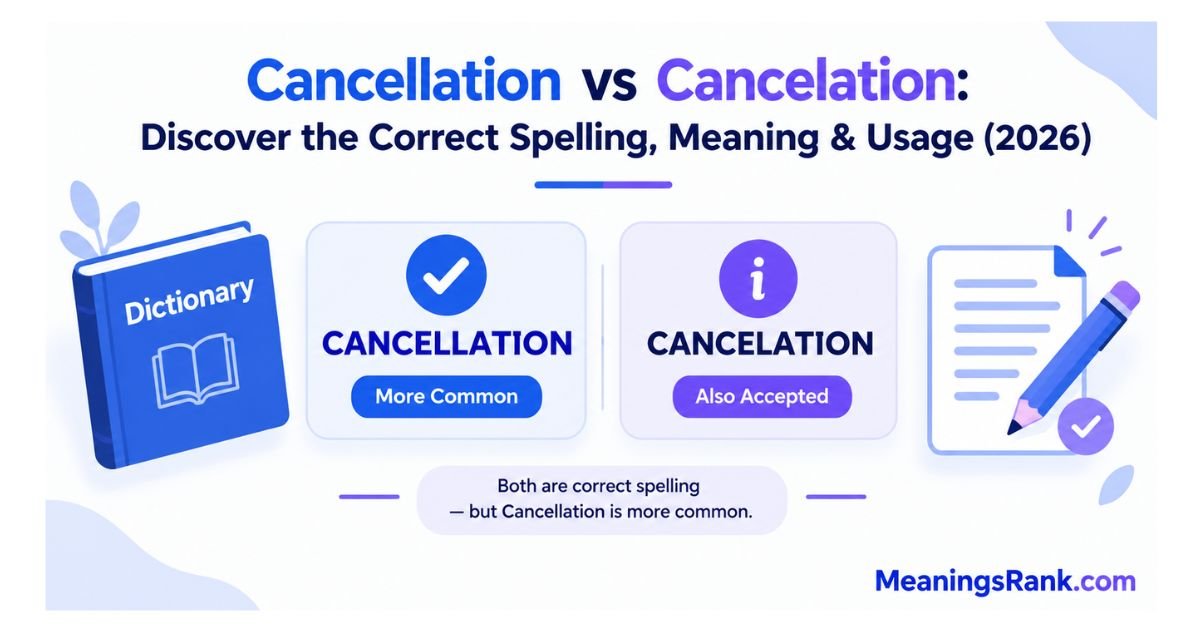
Here is the short version. Cancellation is correct everywhere. Cancelation exists, but only as a minor variant, and it carries risk in professional writing. The confusion comes from a separate spelling quirk: the verb cancel is spelled canceled in American English and cancelled in British English. Because the verb changes between regions, many writers assume the noun must change too. It does not.
Cancellation vs Cancelation: The Key Differences
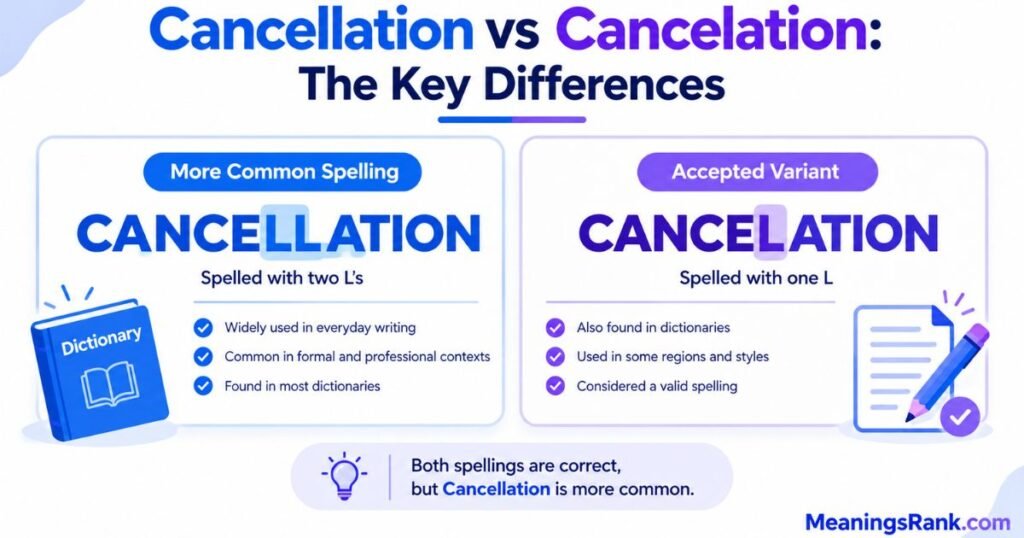
Quick Summary / Key Takeaway: Cancellation (two L’s) is the standard spelling in both American and British English. Cancelation (one L in the middle) is a rare variant that some American dictionaries list, but most editors treat it as a mistake. When in doubt, write cancellation. Your readers will never question it.
The table below gives you the whole picture at a glance.
| Feature | Cancellation | Cancelation |
| Part of speech | Noun | Noun |
| Standard in the US? | Yes | Rare variant |
| Standard in the UK, Canada, Australia? | Yes | No |
| Listed in most dictionaries as the main entry? | Yes | No (variant at best) |
| Safe for business, legal, and academic writing? | Yes | Risky |
| Recommended spelling | Use this one | Avoid |
The rest of this guide explains where each spelling comes from, why one dominates, what the major style guides say, and how to remember the right form without second-guessing yourself.
What Does Cancellation Mean?
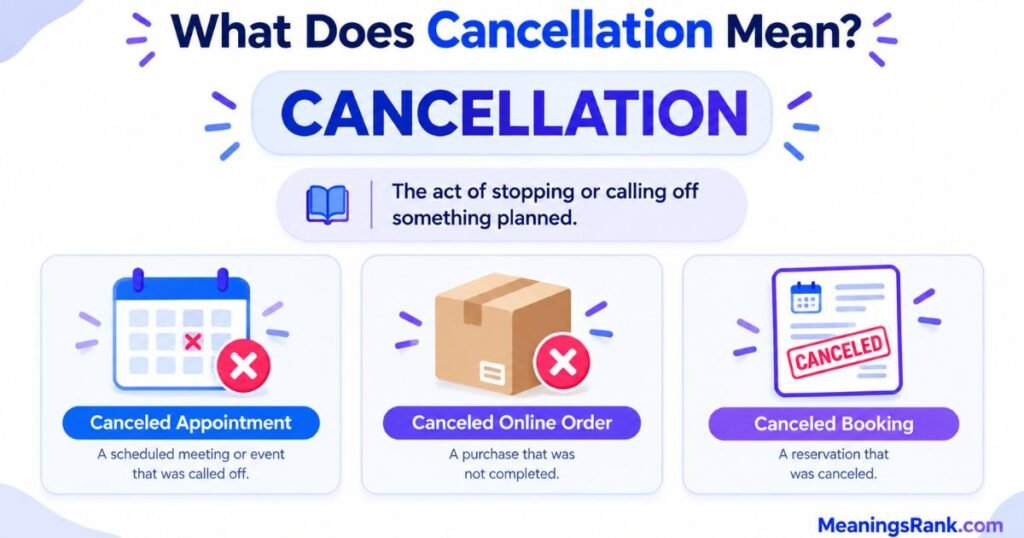
Cancellation is a noun that names the act of calling something off, ending it, or declaring it no longer valid. It refers to the event of canceling, or to the state of having been canceled.
Merriam-Webster and Oxford both define it along similar lines: the act of stopping something that was planned, arranged, or contracted. In everyday life, you meet this word constantly.
- A flight cancellation leaves you stranded at the gate.
- A subscription cancellation stops the monthly charge.
- A cancellation policy explains the fee for changing your mind.
- A cancellation notice is the formal message confirming the end of a contract.
Core Definitions & Usage Rules
The word works as a standard countable or uncountable noun, depending on the sentence.
- Countable use refers to a specific instance: “We received three cancellations this morning.”
- Uncountable use refers to the concept: “Cancellation is free up to 24 hours before check-in.”
- Attributive use places the word before another noun, where it acts like an adjective: cancellation fee, cancellation window, cancellation request.
The word also appears in specialized fields.
- Mathematics: the cancellation law lets you remove a common factor from both sides of an equation. Fractions are simplified by cancellation.
- Insurance and law: a cancellation clause describes when and how a policy or contract may end.
- Media: the cancellation of a television series means the network will not produce more episodes.
Each of these uses keeps the same spelling. The core meaning stays steady across fields: something that was active is now ended or voided.
Read More: Studder vs Stutter: Correct Spelling, Meaning & Key Differences (2026)
Is Cancelation a Real Word?
Yes, with an asterisk. Cancelation is a recorded variant, and you will find it in a few American dictionaries as a secondary spelling. It is not a made-up word, and it is not a typo in the strict sense of the term.
But “recorded” and “recommended” are two different things. A word can appear in a dictionary and still be a poor choice. Dictionaries describe how people actually write, including minority habits. They are not endorsing every variant they list.
In practice, cancelation occurs in a tiny fraction of published English. Copy editors at newspapers, publishers, and corporate communication teams routinely change it to cancellation. If you search large text collections of published English, cancellation appears many times more often than cancelation, in both American and British sources.
So the honest answer sounds like this: cancelation is real enough to exist, but not common enough to trust. Think of it the way you might think of an unusual alternate spelling like judgement versus judgment. Both exist, yet one is clearly the safer default.
Why Is Cancellation Spelled With Two L’s?
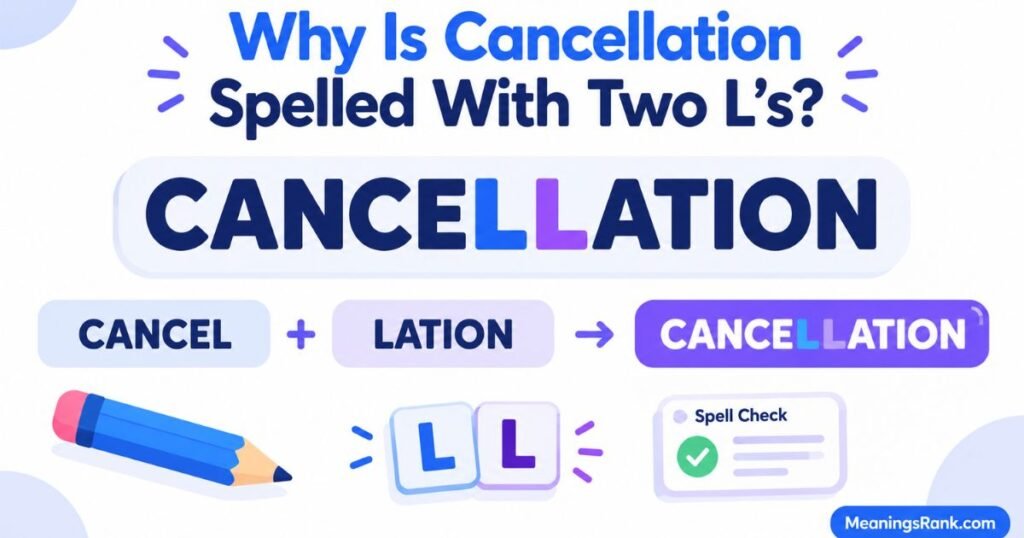
The double L comes from the word’s history, not from a modern spelling rule.
Cancellation traces back to the Latin verb cancellare, meaning “to cross out.” That verb grew from the Latin noun cancelli, meaning “lattice” or “crossbars.” Picture a scribe drawing crisscross lines over a mistake or a debt. The pattern looked like a lattice, so crossing something out became cancellare.
English borrowed the word through Old French and kept the double L from the Latin form cancellatio. The spelling carried the Latin shape forward, and it stuck. You can see the same pattern in related English words that preserve the Latin double consonant: chancellor (from the same cancelli root, because officials once sat behind lattice screens), chancellery, and cancellous (used in anatomy for lattice-like bone tissue).
Here is the key point. The noun has always had its own history, separate from the American spelling of the verb. When American English simplified cancelled to canceled, that change applied to the verb’s inflected forms. The noun cancellation kept its double L because it follows the Latin pattern, and because the -ation suffix attaches to the longer stem cancell-.
That history explains why cancellation feels so stable. It is not following a rule that varies by region. It is following the original word shape.
The Double Consonant Rule Explained
To understand why cancelation even entered the picture, you need to understand the doubling rule for final consonants.
The General Rule
English often doubles a final consonant when you add a suffix that starts with a vowel, such as -ed, -ing, or -er. The doubling happens when the stressed syllable ends in a single vowel followed by a single consonant.
| Base word | Stress pattern | Add -ed / -ing | Result |
| stop | one syllable | stopped, stopping | Doubled |
| begin | be-GIN (stress on final syllable) | beginning | Doubled |
| refer | re-FER (stress on final syllable) | referred, referring | Doubled |
| open | O-pen (stress on first syllable) | opened, opening | Not doubled |
| visit | VIS-it (stress on first syllable) | visited, visiting | Not doubled |
Where Cancel Fits
The word cancel is stressed on the first syllable: CAN-cel. By the standard rule, the final L should not double. That is exactly what American English does: canceled, canceling.
British English handles words ending in L differently. It doubles the final L even when the stress falls earlier in the word. So British writers produce cancelled and cancelling, just as they write travelled, modelling, and labelled.
Why the Noun Is Different
The doubling rule governs inflection (changing a verb’s tense or form with -ed and -ing). It does not govern every word built from a root. Cancellation is a noun formed with the suffix -ation, and it inherited its double L from Latin and French. Writers who see canceled and assume the noun should lose an L are applying a verb rule to a noun.
Whether the verb is canceled or cancelled, the noun cancellation stays identical. That consistency is the strongest argument for treating it as one fixed spelling.
American English vs British English: Which Spelling Is Preferred?
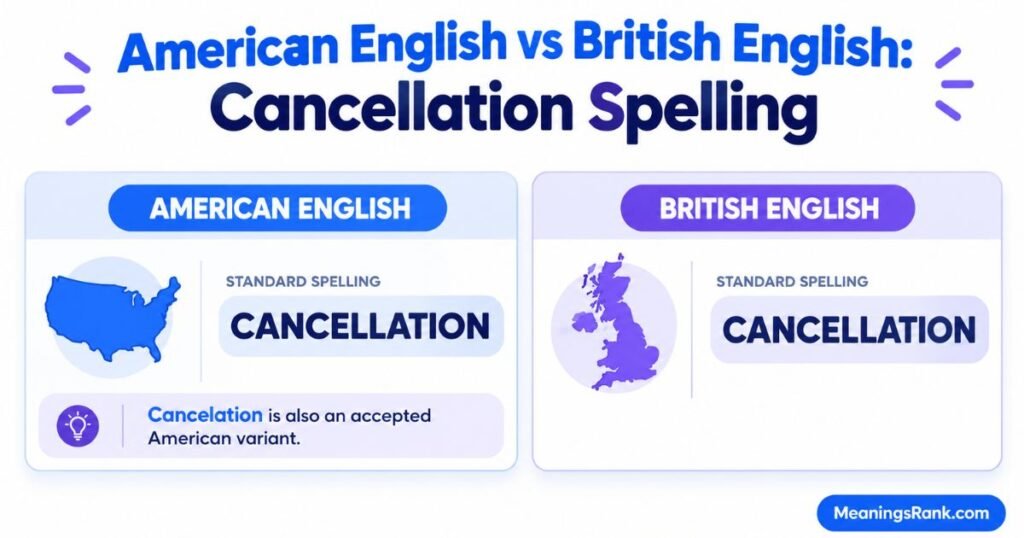
Let us separate the two layers of this question, because they have different answers.
Layer one: the noun. Both American and British English prefer cancellation. Oxford, Cambridge, Collins, Merriam-Webster, and Longman all give cancellation as the primary entry. Merriam-Webster notes cancelation as a variant. The British dictionaries do not treat it as standard.
Layer two: the verb forms. This is where the regional split lives.
| Form | American English | British English |
| Past tense / past participle | canceled | cancelled |
| Present participle | canceling | cancelling |
| Noun | cancellation | cancellation |
So an American writer writes: “The airline canceled my flight, and the cancellation cost me a day.” A British writer writes: “The airline cancelled my flight, and the cancellation cost me a day.” Only the verb changes. The noun does not move.
Canadian, Australian, Indian, and South African English generally follow the British pattern (cancelled), though Canadian usage mixes American and British habits and you will see canceled there too.
If you write for an international audience, pick one verb convention and stay consistent. For the noun, you never need to choose. Cancellation is the universal form.
Cancellation, Canceled, Cancelled, Canceling, and Cancelling
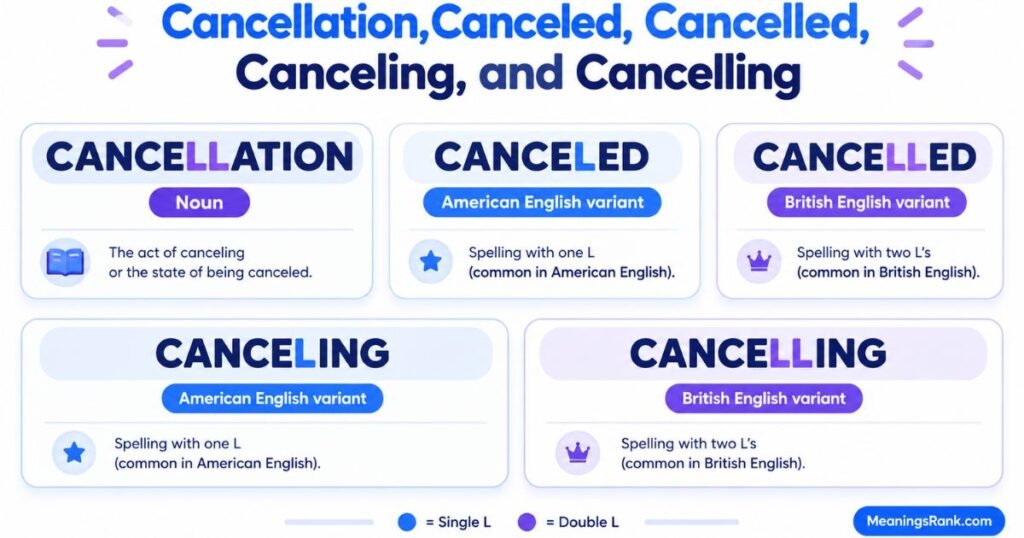
This family of words causes more spelling confusion than any other cluster in everyday English. Here is a clean reference you can bookmark.
| Word | Part of speech | Region | Example |
| cancel | Verb (base form) | Both | “Please cancel my order.” |
| cancels | Verb (third person) | Both | “She cancels every Friday meeting.” |
| canceled | Verb (past) | US | “He canceled the trip.” |
| cancelled | Verb (past) | UK and others | “He cancelled the trip.” |
| canceling | Verb (present participle) | US | “I am canceling the card.” |
| cancelling | Verb (present participle) | UK and others | “I am cancelling the card.” |
| cancellation | Noun | Both | “The cancellation was a surprise.” |
| cancelation | Noun (rare variant) | Occasionally US | Avoid in formal writing |
Two details trip people up.
First, canceled and canceling have one L after the e only in American English, but the noun never follows them. Second, the adjective form canceled/cancelled works as a participial adjective: “a canceled flight” (US) or “a cancelled flight” (UK).
A tidy way to hold all of this in your head is to remember that only the -ed and -ing forms change by region. Every other member of the family stays put.
How to Use Cancellation and Cancelation in Sentences
Seeing the word in action helps the rule stick. Below, each sentence uses cancellation in a different grammatical role.
As the subject of a sentence:
- “The cancellation of the concert disappointed thousands of fans.”
- “Cancellation requires 48 hours’ written notice.”
As the object of a verb:
- “The customer requested a cancellation.”
- “The company announced the cancellation of its loyalty program.”
Read More: Encorporate vs Incorporate: Correct Spelling, Meaning & Usage (2026)
After a preposition:
- “Due to the cancellation, we rebooked for Tuesday.”
- “There is no fee for cancellation within 14 days.”
As a noun adjunct (modifying another noun):
- “Review the cancellation policy before you book.”
- “The cancellation fee is non-refundable.”
Now consider the variant. Cancelation would occupy the same grammatical slots, but it would read as unusual to most editors:
- “The cancelation of the meeting was unavoidable.” (Grammatically fine, stylistically risky.)
The sentence is not ungrammatical. Its clause structure and punctuation are perfectly sound. The only issue is the spelling choice, which signals to an attentive reader that the writer may not have checked a reference. You gain nothing by using it, and you risk a small loss of credibility.
Real-World Examples of Cancellation
You will meet this word in many professional contexts. Looking at how each field uses it shows why a stable, universal spelling matters.
Real-World Examples & Transformations
Travel and hospitality
- “Free cancellation up to 48 hours before arrival.”
- “Airlines must offer a refund after a flight cancellation.”
Subscriptions and e-commerce
- “To start your cancellation, open Account Settings.”
- “We will confirm your cancellation by email.”
Media and entertainment
- “The network confirmed the cancellation of the series after two seasons.”
The next table shows how to transform weaker or incorrect phrasing into polished, standard usage.
| Incorrect or weak | Correct | Why it improves |
| “The cancelation fee applies.” | “The cancellation fee applies.” | Uses the standard spelling |
| “Their cancelation was sudden.” | “Their cancellation was sudden.” | Avoids the rare variant |
| “The cancelling of the show” (noun use, US) | “The cancellation of the show” | Noun form is cleaner and more formal |
| “Cancellation is when you cancel.” | “Cancellation means ending an agreement.” | Avoids circular definition |
Formal versus informal register matters here too. In a casual text message, you might write “my flight got cancelled.” In a contract, you write “cancellation of the agreement.” The noun carries a more formal tone than the verb, which is why it appears so often in policies, terms of service, and official notices.
Cancellation vs Cancelation in Published Writing
Published writing offers the best evidence for what editors actually do. Newspapers, magazines, academic journals, and government websites overwhelmingly use cancellation.
Major news organizations, whether American or British, run headlines such as “Flight Cancellations Surge” and “Cancellation of Festival Sparks Outcry.” You will rarely find the one-L variant in a headline from a reputable outlet. When it does appear, it is usually in a less edited source, such as a personal blog, a forum post, or a quick marketing page.
Corpus linguistics supports this picture. When researchers search large collections of printed and digital text, cancellation appears with overwhelming dominance. Cancelation shows up in a thin sliver of American texts. This gap is not a small preference. It is a landslide.
There is a practical lesson here for writers. Published norms shape reader expectation. Readers rarely notice a standard spelling, because it passes through the eye without friction. A rare variant creates a tiny snag. The reader pauses, wonders if it is an error, and loses a fraction of a second of focus. Across a whole document, those snags add up.
If your goal is clear, trustworthy communication, follow the published majority. In this case, the majority is not close.
What Major Style Guides Recommend
Style guides settle spelling disputes for professional writers. Here is how the leading references handle this family of words.
| Style guide | Verb forms | Noun |
| Associated Press (AP) Stylebook | canceled, canceling | cancellation |
| Chicago Manual of Style | canceled, canceling | cancellation |
| Merriam-Webster (US dictionary) | canceled, canceling (cancelled also listed) | cancellation (cancelation as variant) |
| Oxford English Dictionary / Oxford Style | cancelled, cancelling | cancellation |
| Cambridge Dictionary | cancelled, cancelling (US: canceled) | cancellation |
| Guardian and Times style (UK) | cancelled, cancelling | cancellation |
Notice the pattern. Every major reference agrees on the noun. The only disagreement is the verb, and that disagreement follows the American versus British divide.
The AP Stylebook and Chicago Manual of Style are the two most common guides for American writers. Both prefer the single-L verb forms, yet both keep the double-L noun. That alone shows the noun is not governed by the same rule.
If your organization has an in-house style sheet, check it first. Many companies adopt AP or Chicago as a baseline and then add their own rules. When a house style sheet says nothing about this word, follow the major guide that matches your audience and use cancellation.
Why Spelling Matters in Professional and Business Writing
Some readers shrug at spelling. They say meaning is what counts. That attitude overlooks how readers judge credibility.
A reader forms an impression of a writer within seconds. Small, visible details, such as spelling, punctuation, and consistent formatting, feed that impression. A single odd spelling will not sink a message, but it can nudge the reader toward doubt.
Consider the settings where cancellation appears.
- Contracts and policies: Ambiguity here has financial consequences. Clean, standard language signals care.
- Customer service emails: A misspelled “cancelation confirmation” can make a customer wonder whether the process is reliable.
- Websites and landing pages: Search engines and users both reward consistent, standard spelling. People searching for cancellation policy are more likely to find pages that use the dominant form.
Why Is “Cancelation” Less Common in Business Writing?
Several forces keep the one-L variant out of professional documents.
1. Editors remove it. Copy editors follow style guides, and those guides list cancellation. Anything else gets flagged during review.
2. Templates and legal language repeat the standard form. Contracts, terms of service, and policy pages are often copied from earlier documents. Once cancellation dominates the source material, the habit passes along from document to document.
3. Spell checkers lean toward the standard form. While some tools accept cancelation, many underline it or suggest cancellation first. Writers tend to accept the suggestion.
The upshot is a self-reinforcing cycle. The standard form is common, so it looks right, so people keep using it, so it becomes even more common. A rare variant has no way to break into that loop, which is why it remains rare.
How Regional Differences Affect English Spelling
The cancellation question is one small piece of a much larger story about regional spelling in English.
Noah Webster, the American lexicographer, pushed to simplify English spelling in the early 1800s. His dictionary promoted forms like color over colour, center over centre, and defense over defence. Many of his changes stuck in the United States. British English kept the older forms.
The single-L verb spelling (canceled, traveled) belongs to that same simplifying trend. But it never reached every word in the family, and it did not touch the noun cancellation.
Here are other common regional pairs.
| Concept | American | British |
| -or / -our | color, honor | colour, honour |
| -er / -re | center, theater | centre, theatre |
| -ize / -ise | organize | organise (also organize in Oxford style) |
| Single / double L in verbs | traveled, labeled | travelled, labelled |
When you write for a regional audience, pick the matching spelling set and apply it consistently. Mixing American and British forms in one document looks careless. For example, writing “The airline cancelled my flight, and I chose a different color” mixes UK and US conventions.
Common Mistakes Writers Make
Even careful writers stumble over this word family. These are the errors that show up most often.
Common Mistakes & Key Exceptions
Mistake 1: Applying the verb rule to the noun.
A writer sees canceled and assumes the noun must be cancelation. The verb and noun follow different patterns, so this logic fails.
Read More: Excited vs Exited: Discover the Correct Meaning, Spelling & Usage (2026)
Mistake 2: Mixing regional verb forms.
Writing “canceled” in one paragraph and “cancelled” in the next signals inconsistency. Choose one and hold to it.
Mistake 3: Using “cancelling” as the noun in formal text.
“The cancelling of the contract” is grammatical, but “the cancellation of the contract” sounds more precise and professional. The gerund form can also create ambiguity about whether you mean the act or the result.
Key Exceptions to Keep in Mind
Language is full of exceptions, and a few apply here.
- Proper names and quotations. If a company, title, or quoted source uses cancelation, keep the original spelling in the quote or name. Do not silently correct someone else’s words in a direct quotation.
- Established brand terms. A product might be called “Easy Cancelation.” Respect the brand’s own style when referencing it by name.
- Dictionary variants. A dictionary listing does not make a form preferred. Look at which entry appears first and read any usage note.
- Stressed final syllables. Verbs such as compel and repel double the L in both varieties (compelled, repelled) because the stress falls on the final syllable. The doubling in cancelled is therefore a British habit, not a universal rule.
Synonyms for Cancellation
Varying your vocabulary keeps your writing fresh and helps you choose precisely the right shade of meaning. These synonyms cover most contexts.
| Synonym | Best used when | Example |
| termination | Ending a contract or employment | “Termination of the lease requires 60 days’ notice.” |
| annulment | Legally voiding something, often a marriage or agreement | “The court granted the annulment.” |
| revocation | Withdrawing a right, license, or decision | “The board approved the revocation of his license.” |
| withdrawal | Taking back an offer or application | “Her withdrawal from the race surprised everyone.” |
| abandonment | Giving up a plan entirely | “The abandonment of the project saved costs.” |
| rescission | Legally undoing a contract | “Rescission restores both parties to their prior positions.” |
Not every synonym fits every sentence. Annulment and rescission carry legal weight. Scrapping is casual.
Choose the word that matches your register. In formal and legal contexts, termination, revocation, and rescission are precise. In general writing, cancellation is usually the clearest.
Practical Ways to Remember the Correct Spelling
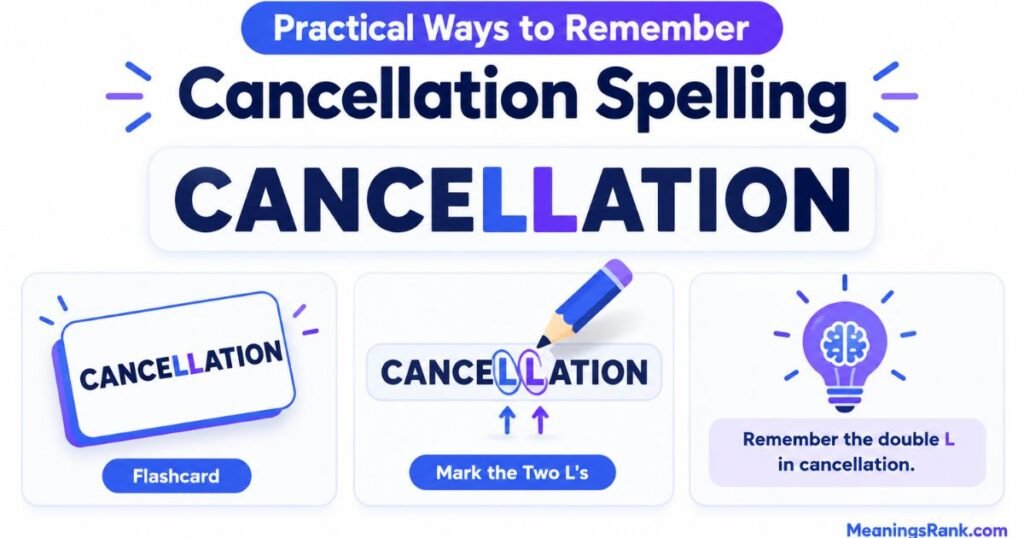
You do not need to memorize a rulebook. A few small tricks will lock the right spelling in place.
Quick Memory Trick / Mnemonic Device
“Two L’s in the middle, like two lamps lighting the way.”
Picture the double L as a pair of lamps. Every time you write the word, light both lamps: cancel-l-ation. If one lamp is missing, the word looks dim.
Here are a few more aids.
- The “cell” trick. Break the word into can-cell-ation. The middle chunk, cell, has two L’s. Think of a prison cell: something canceled is locked away.
- The Latin lattice. Remember that the word comes from crossed lattice bars (cancelli). Lattices have lots of crisscross, and the word has lots of L’s.
- The noun never changes. Tell yourself: “Only the verb changes by region. The noun stays the same.” That one sentence resolves most doubt.
Interactive Practice Quiz
Fill in each blank with the correct word. Try to answer before you look at the key.
- The airline announced the ________ of all evening flights due to the storm. (cancellation / cancelation)
- In the United States, the editor ________ the column before publication. (canceled / cancelled)
- A British writer would say the match was ________ because of rain. (canceled / cancelled)
- Please read our ________ policy before you book. (cancellation / cancelation)
- She is ________ her gym membership this week (American spelling). (canceling / cancelling)
Answer Key
- cancellation. The noun takes two L’s in both American and British English.
- canceled. American English uses one L in the past tense.
- cancelled. British English doubles the L.
- cancellation. The noun, even when it modifies another noun, keeps the standard spelling.
- canceling. American English uses one L in the present participle.
Score yourself. Five out of five means you have mastered the rule. Three or four means a quick review of the regional verb table will fix the gaps. Two or fewer means bookmark this page and revisit the memory tricks above.
Frequently Asked Questions (FAQs)
Is it cancellation or cancelation?
Cancellation is the standard spelling in American and British English. Cancelation is a rare variant found in a few American dictionaries, but most editors and style guides prefer the double-L form.
Is cancelation an acceptable spelling in American English?
It is recorded as a variant, so it is not strictly wrong, but it is uncommon and often corrected by editors. For professional, academic, and business writing, use cancellation to avoid distracting readers.
Why do Americans write “canceled” but “cancellation”?
American English simplifies the verb forms canceled and canceling because the stress falls on the first syllable of cancel. The noun cancellation comes from Latin and keeps its double L, so it follows a different pattern from the verb.
Should I use “canceled” or “cancelled”?
Use canceled if your audience is American and cancelled if your audience is British, Canadian, Australian, or from another region that follows British norms. Choose one and stay consistent throughout your document.
What is the difference between cancel and cancellation?
Cancel is a verb meaning to stop or void something. Cancellation is a noun naming the act or result of that action. Example: “I will cancel my order” (verb), and “My cancellation was confirmed” (noun).
Conclusion
Cancellation is the spelling you want in every context: American, British, formal, casual, legal, or academic. Cancelation exists as a minor variant, but it adds risk without adding value. Remember that only the verb forms (canceled and cancelled) change by region, while the noun stays fixed.
Next time you write the word, picture the two lamps, light both L’s, and move on with confidence. Strong spelling habits like this one build trust with readers and make every sentence you write feel a little more polished.