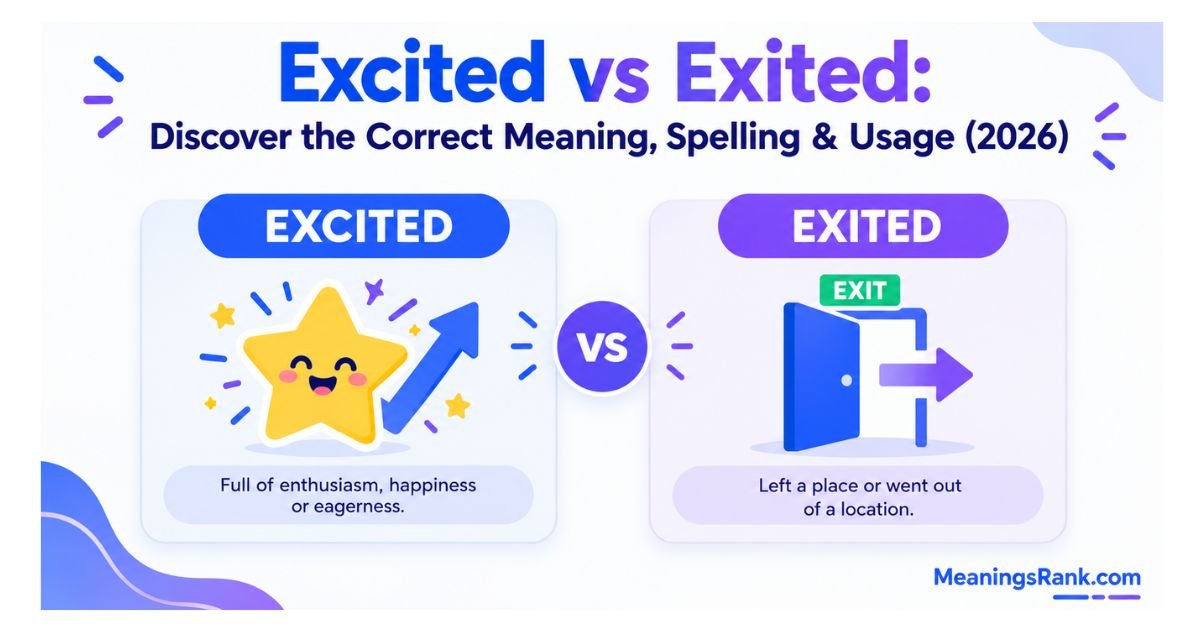

You type “I’m so exited for the weekend,” hit send, and only notice the slip when a friend replies with a grinning emoji. It happens to everyone. Two words that look almost identical, share the same ending, and sound a little alike can swap places on the screen without anyone noticing. But the meanings sit on opposite sides of the door. One describes a feeling. The other describes leaving a place.
This guide gives you the answer upfront, then walks through definitions, grammar rules, real examples, edge cases, and a practice quiz. By the end, you will never mix them up again. And that matters, because a single wrong letter in a cover letter, a client email, or a school essay can quietly weaken an otherwise strong message.
Excited vs Exited: Quick Difference at a Glance
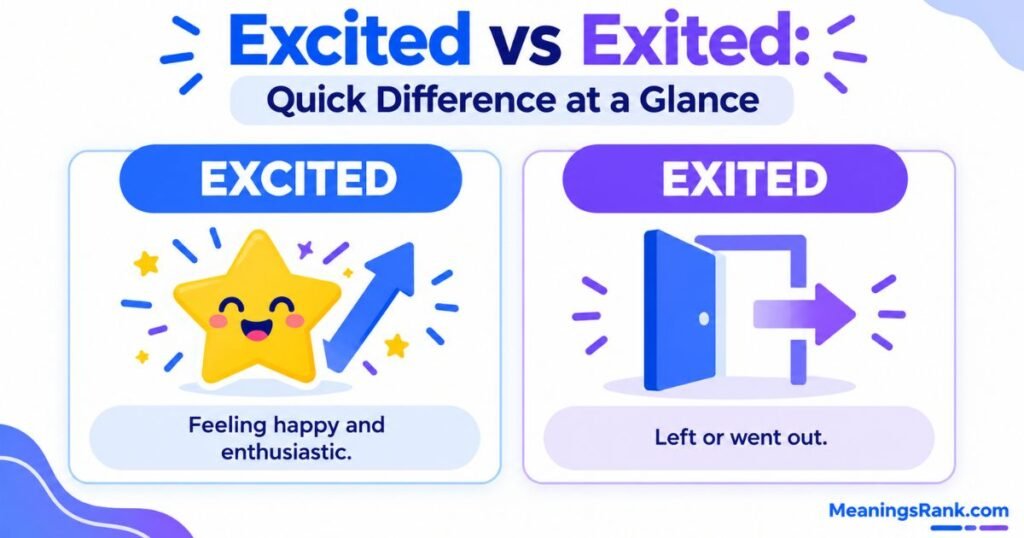
Excited is an adjective that means feeling eager, enthusiastic, or stirred up with energy. Exited is the past tense and past participle of the verb exit, and it means “left” or “went out of” a place, a situation, or a program.
If you can swap the word with “thrilled,” use excited. If you can swap it with “left,” use exited.
| Feature | Excited | Exited |
| Part of speech | Adjective (also past participle of excite) | Verb (past tense and past participle of exit) |
| Core meaning | Full of eager enthusiasm | Went out of or left |
| Quick test | Replace with “thrilled” | Replace with “left” |
| Example | She was excited about the trip. | She exited the building. |
What Does Excited Mean?
Definition and Part of Speech
Excited describes a person (or sometimes an animal) who feels strong, positive anticipation. It is most often used as an adjective, as in “an excited crowd.” It also works as the past participle of the verb excite, which is why you will see it in passive and perfect constructions such as “The students were excited by the news.”
The word can carry other shades, too. In everyday speech it usually means happy and eager. In a more neutral sense, it can mean agitated or stirred up, as in “an excited debate.” Context tells you which shade is meant.
Where the Word Comes From
The verb excite traces back to the Latin excitare, which means “to rouse” or “to call forth.” That original sense of waking something up survives today. When you are excited, your energy has been roused.
Common Patterns and Phrases
Excited is flexible, and it pairs with several prepositions:
- Excited about a topic or event: “I’m excited about the new project.”
- Excited for a person or upcoming event: “We’re excited for you!”
- Excited to plus a verb: “She was excited to start her new job.”
- Excited by a cause or stimulus: “He was excited by the results.”
Style guides generally accept all four patterns. About and to are the safest choices in formal writing.
Read More: Taught vs Tought: Discover the Correct Spelling, Meaning & Key Differences
What Does Exited Mean?
Definition and Part of Speech
Exited is a verb form. The base verb is exit, meaning to go out of or leave a place, and exited is its simple past tense and past participle. Because it is a regular verb, it simply adds -ed. You will see it in sentences like “The actor exited the stage” or “The team exited the tournament in the semifinals.”
Where the Word Comes From
Exit comes from the Latin exitus, linked to exire, “to go out.” Every use of the word keeps that sense of departure, whether the departure is physical, digital, or financial.
Modern Uses Beyond Doors
Today, exited extends well past physical spaces:
- Technology: “The user exited the application without saving.”
- Business and investing: “The founders exited the company after the acquisition.”
- Sports and competition: “The champions exited the cup in the first round.”
- Everyday life: “She exited the conversation politely.”
In each case, the word means something or someone left. Nothing about it expresses emotion.
Excited vs Exited: Side-by-Side Comparison
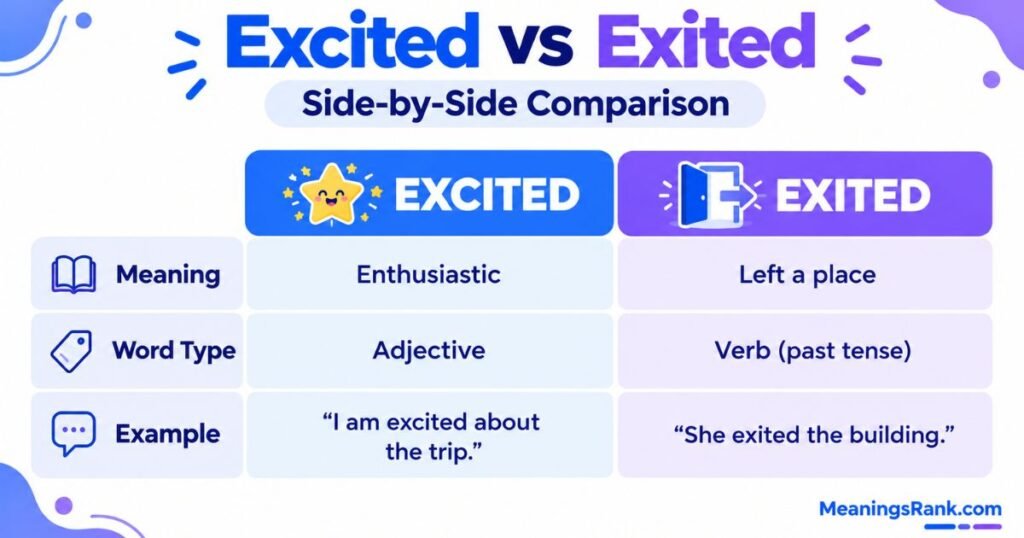
Seeing both words in the same frame makes the contrast stick. Here is a detailed comparison covering grammar, meaning, and pronunciation.
| Category | Excited | Exited |
| Base word | Excite | Exit |
| Word class | Adjective; past participle | Verb (past tense; past participle) |
| Meaning | Eager, thrilled, enthusiastic | Left, departed, went out |
| Emotion involved? | Yes | No |
| Can follow “was/were/felt”? | Yes: “She felt excited.” | Rarely: “She was exited” is awkward unless used passively |
| Takes a direct object? | No (as an adjective) | Yes: “He exited the room.” |
| Typical preposition | about, for, to, by | None needed (transitive) |
| Pronunciation | ik-SY-tid | EG-zi-tid or EK-si-tid |
| Opposite | Bored, indifferent | Entered |
The easiest row to remember is the last one. The opposite of exited is entered. The opposite of excited is bored or calm. If your opposite makes sense, you chose the right word.
Key Differences Between Excited and Exited
Understanding the gap between these two words comes down to five points.
- Meaning. Excited expresses a feeling. Exited expresses an action. One lives in your head, the other happens in space or in a system.
- Grammatical role. Excited works mainly as an adjective, so it describes a noun or pronoun: “an excited child,” “I am excited.” Exited works as a verb, so it needs a subject doing something: “The child exited the room.”
- Sentence structure. Because exit is transitive in most uses, exited usually takes a direct object (“exited the highway”). Excited does not take an object; it links back to the subject through a linking verb like be, feel, or seem.
- Spelling. The only difference is one letter: excited has an extra c (e-x-c-i-t-e-d), while exited goes straight from x to i (e-x-i-t-e-d).
- Frequency and register. Excited is common in conversation, marketing, and storytelling. Exited appears more in news reports, technical writing, business updates, and stage directions.
A short way to remember all of this: feelings take excited, departures take exited.
How to Use Excited and Exited in Sentences
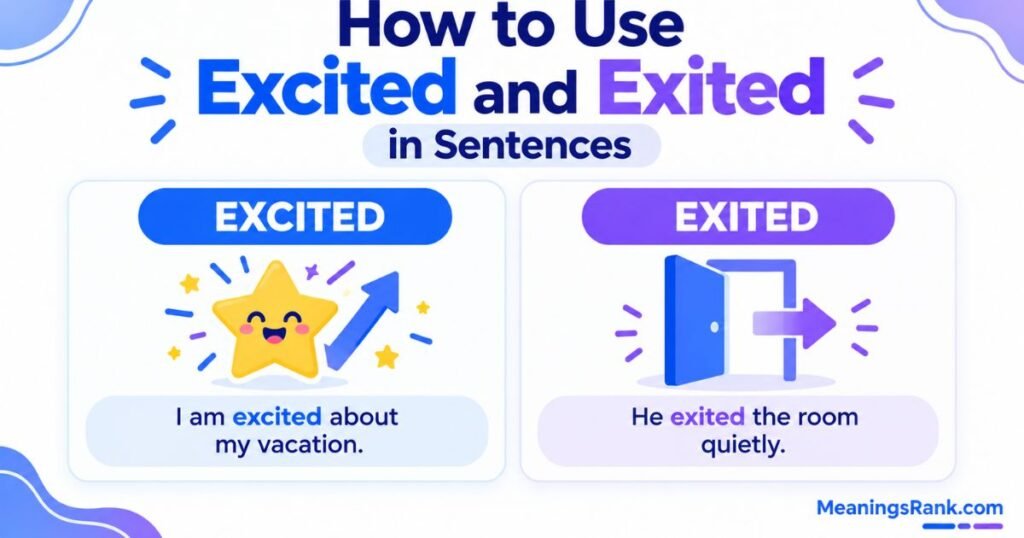
Using Excited
Pair excited with a linking verb and, optionally, a preposition.
- Subject + be + excited: “The children are excited.”
- Subject + feel + excited + about: “I feel excited about the interview.”
- Subject + be + excited + to + verb: “They were excited to meet you.”
- Excited + noun: “An excited puppy tore through the yard.”
Using Exited
Pair exited with a subject and, usually, a place, program, or situation.
- Subject + exited + place: “The delegates exited the hall.”
- Subject + exited + system: “The player exited the game.”
- Subject + exited + commitment: “The investor exited the deal.”
- Passive and perfect forms: “The building had been exited before the alarm stopped.”
Correct vs. Incorrect Usage
| Incorrect | Correct | Why |
| I am so exited about the concert. | I am so excited about the concert. | A feeling needs excited. |
| She excited the room quietly. | She exited the room quietly. | Leaving a place needs exited. |
| The exited crowd cheered loudly. | The excited crowd cheered loudly. | An adjective describing a crowd’s mood is excited. |
| He excited the program and shut down. | He exited the program and shut down. | Closing software is an exit, not a thrill. |
Notice that the incorrect column sometimes produces a real word, which is exactly why spell checkers miss the error. “She excited the room” is grammatically valid, but it means she stirred up the room, not that she left it.
Excited vs Exited: Real-Life Examples
Words make more sense in the situations where you actually meet them. Here are realistic examples drawn from everyday writing.
In a text message
- “Can’t wait for tonight. I’m so excited!”
- “I exited the group chat. Too many notifications.”
In a workplace email
- “We are excited to announce a new partnership.”
- “Two board members exited the meeting before the vote.”
In a news report
- “Fans exited the stadium in an orderly manner.”
- “Voters were excited about the turnout numbers.”
In a school essay
- “The narrator was excited and nervous on the first day.”
- “At the end of the scene, the villain exited through the back door.”
In a product description
- “Kids will be excited to unbox this set.”
- “The app exited unexpectedly. Please update to the latest version.”
Look at the pairs above. Each sentence in the first group tells you how someone feels. Each sentence in the second group tells you where someone went or what stopped running.
Read More: Studder vs Stutter: Correct Spelling, Meaning & Key Differences (2026)
Excited vs Exited in Different Contexts
The same two words shift slightly depending on the setting. Knowing the context keeps your usage precise.
Everyday conversation. Excited dominates. People are excited about holidays, news, and plans. Exited appears when someone describes leaving a place: “We exited through the side door.”
Professional and business writing. Excited is common in announcements and cover letters (“I am excited to apply”), though some editors suggest swapping it for pleased or eager in very formal documents. Exited appears in startup and finance language, where a founder who has sold a company is said to have “exited.” Similarly, an investor “exited a position” when selling a stake.
Technology and software. Exited describes closing an application or leaving a mode: “The system exited safe mode.” You will also see exit code and exited with status 0 in programming logs.
Theater and film. Stage directions use “Exit” for one character leaving and “Exeunt” for several. In prose describing a performance, “the actor exited stage left” is standard.
Science and education. Here, excited gains a technical meaning. In physics and chemistry, an atom or electron in an excited state has absorbed energy and moved to a higher energy level. This has nothing to do with emotion, yet it is still excited, never exited.
Social media and informal writing. The error spreads fastest here, partly because of autocorrect and fast typing. Taking one extra second to reread a post is the simplest fix.
Common Mistakes to Avoid When Using Excited and Exited
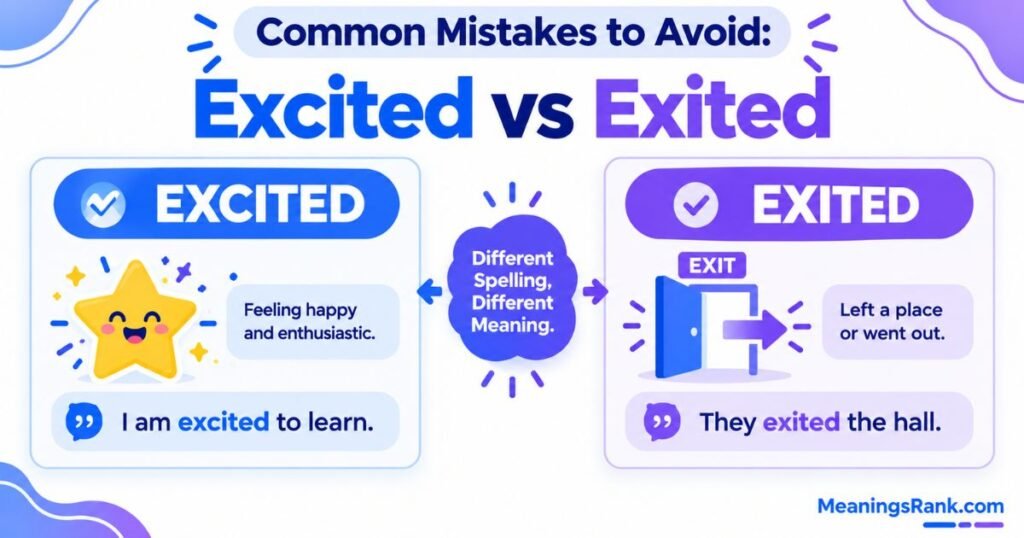
The Typo Trap
The most frequent mistake is a plain keystroke error. Because c and x sit near each other on a QWERTY keyboard, and both words end in -ited, the wrong version slips through. Spell checkers rarely flag it, since both are valid dictionary words.
Autocorrect Confusion
Predictive text can swap one for the other without warning. If you write a lot on a phone, scan every sentence that contains either word before sending.
Using Exited for Emotion
Some writers, especially language learners, assume that exited might be a stronger or more dramatic version of excited. It is not. It carries no emotion whatsoever. If a sentence describes anticipation, joy, or energy, the spelling is excited.
Using Excited for Leaving
The reverse error is less common but equally confusing. A sentence like “The guests excited the venue at midnight” will leave readers puzzled, since it suggests the guests stirred up the venue rather than left it.
Mixing Up Related Forms
The same slip affects the -ing forms. Exciting describes something that causes excitement (“an exciting game”). Exiting describes the act of leaving (“exiting the freeway”). Likewise, excitement and exit belong to separate word families.
Quick Memory Trick / Mnemonic Device
Try this: “Excited has a C for Cheer. Exited has an X like the exit sign.”
Picture a bright green EXIT sign above a door. The X is right there in the word. Now picture confetti and cheering: that is the C. If you feel cheerful, use the word with the C. If you are heading for the door, use the word with only the X.
A second check: say “left” in place of the word. If the sentence still works (“She left the room”), you need exited. If it falls apart (“She was left about the trip”), you need excited.
Pronunciation and Spelling Differences Between Excited and Exited
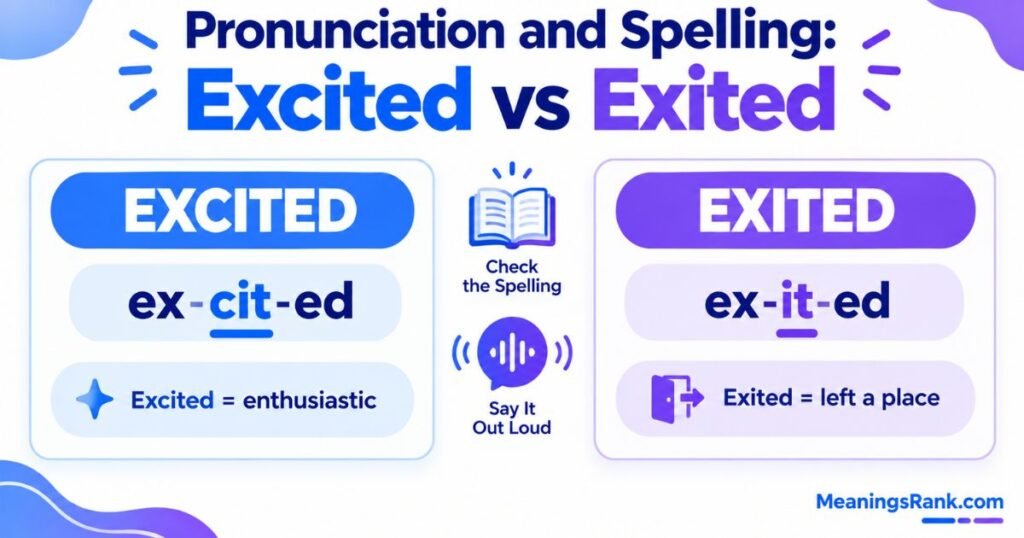
Pronunciation
The two words share an ending but differ in the opening syllables.
- Excited: /ɪkˈsaɪtɪd/. The stress falls on the second syllable: ik-SY-tid.
- Exited: /ˈɛɡzɪtɪd/ or /ˈɛksɪtɪd/. The stress falls on the first syllable: EG-zi-tid or EK-si-tid. Both pronunciations are accepted.
Say them aloud. Excited has a long i sound in the middle (like “sight”). Exited has a short i (like “sit”). Reading the sound pattern out loud is one of the quickest ways to catch the wrong spelling.
Spelling
| Word | Letter-by-letter | Silent or doubled letters |
| Excited | e-x-c-i-t-e-d | The c is part of the -cite core |
| Exited | e-x-i-t-e-d | Based on the base word exit |
A reliable method is to start from the base word. Excite adds -d to make excited. Exit adds -ed to make exited. Because excite already ends in e, you only add d. Because exit ends in t, you add the full -ed.
Both words use American and British spelling identically, so no regional variation applies.
Exceptions and Special Cases
Most uses are straightforward, but a few cases deserve attention.
Excited as a technical term. In physics and chemistry, excited state refers to an atom or molecule holding more energy than its baseline. The word stays excited even though no emotion is involved.
Exited as a business adjective. In the startup world, writers sometimes say “an exited founder” to describe someone who has already sold a company. This is jargon and is not accepted in every style guide, so use it with care in formal documents.
Overexcited and underexcited. Prefixes attach directly: overexcited, never over-exited. Style guides generally prefer the closed form without a hyphen, though dictionary preferences vary.
Excitedly vs. exitedly. Excitedly is a real adverb: “The kids ran excitedly to the door.” Exitedly is not a standard English word.
Exeunt. In stage directions, exeunt is the plural form for characters leaving together. It is Latin, not a variation of exited, and it appears in scripts rather than regular prose.
Prepositions after excited. Some editors prefer excited about over excited for when the cause is an event. Others accept both. Follow the style guide of the publication you are writing for.
Read More: Encorporate vs Incorporate: Correct Spelling, Meaning & Usage (2026)
Practice Exercises: Excited vs Exited
Test yourself before you check the answer key. Fill in each blank with either excited or exited.
Part A: Fill in the blank
- The children were so ________ about the school trip that they could not sleep.
- The CEO ________ the board meeting without answering any questions.
- She felt nervous and ________ as she opened the acceptance letter.
- The user accidentally ________ the app before saving the file.
- We are ________ to welcome our new team members next week.
Part B: Spot and fix the error
Rewrite each sentence correctly.
- The exited fans screamed as the band took the stage.
- He excited the highway at the next junction.
- I’m exited to see you on Saturday.
Part C: Choose the better word
- The investor (excited / exited) the company after three profitable years.
- A (excited / exited) puppy waited by the front door.
Answer Key
- excited
- exited
- excited
- exited
- excited
- The excited fans screamed as the band took the stage.
- He exited the highway at the next junction.
- I’m excited to see you on Saturday.
- exited
- excited
Scoring: 9–10 correct means you have mastered the difference. 6–8 means you are close, so revisit the mnemonic. Below 6, reread the quick comparison table and try again.
Frequently Asked Questions (FAQs)
What is the difference between excited and exited?
Excited means feeling eager or enthusiastic, and it works as an adjective. Exited is the past tense of exit and means “left” or “went out of.” One describes emotion, the other describes departure.
Is “exited” ever a correct way to say you are happy?
No. Exited never describes a feeling. If you want to say you are happy or thrilled, the correct word is excited. Using exited in that context is a spelling error.
Can I say “I’m exited” instead of “I’m excited”?
Not if you mean you feel enthusiastic. “I’m exited” would technically be a passive construction meaning “I was left,” which makes no sense in most conversations. Use “I’m excited” for a feeling.
How do you pronounce excited and exited?
Excited is pronounced ik-SY-tid, with stress on the second syllable. Exited is pronounced EG-zi-tid or EK-si-tid, with stress on the first syllable. The vowel sound in the middle also differs: long i in excited, short i in exited.
Is “excited” a verb or an adjective?
Both, depending on the sentence. In “an excited child,” it is an adjective. In “The news excited the crowd,” the verb is excited (past tense of excite). When people ask whether someone “is excited,” they are almost always using the adjective.
Conclusion
The difference is simple once you see it: excited is about feeling, and exited is about leaving. Use the “thrilled” and “left” substitution tests, remember that the C in excited stands for cheer, and reread any sentence with either word before you publish or send it. With a little practice, this common slip will stop catching you out, and your writing will read as sharp and professional every time.