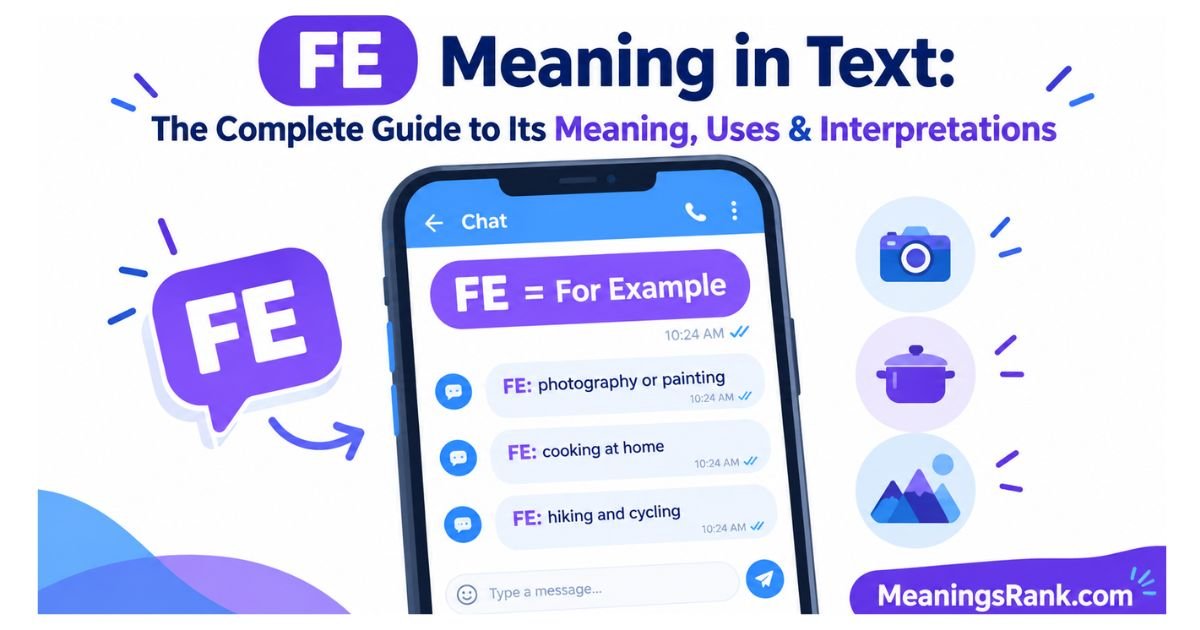

You’re chatting with a friend, and they write, “You should try a new hobby, FE photography or painting.” You pause for a second. What does FE mean?
Here’s the answer: FE means “for example.” People use it when they want to give an example without typing the whole phrase. It’s quick, casual and easy to read once you know the trick.
FE meaning in text is simple, but it’s still confusing for many people because it’s not as famous as LOL or BRB. This guide explains what FE stands for, where it came from, how people use it on WhatsApp, Instagram, TikTok and more, and when you should skip it. You’ll also get real examples, reply ideas and a comparison with similar abbreviations.
What Does FE Mean in Text? – Quick Meaning
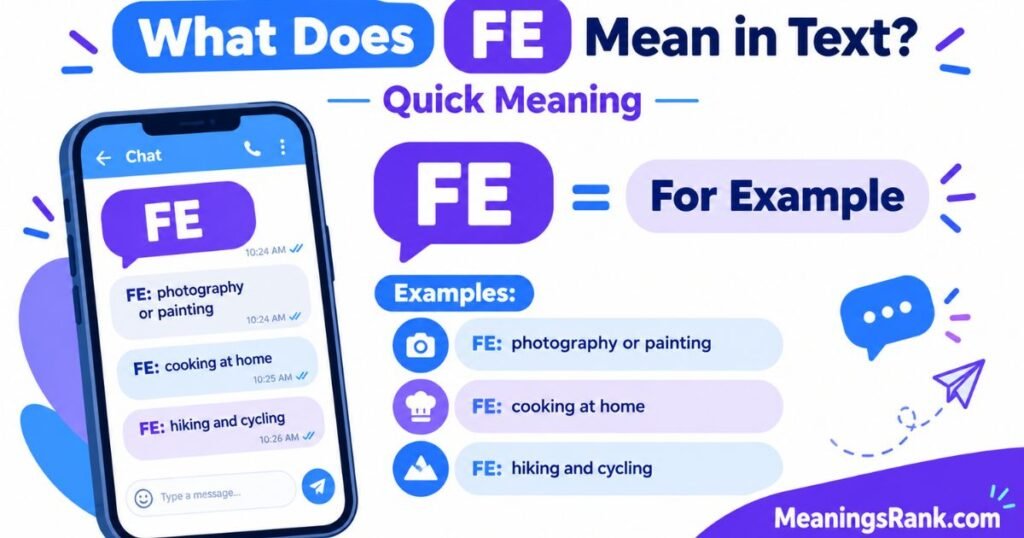
FE stands for “for example.” It’s a short way to introduce an example in a text or chat message.
Here are some quick samples:
- “You should try a new hobby, FE photography or painting.”
- “There are lots of ways to save money, FE cooking at home.”
- “I enjoy outdoor activities, FE hiking and cycling.”
In each message, FE comes right before the examples. You could swap it with “for example” or “like” and the sentence would still make sense.
Fast facts:
- Full form: For example
- Tone: Casual and neutral
- Best used in: Texts, DMs, group chats
- Not ideal for: Formal emails, essays, job applications
FE Meaning in Texting and Social Media
People shorten words when they text. It saves time, especially on a phone. “To be honest” became TBH. “In my opinion” became IMO. In the same way, “for example” became FE.
How FE Works in a Sentence
FE usually sits in the middle of a sentence, after a comma. It points to one or more examples that follow.
- Pattern: Main idea + comma + FE + example
- Sample: “I like snacks, FE popcorn and nachos.”
How It Differs From “E.g.”
Many people know “e.g.” from school or work writing. FE does the same job, but it feels more relaxed and “texty.” You’ll rarely see FE in books or news articles. You’ll see it in quick chats.
Also Read: WHU Meaning in Text: The Complete Breakdown of This Popular Slang & How to Reply
Why People Like It
- It’s short and fast to type.
- It keeps messages light and friendly.
- It makes lists easier to read.
Origin & Background of FE
FE has no single inventor and no viral moment. It grew naturally as people looked for shorter ways to write “for example.”
The Roots of “For Example”
The idea of abbreviating this phrase is old. Writers have used “e.g.” for centuries. It comes from the Latin phrase exempli gratia, which means “for the sake of an example.” Over time, “e.g.” became standard in English writing.
How FE Appeared
Texting changed how people write. With small keyboards and fast replies, users took the first letters of each word: For + Example = FE. It followed the same pattern as other abbreviations built from the first letters of words.
Why It Stayed Small
FE never became as popular as LOL or OMG. Most people still type “e.g.” or the full phrase. So FE lives in everyday chats rather than in public trends or memes. That’s why many people don’t recognize it right away.
Real-Life Conversations Using FE
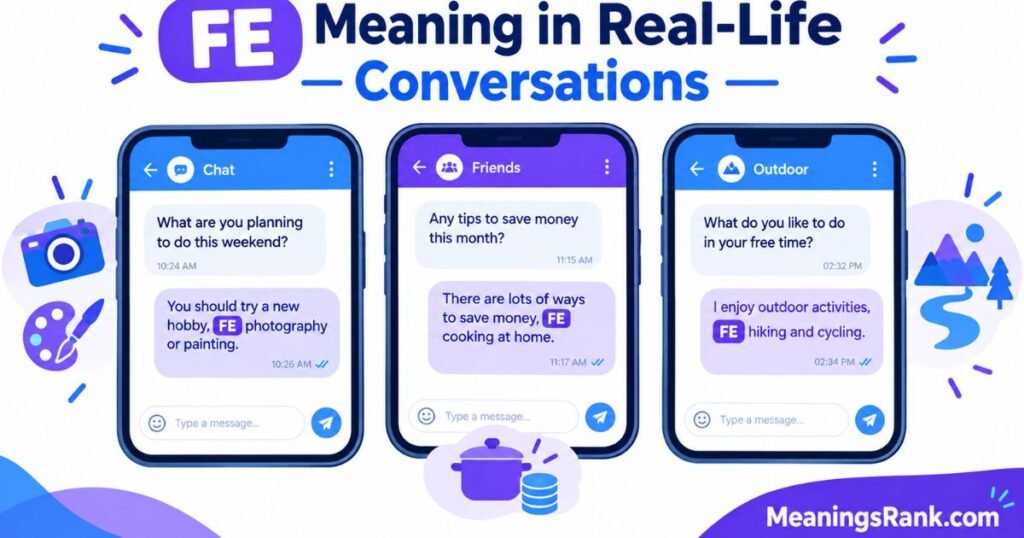
Here are examples across different apps and situations.
Mia: I need ideas for a weekend plan.
Zoe: Try something simple, FE a picnic or a movie night.
Instagram DMs
Ali: I want to start a new hobby but I’m stuck.
Sam: You should try a new hobby, FE photography or painting.
Snapchat
Friend: How do you stay fit?
You: I enjoy outdoor activities, FE hiking and cycling.
TikTok Comments
Creator: Drop your favorite budget tips below!
Viewer: There are lots of ways to save money, FE cooking at home.
Discord and Gaming
Player 1: What roles do we still need?
Player 2: We need support, FE a healer or a tank.
Workplace Chat
Manager: Any ideas for team activities?
Coworker: Something low-cost, FE a lunch or a quiz.
Notice how each FE leads to a short list. That’s the clue. Whenever you see FE followed by examples, it means “for example.”
Emotional & Psychological Meaning of FE
FE doesn’t carry strong feelings by itself. It’s a neutral, helpful tool. But the way it’s used can still tell you something about the sender.
What It Says About the Sender
- Relaxed: Using FE suggests a casual mood. The person is chatting, not writing a report.
- Helpful: People use FE when they’re giving ideas or advice, so it often shows a friendly intent.
- Time-saving mindset: The sender wants to keep things short and easy.
Tone in Different Moods
In a friendly chat, FE feels natural and warm. In a serious or emotional conversation, abbreviations can feel a bit light. If someone is upset, full sentences usually show more care.
Why It Feels Easy to Read
Examples make advice feel real. “Try a hobby” is vague. “Try a hobby, FE painting” feels easier to act on. FE helps make ideas clear without sounding pushy.
FE Meaning in Chat, WhatsApp, Instagram & TikTok
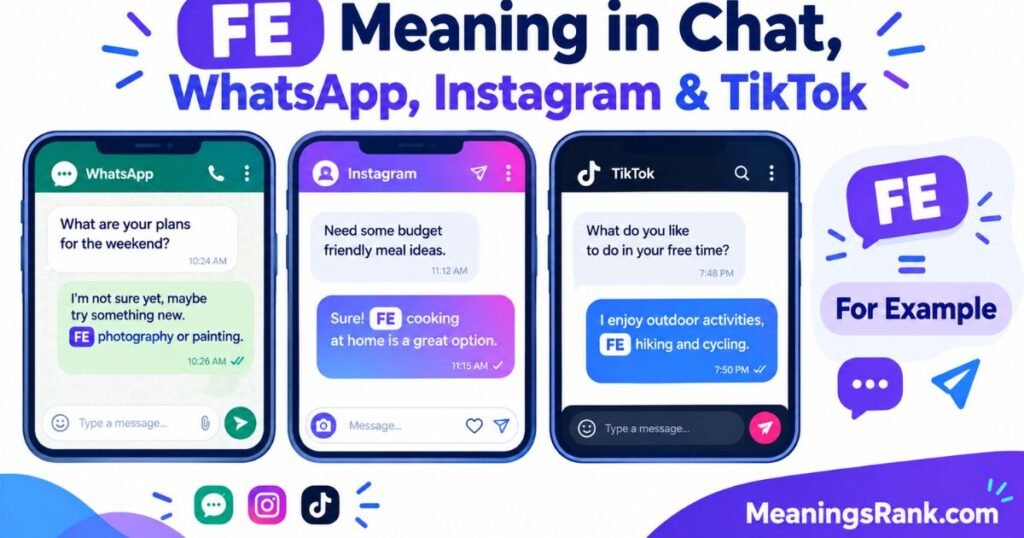
Each platform has its own style, but FE means the same thing everywhere.
Great for short ideas and lists. People often use FE in group chats when planning events or sharing tips.
Used in DMs, comments and captions. You might see it in a caption like “Fun ways to relax, FE reading or music.”
TikTok
Creators and viewers use FE in comments to add quick suggestions. It keeps comments short, which matters on a fast-scrolling app.
Snapchat
Messages are short and disappear quickly, so FE fits well here.
Discord and Telegram
Casual servers and group chats use FE for suggestions, game ideas and quick lists.
Tip: If your audience is mixed in age or language, add the full phrase once so no one is confused.
FE Usage in Different Contexts
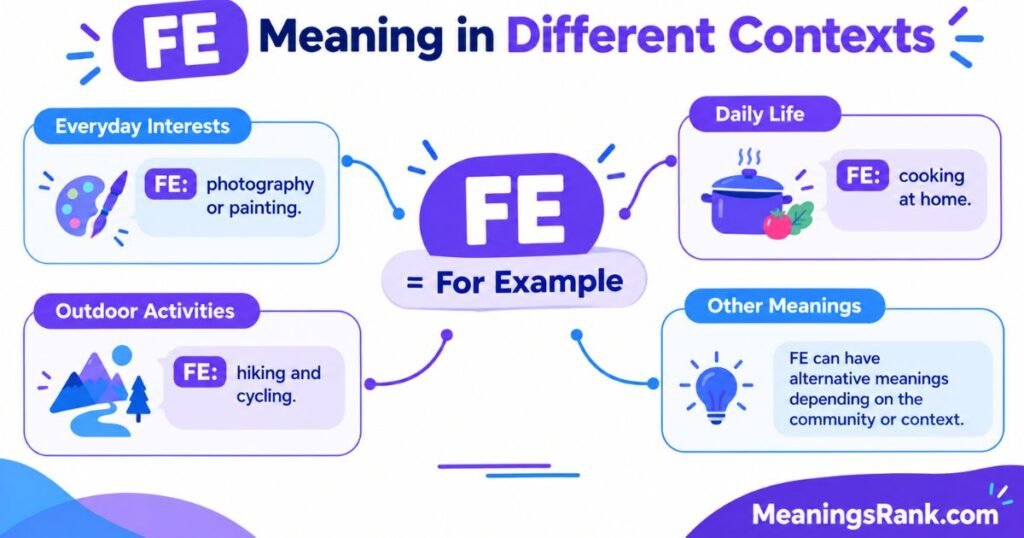
Casual Chats With Friends
This is where FE shines. Use it for ideas, plans and advice: “Let’s do something fun, FE bowling or karaoke.”
Study Groups
Students use FE when sharing notes or tips: “Use memory tricks, FE flashcards or rhymes.”
Work Messages
In informal team chats, FE is fine. In client messages, emails or reports, write “for example” or “e.g.”
Social Media Captions
FE works in short posts: “Easy ways to relax, FE yoga or a walk.” Keep it readable, though. Too many abbreviations can look messy.
Gaming Chats
Gamers use shorthand all the time. FE fits in quick callouts, like “Pick a class, FE mage or archer.”
Voice and Spoken Use
People don’t usually say “F-E” out loud. They say “for example.” FE is mainly a written shortcut.
When NOT to Use FE
FE is handy, but it isn’t always the right choice. Skip it when:
- Writing formal emails: Use “for example” or “e.g.” instead.
- Applying for jobs or school: Full wording looks more professional.
- Writing essays or reports: Teachers expect proper English.
- Texting people who may not know it: Older relatives or non-native English speakers might not understand.
- Sending serious messages: Important or emotional topics deserve clear, complete sentences.
- Giving instructions that matter: For safety, medical or legal details, avoid shortcuts.
Simple rule: If you’d have to explain it, type it out.
Also Read: MMCHT Meaning in Text: The Ultimate Guide to Its Meaning, Origins & Usage
Common Misunderstandings About FE
“FE Is Official Slang Everyone Knows”
Not really. FE is informal shorthand, not a famous slang term. Many people have never seen it, so don’t be surprised if someone asks what it means.
“FE Is Another Word for E.g.”
They mean the same thing, but they aren’t used the same way. “E.g.” is the standard form in writing. FE is a texting habit.
“FE Is Rude or Offensive”
It isn’t. FE has no negative meaning when it’s used for “for example.”
“FE Is a Typo”
Sometimes people mistype letters, but when FE appears before examples, it’s almost always on purpose. If a message makes no sense, ask the sender.
“FE Is the Same as IE”
No. “I.E.” means “that is” and explains a point. FE gives examples. Mixing them up can change your message.
Other Meanings of FE
In rare cases, FE can stand for other things, like “front end” in tech chats or “final exam” in school groups. The surrounding words will make the meaning clear. If FE comes before examples, it means “for example.”
FE vs. Similar Texting Abbreviations – Comparison Table
| Abbreviation | Meaning | Tone | Best Use |
| FE | For example | Casual | Quick ideas in chats |
| E.G. | For example | Neutral to formal | Emails, essays, notes |
| I.E. | That is | Neutral to formal | Explaining or clarifying |
| FYI | For your information | Neutral | Sharing facts or updates |
| IMO | In my opinion | Casual | Giving a personal view |
| TBH | To be honest | Casual | Honest comments |
| FR | For real | Casual | Agreeing or stressing a point |
Key takeaway: FE and E.G. mean the same, but FE is looser and more casual. Use the formal option when writing for school or work.
FE Variations and Related Types
FE can appear in a few forms. Here’s what to look out for.
Capitalization
- FE: the most common version.
- fe: lowercase, used in very fast chats.
- Fe: sometimes typed by autocorrect.
With Punctuation
- FE: often followed by a colon, as in “FE: tea, coffee.”
- FE, with a comma, such as “Try new foods, FE sushi.”
- F.E.: a rarer form that mimics “e.g.”
Related Forms
- E.G. or eg: the standard abbreviation.
- Ex: another casual short form, as in “Ex: apples and pears.”
- For ex: a middle option that’s still easy to understand.
- Like: a simple, spoken-style replacement.
Other Uses
Some communities use FE for different things, like “front end” in tech or “final exam” in school. If a list of examples follows FE, it means “for example.”
How to Respond When Someone Uses FE
You don’t need a special reply. Just answer the content.
If They Gave Ideas
- “Love that. I’ll try photography first!”
- “Good tip. I’ll start cooking at home.”
- “Hiking sounds fun. Want to go this weekend?”
If You Want to Add Your Own
Use FE yourself: “Nice, FE I could also try pottery or sketching.”
If You’re Not Sure What It Means
Ask politely:
- “Is FE short for for example?”
- “Sorry, what does FE mean?”
If You Want to Keep It Formal
Reply in full: “Thanks for the suggestions, for example, photography sounds great.”
Quick Tips
- Match the other person’s tone.
- Answer the examples, not the abbreviation.
- Ask once if you’re confused, then move on.
Regional & Cultural Usage of FE
FE isn’t tied to one country. It appears wherever people text in English.
English-Speaking Countries
In the US, UK, Canada and Australia, FE is understood in casual chats, though many people prefer “e.g.” in writing.
South Asia
In places like Pakistan and India, many people mix English with local languages when texting. FE can appear in these chats as a quick English shortcut, especially among students and young adults.
Non-Native English Speakers
Learners often meet “e.g.” in school but may not know FE. If you’re chatting with someone still learning English, use the full phrase to keep things clear.
Online Communities
Global platforms like TikTok and Discord mix many cultures. Shortcuts spread by habit. FE may be common in one group and unknown in another.
A Note on Other Languages
In Spanish and Portuguese, “fe” and “fé” mean faith. If a bilingual friend types it in another language, it may not be an abbreviation at all.
Is FE Safe for Kids?
Yes. FE is completely safe. It’s a harmless abbreviation for “for example.” It has no hidden adult, violent or negative meaning.
What Parents Should Know
- The abbreviation is fine. It’s simply a shortcut.
- Focus on the conversation. What matters is who your child is talking to and what they’re discussing.
- Use it as a teaching moment. Kids can learn when shortcuts are okay and when they should write properly, like in homework.
Tips for Teens
- Use full words in school work.
- Don’t share personal details with people you don’t know.
- If a chat makes you uncomfortable, tell a trusted adult.
Also Read: WTV Meaning in Text: What It Means, How People Use It, and How to Reply (2026 Guide)
FAQs About FE Meaning in Text
What does FE mean in text messages and chats?
FE means “for example.” People use it to introduce examples quickly. It appears before a list or idea, like “try a hobby, FE painting.”
Is FE the same as e.g. in writing?
They have the same meaning. E.g. is the standard form for formal writing, while FE is casual texting shorthand.
Is FE a rude or offensive word in texts?
No. FE is a neutral, polite abbreviation. It has no negative or adult meaning when used for “for example.”
Can I use FE in school or work messages?
Casual team chats are fine. For emails, essays and formal messages, write “for example” or “e.g.” instead.
How do I reply when someone sends me FE?
Just respond to the examples they shared. If the abbreviation is unclear, politely ask what it means.
Does FE mean the same thing on every app?
Yes, mostly. On WhatsApp, Instagram, TikTok and Snapchat, FE usually means “for example.” Check the context if unsure.
Conclusion: What Does FE Mean in Text?
So, what does FE mean in text? It stands for “for example.” People use it to share ideas quickly, like “I enjoy outdoor activities, FE hiking and cycling.” It’s short, friendly and easy to understand once you spot the pattern: FE comes right before examples.
You can use FE in casual chats on WhatsApp, Instagram, TikTok, Snapchat and Discord. It works best with friends, classmates and teammates who know your style. In formal emails, essays or job applications, stick with “for example” or “e.g.” so your message stays clear and professional.
If you ever get confused by an abbreviation, remember the basics: read the full message, look at what comes next, and ask if you’re still unsure. FE is also completely safe for kids and teens, so there’s nothing to worry about.
Want to decode more texting shortcuts? Explore the other guides on MeaningsRank and keep your chats clear and confident.