
You are typing a thank-you email. The sentence is almost finished: “Your help is ______ appreciated.” Your fingers hesitate. Is it grately vs greatly? The two look almost identical on screen, and a spell checker will not always rescue you.
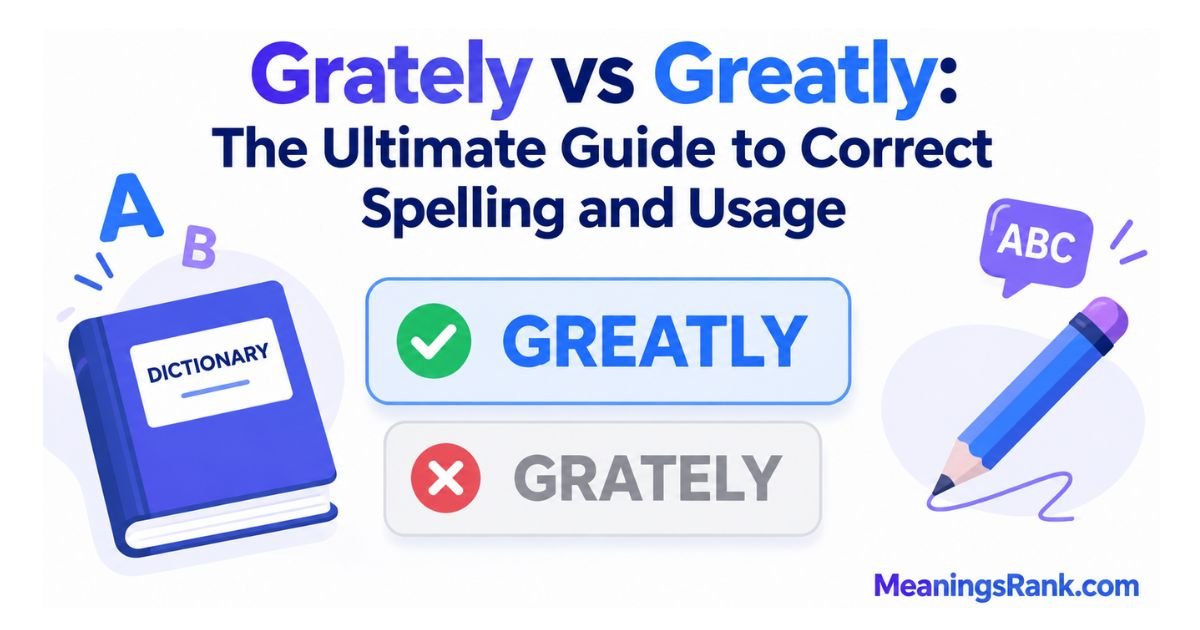
The answer is greatly. Every major dictionary and style guide lists it, and none of them list “grately.” This guide explains why, shows you how the word works in real sentences, and gives you simple tricks so the mistake never slips into your writing again.
The Quick Answer: Grately or Greatly?
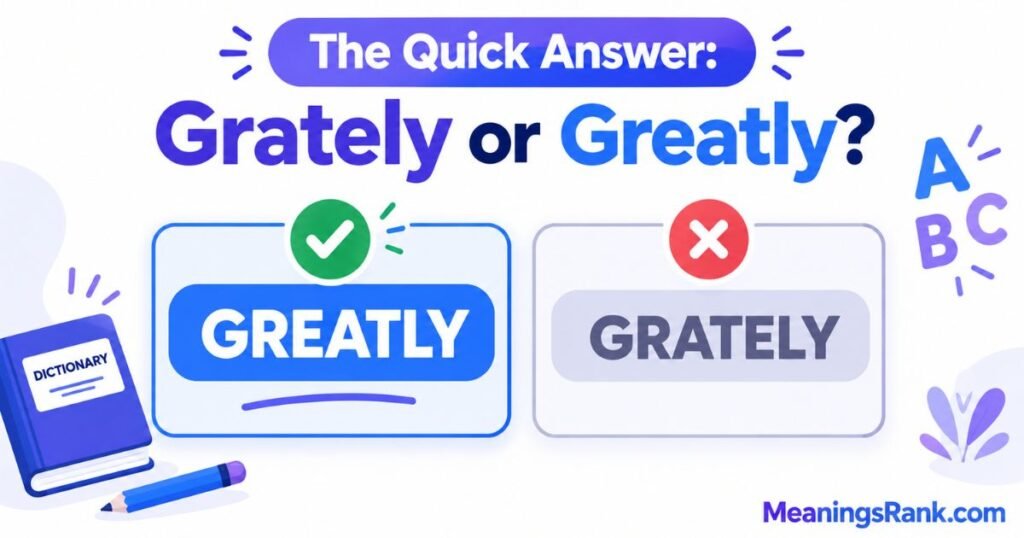
“Greatly” is the only correct spelling. It is an adverb formed from the adjective great plus the suffix -ly, and it means “to a large degree” or “very much.” “Grately” is not a word in standard English. It is a common misspelling, most likely caused by confusing great with grate or grateful.
| Spelling | Correct? | Example |
| Greatly | Yes | Your support is greatly appreciated. |
| Grately | No | ~~Your support is grately appreciated.~~ |
Spelling accuracy matters in job applications, client emails, and school essays. A single misspelled word can change how a reader judges your attention to detail, so it is worth getting this one right.
What Does “Greatly” Mean?
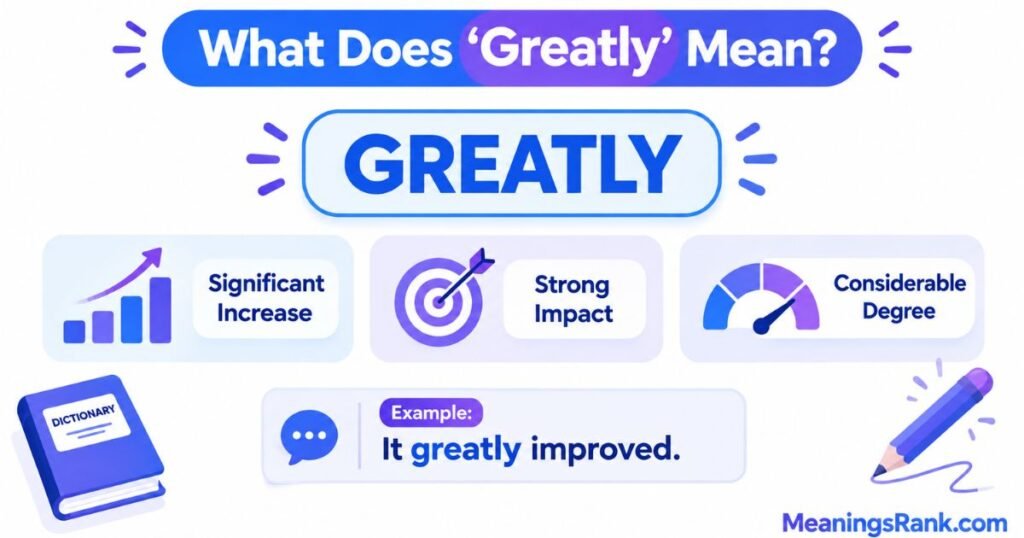
Greatly means “to a great extent,” “very much,” or “by a large amount.” It signals intensity. When you say a policy greatly improved a school, you are saying the improvement was large and noticeable.
Dictionaries also record a second, less common sense: “in a noble or grand manner,” as in an older phrase like “to act greatly.” Modern writing rarely uses it. In everyday English, you can safely treat greatly as an intensifier meaning “a lot.”
Notice that the meaning is about degree, not quality. Greatly does not mean “excellently” or “wonderfully.” It tells you the size of an effect, whether the effect is good or bad. You can greatly reduce a risk and you can greatly damage a reputation.
Understanding “Greatly” as an Adverb
Greatly is an adverb of degree. It tells the reader how much an action happens or how strongly a change occurs. Grammatically, it usually modifies a verb or a past participle acting as an adjective.
- Modifying a verb: The new schedule greatly reduced waiting times.
- Modifying a participle: She was greatly admired by her students.
- Following the verb (common with “differ”): The results differ greatly from last year’s.
The syntax is flexible. Greatly can sit before the main verb (“We greatly value your time”), between an auxiliary and a participle (“It was greatly improved”), or after the object (“I appreciate it greatly”). The last position sounds slightly more emphatic.
One boundary to remember: greatly does not usually modify plain adjectives. You would not write “greatly tall” or “greatly happy.” Use very, extremely, or incredibly there instead.
Also keep great and greatly apart. Great is an adjective (“a great idea”). In casual speech it can act as an adverb (“She did great on the exam”), but formal style guides prefer well in that spot. Neither use of great replaces greatly, which always carries the sense of degree.
Grately Meaning: Why It Is Considered a Misspelling
Search for the grately meaning and you will find nothing, because the word has no meaning. It does not appear in standard dictionaries such as Merriam-Webster, Oxford, or Cambridge. When someone writes “grately,” they almost always intend one of two words:
- Greatly, meaning “very much.”
- Gratefully, meaning “in a thankful way.”
The second possibility explains why the error appears most often next to words like appreciated, thankful, and acknowledged. The writer is reaching for gratitude and produces a blend of grateful and great.
Because gratefully is a real word, the two adverbs are easy to mix up. “We gratefully acknowledge your help” means we are thankful. “We greatly appreciate your help” means we value it a lot. Both are correct, but they carry different shades of meaning, and neither one is “grately.”
Read More: Nominator vs Nominee: Key Differences, Definitions & Examples (2026)
Is Grately a Word? Clearing Up the Confusion
No. Grately is not a word in standard English. A few things can make it feel real, though:
- Grate exists as a noun (a metal frame in a fireplace) and a verb (to shred cheese, or to irritate). A reader might assume an -ly form exists.
- The related adjective grating does exist, and its adverb form is gratingly, not grately.
- Informal text, social media, and fast typing spread the mistake further.
If you ever see “grately” in a piece of writing, treat it as a typo and replace it with greatly. If the sentence is about thankfulness, check whether gratefully fits better.
Grately vs Greatly: Key Differences Explained
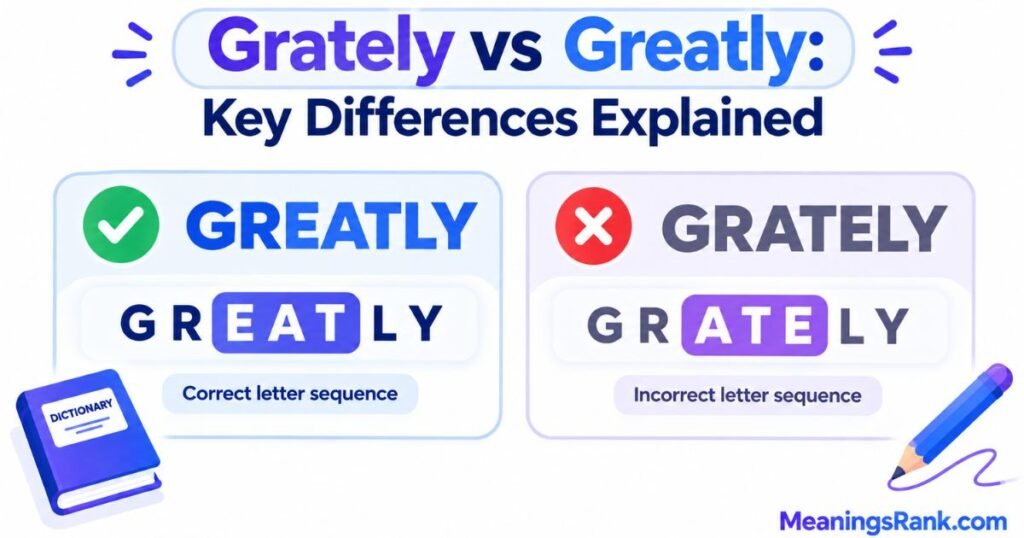
The table below puts the core facts side by side.
| Feature | Greatly | Grately |
| Recognized in dictionaries | Yes | No |
| Part of speech | Adverb | None (invalid) |
| Root word | Great (adjective) | Unclear; likely a blend of grate and great |
| Pronunciation | GRAYT-lee | Not applicable |
| Meaning | To a large degree | None |
| Safe for formal writing | Yes | Never |
Pronunciation helps explain the root. Great rhymes with late and state. Greatly keeps that long “ay” sound: /ˈɡreɪt.li/. Since grate is pronounced exactly the same as great (they are homophones), the ear cannot tell you which spelling is right. Only memory can.
Why Do People Confuse Grately and Greatly?
Three forces cause the mix-up.
Homophones. Great and grate sound identical. Writers who spell by sound can land on either.
Look-alike words. Grateful, gratefully, and gratitude all start with grat-. When the brain is thinking about thankfulness, it pulls the grat- pattern into the wrong word.
Fast typing. Dropping the e from ea is a natural slip when you type quickly, and spell checkers do not always flag the result.
Understanding the cause is half the cure. When you know the confusion comes from sound rather than meaning, you can train your eyes to check for the ea.
How to Spell Greatly Correctly Every Time
Break it into two pieces:
GREAT + LY = GREATLY
You keep the entire base word great and simply attach -ly. Nothing is dropped, nothing is swapped. If you can spell great, you can spell greatly. Before you hit send, glance for the letters g-r-e-a-t at the front. If the e is missing, fix it.
A second check works well when proofreading: read the sentence aloud and ask, “Does this word mean a lot?” If yes, it is greatly, and it must contain the full word great.
How to Use Greatly in a Sentence: Real Examples
Seeing the word in action locks in both the spelling and the rhythm. Here are examples across different settings.
Professional writing
- The new software has greatly improved our response time.
- We greatly value your feedback on the proposal.
Academic writing
- Test scores varied greatly between the two groups.
- The study suggests that sleep greatly affects memory consolidation.
Everyday conversation
- I greatly admire your patience.
- Her cooking has greatly improved since last year.
Emotional or personal contexts
- He was greatly moved by the speech.
- Their friendship meant greatly to her.
Here is a quick “before and after” table showing how the correction looks in practice.
| Incorrect | Correct |
| We grately value your time. | We greatly value your time. |
| The plan was grately improved. | The plan was greatly improved. |
| Prices differ grately by region. | Prices differ greatly by region. |
| Thank you, it is grately appreciated. | Thank you, it is greatly appreciated. |
Greatly Usage Patterns That Sound Natural
Native writers lean on a small set of reliable combinations, called collocations. Pairing greatly with these verbs makes your sentences sound smooth.
| Pattern | Example |
| greatly + improve / enhance | The redesign greatly enhanced the user experience. |
| greatly + reduce / decrease | Training greatly reduced the error rate. |
| greatly + appreciate / admire / value | We greatly appreciate your patience. |
| greatly + differ / vary | Opinions differ greatly on this question. |
| greatly + exaggerate / overestimate | The report greatly exaggerated the risk. |
| greatly + benefit / influence | Children greatly benefit from early reading. |
| be + greatly + participle | She was greatly impressed by the results. |
One punctuation rule goes with these patterns: do not hyphenate an -ly adverb before the word it modifies. Write “a greatly improved design,” not “a greatly-improved design.” Most style guides follow this convention.
“Greatly Appreciated”: Why This Is the Correct Spelling
“Greatly appreciated” is among the most frequent places the error shows up, so it deserves its own spotlight.
Correct: Any help would be greatly appreciated. Incorrect: ~~Any help would be grately appreciated.~~
The logic is simple. Appreciated is a past participle, and greatly is the adverb that tells you how much the appreciation is. You could swap in deeply, sincerely, or truly and the grammar would still work. Grately cannot play that role because it is not a word.
If you want to sound warmer in an email, restructure the sentence into the active voice: “I greatly appreciate your help.” Both versions are correct. The active form feels more personal.
“Greatly Missed” or “Grately Missed”: Which Is Correct?
“Greatly missed” is correct.
You will see it on sympathy cards, memorial notices, and farewell messages: “He will be greatly missed.” The phrase pairs the adverb greatly with the participle missed to express deep loss. “Grately missed” is always an error.
A related point of style: in formal condolences, “sadly missed” and “deeply missed” are common alternatives, but “greatly missed” remains the standard, widely accepted choice.
Greatly Synonyms to Make Your Writing Stronger
Repeating greatly three times in one paragraph can make writing feel flat. Rotate in synonyms, but match the nuance.
| Synonym | Best used for | Example |
| Considerably | Measurable change | Costs fell considerably. |
| Substantially | Formal or business tone | Revenue grew substantially. |
| Significantly | Data and research | Scores improved significantly. |
| Immensely | Strong feeling | I enjoyed the concert immensely. |
| Enormously | Scale or size | The project helped us enormously. |
| Tremendously | Energy and enthusiasm | She contributed tremendously. |
| Deeply | Emotion | He was deeply moved. |
| Profoundly | Serious or philosophical topics | The book profoundly shaped her views. |
| Vastly | Comparisons | The two plans differ vastly. |
A quick style note: significantly carries a statistical meaning in research writing. Use it only when you mean a result is notable or statistically meaningful.
Context Matters: Where to Use “Greatly”
Greatly fits most registers, but it shines in particular places.
- Formal and business writing: Emails, reports, cover letters, and meeting notes. It sounds polished without being stiff.
- Academic writing: Essays and papers, especially when comparing results or describing influence.
- Customer-facing messages: “We greatly regret the inconvenience” is standard in service replies.
- Casual speech: It works, though people often prefer “a lot” or “really” in relaxed conversation.
Where should you avoid it? Skip greatly when it modifies a plain adjective, and watch for overuse. A sentence like “I am greatly very happy” stacks intensifiers and weakens both.
Spelling Rules for Words Ending in -ly
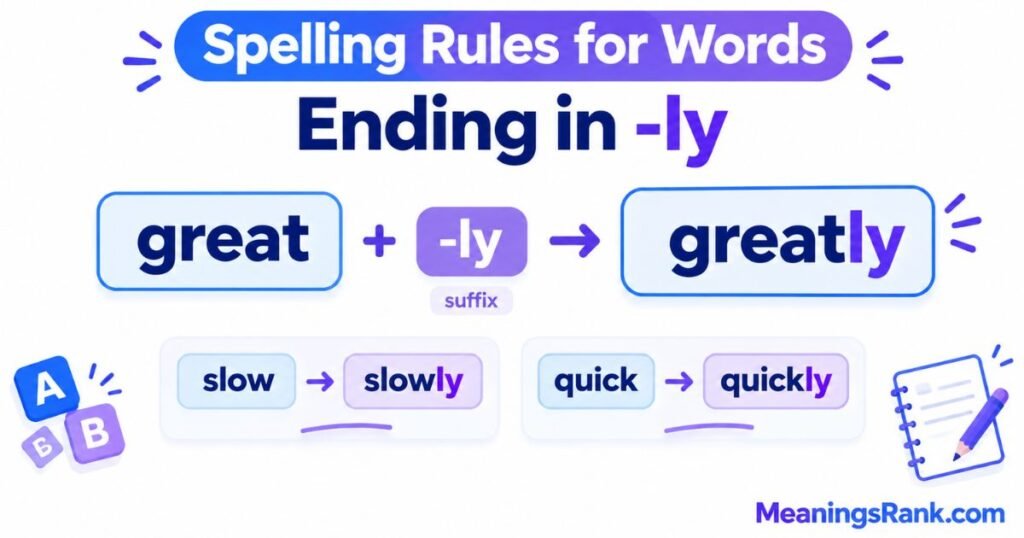
Understanding the suffix -ly turns one spelling fix into a reusable skill. Most adverbs of manner or degree are built by adding -ly to an adjective. The rules below cover almost every case.
| Rule | Example |
| Add -ly directly to most adjectives | great → greatly, quick → quickly, sad → sadly |
| Keep the silent e when the adjective ends in -e | complete → completely, sincere → sincerely |
| Change final y to i | happy → happily, easy → easily |
| Drop -le and add -y | gentle → gently, simple → simply |
| Add -ally to adjectives ending in -ic | basic → basically, tragic → tragically |
Because great ends in a consonant (t), no letters change. That is why greatly is one of the most regular adverbs in English.
A few exceptions drop the silent e: true becomes truly, whole becomes wholly, and due becomes duly. These do not apply to great, which keeps every letter.
Common Spelling Mistakes Similar to Grately vs Greatly
The same sound-versus-spelling trap catches writers on many other words. Practice with this list and you will build a sharper spelling radar.
| Incorrect | Correct | Why the error happens |
| ~~Grately~~ | Greatly | Great and grate sound alike |
| ~~Greatful~~ | Grateful | The brain pulls great into grateful |
| ~~Gratefuly~~ | Gratefully | Writers drop one l before -ly |
| ~~Definately~~ | Definitely | Vowel sounds blur in speech |
| ~~Truely~~ | Truly | Writers keep the e where it must drop |
| ~~Completly~~ | Completely | Writers forget to keep the silent e |
| ~~Wholely~~ | Wholly | An exception to the silent-e rule |
| ~~Extremly~~ | Extremely | The e disappears in fast typing |
Notice the pattern: most of these errors involve a vowel or a silent letter getting lost or added at the seam where the base word meets -ly.
Easy Tricks to Remember the Correct Spelling
Try these four tricks and keep whichever sticks.
The Inside-Word Trick.
Look for the word great sitting at the start of greatly. If you see GREAT + LY, you have it right.
The Cheese Trick.
You grate cheese with a grater. Cheese has nothing to do with how much something happened, so grate never belongs in this word.
Read More: Choosing vs Chosing: The Correct Spelling, Meaning & Examples
The “EA” Anchor.
Say the word slowly and picture the long “ay” sound spelled with an E and an A side by side: gr-EA-t-ly. If your finger skips the E, you have typed grate by mistake.
The Gratitude Split.
Grateful and gratefully belong to thankfulness and share the grat- start. Greatly belongs to size and degree and starts with great. Two ideas, two spellings.
And here is a one-line rhyme to hold onto: “If it’s a lot, it’s G-R-E-A-T.”
How to Use Greatly Correctly in Everyday Writing
Knowing the rule is one thing. Applying it under deadline pressure is another. These habits keep your writing clean.
1. Proofread for the word, not just the sentence. Use your editor’s search function to look for “grately” in long documents. If it appears anywhere, replace it.
2. Pair it with a verb or participle. If you find yourself placing greatly before a plain adjective, swap it for very or extremely.
3. Vary your intensifiers. One greatly per paragraph keeps the tone polished. Rotate in considerably or deeply for variety.
4. Match the word to your register. In a text to a friend, “thanks a lot” is natural. In a formal email, “greatly appreciated” fits better.
5. Do not confuse thanks with degree. If you are thanking someone directly, gratefully (“I gratefully accept”) describes your feeling. If you are measuring how much you value something, greatly describes the degree.
Here is a short email example that puts everything together:
Dear Ms. Patel, Thank you for reviewing my application. Your feedback has greatly improved my cover letter, and I am grateful for your time. Any further advice would be greatly appreciated.
Every adverb in that message is spelled correctly, uses greatly in a natural position, and avoids stacking intensifiers.
Quick Practice: Test Your Understanding
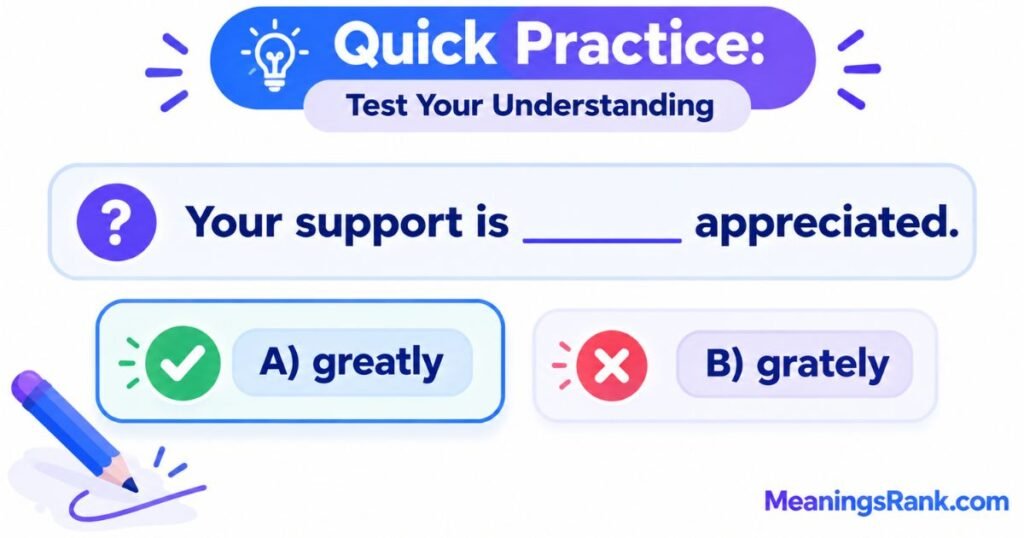
Fill in each blank with greatly, grateful, or gratefully. Then check the answer key below.
- Your donation will be ________ appreciated by the entire community.
- She ________ accepted the scholarship and thanked the committee.
- The two reports differ ________ in their conclusions.
- I am deeply ________ for everything you did.
- Our late colleague will be ________ missed.
Take your time, read each sentence aloud, and ask yourself whether the blank needs a word meaning “very much” or “thankful.”
Answer Key
- greatly (degree of appreciation)
- gratefully (she accepted in a thankful manner)
- greatly (degree of difference)
- grateful (an adjective after the linking verb am)
- greatly (degree of loss)
Scoring: 5/5 means you have mastered it. 3-4 means you are close; reread the usage patterns section. 0-2 means revisit the memory tricks and try the quiz again tomorrow.
Read More: Signer vs Signor: Meaning, Key Differences & Correct Usage
Key Takeaways: Grately vs Greatly
- Greatly is the only correct spelling. Grately is a misspelling.
- Greatly is an adverb of degree built from great + ly.
- Typical phrases include greatly appreciated, greatly missed, greatly improved, and differ greatly.
- Gratefully is a different word that means “in a thankful way.”
- Use greatly with verbs and participles, not with plain adjectives.
- Words ending in a consonant, like great, take -ly with no spelling change.
- Memory tricks such as “GREAT + LY” make correct spelling automatic.
Frequently Asked Questions (FAQs)
Is “grately” a real word?
No. “Grately” does not appear in standard dictionaries and has no defined meaning. It is a misspelling of greatly (very much) or, less often, gratefully (in a thankful way).
Is it “greatly appreciated” or “grately appreciated”?
It is “greatly appreciated.” The adverb greatly tells the reader how strongly something is appreciated. “Grately appreciated” is always incorrect.
What is the difference between “greatly” and “gratefully”?
Greatly describes degree (“very much”), while gratefully describes the feeling or manner of thankfulness. “I greatly appreciate it” stresses how much you value something. “I gratefully accept” shows that you accept with thanks.
Is it “greatly missed” or “grately missed”?
“Greatly missed” is correct. It is the standard phrase for expressing deep loss, as in “She will be greatly missed by her friends.”
Why do people write “grately” instead of “greatly”?
The words great and grate are homophones, so spelling by ear leads to mistakes. The similar-looking word grateful adds to the confusion, especially in sentences about gratitude.
Final Thoughts
The rule behind this spelling is refreshingly simple: keep the word great intact and add -ly. That gives you greatly, a flexible adverb that fits formal emails, academic essays, and heartfelt messages alike. Check for the ea before you send anything, and use the memory tricks whenever doubt creeps in.
Spelling accuracy builds trust with readers, and you now have the tools to protect it. Bookmark this guide, revisit the quiz, and keep exploring more grammar explainers on MeaningsRank to sharpen every sentence you write.