
You reach the word in the middle of a sentence and your fingers hesitate. Studder? Stutter? Both look almost believable, and that small doubt is exactly why this word trips up students, bloggers, and professional writers alike.
The mix-up is understandable. The spelling does not match the way many people say the word out loud, so writers guess. This guide ends the guessing. You will learn which spelling is correct, what the word means, how it is pronounced in American and British English, how it differs from “stammer,” and how to remember the spelling for good. You will also find example sentences, a short practice quiz, and a clear look at the science of stuttering itself.
Studder vs Stutter: Quick Answer and Spelling Comparison
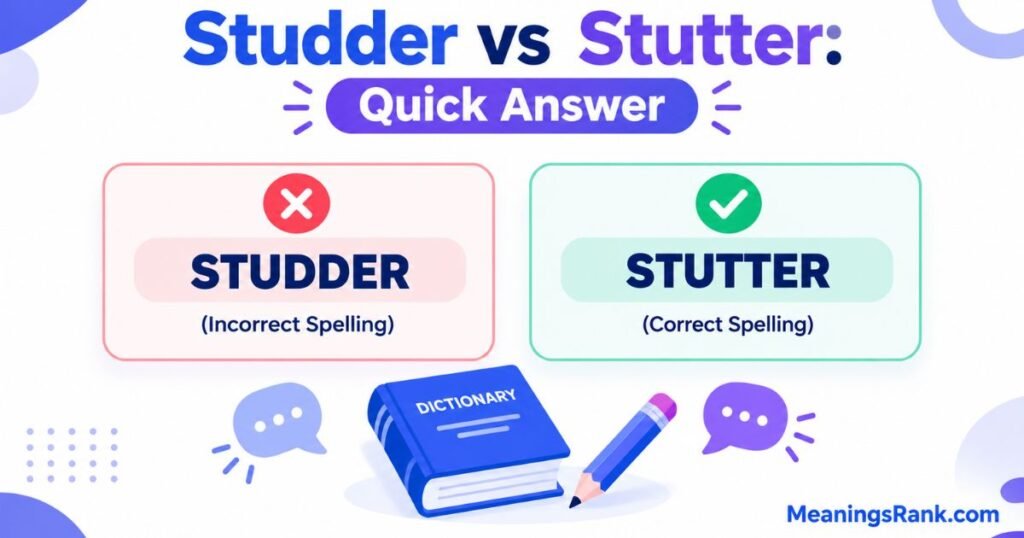
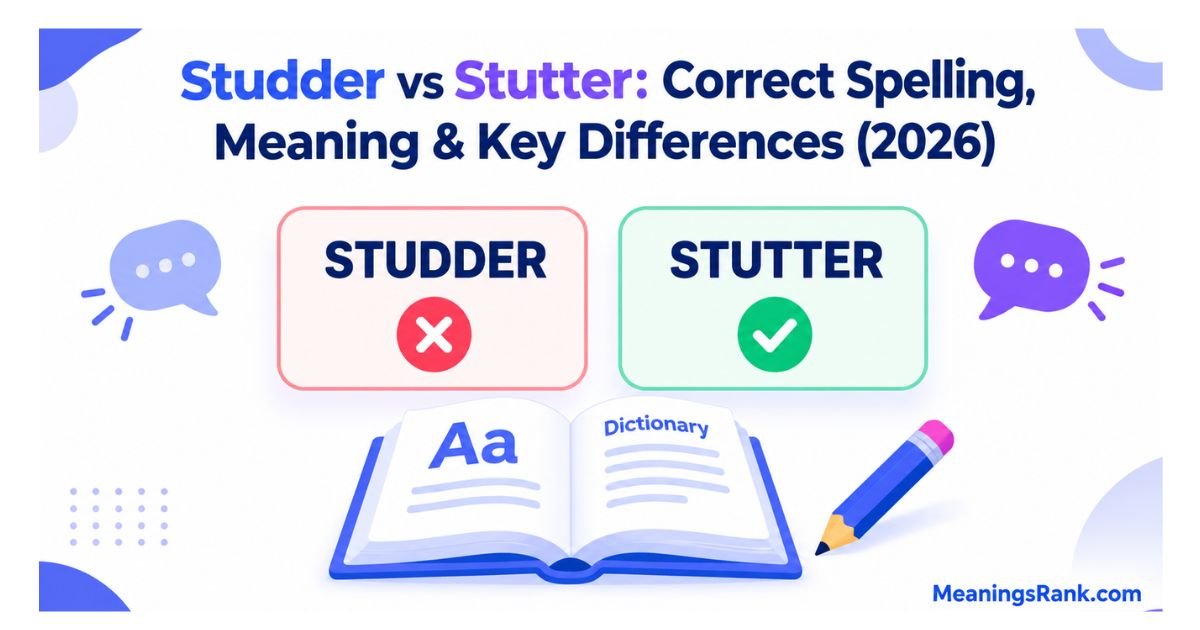
Stutter is the correct spelling. “Studder” is not a standard English word. It is a common misspelling caused by the way Americans pronounce the double t in “stutter,” which often sounds like a soft d. Use stutter (verb and noun) or stuttering (adjective and gerund) in all formal and informal writing.
| Feature | Stutter | Studder |
| Correct spelling? | Yes | No |
| In major dictionaries? | Yes | No |
| Part of speech | Verb, noun | None (not a recognized word) |
| Past tense | stuttered | ~~studdered~~ |
| -ing form | stuttering | ~~studdering~~ |
| Example | He tends to stutter when he is nervous. | ~~He tends to studder when he is nervous.~~ |
Which Spelling Is Correct?
Stutter. S-T-U-T-T-E-R. There is no alternate spelling with dd, and no regional variant that accepts it. American, British, Canadian, and Australian English all use the same double-t form.
The rule is easy to state. The difficulty is purely the gap between sound and spelling. English has many words where the written form hides a pronunciation shift, and “stutter” is one of them. Once you know the shift exists (more on that below), the correct spelling stops feeling arbitrary.
Here is how the correct spelling behaves in every word form:
| Form | Part of Speech | Example |
| stutter | verb (base form) | They sometimes stutter on the first word. |
| stutters | verb (third person singular) | He stutters when he is excited. |
| stuttered | verb (past tense) | She stuttered through the introduction. |
| stuttering | present participle, adjective, gerund | Stuttering is a fluency disorder. |
| stutter | noun | He has a mild stutter. |
| stutterer | noun (a person who stutters) | Many stutterers prefer the phrase “person who stutters.” |
The double t never drops and never changes to dd, whatever the suffix.
Studder or Stutter Meaning Explained Clearly
Only one of these two has a meaning, and it is stutter. Here is the plain-language version.
To stutter is to speak with involuntary interruptions. The speaker knows exactly what they want to say, but the sounds do not flow smoothly. The interruptions usually take one of three forms:
- Repetitions: repeating a sound, syllable, or word (“b-b-b-ball,” “I-I-I want”).
- Prolongations: stretching a sound longer than normal (“sssssun”).
- Blocks: getting stuck with no sound coming out at all.
“Studder” has no meaning because it is not a word. When readers see it, they understand your intent from context, but they also register the error. Meaning travels fine. Credibility takes the hit.
Read More: Signer vs Signor: Meaning, Key Differences & Correct Usage
What Does Stutter Mean in English?
In English, stutter works in two grammatical roles and carries one extended, figurative meaning.
As a verb, it means to speak with involuntary repetitions, prolongations, or pauses. It is usually intransitive (He stuttered.), though it can take an object when it means to say something haltingly (He stuttered an apology.).
As a noun, a stutter is the speech pattern itself, or a halting sound or movement. She has had a stutter since childhood is a standard noun use.
Figuratively, it describes anything that moves or operates in a jerky, interrupted way:
- The old engine stuttered, coughed, and finally died.
- The video began to stutter every time the Wi-Fi dropped.
- The team’s offense stuttered in the second half.
- In sports, a stutter step is a quick, choppy step used to fool a defender.
The word traces back to Middle English stutten, an older verb meaning to stutter, and the -er ending marks a frequentative form: an action that repeats. That history fits the meaning nicely, since a stutter is a repeated sound.
In syntax terms, “stutter” often sits inside a subordinate clause: When she is tired, she stutters more. The spelling stays fixed wherever the word falls in the sentence.
Is Studder a Word? The Dictionary Answer
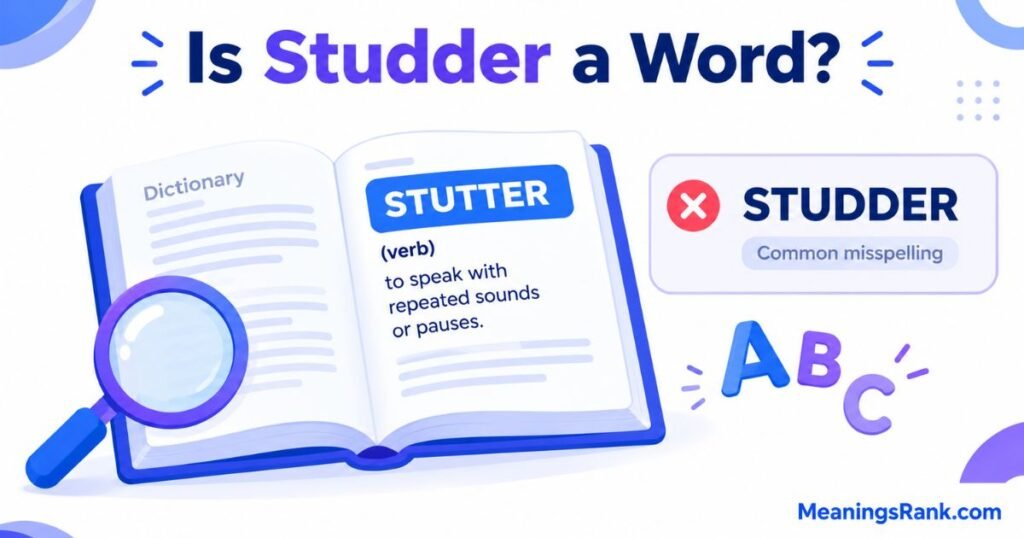
No. Major reference dictionaries, including Merriam-Webster, Oxford, Cambridge, and Collins, list stutter as the standard headword. “Studder” is not recorded as an accepted spelling or as a variant. Word processors flag it with a red underline for good reason.
There is one small caveat. “Studder” can appear as a rare surname, brand, or username. In those cases it is a proper noun with nothing to do with speech, and you should never “correct” someone’s name. As a common word meaning “to speak haltingly,” it simply does not exist.
If you see it in published writing, treat it as a typo or a phonetic guess. A reader familiar with style guide conventions will notice it right away.
Why Do People Confuse Studder vs Stutter?
Three things collide.
1. The American flap t:
In American English, a t between two vowel sounds, especially after a stressed vowel, becomes a quick tap of the tongue called a flap. It sounds very close to a d. That is why “butter” can sound like “budder” and “water” like “wader.” “Stutter” follows the same pattern, so many Americans really do say something close to STUH-der.
2. Spelling by ear:
When a word feels unfamiliar on paper, people write what they hear. Since the flap t sounds like d, “studder” feels natural.
3. Learning the word through speech:
People hear “stutter” in conversation, films, and interviews long before they see it written. Without much visual exposure, the correct spelling has little chance to stick.
None of this signals weak English. It is a predictable pattern in how the language works, and it is the same reason “ladder” and “latter” can sound alike in casual American speech.
Read More: Intention vs Intension: The Ultimate Guide to Meaning and Correct Usage
How to Spell Stutter Correctly
Break the word into three chunks:
S – T – U – T – T – E – R
- It starts with st-, like stop and start.
- The middle has a double t: tt.
- It ends in -er, the same suffix you see in butter and clutter.
English words that follow a “short vowel + double consonant + -er” pattern include butter, mutter, putter, flutter, clutter, shutter, and splutter. Each one doubles the consonant to keep the preceding vowel short. “Stutter” belongs to this family. “Studder” belongs to no family at all.
Quick spelling checklist:
- Does it start with st? Yes.
- Are there two ts in the middle? Yes.
- Does it end in -er? Yes.
- Is there a d anywhere? Never.
Stutter Pronunciation in American vs British English
The word is spelled the same on both sides of the Atlantic, but it does not sound identical.
| Feature | American English | British English |
| Common transcription | /ˈstʌtər/ | /ˈstʌtə/ |
| Middle consonant | Often a flap, close to a soft d | A clearer, crisper t |
| Final r | Pronounced | Usually silent (non-rhotic) |
| Rough sound-out | STUH-der | STUT-uh |
This difference explains why the d spelling creeps in more often among American writers. A British speaker who pronounces a crisp t has a stronger audio cue that the spelling needs a t.
One more detail: the stress falls on the first syllable in both varieties. It is STUT-er, not stut-ER.
Stutter Examples in Real Sentences
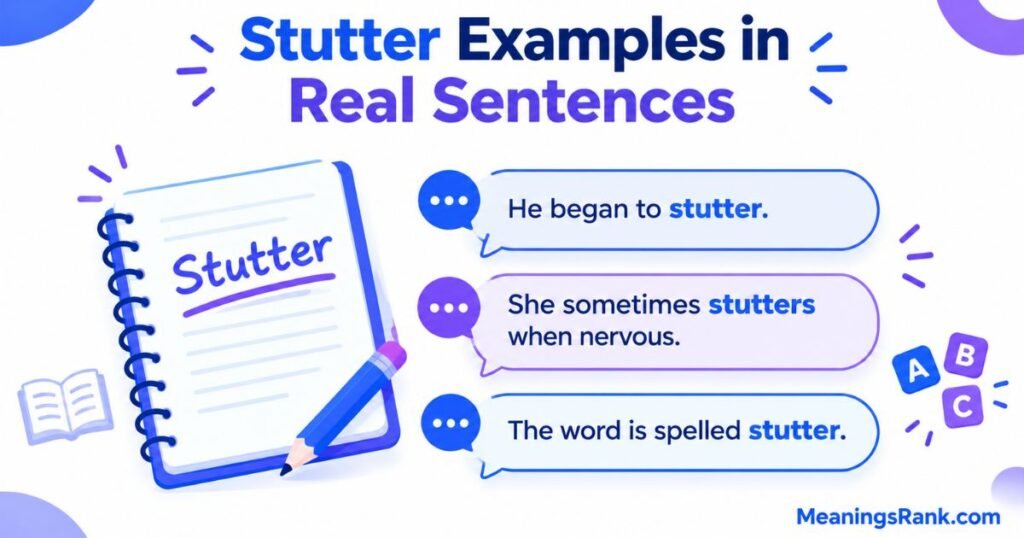
Seeing a word in context is the quickest way to lock in the spelling.
Describing speech:
- He used to stutter when he answered questions in front of the class.
- She stuttered over the first syllable but finished the sentence confidently.
- A mild stutter does not stop him from hosting the podcast.
Describing machines and movement:
- The engine began to stutter on cold mornings.
- The animation stutters whenever too many apps are open.
Formal vs. informal usage:
| Context | Sentence |
| Formal | Stuttering is classified as a childhood-onset fluency disorder. |
| Informal | I always stutter when I get nervous on calls. |
| Academic | The study measured how often participants stuttered during spontaneous speech tasks. |
| Journalism | The lawmaker stuttered through his response before regaining his footing. |
Correct vs. incorrect:
| Correct | Incorrect |
| He began to stutter when the lights came on. | He began to ~~studder~~ when the lights came on. |
| She stuttered through her toast. | She ~~studdered~~ through her toast. |
| His stutter improved with therapy. | His ~~studder~~ improved with therapy. |
| Stuttering affects about 1% of adults. | ~~Studdering~~ affects about 1% of adults. |
| A stutterer can still be a confident speaker. | A ~~studderer~~ can still be a confident speaker. |
Style note: when you write about people who stutter, use neutral, factual phrasing. “He stutters” or “she has a stutter” is fine. Avoid mockery, and use hyphenated dialogue like “I-I-I don’t know” sparingly in fiction.
Stutter Synonyms and Related Words
Synonyms help you vary your writing, but they differ in tone and precision.
| Word | Meaning and Notes |
| Stammer | The closest synonym, more common in British English. |
| Falter | To speak or move hesitantly, often from fear or doubt. |
| Hesitate | To pause before speaking or acting. |
| Splutter | To speak in a rush with spitting or choking sounds, often from anger. |
| Stumble | To trip over words (informal). |
| Halt | To pause or stop, as in “halting speech.” |
Related clinical terms:
fluency disorder, disfluency, repetition, prolongation, block, speech-language pathologist (SLP).
Be careful with substitution. “Falter” and “hesitate” describe moments of doubt or nerves, while stuttering is a neurodevelopmental speech pattern. Use “stutter” when you mean the speech condition, and the others when you mean ordinary hesitation. “Mumble” is sometimes mistaken for a synonym, but it means speaking unclearly and softly, which is a different thing entirely.
Stutter vs Stammer: What Is the Difference?
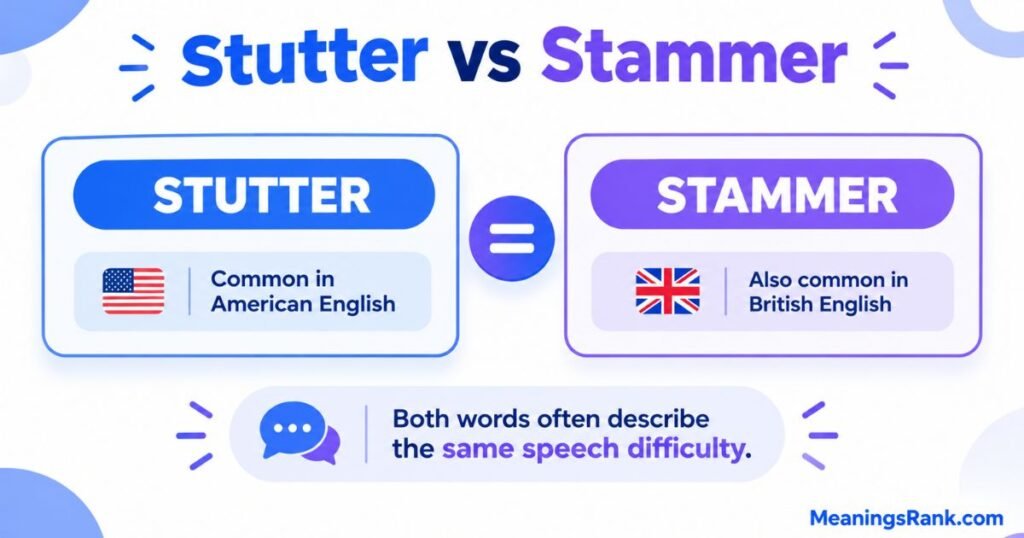
For most purposes, nothing. Both words describe the same pattern of disrupted speech flow. The difference is mostly regional.
| Feature | Stutter | Stammer |
| Meaning | Disrupted speech with repetitions, prolongations, blocks | Same |
| Most common in | United States, Canada | United Kingdom, Ireland, parts of the Commonwealth |
| Clinical usage | Used by U.S. organizations and clinicians | Used by U.K. organizations and the NHS |
| Spelling | S-T-U-T-T-E-R | S-T-A-M-M-E-R |
| Understood everywhere? | Yes | Yes |
Some people draw an informal line, saying “stammer” means getting stuck on a word and “stutter” means repeating sounds. Clinical definitions do not support that split. Choose the word that fits your audience and stay consistent within a piece of writing.
Common Writing Mistakes: Studder Instead of Stutter
The spelling trap appears in more forms than one.
| Mistake | Correction | Why It Happens |
| studder | stutter | Flap t sounds like d |
| studdering | stuttering | Same sound-based error in the -ing form |
| studdered | stuttered | Same error in the past tense |
| stuter | stutter | Missing the double t |
| stutterring | stuttering | Over-doubling the r |
| stuttter | stutter | Typing error with a triple t |
Edge cases worth knowing:
- Proper nouns. A surname or username spelled “Studder” is a name, not an error.
- Regional preference. “Stammer” is not a mistake, even if your audience mostly uses “stutter.”
- Style guides. Some prefer person-first language (“a person who stutters”), while many in the stuttering community also use “stutterer.” Follow your publication’s style guide or the preference of the person you are writing about.
Editing tip: search your document for “stud” to catch accidental “studder” spellings. Words like “student,” “studio,” and “study” will also appear, so check each hit.
Memory Trick to Remember the Correct Spelling
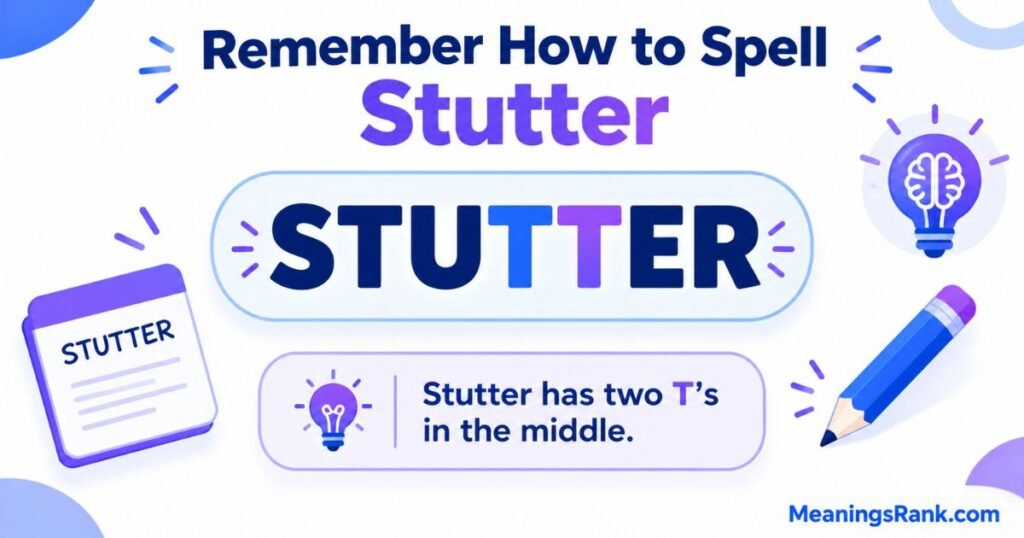
Three quick ways to lock it in:
1. The “t-t-t” trick:
When someone stutters, they often repeat the t sound: “t-t-t-table.” The word stutter hides that repetition inside its own spelling with two ts in a row. The double letter is the stutter.
2. The “Tap-Tap” rule:
Picture your tongue tapping the roof of your mouth twice for the tt. No d required.
3. The word family check:
Say “butter, mutter, flutter, stutter.” All end in -utter. If “butter” is not “budder,” then “stutter” is not “studder.”
If you remember only one, remember this: the double t is the stutter.
Practice Exercises: Studder vs Stutter
Fill in each blank with the correct word: stutter, stutters, stuttered, or stuttering. Write your answers down before checking the key.
- As a child, Maya used to __________ whenever she had to read aloud in class.
- The old truck __________ down the road before the engine finally gave out.
- Speech therapy helped him manage his __________ and speak with confidence.
- Researchers are studying the genetic links to __________ in young children.
- Which spelling is correct: “studder” or “__________”?
Bonus: spot the error. Rewrite this sentence correctly: “She studdered through the first line, but her studdering faded as she relaxed.”
Answer Key
- stutter (base verb after “used to”)
- stuttered (past tense, figurative use for an engine)
- stutter (noun)
- stuttering (gerund used as a noun)
- stutter
- Bonus: “She stuttered through the first line, but her stuttering faded as she relaxed.”
Score yourself: 5 out of 5 means you have this word locked down. 3 or 4 means you are close. Reread the memory trick and try again.
The Science Behind Stuttering
Now that the spelling is settled, it helps to understand what the word actually describes. Stuttering is a speech fluency disorder in which the normal flow of speech is interrupted. It is not a problem with intelligence, vocabulary, or knowing what to say.
Developmental stuttering usually begins in early childhood, often between ages two and five, as language grows rapidly. Research estimates that around 5% of children go through a period of stuttering, and a large majority recover, often by their teenage years. In adults, stuttering affects roughly 1% of the population, and it is more common in males than in females.
Many people who stutter also show secondary behaviors, such as eye blinking, facial tension, or avoiding certain words and situations. These are often learned responses to the struggle of speaking rather than part of the core condition.
Brain imaging research points to differences in how speech-motor networks coordinate timing, including regions such as the basal ganglia and the connections between auditory and motor areas. In plain terms, the brain’s “timing and sequencing” system for speech does not always fire smoothly. Many well-known public figures, including actors, singers, and politicians, have spoken openly about living with a stutter, which has helped shift public understanding.
Read More: Taught vs Tought: Discover the Correct Spelling, Meaning & Key Differences
What Causes Stuttering?
There is rarely a single cause. Current research points to a mix of factors.
- Genetics. Stuttering runs in families. A substantial share of people who stutter have a relative who does too, and researchers have identified several genes linked to it.
- Neurological differences. Variations in how brain regions for speech planning and timing communicate.
- Language and motor development. In young children, rapid language growth can outpace speech-motor control, which may trigger early stuttering.
- Family dynamics and temperament. These can influence how a child experiences stuttering, but they are not the cause.
- Rare acquired causes. Stroke, head injury, or certain medications can lead to neurogenic stuttering in adults. Intense psychological trauma can occasionally trigger psychogenic stuttering, though that is uncommon.
A myth worth clearing up: stuttering is not caused by nervousness, bad parenting, or low intelligence. Anxiety can make stuttering more noticeable in the moment, but it does not create the condition.
Can Stuttering Be Treated or Improved?
Stuttering has no universal cure, but effective support exists. The right approach depends on age and goals.
- Early intervention for children. A speech-language pathologist can evaluate a child and recommend therapy. Programs such as the Lidcombe Program, which involves parents in daily practice, have shown strong results for preschoolers.
- Fluency shaping. Techniques that teach slower, smoother speech through controlled breathing and gentle onsets of sound.
- Stuttering modification. Therapy that helps a person stutter more easily, with less tension and fear, rather than trying to eliminate stuttering altogether.
- Cognitive behavioral therapy (CBT). Helpful for the anxiety and avoidance that can build around speaking.
- Support communities. Groups for people who stutter can reduce isolation and build confidence.
- Technology. Some people use devices or apps that alter auditory feedback, though results vary.
Improvement does not always mean “no stuttering.” For many people, success means speaking freely and confidently, even when some stuttering remains. If a child has stuttered for more than several months, or shows tension or avoidance, a professional evaluation is a sensible next step.
Why Correct Spelling Matters
A single misspelling will not ruin an article, but it does chip away at trust.
- Credibility. Readers judge writing quality fast. A misspelled word can make a strong argument feel careless.
- Search visibility. Search engines handle common misspellings reasonably well, yet content that uses the standard spelling aligns better with how people search for and cite information.
- Respect for the topic. Stuttering is a real condition. Writing about it accurately shows awareness and care.
- Professional polish. In emails, resumes, essays, and exams, correct spelling reflects attention to detail.
Frequently Asked Questions (FAQs)
Is it studder or stutter?
It is stutter. “Studder” is a misspelling and is not recognized in standard dictionaries. The correct spelling has a double t in the middle and ends in -er.
Why do people spell stutter as “studder”?
Because of pronunciation. In American English, the middle t is often pronounced as a quick flap that sounds like a d. People write what they hear, which produces “studder.”
What is the difference between stutter and stammer?
There is no meaningful difference in meaning. Both describe disrupted speech with repetitions, prolongations, or blocks. “Stutter” is more common in the United States, while “stammer” is more common in the United Kingdom.
What does stutter mean in simple words?
To stutter means to speak with involuntary repeats, stretched sounds, or pauses that interrupt smooth speech. As a noun, a stutter is that speech pattern. The word is also used figuratively for any halting or jerky movement, like an engine that stutters.
Is stuttering caused by anxiety or nervousness?
No. Stuttering is linked mainly to genetics and differences in how the brain coordinates speech. Anxiety and stress can make it more noticeable in a given moment, but they do not cause the condition.
Can you stop stuttering?
Many children recover on their own or with early therapy. For adults, there is usually no complete cure, yet speech therapy, fluency techniques, and counseling can greatly improve fluency and confidence. A licensed speech-language pathologist can recommend the right approach.
Conclusion
Stutter is the only correct spelling, and “studder” is a phonetic mistake with no place in standard English. The confusion comes from the American flap t, which makes the middle of the word sound like a d. Remember the double t, picture the repeated “t-t-t” sound, and compare it with the -utter family: butter, mutter, flutter. Use “stutter” for the speech pattern and for jerky motion, and choose “stammer” when your audience leans British. Beyond spelling, treat the topic with accuracy and respect, since stuttering is a real, well-studied fluency condition that affects millions of people. Get the small details right, and your writing will read as careful, credible, and polished every time.