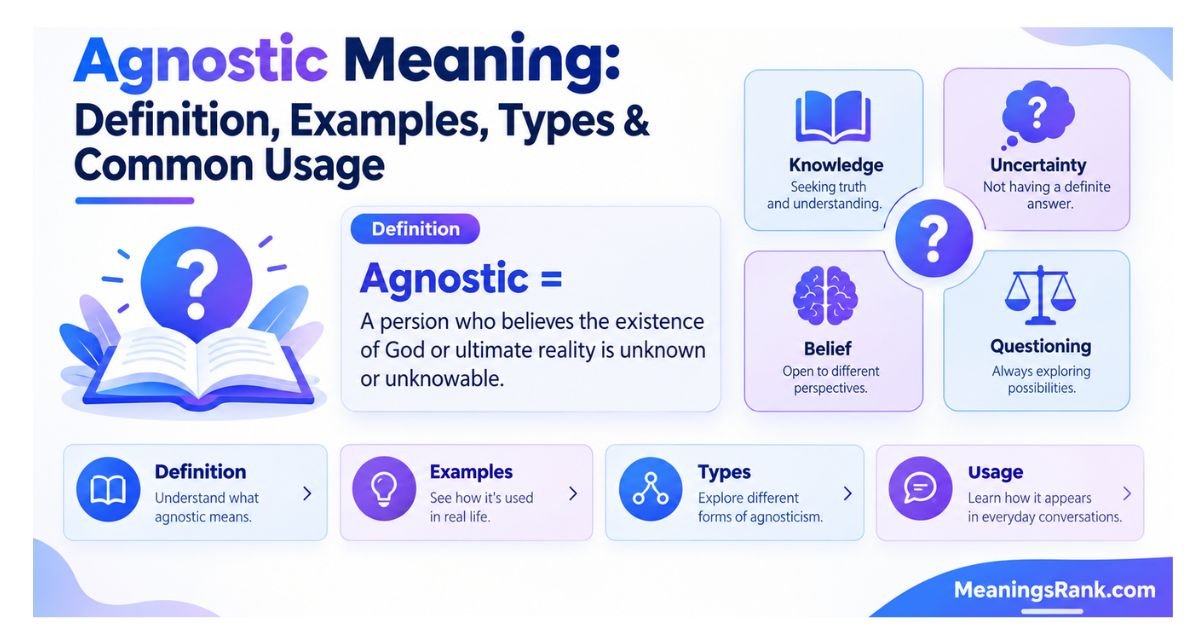

Agnostic meaning is simple at its core: someone who says “I don’t know” about something that can’t be proven. Most people link the word to religion, where it describes a person who isn’t sure whether a god exists. But you’ll also see it in group chats, tech talk, gaming servers, and even food debates.
Maybe a friend texted “I’m agnostic about it” and you didn’t want to ask what they meant. Maybe you saw “platform-agnostic” in a job post. Either way, you’re in the right place.
This guide explains the word in plain English. You’ll get the definition, the different types, real chat examples, reply ideas, common mistakes, and the origin of the word. By the end, you’ll know exactly how to read it and use it.
What Does Agnostic Mean?
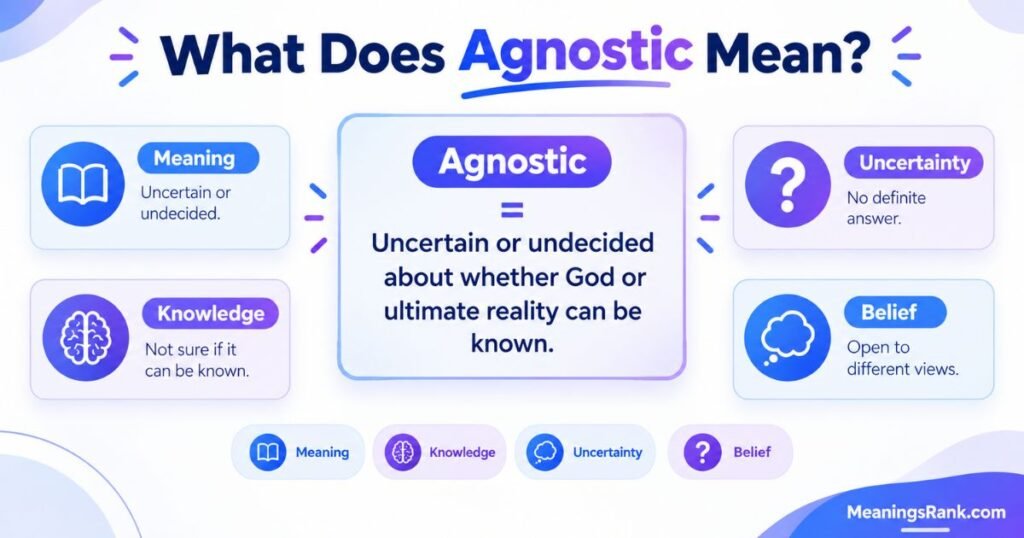
Agnostic means “not knowing.” In everyday use, an agnostic person believes that some big questions, like whether a god exists, can’t be answered with the facts we have. They don’t say yes. They don’t say no. They say, “I’m not sure, and maybe no one can be.”
Here’s the quick version you can remember:
- Short definition: Someone who doesn’t claim to know if a god exists.
- Wider definition: Someone who holds back judgment when there isn’t enough proof.
- Tech definition: Something that works with many systems, not just one.
Quick Answer for Voice Search
If you asked your phone “what does agnostic mean,” here’s the answer: agnostic describes a person who believes it’s impossible to know whether God exists, or who simply isn’t sure. It can also describe a product or tool that works on any platform.
The Main Agnostic Meaning
The main agnostic meaning is about knowledge, not belief. That’s the part most people miss.
Think of it like this. Belief asks, “Do you think a god exists?” Knowledge asks, “Can anyone actually prove it?” An agnostic answers the second question with “No, I don’t think we can be sure.”
Breaking Down the Word
The word comes from two Greek parts:
- a- meaning “without”
- gnosis meaning “knowledge”
Put them together and you get “without knowledge.” That’s why the word fits any situation where someone admits they don’t have the full picture.
A Simple Example
Imagine two friends talking about life after death.
Friend A: “I’m sure there’s something after we die.” Friend B: “I’m sure there’s nothing.” Friend C: “Honestly? I don’t think anyone can know.”
Friend C is the agnostic. Not because they’re confused, but because they won’t claim certainty either way.
Also Read: What Does IGZ Mean in Text? The Complete Guide to Its Meaning, Origin & Examples
Agnostic Beliefs and What They Mean
People often ask, “What do agnostics actually believe?” The honest answer is that there’s no single rulebook. Agnosticism isn’t a religion. It’s a position on what we can know.
Core Ideas Many Agnostics Share
- Certainty is hard. Big questions about existence may be beyond human proof.
- Evidence matters. Many agnostics wait for solid proof before choosing a side.
- Doubt is fine. Being unsure isn’t a weakness. It’s an honest answer.
- Respect for others. Many agnostics are comfortable with religious and non-religious friends alike.
Do Agnostics Pray or Go to Religious Places?
Some do. A person can be agnostic and still enjoy church music, join family prayers, or practice meditation. Others skip all of it. Agnosticism describes what you claim to know, not what you do on weekends.
Agnostic Does Not Mean Lost
Some people think agnostics are “searching” or “undecided” in a bad way. That’s not always true. Plenty of agnostics feel settled in their view. They’re simply at peace with not having the answer.
Types of Agnosticism
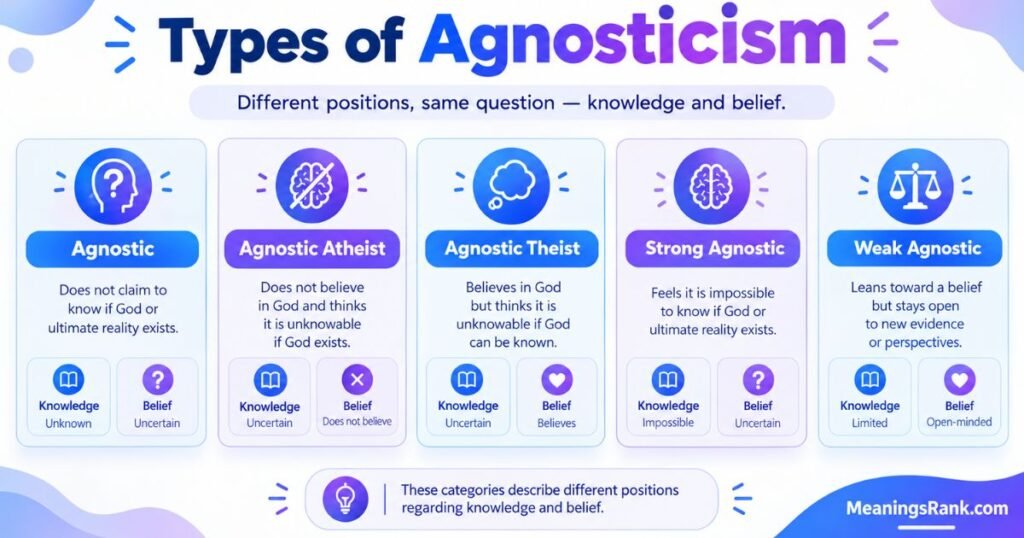
Not every agnostic thinks the same way. Writers and philosophers describe several types. Here’s an easy breakdown.
Strong Agnosticism
A strong agnostic says, “No one can know whether a god exists. It’s impossible.” They believe the question is unanswerable for everyone, now and forever.
Weak Agnosticism
A weak agnostic says, “I don’t know, but maybe someone could find out one day.” They leave the door open. It’s a personal “not sure” rather than a claim about all humans.
Agnostic Theism
This person believes in a god but admits they can’t prove it. Example: “I believe, but I can’t claim I know.”
Agnostic Atheism
This person doesn’t believe in a god but also admits they can’t prove none exists. Example: “I don’t believe, but I can’t say I know.”
Apatheism
An apatheist doesn’t really care. “Maybe there’s a god, maybe not. It doesn’t change my day.”
Quick Comparison Table
| Type | What They Say | Key Idea |
| Strong agnostic | “Nobody can ever know.” | Knowledge is impossible |
| Weak agnostic | “I don’t know yet.” | Knowledge may be possible |
| Agnostic theist | “I believe, but can’t prove it.” | Belief without certainty |
| Agnostic atheist | “I don’t believe, but can’t prove it.” | No belief, no certainty |
| Apatheist | “I don’t really care.” | Question feels unimportant |
What Does Agnostic Mean in Text?
In texting and social media, agnostic usually shows up in one of three ways.
1. As a Belief Label
Someone says it about themselves in a bio, a chat, or a debate.
- “Agnostic 🤷” in an Instagram bio
- “I grew up religious but now I’m agnostic” in a WhatsApp message
2. As a Casual “I Don’t Mind” Phrase
People stretch the word jokingly to mean “I have no strong opinion.”
- “I’m agnostic about pineapple on pizza.”
- “Honestly agnostic on which movie we watch.”
3. As a Tech Word
In work chats and developer servers, it means “works with anything.”
- “Is this app platform-agnostic?”
- “We need a device-agnostic design.”
The tone is usually calm and neutral. It’s not slang like “bet” or “no cap,” but it’s common enough in online talk that people look it up often.
Agnostic vs. Atheist
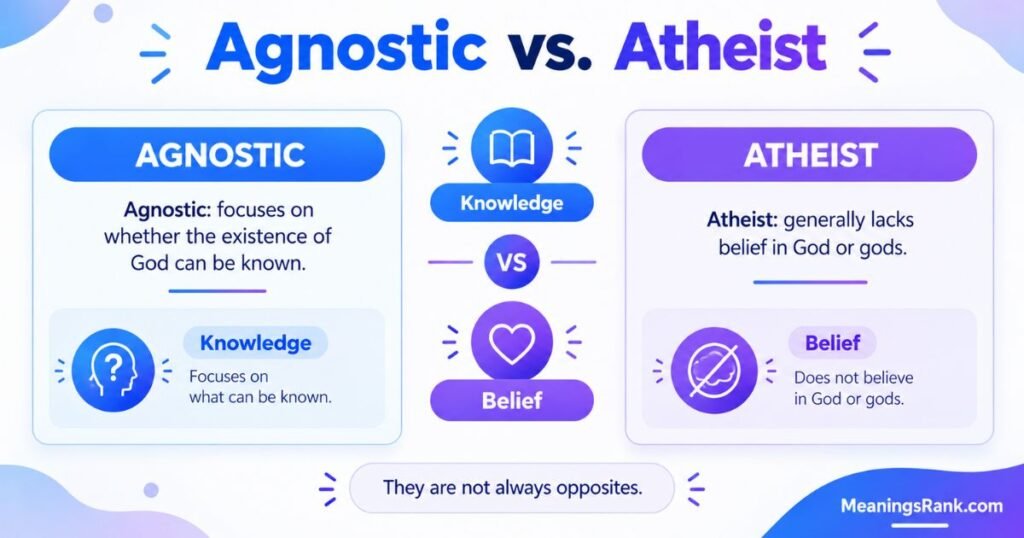
This is the question people search most. The two words sound close but answer different questions.
- Atheist is about belief. An atheist doesn’t believe in any god.
- Agnostic is about knowledge. An agnostic says the answer can’t be known for sure.
That’s why a person can be both. Many people call themselves “agnostic atheists,” meaning they don’t believe in a god, but they also don’t claim to know for certain.
Side-by-Side Table
| Feature | Agnostic | Atheist |
| Main focus | What we can know | What we believe |
| Typical statement | “I’m not sure anyone can know.” | “I don’t believe in a god.” |
| Claims certainty? | No | Sometimes, sometimes not |
| Can overlap? | Yes | Yes |
| Religion? | Not a religion | Not a religion |
A Handy Memory Trick
Atheist = “I don’t believe.” Agnostic = “I can’t be sure.”
How Context Changes the Agnostic Meaning
Words shift with the room you’re in. Agnostic is a good example.
- In a religion talk, it means unsure about God.
- In a tech meeting, it means “works with any system.”
- In a casual chat, it can mean “I don’t care either way.”
- In a science talk, it can mean “I’m not taking a side without proof.”
Also Read: Green FN Meaning: The Ultimate Guide to What It Means, Uses & Alternatives (2026)
Clues to Read the Meaning
Look at the words around it:
- Near words like God, faith, church, belief → religious meaning
- Near words like platform, cloud, device, software → tech meaning
- Near food, movies, or plans → casual “no preference” meaning
If you’re unsure, ask. A quick “Do you mean religion or just in general?” clears it up without any awkwardness.
Agnostic in Different Contexts
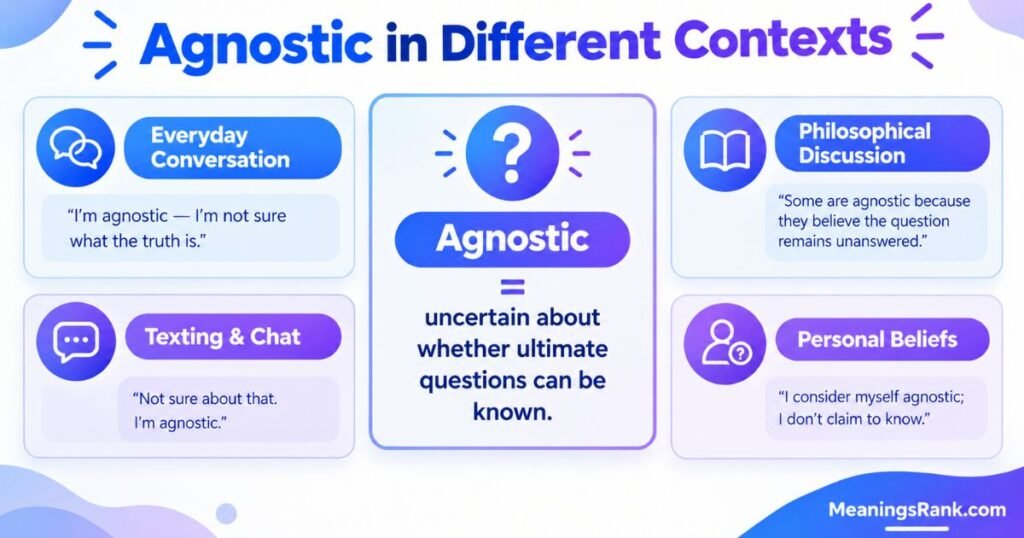
Here’s how the word shows up across daily life.
Religion and Philosophy
The classic use. “I’m agnostic” tells people you don’t claim to know whether a higher power exists.
Technology and Business
You’ll see compounds like:
- Platform-agnostic: works on Windows, Mac, Android, and more
- Cloud-agnostic: not tied to one cloud provider
- Device-agnostic: works on phones, tablets, and laptops
- Vendor-agnostic: not locked to one company
Gaming and Discord
Gamers use it lightly. “I’m class-agnostic, I’ll play whatever the team needs.” Here it means flexible and not tied to one choice. Cross-platform games are sometimes described as “platform-agnostic” too.
Gender and Identity
You may also see gender-agnostic, meaning something that isn’t tied to one gender, like a gender-agnostic perfume or clothing line. A related label, agender, is different and describes identity.
Everyday Opinions
“I’m agnostic about coffee versus tea” just means you’re fine with both.
Real Conversation Examples
Seeing the word in action helps. Here are realistic examples from different apps.
WhatsApp (Family Chat)
Aunt: Are you coming to the prayer gathering Sunday?
You: I’m agnostic, but I’ll come for the family time 😊
Aunt: That works. We’d love to see you.
Instagram DM
Friend: Wait, are you religious?
You: Not really. More agnostic. I just don’t think anyone can know for sure.
Friend: Fair. I never thought about it like that.
Snapchat
Her: do you believe in all this astrology stuff
You: kinda agnostic lol. not sold, not against it
TikTok Comments
Comment: As an agnostic, I respect both sides.
Reply: Same. Staying open-minded is underrated.
Discord (Tech Server)
Dev: Should we build this for iOS only?
Lead: Let’s keep it platform-agnostic. Web app first.
Gaming Chat
Teammate: You want tank or healer?
You: I’m role-agnostic tonight. Pick for me.
Workplace Slack
Manager: Do you prefer morning or afternoon for the call?
You: I’m agnostic on timing. Whatever suits the team.
Quick Tone Check
| Message | Likely Meaning |
| “I’m agnostic.” | Not sure about God |
| “Agnostic about the plan.” | No strong preference |
| “Cloud-agnostic tool.” | Works with any cloud |
Is Agnostic Rude?
No, the word itself is not rude. It’s a neutral, respectful label. It simply says, “I don’t claim to know.”
That said, tone matters. Compare these:
- Polite: “I’m agnostic, but I enjoy hearing about your faith.”
- Dismissive: “I’m agnostic, so I think your beliefs are pointless.”
The second one is rude, but not because of the word. It’s because of what follows.
Why Some People React Badly
Religion can be a sensitive topic. A devout relative might hear “I’m agnostic” as rejection, even if you didn’t mean it that way. Some atheists also dislike the word, feeling it sits on the fence. These reactions come from the listener’s feelings, not from the word’s meaning.
Tip
Add a short, warm line. “I’m agnostic, but I respect your beliefs” keeps things friendly.
Is Agnostic Flirty?
No. Agnostic has no flirty meaning in slang or texting. It isn’t a pickup word, a hint, or a code for interest.
Where the Confusion Might Come From
Sometimes people use it in dating chats when talking about worldviews:
- “I’m agnostic. Is that okay with you?”
- “Are you religious? I’m more agnostic.”
That’s a values conversation, not flirting. On dating apps, it’s often a way to share beliefs early so both people know where they stand.
Dating Tip
If someone says it to you on a date, treat it like any other honest answer. Ask a curious question like “What made you feel that way?” Keep it respectful and relaxed.
Also Read: What Is a Fascist? The Ultimate Guide to the Meaning, Beliefs & Examples
How to Reply to Agnostic
Your reply depends on who’s talking and why they said it.
Friendly and Curious
- “Interesting! How did you land on that?”
- “That makes sense. I’m still figuring mine out.”
Respectful and Neutral
- “Thanks for sharing. I appreciate the honesty.”
- “Cool. Everyone has their own path.”
If You Disagree (Politely)
- “I see it differently, but I like hearing your view.”
- “I believe, but I get where you’re coming from.”
If It’s a Tech or Work Message
- “Great, let’s keep it platform-agnostic then.”
- “Got it. I’ll make sure it works across systems.”
If It’s Casual
- “Ha, same. Let’s just flip a coin.”
What Not to Say
Avoid replies like “You’ll change your mind” or “That’s just a phase.” They sound pushy and can end a good conversation fast.
When to Use the Term
Use agnostic when it describes your position honestly and clearly.
Good Times to Use It
- Describing your beliefs: “I’m agnostic. I don’t think we can know.”
- Explaining a no-preference stance: “I’m agnostic about restaurants, you pick.”
- Writing about tech: “Our tool is cloud-agnostic.”
- Discussing a debate: “I’m agnostic on that issue until I see more evidence.”
- Filling out a profile or form: Where a belief label is requested.
Practical Tips
- Be clear about context. Say “religiously agnostic” if there’s any chance of confusion.
- Keep your tone calm. The word works best when it sounds open, not defensive.
- Explain if asked. One short sentence is enough: “It means I’m not sure it can be known.”
When to Avoid the Term
Sometimes another word works better.
Skip It When
- You actually do hold a firm belief. If you’re sure there’s no god, “atheist” fits better. If you’re sure there is one, use the word that matches your faith.
- You don’t know your audience. In a strict religious setting, the word may spark a heavy debate you don’t want.
- You mean “I don’t care.” Say “I don’t mind” or “I’m easy.” It’s clearer, and it avoids mixing religion into small talk.
- You’re just trying to sound smart. Overusing technical words can make messages feel stiff.
- You’re in a rushed work chat. “Works on any platform” may be faster than “platform-agnostic” for someone new to the field.
Quick Rule
If a simpler word says the same thing, use the simpler word.
Common Mistakes About Agnostic
Many people use or understand the word the wrong way. Here are the most common slip-ups.
Mistake 1: “Agnostic Means Atheist”
Not quite. Atheism is about belief. Agnosticism is about knowledge. They can overlap but aren’t the same.
Mistake 2: “Agnostics Can’t Decide”
Some are undecided, but many have thought hard and settled on “it can’t be known.” That’s a position, not confusion.
Mistake 3: “Agnostic Is a Religion”
It isn’t. There’s no church, book, or leader. It’s a view about knowledge.
Mistake 4: “Agnostics Hate Religion”
False. Many agnostics respect faith, attend religious events, or come from religious families.
Mistake 5: “It Only Means Religion”
The word also appears in tech, design, and everyday chat. “Platform-agnostic” has nothing to do with God.
Mistake 6: Mixing It Up With “Agnostic Atheist” Jokes
Some people throw the term around to sound edgy. It works better when you use it carefully and mean it.
Similar Terms to Agnostic
These words sit close to agnostic. Knowing the differences helps you pick the right one.
| Term | Meaning | How It Differs |
| Atheist | Doesn’t believe in a god | About belief, not knowledge |
| Theist | Believes in a god | Opposite of atheist |
| Skeptic | Questions claims until proven | Wider than religion |
| Apatheist | Doesn’t care about the question | Focus is on interest |
| Freethinker | Forms views using reason | Not tied to one answer |
| Humanist | Focuses on human values | A life outlook, not just belief |
| Non-religious | Not part of any religion | Doesn’t say what they believe |
| Undecided | Hasn’t chosen yet | Often temporary |
Tech-Side Cousins
- Neutral: takes no side
- Universal: works everywhere
- Cross-platform: runs on many systems
- Flexible: adapts easily
Origin and Usage
The word has a clear and interesting history.
Who Created the Word?
English biologist Thomas Henry Huxley coined “agnostic” in 1869. He was a strong supporter of Charles Darwin’s ideas and wanted a word for his own position. He felt that claims about the unknowable should not be treated as fact without evidence.
Why He Chose It
Huxley built the word from the Greek a- (“without”) and gnosis (“knowledge”). Some writers also link his choice to an old Christian idea called Gnosticism, which claimed special spiritual knowledge. Huxley’s word was meant to be the opposite: honest about what we don’t know.
How the Meaning Grew
For many years, the word stayed in religion and philosophy. Later, tech writers borrowed it to mean “not tied to one thing.” That’s how we got platform-agnostic and similar terms. Today, social media has made it even more flexible, so you’ll see it in bios, memes, and casual jokes.
Where You’ll See It Today
- Religion and philosophy discussions
- Software and IT writing
- Product design and marketing
- Social media bios and comments
- Everyday talk about preferences
Quick Recap
- Agnostic means “not knowing,” usually about whether a god exists.
- It’s about knowledge, while atheist is about belief.
- There are several types: strong, weak, agnostic theist, agnostic atheist, and apatheist.
- In tech, it means “works with many systems.”
- In casual chat, it can mean “I have no strong preference.”
- It’s not rude and not flirty by itself.
- Reply with curiosity and respect.
- Use simpler words when they fit better.
- The word was coined by Thomas Henry Huxley in 1869.
Frequently Asked Questions
What does agnostic mean in simple words?
It means not being sure something can be known, especially about God.
Is agnostic the same as atheist?
No. Atheists lack belief in God, while agnostics question certainty.
Can someone be agnostic and still religious?
Yes. Some believers admit they can’t fully prove their faith.
What does agnostic mean in tech?
It describes software or tools that work across many systems.
Does agnostic mean undecided or confused about beliefs?
Not always. Many agnostics feel settled that certainty isn’t possible.
Who invented the word agnostic?
Biologist Thomas Henry Huxley created the word in 1869.
Final Thoughts
Agnostic meaning comes down to honesty about what we can and can’t know. In religion, it describes someone who won’t claim certainty about God. In tech, it means something flexible that isn’t locked to one system. In daily chats, it can simply mean “I’m easy either way.”
The word isn’t rude, and it isn’t flirty. It’s a calm, neutral way to say where you stand. The way you use it matters most. A warm tone and a bit of curiosity go a long way, especially when talking with people who see things differently.
Remember the key difference: atheist is about belief, agnostic is about knowledge. Keep that in mind and you’ll rarely get the two mixed up. Whether you saw the word in a text, a bio, or a job post, you now know how to read it, reply to it, and use it with confidence.
Next time someone says “I’m agnostic,” you’ll understand what they mean and how to respond.