
You may have seen the word elegy in a poetry class, a movie review, or even an Instagram caption about a lost friend. So what does it really mean? The elegy meaning is simple at its core: it is a serious poem or piece of writing that mourns someone who has died. But the word has grown over time. Today people also use it for songs, essays, and sad reflections on things that are gone, like an old neighborhood or a favorite game server.
In this guide, you will learn the exact definition, the main features, the different types, famous examples, and how to use the word the right way in real life. By the end, you will spot an elegy easily and use the word with confidence.
What Does Elegy Mean?
An elegy is a piece of writing that expresses sorrow, usually for a person who has died. Most of the time, it is a poem. It looks back at a life, honors it, and tries to make sense of the loss.
Simple Definition
Elegy (noun): A thoughtful poem or piece of writing that mourns the death of a person, or sadly reflects on something lost.
Think of it as a “sad poem with a purpose.” It does not just say “I am sad.” It reflects, remembers, and often finds some comfort at the end.
How to Pronounce Elegy
Say it EL-uh-jee, with the stress on the first syllable. The adjective elegiac is el-uh-JY-ik.
Word Forms
- Elegy: noun (one elegy)
- Elegies: plural noun
- Elegiac: adjective, describing a sad, reflective mood
- Elegist: a person who writes elegies
Also Read: FN Meaning in Slang: The Ultimate Guide to Its Definition, Origin & Usage (2026)
The Main Elegy Meaning in Literature
In literature, the main elegy meaning is a poem of mourning and reflection. Poets write elegies to remember the dead, express grief, and slowly move toward acceptance. It is one of the oldest forms of poetry.
Elegy as a Poem of Mourning
A poet loses a parent, a friend, a teacher, or a hero, and the poem becomes a place to hold that pain. It is not about facts. It is about feeling, written in a calm, serious voice.
The Three-Part Emotional Journey
Many traditional elegies follow a loose pattern that mirrors how grief works:
- Lament: Shock and sorrow. This is the “I can’t believe they’re gone” part.
- Praise: The speaker honors the person and remembers what made them special.
- Consolation: The speaker finds some comfort or peace.
Not every elegy uses all three steps, but the pattern explains why elegies feel like they are going somewhere.
Elegy in Other Art Forms
The same mood shows up in music, film, and prose. Composers have written instrumental pieces called elegies. Writers have written elegiac memoirs. Here, the word means a quiet, sad farewell.
Key Features of an Elegy
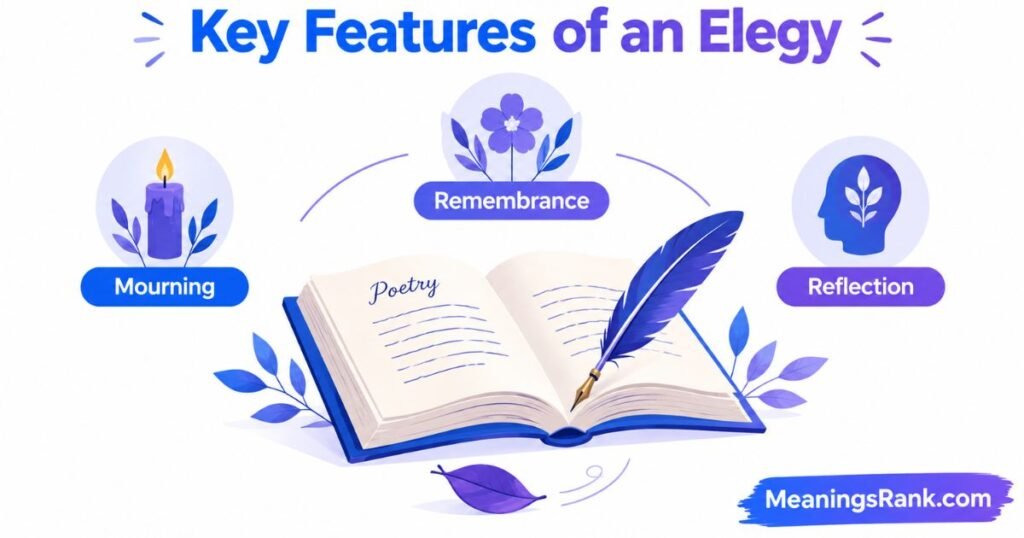
Not every sad poem is an elegy. A true elegy has a few signs.
A Reflective, Serious Tone
Elegies are slow and thoughtful. There is very little rush or humor.
A Clear Focus on Loss
Every elegy centers on something that is gone: a person, a place, or a time in life.
Praise for What Was Lost
An elegy does more than cry. It celebrates. The speaker remembers what made the person kind, funny, or brave.
A Movement Toward Acceptance
Many elegies start in pain and end in a calmer place. Some modern ones refuse easy comfort and end with open grief, which is also valid.
Imagery and Symbols
Elegies lean on images that connect to loss and renewal:
- Flowers, seasons, and fading light
- Water, rivers, and the sea
- Graves, stones, and quiet places
- Empty chairs, old letters, and familiar objects
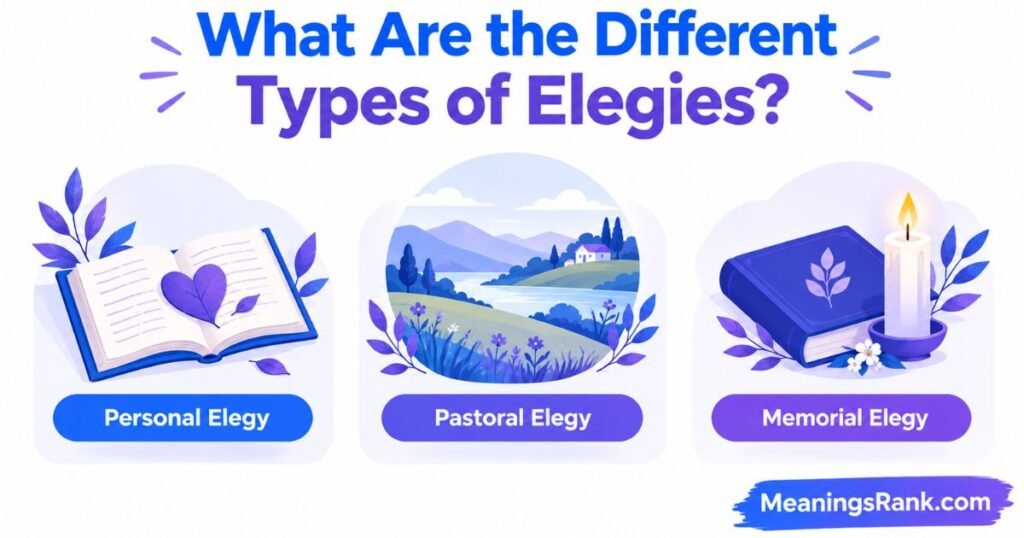
What Are the Different Types of Elegies?
Personal Elegy
The most common type. A poet writes about someone they loved, such as a parent or friend. It feels private and honest.
Pastoral Elegy
The poet and the dead person are pictured as shepherds in the countryside, and nature itself mourns. It sounds old-fashioned, but it has been a major tradition for centuries.
Public or Political Elegy
A poet mourns a leader, a soldier, or the victims of a tragedy. These elegies speak for a whole community.
Elegy for Places, Ideas, and Eras
Modern writers write elegies for lost homelands, disappearing languages, or a vanished way of life. No single person has to die.
Classical Elegiac Verse
In ancient Greece and Rome, “elegy” meant a poem in a specific rhythm, the elegiac couplet. These poems could be about love or war, not only death.
| Type | Main Focus | Typical Mood |
| Personal elegy | A loved one who died | Intimate, tender |
| Pastoral elegy | A friend, shown in nature | Graceful, symbolic |
| Public elegy | A leader or group | Solemn, shared |
| Place or era elegy | Something that faded | Nostalgic, wistful |
| Classical elegiac verse | Varied topics | Reflective |
How Context Changes the Elegy Meaning
In a Poetry or English Class
Here, elegy has its strict meaning: a formal poem of mourning with grief, praise, and closing comfort.
In Music and Film
Critics call a movie “an elegy” when it feels like a slow, sad goodbye. A western about the end of the cowboy era might be an elegy to the old frontier. No one has to die in the story.
In News and Essays
A writer might call a column “an elegy for local newspapers.” They mean it mourns something that is disappearing.
In Texts and Social Media
Online, people rarely say “elegy” in casual chat. When they do, it sounds poetic and heartfelt, not like a joke.
Also Read: Demisexual Meaning: The Ultimate Guide to Its Definition, Signs & Usage
Famous Examples of Elegies
These are described in my own words, so you can find the full poems from trusted sources.
“Elegy Written in a Country Churchyard” by Thomas Gray
Published in 1751, this poem follows a speaker through a quiet village graveyard. He thinks about ordinary people who lived and died without fame.
“When Lilacs Last in the Dooryard Bloom’d” by Walt Whitman
Written after the death of Abraham Lincoln, it uses lilacs, a star, and a bird’s song to express national grief. It is a classic public elegy.
“Lycidas” by John Milton and “Adonais” by Percy Bysshe Shelley
Both are pastoral elegies. Milton mourned a college friend. Shelley mourned the poet John Keats.
“In Memoriam A.H.H.” by Alfred, Lord Tennyson
Tennyson wrote this long poem after his close friend Arthur Hallam died suddenly. It follows the uneven path of grief, including doubt and hope.
Modern Examples
- “Duino Elegies” by Rainer Maria Rilke: Poems about life, death, and being human.
- “Elegy for Jane” by Theodore Roethke: A tender poem about a young student who died.
Real-World Examples of the Word Elegy
Text Messages and WhatsApp
- “I wrote a little elegy for Grandma last night. Want to hear it?”
- “Your dad’s speech was more of an elegy. Beautiful.”
Instagram and Snapchat
- “An elegy for the summer we never wanted to end.”
- “Posting this elegy for my old school. Gone but not forgotten.”
TikTok
A creator posts slow footage of an empty childhood home with the caption “An elegy for the house I grew up in.” Here, elegy meaning a nostalgic, emotional tribute.
Discord and Gaming
- “This patch is an elegy for the old meta.”
- “Server’s shutting down. Writing an elegy in #general.”
Gamers use the word half-seriously, with a fond and slightly dramatic tone.
Workplace Chats
- “The founder’s farewell email read like an elegy for the old office.”
At work, the word describes a heartfelt, reflective goodbye. Use it carefully, since it carries weight.
The Tone and Emotional Meaning of Elegy
The Emotional Layers
An elegy is not just “sad.” It mixes:
- Grief: the raw pain of loss
- Love: deep respect for what was lost
- Memory: a wish to hold on to details
- Acceptance: a slow step toward peace
This mix is why elegies feel comforting even though they are sad.
What “Elegiac” Means in Everyday Talk
Calling a photo, song, or mood elegiac means it feels wistful, like a gentle goodbye. A foggy evening at the beach or an empty school hallway can feel elegiac.
How to Recognize an Elegy
Quick Checklist
Ask if the piece:
- Mourns a death or a major loss
- Speaks in a serious, thoughtful voice
- Praises or remembers the person or thing
- Moves from sorrow toward some understanding
- Uses images like nature, graves, light, or seasons
If most answers are yes, it is probably an elegy.
Helpful Questions to Ask
- Who or what is being mourned?
- Does the speaker only complain, or also remember and reflect?
- Does the ending feel calmer than the beginning?
A piece with only anger or despair is more likely a lament.
When to Use the Word Elegy
In Writing and School Work
Use it when you analyze poems, write essays, or review books and films.
When Describing Tribute Pieces
Call something an elegy when it honors a loss seriously, such as a song written after a musician’s death or a documentary about a closed factory town.
Good Everyday Uses
- “She wrote an elegy for her grandfather.”
- “That song feels like an elegy for my teenage years.”
Also Read: What Does 🥰 Meaning From a Girl in Text?Meaning, Signs & Replies (2026)
When to Avoid the Word Elegy
Light or Joking Situations
“An elegy for my lunch” can be funny among friends, but it can sound careless around people who are grieving.
Happy or Celebratory Pieces
A cheerful birthday toast is not an elegy. Elegies are rooted in loss.
When You Mean a Funeral Speech
For a speech read aloud at a funeral, the better word is usually eulogy.
With Someone Freshly Grieving
In a message to a grieving friend, plain, warm words work better. Calling their loss “an elegy” may feel too literary.
Common Mistakes About Elegy
Mistake 1: Confusing Elegy With Eulogy
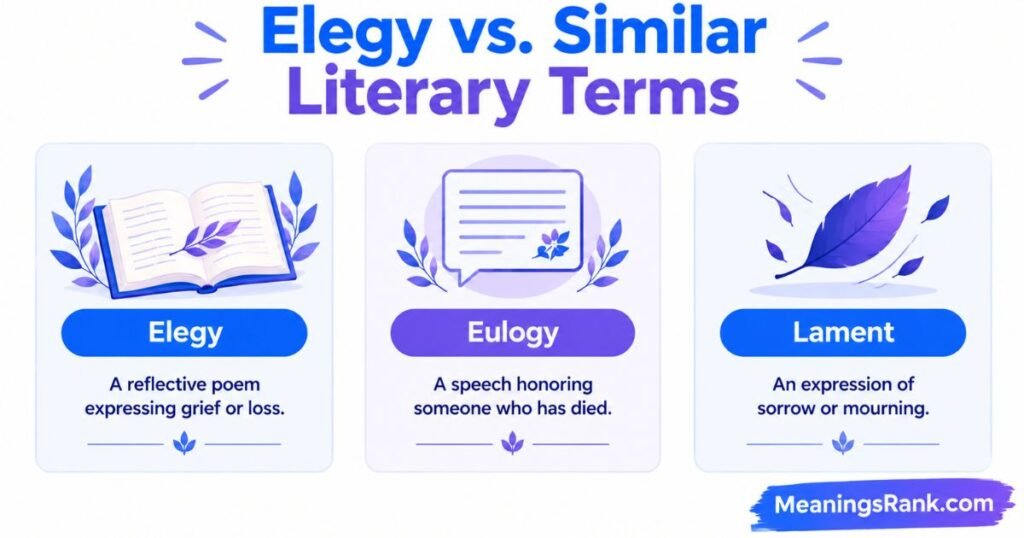
A eulogy is a speech praising someone, usually at a funeral. An elegy is a poem or written reflection on loss.
Mistake 2: Thinking Every Sad Poem Is an Elegy
A poem about heartbreak is not automatically an elegy. A true elegy mourns a loss and reflects on it.
Mistake 3: Believing Elegies Must Rhyme
Many famous modern elegies use free verse with no rhyme.
Mistake 4: Saying It Is Only About Death
Death is the main subject, but writers also use elegies for lost places and eras.
Mistake 5: Spelling and Pronunciation Slips
People sometimes write “eligy” or say “e-LEE-jee.” The correct form is elegy, said EL-uh-jee.
Elegy vs. Similar Literary Terms
| Term | What It Is | Form | Main Purpose |
| Elegy | Reflection on a loss | Poem or writing | Grieve, remember, find comfort |
| Eulogy | Speech praising someone who died | Spoken | Honor the person publicly |
| Epitaph | Short grave inscription | A few lines | Sum up a life |
| Ode | Poem praising something | Poem | Celebrate or admire |
| Lament | Passionate cry of grief | Poem or song | Express raw sorrow |
| Dirge | Slow funeral song | Song | Accompany mourning |
| Requiem | Musical work for the dead | Music | Honor the dead |
Elegy vs. Eulogy
You hear a eulogy at a funeral, and you often read an elegy afterward. A eulogy is public and praising. An elegy is more private and reflective.
Elegy vs. Lament
A lament is mostly an outpouring of grief. An elegy adds remembering, praise, and a search for meaning.
Elegy vs. Ode
An ode celebrates. An elegy mourns. Some poems blend both, but mood is the easiest clue.
Origin and Literary Tradition of Elegy
Greek Roots
The word comes from the Greek elegeia, linked to elegos, a song of mourning. At first, Greek elegies were defined by their rhythm and covered many themes. Over time, the link to mourning became the main meaning.
Roman Elegists
Poets like Catullus, Propertius, Tibullus, and Ovid wrote elegies, though many were about love rather than death.
The English Tradition
Pastoral elegies by Milton and Shelley became famous. In the 1700s, Gray’s churchyard poem made the elegy a symbol of quiet reflection. Old English poems like “The Wanderer” and “The Seafarer” are also called elegies because they mourn lost homes and companions.
Modern and Contemporary Elegies
Today’s poets mourn victims of war, illness, or injustice, and the loss of cultures. Many refuse neat comfort, which makes them feel real.
Why Is Elegy Important in Literature?
It Gives Grief a Shape
Grief feels messy and endless. An elegy gives those feelings a beginning, middle, and end, which can be healing.
It Keeps Memory Alive
Long after someone is gone, the poem still carries their name and story.
It Connects Readers Across Time
You can read a poem written centuries ago and feel what the poet felt. Loss is a shared human thread.
Quick Recap
- Elegy meaning: A serious poem or writing that mourns a loss, usually a death.
- Pronunciation: EL-uh-jee. Elegiac is el-uh-JY-ik.
- Key features: Reflective tone, loss, praise, and movement toward acceptance.
- Main types: Personal, pastoral, public, place or era, and classical.
- Famous examples: Gray, Whitman, Milton, Shelley, and Tennyson.
- Not the same as: Eulogy, epitaph, ode, or lament.
Frequently Asked Questions
What is the simple meaning of the word elegy?
An elegy meaning is a thoughtful poem or writing that mourns someone who has died or something lost.
Is an elegy always about someone who has died?
Not always. Writers also use elegies for lost places, past eras, and fading ways of life.
What is the difference between an elegy and eulogy?
A eulogy is a spoken speech praising someone. An elegy is a poem or written reflection mourning a loss.
Does an elegy have to rhyme or follow rules?
No. Many modern elegies use free verse with no rhyme and a flexible structure.
Can a sad song or film be called an elegy?
Yes. People call songs, films, and essays elegies when they feel like slow, reflective goodbyes.
How do you pronounce elegy and the word elegiac?
Say EL-uh-jee for elegy, and el-uh-JY-ik for elegiac.
Final Thoughts
The elegy meaning goes far beyond a simple dictionary line. At its heart, an elegy is a way of turning grief into something beautiful and lasting. It begins with loss, makes room for remembering, and often ends with a quiet kind of peace. From ancient Greek verse to Whitman’s tribute to Lincoln, and now to a heartfelt TikTok about an empty childhood home, the idea has stayed the same: people need words when they say goodbye.
Now you know how to spot an elegy, tell it apart from a eulogy, ode, or lament, and use the word with care. Remember that it fits best when the loss is real and the tone is thoughtful. If the moment is light or joking, choose a simpler word.
Next time you read a poem, watch a film, or scroll past a tribute post, ask yourself if it is an elegy. You may find that this old word describes some of the most honest writing you will ever read.