
You open a chat and see a message that says, “nga that was crazy.” You stop for a second. Is it a typo? A name? Something else?
NGA meaning in text is simple, but it comes with a warning. In most chats, NGA is a shortened and “softened” spelling of a racial slur, the n-word. People type it to look casual, to skip filters, or to feel less harsh. It is still sensitive, and it can offend people fast.
This guide explains what NGA means, where it came from, and how people use it on WhatsApp, Instagram, TikTok, Discord, and more. You will also learn how to reply, when to stay away from it, and what other meanings the letters can have. Let’s clear up the confusion.
NGA – Quick Meaning
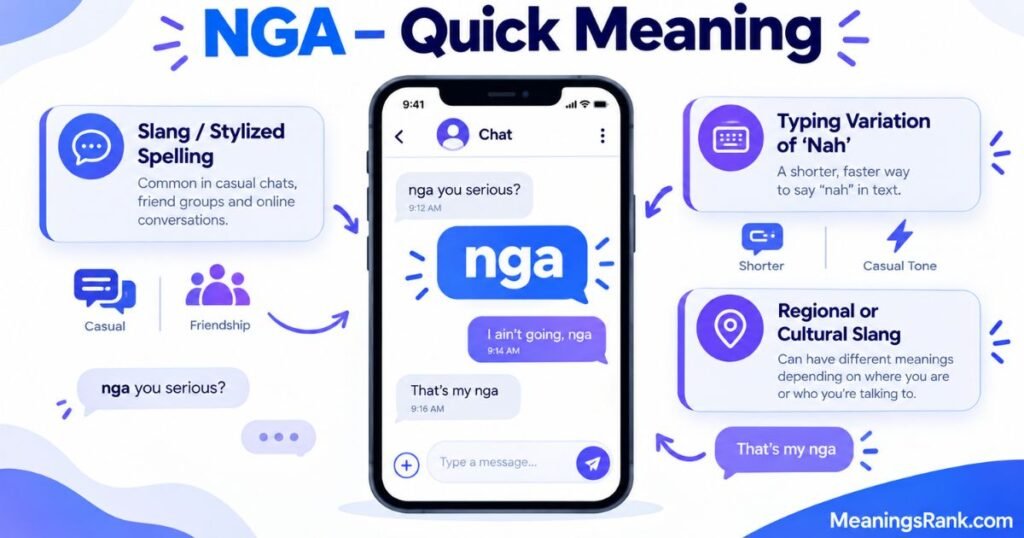
At its core, “nga” is a slang abbreviation or stylized spelling, and its meaning depends heavily on context.
Most common meanings:
- A casual or stylized way of writing the n-word, often used among close friends in certain communities
- An occasional typing slip for “nah” (meaning no), when the context clearly shows a “no”
- A regional or cultural slang expression used informally in chats, including the Filipino word “nga,” which has nothing to do with the slur
Simple examples:
- “That’s my nga.”
- “Nga you serious?”
- “I ain’t going, nga.”
The tone can range from friendly and playful to intense or inappropriate, depending on who is saying it and how. Because the main meaning carries a painful history, it is a high-risk word to use yourself.
Outside of slang, NGA can also mean the National Geospatial-Intelligence Agency or the National Gallery of Art. If you only need a fast answer, that is it. Read on for the full picture.
What Does NGA Mean in Text?
When someone sends NGA in a text, they almost always mean the shortened form of the n-word. Dropping letters makes it look milder, and it helps the word slip past chat filters and content rules.
How It Looks in a Sentence
You will usually see NGA used in one of three ways:
- As a name for someone: “Nga where you at?”
- As an exclamation: “Nga I can’t believe he did that.”
- As a label for a person: “That nga is funny.”
In each case, it works like “man,” “dude,” or “bro.” But the original word carries a heavy history, and shortening it does not remove that.
Why People Type It Instead of Spelling It Out
There are a few common reasons:
- Speed. Fewer letters, faster typing.
- Filters. Apps like TikTok and Instagram flag or hide the full word.
- Softening. Some people feel the short form is less harsh.
- Style. It has become part of certain online slang styles.
None of these reasons changes how the word can land with the person reading it.
Also Read: IGL Meaning in Text: What It Means, How to Use It, and Real Examples (2026 Guide)
NGA Origin & Background
The story of NGA starts with the full word it stands for. That word was used for centuries as a slur against Black people. Over time, some Black communities took a version of it and used it among themselves, giving it a different meaning tied to friendship and shared identity. This reclaimed use is debated even inside those communities. Some people embrace it. Others reject it completely.
How It Spread Online
Hip-hop, social media, and gaming helped spread the word far beyond its original circles. As more people saw it in lyrics, memes, and videos, some copied it without knowing its weight. Text spelling changes followed. Versions like “nga” and “ngga” appeared as people tried to bypass filters or write faster.
Why the Short Form Matters
The short form is not a new word. It is the same word with letters removed. That is why many people, including many Black internet users, still take offense when it is used by someone outside the community. Knowing this history helps you understand why the topic is more than just slang.
NGA Meaning in Real-Life Conversations
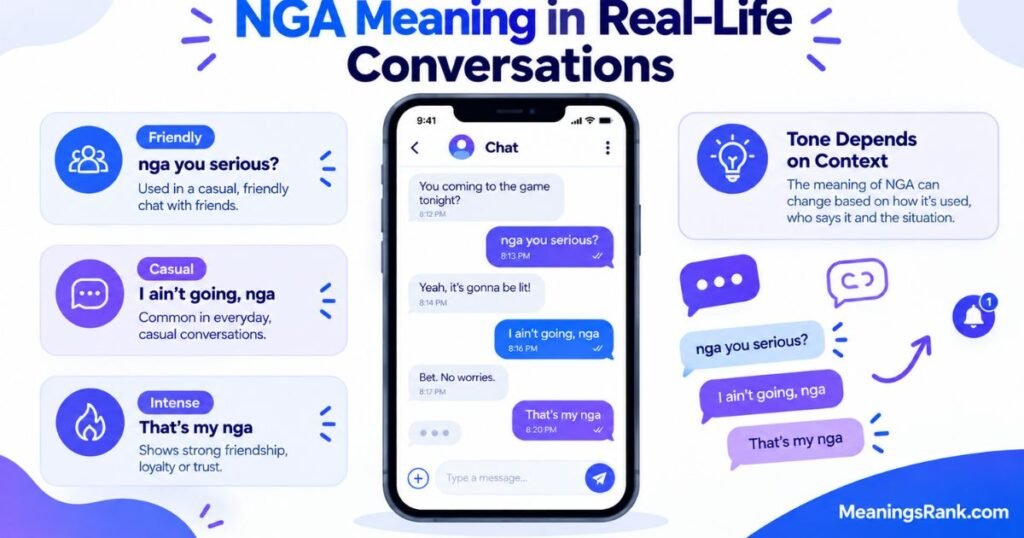
In real chats, NGA tone depends on who is talking and who is listening. The same three letters can feel warm in one chat and hurtful in another.
Example 1: Friends joking
- “Nga you really ate all the pizza?”
- “Lol I was hungry.”
Example 2: Hype and surprise
- “Nga we won the whole tournament!”
Example 3: Frustration
- “Nga what are you doing?”
Example 4: Aggressive use
- A stranger sends it in an argument to insult someone. This is where it clearly becomes harmful.
Tone Is Everything
In voice or in person, you can hear the tone. In text, you cannot. That is why NGA often gets misread. A friendly message can feel like an attack, and a rude one can be brushed off as “just slang.” When in doubt, the safer choice is to not use it.
NGA Meaning in Chat, WhatsApp, Instagram & TikTok
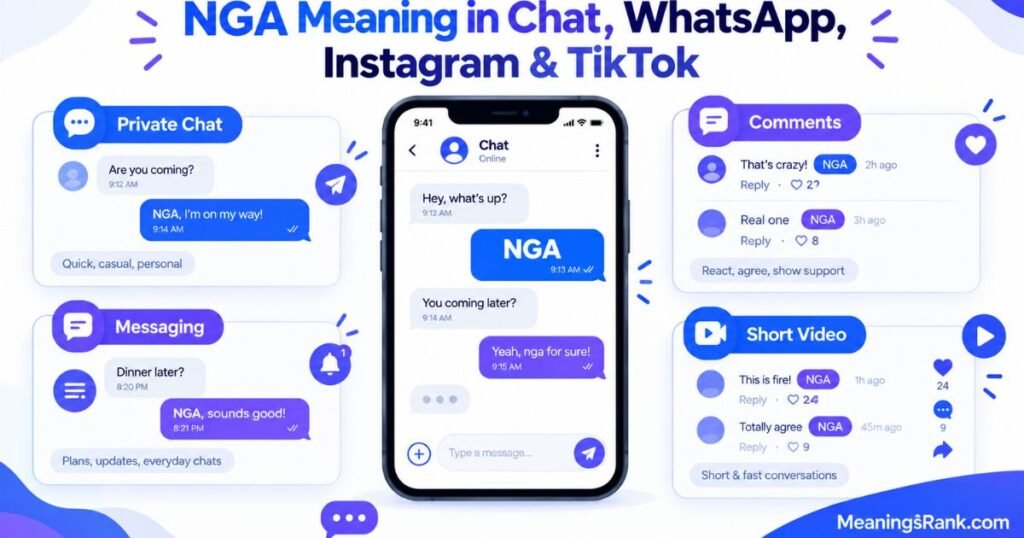
Each platform has its own style, so NGA shows up a little differently.
WhatsApp and Text Messages
In private chats and group chats, NGA is often used as casual filler between friends. “Nga send the location” means “man, send the location.” Group chats with mixed friends can get awkward fast, so people who use it tend to know their audience.
On Instagram, NGA appears in comments, captions, and DMs. Meta filters often hide the full slur, so users type the short form. Comments using it can be reported and removed.
TikTok
TikTok users use NGA in captions, comments, and sounds. The platform has strict rules, so videos with the word can get muted or removed. Creators often use the short form to avoid this, but moderation still catches many posts.
Snapchat, Discord and Gaming Chat
- Snapchat: Used in quick snaps and chats between close friends.
- Discord: Servers often ban the word. Many moderators treat NGA the same as the full word.
- Gaming chat: Voice and text chats in games like Call of Duty or Fortnite see heavy use, and also heavy reports and bans.
If you play online, know that using NGA can get your account muted or banned, even if you meant it as a joke.
NGA Meaning in Different Contexts
The meaning shifts with the setting. Here is how it breaks down.
Among Close Friends
Some friend groups use it like “dude.” It is part of their shared language. Even then, others in the chat may feel uncomfortable, and one person’s joke can be another person’s hurt.
In Arguments and Insults
When used to attack someone, it is a slur. Simple as that. It can lead to blocks, reports, and real harm.
In Music and Media
Songs, videos, and streamers use it in ways that spread it to new audiences. Hearing it in a song does not make it safe to repeat in your own chats.
In the Workplace
Never appropriate. Work chats on Slack, Teams, or email have strict conduct rules. Using NGA can lead to warnings or job loss.
Other Meanings of NGA
The same letters mean other things in other places:
- NGA: National Geospatial-Intelligence Agency (US government)
- NGA: National Gallery of Art (Washington, D.C.)
- Nga: A small word in Tagalog and other Philippine languages that adds emphasis, like “really” or “please” (“Sige nga” means “go on then”)
- NGA: Short forms in some organizations, like National Governors Association
If the message has nothing to do with slang, check the topic before jumping to conclusions.
Emotional & Psychological Meaning of NGA
Words carry feelings. NGA is no different.
For People Who Use It
Some users feel it creates closeness. Using the same slang can feel like belonging to a group. Others use it for attention or to seem “cool” online. Peer pressure plays a big role, especially for teens who see it everywhere.
For People Who Receive It
For many Black people, hearing the word from someone outside the community can bring up pain tied to a long history of discrimination. Even when the sender says “I was joking,” the impact can stay.
Intent vs. Impact
This is the key idea. You may mean no harm, but the effect on the reader still counts. Good communication means caring about both. If someone tells you a word hurts, believing them is a sign of respect.
NGA Meaning in Dating Apps & Online Conversations
On Tinder, Bumble, Hinge, and similar apps, NGA is a red flag for many people.
What It Signals in Dating Chats
- Casual tone: Some users think it makes them sound relaxed.
- Poor judgment: Others see it as disrespectful, especially in a first conversation.
- Mismatch of values: If you dislike it and your match uses it, that tells you something early.
Also Read: GPI Meaning in Text: The Ultimate Guide to Its Full Meaning & Usage (2026)
Examples
- “Nga you’re funny” from a match you just met may feel too familiar, or worse.
- A long-term partner using it in private banter is a different situation, but you still get to set boundaries.
Practical Tip
On dating apps, first impressions matter. Skip the slang and use clear, kind language. You will attract better conversations and avoid awkward moments.
NGA Variations & Types
You may see different spellings and forms of this word. They all point to the same root.
Common Spelling Variations
- Nga
- Ngga
- Nggas (plural)
- Ngas (plural)
- N-word (the polite way to refer to it)
Types by Use
- Casual address: used like “bro” or “man”
- Emphasis: used at the start of a sentence to show shock or excitement
- Group label: used to talk about a group of friends
- Insult: used to attack someone
Emoji and Symbol Versions
Some people swap letters for symbols or emojis to dodge filters. Filters are getting better at catching these, so this rarely works for long.
NGA vs Similar Words: What’s the Difference?
People often mix NGA with other slang. Here is how they compare.
| Term | Meaning | Tone | Risk Level |
| NGA | Shortened form of the n-word | Casual to aggressive | High |
| Bro | Friend or buddy | Friendly | Low |
| Dude | Casual word for a person | Neutral | Low |
| Fam | Close friend, like family | Warm | Low |
| Homie | Close friend | Friendly | Low |
| Bruh | Casual, often used in disbelief | Neutral to funny | Low |
| Nah | “No” in casual speech | Neutral | Low |
The Key Difference
Words like bro, dude, and fam have no painful history behind them. NGA does. That is why they are not interchangeable, even when the sentence looks the same.
Common Misunderstandings About NGA
“It’s Just a Different Word from the Slur”
Not true. It is the same word with letters removed. Most people read it that way.
“Everyone Uses It, So It’s Fine”
Common use online does not equal acceptance. Many people still find it offensive, and platforms still act on it.
“If My Friends Don’t Mind, No One Does”
Your friends are not everyone. Screenshots, group chats, and shared servers can put your message in front of people you never planned to reach.
“It Always Means Something Bad”
Not quite. Tone and speaker matter. But because the risk is so high, it is not worth the gamble in most cases.
“NGA Always Means This Slang”
Also not true. Government agencies, museums, and Filipino speech all use “NGA” or “nga” with completely different meanings.
NGA Meaning Comparison Table
| Context | What NGA Means | Example | Should You Use It? |
| Casual text | Slang for “man” or “bro” | “Nga where are you?” | Better not |
| Argument | Slur used as an insult | Used to attack someone | Never |
| Gaming chat | Trash talk or hype | “Nga we clutched that” | No, risk of ban |
| Workplace | Not acceptable | Any work chat | Never |
| News or government | National Geospatial-Intelligence Agency | “NGA released a report” | Yes, in that context |
| Filipino chat | Emphasis word “nga” | “Kain ka nga” | Yes, if you speak the language |
| Museums and art | National Gallery of Art | “Visit the NGA” | Yes |
How to Respond When Someone Uses NGA
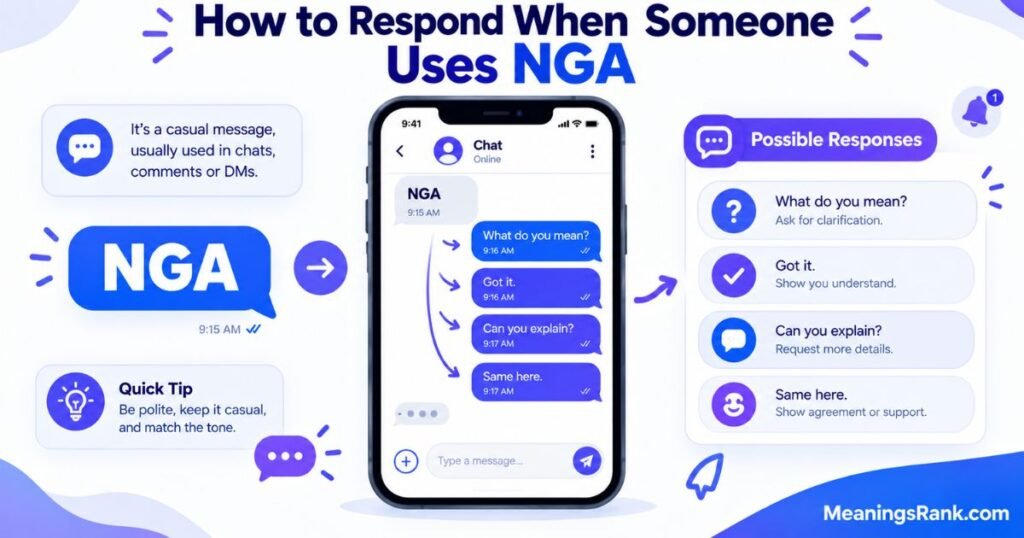
Your reply depends on who sent it and how you feel.
If a Friend Uses It Casually
You have options:
- Ignore it and move on: “Haha I’m outside, come down.”
- Set a soft boundary: “Not a fan of that word, but yes, I’m coming.”
- Ask directly: “Do you mean it as slang? It can read badly in text.”
If a Stranger Uses It to Insult You
Do not reply in anger. Instead:
- Take a screenshot.
- Block the sender.
- Report the message on the app.
If You’re Not Sure What They Meant
Ask. A simple “What do you mean by that?” gives them a chance to explain without escalating.
Sample Replies
- “That word makes me uncomfortable. Can we skip it?”
- “I get that it’s slang, but I’d rather not use it.”
- “Let’s keep it friendly.”
If You’re a Moderator or Group Admin
Set clear rules, remove messages quickly, and explain why. Consistency protects your community.
When NOT to Use NGA
Some situations are clear-cut. Do not use NGA:
- In school, college, or workplace chats
- With people you do not know well
- If you are not part of the community that reclaimed the word
- In public comments, posts, or livestreams
- On platforms with strict language rules
- In group chats with mixed audiences
- When someone has asked you not to
- With children or teens around
A Simple Test
Ask yourself: “Would I say this in front of my grandmother, my boss, and a stranger?” If the answer is no, skip it.
Better Alternatives
Try words like bro, dude, man, mate, fam, or homie. They get the same casual tone across without the risk.
Regional & Cultural Usage of NGA
United States
The word is most common in the US, where its history is deepest. Attitudes vary by community, age group, and region. In many places, use by non-Black people is widely seen as unacceptable.
United Kingdom, Canada, and Australia
Online culture spreads US slang quickly. Users in these countries may repeat it without understanding the history. Schools and employers usually treat it as serious misconduct.
Nigeria, Pakistan, India, and Other Countries
In many places, English learners pick up the word from music, games, or social media. They may see it as normal slang without knowing how offensive it can be. If you are in this situation, it helps to learn the background before using it. Being new to a word is not a crime, but repeating it after learning better is a choice.
Philippines and Filipino Language
“Nga” is a common particle in Tagalog, Bisaya, and other languages. It has nothing to do with the slur. Context makes this clear, but it can still confuse people in English-language chats.
Global Social Media
Because TikTok, Instagram, and gaming servers are global, one message can be read by people from many cultures. Something that seems harmless where you live may hurt someone somewhere else.
Also Read: What Does WTP Mean in Text? The Ultimate Guide to Its Meaning, Uses & Real-Life Examples (2026)
Is NGA Safe for Kids?
No, NGA is not safe or appropriate for kids.
Why Parents Should Care
- It is tied to a racial slur.
- Kids may copy it after hearing it in games, songs, or videos.
- Using it at school can lead to discipline.
- It can hurt classmates and damage friendships.
What Parents Can Do
- Talk openly. Explain what the word means and why it hurts.
- Check platforms. Use parental controls in games and social apps.
- Encourage reporting. Teach kids to block and report hateful messages.
- Model good language. Kids copy what adults do.
- Stay calm. If your child used it, ask where they heard it before reacting.
For Teachers and Older Siblings
Use it as a teachable moment. A short, honest chat about history and respect works better than punishment alone.
FAQs About NGA Meaning
What does NGA mean in a text message?
NGA is a shortened form of the n-word. Some people use it as casual slang for “man” or “bro,” but it can be seen as offensive.
Is NGA the same as the n-word?
Yes, in most chats it is the same word with letters removed. Many people still read it as a slur.
Can NGA mean something other than slang?
Yes. It can mean National Geospatial-Intelligence Agency, National Gallery of Art, or the Filipino word “nga.”
Is it okay to use NGA with friends?
It is risky. Even friends may feel uncomfortable, and screenshots can spread messages beyond your group.
Why do apps block or flag the word NGA?
Platforms treat it as hate speech, so they mute, remove, or ban accounts that use it.
What should I say if someone sends me NGA?
Stay calm. Ask what they mean, set a boundary, or block them if it feels like harassment.
Conclusion
NGA meaning in text comes down to this: it is a shortened version of the n-word, often used as slang for “bro” or “man,” but carrying a painful history that letters cannot erase. Some people use it casually, some use it to hurt, and some never use it at all. Because you cannot see tone in a text, misunderstandings happen fast.
You also learned that the same letters can stand for a US intelligence agency, an art museum, or a helpful little word in Filipino languages. Always check the context before you decide what a message means.
The safest path is simple. Avoid using NGA yourself, especially in public chats, work, school, or with people you do not know. Choose friendly words like bro, dude, or fam. If someone sends it to you, you can ask what they meant, set a boundary, or block and report. Respect costs nothing, and it keeps your conversations healthy, clear, and kind.