
You ask a friend when they’ll show up, and they reply with just “ETA 10 min.” Short, quick, and to the point. The ETA meaning in text is simple: it tells you when someone expects to arrive or when something will happen. You’ll see it in texts, WhatsApp chats, delivery apps, gaming lobbies, and even workplace emails. It’s one of those abbreviations that feels obvious once you know it, but confusing the first time you spot it.
Understanding ETA helps you plan better, respond faster, and avoid the awkward “wait, what does that mean?” moment. Let’s go through everything ETA covers, from texting to other everyday uses.
What Does ETA Mean in Text & Chat?
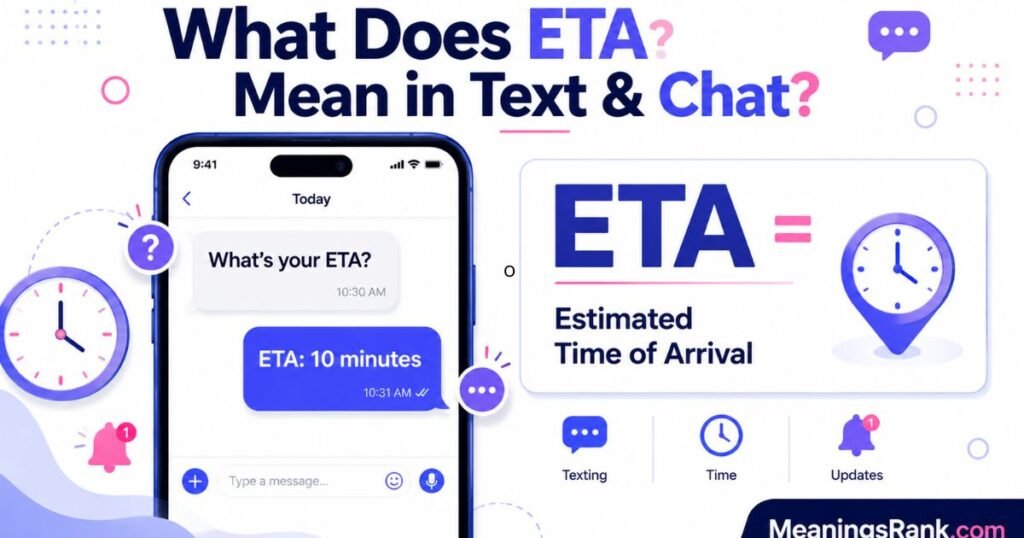
ETA is used to share or ask about timing. It tells someone when to expect an event, an arrival, or a task to finish.
In texting, it almost always relates to time. People use it to keep others updated without typing a full sentence.
Example:
Person A: “Are you close?”
Person B: “ETA 5 minutes.”
Here, Person B isn’t just saying they’re nearby. They’re giving a specific time estimate, which is exactly what ETA is built for.
ETA works two ways in conversation:
- As a question: “What’s your ETA?”
- As a statement: “ETA 20 minutes.”
Both forms serve the same purpose communicating time expectations quickly.
Some common patterns you’ll notice:
- ETA usually pairs with a number (“ETA 15 min”)
- It can also pair with a time (“ETA 6 PM”)
- Sometimes it’s used loosely, like “ETA soon” or “ETA whenever traffic clears”
This flexibility is why ETA shows up so often. It fits short texts, group chats, and even one-word replies without losing meaning.
Once you get used to spotting it, ETA becomes one of the easiest abbreviations to understand, since context almost always makes the meaning clear.
ETA Full Form, Meaning & What It Stands For
ETA stands for “Estimated Time of Arrival.” It’s a straightforward phrase, and the abbreviation hasn’t strayed far from its original meaning.
The full form explains exactly what the term does: it estimates when something or someone will arrive. That could mean a person, a package, a flight, or even a finished task.
Breaking down the phrase helps clarify things further:
- Estimated: Not exact, just a close guess
- Time: The specific moment being predicted
- Arrival: The point when someone or something reaches its destination
Because it’s an estimate, ETA isn’t a promise. It’s a best guess based on current conditions, which is why it can shift depending on traffic, delays, or unexpected changes.
You’ll often see it written in all caps (“ETA”) or lowercase (“eta”), and both mean the same thing. Some people also stretch its use slightly, applying it to tasks instead of physical arrival, like “ETA on that report is tomorrow.”
This small shift shows how flexible the phrase has become, stretching beyond its original travel-based meaning into everyday planning and scheduling.
Also Read: JS Meaning in Text: The Ultimate Guide to What JS Really Means in Chat
Origin, History & First Known Use of ETA
ETA didn’t start as internet slang. It actually comes from aviation and shipping industries, where precise timing mattered long before texting existed.
Pilots, air traffic controllers, and ship captains used “estimated time of arrival” to communicate schedules clearly. This term became standard across transportation industries decades before smartphones were even invented.
A quick timeline of its journey:
- Early-to-mid 1900s:
ETA becomes common in aviation and maritime communication
- Later 20th century:
Businesses adopt ETA for shipping and logistics tracking
- 2000s onward:
Texting culture picks up ETA as a quick, casual abbreviation
- Today:
ETA appears in texting, apps, gaming, and everyday planning
What makes ETA interesting is that its meaning barely changed as it moved from professional industries into casual texting. Unlike a lot of slang that shifts meaning over time, ETA kept its original purpose completely intact.
This history also explains why ETA feels more “normal” than other internet abbreviations. It wasn’t invented for texting it was borrowed from an industry where clear communication about timing was essential.
That practical background is part of why ETA still works so well today, whether you’re waiting for a friend, a delivery, or even a coworker’s project update.
How People Use ETA in Daily Conversations
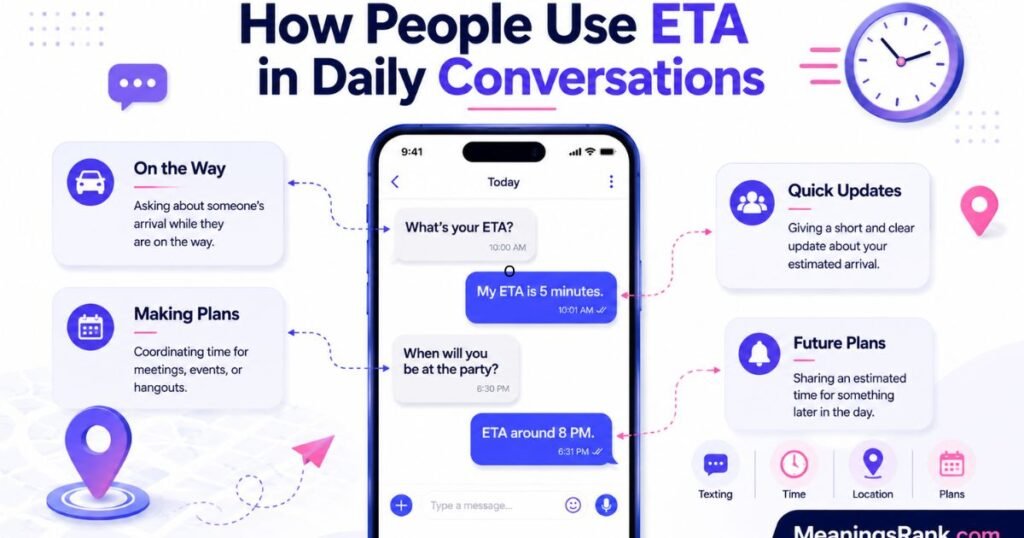
ETA usually appears in short, direct messages. People rarely build long sentences around it because its purpose is speed and clarity.
Typical Structure:
“ETA + [time]” or “What’s your ETA?”
Examples:
- “ETA 15 minutes, stuck in traffic.”
- “What’s your ETA for the meeting?”
- “ETA tomorrow morning.”
ETA shows up constantly in daily life, not just texting. Here are common situations where it naturally fits:
- Waiting for a friend or family member to arrive
- Tracking food delivery or online packages
- Coordinating pickup or drop-off times
- Estimating when a task or project will be done
- Planning group outings or meetups
Because it’s so practical, ETA rarely needs extra explanation. Most people understand it instantly, even without knowing texting slang well.
It’s also common for ETA to appear without a full sentence around it, since the context usually fills in the gaps. A simple “ETA 10” is enough for most people to understand exactly what’s being communicated.
This efficiency is exactly why ETA remains one of the most functional and widely recognized abbreviations across both texting and daily spoken conversation.
ETA Meaning on WhatsApp, Instagram, TikTok & Snapchat
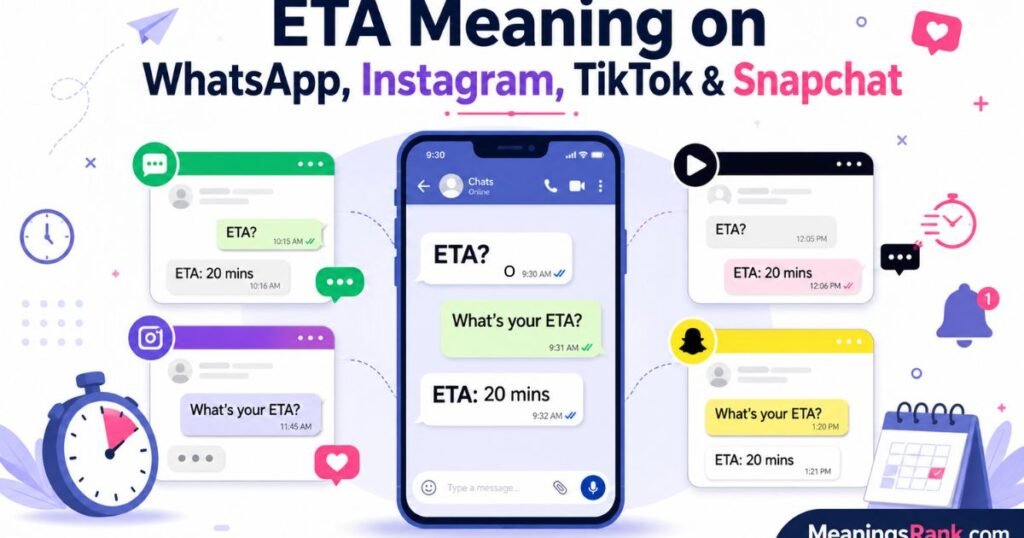
ETA keeps the same core meaning across every platform, but how it’s used can shift slightly depending on the app.
WhatsApp:
“ETA 20 mins, leaving now 🚗”
WhatsApp is where ETA appears most naturally, especially in one-on-one or group chats coordinating plans.
Instagram Comments:
“ETA on that giveaway winner announcement? 👀”
Here, ETA stretches beyond arrival time to ask about a future update or event.
TikTok Comments:
“ETA on part 2 of this story?? need it now 😩”
TikTok often uses ETA loosely, asking creators when new content is coming rather than tracking physical arrival.
Snapchat:
“eta bestie, almost there!”
Snapchat keeps ETA casual and quick, often paired with emojis or shorthand.
Discord/Gaming:
“ETA 5 min till the match starts.”
Workplace Chats:
“ETA on the client proposal?”
Across these platforms, ETA adapts to fit the pace of each app while keeping its core purpose: estimating when something will happen.
| Platform | Common ETA Usage |
| Arrival time for meetups | |
| Timing for updates or events | |
| TikTok | Requesting new content timing |
| Snapchat | Casual, quick arrival updates |
| Discord | Timing for games or events |
| Workplace | Task or project completion time |
This adaptability is a big reason ETA has stayed relevant across so many different types of digital spaces.
Different Meanings of ETA in Other Fields
Outside texting, ETA holds specific meanings in different professional and technical fields.
Logistics & Shipping:
ETA tracks when packages or cargo will reach their destination, often shown directly in tracking apps.
Aviation:
Pilots and airports use ETA to estimate flight arrival times, factoring in weather and air traffic.
Also Read:HYD Meaning in Text: The Ultimate Guide to What HYD Really Means in Chat
Project Management:
Teams use ETA to estimate when tasks, milestones, or deliverables will be completed.
Software & Tech Support:
Developers sometimes use ETA when estimating how long a bug fix or feature update will take.
Customer Service:
Companies use ETA to tell customers when help, refunds, or responses are expected.
Here’s a simple breakdown:
| Field | ETA Meaning |
| Texting | Arrival time for a person |
| Shipping | Delivery arrival estimate |
| Aviation | Flight arrival estimate |
| Project Management | Task completion estimate |
| Customer Service | Response or resolution time |
Even though the setting changes, the core idea stays the same: ETA always estimates when something will happen. That consistency is part of why the term translates so easily between casual texting and professional communication.
Common Confusions, Mistakes & Wrong Interpretations of ETA
Even though ETA is simple, a few mix-ups happen regularly.
Confusion 1: ETA Means an Exact Time
Not true. ETA is always an estimate, not a guarantee. Delays can still happen even after someone shares their ETA.
Confusion 2: ETA Only Applies to People
Many assume ETA only tracks a person’s arrival, but it applies just as often to packages, tasks, or events.
Confusion 3: ETA and ETD Mean the Same Thing
They don’t. ETA means arrival, while ETD means “Estimated Time of Departure.” Mixing these up can cause real scheduling confusion.
Confusion 4: No Response Means No ETA
Sometimes people forget to reply with a time estimate, which isn’t the same as refusing to share one. A quick follow-up usually clears this up.
Confusion 5: ETA Is Always Formal
While it started in professional settings, ETA today feels completely casual in texting and social media.
Clearing up these small misunderstandings helps prevent unnecessary confusion, especially in group chats or work settings where timing really matters.
Similar Terms, Alternatives & Related Acronyms
ETA isn’t the only time-related abbreviation used in texting. Here are a few related terms worth knowing.
| Term | Meaning | When to Use |
| ETA | Estimated Time of Arrival | Sharing or asking arrival time |
| ETD | Estimated Time of Departure | Sharing when someone is leaving |
| OMW | On My Way | Confirming travel has started |
| RN | Right Now | Emphasizing the current moment |
| ASAP | As Soon As Possible | Requesting urgency |
ETA vs OMW:
OMW confirms someone has already left, while ETA estimates when they’ll arrive.
Example: “OMW!” (already left) “ETA 10 minutes” (still calculating arrival)
ETA vs ASAP:
ASAP requests speed, while ETA provides a specific time estimate.
Knowing these differences helps you communicate timing more precisely, especially in fast-moving group chats.
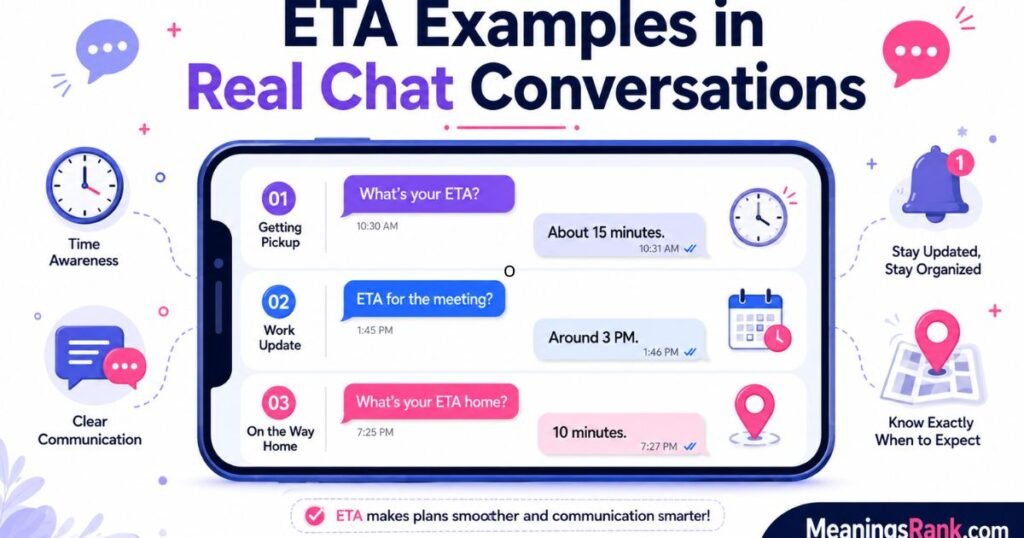
ETA Examples in Real Chat Conversations
Text Message:
Person A: “Almost here?”
Person B: “ETA 5 min, just parked.”
WhatsApp Group:
Person A: “Everyone ready?”
Person B: “ETA 10 mins, running behind a bit.”
Instagram DM:
“ETA on that outfit link you promised? 😂”
Gaming Chat:
“ETA 2 min till I respawn, hold the point.”
Workplace Slack:
“ETA on the client deck? Need it before noon.”
These examples show how ETA adjusts naturally to casual chats, group coordination, and even workplace deadlines without losing its core meaning.
How to Reply When Someone Says “ETA”
Replying to ETA is usually quick and direct.
If You Know the Time:
“ETA 15 minutes.” “Should be there by 6.”
If You’re Unsure:
“Not sure yet, traffic’s bad.” “Still figuring out my ETA.”
If Asking for Someone Else’s ETA:
“What’s your ETA?” “How far out are you?”
Keeping replies short matches the tone ETA naturally sets in a conversation.
Is ETA Still Popular? Trends & Online Usage
Yes, ETA remains extremely common, especially with delivery apps, ride-sharing services, and everyday texting. Unlike trendy slang that fades quickly, ETA’s practical use keeps it relevant across every generation.
Also Read: WTV Meaning in Text: What It Means, How People Use It, and How to Reply (2026 Guide)
Quick Facts About ETA
- ETA stands for “Estimated Time of Arrival”
- It originated in aviation and shipping industries
- It works in both questions and statements
- It’s used casually and professionally
- It applies to people, packages, and tasks alike
FAQs About ETA Meaning
What does ETA mean in a text?
It means “Estimated Time of Arrival,” used to share or ask when someone will arrive.
Is ETA the same as OMW?
No, OMW means someone already left, while ETA estimates arrival time.
Can ETA apply to tasks, not just people?
Yes, ETA often estimates when a task or project will be finished.
Is ETA formal or casual slang?
It works both ways, fitting casual texting and professional communication equally well.
What’s the difference between ETA and ETD?
ETA means arrival time, while ETD means estimated departure time.
Conclusion
The ETA meaning in text really comes down to one simple idea: it estimates when something or someone will arrive. Whether you’re waiting on a friend, tracking a delivery, or asking a coworker about a deadline, ETA keeps communication quick and clear.
We’ve covered where ETA came from, how it’s used across texting and social media, its meaning in other fields, and how it compares to similar terms like OMW and ETD.
Next time someone texts you “ETA,” you’ll know exactly what they mean and how to respond. It’s a small abbreviation, but understanding it fully makes everyday planning just a little bit smoother.