
If you’ve seen the word “opp” pop up in a text, a TikTok comment, or a rap song and felt lost, you’re not alone. This short slang word carries a lot of weight, and it’s easy to misread if you don’t know the background.
The opp meaning slang trend has spread from street culture into everyday texting, gaming chats, and social media captions, and it keeps evolving. This guide breaks down exactly what opp means, where it came from, how people use it today across different apps, and what to do if someone calls you one. By the end, you’ll understand every angle of this term without any confusion.
Quick Answer: What Does Opp Mean?
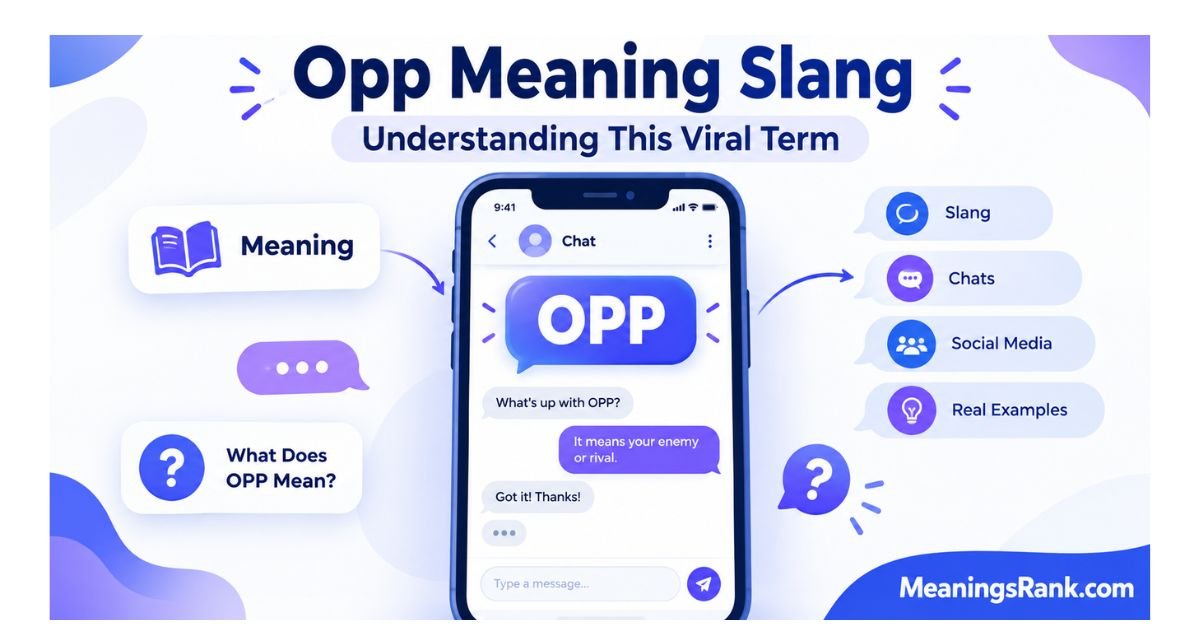
“Opp” is short for opponent or opposition. In slang, it means someone who is your enemy, rival, or someone actively working against you. It’s used to describe people you don’t trust, people from a rival group, or someone who has wronged you in some way.
Here’s the fastest way to understand it:
- Short form of: Opponent / Opposition
- Basic meaning: Enemy, rival, hater, or someone against you
- Common in: Rap lyrics, TikTok, Instagram captions, gaming chats, group texts
- Tone: Can be serious (real beef) or joking (light teasing between friends)
- Example: “That whole squad is opps, don’t trust them.”
The word can be used seriously in situations involving real conflict, or it can be tossed around jokingly between friends who are just messing with each other. Context is everything with this one.
Why People Search for This Term
Most people looking up “opp meaning slang” fall into one of three groups. Some heard it in a song and want a quick definition. Some saw it in a text or comment aimed at them and want to know if they should be worried. And some are parents or teachers trying to understand what teens are saying online. This guide covers all three angles, so no matter why you landed here, you’ll walk away with a clear answer.
The One-Sentence Version
If you only remember one thing from this article, remember this: “opp” means someone treated as an enemy or rival, and whether it’s a joke or a real warning depends entirely on the tone of the conversation around it.
What Does Opp Mean in Slang and Text?
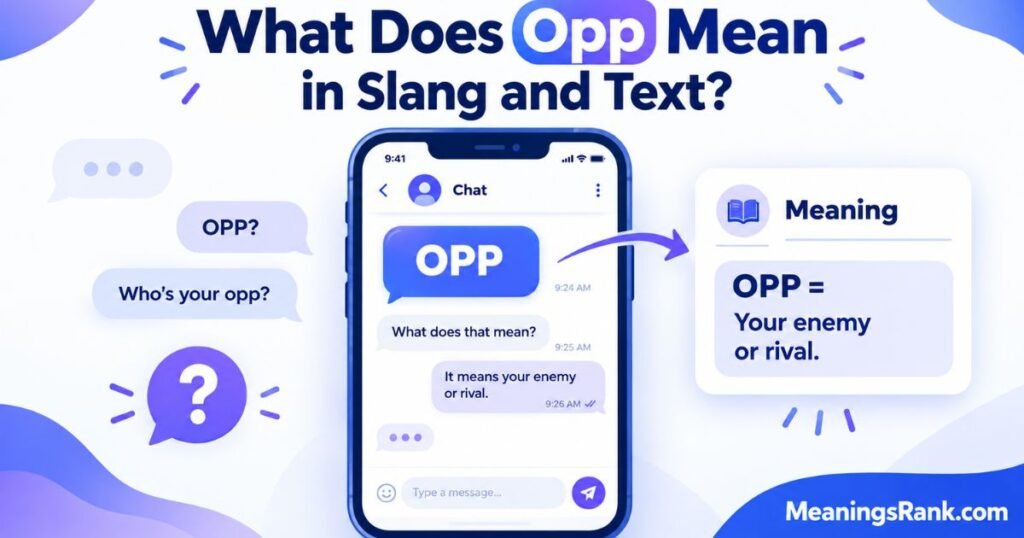
In texting and casual slang, “opp” almost always refers to a person or group seen as an enemy. It’s not usually about a sports opponent or a competitor in a game, even though the root word is “opponent.” Instead, it points to personal conflict, rivalry, or distrust.
The Core Idea Behind Opp
When someone says “he’s an opp” or “watch out for opps,” they mean:
- This person is not on your side
- This person might be plotting against you or your friend group
- This person is connected to a rival crew, gang, or social circle
- This person has beef with you or your friends
Opp vs Opponent: What’s the Difference?
People often assume “opp” is just a casual way to say “opponent,” but the slang version carries a much heavier, more personal tone. A sports opponent is neutral you compete, then shake hands. An “opp” implies real dislike, distrust, or danger.
| Term | Meaning | Tone | Common Setting |
| Opponent | Person you compete against | Neutral | Sports, games, debates |
| Opp | Enemy or rival with personal conflict | Negative, tense | Street culture, rap, group beef |
| Rival | Someone you compete with, often respectfully | Mixed | Business, sports, gaming |
| Hater | Someone jealous or negative toward you | Negative but less serious | Social media |
This table shows why swapping “opp” for “opponent” in a sentence usually sounds wrong. Nobody says “my chess opp beat me.” That’s not how the word works.
Opp Meaning, Full Definition & Common Interpretation
To fully understand opp meaning slang, it helps to look at it from a few different angles: dictionary-style definition, cultural meaning, and how it feels emotionally when someone uses it.
Dictionary-Style Definition
Opp (noun): slang term, short for “opponent” or “opposition,” referring to an enemy, rival, or someone actively working against a person or group. Often used in street, rap, and youth culture to describe someone from a rival crew, someone untrustworthy, or someone with a personal grudge.
Also Read: Seaver Meaning: The Ultimate Guide to Its Definition, Uses & Common Contexts
Common Interpretations
- Literal enemy → someone from a rival gang, crew, or group with real tension.
- Social rival → someone competing for the same attention, status, or relationship.
- Untrustworthy person → someone who talks behind your back or can’t be trusted.
- Playful jab → friends calling each other “opp” as a joke, with zero real conflict behind it.
Why the Meaning Shifts Depending on Who Says It
A teenager joking with friends on Snapchat might use “opp” completely differently than someone referencing a real conflict in a rap verse. The word hasn’t changed, but the intent behind it has stretched to cover both serious and silly situations. This is common with slang it starts specific and then broadens as more people adopt it in casual conversation.
The Origins and History of Opp Slang
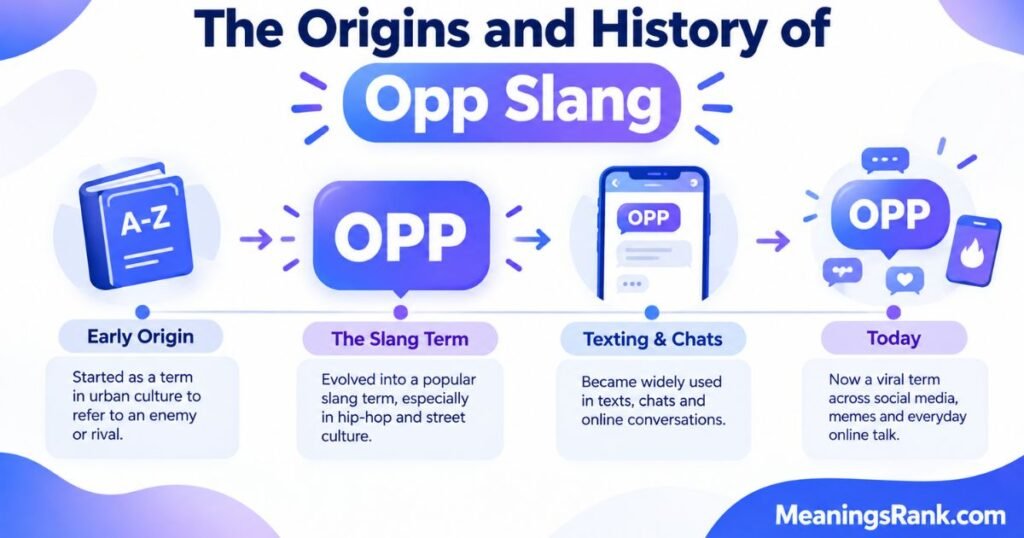
Understanding where “opp” came from helps explain why it carries the weight it does today.
Where the Word Started
“Opp” traces back to African American Vernacular English (AAVE) and street culture, particularly linked to gang and crew rivalries in urban communities. It’s a shortened form of “opposition” or “opponent,” used to label people from rival groups or areas.
The Role of UK Drill and US Rap
The word gained massive visibility through drill music, a genre that started in Chicago and later exploded in the UK, especially London. Drill artists used “opp” constantly in lyrics to talk about rival gang members or people they had beef with. As drill music spread globally through YouTube and streaming platforms, the term traveled with it.
US rap scenes also picked up the word heavily, especially in songs discussing street conflict, loyalty, and rivalry. Over time, “opp” became one of those words that non-rap listeners started recognizing just from hearing it repeated in popular songs.
From Music to Mainstream Slang
Once drill and rap made the term familiar, social media did the rest. TikTok trends, meme pages, and Instagram captions picked up “opp” and stretched its meaning beyond gang culture. Now you’ll hear teenagers use it about:
- A rival sports team
- Someone flirting with their crush
- A sibling who snitched
- A coworker who took credit for their idea
This shift from serious street slang to everyday joking language is a pattern seen with many words that start in music culture and move into general youth slang.
How the Word Spread Beyond Music
Once “opp” became a fixture in drill and rap lyrics, it didn’t stay locked inside music culture for long. Radio play, music videos, and lyric breakdown channels on YouTube introduced the word to listeners who had never encountered street slang before. Then came streaming platforms and algorithm-driven recommendations, which pushed drill and rap tracks to much wider, younger audiences worldwide.
Kids who had never set foot near a real rivalry started repeating the word because it sounded cool in a song, and that’s really the turning point where “opp” split into two lives: the original, heavier meaning, and the newer, lighter internet version.
The Influence of Memes and Reaction Culture
Meme culture played a huge role in softening the word. As soon as creators started slapping “opp” onto funny reaction videos and petty situations like someone stealing a fry off your plate the term picked up a comedic layer that had nothing to do with its violent roots. This is a common pattern in internet slang: a heavy word gets borrowed for humor, and eventually most casual users only know the lighter version, even if they’ve never heard the original context.
Timeline Snapshot
| Era | How “Opp” Was Used |
| Early street slang | Referred to rival gang or crew members |
| Chicago drill music | Popularized in lyrics about real conflict |
| UK drill scene | Widely used, sometimes tied to real danger |
| Social media era | Adopted into everyday teasing and memes |
| Today | Mix of serious and joking usage across platforms |
Context and Usage: How Opp Is Used Today
Context is the most important part of figuring out what someone means when they say “opp.” The exact same word can mean something dangerous or something completely harmless depending on where it’s said and who’s saying it.
Serious Context
In this context, “opp” refers to real conflict:
- Gang or crew rivalries
- Someone who has physically threatened another person
- Someone connected to a violent dispute
This usage is heavier and shows up in music, news coverage of drill culture, or serious conversations about safety.
Casual and Joking Context
Most people encountering “opp” online will see it used lightly:
- Friends calling each other “opp” after losing a game
- Teasing a sibling who told on you
- Joking about a “work opp” who takes your ideas in meetings
- Calling a friend’s ex an “opp” as a joke
How to Tell the Difference
Here are a few signs that “opp” is being used casually rather than seriously:
- It’s followed by laughing emojis 😂 or “lol”
- It’s about a small, harmless situation (losing a game, a joke gone wrong)
- The people involved are clearly still friends
- It’s part of a meme or trend, not a personal callout
And signs it might be more serious:
- It’s tied to a real ongoing conflict between people or groups
- The tone in the conversation feels tense or angry
- There’s mention of specific names, locations, or threats
- It shows up alongside language about safety or retaliation
Also Read: Huzz Meaning: The Ultimate Guide to This Viral Gen Z Slang
Regional Differences in Usage
The word doesn’t sound exactly the same everywhere. In UK slang, especially in London and other cities where drill music is huge, “opp” can carry a heavier, more location-specific meaning tied to postcode rivalries. In the US, usage varies by city too, but it has spread further into general teen slang thanks to TikTok and meme pages, so American teenagers often use it much more casually than the original UK drill scene intended.
Outside of English-speaking countries, the word is usually picked up purely through music and social media, so it tends to keep only the lighter, joking meaning since listeners aren’t plugged into the cultural backstory.
Generational Differences
Gen Z tends to use “opp” constantly and casually, often draining it of any real weight. Millennials and older users who do use the word usually picked it up from rap lyrics and tend to reserve it for slightly more pointed situations, like calling out someone who was genuinely disloyal. Older generations unfamiliar with slang may not recognize the word at all, which is exactly why context and audience matter so much before using it.
Opp Meaning on Social Media and Different Platforms
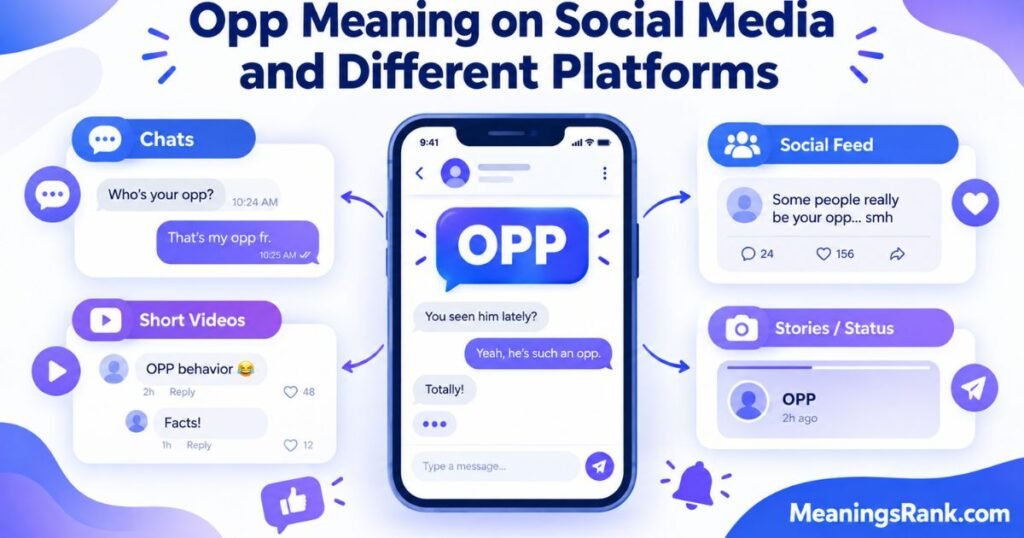
Each platform has its own flavor of how “opp” gets used. Here’s a breakdown of what it typically looks like across the apps people use most.
Opp on TikTok
TikTok has turned “opp” into meme material. You’ll see comments like “the real opp is my alarm clock” or “opp behavior” under videos showing someone doing something petty or annoying. It’s often used humorously, far removed from its original serious tone.
Example TikTok comment:
“Bro really left me on read then posted an hour later, opp behavior 💀”
Opp on Instagram
On Instagram, “opp” shows up in captions, comments, and story replies. It’s common in captions poking fun at situations, like posting a photo with the caption “no opps in sight today.”
Example Instagram caption:
“Good vibes only, no opps allowed 🚫”
Opp on Snapchat
Snapchat conversations tend to be more private and personal, so “opp” here usually relates to real-life drama between friend groups, exes, or rivals at school.
Example Snapchat text:
“Don’t invite her, she’s been acting like an opp lately.”
Opp on Discord and Gaming Chats
In gaming spaces, “opp” often circles back closer to its literal root describing an opponent in a match but with slang attitude added. Players might call the enemy team “opps” during a heated match, blending competitive trash talk with slang culture.
Example Discord message:
“Opps are camping spawn again, watch your back.”
Opp in Workplace Chats (Informal Use)
While rare in formal settings, younger employees sometimes use “opp” jokingly in casual work group chats to describe a coworker who’s overly competitive or takes credit for shared work.
Example Slack message:
“Lol he presented MY idea in the meeting, total work opp.”
Opp on Twitter/X
On X, “opp” often shows up in quote tweets or replies aimed at public figures, sports teams, or trending topics. It’s frequently used with humor when reacting to a losing team or a celebrity feud, and it spreads fast because the platform rewards short, punchy reactions.
Example X post:
“The refs were playing for the opps tonight, no way that was a foul 😤”
Opp on Facebook
Facebook usage tends to be a bit more old-school and community-based, often showing up in comment sections under local sports pages, community groups, or family group chats where younger relatives introduce the term to a mixed-age audience. It’s less common here than on TikTok or Instagram, but it still pops up, usually in a joking way.
Example Facebook comment:
“Our team beat the opps by 20 points, what a game!”
Platform Comparison Table
| Platform | Typical Tone | Common Use Case |
| TikTok | Joking, meme-based | Reacting to petty or funny situations |
| Light, caption-style | Captions and comment banter | |
| Snapchat | Personal, sometimes serious | Real friend group drama |
| Discord/Gaming | Competitive, playful | Describing enemy players |
| Workplace chats | Very casual, joking | Teasing about competitive coworkers |
| Rap/Drill music | Serious | Describing real rivals or enemies |
Real-Life Examples of Opp in Conversation
Seeing “opp” used in real conversation formats makes the meaning click faster than any definition alone.
Text Message Examples
Example 1 (joking):
Friend: “Did you hear Jake told everyone about your text?” You: “Ok he’s officially an opp now 💀”
Example 2 (serious tone):
“Stay away from that group, they’re opps, real tension there.”
Group Chat Examples
“Anyone seen the game last night? Their whole team played like opps lol”
“Don’t add him to the group, he’s been acting like an opp since the breakup.”
Social Media Comment Examples
“This video is giving major opp energy 😂”
“No opps in this comment section, just love”
Gaming Chat Example
“Opps pushing mid, need backup now!”
School and Friend Group Examples
“She told the teacher I copied her homework, she’s such an opp.”
“Ever since he started hanging with that other group, he’s been acting like an opp toward us.”
Sports and Competition Examples
“Our rival school showed up wearing our old team colors, total opp move.”
“The opps talked so much trash before the game and then lost by 30.”
Relationship and Dating Examples
“His ex keeps commenting on his posts, she’s acting like a whole opp.”
“Don’t introduce them, her friend group has beef with mine, total opp energy.”
These examples show how flexible the word is. The tone, punctuation, and emojis around it usually tell you whether it’s a joke or something more serious.
Alternative Meanings and Common Confusions
“Opp” isn’t always slang for enemy. There are a few other ways this short word gets used, and mixing them up can lead to confusing conversations.
Opp as an Abbreviation
In non-slang contexts, “opp” can simply be short for:
- Opportunity (common in business or casual writing: “great opp for you”)
- Opponent in sports writing or commentary
- Operations in some business or military abbreviations
Common Confusions
Confusing “opp” with “op”
“OP” usually means “original poster” on forums like Reddit, or “overpowered” in gaming. It’s a completely different word from “opp.”
Also Read: RB Meaning in Text: The Complete Guide to This Popular Slang
Assuming it’s always serious
Many people panic thinking “opp” always means dangerous gang talk, when most modern uses are lighthearted jokes.
Assuming it’s always joking
On the flip side, some people brush off the word entirely, missing when it’s used to describe a real, tense situation.
Mixing up opp and rival
While similar, “rival” often implies mutual respect (like sports rivals), while “opp” leans more negative and one-sided.
Opp vs Op vs Opportunity Quick Reference
| Word | Meaning | Example |
| Opp | Enemy, rival, opposition | “He’s acting like an opp.” |
| Op | Original poster / overpowered | “OP said the game restarts at 6.” |
| Opportunity (opp) | A chance or good deal | “This job is a great opp for you.” |
Related Slang Terms and NLP Variations
Slang rarely travels alone. “Opp” is often used alongside or compared to other similar terms. Knowing these related words helps you understand the full picture of internet and street slang.
Words Similar to Opp
- Beef → ongoing conflict or tension between people
- Snake → someone who betrays trust
- Fake → someone who pretends to be a friend but isn’t
- Hater → someone who criticizes out of jealousy
- Enemy → the plain English version of opp
- Rival → competitor, sometimes respectful
Common Phrases Using Opp
- “Opp behavior” → acting in a way that seems enemy-like or petty
- “Opp energy” → giving off a vibe of dislike or rivalry
- “No opps” → a phrase meaning peace, no enemies, good vibes
- “Real opp hours” → a joking phrase used late at night when petty drama happens
- “Certified opp” → someone confirmed to be acting against you
Similar Slang From Other Cultures
Nearly every culture has its own word for describing an enemy or rival in casual speech, and comparing them helps show that “opp” isn’t a totally new concept, just a new label. Some examples include calling someone a “hater” in general American slang, a “beefer” in some UK youth slang, or simply “enemy number one” in older generations’ phrasing. Recognizing these parallels makes it easier to understand why “opp” caught on so quickly. It filled a gap for a short, punchy way to say the same thing that already existed in different forms.
How Search Engines and NLP Understand Opp
From an NLP (natural language processing) standpoint, “opp” is closely linked in meaning to words like enemy, rival, hater, and opposition. Search engines increasingly recognize slang terms as part of everyday language, especially when they appear across music lyrics, social captions, and youth conversation. This is why understanding related terms and natural phrasing patterns helps clarify the true meaning behind a trending word like this one.
How to Respond If Someone Calls You an Opp
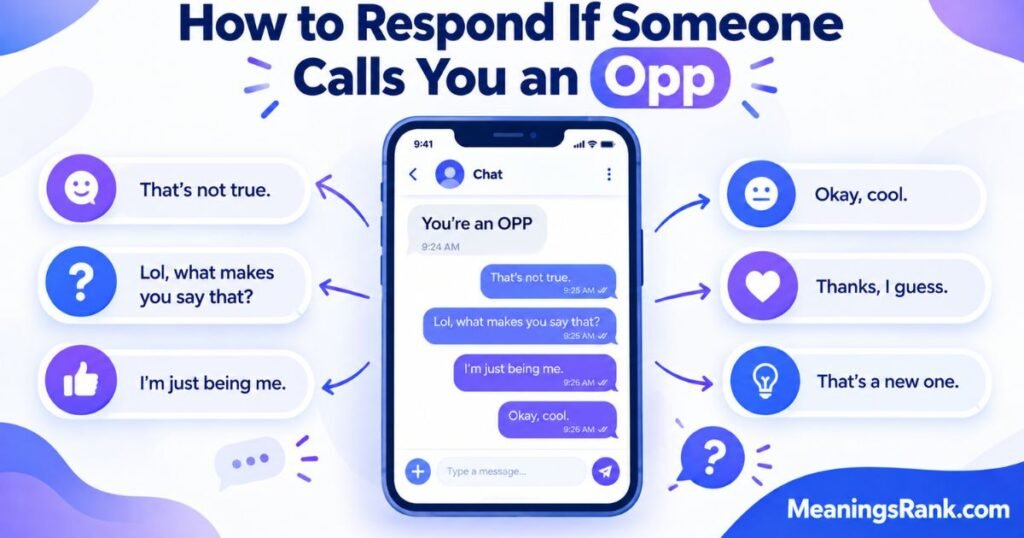
Getting called an “opp” can feel confusing or even hurtful if you don’t know the context. Here’s how to handle it depending on the situation.
Step 1: Figure Out the Tone First
Before reacting, check the context:
- Is this a joke among friends?
- Is this tied to a real disagreement?
- Did something specific just happen between you two?
Step 2: If It’s Clearly a Joke
Play along or laugh it off. Overreacting to a joking use of “opp” can actually make the situation more awkward than it needs to be.
Example response:
“Lol fair, I did leave you on read for a week 😂”
Step 3: If It Feels Serious
If someone genuinely seems upset and calls you an opp with real tension behind it, it’s worth addressing directly instead of ignoring it.
Example response:
“Wait, why do you think that? Did I do something?”
Step 4: Avoid Escalating Online
If the accusation happens in a group chat or public comment, avoid firing back with insults. A calm, direct question usually defuses tension faster than a heated reply.
Quick Response Guide
| Situation | Suggested Response |
| Friends joking around | Laugh it off, joke back |
| Confusion over a misunderstanding | Ask directly what happened |
| Real tension or conflict | Address it calmly, avoid public arguments |
| Random troll online | Ignore or mute, don’t engage |
Misinterpretations to Avoid When Using Opp
Using slang the wrong way can create awkward or even harmful misunderstandings. Here are common mistakes people make with “opp.”
Mistake 1: Using It Too Aggressively
Calling someone an opp in a heated moment can escalate a small disagreement into something bigger than it needs to be, especially if the other person takes it seriously.
Mistake 2: Using It Outside Its Cultural Context
Since the word has roots in specific communities and music genres, using it carelessly or mockingly without understanding its background can come across as disrespectful.
Mistake 3: Assuming Everyone Knows the Slang Meaning
Not everyone, especially older relatives, teachers, or coworkers, will understand the slang version of “opp.” Using it in a formal setting or with someone unfamiliar with internet slang might cause confusion instead of humor.
Mistake 4: Ignoring Tone Indicators
Text lacks tone of voice, so a message like “you’re an opp” without any emoji or context can easily be misread as a serious insult, even when it was meant as a joke.
Mistake 5: Overusing the Word
Like most slang, repeating “opp” in every sentence can make it lose its punch and start to feel forced rather than natural.
When NOT to Use Opp Slang
Knowing when to hold back is just as important as knowing how to use the word correctly.
Avoid Using Opp In These Situations
- Formal writing: School essays, resumes, official emails
- Professional workplace communication: Especially with clients or supervisors
- Serious conflict resolution conversations: Where clarity matters more than casual tone
- When talking to someone unfamiliar with slang: Like older family members or new coworkers
- In sensitive situations involving real safety concerns: Where the joke could be misread as a genuine threat reference
Why This Matters
Slang carries cultural weight, and “opp” specifically has roots tied to real conflict and, in some cases, real danger in certain communities. Using it carelessly around serious topics can come across as tone-deaf or disrespectful to people who understand its heavier origins.
Practical Usage Tips for Mastering Opp
If you want to use this slang term naturally and correctly, keep these tips in mind.
Tips for Using Opp the Right Way
- Match the tone of the conversation: If everyone’s joking, keep it light. If the mood is serious, don’t drop it in as a joke.
- Add context clues: Emojis, “lol,” or exclamation points help signal you’re being playful.
- Know your audience: Use it with friends who understand slang, not in formal or professional spaces.
- Don’t force it into every sentence: Slang feels natural when it’s used sparingly, not repeated constantly.
- Pay attention to platform culture: What works as a TikTok comment might feel out of place in a work Slack channel.
- Read the room before joining in: If a conversation about “opps” seems tied to real tension, it’s better to stay neutral than to jump in casually.
Quick Practice Examples
- Correct casual use: “Lol you really pulled up uninvited, opp move 😂”
- Incorrect formal use: “Please send the opp report by Friday.” (confusing sounds like a typo for “op” or “report”)
- Correct gaming use: “Opps are low on health, push now!”
- Incorrect serious use: Making light of a real, tense conflict by calling it “just an opp joke” when someone is genuinely hurt.
Frequently Asked Questions About Opp Meaning
What does opp mean in a text message?
It usually means someone acting like an enemy, rival, or untrustworthy person, often used jokingly among friends.
Is opp a bad word to call someone?
It can be, depending on tone and context; among friends it’s often playful, but in serious situations it implies real conflict.
What’s the difference between opp and op?
Opp means enemy or rival, while op usually means “original poster” or “overpowered” in gaming.
Is it okay to use opp with coworkers or teachers?
It’s best avoided in formal or professional settings since not everyone understands slang terms.
Does opp always relate to gangs or violence?
No, most modern uses online are lighthearted jokes with no real conflict involved.
How do I know if someone means opp seriously?
Check for tense wording, real names, or ongoing conflict instead of jokes or emojis.
Conclusion
The opp meaning slang trend shows just how far a single word can travel, starting in street culture and music, then landing in everyday texts, TikTok comments, and gaming chats. At its core, “opp” simply means enemy, rival, or someone working against you, but its tone can shift from serious to playful depending on who’s talking and where. Reading the context, checking for emojis or joking language, and knowing your audience are the best ways to use this word correctly and avoid awkward misunderstandings.
Whether you’re texting a friend, commenting on a video, or gaming with strangers online, understanding this term helps you stay in the loop without misreading the room. Slang like this keeps changing, so the smartest move is always to pay attention to tone first and let context guide how you respond.