
You’re scrolling through your DMs and someone replies with just “IDM.” No context, no explanation, just three letters staring back at you. If you’re not part of the loop, that can feel confusing, even a little annoying. The good news is that IDM meaning in text is actually pretty simple once you know it. It’s one of those short slang terms people use to save time while chatting, and it pops up everywhere from WhatsApp groups to Discord servers.
This guide breaks down exactly what IDM means, where it came from, how people use it in real conversations, and how you should reply when it lands in your chat. By the end, you’ll never second-guess this abbreviation again.
What Does IDM Meaning in Text & Chat?
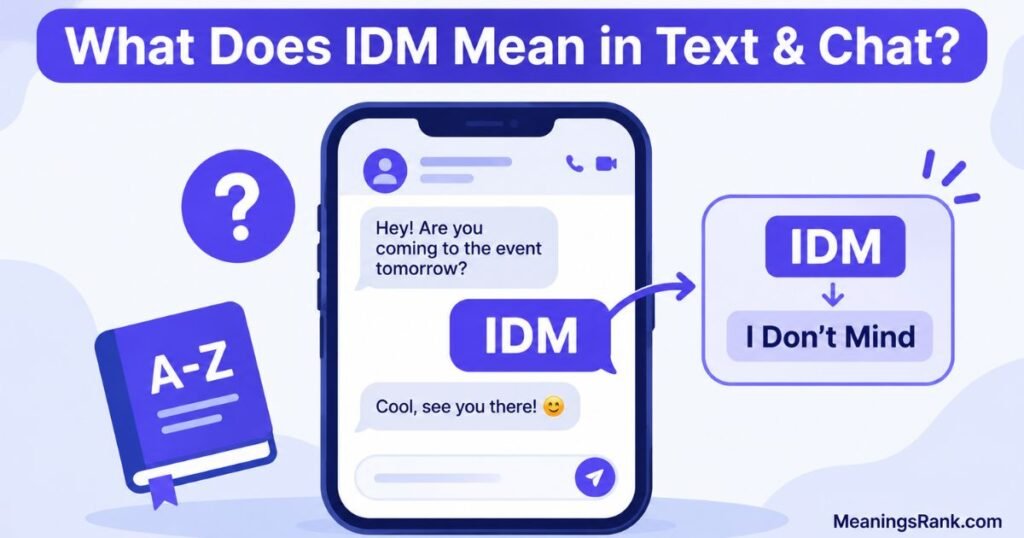
IDM stands for “I Don’t Mind.” It’s a quick way of telling someone you’re okay with whatever option they’re suggesting. Think of it as a laid-back cousin of “sure” or “either way works for me.”
People use IDM when they genuinely have no strong preference. If a friend asks where to eat and you reply “IDM,” you’re basically saying you’ll go along with their choice. It’s casual, friendly, and doesn’t require much thought to type out.
This abbreviation is especially common in group chats where decisions need to happen fast. Instead of typing a full sentence, someone just drops “IDM” and the conversation moves on.
IDM Full Form, Meaning & What It Stands For
The full form of IDM is:
- I – I
- D – Don’t
- M – Mind
So the complete phrase is “I Don’t Mind.” It’s used to express agreement, flexibility, or a lack of strong opinion about a topic being discussed.
It’s worth noting that IDM is mostly a British and Commonwealth English expression. In American English, people often say “I don’t care” or “I’m fine with that” instead, which is why IDM shows up more frequently in chats from the UK, Australia, India, and other English-speaking regions outside the US.
Origin, History & First Known Use of IDM
IDM isn’t a brand-new invention from social media. The phrase “I don’t mind” has been part of everyday British English speech for generations, long before texting existed. People said it out loud when agreeing to plans, and it naturally carried that same casual, easygoing tone.
When texting became popular in the early 2000s, character limits on SMS messages pushed people to shorten common phrases. “I don’t mind” became “IDM” for the same reason “I don’t know” became “IDK.” As instant messaging apps and social media took over, these abbreviations carried straight into digital chat culture.
There’s no single person or moment credited with inventing IDM. It grew organically the same way most texting slang does, through everyday use, especially among younger texters trying to type faster.
Also Read: IDTS Meaning in Text: The Ultimate Guide to What IDTS Really Means in Chats & Messages
How People Use IDM in Daily Conversations
IDM shows up most often when someone is being asked to choose or decide something. Here are common situations where you’ll see it:
- Choosing a restaurant or food order
- Agreeing on a movie or show to watch
- Deciding on a meeting or hangout time
- Responding to “what do you want to do today?”
- Agreeing to split a bill or task
Example 1:
Friend: “Pizza or burgers tonight?” You: “IDM, whatever you’re craving.”
Example 2:
Coworker: “Can we push the call to 3 PM?” You: “IDM, works fine for me.”
Example 3:
Group chat: “Should we go Friday or Saturday?” Reply: “IDM either day tbh.”
It’s a low-effort, friendly way to keep a conversation moving without overthinking a small decision.
IDM Meaning on WhatsApp, Instagram, TikTok & Snapchat
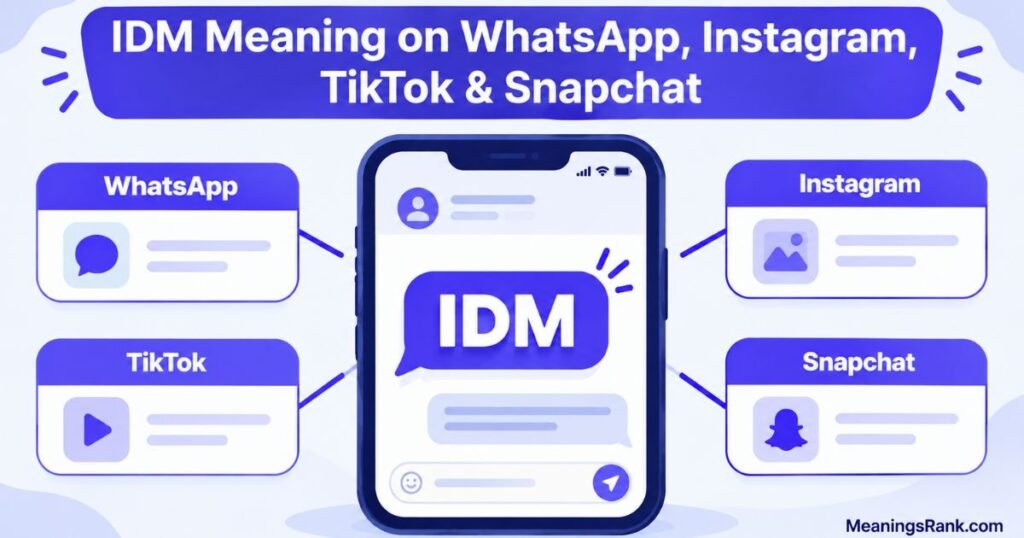
The IDM meaning stays the same across platforms, but how it’s used can shift slightly depending on the app’s culture.
WhatsApp:
Extremely common in group chats, especially when planning outings, dinners, or trips. Since WhatsApp is popular globally, including in the UK and India, IDM appears frequently here.
Instagram:
Often used in DMs when replying to a friend’s suggestion, like picking a caption style or deciding whether to post a photo now or later.
TikTok:
Shows up in comment sections when creators ask followers to vote on content ideas. A comment like “IDM which one you post” is common.
Snapchat:
Used in quick chat replies, especially among teens coordinating plans. Since Snapchat conversations are fast and casual, short forms like IDM fit naturally.
Discord:
In gaming servers, IDM is used when deciding which game mode to play or which team someone joins. Example: “IDM being support this round.”
Other Meanings of IDM in Different Fields
While “I Don’t Mind” is the most common meaning in casual texting, IDM has other meanings depending on the context:
| Field | Meaning of IDM |
| Music | Intelligent Dance Music, an electronic music genre |
| Marketing | Integrated Digital Marketing |
| Technology | Internet Download Manager, a popular download software |
| Healthcare | Insulin Dependent (Diabetes) Mellitus |
| Business | Identity Management (in IT security contexts) |
If you see IDM used outside a personal chat, especially in a professional, tech, or academic setting, it’s worth checking the context because it likely isn’t referring to “I Don’t Mind” at all.
Common Confusions, Mistakes & Misinterpretations of IDM
Because IDM is short and looks similar to other abbreviations, people sometimes misread it. Here are common mix-ups:
Confusing IDM with IDK (“I Don’t Know”)
These have completely different meanings. IDM shows agreement, while IDK shows uncertainty.
Mistaking IDM for IDC (“I Don’t Care”)
IDM is more polite and neutral. IDC can sound dismissive or indifferent, sometimes even rude.
Assuming IDM always means agreement to everything
It only reflects flexibility on the specific question being asked, not blanket approval for anything else in the conversation.
Using IDM in formal emails
This can come across as too casual for professional writing unless the workplace culture is relaxed.
A quick tip: if the context is a decision or choice, IDM almost always means “I don’t mind.” If it’s tech or music-related content, it likely means something else entirely.
Also Read: RS Meaning in Text: The Ultimate Guide to Its Real Meaning in Chat & Social Media
Similar Terms, Alternatives & Related Slang
If you want to mix up your texting style, here are alternatives that carry a similar meaning to IDM:
- IDC = I Don’t Care
- NVM = Never Mind
- W/E =Whatever
- UTM = Up To Me/You (variation used regionally)
- Either way = Full phrase version
- Your call = Hands the decision over
- All good = Shows general agreement
These terms aren’t identical in tone. Some, like IDC, can sound a bit blunt, while “your call” feels warmer and more considerate.
IDM vs. IDK and IDC: What’s the Difference?
These three abbreviations get mixed up a lot, so here’s a clear breakdown.
| Abbreviation | Full Form | Meaning | Tone |
| IDM | I Don’t Mind | Shows flexibility, agreeable to options | Neutral, friendly |
| IDK | I Don’t Know | Shows uncertainty or lack of information | Neutral |
| IDC | I Don’t Care | Shows indifference, sometimes dismissive | Can sound blunt |
Example comparison:
Question: “Should we watch a comedy or horror movie?”
- IDM reply: “IDM, pick whichever you like.”
- IDK reply: “IDK, I haven’t seen either genre in a while.”
- IDC reply: “IDC, just choose something.”
Notice how IDM sounds warmer and more cooperative compared to IDC, even though both technically mean the person has no strong preference.
Is IDM Formal or Informal?
IDM is strictly informal. It belongs in text messages, DMs, and casual group chats, not in emails, reports, or professional documents.
That said, some relaxed workplace chat tools like Slack or Microsoft Teams see IDM used between coworkers who have a friendly, informal relationship. Even then, it’s best used in quick back-and-forth messages rather than official communication.
When IDM is appropriate:
- Texting friends or family
- Casual social media DMs
- Informal workplace chats with close teammates
- Gaming and Discord conversations
When to avoid IDM:
- Client emails
- Job applications or interviews
- Formal reports or documentation
- First-time professional conversations
IDM Examples in Real Chat Conversations
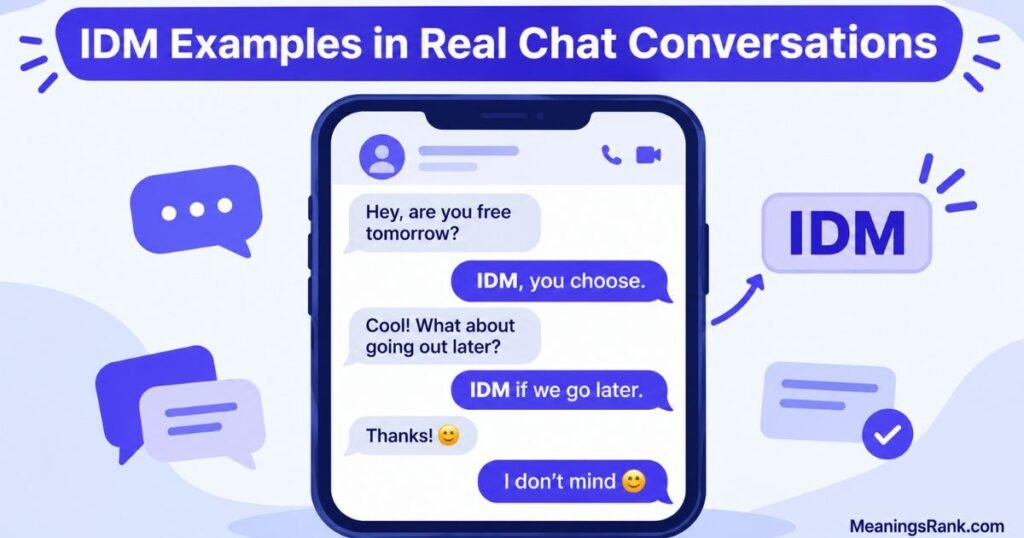
Here are more natural examples showing IDM in action across different settings.
Texting a friend:
“Hey, want to grab coffee or just chill at my place?” “IDM tbh, coffee sounds nice though.”
Instagram DM:
“Should I post the beach pic or the sunset one first?” “IDM, both are fire honestly.”
Discord gaming chat:
“You want mid lane or jungle this game?” “IDM, I’ll take whatever’s free.”
Workplace Slack message:
“Can we reschedule standup to 10 instead of 9:30?” “IDM, either time works for me.”
Snapchat quick reply:
“Movie night Friday or Saturday?” “IDM, you pick lol.”
These examples show how IDM naturally fits into fast, casual replies without needing extra explanation.
How to Reply When Someone Says “IDM”
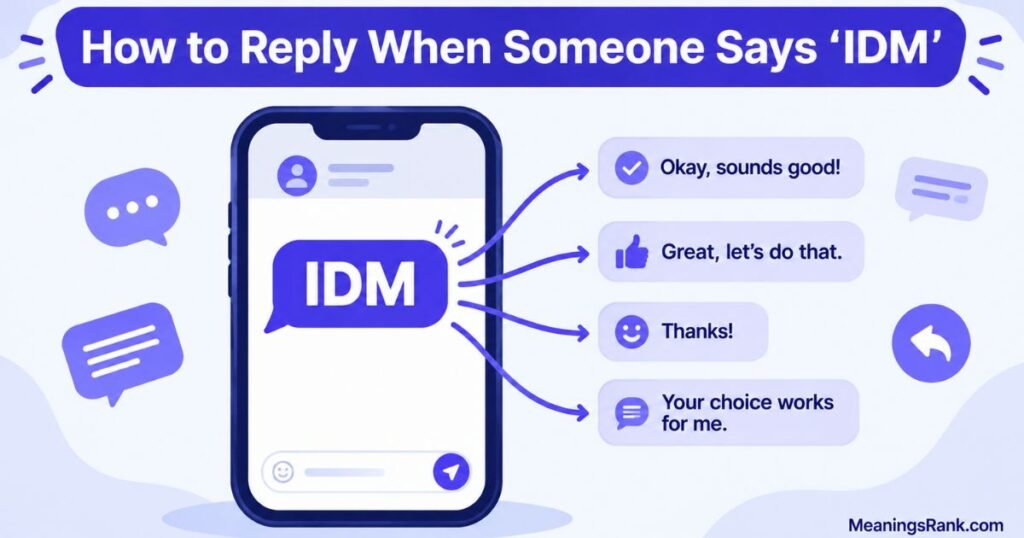
If someone texts you “IDM,” it usually means the decision is now back in your hands. Here’s how you can respond:
Make the choice yourself:
“Okay cool, let’s do pizza then.”
Offer another option:
“IDM either, how about we try that new place instead?”
Confirm their flexibility:
“Are you sure? I don’t want to pick if you have a preference.”
Keep it moving:
“Alright, Saturday it is.”
The key is recognizing that “IDM” hands you the decision-making role, so it’s usually polite to actually make a choice rather than bouncing it back and forth endlessly.
Is IDM Still Popular? Trends & Online Usage
IDM remains a steady, commonly used abbreviation, especially in British, Australian, Indian, and South African English-speaking online communities. While it hasn’t gone viral like newer slang terms, it has stayed relevant because it fills a simple, everyday communication need.
Search interest and usage of IDM tend to be consistent rather than trending in spikes. It’s not tied to a meme, challenge, or viral moment, which actually helps it stay in steady use over the years. Younger texters continue to use it in fast-paced apps like Snapchat and Discord, while older users still use the full phrase “I don’t mind” more often in emails and formal texts.
Compared to trendier slang, IDM is more of a reliable, background term. It’s not flashy, but it’s practical, which is exactly why it hasn’t disappeared from everyday chat.
Quick Facts About IDM
- Full form: I Don’t Mind
- Category: Chat and texting abbreviation
- Tone: Casual, friendly, neutral
- Common platforms: WhatsApp, Instagram, Snapchat, Discord
- Region: More common in UK, Australia, India than in the US
- Other meanings: Music genre, download software, digital marketing term
- Formality: Informal only
- Opposite meaning: IDC (I Don’t Care), which can sound more dismissive
Also Read: DW Meaning in Text: What It Means, How to Use It, and How to Reply (2026 Guide)
FAQs
What does IDM mean from a girl or guy in texting?
It means “I don’t mind,” showing they’re okay with any option.
Is IDM the same as IDC in text messages?
No, IDM is friendlier while IDC can sound indifferent.
Can I use IDM in a work email?
It’s best avoided in formal emails; use “I don’t mind” instead.
Does IDM always mean full agreement with everything?
No, it only applies to the specific question or choice asked.
Why do British people use IDM more than Americans?
“I don’t mind” is more common phrasing in British English generally.
Is IDM used in gaming chats like Discord?
Yes, it’s common when choosing roles, teams, or game modes.
Conclusion
At the end of the day, IDM meaning in text comes down to one simple idea: flexibility. When someone types “IDM,” they’re telling you they’re comfortable with whatever choice gets made, whether that’s picking a restaurant, choosing a movie, or deciding on a meeting time. It’s casual, friendly, and shows up everywhere from WhatsApp chats to Discord gaming sessions. While it has other meanings in fields like music and technology, its everyday use in texting almost always points back to “I don’t mind.” Now that you know the full meaning, origin, and how to reply when it shows up in your own chats, you’ll never be confused by those three little letters again.