
You’re scrolling through a TikTok caption or a busy group chat, and you spot two small letters at the start of a message: “TW: violence.” You pause. Did you miss something?
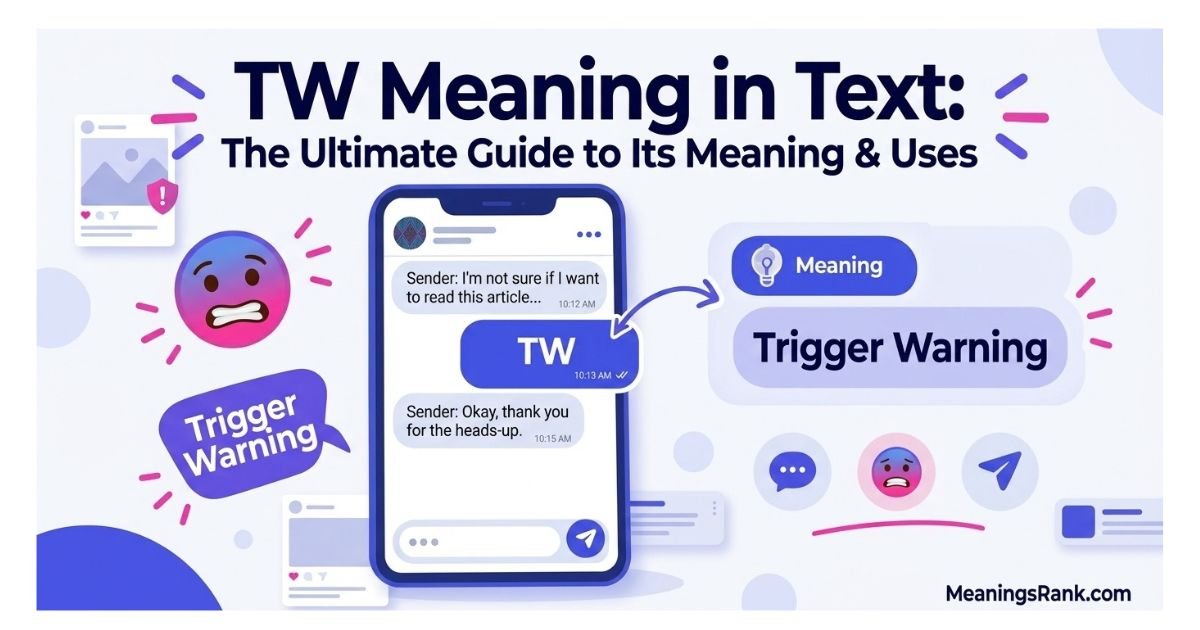
You didn’t. That’s the TW meaning in text. It stands for trigger warning, a quick heads-up that a message, post, or video contains something that could upset people. It lets readers choose what to do next. They can keep going, skip it, or come back when they feel ready.
You’ll see TW on Instagram, Snapchat, WhatsApp, Discord, and even in some work chats. In this guide, you’ll learn what it stands for, where it came from, how it differs from CW, and how to use it without sounding awkward. You’ll also get real examples you can copy.
What Does TW Mean in Text?
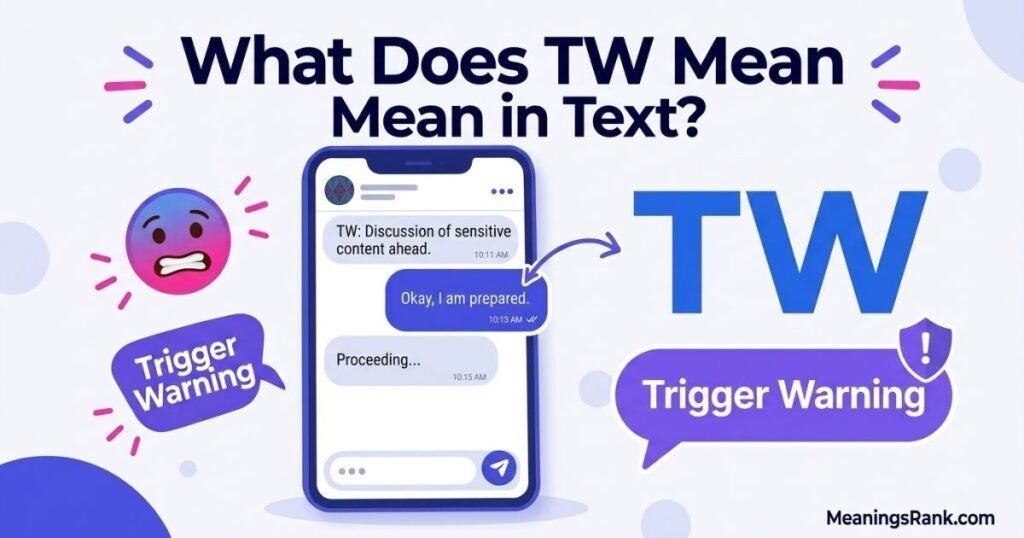
TW means “trigger warning” in text. It’s a short label people put before content that might upset, scare, or remind someone of a painful experience.
Think of it like a “wet floor” sign. The sign doesn’t stop you from walking. It just lets you step with care.
The Short Answer
When you see TW in a chat or caption, read it as: “Heads-up, the next part covers a heavy topic.” The topic usually follows right after, like “TW: car accident” or “tw // blood.”
How TW Usually Looks
People write it in a few different ways:
- TW: self-harm
- tw // spiders
- TW blood
- (tw: food talk)
The style changes from person to person. The meaning stays the same.
What Does TW Stand For?
TW stands for trigger warning. Both words carry weight, so let’s break them down.
What Is a “Trigger”?
A trigger is anything that sets off a strong emotional or physical reaction. For someone who has been through trauma, a trigger can bring back scary memories, cause panic, or make them feel unsafe. It might be a word, an image, a sound, or a whole topic.
Triggers are personal. Something that hits one person hard may not bother another person at all.
What Is a “Warning”?
The warning is a notice given before the content, not after. Its job is simple. It gives people a moment to get ready, or a chance to skip it.
Is It TW or tw?
Both are fine. Capital letters look a bit more serious. Lowercase is common on TikTok, Tumblr, and Discord. Some people add a colon, slashes, or brackets. Nobody polices the format. Just make sure it’s easy to see and easy to understand.
Also Read: What Does NSFW Mean in Text? The Ultimate Guide to This Important Internet Warning
Where Did TW Come From? A Quick Origin Story
It’s hard to point to the very first use. TW grew out of online communities, not from one company or one person. Still, the general story is clear.
Early Online Roots
In the early 2000s, feminist blogs and online forums began adding warnings before posts about sexual violence, abuse, and other painful topics. Many readers were survivors. They asked writers to flag heavy posts so they could read them when they felt ready.
How Tumblr and Social Media Spread It
In the 2010s, blogging sites like Tumblr helped the habit spread far beyond those first communities. Users tagged posts with warnings and even used tools to hide tagged content. From there, the habit moved to Twitter, Instagram, TikTok, Discord, and private group chats.
The short form “TW” caught on because online writing is fast. Two letters do the job of two words.
Why It’s Still Debated
The idea later moved into college classrooms and news sites, and people started arguing about it. Some say warnings are kind and help people protect their mental health. Others worry they can make people more anxious or encourage avoidance.
Research so far is mixed. Some studies suggest warnings don’t reduce distress much and may slightly raise worry before reading. Other people say warnings help them feel respected and in control. Both views are part of the conversation today.
How Is TW Used in Text and Social Media?
In short, TW goes before the sensitive part. The writer adds a short label naming the topic, so readers know what’s coming.
The Basic Format
The simple formula is: TW + topic + a little space.
TW: hospital talk . . . Okay, so my day was wild…
The blank lines matter. They stop the sensitive part from showing up in a preview.
Platform-by-Platform Use
- WhatsApp and text messages: Type it at the start of the message. Example: “TW: breakup talk. Can I vent?”
- Instagram: Put it at the start of the caption, on the first slide of a carousel, or in the text of a Story.
- Snapchat: Add it as on-screen text on the Snap, or before a long chat message.
- TikTok: Show it as on-screen text in the first seconds, and repeat it in the caption.
- Discord: Write it in the message, then hide the content with a spoiler tag, like this: ||text||.
- Gaming chats: Drop a quick “tw: gore” before sharing a clip.
Common Topics That Get a TW Label
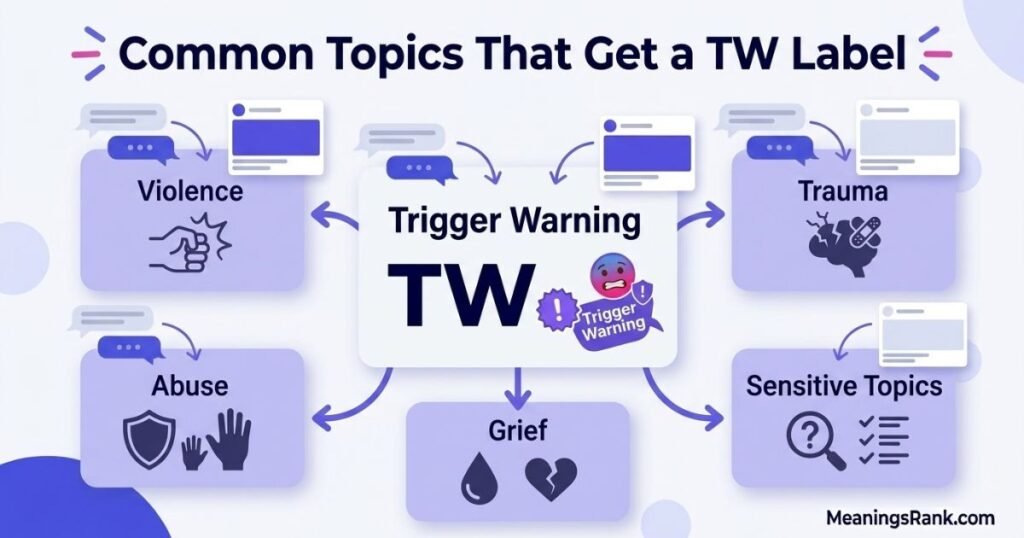
There’s no official list. Still, some topics come up again and again.
Topics People Label Most
- Violence, gore, and blood
- Death, grief, and suicide
- Self-harm
- Sexual assault and abuse
- Eating disorders, dieting talk, and weight numbers
- Drug use and addiction
- Racism, hate speech, and slurs
- War, terrorism, and natural disasters
- Pregnancy loss
- Needles, surgery, and medical procedures
Everyday Triggers People Also Flag
Some warnings cover things that seem small but matter a lot to the people affected:
- Spiders and insects
- Flashing lights
- Loud noises
- Vomiting or choking
- Animal death
- Food talk
- Heights
Why the List Keeps Changing
Every community has its own needs. A gaming server may label jump scares. A recovery group may label weight talk. You can’t guess every trigger, so label what you know could be heavy, and listen when your audience tells you more.
TW vs. CW: What Is the Difference?
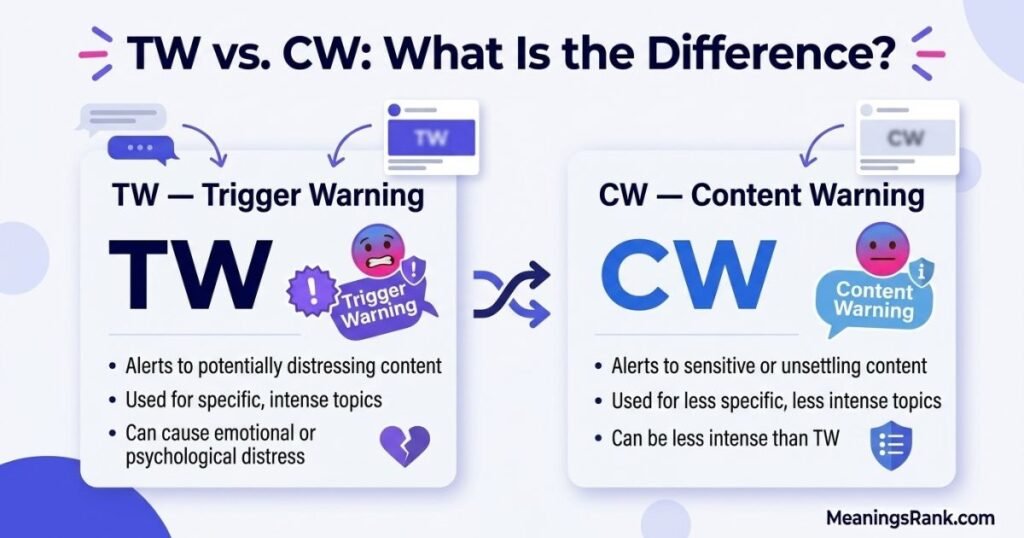
You’ll often see TW and CW side by side. CW means content warning. Here’s how they compare.
| Feature | TW (Trigger Warning) | CW (Content Warning) |
| Full form | Trigger warning | Content warning |
| Main focus | Content that may set off trauma or panic | Any content some people may want to avoid |
| Typical topics | Abuse, assault, self-harm, death | The same topics, plus gore, swearing, and other sensitive themes |
| Tone | More tied to trauma | Broader and more general |
| Where you’ll see it | Tumblr, TikTok, Discord, group chats | The same places, plus news sites, schools, and streaming |
| Example | TW: sexual assault | CW: violence |
The Main Difference
CW is the bigger umbrella. TW is narrower and points to trauma. In real life, though, most people use them as if they mean the same thing.
Why Some People Prefer CW
“Trigger” comes from mental health language, so some people feel it’s too specific. CW feels more open. Many schools and organizations also choose “content warning” because it covers a wider range of material.
What About CN?
You might also see CN, short for content note. It’s a softer version. “CN: mentions of divorce” says something like “this is here if you want to know,” without sounding like an alarm.
Does TW Have Other Meanings in Text?
Yes, but trigger warning is by far the most common. Here are the other meanings you might run into.
| Meaning | Where You’ll See It | Example |
| Taiwan | Country codes and web addresses | “Flights to TW are cheap in May.” |
| Older posts and profiles | “Follow me on TW.” | |
| Total War | Gaming | “Playing TW: Warhammer tonight.” |
| Teamwork | Work chats and sports | “TW makes the dream work.” |
| This week | Work planning (rare) | “Report is due TW.” |
| Terawatt | Science and energy | “The grid produced 1 TW.” |
How to Tell Which One Someone Means
Look at where TW sits and what surrounds it.
- If it’s at the start of a post, followed by a colon and a topic, it’s almost always a trigger warning.
- If it’s in the middle of a sentence next to a place, a game, or a number, it likely means something else.
- If you’re still unsure, just ask. A quick “TW as in trigger warning?” saves confusion.
Real-Life Examples of TW in Text and Social Media
Here’s how TW shows up in everyday conversations.
Text Messages and WhatsApp
Mia: TW: family argument. Can I vent for a sec?
Sam: Yeah, go ahead. I’m here.
This is one of the kindest uses of TW. Mia asks before dumping a heavy story, and Sam gets to say yes.
TW: hospital photos. Sharing my recovery story. Swipe only if you’re comfortable 💛
The warning sits at the top, and the first slide carries no images. People can decide before they swipe.
Also Read: FOMO Meaning in Text: What It Means, How People Use It & How to Reply (2026 Guide)
Snapchat
A user sends a Snap with the on-screen text “tw // surgery scar” over a plain background first. Friends who don’t want to look can skip it.
TikTok
A creator opens a video with the text “TW: mention of eating disorders” on screen for the first three seconds. The caption repeats it. Viewers can scroll away before the topic begins.
Discord and Gaming
Player1: tw: gore. Sharing the boss fight clip in spoilers.
Player2: Thanks for the heads-up, I’ll skip it.
Gaming chats often use TW for jump scares, blood, or scary sounds. It keeps horror-game servers friendly for everyone.
Workplace Chat
TW is less common at work, but you may see it in Slack or Teams, especially in HR or wellness channels.
“Quick note before Friday’s call: we’ll discuss a customer injury report. Feel free to step out if you need to.”
Notice that this message doesn’t use the letters TW at all. Many workplaces prefer plain words. The idea is the same.
How to Use TW Correctly (And What to Avoid)
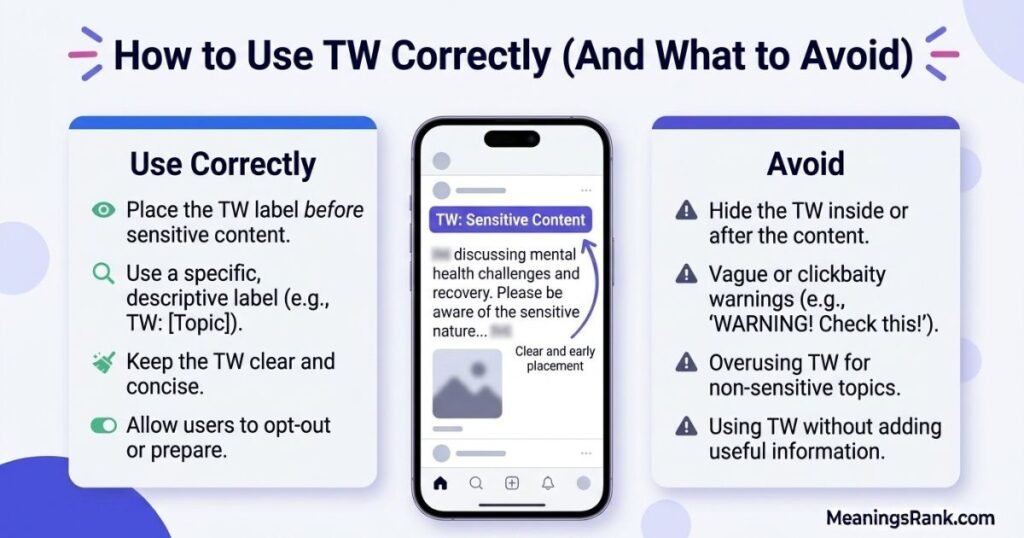
Using TW well takes a few seconds. Here’s how to do it.
Step-by-Step
- Decide if the content is sensitive. Ask yourself if it could upset someone who reads it without warning.
- Put TW at the very start. A warning at the end is too late.
- Name the topic clearly. Write “TW: suicide mention” instead of “TW: bad stuff.”
- Keep the label short. A few words is enough.
- Add space. Use line breaks or a spoiler tag so the content doesn’t show in a preview.
Handy Tips
- Be specific but not graphic. Name the topic. Don’t describe it.
- Use platform tools too. Many apps have sensitive-content settings, blur options, or spoiler tags. They work well alongside TW.
- Warn on videos and images, not only text. Use on-screen text and a caption.
Common Mistakes People Make With TW
Most mistakes come from rushing. Here are the ones to watch for.
Putting the Warning After the Content
A warning that comes too late doesn’t warn anyone. Always place it first.
Being Too Vague
“TW: heavy stuff” doesn’t tell people much. They can’t decide if it’s something they can handle. A clear label like “TW: death of a pet” is much more useful.
Describing the Trigger in Graphic Detail
The label itself shouldn’t cause harm. “TW: assault” is enough. You don’t need to add details in the warning.
Using TW as a Joke or for Attention
Some people add “tw” to jokes, memes, or dramatic captions. This can make the label feel less serious and confuse people who rely on it.
Labeling Everything
If every message has a TW, people start to ignore it. Save it for content that truly needs it.
Forgetting Images and Videos
A TW in the caption won’t help if the image shows up first. Blur the picture or add a cover screen when you can.
Should You Always Use TW or Is It Optional?
In casual life, TW is optional. No law or app rule says you must add one to every chat. But it’s a thoughtful habit, and some places do require it.
When You Should Use It
- You’re sharing a heavy personal story in a group chat.
- You’re posting to a large audience you don’t know well.
- A community or server has a rule about it.
- You’re sharing news or videos that show violence or injury.
- You’re about to send a long message about grief or trauma to a friend who hasn’t agreed to hear it.
When It’s Not Needed
- You’re chatting about everyday things with a close friend.
- The topic is the whole point of the space, like a support group where everyone has agreed to talk about it.
- The other person has already said, “Go ahead, I’m ready.”
A Simple Test
Picture someone scrolling and seeing your message with no warning. Could it hit them hard? If the answer is “maybe,” add a TW. It only takes two letters.
TW in Text vs. TW in Formal Writing
The letters TW belong to casual online talk. Formal writing uses a different style.
| Text and Social Media | Formal Writing | |
| Form | TW, tw, TW: | Content warning or content note, written out |
| Tone | Casual and quick | Polite and professional |
| Example | tw: death | “Note: this article discusses death and grief.” |
| Where | Chats, captions, comments | Emails, reports, syllabi, articles |
In Schools and Workplaces
Teachers often add a note to a syllabus or before a lesson: “Some readings include descriptions of violence.” Companies may use a line in an email or a slide: “The following report contains descriptions of injury.”
In both cases, the abbreviation is skipped. Not everyone knows what TW means, and a clear sentence avoids confusion.
Sample Formal Phrases
- “Content note: this section discusses…”
- “Please be aware that the following includes…”
- “Sensitive content ahead.”
If you’re writing to clients, professors, or managers, spell it out. It sounds more professional and reaches everyone.
Also Read: AWOL Meaning: The Ultimate Guide to What AWOL Means in Text & Chat
How to Respond to a Trigger Warning
There’s no single right way. What matters is being respectful.
When You See One in a Post
You have three choices: read, skip, or come back later. You don’t have to comment. If you skip it, just scroll on. Avoid replying with things like “this is silly.” Warnings help some people, even if you don’t need one.
When a Friend Sends One in a Chat
Here are a few simple replies:
- “Thanks for the heads-up. I’m ready, go ahead.”
- “I’m not up for that today. Can we talk tomorrow?”
- “Thanks for asking first. I’m here for you.”
Both saying yes and saying “not now” are fine. You’re allowed to protect your own energy.
When Someone Asks You to Add One
Keep it easy: “Sure, thanks for telling me.” Then add it. You don’t have to debate it or explain your opinion.
If a Post Affects You Anyway
Sometimes content upsets you even with a warning, or without one. If that happens, stop reading, take a break, and breathe. Talk to someone you trust. If you’re struggling a lot, consider reaching out to a mental health professional or a support line in your area.
Which Should You Use: TW, CW, or Something Else?
Here’s a quick guide to help you pick the right label.
| Situation | Best Label |
| Trauma topics like abuse, assault, or self-harm | TW or CW |
| Violence, gore, or strong language | CW |
| A mild or general heavy topic | CN |
| Plot reveals | Spoiler alert or a spoiler tag |
| Adult content | NSFW |
| Emails, school, or work | “Content note,” written out |
| You’re not sure who’s reading | “Content warning,” written out |
A Quick Rule of Thumb
Match the label to your audience. Younger social media users usually know both TW and CW. Older readers or professional contacts may not. When you’re unsure, write “Content warning: [topic]” in full.
When Plain Words Work Best
You don’t need a label at all sometimes. A simple sentence can be warm and clear: “Heads up, this next part is about hospital stuff. Skip if you need to.” It feels more human, and everyone understands it.
Frequently Asked Questions About TW
What does TW meaning in text when someone texts it to you?
It means “trigger warning.” The sender is telling you the message or link contains upsetting content, so you can decide whether to read it.
Is TW the same as a content warning?
They’re very close. TW focuses on trauma triggers, while a content warning covers a wider range of sensitive material. Most people use them interchangeably.
Do you have to use TW before every sensitive post?
No, it’s not required in casual chats. But it’s a kind habit, especially for public posts or groups where rules ask for it.
Can TW mean something other than trigger warning?
Yes. It can mean Taiwan, Twitter, Total War, teamwork, or terawatt. Context, like where it sits in the message, tells you which one it is.
How do you write a TW on TikTok or Instagram?
Put “TW: [topic]” at the start of your caption, and add it as on-screen text in videos. Keep the topic short and clear.
Is it rude to ignore someone’s trigger warning?
Not if you simply scroll past. It becomes rude if you mock the warning or share the content after someone asked you not to.
Conclusion
TW meaning in text is simple: it stands for trigger warning, a short label that tells people a heavy topic is coming. It began in online support and blogging communities, grew on Tumblr and other platforms, and now appears in texts, captions, videos, and gaming chats.
Using it well comes down to a few habits. Put the label first, name the topic clearly, add a little space, and skip graphic detail. Use it when it matters, but don’t slap it on everything. And if a friend asks you to add one, just do it.
Not everyone loves the idea, and research on its effects is still mixed. Even so, a quick heads-up is a small act of care. When you’re not sure whether to use TW, CW, or plain words, think about who’s reading and pick the option they’ll understand best. A few seconds of thought can make someone’s day a lot easier.