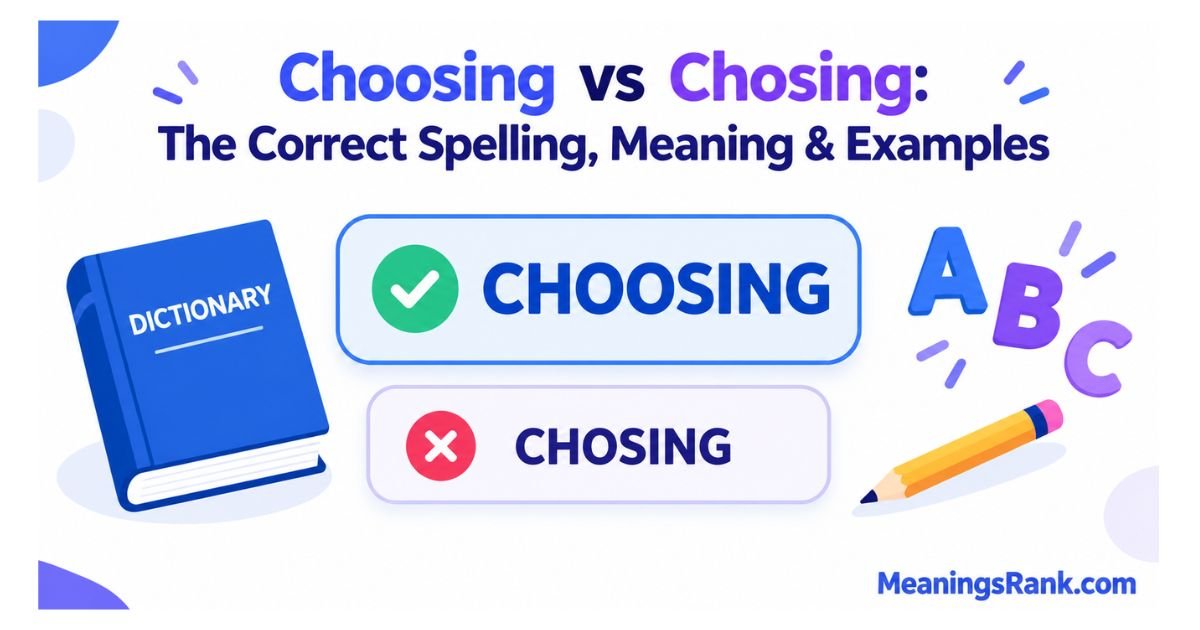

Quick answer: Choosing is the only correct spelling. It is the “-ing” form of the verb choose, and it keeps both O’s. Chosing is a common misspelling and is never correct in standard English.
You are typing a quick email, a caption, or a school essay. You write “I am chosing the blue one,” and something looks off. Red squiggle. A tiny pause. You wonder whether a letter is missing.
It is. The correct word is choosing, and the confusion is easy to understand. English has a well-known rule that says to drop a silent E before adding “-ing.” Many writers apply that rule but remove the wrong letter, or they mix up choose with its past tense chose, which has only one O.
This guide clears up the whole word family: choose, chose, choosing, and chosen. You will learn what the word means, why “chosing” fails, how choosing vs chosing behaves in a sentence, and how to remember the spelling for good. Spelling slips in professional writing can cost you credibility, so a few minutes here is time well spent.
What Does Choosing Mean?
Choosing means making a decision between two or more options. It describes the act or process of deciding which person, thing, or path you prefer.
It can work as the ongoing action of a verb (“She is choosing a college”) or as a noun that names the activity itself (“Choosing takes patience”). In both cases, the core idea is the same: you weigh your options, and you commit to one.
You will see the word in everyday situations such as choosing a meal, choosing a career, or choosing your words carefully. The meaning is neutral, so it fits formal and informal writing equally well.
Choosing vs Chosing: Which Spelling Is Correct?
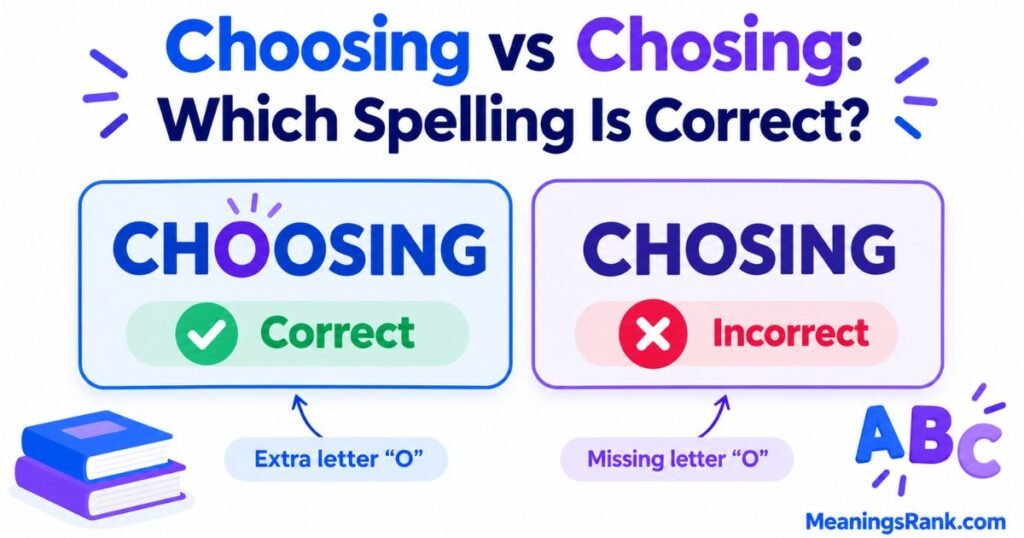
Only choosing is correct. Major dictionaries, including Merriam-Webster, Oxford, and Cambridge, list choosing and do not recognize chosing as a valid English word. Style guides such as the Chicago Manual of Style follow the same standard.
If you need a one-line rule, use this: spell choosing with two O’s, exactly like the base verb choose. Whenever you see “chosing” in a draft, treat it as a typo and fix it.
Main Differences Between Choosing and Chosing
The comparison is short because only one of these words actually exists.
| Feature | Choosing | Chosing |
| Status | Correct standard spelling | Incorrect misspelling |
| Root verb | choose (two O’s) | Seems to copy chose (one O) |
| Pronunciation | /ˈtʃuːzɪŋ/ (“CHOO-zing”) | Would sound like “CHOH-zing” |
| Found in dictionaries | Yes | No |
| Safe for formal writing | Yes | No |
The O count also hints at the sound. A double O usually signals the long “oo” sound, as in moon or choose. A single O followed by a consonant and a silent E usually signals the long “oh” sound, as in rose or chose.
Why Is Chosing Incorrect?
“Chosing” breaks the spelling logic of the verb it comes from. Here is the chain.
The base verb is choose. To form the present participle, you add “-ing.” English has a standard rule for verbs that end in a silent E: drop the E, then add the ending. That gives us make → making, write → writing, and choose → choosing.
Notice what changes. The silent E disappears. The double O stays exactly where it is. Writers who type “chosing” have deleted an O instead of the E, most likely because they are echoing the past tense chose.
There is a sound problem too. In “chosing,” the single O would make the word rhyme with “posing.” The real word rhymes with “bruising.” Your ear, as much as your eye, tells you something is wrong.
Verb Forms: Choose, Chose, Choosing, and Chosen
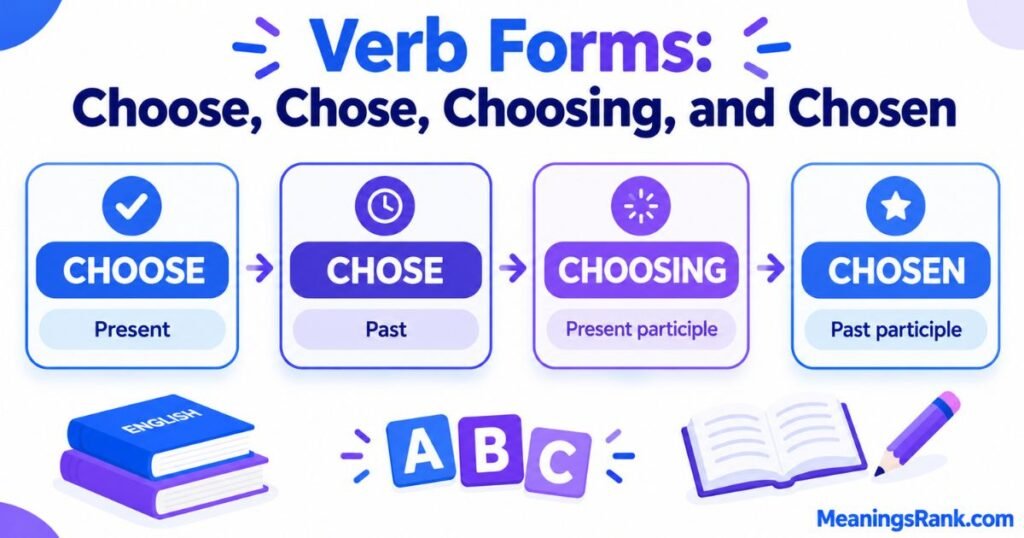
Choose is an irregular verb, which means it does not follow the usual “add -ed” pattern. Learning its four forms side by side is the fastest way to stop mixing them up.
| Form | Name | Example Sentence |
| choose | Base form / present tense | I choose the red jacket. |
| chose | Simple past tense | Yesterday, I chose the red jacket. |
| choosing | Present participle / gerund | I am choosing a jacket right now. |
| chosen | Past participle | I have chosen the red jacket. |
Two quick notes. Chose stands alone for past events and never needs a helping verb. Chosen usually follows a helper such as has, have, had, or was, or it appears as an adjective, as in “the chosen one.”
Parts of Speech: Is Choosing a Verb or a Noun?
It can be either, depending on how the sentence is built. That flexibility is part of why choosing appears so often.
As a verb (present participle): It pairs with a form of to be to show an action in progress.
- They are choosing a venue for the wedding.
As a noun (gerund): It acts as the subject or object of a clause.
- Choosing a password is harder than it looks.
- She dislikes choosing between two good options.
As an adjective (participial): This use is less common, but it works in descriptive phrases.
- The choosing committee will announce its pick on Friday.
Here is a simple test. If the word names the activity itself, it is a noun (a gerund). If it describes an action that is happening, it is a verb. The spelling is identical in every role.
Read More: Batchelor vs Bachelor: Which Spelling Is Correct? Meaning & Examples (2026)
Choosing vs Selecting vs Picking: Understanding the Differences
All three words point to making a decision, but they carry different shades of meaning and tone.
| Word | Core Idea | Tone | Example |
| Choosing | Weighing options and deciding | Neutral, personal | She is choosing a major. |
| Selecting | Taking one from a defined set, often carefully | Formal, technical | Please select a payment method. |
| Picking | Making a quick, casual decision | Informal, relaxed | Let’s pick a movie. |
Choosing works almost anywhere. Selecting suits forms, menus, and professional writing, because it implies a structured list. Picking feels spontaneous and conversational. When you are unsure, choosing is the safest all-purpose option.
How to Use Choosing in Sentences
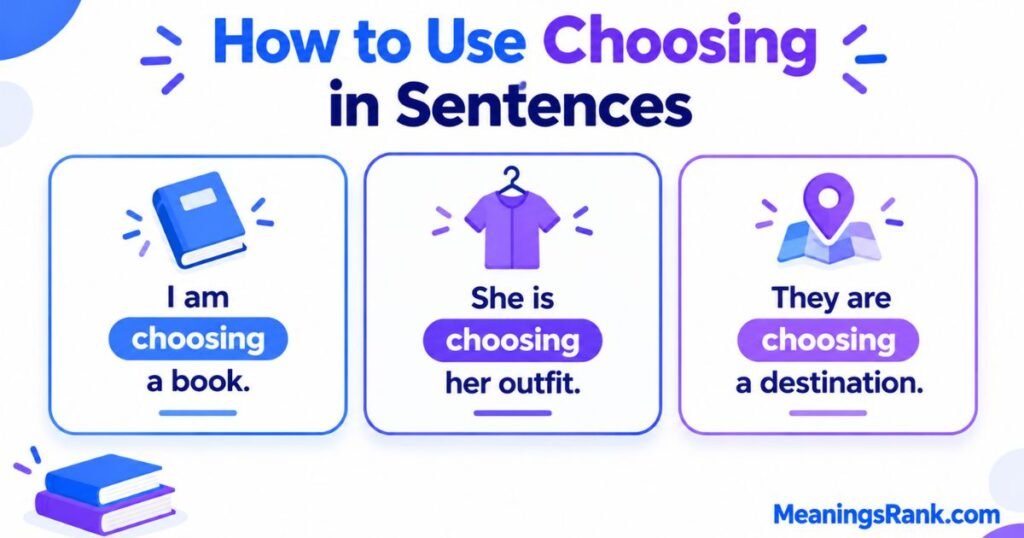
Follow these usage rules, and your sentences will stay clean.
- Use a helping verb for continuous action. Pair choosing with am, is, are, was, were, or been: We were choosing paint colors when the phone rang.
- Treat it as a noun at the start of a sentence. A gerund phrase can serve as the subject: Choosing wisely saves time later.
- Follow it with an object or a preposition. You can choose something or choose between options: He is choosing between two job offers.
- Mind your punctuation. When a choosing phrase opens a sentence, add a comma after it: After choosing a seat, she opened her laptop.
Because choosing is a participle, the phrase must also match the subject of the main clause. “Choosing the wrong exit, the road took us nowhere” is a dangling modifier, since the road did not choose anything. “Choosing the wrong exit, we ended up lost” has clear clause structure and works well.
Read More: Accross vs Across: Discover the Correct Spelling, Meaning & Usage (2026)
Real-World Examples of Choosing
Seeing the word in context makes the rule stick. Here are correct and incorrect versions across different settings.
| Context | Correct | Incorrect |
| Everyday speech | I’m choosing pizza tonight. | I’m chosing pizza tonight. |
| Workplace email | We are choosing a vendor by Friday. | We are chosing a vendor by Friday. |
| Academic writing | Choosing a research method shapes the whole study. | Chosing a research method shapes the whole study. |
| Social media | Choosing peace over drama today. | Chosing peace over drama today. |
| Formal | The board is choosing a new director. | The board is chosing a new director. |
| Informal | We’re choosing the next movie. | We’re chosing the next movie. |
Notice that the formal and informal examples keep the same spelling. Register changes your vocabulary and tone, but it never changes the correct spelling.
Common Spelling Mistakes and How to Avoid Them
Most errors in this word family come from three habits.
- Copying the past tense. Writers see chose (one O) and carry that shape into chosing. Fix: remember that choosing comes from choose, not chose.
- Over-applying the silent-E rule. The rule says to drop the E. It never says to drop any other letter.
- Trusting speed over sight. Fast typing and autocorrect fatigue let “chosing” slip through. Fix: reread your final draft once with this word family in mind.
A small habit helps. Whenever you type any form of this verb, glance at the double O. If you see two O’s in choose, choosing, and choosy, you are safe. If a word that is not in the past tense shows only one O, stop and check it.
One edge case is worth knowing: choosy (meaning “picky”) is the standard spelling, and choosey is a less common variant. Use choosy in formal writing.
Chosen vs Choosen: A Related Spelling Mistake
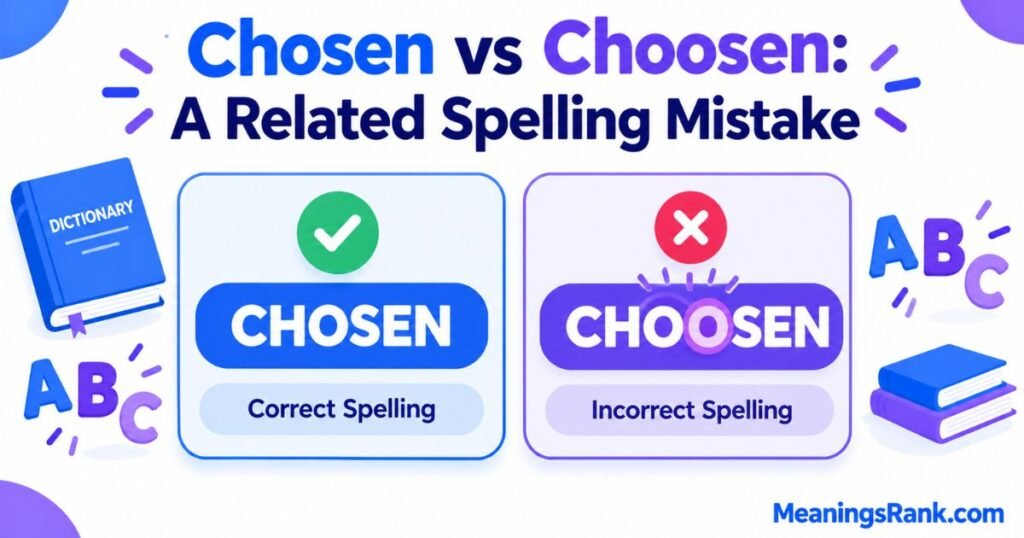
The same confusion creates another popular error: “choosen.” It goes wrong in the opposite direction. Writers add an extra O because they are thinking of choose.
The past participle is chosen, with one O, just like chose. Both past forms are short, and both lose the second O.
| Correct | Incorrect |
| She has chosen a name. | She has choosen a name. |
| The chosen candidate starts Monday. | The choosen candidate starts Monday. |
Here is the pattern to keep: double O for the present side (choose, choosing) and single O for the past side (chose, chosen). That one rule fixes nearly every error in the family.
How to Pronounce Choosing
Say it as CHOO-zing, with the phonetic spelling /ˈtʃuːzɪŋ/. The stress falls on the first syllable.
- CHOO rhymes with “too” and “blue.”
- zing rhymes with “ring.”
Do not pronounce it like “CHOH-zing.” That sound belongs to chose, which rhymes with “rose,” and it is the sound the incorrect spelling suggests. Keep the long “oo” sound, and the double O will feel natural.
Memory Tricks to Remember the Correct Spelling
Try this one: “Two O’s make a choice for two.”
Choosing usually means picking between at least two options, and the word carries two O’s. Picture the double O as a pair of circles, two options side by side, waiting for you to decide.
A second trick uses a look-alike pair: lose has one O, and loose has two. If choose ever tempts you to drop an O, remember that it belongs with the double-O group.
For the past forms, flip the idea: “Once you’ve decided, one O is enough.” Chose and chosen describe decisions already made, so they shrink to a single O.
Finally, say the word aloud before you type it. If your mouth makes the “oo” sound, your fingers should type two O’s.
Practice Exercises: Choosing vs Chosing
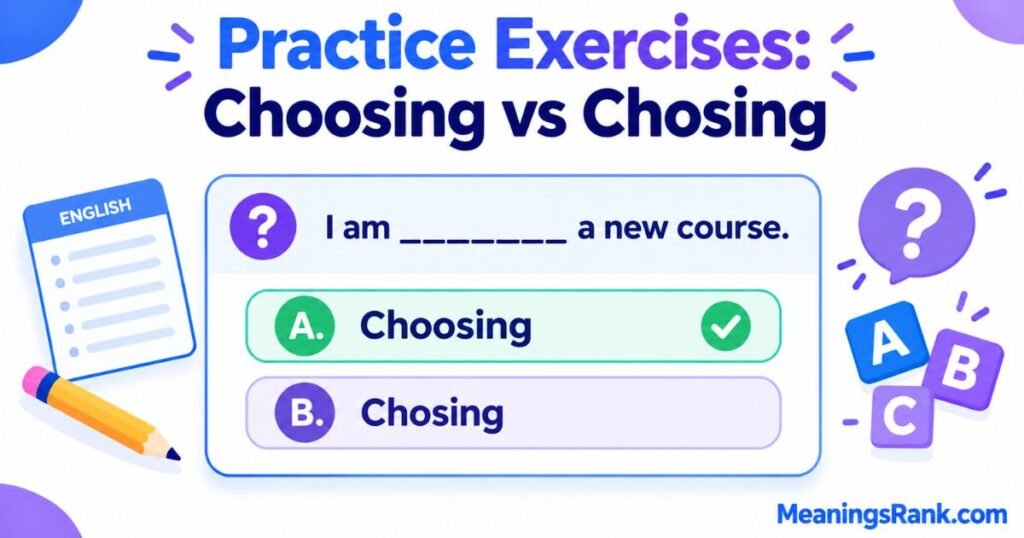
Fill in each blank with choose, chose, choosing, or chosen. Try all five before you check the answer key.
- Right now, I am ________ between tea and coffee.
- Last night, we ________ a movie after twenty minutes of debate.
- She has finally ________ a topic for her thesis.
- Which spelling do you ________: “choosing” or “chosing”?
- ________ a good password is the first step in protecting your account.
Answer Key
- choosing (present continuous, needs “-ing” after am)
- chose (simple past, a finished action)
- chosen (past participle after has)
- choose (base form after do)
- Choosing (gerund acting as the subject of the sentence)
Score 5 out of 5, and the whole word family is under control.
Read More: Nominator vs Nominee: Key Differences, Definitions & Examples (2026)
Key Takeaways: Choosing vs Chosing
- Choosing is correct. Chosing is always a misspelling.
- The verb family is choose, chose, choosing, chosen.
- Double O belongs to the present side (choose, choosing). Single O belongs to the past side (chose, chosen).
- Choosing can act as a verb, a noun, or an adjective.
- “Choosen” is wrong too. The correct past participle is chosen.
- Pronounce it CHOO-zing, not CHOH-zing.
Frequently Asked Questions (FAQs)
Is it choosing or chosing?
The correct spelling is choosing. “Chosing” is a misspelling that does not appear in standard dictionaries.
Why does choosing have two O’s?
It keeps both O’s because it comes from the base verb choose. The silent-E rule removes the final E before “-ing,” and the double O stays untouched.
Is choosing a verb or a noun?
It can be both. As a verb, it shows an action in progress (I am choosing a gift). As a gerund, it works as a noun (Choosing a gift takes time).
What is the past tense of choose?
The simple past tense is chose (I chose the blue one). The past participle is chosen (I have chosen the blue one).
Is “choosen” a real word?
No. “Choosen” is a common misspelling of chosen. Remember that both past forms of this verb have a single O.
What is the difference between choosing and selecting?
Choosing is a neutral, all-purpose word for deciding between options. Selecting sounds more formal and fits structured situations such as forms, menus, and technical instructions.
Conclusion
The spelling question is settled: choosing is correct, and chosing is a mistake. The word comes from the verb choose, so it keeps its double O and only drops the silent E before “-ing.” Remember the pattern of double O for the present side (choose, choosing) and single O for the past side (chose, chosen). That one habit also protects you from the related error “choosen.” Use the “two O’s make a choice for two” memory trick whenever you hesitate, and reread your drafts once before you publish. With these few steps, you will spell every form of this verb with confidence in school, at work, and online.