
You’ve probably seen “POV” pop up everywhere lately on TikTok captions, Instagram reels, group chats, and even in your coworker’s Slack message. If you paused and thought, “wait, what does POV actually mean here?” you’re not alone. POV meaning has grown far beyond its original definition, and it now shows up in dozens of different situations online.
This guide breaks down exactly what POV meaning, where it came from, how people use it across different apps, and how you can use it naturally too. By the end, you’ll never second-guess a POV text again, and you’ll actually understand why this three-letter term took over the internet.
Quick Answer Box
POV stands for “Point of View.” It’s used to describe a situation, video, or story from a specific person’s perspective. Online, POV is most commonly used as a caption starter, like “POV: you just woke up late for work.” It helps the viewer imagine they’re experiencing the moment themselves, almost like they’re standing in someone else’s shoes.
- Full form: Point of View
- Common platforms: TikTok, Instagram, Snapchat, Twitter/X, Discord, texting
- Tone: Casual, creative, storytelling
- Origin: Film and photography terminology
- Popularity: Extremely high, especially in short-form video content
- Best used for: Setting up a relatable scene, not just stating an opinion
What Does POV Mean?
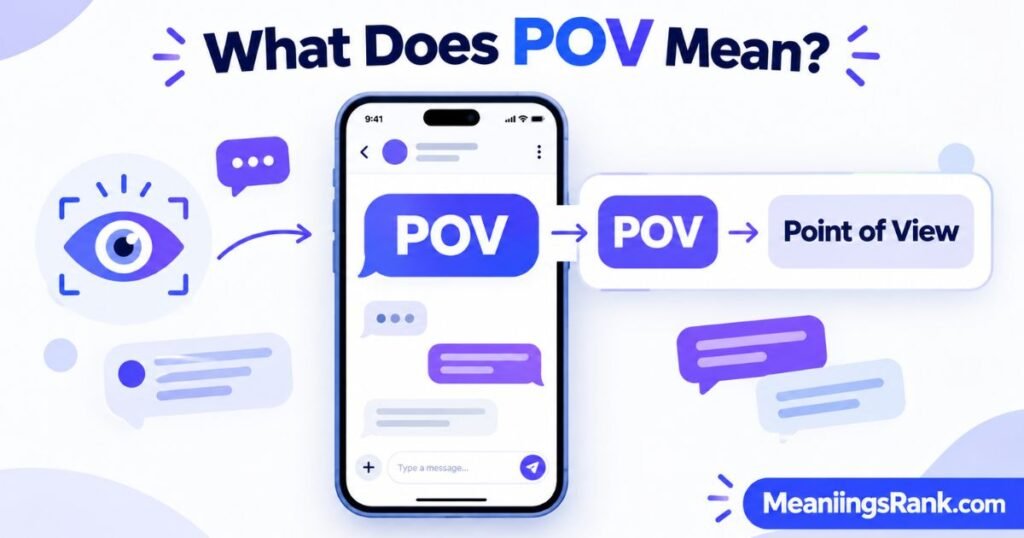
POV simply means “Point of View.” Originally, this term came from filmmaking and photography, where it described a camera angle that showed the audience exactly what a character was seeing. Think of a scene in a movie where the camera becomes the character’s eyes that’s a POV shot. If you’ve ever watched a horror movie where the camera creeps down a hallway as if you’re the one walking, that’s a classic POV technique used to build tension and make the viewer feel present in the moment.
Over time, internet users borrowed this idea and turned it into a creative writing and video tool. Now, when someone writes “POV” online, they’re inviting you to imagine a specific scenario as if it’s happening directly to you. It’s less about literal camera angles and more about storytelling from a first-person perspective. The word itself hasn’t changed, but the way people apply it has stretched far beyond cinema.
For example, someone might post a video captioned “POV: your best friend just told you she’s moving away.” The video then shows a reaction or moment that lets viewers feel like they’re the one hearing that news. This is the core idea behind almost every POV meaning post you’ll come across today it’s an invitation to step into someone else’s shoes for a few seconds.
Where POV Came From
The term has been part of film and photography vocabulary for decades. Directors used “POV shot” to describe scenes filmed from a character’s visual perspective. Video game developers also used POV to describe first-person gameplay, where the player sees the game world through their character’s eyes, much like in shooter games or racing simulators.
Social media took this idea and simplified it. Instead of needing an actual camera trick, creators just add the word “POV” as a caption, and the audience automatically understands they should imagine themselves in that role. This shift happened gradually, starting with early YouTube vlogs and Vine skits, before exploding in popularity on TikTok around 2019 and 2020. Once TikTok’s algorithm started favoring relatable, story-driven content, POV videos became one of the easiest ways for creators to build an audience quickly.
Also Read: RSVP Meaning: The Ultimate Guide to What It Stands For & How to Use It
Why the Term Stuck Around
Language on the internet moves fast, and most slang terms fade within a year or two. POV has stuck around much longer because it’s genuinely useful. It gives people a fast, recognizable way to set up a scenario without writing out a long explanation. Instead of typing “imagine you’re at work and your boss just walked in while you were on a personal call,” someone can simply write “POV: your boss caught you on a personal call.” It’s efficient, visual, and instantly understood by anyone active on social media.
Full Definition
POV (Point of View) refers to the perspective from which something is experienced, told, or shown. In everyday language, it can mean:
- A literal viewpoint → how something looks from a certain angle or position.
- A personal opinion or perspective → “In my POV, that movie was underrated.”
- A storytelling technique → used in videos, memes, and captions to place the viewer inside a specific scenario.
- A camera technique → filming or photographing something as if through someone’s own eyes.
The internet mostly uses the third meaning today. When you see “POV” in a caption, it usually means “imagine you’re in this exact situation right now.”
Dictionaries define POV as an abbreviation for “point of view,” referring to a particular attitude or way of considering a matter. Social slang has expanded that definition into something more visual and immersive, especially on video-based platforms. Grammar-wise, POV is typically followed by a colon and then a short description of the scenario, almost like a mini script direction. This format has become so recognizable that people instantly understand the structure even before reading the rest of the sentence.
POV as a Grammar Pattern
One interesting thing about POV is how consistent its sentence structure has become. Almost every POV post follows the same basic pattern: “POV: [second-person scenario].” This consistency is part of why it works so well. Readers don’t have to guess the format they already know what’s coming the moment they see those three letters followed by a colon. This predictability actually makes POV content easier to scroll through and understand quickly, which matters a lot on fast-paced platforms like TikTok and Instagram Reels.
POV Meaning in Text, Chat & Social Media
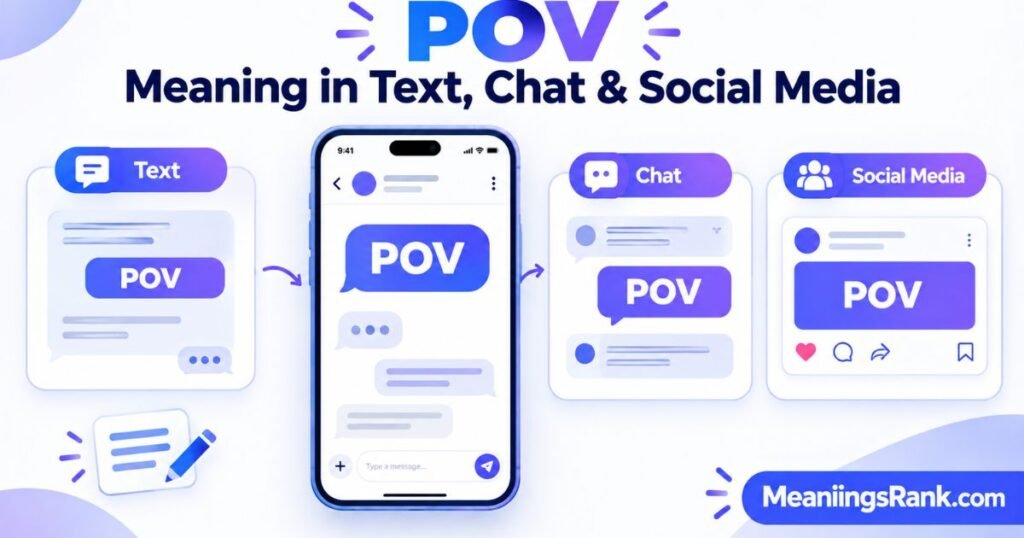
This is where POV gets interesting. The meaning doesn’t change much across platforms, but the way people use it definitely does. Whether you’re scrolling TikTok, texting a friend, or reading a Discord message, POV usually signals one thing: “picture this scenario from this perspective.”
In texting and casual chat, POV meaning is often used humorously or dramatically. Someone might text, “POV: I just spilled coffee on my laptop right before a meeting,” to describe their unlucky morning in a relatable, story-like way. It adds emotion and context without needing a long explanation. Instead of typing out a full paragraph describing a situation, POV lets the sender set a scene quickly, almost like a mini movie trailer, and it works because most people already understand the format from scrolling social media.
This shorthand has become so common that many people use it even outside of video content, simply as a fun way to describe daily life events, awkward moments, relatable struggles, or funny coincidences, turning ordinary texts into something that feels a bit more entertaining and shareable, and it often invites a reply that continues the story rather than a plain yes-or-no answer, which is part of why it keeps conversations going longer than a normal message would.
Here’s how the tone usually shifts by platform:
- Texting: Quick, personal, often funny or dramatic
- Instagram: Aesthetic storytelling, relationship posts, lifestyle content
- TikTok: Skits, acting scenarios, relatable humor
- Snapchat: Everyday moments, inside jokes between friends
- Discord/Gaming: Reaction clips, funny in-game moments
- Twitter/X: Short, witty one-liners that read like tiny stories
Why POV Feels So Relatable
People connect with POV content because it feels personal. Instead of watching someone else’s story from the outside, POV pulls you into the middle of it. That’s why POV videos often get high engagement viewers feel like they’re part of the moment, not just watching it happen to someone else. Psychologically, this taps into something called “perspective-taking,” where imagining yourself in a situation creates a stronger emotional response than simply hearing about it secondhand.
How POV Changed Online Storytelling
Before POV became popular, most social media captions were written in first person or third person, describing events after they happened. POV flipped that around by putting the audience directly into the scene as it unfolds. This small shift changed how creators write captions, plan videos, and even edit content.
Many creators now build entire content styles around POV formats, using them to act out relationship dynamics, customer service situations, or even historical reenactments, all designed to make the viewer feel like an active participant rather than a passive observer.
Context and Usage
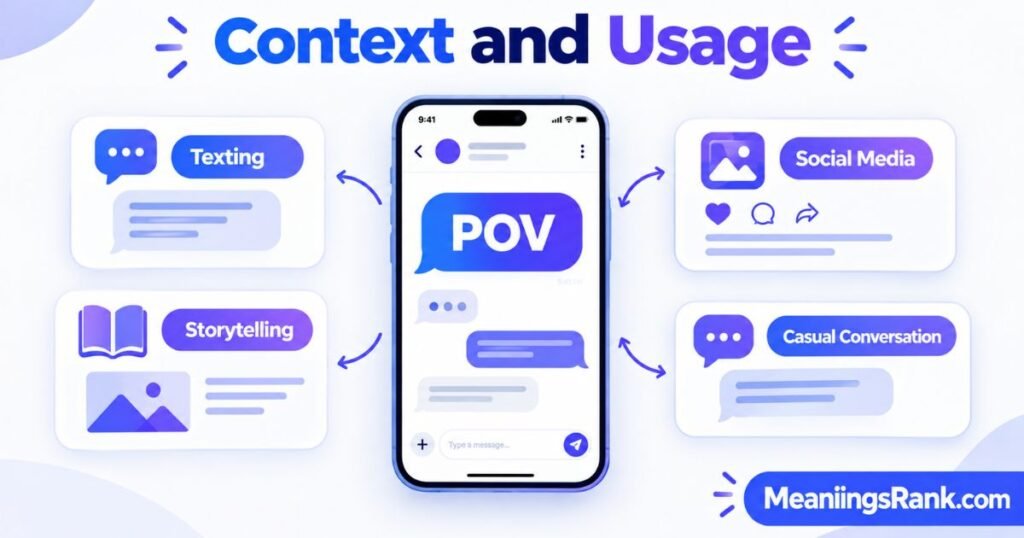
Context matters a lot with POV. The same three letters can shift meaning slightly depending on where and how they’re used.
In Casual Conversations
When friends text each other “POV,” it’s usually playful. It sets up a mini scenario, almost like starting a short story.
Example: “POV: you just realized you left your phone charger at home again.”
In Content Creation
Creators use POV to build immersive skits. A TikTok video might show someone acting out both sides of a conversation, captioned “POV: your mom finds out you skipped class.” These videos often rely on quick costume changes, different camera angles, or exaggerated facial expressions to sell the scenario.
In Professional or Semi-Formal Settings
Occasionally, POV shows up in workplace chats too, but with a slightly different tone. Instead of storytelling, it usually means “from my perspective.”
Example: “POV: as a manager, I think flexible hours actually boost productivity.”
In Gaming
In gaming communities, POV often refers to first-person camera view. A gamer might say, “Check out this POV clip from my match last night,” meaning the video shows gameplay from their in-game character’s eyes. This usage is closer to the original filmmaking definition, since it’s describing an actual camera angle rather than a hypothetical scenario.
In Reviews and Opinions
Sometimes POV appears in product reviews or opinion pieces to soften a statement. Writing “POV: someone who’s tried five skincare brands this year” signals that the opinion coming next is based on personal experience, which can make the statement feel more trustworthy to readers.
In Parenting and Family Chats
Parents and family members have started picking up POV too, often using it to describe funny or chaotic household moments. A parent might text the family group chat, “POV: it’s 7 AM and nobody can find their shoes,” which turns a stressful morning into a lighthearted, shareable moment rather than just a complaint.
Real-Life Examples
Seeing POV in action makes it much easier to understand. Here are examples from different everyday situations.
Text Message Examples
- “POV: it’s 2 AM and you’re still awake scrolling your phone.”
- “POV: your alarm didn’t go off and you have a 9 AM class.”
- “POV: you just remembered an embarrassing thing you said in 2015.”
- “POV: you’re pretending to listen but you’re actually thinking about food.”
WhatsApp Examples
- “POV: the family group chat is arguing about dinner plans again 😂”
- “POV: your mom sends 15 voice notes in a row.”
- “POV: someone left you on read for three days and then acts normal.”
Instagram Examples
- Caption on a beach photo: “POV: you finally took that solo trip you’ve been planning for years.”
- Caption on a couple’s photo: “POV: he surprised you after months apart.”
- Caption on a graduation photo: “POV: four years of stress just paid off.”
Also Read: LFG Meaning in Text: The Ultimate Guide to Its Meaning, Uses & Examples
Snapchat Examples
- “POV: you’re the third wheel again tonight lol”
- “POV: you just got home from a double shift and your bed is calling.”
- “POV: your best friend just sent you a meme that describes your whole personality.”
TikTok Examples
- A video showing someone pretending to be a strict teacher, captioned: “POV: you forgot your homework again.”
- A cooking video captioned: “POV: you’re trying to cook your grandma’s recipe for the first time.”
- A retail-themed skit captioned: “POV: it’s the last hour of your shift and a customer wants a refund without a receipt.”
Discord & Gaming Examples
- “POV: you’re the last one alive in the match and your team is spectating you.”
- “POV: you just got clutched by a random teammate.”
- “POV: your squad blames you for the loss even though you carried.”
Workplace Chat Examples
- “POV: it’s Monday and your inbox has 47 unread emails.”
- “POV: the meeting could’ve been an email.”
- “POV: you’re waiting for your coworker to reply before you can finish the report.”
Platform-Specific Meaning
While the core definition of POV stays the same everywhere, the way it’s used can shift slightly depending on the platform’s culture and audience.
| Platform | Typical Use | Tone |
| TikTok | Skits, acting scenarios, storytelling videos | Creative, humorous, dramatic |
| Captions for photos, reels, lifestyle posts | Aesthetic, emotional, relatable | |
| Snapchat | Everyday moments between close friends | Casual, personal |
| Twitter/X | Short relatable statements or jokes | Witty, quick, sarcastic |
| Discord | Gaming clips, reaction screenshots | Fun, community-based |
| Texting/WhatsApp | Personal storytelling in chats | Informal, expressive |
| Workplace Chat | Sharing opinions or perspectives | Slightly more professional |
TikTok’s Special Role
TikTok deserves extra attention here because it’s largely responsible for POV becoming mainstream. The platform’s short-video format is perfect for POV-style acting, where creators play multiple characters or react to imaginary situations. This trend has inspired countless viral videos and even inspired similar formats on Instagram Reels and YouTube Shorts. On TikTok specifically, POV videos often use trending sounds or background music to reinforce the mood of the scenario, whether it’s comedic, dramatic, or nostalgic.
Instagram’s Aesthetic Twist
On Instagram, POV captions often lean more emotional and visual. Instead of acting out a skit, users pair a POV caption with a still photo or short reel that captures a feeling rather than a full story. A caption like “POV: the last day of summer before everything changes” works with a simple photo of a sunset, letting the image carry most of the emotional weight while the caption adds context.
Snapchat’s Personal Touch
Snapchat’s POV usage tends to be the most private and inside-joke driven, since most Snapchat content is shared with close friends rather than a public audience. This means POV captions on Snapchat often reference specific shared memories or ongoing jokes that wouldn’t make sense to a stranger scrolling by.
Alternative Meanings
Although “Point of View” is the most common meaning, POV can occasionally stand for other things depending on context. It’s rare, but worth knowing so you’re never confused.
- Privately Owned Vehicle → used in military or logistics contexts.
- Proof of Vaccination → sometimes used in health-related conversations.
- Point of Value → occasionally used in business or marketing discussions.
- Point of Vulnerability → occasionally used in cybersecurity or risk discussions.
These alternate meanings are far less common in casual texting or social media, but they can appear in specific professional or formal contexts. If someone uses POV outside of a storytelling or opinion-based context, it’s worth checking the surrounding conversation for clarity. In almost all cases involving texting, social media, or gaming, “Point of View” will be the correct interpretation.
Related Terms and NLP Variations
People often search for or use POV alongside similar slang terms. Understanding these related terms can help you use POV more naturally and understand conversations better.
- POV meaning in text
- What does POV mean in a text
- POV meaning slang
- POV meaning TikTok
- POV meaning Instagram
- POV meaning Snapchat
- POV full form
- POV in gaming
- First-person POV
- POV story format
- POV meaning in chat
Similar Slang Terms
- IRL – In Real Life
- FR – For Real
- NGL – Not Gonna Lie
- TBH – To Be Honest
- IMO/IMHO – In My Opinion / In My Humble Opinion
- FYP – For You Page (often paired with POV videos on TikTok)
These terms often appear in the same type of casual, expressive conversations as POV, especially when someone is sharing a personal experience or reaction. Many creators combine POV with hashtags like #fyp or #storytime to help their content reach a wider audience, since the algorithm often groups similar storytelling formats together.
POV vs. Other Similar Terms
It’s easy to confuse POV with other opinion-based or perspective-based abbreviations. Here’s a clear breakdown of how they differ.
| Term | Meaning | Best Used For |
| POV | Point of View | Describing a scenario or perspective, often storytelling |
| IMO | In My Opinion | Sharing a personal opinion directly |
| IMHO | In My Humble Opinion | Softer, more polite opinion sharing |
| FYI | For Your Information | Sharing facts or updates |
| TBH | To Be Honest | Expressing honesty about a topic |
| NGL | Not Gonna Lie | Admitting something slightly surprising or honest |
Key Difference
The biggest difference is that POV usually sets up a scene or situation, while IMO and IMHO are used to directly state an opinion without any storytelling element. For example, “POV: you’re stuck in traffic and late for a date” paints a picture, while “IMO, traffic in this city is terrible” simply states a fact-based opinion. POV invites the reader to imagine themselves in the moment, while opinion-based abbreviations simply share a viewpoint without asking the reader to picture anything.
Comparing Tone and Length
POV messages also tend to be slightly longer and more descriptive than simple opinion abbreviations, since they need enough detail to paint a scene. IMO and TBH, on the other hand, are usually followed by a short, direct statement. This difference in length is a quick way to tell which format fits your message better before you hit send.
When to Choose POV Over an Opinion Term
If you want your message to feel more like a story or a shared experience, POV is the better choice. If you just want to state how you feel about something quickly and directly, IMO or TBH will usually fit better. Mixing them up isn’t a huge mistake, but using the right one makes your message feel more natural and easier to understand at a glance.
How to Respond to POV
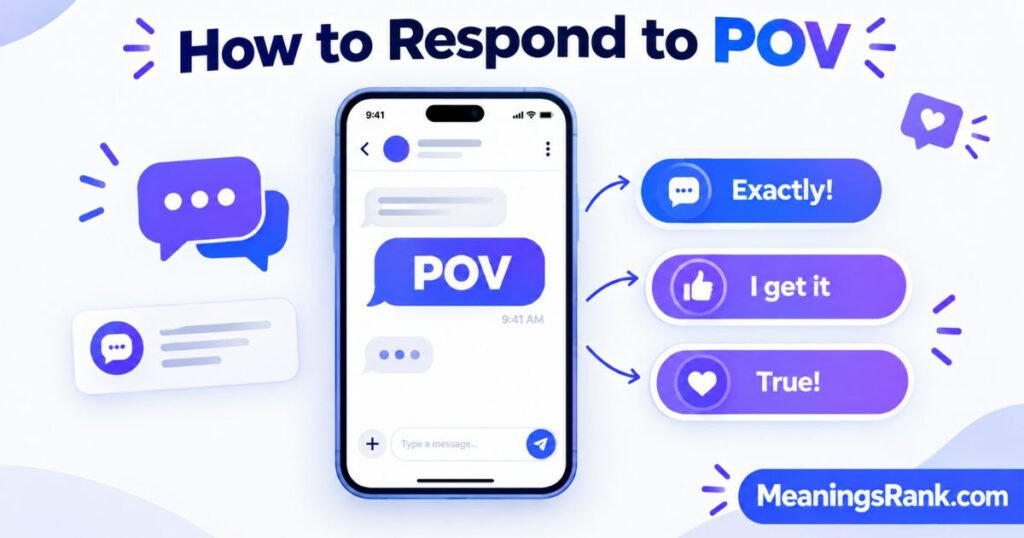
If someone sends you a POV message or you see a POV video, there are several natural ways to respond depending on the context.
- If it’s relatable: “Omg this is literally me 😂”
- If it’s funny: “I can’t, this is too accurate”
- If it’s emotional: “This hit different, no lie”
- If it’s a gaming clip: “That clutch was insane”
- If it’s a caption on a photo: A simple like, heart emoji, or comment like “living for this 😍” works well
- If it’s dramatic or exaggerated: “Okay but why is this SO real”
Responding in Text Conversations
If a friend texts you a POV scenario, you can respond by playing along with the story or reacting genuinely.
Example: Friend: “POV: you just walked into a glass door in front of your crush.” You: “I would actually disappear on the spot lol”
Responding on Social Media
On platforms like TikTok and Instagram, comments on POV videos often add to the storyline instead of just reacting. For example, under a POV video about a strict teacher, a common comment might be “the way I would’ve cried right there” or “this is giving flashbacks,” which keeps the playful, immersive tone going rather than breaking the fictional scenario.
Also Read: HYD Meaning in Text: The Ultimate Guide to What HYD Really Means in Chat
Misinterpretations
Even though POV is widely understood, a few common misunderstandings still happen, especially among people less familiar with internet slang.
Thinking POV means “photo of view”
Some assume it’s related to scenery or landscape photos, which isn’t accurate.
Confusing POV with “opinion” only
While it can relate to opinions, POV in slang is usually storytelling-based, not just a stated opinion.
Assuming POV always means literal first-person camera footage
This applies more to gaming and film, but on social media, it’s often just a caption style, not literal footage.
Missing sarcasm or humor
POV captions are sometimes exaggerated for comedic effect, so taking them too literally can lead to confusion.
Thinking POV requires a video
Many people use POV in plain text with no visual content at all, which can confuse someone expecting a clip.
When NOT to Use POV
While POV is flexible, there are situations where using it might feel out of place or unclear.
- In formal emails or official documents: POV is too casual for professional writing outside of casual internal chats.
- When clarity is more important than creativity: If you need to give clear instructions, POV-style captions can confuse the message.
- In serious or sensitive conversations: Using POV as a joke format during emotional or serious discussions can come across as dismissive.
- When your audience may not understand slang: Older audiences or non-native speakers might not immediately understand the format, so context clues become important.
- In legal or contractual writing: POV has no place in documents where precise, literal language is required.
POV in Different Age Groups
Younger users, especially teens and young adults, tend to use POV constantly and understand its many casual variations without needing an explanation. Older users, on the other hand, might still associate POV mostly with its literal camera meaning from photography or gaming, which can occasionally cause a small disconnect in family group chats. If a parent sees their teenager text “POV: I’m stuck babysitting again,” they might interpret it more literally at first before realizing it’s simply a dramatic, playful way of describing the situation.
POV in Memes
Memes often use POV as a setup line before showing an image or short clip that delivers the punchline. This format works especially well because it separates the “setup” from the “payoff,” giving the joke a small moment of suspense. A meme captioned “POV: you finally find the TV remote” followed by an image of someone triumphantly holding a remote is a simple example of how this structure builds comedic timing in just a few words.
Usage Tips
- Keep POV captions short and punchy for maximum impact.
- Use present tense to make the scenario feel immediate (“POV: you’re running late” instead of “POV: you ran late”).
- Pair POV with visuals or a story-driven caption for the best engagement on social media.
- Avoid overusing POV in every single post, since it can lose its impact if repeated too often.
- Match the tone of your POV scenario to your platform. Keep it funny and light on TikTok, aesthetic on Instagram, and simple in text messages.
- When texting, use POV to explain relatable daily situations without needing long explanations.
- Try to make your POV scenario specific rather than vague, since specific details usually feel more relatable than generic ones.
- If you’re a content creator, test different POV angles for the same idea to see which resonates best with your audience.
Frequently Asked Questions
What does POV mean in a text message?
POV means “Point of View,” describing a scenario from someone’s perspective.
Is POV only used on TikTok?
No, POV is used across texting, Instagram, Snapchat, and gaming too.
Can POV be used sarcastically?
Yes, POV is often used humorously or sarcastically in captions and texts.
Does POV always mean a video?
No, POV can also appear in plain text messages or captions.
What’s the difference between POV and IMO?
POV sets a scene, while IMO directly states a personal opinion.
Is POV appropriate for workplace chats?
Yes, but it’s usually used more formally to express perspective.
Conclusion
POV meaning has evolved from a simple filmmaking term into one of the most popular expressions across texting, social media, and gaming. At its core, POV still means “Point of View,” but the way people use it today is far more creative and personal. Whether it’s a funny TikTok skit, a relatable Instagram caption, or a quick text describing your chaotic morning, POV helps people share moments in a way that feels immediate and immersive.
It works because it invites the reader or viewer to step into a scene rather than simply hear about it secondhand, which makes everyday moments feel more entertaining and shareable. Now that you understand its full definition, platform differences, common misuses, and the situations where it fits best, you can use POV confidently in your own conversations. The next time you see “POV” pop up in a chat or video, you’ll know exactly what it means and maybe even use it yourself in your next post or message.