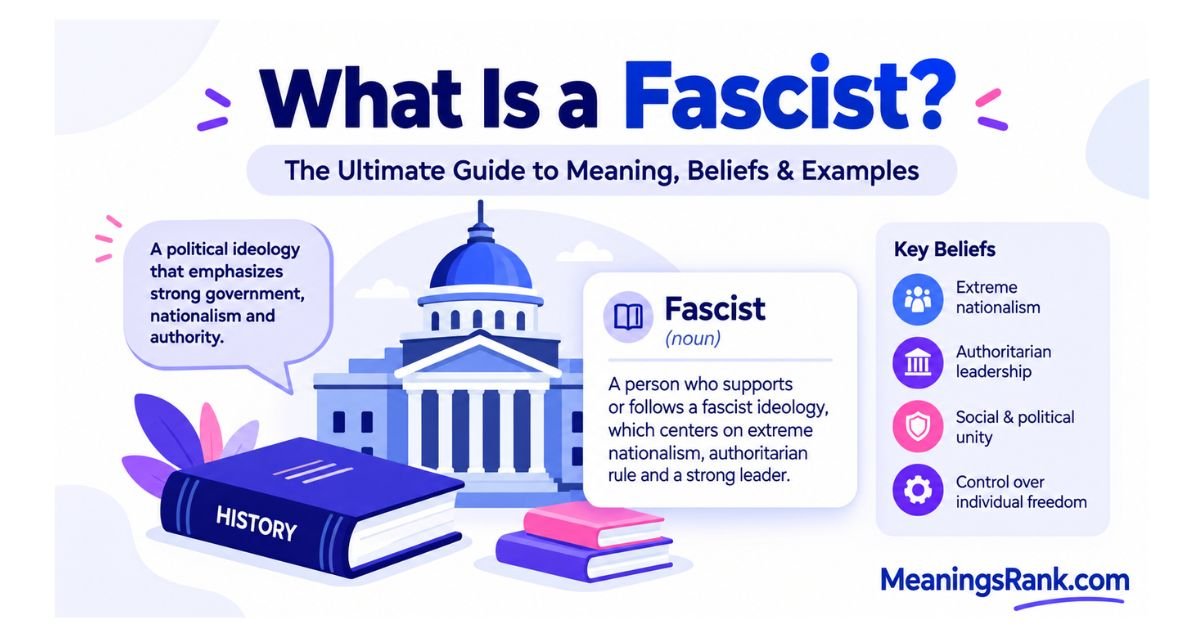

If you’ve seen the word “fascist” thrown around in a group chat, on Instagram, or during a heated family debate, you’ve probably wondered what it actually means. Is it just an insult, or does it point to something specific? The truth is, what is a fascist has a real historical and political answer, but people also use the word loosely online to describe anyone controlling or strict.
This guide breaks down the actual meaning, the political definition, and how the term shows up in texts, DMs, and everyday conversation. By the end, you’ll know exactly what someone means when they call something (or someone) fascist.
What Does Fascist Mean?
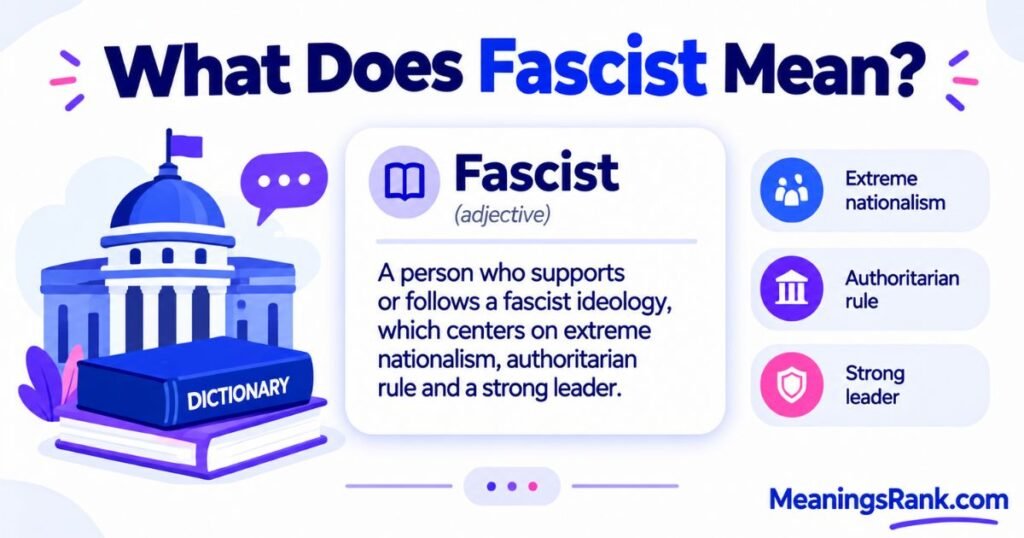
At its core, a fascist is someone who supports fascism, a political system built around total control by one leader or party, extreme nationalism, and the crushing of opposing views. The word comes from a real 20th-century political movement, not a made-up internet term.
Simple Definition
In plain words: a fascist believes in a strict, all-powerful government led by one strongman figure, where individual rights take a back seat to national strength and unity. There’s no room for disagreement, free press, or political rivals in a truly fascist system.
Word Origin at a Glance
The term traces back to Italy in the early 1900s. It comes from the Italian word “fascio,” meaning a bundle or group, which symbolized strength through unity. Benito Mussolini’s political party adopted this term, and it later became linked with authoritarian, nationalist movements across Europe.
What Is the Fascist Meaning in Politics?
In political science, fascism is treated as a specific ideology, not just a general insult. It’s usually described as a far-right, ultra-nationalist movement that rejects democracy in favor of a single powerful leader.
Key Political Features
Political scientists generally agree fascism includes:
- A single all-powerful leader or party in charge of the state
- Extreme nationalism, often built on the idea of national rebirth or glory
- Suppression of political opposition, free press, and dissent
- Use of propaganda and mass rallies to build loyalty
- A belief that the nation matters more than individual freedom
It’s worth noting that historians and political scientists still debate the exact boundaries of fascism, and not every authoritarian government is automatically fascist. The label is specific, even though it’s often used broadly.
What Are the Main Characteristics of Fascism?
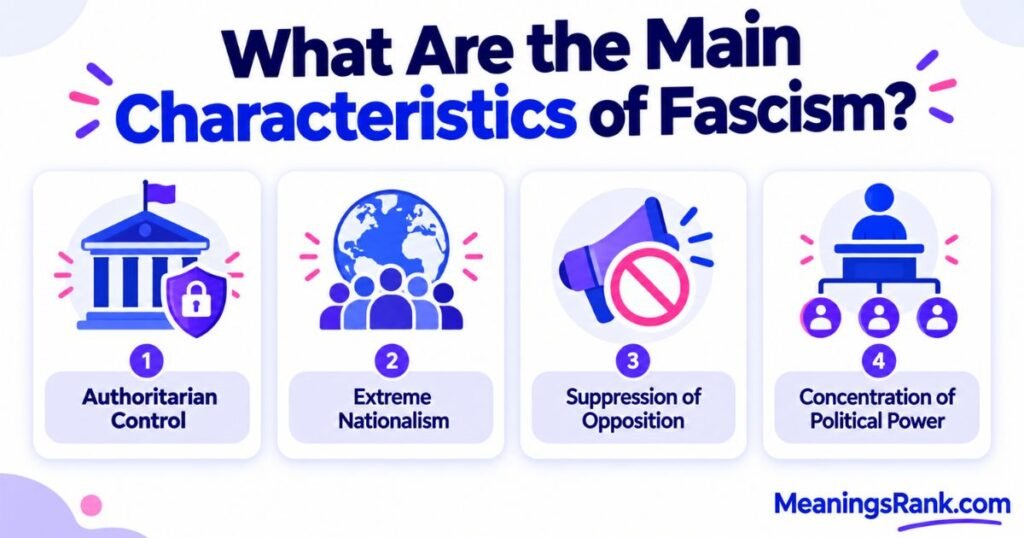
Fascism isn’t just “a government you don’t like.” It has recognizable traits that experts point to when identifying a truly fascist movement or regime.
Common characteristics include:
- One-party rule – Other political parties are banned or made powerless.
- Cult of personality – The leader is presented as a hero or savior of the nation.
- Militarism – Heavy focus on military strength and often glorifying war.
- Censorship – Media and speech are tightly controlled by the state.
- Scapegoating – Blaming a specific group for the country’s problems.
- Extreme nationalism – The idea that one’s nation or group is superior to others.
- Suppression of dissent – Critics, journalists, and activists are silenced or punished.
Not every strict government has all of these traits, but the more boxes it checks, the more accurately it fits the historical definition of fascism.
Also Read: DSL Meaning Slang: The Ultimate Guide to Its Meaning in Text, TikTok & Chat
Is Fascist the Same as Authoritarian?
No, and this mix-up happens a lot. Authoritarianism is a broader term. It just means a government or leader that holds tight, top-down control and limits freedoms. Fascism is a specific type of authoritarianism, but not every authoritarian system is fascist.
| Feature | Authoritarianism | Fascism |
| Definition | Strict, centralized control by a leader or small group | A specific far-right ideology built on nationalism and total state control |
| Political parties | May allow limited or fake opposition | Usually bans all rival parties |
| Ideology | Not tied to one specific belief system | Tied to extreme nationalism and often racial or ethnic superiority |
| Examples of use | Military juntas, single-party states, monarchies | Historical regimes like Mussolini’s Italy and Hitler’s Germany |
| Everyday use | Describes any controlling leadership style | Describes extreme, hostile, or oppressive control |
Think of it this way: all fascist systems are authoritarian, but not all authoritarian systems are fascist. It’s like how every square is a rectangle, but not every rectangle is a square.
How Context Changes the Meaning
The word “fascist” changes a lot depending on where and how it’s used. In a history class, it refers to a specific political movement. In a casual chat, it might just mean “way too strict.”
Formal vs. Casual Use
- Formal/academic use: Refers to actual fascist governments, ideology, and historical events, backed by research and evidence.
- Casual/online use: Often exaggerated, used to describe a strict teacher, boss, parent, or friend who enforces rules too hard.
This gap between formal and casual meaning is exactly why the word causes so many arguments online. One person means it literally; the other means it as a joke or exaggeration.
Fascist Meaning in Text and Online Chat
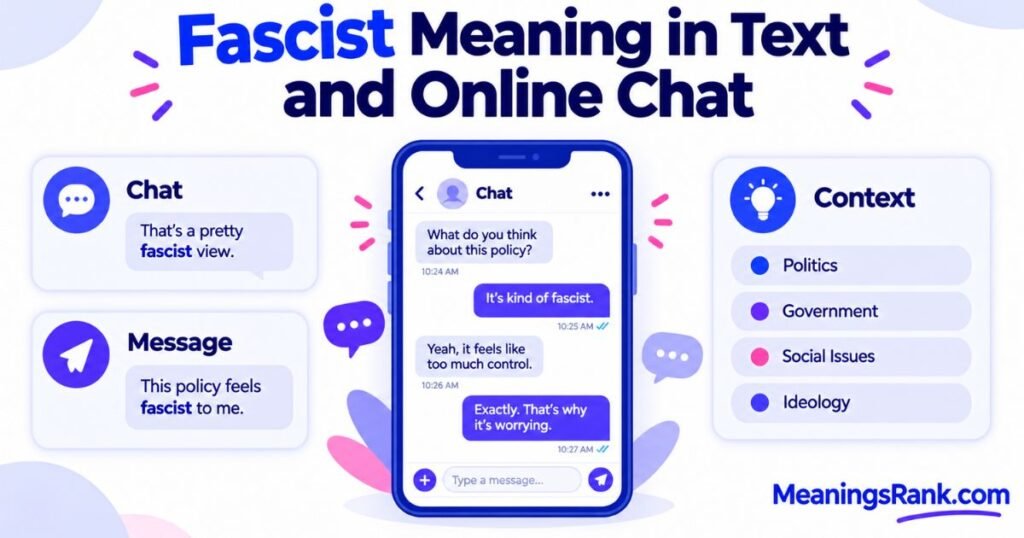
In texts and DMs, “fascist” is rarely meant as an academic term. It’s usually a dramatic way to complain about someone being controlling, rigid, or unreasonable.
WhatsApp example:
“My landlord is being such a fascist about the noise rules 😤”
SMS example:
“Coach won’t let us skip even one practice. Total fascist behavior.”
In both cases, the sender isn’t accusing anyone of running a dictatorship. They’re venting about strict, unfair-feeling control, usually with some humor or exaggeration mixed in.
Fascist Meaning on Social Media
Social media has its own flavor of how this word gets used, and it shifts slightly by platform.
Instagram:
Often used in caption jokes or comment sections to poke fun at overly strict school or workplace rules.
Comment: “This dress code is giving fascist energy 💀”
Snapchat:
Used casually between friends, usually as an exaggerated complaint in a private chat.
“Ugh my mom confiscated my phone, she’s being fascist rn”
TikTok:
Shows up in comment sections under videos about strict parents, bosses, or school rules, often blended with humor and sarcasm.
Comment: “The way she banned phones during dinner… fascist household 😭”
Discord/gaming chats:
Used when a mod or admin enforces rules too harshly, or when a game restricts player freedom in an annoying way.
“This server mod is straight up fascist, banned me for one joke”
Across platforms, the pattern is the same: it’s exaggeration meant to express frustration, not a literal political statement.
Real Conversation Examples
Here’s how the word plays out in different everyday scenes:
Group chat (friends planning a trip):
A: “Can we push the trip back a day?”
B: “No, we booked everything already.”
A: “Wow, so fascist about the schedule lol”
Workplace Slack/Teams chat:
“New policy says no phones at desks at all. Feels kind of fascist tbh.”
Gaming Discord:
“Bro got timed out for saying ‘gg’? This mod’s a mini fascist.”
Text between siblings:
“Mom said no snacks before dinner AGAIN. She’s basically a fascist dictator lol”
In almost every case, the tone is joking or annoyed, not a serious political accusation.
What Tone Does “Fascist” Have?
The tone depends heavily on context, but generally it falls into three categories:
- Serious/political tone: Used in news, debates, or history discussions to describe an actual authoritarian ideology. This use is heavy and carries real weight.
- Sarcastic/joking tone: Used among friends to exaggerate annoyance about small rules. Light, dramatic, often paired with emojis like 😤 or 💀.
- Confrontational/insulting tone: Used in arguments (online or in person) as a harsh accusation meant to shut someone down or label them extreme.
Knowing which tone is being used matters a lot. Reading it wrong can turn a joke into a real fight, or make a serious accusation seem like it’s not being taken seriously.
How to Reply When Someone Calls You a Fascist
Getting called a fascist, even jokingly, can feel jarring. How you respond depends on whether it was said in fun or as a genuine accusation.
Light-Hearted Replies
If it’s clearly a joke about you being strict or particular:
- “Guilty as charged, rules are rules 😂”
- “I do run a tight ship, not gonna lie”
- “Someone’s gotta keep order around here”
Serious Replies
If it feels like a real political accusation:
- “That’s a strong word, can you explain what you mean?”
- “I don’t think that’s fair, let’s talk about what actually happened.”
- “I disagree, but I’m open to hearing your point.”
The key is staying calm. Reacting with anger usually escalates things, while a steady response shows confidence and keeps the conversation productive.
When to Use the Term
Use “fascist” carefully. It carries real historical weight, so context matters.
Good times to use it:
- Discussing actual historical fascist regimes (Italy, Germany, Spain under Franco)
- Academic or political science conversations
- Light, obviously joking complaints among friends about strict rules
- Analyzing news or political movements using its accurate definition
When to Avoid the Term
Because it’s such a loaded word, there are times it’s better left unused:
- In workplace or professional settings, where it can sound extreme or unprofessional
- When arguing with someone you don’t know well online, since it can escalate fast
- As a casual insult toward a person’s entire character, rather than a specific behavior
- In serious political debates without understanding the actual definition first
Misusing the term can shut down a conversation instead of helping it, especially with people who take the word literally.
Common Mistakes
People often get this word wrong in a few common ways:
Confusing it with “strict”:
Not every strict rule or person is fascist. Strictness alone isn’t the same as an authoritarian ideology.
Using it interchangeably with “conservative” or “right-wing”:
Fascism is a specific extreme ideology, not a general political leaning.
Assuming it always means “Nazi”:
While related, the two aren’t identical (more on that below).
Ignoring the historical weight:
Using it too casually in serious discussions can come across as disrespectful to real historical events.
Similar Political Terms
Here’s how “fascist” compares to other political labels people often mix up:
| Term | Meaning | How It’s Different from Fascism |
| Authoritarian | Strict, top-down control by a leader | Broader term, not tied to one ideology |
| Totalitarian | Government controls nearly every part of life | Overlaps with fascism but also applies to other systems, like Stalinist communism |
| Dictator | A single ruler with unchecked power | Describes a person, not a full ideology |
| Nationalist | Strong pride and loyalty to one’s nation | Not automatically extreme or authoritarian on its own |
| Communist | Belief in collective ownership and classless society | Opposite economic approach; fascism supports strong nationalism over class equality |
Fascist vs. Nazi: Are They the Same?
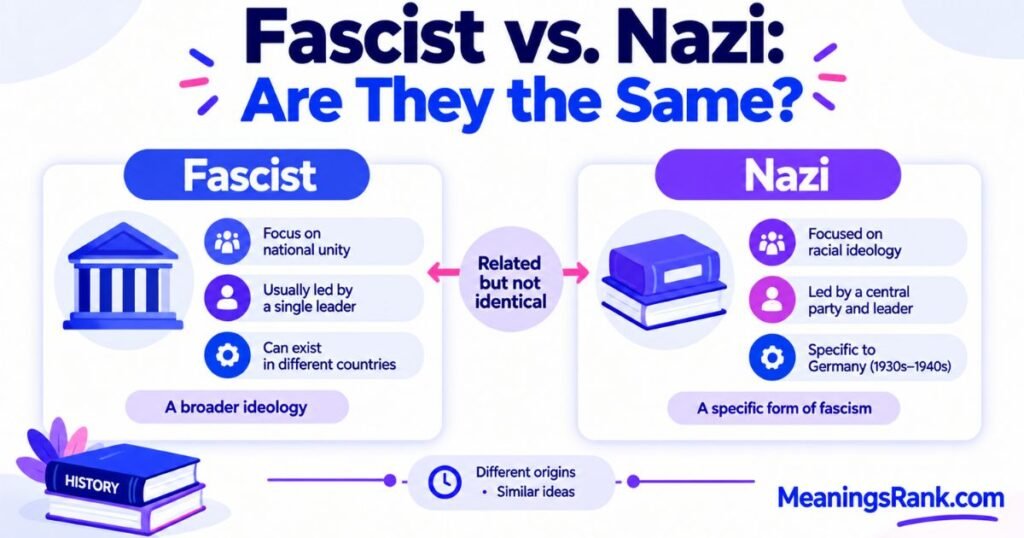
This is one of the most common mix-ups, so let’s clear it up.
| Category | Fascism | Nazism |
| Definition | A broad political ideology based on nationalism and authoritarian rule | A specific German version of fascism under Hitler’s regime |
| Core belief | Total state control and national unity | Fascist ideology combined with racial superiority and antisemitism |
| Origin | Italy, under Mussolini | Germany, under the Nazi Party |
| Scope | General term for similar movements worldwide | Refers specifically to Hitler’s party and ideology |
| Relationship | Nazism is considered a form of fascism | Not all fascists are Nazis, but all Nazis follow a fascist framework |
In short: Nazism is a specific, more extreme branch of fascism, built around racial ideology. Fascism is the wider umbrella term.
Origin and Historical Use
The word “fascist” became widely known in the 1920s, when Benito Mussolini’s National Fascist Party rose to power in Italy. The name came from “fascio,” symbolizing strength through unity, and the party used strict nationalism, censorship, and one-party rule to control the country.
The ideology spread and influenced other movements in the 1930s and 1940s, most notably Nazi Germany and Franco’s Spain. After World War II, fascism became strongly associated with the atrocities of that era, and the word took on a heavier, more negative meaning worldwide.
Since then, “fascist” has been used both accurately, to describe similar authoritarian nationalist movements, and loosely, as a general insult for anyone seen as controlling or extreme.
Quick Recap
- A fascist supports fascism: a system built on nationalism, one-party control, and crushing opposition.
- Fascism is a specific type of authoritarianism, not the same thing as general strictness.
- Online and in texts, it’s often used loosely to complain about strict rules or controlling behavior.
- Nazism is a specific, extreme branch of fascism tied to racial ideology.
- Context and tone completely change how the word should be understood and how to respond to it.
Also Read: What Does Introvert Mean? The Ultimate Guide to Introvert Meaning
Frequently Asked Questions
What is a fascist in simple terms?
Someone who supports total government control and extreme nationalism.
Is calling someone a fascist an insult?
Yes, it’s usually meant as a serious or exaggerated criticism.
What’s the difference between fascist and authoritarian?
Authoritarian is broader; fascism is one specific extreme type.
Are fascist and Nazi the same thing?
No, Nazism is one specific extreme form of fascism.
Why do people use “fascist” casually online?
To exaggerate frustration about strict rules or controlling behavior.
Is fascism a real political system or just an insult?
It’s a real historical ideology, though the word is often used loosely.
Final Thought
Understanding what is a fascist helps you use the word correctly, whether you’re studying history, following the news, or just texting a friend about a strict teacher. The real, historical meaning points to a specific kind of authoritarian nationalism, while the casual online use is usually exaggeration or humor. Knowing the difference matters because this word carries real weight, and using it carelessly can confuse or offend people who take it literally.
Before calling something or someone fascist, think about your context: are you making a light joke, or making a serious claim? Getting that right keeps your conversations clear, respectful, and accurate, whether you’re chatting on WhatsApp, commenting on TikTok, or debating politics with friends. Words carry meaning, and this one carries more than most, so use it with intention.