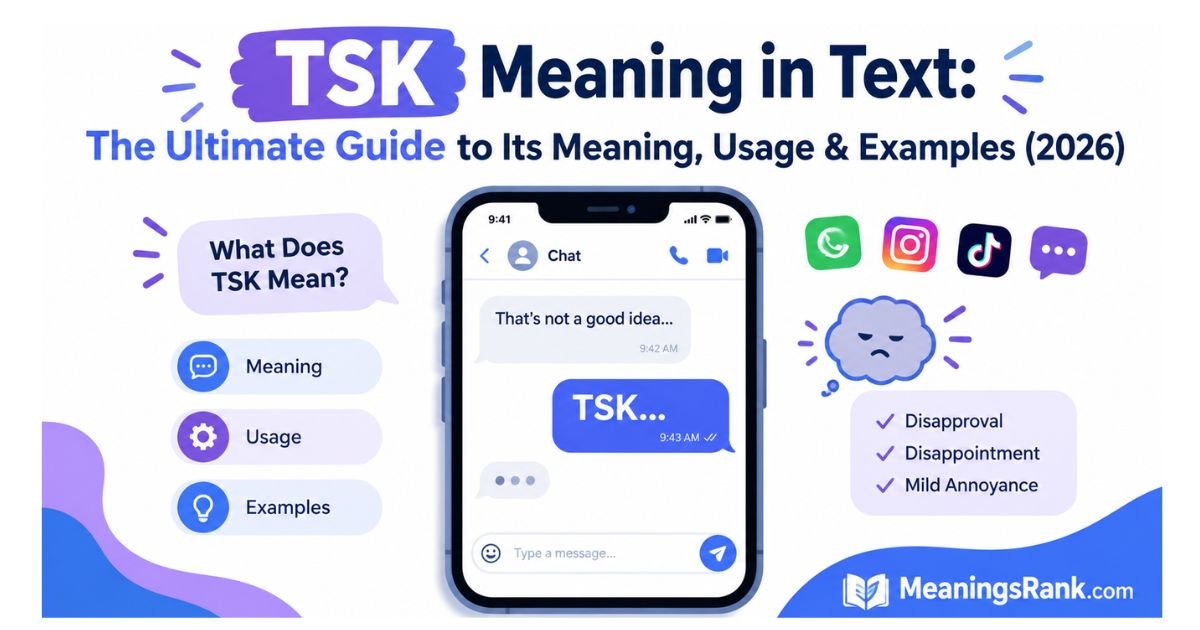

Seen “tsk” pop up in a text and wondered what it actually means? You’re not alone. The TSK meaning in text is simple once you know it it’s a small sound people type out to show annoyance, disappointment, or mild disapproval. It’s not a new word invented for texting; it’s actually a sound humans have made for ages, now typed into chats, comments, and captions.
You’ll spot it in WhatsApp messages, Instagram replies, TikTok comments, and even gaming chats. Understanding what TSK really means helps you read tone correctly and avoid misreading someone’s mood. This guide breaks down everything about TSK, from its meaning to how people actually use it today.
What Does TSK Mean in Text?
TSK is a written version of a clicking sound people make with their tongue. It’s the same sound you’d hear if someone shook their head slightly while feeling annoyed or unimpressed.
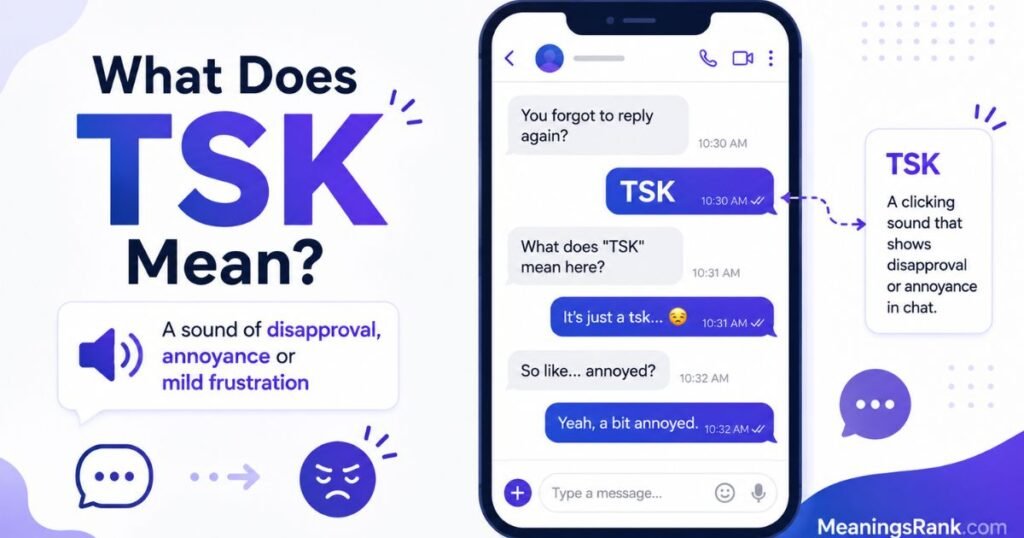
In texting, TSK works as a short reaction rather than a full sentence. It doesn’t need extra words to make sense.
Here’s a simple example:
Person A: “I forgot your birthday again.”
Person B: “tsk. seriously?”
In this chat, Person B isn’t typing out anger in full sentences. The single word “tsk” already carries the disappointment, so the message feels complete even though it’s short.
A few things worth knowing about TSK in texting:
- It usually shows mild annoyance, not serious anger
- It can stand alone or attach to a short sentence
- It often appears in lowercase, since tone doesn’t need capital letters
- It’s used more in reaction to someone’s actions than to a topic or fact
People often type “tsk tsk” too, repeating it for extra emphasis, almost like saying “come on now” in a disappointed tone. This repeated version tends to sound a little more playful than serious.
Because TSK mimics a real sound, it feels more expressive than typing “annoyed” or “disappointed.” It adds personality to a text without needing extra explanation, which is exactly why it has stuck around in casual chat culture for so long.
TSK Meaning in English: What Does It Express?
In everyday English, TSK expresses a quiet form of disapproval. It’s the kind of reaction you give when something isn’t a big deal, but it still bothers you a little.
Think about someone spilling coffee on a counter. A quick tongue click, paired with a slight headshake, is a natural reaction. That’s exactly what TSK represents in text.
TSK usually expresses:
- Mild annoyance (“tsk, you’re late again”)
- Disappointment (“tsk, I expected better”)
- Playful judgment among friends (“tsk tsk, look who’s talking”)
- Light sarcasm, depending on the sentence around it
Unlike stronger reactions like anger or frustration, TSK stays fairly soft. It’s rarely used for serious arguments or heated conversations. Instead, it fits smaller, everyday moments.
For example:
Person A: “I ate the last slice of pizza.”
Person B: “tsk, you always do that.”
This isn’t a real fight it’s a light complaint, almost teasing in tone. That’s the emotional range TSK usually covers.
It’s worth noting that tone depends heavily on what follows TSK. On its own, “tsk” can feel neutral, but paired with certain words, it can lean more sarcastic or more genuinely irritated.
Because it mimics a real-life sound so closely, TSK often feels more natural than typed-out phrases like “ugh” or “smh.” It captures a specific kind of reaction that’s hard to put into plain words, which is exactly why people keep using it in texts and comments.
Also Read: SFS Meaning in Text & Social Media: What Does SFS Mean?
TSK Full Form, Stands For & Other Meanings
Unlike many texting abbreviations, TSK doesn’t stand for a phrase. It’s not short for a group of words it’s simply the written form of a sound.
This makes TSK different from acronyms like BTW or IMO, which represent full sentences. TSK is closer to an onomatopoeia, a word that imitates the sound it represents.
Quick Clarifications:
- TSK has no hidden full form
- It’s not an abbreviation in the traditional sense
- It represents a tongue-clicking sound used to express disapproval
Other Contexts Where TSK Appears:
In some fields, TSK also appears as an acronym with a completely different meaning:
- In cybersecurity, TSK can refer to “The Sleuth Kit,” a toolkit used for digital forensics
- In certain gaming communities, TSK might be used as a clan tag or username, unrelated to its original meaning
- In some regional slang, TSK gets stretched into “tsss” or “tsk tsk” for extra emphasis
These alternate meanings are far less common in everyday texting, but they’re worth knowing if you come across TSK outside a casual chat context.
In texting and social media, though, TSK almost always refers back to that same disapproving sound. It’s simple, direct, and doesn’t require decoding once you know its purpose.
Because it functions more like an expression than a word with letters standing for something, TSK feels more universal. Many languages have a similar tongue-click sound, which is part of why this term translates so easily across different online communities.
TSK Meaning From a Girl or Guy in Text
TSK doesn’t carry a different meaning based on gender. Both guys and girls use it the same way to express mild annoyance or disappointment.
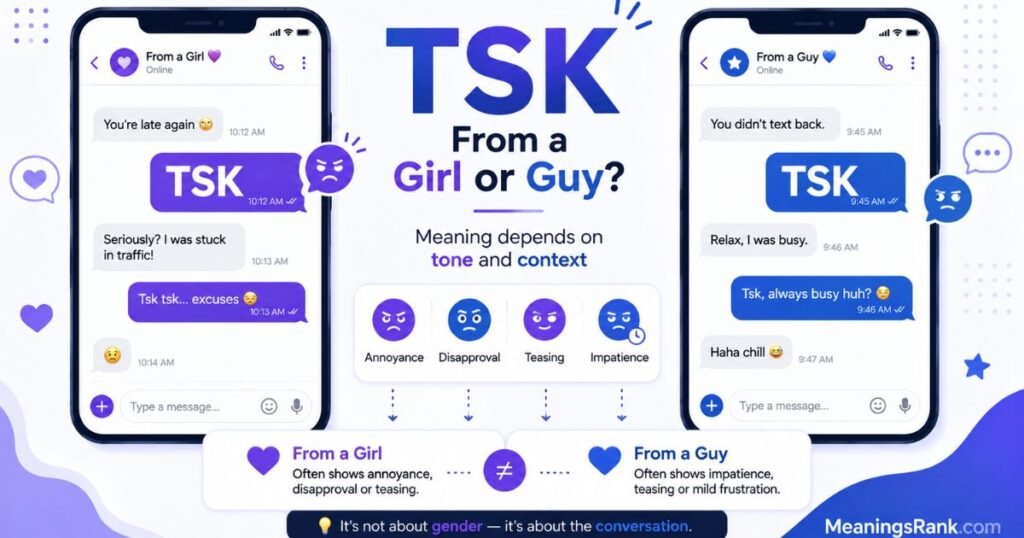
That said, tone can shift slightly depending on the relationship between the two people texting.
From a Friend:
“tsk, you didn’t tell me you were coming 😒” This usually feels playful, almost teasing rather than genuinely upset.
From a Partner:
“tsk, you forgot again?” Here, it might carry a bit more real frustration, especially if it’s about something they’ve mentioned before.
From a Parent or Older Relative:
“tsk. clean your room.” This version often feels more scolding, similar to how the sound is used in face-to-face conversations.
In Flirty Conversations:
TSK can appear in playful teasing too: “tsk, stop being so cute, it’s distracting.”
In this case, the flirty tone comes from the rest of the sentence, not from TSK itself. The word simply adds a light, teasing texture to the message.
So whether it’s from a girl or guy, TSK doesn’t change meaning. What shifts is the emotional weight behind it, which depends on the relationship, the topic, and the words surrounding it.
This makes TSK a flexible reaction. It can be sharp or soft, teasing or genuinely annoyed, all depending on context rather than who’s typing it.
How People Use TSK in Daily Conversations
TSK usually appears as a quick, immediate reaction rather than something planned out. People type it the moment something mildly annoys or surprises them.
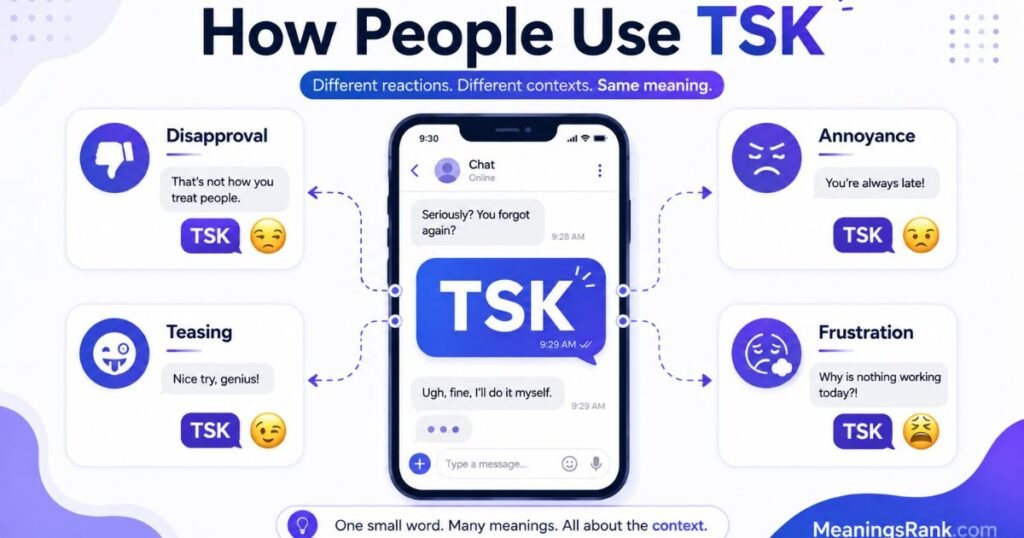
Common Ways TSK Shows Up:
- As a standalone reaction: “tsk.”
- Paired with a short comment: “tsk, not again.”
- Repeated for emphasis: “tsk tsk tsk.”
- Combined with emojis: “tsk 🙄” or “tsk 😑”
Everyday Examples:
Text Message: “tsk, traffic is so bad today.”
Group Chat: “tsk, why does he always cancel last minute?”
Reacting to News: “tsk, that’s disappointing to hear.”
Reacting to a Mistake: “tsk, I told you to double-check that.”
TSK also blends naturally into longer sentences without disrupting the flow:
“tsk, I really thought you’d remember this time.”
Because it mimics a real sound, TSK feels more emotional than typing something like “annoyed” in plain text. It adds a layer of personality that flat words sometimes miss.
People also use TSK sarcastically in casual banter, especially among close friends. In these cases, it doesn’t reflect real annoyance at all it’s more of an inside joke or playful jab.
Across most conversations, TSK stays lighthearted. It rarely escalates a conversation and instead works as a small emotional cue that keeps chats feeling natural and expressive.
TSK Meaning on WhatsApp, Instagram, TikTok & Snapchat
TSK shows up across nearly every major platform, though its exact use can shift slightly depending on where it’s posted.
WhatsApp:
“tsk, you left me on read again 😒” Here, TSK adds a playful complaint, common between friends or partners.
Instagram Comments:
“tsk tsk, using my photo without credit 👀” This version often calls someone out in a semi-joking, semi-serious way.
TikTok Comments:
“tsk, why is this so relatable” On TikTok, TSK is frequently used as a quick emotional reaction to a video, especially ones showing relatable frustrations.
Snapchat:
“tsk you’re always late lol” This tends to feel casual and light, matching Snapchat’s fast, informal style.
Discord:
“tsk, lost that round because of lag again” In gaming spaces, TSK often reacts to bad luck or frustrating moments during gameplay.
Gaming Chats:
“tsk, missed that shot by an inch” This reflects mild frustration with gameplay, not with another player specifically.
Workplace Chats:
TSK is rarely used here. Its casual, sound-based nature doesn’t fit most professional messaging styles.
Across these platforms, the meaning of TSK barely changes. What shifts is the setting and audience, which slightly adjusts how playful or serious it feels.
Because TSK works so well as a quick reaction, it fits naturally into fast-paced platforms like TikTok and Snapchat, where short, expressive comments are the norm.
Examples of TSK in Real Chat Conversations
Seeing TSK across different everyday situations makes its function even clearer.
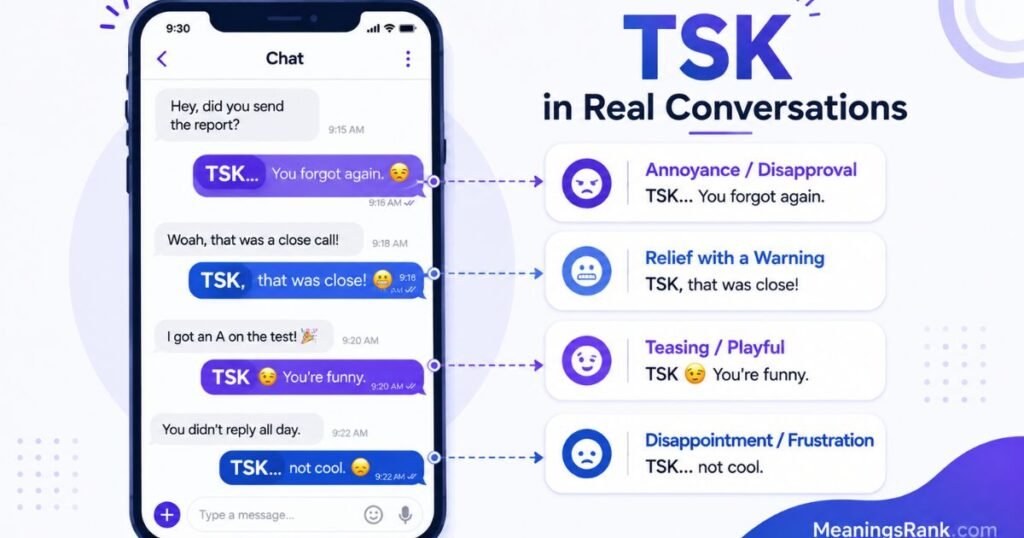
Text Message:
Person A: “I might be 20 minutes late.”
Person B: “tsk, again?”
WhatsApp:
Person A: “I ate your leftovers, sorry.”
Person B: “tsk tsk, we talked about this.”
Instagram Comment:
“tsk, this edit is way too good, teach me.”
Snapchat:
“tsk you didn’t save me a seat? rude.”
TikTok Comment:
“tsk, why did this make me tear up.”
Also Read: NTM Meaning in Text: What It Means, How to Use It, and How to Reply (2026 Guide)
Gaming Chat:
“tsk, that was such an unlucky spawn.”
Discord Message:
“tsk, server crashed right before the boss fight.”
Workplace Chat (Rare Use):
“tsk, the client changed the deadline again.” Even here, it stays casual and would only appear in relaxed workplace cultures.
In each of these examples, TSK adds emotional context that plain text sometimes lacks. It shows the reader exactly how the sender feels without needing extra explanation.
This is really the core value of TSK it condenses a small emotional reaction into a single, simple word that almost everyone instantly understands.
How to Reply When Someone Says TSK
Replying to TSK is usually easy since it’s a reaction, not a question or request.
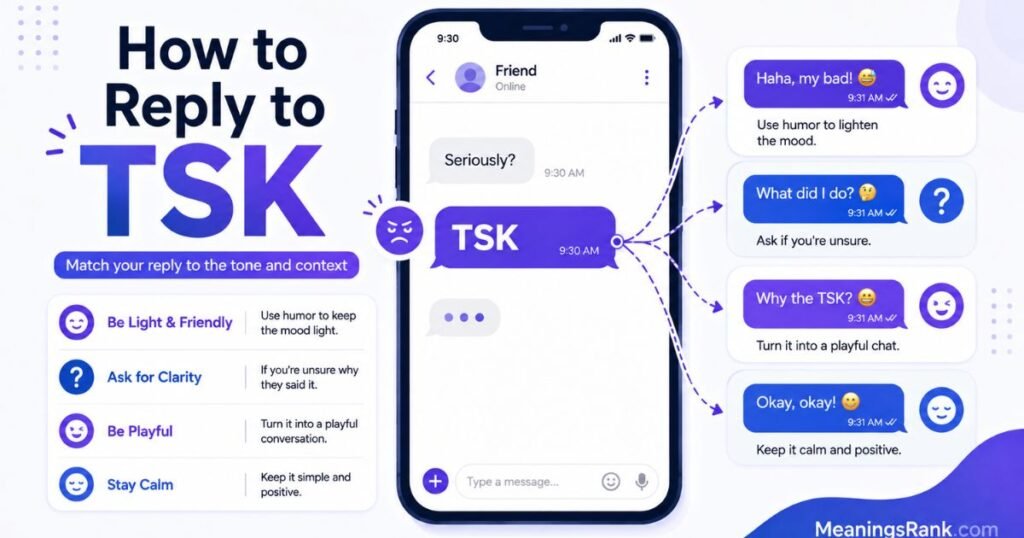
If You Want to Apologize:
“my bad, I’ll be quicker next time.”
If You Want to Tease Back:
“tsk tsk, look who’s talking.”
If You Want to Explain Yourself:
“I know, traffic was insane today.”
If You Want to Keep It Light:
“haha okay okay, fair.”
Here’s a quick example from a group chat:
Person A: “tsk, you didn’t text back for two days.”
Person B: “I know, sorry, work’s been crazy.”
Notice how Person B doesn’t need to overexplain. A short, honest reply usually settles the reaction naturally.
In more playful settings, replying with humor works just as well.
Example:
Person A: “tsk, you beat my score again.”
Person B: “practice makes perfect 😏”
The key with TSK replies is matching the tone. If it feels playful, respond playfully. If it feels genuinely annoyed, a short acknowledgment or explanation usually smooths things over quickly.
When to Use and When Not to Use TSK
TSK works well in many casual settings, but there are moments where it’s better left out.
Good Times to Use TSK:
- Reacting to small mistakes among friends
- Teasing someone playfully
- Commenting on relatable content online
- Reacting to minor frustrations, like bad luck in a game
Times to Avoid TSK:
- During serious arguments or emotional conversations
- In professional emails or formal documents
- When talking to someone you don’t know well
- In customer service or client-facing messages
Why Context Matters:
Using TSK during a serious conversation can come across as dismissive, even if that wasn’t the intention. Because it’s a light, almost teasing sound, it can clash badly with heavier topics.
Example of poor use:
Person A: “I’m really struggling this week.”
Person B: “tsk, that’s rough.”
Here, TSK feels out of place. A more supportive reply would fit the moment better.
Better Alternative:
“That sounds really tough, I’m here if you want to talk.”
Knowing when to skip TSK shows emotional awareness, especially in conversations where someone needs support rather than a casual reaction.
Different Meanings of TSK in Other Fields
While TSK is mostly known as a disapproving sound in texting, it appears in a few other contexts too.
| Field | Meaning of TSK |
| Texting & Chat | A sound expressing mild annoyance or disapproval |
| Cybersecurity | Short for “The Sleuth Kit,” a digital forensics tool |
| Gaming Communities | Sometimes used as a clan tag or username |
| Linguistics | Referred to as a “click consonant” sound |
| Casual Slang | Used as “tsk tsk” for emphasis or teasing |
In linguistics, the tsk sound actually has a name: it’s called a dental click. Some languages, especially in parts of Africa, use click sounds as actual letters within words, not just casual reactions.
In cybersecurity, “TSK” refers to a completely different concept, standing for a real software toolkit used by investigators to examine digital evidence. This meaning has nothing to do with texting slang.
Because TSK appears in different fields with different meanings, context matters a lot. In a casual chat, it almost always refers to the disapproving sound. In a technical or gaming setting, it might mean something entirely different.
Common Confusions, Mistakes & Wrong Interpretations
Even though TSK is simple, a few mix-ups happen fairly often.
Mistake 1: Thinking TSK Means Serious Anger
TSK almost always reflects mild annoyance, not intense anger. Confusing the two can make a message seem more serious than intended.
Mistake 2: Assuming TSK Always Means Disapproval
Sometimes TSK is used playfully or sarcastically, especially between close friends, without any real disapproval behind it.
Mistake 3: Believing TSK Has a Full Form
Unlike BTW or FYI, TSK isn’t short for a phrase. It’s a sound, not an acronym.
Mistake 4: Using TSK in Serious Conversations
Because it feels light and casual, TSK can accidentally come across as dismissive during emotional discussions.
Mistake 5: Reading Too Much Into a Single “tsk”
On its own, “tsk” can feel ambiguous. Reading the full message and relationship context matters more than the word alone.
Clearing up these small misunderstandings helps prevent awkward replies, especially in mixed-age chats or conversations with people less familiar with texting slang.
Also Read: DW Meaning in Text: What It Means, How to Use It, and How to Reply (2026 Guide)
Similar Terms, Alternatives & Related Slang
TSK isn’t the only reaction-based slang term used in texting. Here are a few similar expressions.
| Term | Meaning | When to Use |
| TSK | Mild disapproval or annoyance | Small mistakes, teasing, light frustration |
| SMH | Shaking My Head | Disbelief or disappointment |
| UGH | Frustration or annoyance | Expressing irritation |
| PFFT | Dismissive reaction | Brushing something off casually |
| MEH | Indifference | Showing lack of interest or enthusiasm |
TSK vs SMH:
TSK feels shorter and softer, almost like a quick reflex reaction, while SMH often carries a bit more disbelief or disappointment.
Example: “smh, I can’t believe that happened.” (stronger disbelief) “tsk, that’s annoying.” (lighter reaction)
TSK vs UGH:
UGH usually signals frustration with a situation, while TSK often reacts to someone’s specific action or behavior.
Both terms are casual and rarely appear in formal writing, but TSK tends to feel a little more personal and reactive.
Origin, History & First Known Use of TSK
TSK isn’t a modern invention. The sound itself has existed in human speech for a very long time, long before texting or the internet.
Linguists classify this sound as a dental click, a type of noise made by pressing the tongue against the roof of the mouth and releasing it quickly. It’s found in everyday expressions across many cultures and languages.
Written versions of the sound, like “tsk” or “tut,” have appeared in English texts for over a century, often used in books and dialogue to represent disapproval without needing extra explanation.
When texting became common, people naturally carried this sound into digital conversations because it captured a feeling that plain words couldn’t express as clearly.
Timeline Overview:
- Long before texting: Used as a spoken sound expressing disapproval
- Early 1900s: Appeared in written dialogue in books and articles
- 2000s texting era: Adopted into SMS and instant messaging
- Social media era: Spread widely across Instagram, Twitter, and TikTok comments
Because TSK didn’t need reinvention to fit online spaces, it transitioned smoothly from spoken language into digital slang, which explains why it feels so natural compared to newer, invented internet terms.
Is TSK Still Popular in 2026?
Yes, “TSK” is still understandable in 2026, especially in casual texting, online chats, and social media conversations. However, it is not necessarily a trending slang term used by everyone. “Tsk” is an expression that represents a clicking sound people make to show disapproval, disappointment, frustration, or mild annoyance.
People may use “tsk” in messages when they disagree with someone’s actions, react to a poor decision, or express disappointment in a short and informal way. For example, someone might text, “Tsk, you forgot again!” to show mild frustration or disapproval.
Although newer internet slang and abbreviations appear regularly, “tsk” remains recognizable because it represents a familiar sound used in everyday communication. Its popularity can vary by age group, online community, and context.
In short: TSK remains useful in 2026, but it is better described as an established expression than a newly trending slang term. The meaning usually depends on the conversation and the tone the sender wants to convey.
FAQs About TSK Meaning in Text
What does TSK mean from a guy?
TSK from a guy usually means mild annoyance, teasing, or light disapproval. It doesn’t carry a different meaning based on gender and depends mostly on the conversation’s context.
What does TSK mean from a girl?
TSK from a girl carries the same meaning as from anyone else. It reflects mild frustration, playful teasing, or disappointment, depending on the message it’s paired with.
Is TSK the same as tsk tsk?
Yes, “tsk tsk” is simply a repeated version used for extra emphasis. It often sounds more playful or scolding compared to a single “tsk.”
Does TSK mean someone is mad?
Not usually. TSK reflects mild annoyance rather than real anger. It’s a soft reaction, closer to mild disappointment than genuine frustration.
Can TSK be used in professional messages?
It’s best avoided in professional settings. TSK feels too casual for formal emails or workplace communication, even in relaxed office chat tools.
Conclusion
Understanding the TSK meaning in text really comes down to recognizing it as a written version of a real, familiar sound. Whether it shows up in a WhatsApp message, an Instagram comment, or a gaming chat, TSK expresses mild annoyance, light disapproval, or playful teasing without needing extra words.
We’ve covered what TSK stands for, how people use it across different platforms, its origin as a real-life sound, and how it compares to similar reactions like SMH and UGH.
Since TSK is based on natural human expression rather than internet trends, it’s likely to stay relevant for years to come. The next time you see it in a message, you’ll know exactly what it means and how to respond naturally.