
Seen “OTP” in a text and had no idea if your friend was talking about a couple they love or a security code they need? You’re not alone. The OTP meaning in text actually depends heavily on where you see it, which makes this one a little trickier than most texting slang.
On social media, fan pages, and group chats, OTP usually means something totally different than it does in a banking app or login screen. You’ll run into it on Instagram, TikTok, Discord, and even in work emails. Once you learn how to spot the difference, you’ll never be confused by this two-letter mix-up again.
What Does OTP Meaning in Text?
OTP has two completely different meanings, and the trick is figuring out which one fits the conversation. This isn’t a case of slight variation the two meanings are worlds apart.
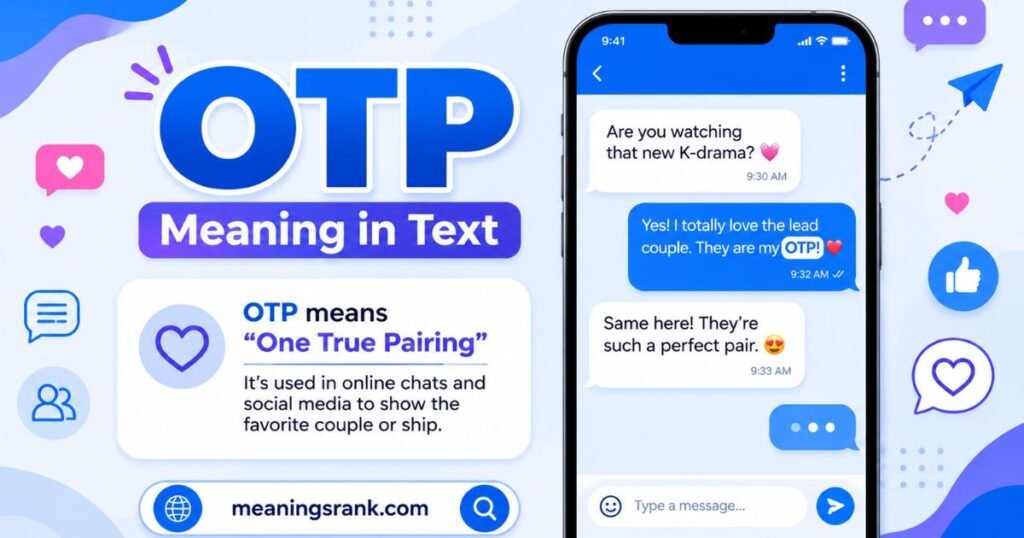
Meaning 1: One True Pairing
This version is used in fandom culture, social media, and casual chats about relationships, shows, or characters.
Meaning 2: One-Time Password
This version is used in security contexts, like logging into an account or verifying a purchase.
Here’s a quick example showing how different these meanings really are:
Person A: “Who’s your OTP from the show?”
Person B: “Definitely Mia and Jake, they’re perfect together.”
Compare that to:
Person A: “I can’t log in.”
Person B: “Check your phone, they probably sent an OTP.”
Same two letters, completely different topics. That’s why context matters so much with this particular acronym.
A few quick facts to keep in mind:
- Fandom OTP is emotional and opinion-based
- Security OTP is technical and functional
- Neither meaning is more “correct” both are widely used
- The surrounding words almost always make the meaning obvious
If someone mentions a TV show, movie, or celebrity crush right before or after OTP, they’re almost certainly talking about a pairing. If the conversation involves logging in, verifying an account, or receiving a code, they mean the password version.
Understanding both meanings from the start makes the rest of this guide much easier to follow, especially once we get into real examples from different platforms.
What Does OTP Stand For?
OTP stands for two very different things depending on where it’s used: “One True Pairing” or “One-Time Password.”
One True Pairing (Fandom Meaning):
This phrase comes from fan communities, especially around books, movies, TV shows, and anime. It refers to two characters, or sometimes real people, that fans believe belong together romantically above all other possible pairings.
The term grew out of early 2000s fan forums and fanfiction communities, where fans would debate which couple was the “one true” match compared to other possible combinations.
Read More: ASF Meaning in Text: What Does ASF Mean in Chat & Social Media? (2026 Guide)
One-Time Password (Security Meaning):
This version comes from tech and cybersecurity. It refers to a temporary code sent to verify your identity, usually through text message or email, when logging into an account or confirming a transaction.
This meaning became common as two-factor authentication became a standard security feature across banking apps, social media platforms, and email services.
Quick comparison:
| Meaning | Origin | Common Setting |
| One True Pairing | Fandom and fanfiction culture | Social media, fan chats |
| One-Time Password | Cybersecurity and tech | Banking apps, logins |
Both meanings are widely recognized, but they rarely overlap in the same conversation. You won’t usually see someone confuse the two once they understand the context clues, which we’ll cover in the next section.
Interestingly, both versions of OTP became popular around similar timeframes but through completely separate communities, which explains why the acronym ended up carrying two unrelated meanings instead of evolving from one into the other.
How to Know Which OTP Meaning Someone Is Using
Since OTP carries two very different meanings, context is everything. Luckily, there are clear signals that make it easy to tell them apart almost instantly.
Signs It Means “One True Pairing”:
- The conversation mentions a show, movie, book, or celebrity
- Emojis like 💕, 😍, or 🥹 appear nearby
- Words like “ship,” “couple,” or “relationship” show up
- It’s used on fan pages, Instagram, TikTok, or Discord fan servers
Example: “BTS and Areum are my OTP, I don’t make the rules 😭”
Signs It Means “One-Time Password”:
- The conversation involves logging in, verifying, or resetting a password
- It comes from a bank, app, or official business number
- Words like “code,” “verify,” or “account” appear nearby
- It shows up in automated texts or emails, not casual chats
Example: “Your OTP is 483920. Do not share this code with anyone.”
Quick Self-Check Questions:
Ask yourself these two questions if you’re ever unsure:
- Is this message about entertainment, relationships, or fandoms? → Likely “One True Pairing”
- Is this message about logging in, security, or verification? → Likely “One-Time Password”
In almost every case, the surrounding words settle the confusion within a sentence or two. Automated OTP security messages also tend to follow a very specific, formal pattern, which makes them easy to spot compared to casual fandom chatter.
Once you get used to spotting these clues, switching between the two meanings becomes second nature, even if they show up in the same day across different apps.
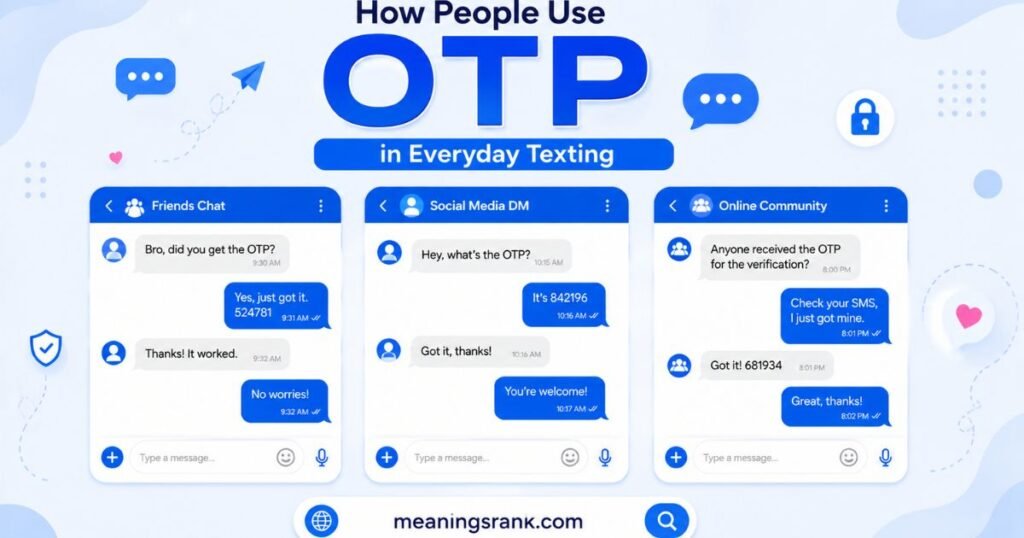
How Is OTP Used in Real Conversations?
OTP fits into sentences differently depending on which meaning is being used, but each version follows a fairly predictable pattern.
Fandom OTP Structure:
“[Character/Couple Name] is my OTP” or “OTP + [reason why]”
Example: “Ellie and Noah are my OTP, their chemistry is unreal.”
Security OTP Structure:
“Your OTP is [code]” or “Enter your OTP to continue”
Example: “Your OTP is 726104. It expires in 5 minutes.”
Here’s how both versions show up across different platforms:
Text Messages (Security):
“Your OTP for the bank app is 118273.”
WhatsApp (Fandom):
“omg they’re literally my OTP, I can’t 😭”
Instagram Comments (Fandom):
“This is why they’re everyone’s OTP, the chemistry is insane.”
Snapchat (Fandom):
“my OTP just became canon and I’m crying”
TikTok Comments (Fandom):
“OTP alert 🚨 these two need to end up together.”
Gaming Chats (Fandom, rare crossover use):
“Honestly these two characters are my OTP in this game’s story mode.”
Discord Servers (Fandom):
“New OTP poll just dropped, vote for your favorite pairing.”
Workplace Chats (Security, common):
“Can you resend the OTP? Mine expired before I could log in.”
Notice how fandom OTP almost always carries emotional language, while security OTP stays strictly factual and instructional. This contrast makes the two versions easy to separate once you see them side by side.
Workplace chats are actually one of the more common places you’ll see the security meaning, especially when employees are dealing with login issues for shared tools or verification steps.
Real Examples of OTP in Different Situations
Seeing OTP play out in full conversations makes both meanings even clearer. Here are realistic examples across different everyday situations.
Text Message (Security):
Person A: “I can’t get into my account.”
Person B: “Did you check for the OTP text? It usually comes within a minute.”
WhatsApp Group Chat (Fandom):
Person A: “Who do you think should end up together in the finale?”
Person B: “Zara and Leo, obviously. They’re my OTP.”
Instagram Comment (Fandom):
“The way they look at each other in this scene… definitely my OTP.”
Snapchat Caption (Fandom):
“rewatching the whole series just for my OTP’s scenes lol”
TikTok Comment Section (Fandom):
“This edit made me remember why they’re everyone’s OTP.”
Gaming Voice/Text Chat (Fandom):
“Ngl the side story with those two characters made them my OTP.”
Discord Message (Fandom):
“New chapter dropped and it’s basically an OTP confirmation, I’m losing it.”
Workplace Slack Message (Security):
“Sent the file, but also FYI, your OTP for the new system expires in 10 minutes.”
In each of these examples, context does all the heavy lifting. The fandom examples lean emotional and expressive, often paired with reactions or opinions. The security examples stay short, direct, and functional.
If you ever see OTP used without context, checking the platform can help too. Fan pages, entertainment accounts, and group chats about shows almost always mean “One True Pairing,” while banking apps, verification emails, and account settings almost always mean “One-Time Password.”
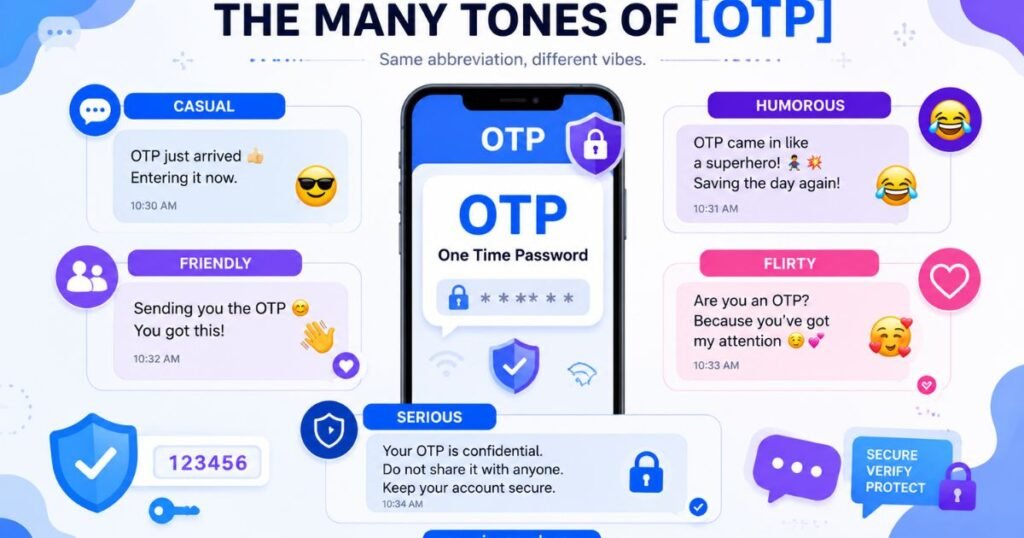
Is OTP Rude, Flirty, or Safe to Use?
Neither version of OTP is rude or offensive. However, each carries a very different emotional tone worth understanding.
Is Fandom OTP Flirty?
Not really flirty on its own, but it often carries romantic or emotional energy since it’s usually describing a couple people admire or root for.
Example: “They’re my OTP, I’d fight for their relationship 😭” shows strong emotional investment, not flirtation directed at the person you’re texting.
Is Fandom OTP Ever Used to Flirt With Someone Directly?
Occasionally, in a playful way.
Example: “Ngl we’d make a good OTP” is a lighthearted, flirty way some people playfully hint at liking someone, though this usage is far less common than the fandom version.
Is Security OTP Ever Emotional?
No. This version is completely neutral and functional. It never carries tone, humor, or emotion since it’s almost always automated.
Example: “Your OTP is 552910” is simply a security message, nothing more.
Is OTP Safe to Use in Any Setting?
- Fandom OTP: safe in casual chats, fan communities, and social media
- Security OTP: safe and expected in tech, banking, and account-related messages
- Neither version is considered rude or inappropriate in normal contexts
One Important Safety Note:
Never share a security OTP code with anyone, even if they claim to be from your bank or a trusted company. Legitimate businesses will never ask you to read your OTP back to them over a call or message. This is one of the most common tactics used in account scams.
Understanding this distinction isn’t just about grammar it’s genuinely useful for protecting your accounts online.
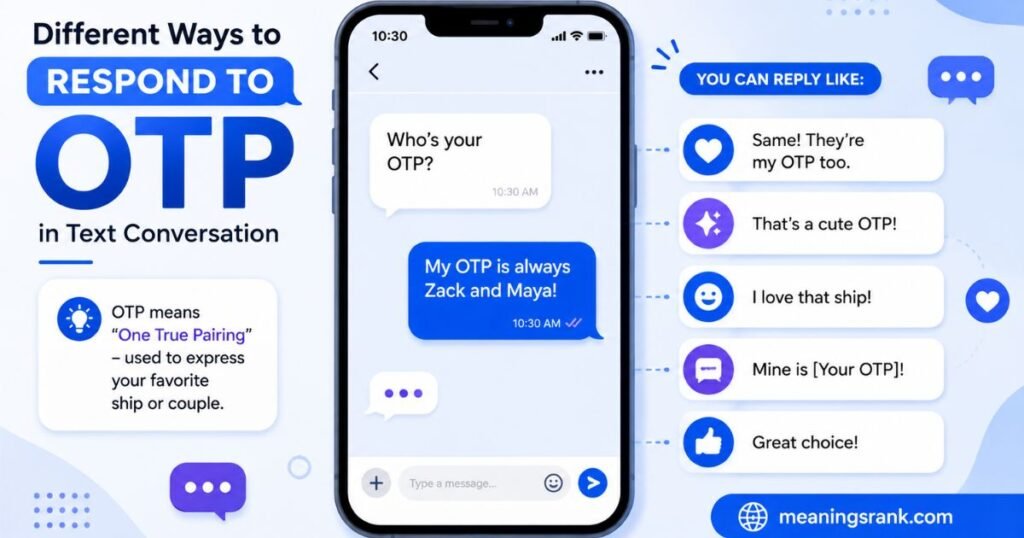
How to Respond When Someone Says “OTP”
Replying to OTP depends entirely on which version is being used, so context guides the response here too.
Replying to Fandom OTP:
If You Agree: “Yes! Same, they’re perfect together.”
If You Disagree: “Really? I actually prefer a different pairing.”
If You Want to Join the Conversation: “Omg who’s your OTP? I need to know.”
Example: Person A: “They’re officially my OTP now.”
Person B: “Honestly same, their storyline this season sold me.”
Replying to Security OTP:
If You Received the Code: No reply needed you simply enter the code where required.
If You Didn’t Receive It: “I didn’t get the OTP, can you resend it?”
If You’re Helping Someone Else: “Check your messages, the OTP usually arrives within a minute.”
Example: Person A: “I never got my OTP.”
Person B: “Try requesting it again, sometimes it’s delayed a few seconds.”
Quick Tip:
If you’re ever unsure which meaning someone means, a simple clarifying question works fine: “Wait, do you mean a couple or a login code? 😂”
This kind of question is completely normal, especially in group chats where topics shift quickly. Most people won’t think twice about clarifying, since the two meanings are so different from each other.
Read More: HN Meaning in Text: What Does HN Mean in Chat, Texting & Social Media? (2026 Guide)
OTP vs Similar Text Abbreviations
OTP sometimes gets confused with other short acronyms, especially in fast-moving chats. Here’s how it compares to similar terms.
| Term | Meaning | When to Use |
| OTP | One True Pairing / One-Time Password | Fandom talk or account security |
| BROTP | Best Friend Pairing (non-romantic) | Describing a strong friendship, not romance |
| NOTP | Not My Pairing | Expressing dislike for a specific couple |
| 2FA | Two-Factor Authentication | Describing the broader security process OTP is part of |
| ID | Identification | Verifying identity, different from a login code |
OTP vs BROTP:
BROTP describes a favorite friendship pairing instead of a romantic one. Fans often use both terms together when discussing a full cast of characters.
Example: “They’re not my OTP, but definitely my BROTP.”
OTP vs NOTP:
NOTP is the direct opposite of the fandom meaning. Instead of supporting a pairing, it expresses disapproval.
Example: “That’s a hard NOTP for me, I don’t see it.”
OTP vs 2FA:
These two are closely related but not identical. Two-factor authentication (2FA) is the overall security method, while an OTP is often the actual code used within that process.
Example: “I turned on 2FA, so now I get an OTP every time I log in.”
Knowing these related terms helps you navigate both fandom spaces and tech-related conversations without mixing up similar-sounding acronyms.
When Should You Avoid Using OTP?
While OTP is useful, there are moments where using it can create confusion or feel out of place.
In Mixed Conversations Without Context
If you jump straight into “OTP” without any lead-in, the other person might not know which meaning you’re referring to.
In Formal or Professional Writing
The fandom meaning should never appear in professional communication, and even the security meaning is usually better written out as “one-time password” in official documents.
When Talking to Someone Unfamiliar With Fandom Culture
Not everyone follows shows, ships, or fan communities. Using OTP without explanation might leave some people confused.
When Sharing an Actual Security Code Publicly
Never post your OTP code on social media, screenshots, or public chats. This is a major security risk, even if it seems harmless.
In Customer Service Messages
Businesses should always spell out “one-time password” clearly in official messages to avoid any confusion, especially for less tech-savvy customers.
When Precision Matters
If clarity is essential, like in tech support or security instructions, spelling out the full term prevents any possible misunderstanding.
Knowing when to avoid OTP, or when to add quick context, keeps your conversations clear and avoids unnecessary mix-ups between its two very different meanings.
Frequently Asked Questions About OTP
What does OTP mean in a text message?
OTP can mean “One True Pairing” in fandom chats or “One-Time Password” in security messages. The meaning depends entirely on the conversation’s context.
Is OTP always about relationships?
No. OTP only means a romantic pairing in fandom and social media contexts. In banking or tech messages, it refers to a security code instead.
Is it safe to share an OTP code?
No, never share a security OTP code with anyone. Legitimate companies will never ask for it, and sharing it can lead to account theft.
What does OTP mean on Instagram or TikTok?
On these platforms, OTP almost always means “One True Pairing,” referring to a favorite couple from a show, movie, or fandom.
What’s the opposite of OTP in fandom slang?
NOTP is the opposite, meaning “Not My Pairing.” It’s used to express dislike or disagreement with a specific couple.
Final Thoughts on the Meaning of OTP
Understanding the OTP meaning in text really comes down to context. In fandom spaces, it celebrates a favorite couple people can’t stop talking about. In tech and security settings, it protects your accounts with a quick, temporary code.
We’ve covered both meanings in detail, how to tell them apart instantly, and real examples from texting, social media, gaming, and workplace chats. We also looked at related terms like BROTP, NOTP, and 2FA to round out the full picture.
The next time OTP shows up in your messages, you’ll immediately know which meaning fits, whether someone’s gushing over their favorite fictional couple or simply trying to log into an account. Context really is everything with this one.