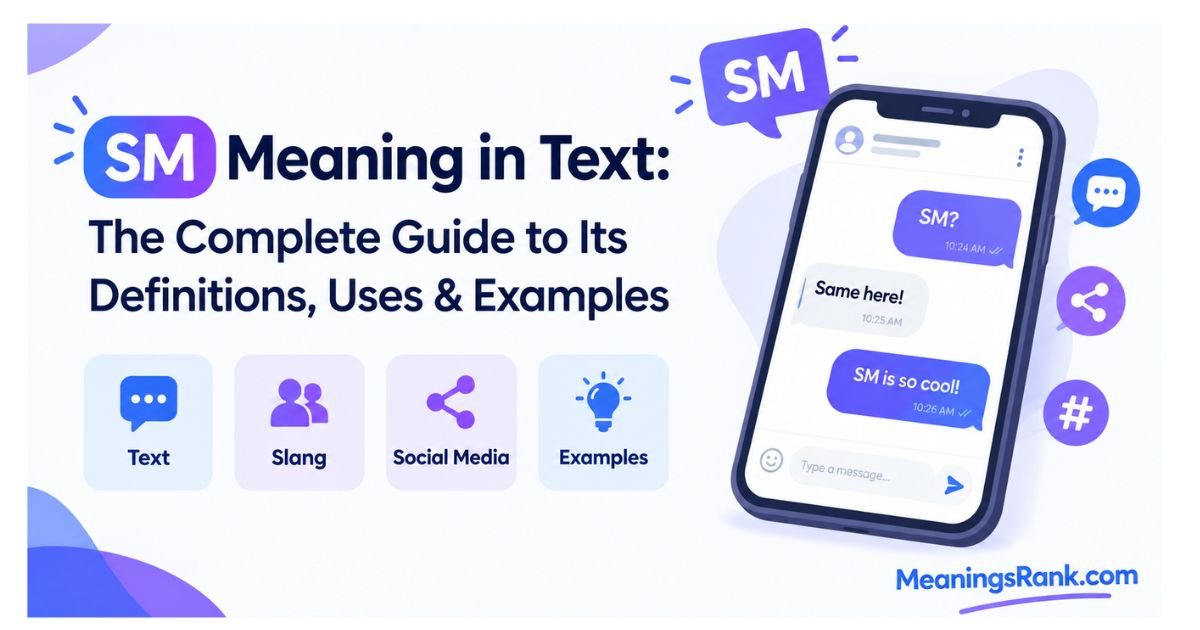

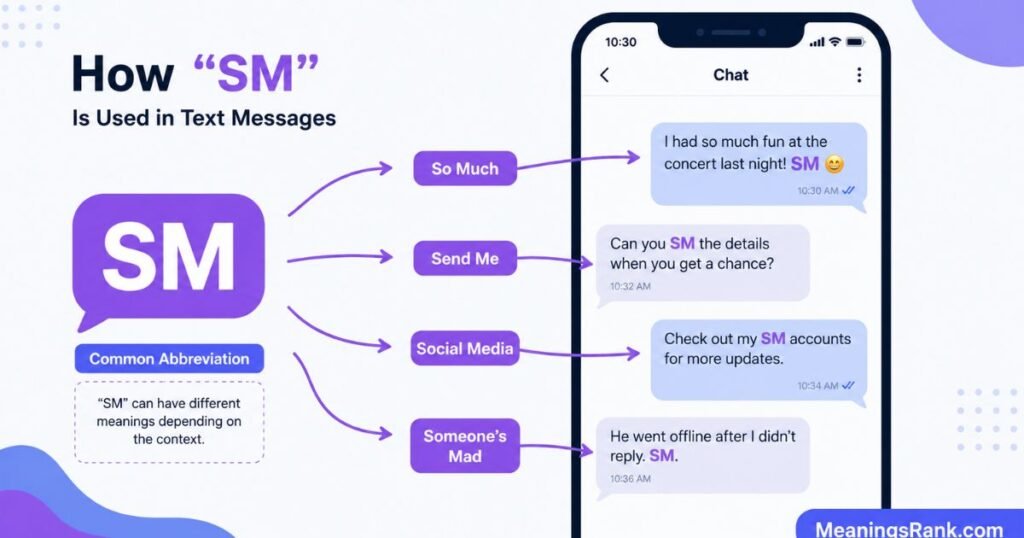
Seen “SM” pop up in a text and had no clue what it meant? You’re not alone. The SM meaning in text usually comes down to one of two things: “So Much” or “Social Media,” depending on the conversation. It’s a short, flexible abbreviation that shows up in texting, Instagram captions, Snapchat chats, gaming lobbies, and even workplace messages.
Because SM can shift meaning based on context, it sometimes confuses people who aren’t used to reading between the lines of a chat. This guide breaks down every common use of SM, from casual texting to specific fields like the military, business, and sports, so you never have to guess again.
What Does SM Mean?
SM is a short abbreviation with more than one meaning, and the correct one depends entirely on the conversation happening around it.
In most everyday texting, SM means one of these two things:
- “So Much”
Used to add emphasis, like “I miss you SM”
- “Social Media”
Used when talking about platforms like Instagram or TikTok
Here’s a simple example:
Person A: “Thanks for helping me today.”
Person B: “Of course! I appreciate you SM.”
In this chat, SM stands for “so much.” Person B is simply adding extra emphasis to their appreciation, similar to how someone might say “a lot” or “really.”
Now compare that to this one:
Person A: “How do you find new recipes?”
Person B: “Mostly SM, TikTok has so many good ones.”
Read More: Demisexual Meaning: The Ultimate Guide to Its Definition, Signs & Usage
Here, SM clearly means “social media” since the conversation is about finding content online.
A few quick things to remember about SM:
- Its meaning depends heavily on context
- It’s almost always casual, rarely formal
- It can appear in both emotional and factual sentences
- Some fields, like the military or business world, use SM for entirely different terms
Because SM is short and flexible, people use it constantly without much thought. Once you understand the context clues, figuring out which meaning applies becomes second nature.
SM Meaning in Text Messages
In everyday texting, SM most often means “so much.” It’s used to boost emotion or emphasis in a sentence, almost like adding an exclamation point through words instead of punctuation.
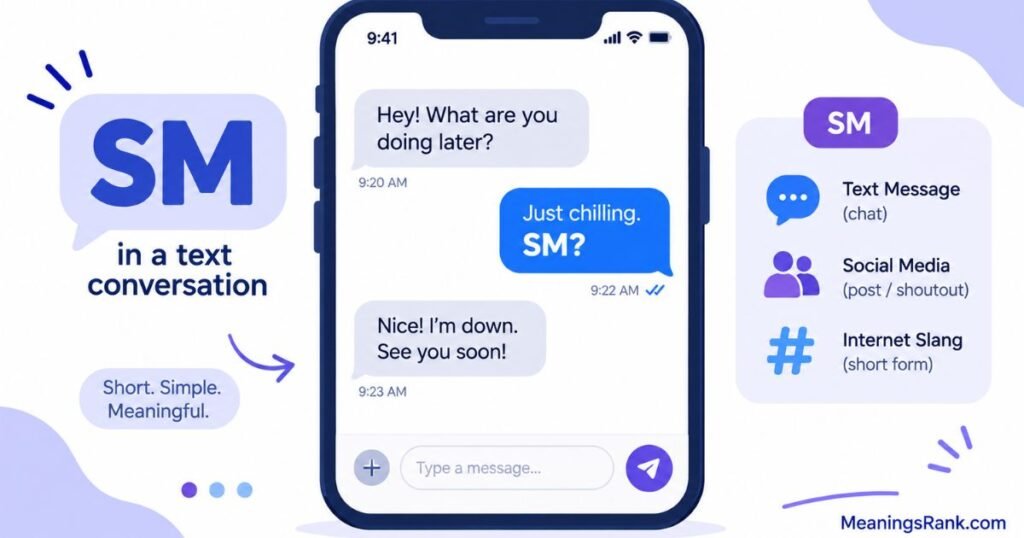
Common Examples:
- “I love you SM ❤️”
- “Thank you SM for today”
- “I missed this SM”
- “That helped SM, thank you”
Notice how SM in these examples always follows a feeling or reaction. It rarely stands alone and almost always attaches to a verb like “love,” “miss,” “thank,” or “appreciate.”
Here’s a quick text conversation example:
Person A: “Happy birthday! Hope your day is amazing.”
Person B: “Thank you SM, means a lot 🥹”
In this case, SM adds warmth to the message. It shows genuine appreciation without needing a long sentence to explain it.
SM can also show up in less emotional texts, simply to emphasize a point:
Person A: “How was the traffic today?”
Person B: “Bad SM, took me an hour longer.”
Here, SM emphasizes how bad the traffic really was, similar to saying “really bad” or “so bad.”
A few tips for understanding SM in texting:
- If it follows an emotional word, it likely means “so much”
- If it’s placed at the end of a sentence, it usually adds emphasis
- It’s rarely used to start a sentence
This pattern makes SM easy to recognize once you’ve seen it a few times. It blends naturally into casual texting without needing much explanation.
Read More: PMO Meaning: What Does PMO Stand For in Business?
SM Meaning in Chat and Social Media
Outside of texting, SM shifts meaning slightly depending on the platform and topic of conversation. In many online chats, especially ones about marketing, content, or platforms, SM stands for “social media.”
Examples in Chat Settings:
- “I found this on SM, not sure if it’s true.”
- “My SM game has been weak lately, need to post more.”
- “She works in SM for a small company.”
In group chats discussing trends, news, or content creators, SM almost always refers to social media rather than “so much.”
Here’s a quick example from a group chat:
Person A: “Where did you hear about the concert?”
Person B: “SM, saw it on three different pages.”
In this case, Person B is clearly referring to social media as the source of information, not expressing emotion.
Quick Way to Tell the Difference:
| Context Clue | Likely Meaning |
| Follows an emotional word (love, miss, thank) | So Much |
| Talks about platforms, posts, or trends | Social Media |
| Appears in marketing or business chats | Social Media |
| Appears in personal or relationship texts | So Much |
This small pattern makes it much easier to figure out which meaning fits, even without asking the person directly.
Because SM is so short, context does almost all the work. Once you notice what the rest of the sentence is about, the correct meaning usually becomes obvious within a few words.
What Does SM Mean From a Girl or Friend?
When SM shows up in a text from a friend, especially in a personal or emotional message, it almost always means “so much.” This is one of the most common uses of the abbreviation in everyday friendships.
Example:
Person A (friend): “I really needed that talk today.”
Person B: “Anytime, I care about you SM.”
Here, SM adds warmth and sincerity to the message. It’s a quick way to express strong feelings without sounding overly dramatic or formal.
Friends often use SM in supportive or appreciative messages, especially after:
- A compliment
- A favor or act of kindness
- An emotional conversation
- A thank-you message
More Examples:
- “You always know what to say, love you SM.”
- “Thanks for listening SM, I needed that.”
- “You’re the best SM, seriously.”
In these cases, SM works almost like an emotional highlighter. It draws attention to how much the sender genuinely means what they’re saying.
It’s worth noting that SM from a friend rarely carries hidden meaning. It’s straightforward and doesn’t usually require overthinking, unlike some slang terms that shift depending on tone or sarcasm.
If a girl or friend sends “SM” in a sentence tied to appreciation, gratitude, or affection, it’s safe to assume they mean “so much,” not “social media.” The emotional context almost always gives it away immediately.
SM Meaning in Love and Relationships
In romantic conversations, SM plays a similar role to how it works in friendships, but often carries a bit more emotional weight. It’s frequently used to express affection, appreciation, or longing.
Common Examples in Relationships:
- “I miss you SM right now.”
- “You make me happy SM.”
- “I can’t wait to see you SM.”
- “Thinking about you SM today.”
Here’s a short example conversation:
Person A: “Can’t stop thinking about last night.”
Person B: “Same, I liked that SM.”
In this exchange, SM meaning in text strengthens the emotional tone of the message. It shows genuine enthusiasm without needing extra words.
SM is especially common in:
- Good morning or goodnight texts
- Messages after a date
- Long-distance relationship texts
- Compliments during a conversation
Example:
“Good morning! Missed talking to you SM last night lol”
This kind of message feels casual but still emotionally sincere, which is exactly why SM fits so naturally into romantic texting.
Unlike some slang terms that can feel confusing or mixed in meaning, SM in relationships is almost always positive. It rarely appears in arguments or negative messages, since its main job is boosting emotional expression, not softening criticism.
If someone in a relationship sends “SM” after an affectionate sentence, it’s a clear, simple sign they’re emphasizing genuine feelings, nothing more complicated than that.
Read More: What Does WDYM Mean in Text? Meaning, Uses & Examples
SM Meaning on Snapchat and Instagram
On visual platforms like Snapchat and Instagram, SM can mean both “so much” and “social media,” depending heavily on the caption or comment style.
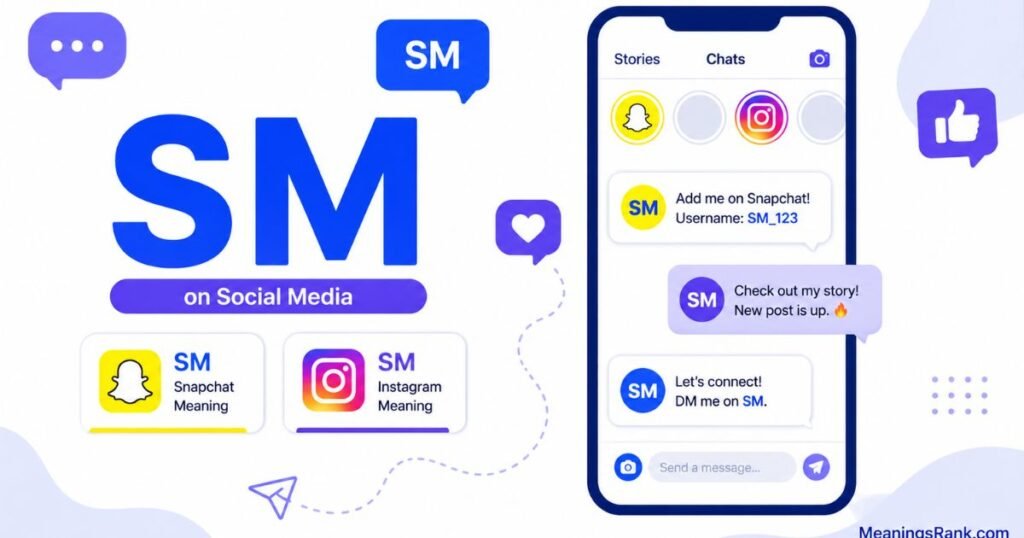
Snapchat Examples:
- “Missed this SM 🥺” (so much)
- “This blew up on SM overnight” (social media)
Instagram Comment Examples:
- “This made my day SM 😭” (so much)
- “Saw this trending on SM everywhere” (social media)
Here’s a quick Instagram-style example:
Comment:
“This photo is stunning, love it SM 😍”
In this case, SM clearly emphasizes admiration, similar to saying “so much” in a spoken compliment.
Now compare that to a caption example:
Instagram Caption:
“Grateful this got shared across SM this week.”
Here, SM refers to social media platforms in general, especially since the sentence discusses sharing and visibility.
Quick Tips for Reading SM on These Platforms:
- Emotional captions and comments usually mean “so much”
- Captions about growth, reach, or trends usually mean “social media”
- Stories and quick captions lean toward “so much” more often
Because both platforms mix personal expression with content promotion, SM meaning in text naturally shifts between meanings depending on what the post or comment is about. Once you notice the topic, the correct meaning becomes easy to identify almost instantly.
SM Meaning in Different Contexts
Outside of texting and social media, SM takes on completely different meanings depending on the field or industry being discussed.
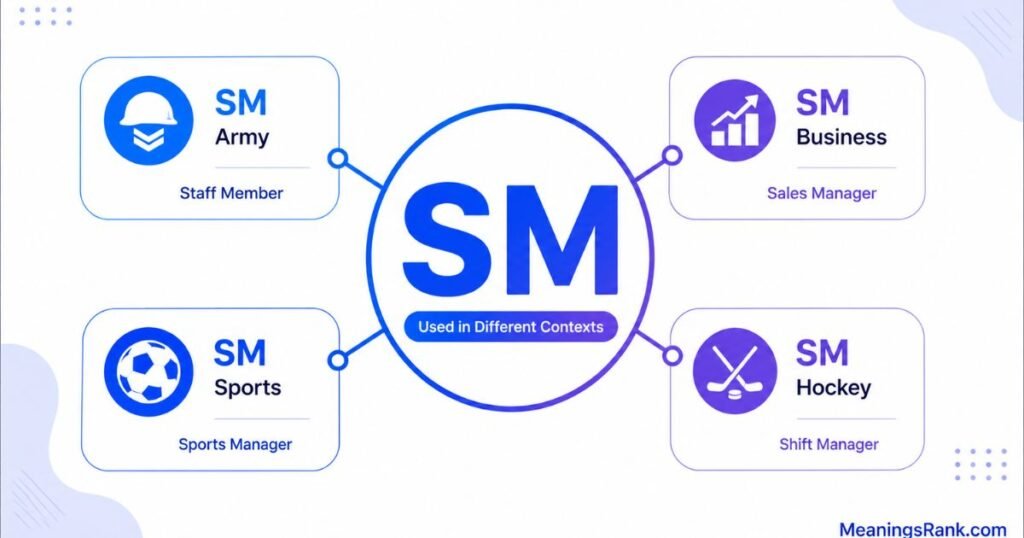
SM Meaning in the Army
In military contexts, SM commonly refers to “Sergeant Major”, a senior enlisted rank responsible for leadership and discipline within a unit. It can also be used more broadly to mean “Service Member” in general conversation.
Example: “The SM addressed the unit before deployment.”
SM Meaning in Business
In workplace and business settings, SM often stands for “Social Media”, especially in marketing departments. It can also refer to “Senior Manager” or “Sales Manager”, depending on the company structure.
Example: “The SM approved the new campaign budget.”
SM Meaning in Sports and Hockey
In sports discussions, especially hockey, SM is sometimes used to refer to specific team roles or statistical shorthand, and its exact meaning can vary by league, team, or region. Fans and commentators may use it differently depending on context, so it’s best understood alongside surrounding sports terminology.
Example: “Their SM strategy shifted in the third period.”
Across all these fields, one thing stays consistent: SM meaning in text only makes sense with context. Without knowing the topic, it’s nearly impossible to guess the correct meaning right away.
How Is SM Used in Conversations?
SM typically appears in the middle or end of a sentence, right after the word or phrase it’s emphasizing or describing. Its placement rarely changes, which makes it easier to recognize once you’re familiar with the pattern.
Typical Sentence Structures:
- “[Feeling] + SM” → “love you SM,” “miss this SM”
- “SM + [topic]” → “SM has changed marketing a lot”
Examples Across Platforms:
Text Messages: “Thank you SM for today.”
WhatsApp: “Miss our group chats SM lol”
Instagram: “This edit is amazing SM 🔥”
Snapchat: “lol I needed that laugh SM”
TikTok: “This trend blew up on SM so fast”
Gaming Chats: “That comeback was clutch SM”
Discord: “This update helped the game SM”
Workplace Chats: “Our SM engagement grew a lot this month.”
Notice how SM adjusts meaning slightly depending on setting, but the sentence structure barely changes. This consistency is exactly why SM feels so natural once you understand it, even across very different types of conversations.
Read More:SB Meaning in Text: What It Means, How to Use It, and How to Reply (2026 Guide)
50 Examples of SM in Text Messages
To make the meaning even clearer, here are 50 real-style examples showing SM in everyday texting.
- Love you SM ❤️
- Miss you SM today
- Thanks SM for helping
- That meant SM to me
- I appreciate you SM
- This made my day SM
- I needed that SM
- You’re the best SM
- Can’t wait SM for this
- That helped SM, thank you
- I’m grateful SM right now
- This hit different SM
- I laughed SM at that
- That made me smile SM
- I owe you SM
- This means SM to me
- I’m proud of you SM
- That was funny SM
- I trust you SM
- This song hits SM
- I respect that SM
- You inspire me SM
- That was sweet SM
- I enjoyed that SM
- This helped calm me SM
- I’m excited SM
- That made sense SM
- I relate to this SM
- This is useful SM
- I appreciate the effort SM
- That was thoughtful SM
- I loved the surprise SM
- This made everything easier SM
- I’m thankful SM
- That comment made me smile SM
- I missed talking SM
- This blew up on SM (social media)
- Our brand grew on SM (social media)
- I saw this trending on SM (social media)
- She works in SM marketing (social media)
- Our SM engagement improved (social media)
- That video spread across SM fast (social media)
- I check SM way too often (social media)
- This news broke on SM first (social media)
- Our SM strategy needs updating (social media)
- He’s active on SM daily (social media)
- That trend started on SM (social media)
- Our SM followers doubled (social media)
- That post did well on SM (social media)
- I found this recipe on SM (social media)
As shown above, roughly half the examples lean emotional (“so much”), while the other half relate to platforms and content (“social media”). Reading the surrounding words instantly reveals which meaning fits.
SM vs. “So Much” vs. “Very Much”
Although SM, “so much,” and “very much” carry similar meaning, small differences in tone and formality set them apart.
| Term | Formality Level | Best Used In |
| SM | Very casual | Texting, social media, quick chats |
| So Much | Neutral | Everyday speech and writing |
| Very Much | More formal | Emails, professional messages |
Example Comparison:
- “Thank you SM” (casual texting)
- “Thank you so much” (everyday spoken or written English)
- “Thank you very much” (formal or professional tone)
All three phrases share the same core meaning, but SM feels the most relaxed and quick, making it perfect for fast-paced digital conversations rather than formal writing.
SM vs. OMG vs. LOL: What’s the Difference?
While SM, OMG, and LOL are all common texting abbreviations, each one serves a very different purpose in conversation.
| Term | Meaning | Purpose |
| SM | So Much / Social Media | Adds emphasis or refers to platforms |
| OMG | Oh My God | Expresses shock or surprise |
| LOL | Laugh Out Loud | Expresses humor or amusement |
Example Comparison:
- “That surprised me SM” (emphasis)
- “OMG, I can’t believe that happened” (shock)
- “LOL that’s hilarious” (humor)
Unlike OMG and LOL, which express specific emotional reactions, SM meaning in text mostly boosts intensity or refers to online platforms. It doesn’t carry humor or shock on its own, which makes it more flexible across different types of messages.
Real Chat Examples Using SM
WhatsApp Family Group:
Person A: “Dinner’s ready, come down!”
Person B: “Coming, missed home-cooked food SM.”
Gaming Discord Server:
Person A: “That win was insane.”
Person B: “Fr, that last play saved us SM.”
Workplace Slack Message:
Person A: “Great job on the campaign.”
Person B: “Thank you SM, the team worked hard.”
Instagram DM:
Person A: “Loved your latest post.”
Person B: “Thank you SM, means a lot 🥹”
These real-style examples show how naturally SM fits into different types of digital conversations, whether personal, professional, or platform-based.
When Should You Not Use SM?
While SM is common in casual chats, certain situations call for more formal language instead.
- Formal emails:
Use “so much” or “very much” instead of SM.
- Professional documents:
Avoid abbreviations entirely for clarity.
- Conversations with people unfamiliar with texting slang:
Spell it out to avoid confusion.
- Serious or sensitive topics:
Full sentences feel more sincere and clear.
- Customer service messages:
Stick to professional, complete phrasing.
Skipping SM in these settings helps keep communication clear and appropriate for the audience.
Is SM Slang Appropriate for Kids and Teens?
The abbreviation SM can be appropriate for kids and teens, but its meaning depends on the context in which it is used. In text messages and social media, SM may mean “so much,” “social media,” or other phrases. However, in some adult or sexual contexts, it can refer to BDSM-related terminology. This is why parents and young users should consider the surrounding conversation before interpreting the abbreviation.
For younger users, it is best to use SM meaning in text only in a clear, appropriate context and avoid assuming that it always has the same meaning. Parents can help teens understand online slang by encouraging open conversations about digital communication, privacy, and online safety. The key is to understand the context rather than judging the abbreviation alone.
Internet Safety Tips When Using Slang Online
- Avoid sharing personal information, even in casual slang-filled chats
- Double-check context before assuming a word’s meaning
- Be cautious with abbreviations in messages from unknown accounts
- Teach younger users to ask trusted adults about confusing slang
- Remember that tone can be easily misunderstood in text-only conversations
Synonyms and Related Terms for SM
- So Much
- Very Much
- A Lot
- Deeply
- Truly
- Social Platforms (for the “social media” meaning)
- Online Platforms
FAQs About SM Meaning
What does SM mean in a text message?
SM usually means “so much,” used to add emphasis to feelings like love, thanks, or appreciation in casual texting.
Does SM always mean social media?
No, SM often means “so much” in personal texts, while “social media” fits better in marketing or platform-related conversations.
Is SM appropriate to use with friends?
Yes, SM is casual and friendly, commonly used in supportive or appreciative messages between friends.
What does SM mean in business chats?
In business settings, SM often means “social media,” though it can also refer to “senior manager” or “sales manager.”
Is SM the same as OMG or LOL?
No, SM adds emphasis or refers to platforms, while OMG expresses shock and LOL expresses laughter.
Conclusion
The SM meaning in text really depends on context, but it almost always falls under “so much” or “social media.” Whether it’s a heartfelt text between friends, a romantic message, or a comment about a trending post, SM adds emphasis or points toward online platforms depending on the situation. We’ve also covered how SM shifts meaning in fields like the military, business, and sports, along with practical tips for using it appropriately. The next time SM shows up in a message, you’ll know exactly how to read it. Small abbreviations like this make digital conversations faster, but understanding their context makes your communication even clearer and more confident.