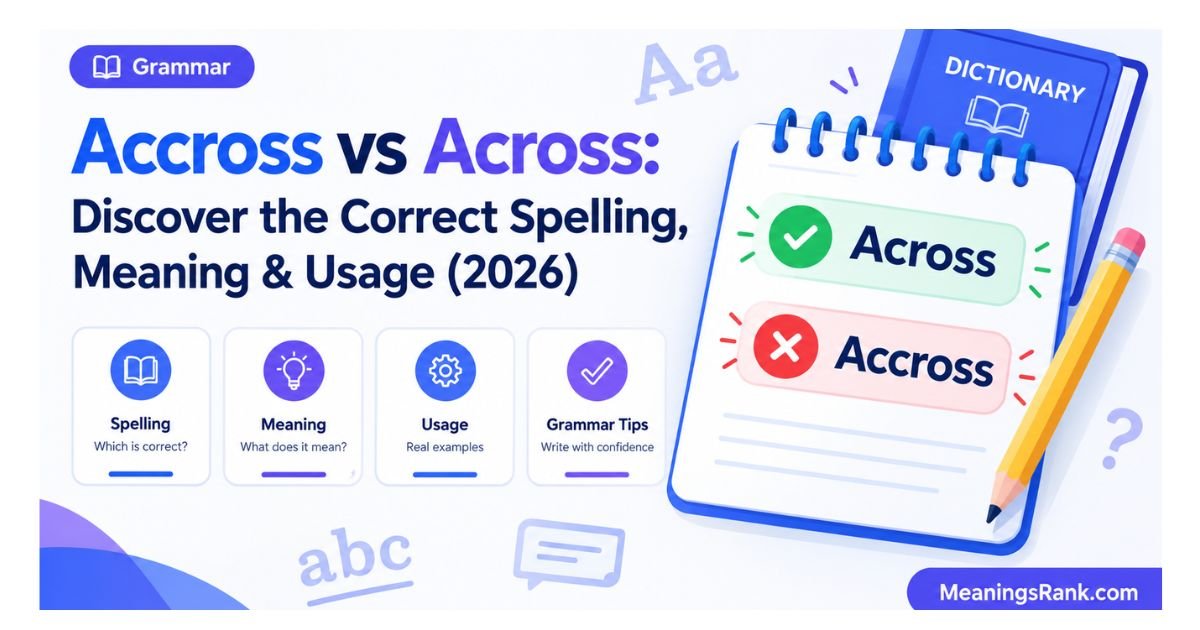

You are typing a sentence, you reach the word that means “from one side to the other,” and your fingers hesitate. Is it across or accross? That tiny pause happens to students, professionals, and confident writers every day.
The good news is that the rule is simple, and once you see how the word is built, you will not forget it. “Across” is one of the most frequently used prepositions in English, so getting it right matters. A single misspelled word in an email, essay, or blog post can quietly weaken your credibility, even when the rest of your grammar, punctuation, and clause structure is flawless.
This guide walks you through the correct spelling, the meaning, the grammar rules, the common traps, and the differences between “across,” “through,” and “over.” You will also find memory tricks and a short quiz at the end. Think of it as a private lesson with an English tutor, minus the red pen.
Accross vs Across – Quick Answer and Correct Spelling
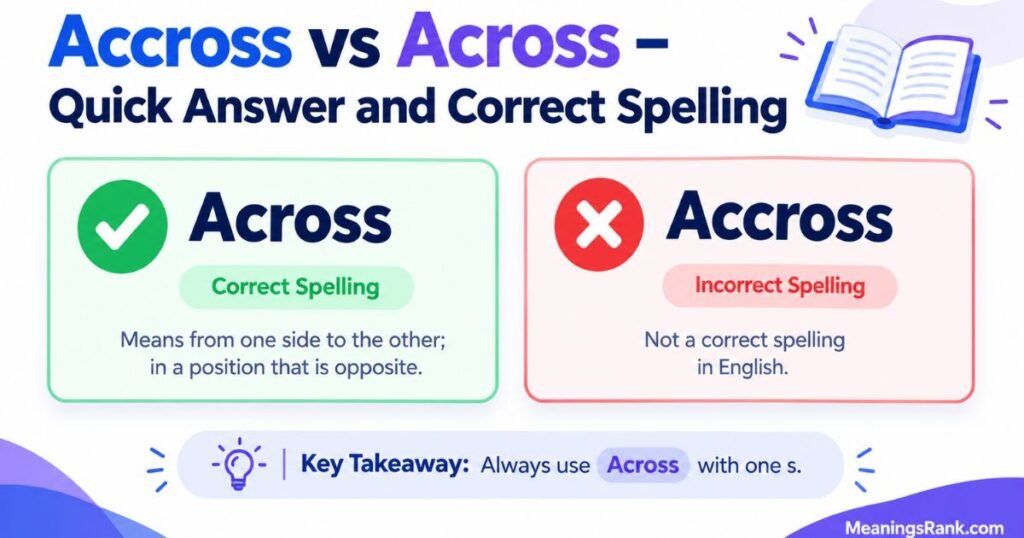
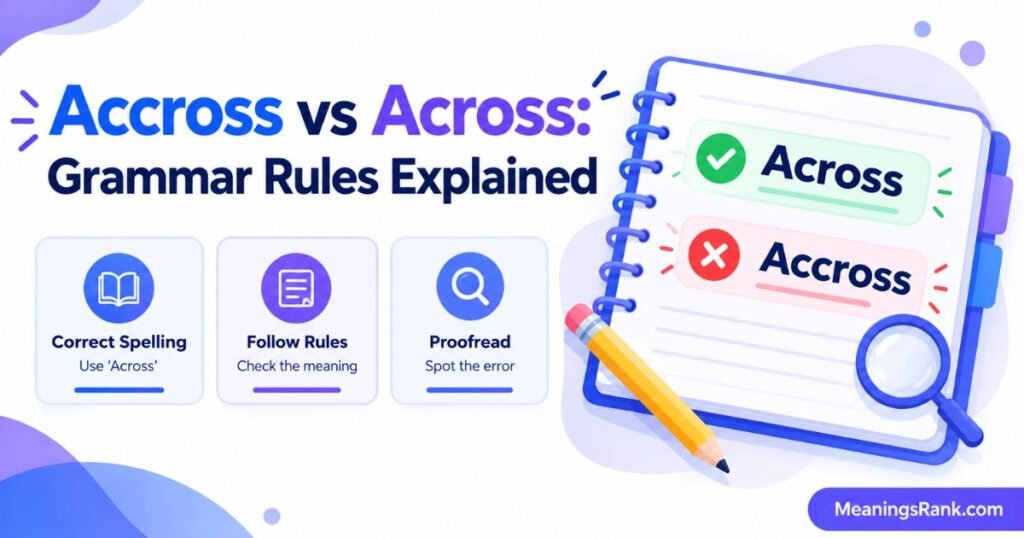
“Across” is the only correct spelling. “Accross” (with a double “c”) is a common misspelling and does not appear in standard English dictionaries. Remember the formula: A + CROSS = ACROSS. The word is built from the letter “a” plus the word “cross,” so it has one “c” before the “r” and a double “s” at the end.
| Spelling | Status | Example |
| across | Correct | She walked across the bridge. |
| accross | Incorrect (extra “c”) | ~~She walked accross the bridge.~~ |
| acros | Incorrect (missing “s”) | ~~She walked acros the bridge.~~ |
What Does Across Mean in English?
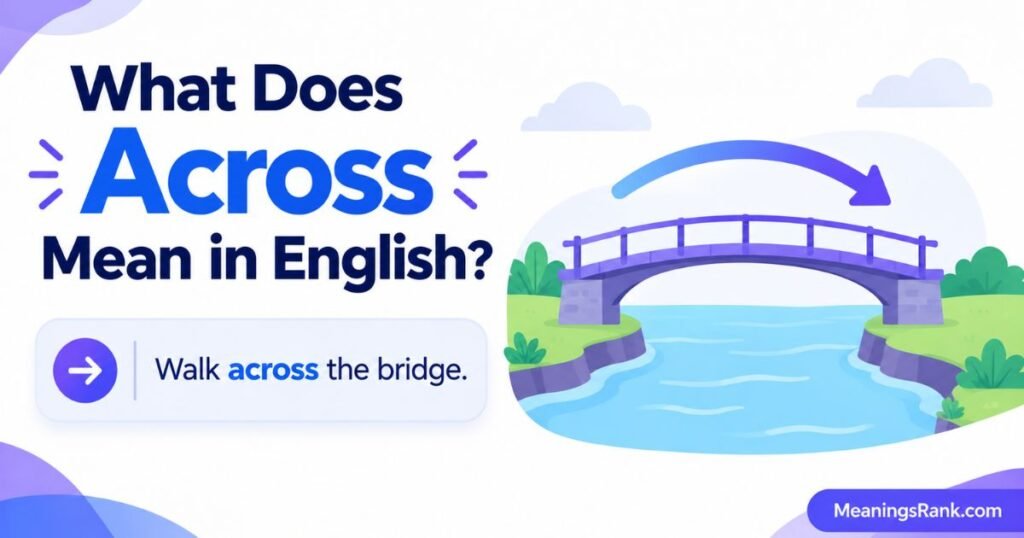
“Across” works as a preposition and as an adverb. Its core idea is movement or position from one side of something to the other, or on the opposite side.
| Part of Speech | Meaning | Example |
| Preposition | From one side to the other side of | The children ran across the playground. |
| Preposition | On the opposite side of | The bakery is across the street. |
| Preposition | Over a wide area or throughout | Her fans live across the globe. |
| Adverb | From one side to the other | The river is 50 metres across. |
| Adverb | To the other side | He swam across in under ten minutes. |
| Phrasal verb | To find or meet by chance (come across) | I came across an old photo yesterday. |
| Idiom | Applying to everything in a group (across the board) | The company announced pay rises across the board. |
Notice that every meaning carries the same picture: a line, a surface, or an area, and something moving over it or sitting at its far edge.
Accross vs Across: Meaning and Key Differences
Here is the key difference: “across” has a meaning, and “accross” does not. They are not two words with two senses. One is a real word. The other is a spelling error that readers will decode as “across” anyway.
So the “difference” is entirely about correctness, credibility, and polish. A reader who meets “accross” does not wonder what you mean. They wonder how carefully you proofread.
| Feature | Across | Accross |
| Listed in dictionaries | Yes | No |
| Part of speech | Preposition, adverb | None (not a word) |
| Accepted by style guides | Yes | No |
| Safe in formal writing | Yes | Never |
| Origin | Anglo-French a cros (“in a cross”) | Spelling error |
Why Is Across Spelled With One “C”?
The answer lives in the word’s history. “Across” comes from Middle English acros, which traces back to the Anglo-French phrase a cros, meaning “in a cross” or “crosswise.” In plain terms, it is the prefix a- attached to cross.
That gives us:
- a + cross = across
There is no second “c” because the prefix “a-” is a single letter. Adding another “c” would turn the prefix into “ac-,” and that is not what the word is made of.
Easy memory tricks:
- A + CROSS = ACROSS. You are adding one letter to the word “cross.”
- “One C, two S’s.” Picture crossing a street: one person (c), two footsteps (ss).
- Cross the street. The word describes the action. You cross from one side to the other, so you go a-cross.
- Write “cross,” then add a small “a” in front. That image blocks the extra “c.”
Read More: ICL Meaning: The Ultimate Guide to ICL Slang in Text & Social Media
Why Do People Commonly Spell Across Incorrectly?
Three habits cause most of the trouble.
- Prefix confusion. English has many words that begin with “ac-” followed by a doubled letter, such as accept, accord, account, and accommodate. Writers carry that pattern over to “across” by mistake.
- Pronunciation. We say /əˈkrɒs/ or /əˈkrɔːs/. The sound gives no hint about how many letters to use, so the brain guesses.
- The “cross” echo. Because “cross” has a double “s,” some writers overcorrect and add a double “c” at the front as well.
Spellcheck usually catches “accross,” but not always. Autocorrect can fail in browsers, social media captions, and handwritten notes. Fast typing on a phone makes the error even more likely.
Accross vs Across: Grammar Rules Explained
Because “across” is a preposition, it follows the usual syntax of prepositions. A few rules are worth knowing.
As a preposition, it needs an object.
In “She ran across the field,” the field is the object of the preposition.
As an adverb, it stands alone.
In “The lake is a mile across,” there is no object. The word completes the description of the lake.
It pairs naturally with motion and position verbs.
Walk across, look across, stretch across, spread across.
Do not add “of.”
Write “across the room,” not “across of the room.”
Mind the punctuation.
When “across” begins an introductory phrase, add a comma after that phrase: “Across the valley, the lights flickered on.”
Keep it as one word.
Writing “a cross” as two words changes the meaning completely, because a cross is an object, such as a religious symbol.
The spelling stays the same in every clause structure. Whether “across” opens a sentence, sits in the middle, or ends it, the letters never change.
How to Use Across Correctly in a Sentence
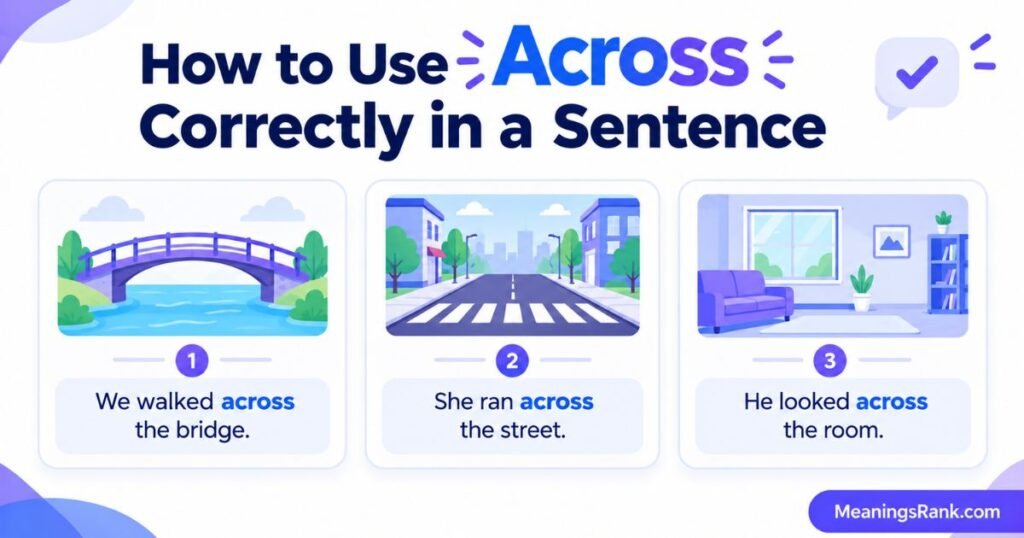
Use “across” to show crossing, opposite position, or wide coverage.
| Use | Example |
| Crossing a surface | The kids ran across the playground. |
| Opposite position | The library is across from the post office. |
| Wide coverage | The campaign launched across twelve countries. |
| Measurement | The table is two metres across. |
| Phrasal verb | She came across a rare book at the market. |
| Idiom | Management wants consistency across the board. |
Formal vs. informal context:
| Context | Example |
| Formal (academic) | Rainfall varied significantly across the three regions studied. |
| Formal (business) | We have standardised procedures across all departments. |
| Informal (texting) | The shop’s across from my place. |
| Informal (spoken) | I just came across the funniest video. |
The spelling never changes between registers. Only the surrounding tone does.
Common Spelling Mistakes to Avoid When Using Across
| Incorrect | Correct | What Went Wrong |
| She walked accross the road. | She walked across the road. | Extra “c” |
| We travelled accross Europe. | We travelled across Europe. | Extra “c” in a formal sentence |
| The cafe is acros the street. | The cafe is across the street. | Missing final “s” |
| He swam acrross the lake. | He swam across the lake. | Extra “r” |
| She crossed acorss the field. | She crossed across the field. | Letters swapped |
| He came accross an old letter. | He came across an old letter. | Error inside a phrasal verb |
| Let’s meet a cross from the station. | Let’s meet across from the station. | Split into two words |
A quick proofreading habit: after you finish a draft, search for “accross” and “acros” with Find (Ctrl+F or Cmd+F). It takes five seconds and catches the usual suspects.
Across vs Through vs Over: Key Differences
These three prepositions overlap, and that overlap is where many writers slip.
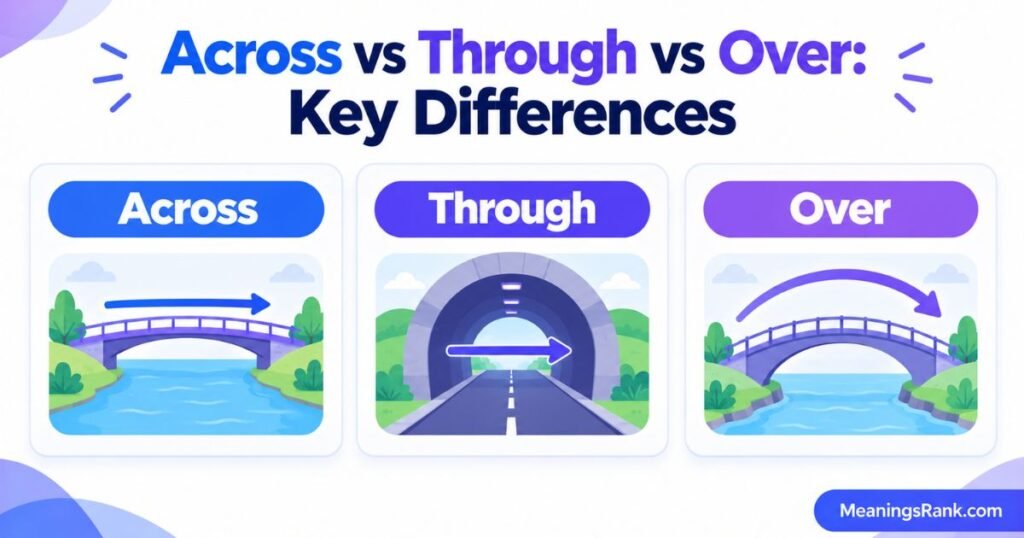
| Word | Core Idea | Example |
| Across | Side to side on a surface or line | He swam across the lake. |
| Through | Inside something, entering one side and leaving the other | The train went through the tunnel. |
| Over | Above, or passing higher than something | The plane flew over the mountains. |
A quick test: if you could draw a line on a flat surface, use across. If you are enclosed by walls, trees, or a crowd, use through. If something is higher than the object, use over.
Edge cases worth knowing:
- “Walk over the bridge” and “walk across the bridge” are both correct. “Over” stresses the height, while “across” stresses the crossing.
- “Walk through the park” and “walk across the park” can both work. “Through” suggests trees and paths around you, and “across” suggests an open stretch of grass.
- “Spread across the table” and “spread over the table” are near-synonyms. “Across” feels wider, and “over” feels like covering.
Synonyms and Similar Words for Across
Depending on the sentence, you can swap “across” for one of these:
- Opposite (the shop opposite the park)
- Beyond (the village beyond the river)
- On the other side of (a friendly, plain-English option)
- Throughout (for coverage: across the country = throughout the country)
- Over (in some contexts)
- Spanning or traversing (more formal)
- Crosswise or transversely (technical)
Not every synonym fits every sentence, so check the clause structure and the intended meaning before you swap. “Throughout” cannot replace “across” in “She walked across the road,” for example.
Read More: Seaver Meaning: The Ultimate Guide to Its Definition, Uses & Common Contexts
Accross vs Across in UK and US English: Is There a Difference?
No. British and American English share the same spelling: across. Unlike “colour/color” or “centre/center,” this word has no regional variant. The same is true in Canadian, Australian, and Indian English.
The only noticeable difference is usage:
| Variety | Common Phrasing |
| US English | “The bank is across from the school.” |
| UK English | “The bank is opposite the school,” or “across the road from the school.” |
Both are correct, and the spelling of “across” is identical.
Is Accross Ever Correct to Use?
In standard English, never. The Chicago Manual of Style, the AP Stylebook, and major dictionaries list only “across.” Here are the few situations where “accross” might appear:
- Quoting someone’s error. If you are citing a text that contains the mistake, you can reproduce it with [sic].
- Teaching the misspelling. Grammar articles like this one show it in quotation marks or italics.
- Proper names or usernames. A brand, handle, or username may use any spelling the owner chooses. That is a name, not standard English.
Outside those cases, it is simply an error. If you are unsure, use “across” and move on.
The Impact of Spelling Errors on Writing
Small errors send big signals.
- Credibility drops. Readers often judge a writer’s care by their spelling.
- Professional image suffers. A typo in a CV, proposal, or client email can undercut otherwise strong work.
- Clarity can slip. Repeated errors pull readers out of the sentence and break their focus.
- Search visibility can suffer. On websites, misspellings in headings or body text may weaken how well a page matches what people actually search for.
- Grades may fall. Teachers and examiners often deduct marks for spelling and mechanics.
One habit keeps all of this simple: proofread the little words, because those are the ones the eye skips. A common word like “across” is easy to type on autopilot, and that is exactly why it deserves a second look.
Practice Exercise: Accross vs Across
Fill in each blank with the correct word or spelling. Answers are at the bottom.
- The children walked ________ the playground after the bell rang. (across / accross)
- The tennis ball flew ________ the net. (across / accross)
- I came ________ my old yearbook while cleaning the attic. (across / accross)
- The thief crawled ________ the tunnel to reach the other room. (across / through)
- Choose the correct spelling: acros, accross, across, acrross → ________
Answer Key
- across: movement from one side of a surface to the other.
- across: the ball passes from one side of the net to the other.
- across: “come across” is a phrasal verb meaning “to find by chance.”
- through: a tunnel is enclosed, so “through” fits better than “across.”
- across: the only correct spelling (a + cross).
Scoring: 5/5 means you have mastered it. 3-4 means you are close, so re-read the memory tricks. 0-2 means bookmark this page and try again tomorrow.
Read More: CC Meaning in Text: Discover Its Real Meaning Across Messages, Emails & Social Media
Frequently Asked Questions (FAQs)
Is it “accross” or “across”? The correct spelling is across.
“Accross” is a misspelling and does not appear in standard dictionaries.
Why is “across” spelled with one “c”?
“Across” is formed from the prefix a- and the word cross. Since the prefix is a single letter, the word has only one “c” at the start, followed by “ross.”
Is “accross” a word in British or American English?
No. Neither variety recognises “accross.” Both use “across,” and the spelling is identical in the UK, US, Canada, and Australia.
What is the difference between “across,” “through,” and “over”?
“Across” means from one side to the other of a surface or line. “Through” means moving inside or within something. “Over” means above or higher than something. For example: walk across a field, drive through a forest, fly over a city.
How can I remember how to spell “across”?
Use the formula A + CROSS = ACROSS. Think of the word “cross” with a small “a” in front, and remember: one “c,” two “s’s.”
Can “across” be used as both a preposition and an adverb?
Yes. As a preposition it takes an object (“across the river”). As an adverb it stands alone, as in “The lake is a mile across.” Both uses share the same spelling.
Final Takeaway
The correct spelling is across, and “accross” is always a mistake. The word comes from the prefix “a-” plus “cross,” which is why it has one “c” and a double “s.” You can use it as a preposition (“across the street”) or as an adverb (“ten feet across”), and it appears in familiar phrases like come across and across the board. Keep “through” for enclosed spaces and “over” for movement higher than an object, so your sentences stay precise. When in doubt, picture the formula A + CROSS = ACROSS and proofread the small words twice. Get this one right, and your writing instantly looks more polished and trustworthy.