
You’re scrolling through a group chat and someone drops “TBD” instead of an actual answer. No date, no plan, just three letters. If you’ve ever paused and wondered what that meant, you’re not alone. TBD meaning slang has become one of the most common shorthand terms in texting, social media, and even office emails.
It’s short, it’s flexible, and it shows up almost everywhere people talk about plans that aren’t locked in yet. This guide breaks down exactly what TBD meaning, where it came from, how people use it on different apps, and how you should respond when someone sends it your way.
Quick Answer: What Does TBD Mean?
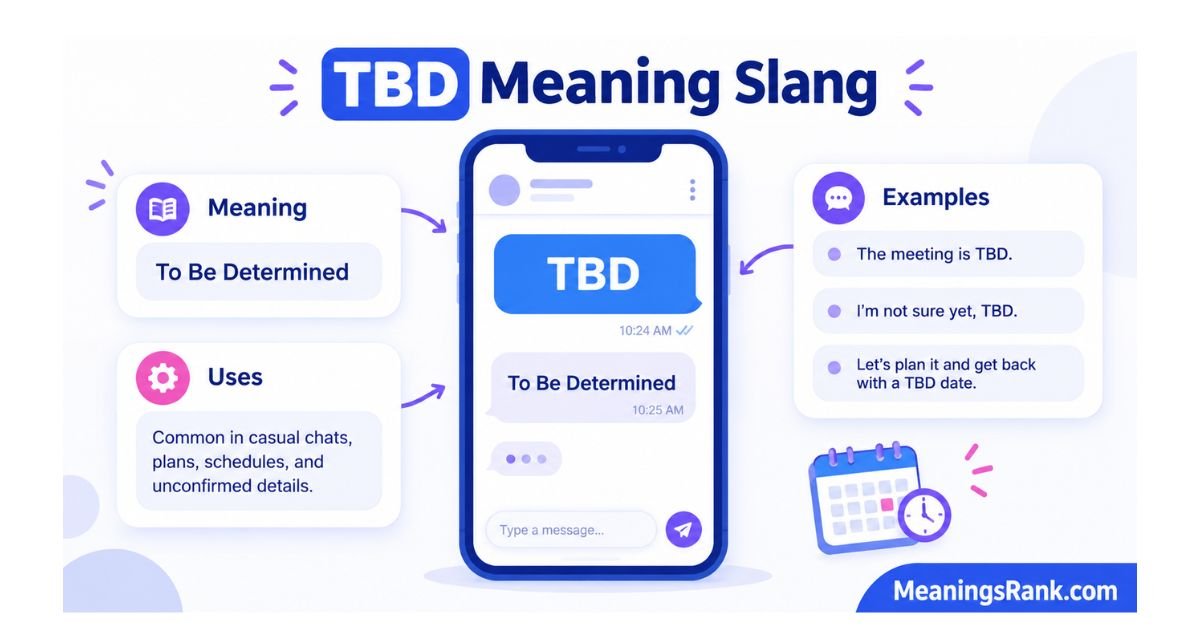
TBD stands for “To Be Determined.” It’s used when a decision, date, time, or detail hasn’t been finalized yet.
People use TBD when they know something is going to happen but don’t have all the details worked out. Think of it as a placeholder. It tells the other person, “This is happening, but I don’t have the full picture right now.”
Here’s the short version:
- Full form: To Be Determined
- Sometimes also means: To Be Decided, To Be Discussed, or To Be Disclosed
- Common in: texting, social media, business emails, schedules, gaming, sports
- Tone: neutral and casual, not rude or dismissive
- Best used when: plans are still forming and details will follow later
If someone texts you “TBD” about a party, meeting, or trip, it simply means the exact time, place, or plan hasn’t been locked in yet.
This is exactly the kind of question people type into Google or ask their voice assistant when they’re staring at a confusing text. “Hey Siri, what does TBD mean?” or “What does TBD mean in a text from my friend?” The answer is always the same short definition, but the way it’s used can shift a little depending on who’s sending it and where the conversation is happening. That’s why this guide goes beyond the one-line definition and breaks down every situation you’re likely to run into.
Why TBD Matters More Than It Seems
At first glance, TBD looks like a throwaway abbreviation. But it actually solves a real communication problem. Without it, people would either have to commit to a plan before they’re ready, or write out a long explanation every time something isn’t finalized. TBD gives people a socially acceptable way to say “this is happening, just not fully planned yet” in three letters instead of a full sentence.
What Does TBD Mean in Text & Chat?
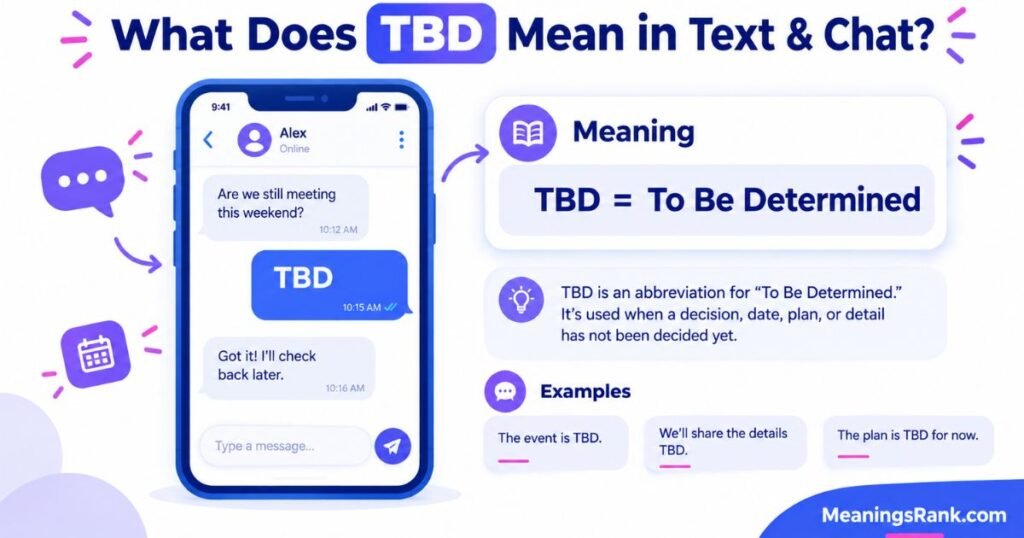
In texting and casual chat, TBD works as a quick way to avoid giving a half-answer. Instead of typing out “I’m not sure yet, we’ll figure it out later,” someone just types TBD.
It fits naturally into fast-paced conversations. Texting is all about speed, and TBD delivers a full thought in three letters. You’ll see it used in personal chats, group threads, and even flirty conversations where someone isn’t ready to commit to firm plans.
Why People Use TBD Instead of a Full Sentence
Texting culture rewards short answers. Nobody wants to type a paragraph when three letters do the job. TBD also removes pressure. It doesn’t force anyone to commit to something before they’re ready, which makes it a safe, low-stakes way to keep a conversation moving without making promises.
TBD in Casual vs Formal Texting
In casual texting, TBD often shows up without any explanation attached. A friend might just say “dinner Friday, time TBD” and leave it at that. In more formal texting, like a message to a coworker or a client, TBD usually comes with a bit more context, such as “The meeting is confirmed, but the location is still TBD, I’ll update you by Thursday.”
How Tone Changes the Meaning Slightly
The words stay the same, but tone shapes how TBD lands. A text with a laughing emoji next to TBD usually feels relaxed and playful, like the person genuinely doesn’t mind waiting to see what happens. A plain “TBD.” with a period and nothing else can come across as more final or a little short, especially in a conversation that already feels tense. Reading the rest of the message, and the relationship you have with the sender, usually clears up any confusion about tone.
Punctuation and Capitalization Habits
You’ll see TBD written in a few different ways: all caps (TBD), lowercase (tbd), or even stylized with periods (T.B.D.). None of these change the meaning. Lowercase versions are more common in casual texting between friends, while all-caps versions show up more often in schedules, emails, and official documents. It’s purely a style choice, not a signal of different meaning.
What Is the Full Form of TBD?
The most widely accepted full form of TBD is “To Be Determined.” This is the version you’ll find in dictionaries, business documents, and most online slang guides.
However, TBD has picked up a few alternate meanings over the years depending on context:
| Full Form | Meaning | Common Use Case |
| To Be Determined | Details are not final yet | Plans, schedules, events |
| To Be Decided | A choice hasn’t been made | Voting, group decisions |
| To Be Discussed | Something needs a conversation first | Work meetings, negotiations |
| To Be Disclosed | Information is being kept private for now | Announcements, reveals |
| To Be Done | A task is still pending | Project management, to-do lists |
Out of all these, “To Be Determined” is by far the most common. The others show up occasionally, but context almost always makes the meaning clear.
Where the Term TBD Originated
TBD isn’t a new internet invention. It actually comes from older business and military shorthand, where abbreviations were used to save space on documents, schedules, and reports. Long before texting existed, TBD was already appearing on printed schedules and planning sheets to mark unfinished details. When texting and instant messaging became popular in the 1990s and 2000s, TBD moved naturally into everyday chat because it already meant exactly what people needed: “not final yet.”
Also Read: Zesty Meaning Slang: The Ultimate Guide to What Zesty Really Means
How TBD Moved From Paperwork to Pop Culture
Before smartphones, TBD lived mostly in office memos, event programs, and printed schedules. Sports programs would list “Time: TBD” next to games that hadn’t been scheduled. Conference agendas used it for speakers who hadn’t confirmed. Once texting became the main way people communicated day to day, this same shorthand slipped naturally into personal conversations. People were already used to seeing it on paper, so using it in a text felt familiar rather than new.
Why Abbreviations Like TBD Took Off in Digital Communication
Character limits on early text messages, along with the general push toward faster typing, made abbreviations like TBD extremely useful. Similar short forms, like ASAP, FYI, and ETA, followed the same path from formal documents into casual digital speech. TBD simply became one more entry in that growing list of shorthand that everyone understands without needing an explanation.
Context and Usage of TBD
TBD changes slightly depending on where and how it’s used. The core meaning stays the same, but the tone and purpose can shift.
In Personal Plans
Friends use TBD constantly when making loose plans. “We’re doing something for her birthday, details TBD” is a normal sentence in any group chat. It signals that the event is happening, but nobody has nailed down the specifics.
In Work and Business Settings
At work, TBD often appears in schedules, project timelines, and emails. A manager might write, “Launch date: TBD, pending final approval.” Here, TBD carries a slightly more formal weight. It tells a team that something is planned but still waiting on a decision from someone else.
In Sports and Entertainment
You’ll often see TBD used for game times, matchups, or event lineups. A sports schedule might list “Opponent: TBD” when the bracket hasn’t been finalized. Award shows and conferences use it the same way for speakers or performers who haven’t been confirmed.
In Online Shopping and Listings
Sometimes TBD shows up next to a price or delivery date on shopping sites, meaning the seller hasn’t finalized that detail. This use is less common in personal chat but still worth recognizing.
In School and Academic Settings
Students and teachers use TBD often too. A syllabus might list “Exam date: TBD” when the professor hasn’t picked the exact day yet. Group projects also lean on TBD a lot, especially when team members are still figuring out who’s doing what and when they’ll meet. “Group meeting TBD, checking everyone’s schedule” is a normal message in a class group chat.
In Travel Planning
Travel plans are one of the biggest breeding grounds for TBD. Flights get booked before hotels are chosen, and hotels sometimes get picked before activities are planned. A group planning a trip might send a message like, “Flights are booked, hotel TBD, we’re comparing a few options” as the trip slowly comes together piece by piece.
How Is TBD Used in Everyday Conversations?
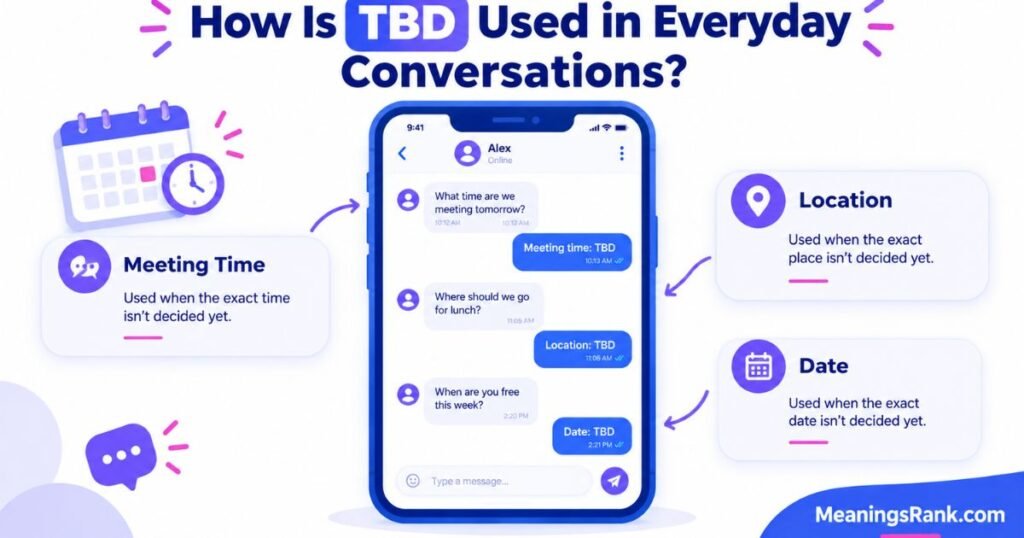
TBD works best as a quick placeholder answer. Here’s how it typically fits into daily conversations:
- Confirming something is happening, just not the details. “We’re going, time TBD.”
- Avoiding early commitment. “Might join, TBD on my schedule.”
- Keeping options open. “TBD if I can make it, depends on work.”
- Passing a decision to someone else. “Venue is TBD, waiting on Sam to pick.”
- Buying time without ghosting. “Haven’t decided, TBD for now.”
Notice that TBD almost never means “no.” It usually means “not yet,” which is an important difference. People sometimes worry that TBD is a soft rejection, but in most cases, it’s genuinely just an open question waiting to be answered.
TBD as a Standalone Reply
One of the more interesting things about TBD is that it works perfectly fine as a one-word reply. Someone can ask, “Are we still doing brunch Saturday?” and get a single-word answer: “TBD.” No further explanation is needed because both people already understand what it means.
TBD Paired With Emojis
People often soften or clarify TBD by pairing it with an emoji. A shrug emoji next to TBD signals genuine uncertainty. A thumbs up next to TBD suggests the plan is basically happening, just not fully scheduled. A calendar emoji hints that a date is coming soon. These small additions help fill in the tone that plain text sometimes misses.
How Age and Group Dynamics Affect TBD Usage
Younger texters and social media users tend to use TBD more loosely and more often, sometimes multiple times in a single conversation. Older generations or more formal communicators tend to reserve it for genuinely undecided situations, often pairing it with a bit more explanation. Neither use is wrong, it just reflects different texting habits across age groups and communication styles.
Real-Life Examples of TBD in Text
Seeing TBD in action makes the meaning click faster than any definition. Here are realistic examples from different types of conversations.
Friend group chat:
“Movie night this weekend, time TBD, I’ll confirm once I check the showtimes.”
Dating app conversation:
“I’m down for coffee sometime next week, exact day TBD depending on my shift.”
Family text thread:
“Thanksgiving is at our place again, menu TBD, everyone bring a dish idea.”
Coworker message:
“Meeting moved to next week, room TBD, calendar invite coming soon.”
Roommate chat:
“Rent split for the new place is TBD until we see the final lease.”
Event planning group:
“Guest list is TBD, we’re waiting on RSVPs before finalizing catering.”
Gaming squad chat:
“Tournament sign-up is done, our fifth player is TBD, still asking around.”
Also Read: Opp Meaning Slang: The Powerful Guide to Understanding This Viral Term
Long-distance relationship text:
“Visiting you next month for sure, exact dates TBD until I hear back from work about time off.”
Each of these examples shows the same pattern: something is confirmed to be happening, but one specific piece is still open.
What Makes These Examples Work
Notice that in every example, there’s a clear anchor point, something that IS confirmed, paired with the one detail that isn’t. “Movie night this weekend” is confirmed. Only the time is TBD. This pattern is what makes TBD useful instead of confusing. It tells the reader exactly what’s settled and exactly what’s still up in the air, all in one short message.
TBD Meaning on Different Platforms
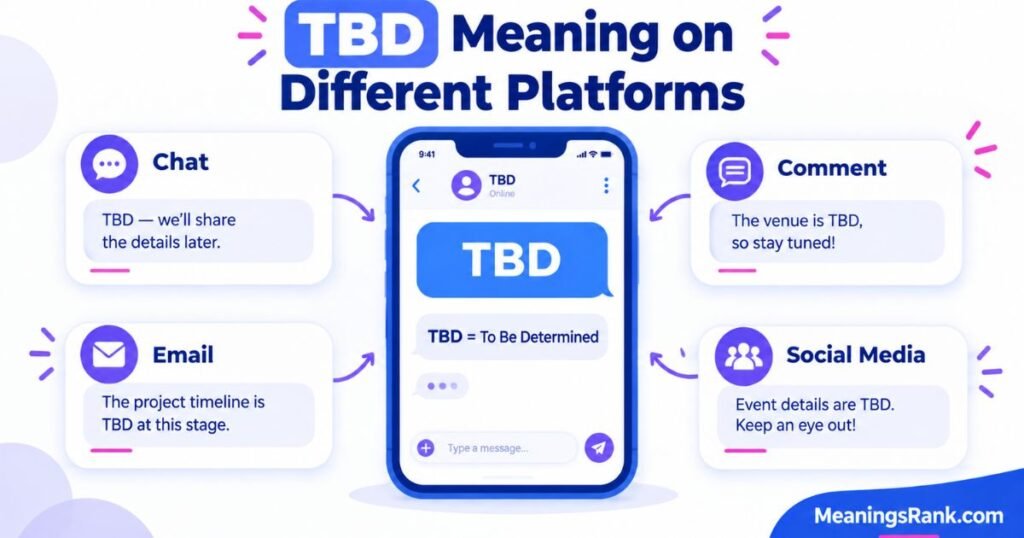
TBD doesn’t change meaning across apps, but the way it’s used can look a little different depending on the platform’s culture and pace.
TBD on WhatsApp
WhatsApp is often used for group planning, family chats, and event coordination. TBD shows up constantly in these threads, especially when multiple people are trying to agree on a time or place. A typical WhatsApp message might read, “Trip dates are TBD, waiting to hear back from everyone before booking.”
TBD on Instagram
On Instagram, TBD meaning often appears in captions, story polls, or comments. A creator might post, “New merch drop, date TBD” to build anticipation without locking in a specific release date. It’s also common in comment replies when someone asks “when’s the next post/event?”
TBD on Snapchat
Snapchat conversations move fast and are usually shorter than other platforms. TBD fits perfectly here because it answers a question instantly without slowing down the back-and-forth. “Hanging out later? TBD, might have plans already.”
TBD on TikTok
TikTok creators use TBD in captions and comments when announcing upcoming content, collabs, or challenges that aren’t fully planned yet. “Part 2 coming, date TBD” is a very common caption style that keeps followers checking back.
TBD on Discord
In gaming and community servers, TBD is used constantly for event scheduling. “Raid night is TBD, depends on how many people are online” is a normal message in a Discord server. It’s also common in tournament brackets and matchmaking discussions.
TBD in Gaming Chats
Beyond Discord, TBD pops up in in-game chat and matchmaking lobbies. Players might say “Squad TBD, need one more” when a team isn’t fully formed yet, or “Strategy TBD, let’s see what map we get.”
TBD in Workplace Chats (Slack, Teams, Email)
Workplace tools like Slack and Microsoft Teams use TBD heavily for project timelines. “Deadline TBD, waiting on client feedback” is one of the most common phrases in professional messaging. It keeps communication clear without requiring a long explanation for why something isn’t finalized.
Comparison Table: TBD Usage Across Platforms
| Platform | Typical Use of TBD | Example |
| Group plans, trips, events | “Departure time TBD, checking flights” | |
| Captions, announcements | “Collection drops soon, date TBD” | |
| Snapchat | Quick casual replies | “Later? TBD, let you know” |
| TikTok | Content teasers | “Next video TBD, stay tuned” |
| Discord | Gaming schedules, events | “Match time TBD, waiting on players” |
| Workplace (Slack/Teams/Email) | Deadlines, meetings | “Launch date TBD, pending review” |
Alternative Meanings of TBD
While “To Be Determined” covers most cases, TBD meaning can occasionally something slightly different based on context clues in the conversation.
To Be Decided
This version leans more toward a group choosing between options. “Venue is TBD, we’re voting between two places” fits this meaning well.
To Be Discussed
Sometimes TBD hints that a conversation needs to happen first before anything is set. “Budget is TBD, we need to talk numbers first” uses this angle.
To Be Disclosed
In announcements or reveals, TBD can mean information is being intentionally held back. “Winner is TBD until the ceremony” fits here.
To Be Done
In task lists and project boards, TBD sometimes gets used loosely to mean a task hasn’t been completed, though “to do” or “pending” are more accurate terms for that meaning.
A Note on Confusing TBD With Similar Terms
People sometimes mix up TBD with TBA (To Be Announced) or TBC (To Be Confirmed). While they’re similar, there are small differences worth knowing.
| Term | Full Form | Best Used When |
| TBD | To Be Determined | Details aren’t finalized yet |
| TBA | To Be Announced | Info exists but hasn’t been shared publicly |
| TBC | To Be Confirmed | Something needs final approval or verification |
Related Terms and NLP Variations
Search engines and voice assistants often connect TBD with related questions and phrases. Here are common variations people search for or type when trying to understand this term:
- what does tbd mean in text
- tbd full form in chat
- tbd meaning in a relationship
- what does tbd stand for on social media
- tbd vs tba vs tbc meaning
- tbd meaning in business email
- what does tbd mean when a guy says it
- tbd meaning in gaming
- is tbd a rude reply
- tbd meaning schedule
Other Common Planning Abbreviations
Along with TBD, you’ll often run into these similar shorthand terms in everyday chats:
- ASAP – As Soon As Possible
- EOD – End of Day
- ETA – Estimated Time of Arrival
- N/A – Not Applicable
- FYI – For Your Information
Knowing these alongside TBD makes it much easier to read fast-moving conversations without asking for clarification every time.
Questions People Also Ask About TBD
Search engines often group related questions together, and TBD comes with its own cluster of common curiosities. People frequently want to know if TBD is appropriate in a formal resume or cover letter (generally, no, it’s too casual for those documents). They also ask whether TBD can be used to describe a person’s relationship status, which does happen informally, as in “it’s TBD between us right now,” meaning the relationship hasn’t been clearly defined yet. Another common question is whether TBD needs periods between the letters. It doesn’t. “TBD” without periods is the standard and most widely accepted form across texting, business writing, and social media.
How to Respond When Someone Says TBD
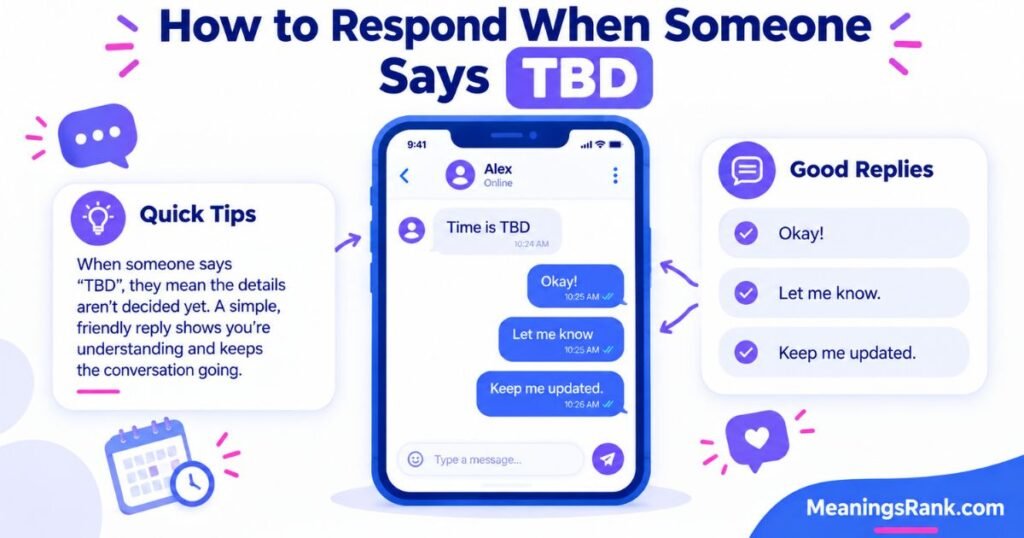
Getting a TBD reply doesn’t need a complicated response. The goal is to keep the conversation open without pushing too hard for an answer that isn’t ready yet.
Good Ways to Respond
- “Sounds good, let me know when you know more.”
- “No rush, just keep me posted.”
- “Okay, TBD works, I’ll wait to hear back.”
- “Cool, ping me once it’s locked in.”
- “All good, keeping my schedule flexible.”
When You Need a Firmer Answer
Sometimes TBD isn’t good enough, especially if you’re trying to plan around it. In that case, it’s fine to ask a follow-up question instead of just accepting the vague answer.
- “Totally get it’s TBD, but roughly what day are we thinking?”
- “No worries, just let me know by Wednesday if possible.”
- “Understood, is there a rough timeframe though?”
This approach respects that things are still being worked out while gently pushing for more clarity if you genuinely need it.
Matching Your Response to the Relationship
How you respond to TBD can depend a lot on who sent it. With close friends, a short and relaxed reply works fine, since you both already trust that plans will come together eventually. With a boss or client, it often helps to acknowledge the TBD while gently setting an expectation for when you’ll need an update, such as “Understood, just flag me once the date is locked in so I can plan my week.” With someone you’re dating, it usually helps to stay warm and low-pressure, since pushing too hard for a firm answer can feel like you’re rushing things that are still forming naturally.
When Silence Follows a TBD
Sometimes a TBD is the last message in a conversation for a while, and that can feel a little uncertain if you’re waiting on plans. In most cases, this doesn’t mean anything negative, it usually just means the other person is still waiting on their own answer from someone else, like a boss confirming time off or a venue confirming availability. A simple, friendly check-in a few days later, like “Hey, any update on that TBD?” is a completely normal and low-pressure way to follow up.
Misinterpretations to Avoid
TBD is simple, but it does get misread sometimes. Here are the most common misunderstandings.
Thinking TBD Meaning “No”
TBD is not a rejection. It means the plan is still open, not canceled. Reading it as a “no” often leads to unnecessary confusion or hurt feelings.
Assuming TBD Meaning Someone Is Ignoring You
In texting, especially dating conversations, people sometimes assume TBD is a brush-off. Most of the time, it genuinely reflects an unfinished plan, not disinterest.
Confusing TBD With Indecisiveness
TBD doesn’t always mean someone can’t make up their mind. Often, the delay depends on factors outside their control, like waiting for other people, checking a schedule, or needing more information first.
Overusing TBD Until It Loses Meaning
If every single message ends in TBD, it starts to feel like a way to avoid commitment altogether rather than a genuine placeholder. Using it too often can come across as flaky, even if that’s not the intention.
When NOT to Use TBD
While TBD is handy, it’s not the right fit for every situation. Here’s when to avoid it.
- When someone needs a firm answer for planning purposes: If a friend needs to book flights, “TBD” isn’t helpful enough on its own.
- In situations that require sensitivity: Using TBD to answer serious personal or emotional questions can come across as dismissive.
- When you actually know the answer: If details are already set, using TBD anyway can create confusion or make you seem unprepared.
- In formal documents needing exact dates: Legal or financial paperwork usually needs specific dates, not placeholders.
- When it’s used to avoid a conversation: If TBD becomes a way to dodge making a decision entirely, it stops being useful and starts causing frustration.
Useful Tips for Using TBD Correctly
A few small habits can make TBD work better in everyday conversations.
- Add context when possible: Instead of just “TBD,” try “TBD, waiting on the venue confirmation” so people know why.
- Give a rough timeframe if you can: “TBD, should know by Friday” is far more helpful than TBD alone.
- Don’t overuse it: Save TBD for genuinely undecided details, not everything.
- Follow up once you know: TBD works best when it’s followed by an actual update later.
- Match the tone to the setting: Keep it casual in personal chats and slightly more detailed in professional messages.
- Use related terms correctly: If something is confirmed but not yet public, TBA might fit better than TBD.
A Simple Checklist Before You Hit Send
Before typing TBD and sending it off, it helps to run through a quick mental checklist. Is there anything you actually do know that you could share alongside it? Is there a rough timeframe for when the details will be locked in? Is the person on the other end going to need a firmer answer soon for their own planning? Answering these three questions takes just a few seconds but makes your TBD far more useful to whoever receives it.
Building Trust Around TBD
The people who use TBD most effectively are the ones who follow through on it. If you say “TBD, I’ll know by Friday,” and then actually update the person by Friday, TBD starts to feel reliable instead of vague. Over time, this builds trust in your planning style, so when you do send a TBD, people know it’s genuinely temporary rather than a way of avoiding commitment altogether.
Also Read: What Does WYF Mean in Text? WYF Meaning, Uses & Examples
Frequently Asked Questions About TBD
What does TBD meaning in a text message?
TBD means “To Be Determined,” used when details aren’t finalized yet.
Does TBD mean yes or no?
TBD means neither yes nor no, it means undecided for now.
What is the difference between TBD and TBA?
TBD means details aren’t set, TBA means info exists but isn’t shared yet.
Is TBD a rude or dismissive reply?
No, TBD is neutral and simply reflects an unfinished plan or decision.
Can TBD be used in professional emails?
Yes, TBD is common in business emails for schedules and pending decisions.
What does TBD meaning in dating conversations?
It usually means plans are still open, not a rejection or disinterest.
Conclusion
TBD meaning slang is one of those small phrases that makes modern texting faster and easier. Whether you’re chatting with friends on WhatsApp, planning a trip, replying in a work Slack channel, or scheduling something on Discord, TBD simply tells the other person that a plan exists but the details aren’t final yet. It’s not a rejection, and it’s rarely meant to confuse anyone, it’s just a placeholder for information that’s still coming together.
Understanding how TBD works across different platforms, when to use it, and when to avoid it can help you communicate more clearly in almost any conversation. The next time someone sends you a simple “TBD,” you’ll know exactly what it means, and you’ll know how to respond without any second-guessing.