

If you’ve seen “PTSO” mentioned in a school newsletter, email, or flyer, you might be wondering what it actually means. The PTSO meaning is simple: it stands for a group that brings parents, teachers, and students together to support a school. You’ll usually spot this term in school websites, parent emails, class group chats, and community bulletin boards.
Unlike some school terms that only apply to staff, PTSO involves the whole school community, including students themselves. Understanding what PTSO means helps parents get involved, helps students know their voice counts, and helps everyone understand how schools organize support outside the classroom. Let’s break down exactly what it means and how it works.
📝 What Does PTSO Mean?
PTSO stands for Parent Teacher Student Organization. It’s a group formed within a school to help parents, teachers, and students work together on school activities, events, and improvements.
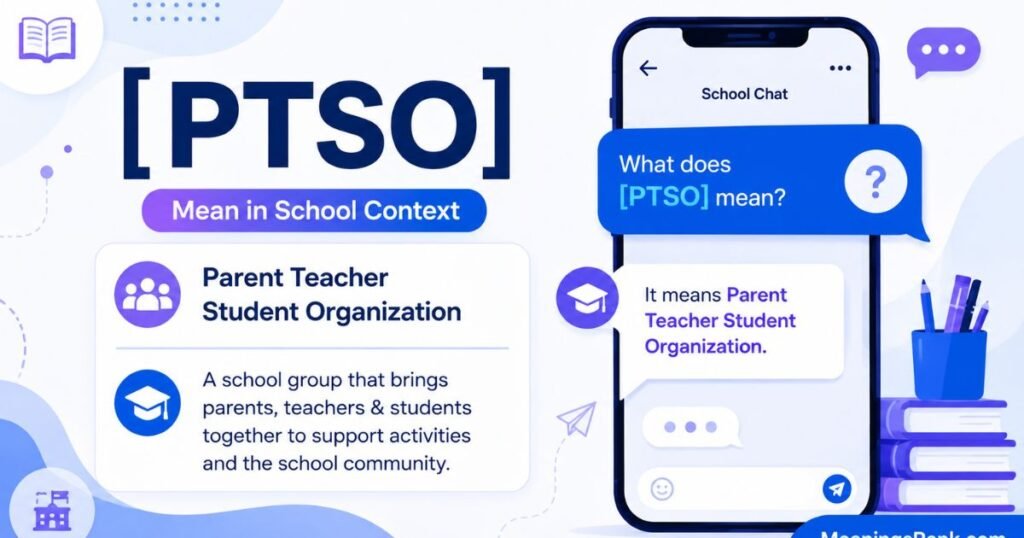
Unlike a group that only includes adults, PTSO makes room for student voices too. That’s the biggest difference between this term and some similar school groups.
Here’s a simple way to think about it:
Person A: “What’s PTSO?”
Person B: “It’s like PTA, but students get a seat at the table too.”
In this exchange, Person B captures the core idea perfectly. PTSO isn’t just about parents supporting teachers from the outside — it invites students to actually participate in planning and decisions.
A PTSO usually handles things like:
- Organizing school events and fundraisers
- Supporting classroom needs and school programs
- Improving communication between families and staff
- Giving students a chance to share ideas and feedback
Because it includes three different groups parents, teachers, and students a PTSO often reflects a wider range of opinions and needs than groups made up of just one type of member.
This structure has made PTSOs increasingly common in middle schools and high schools, where student input naturally becomes more valuable as kids grow older and more independent.
📚 Origin and Popularity of PTSO
The idea behind PTSO grew out of older, more traditional school groups that only included parents and teachers. As schools began recognizing the value of student input, especially in older grades, many groups expanded their structure to include students directly.
This shift became more common through the 1990s and 2000s, as schools started focusing more on student leadership and involvement in school culture, not just academics.
A few key points about how PTSO became popular:
- It grew from the traditional PTA model, but added students as official members
- It became more common in middle and high schools, where student opinions carry more weight
- It reflects a shift toward including younger voices in school decisions
- It’s now used by public, private, and charter schools across many regions
While PTA groups still exist widely, especially in elementary schools, PTSO has become the preferred structure once students are old enough to actively participate in meetings, planning, and events.
Today, you’ll find PTSO groups mentioned in school newsletters, parent portals, and even school social media pages. Many schools promote their PTSO group at the start of the school year to encourage sign-ups from parents and students alike.
The term has stayed relevant because it fills a real gap — younger PTA-style groups didn’t always account for how much students actually notice and care about school culture, events, and improvements. PTSO changed that by giving them an official role.
Also Read: What Does WDYM Mean in Text? Meaning, Uses & Examples
Facts About PTSO
Here are some quick, useful facts that explain how PTSO groups typically function:
- Three groups, one team:
PTSO always includes parents, teachers, and students working together, not just adults making decisions alone.
- Mostly volunteer-based:
Most PTSO members participate voluntarily, without pay, simply because they want to support their school community.
- Common in middle and high schools:
While possible at any grade level, PTSO groups appear most often once students are mature enough to contribute ideas.
- Meetings are usually open:
Most PTSO meetings welcome any parent, teacher, or student from the school, not just elected members.
- Fundraising is a major focus:
Many PTSOs organize fundraisers to support school trips, supplies, events, and extracurricular programs.
- Not the same everywhere:
Each school’s PTSO can look a little different, depending on size, community involvement, and school needs.
These facts show that PTSO isn’t a rigid, one-size-fits-all structure. It adapts based on what each school community actually needs, which is part of why it has remained a flexible and popular model.
How a PTSO Works in Daily School Life
A PTSO doesn’t just exist on paper it plays an active role in daily and weekly school activities.
Typical PTSO Activities Include:
- Planning school dances, fairs, or spirit weeks
- Organizing fundraisers for school supplies or trips
- Hosting parent-teacher meet-and-greet nights
- Supporting teachers with classroom resources
- Creating opportunities for student leadership
For example, a PTSO might meet once a month to discuss upcoming events, review fundraising progress, and gather feedback from students about what’s working and what isn’t.
Here’s a simple daily-life example:
Person A: “Why is there a bake sale in the cafeteria today?”
Person B: “PTSO is raising money for the new library books.”
This kind of small, everyday moment shows how PTSO activities blend directly into normal school routines, often without students even realizing a formal group is behind it.
PTSOs also help bridge communication gaps. If students feel like a schedule change is confusing, or if parents want more updates about school programs, PTSO meetings often become the place where those concerns get raised and addressed.
In many schools, PTSO announcements appear in:
- School newsletters
- Parent portal emails
- Social media pages
- Morning announcements
- Flyers sent home with students
Because PTSO stays involved in so many parts of school life, it often becomes one of the most visible community groups within a school, even if many students don’t fully understand its structure until they get older.
Who Can Join a PTSO?
One of the most appealing parts of a PTSO is how open it usually is. Unlike some school committees that require special qualifications, PTSO membership tends to be simple and inclusive.
Typically, PTSO members include:
- Parents or guardians of current students
- Teachers and school staff members
- Students, especially in middle and high school
- Sometimes school administrators, depending on the structure
How Joining Usually Works:
- Sign-up forms sent home at the start of the school year
- Online registration through the school’s website
- Simply showing up to an open meeting
- Being nominated or volunteering for a leadership role
Most PTSOs don’t require any special experience. Enthusiasm and willingness to help are usually enough to get involved.
Here’s an example of how this plays out in real conversation:
Person A: “Can I join PTSO even if I’m just a freshman?” Person B: “Yeah, most schools let any student join, especially in middle and high school.”
This kind of open access is part of what makes PTSO groups successful they don’t rely only on a small group of highly involved parents. Instead, they invite broad participation across the entire school community.
Some schools even create smaller sub-committees within PTSO, allowing members to focus on specific tasks like fundraising, event planning, or communication, which makes joining even easier for people with limited time.
Also Read: Nieve Meaning: What Does Nieve Mean? Definition, Origin & Examples (2026 Guide)
Why Students Matter in a PTSO
Unlike older school group models, PTSO puts real emphasis on student involvement, not just as participants but as contributors to decisions.
Why Student Voices Matter:
- Students understand the day-to-day school experience better than anyone else
- They notice problems or gaps that adults might overlook
- They bring fresh, creative ideas for events and activities
- Their involvement builds leadership and communication skills
For example, students might point out that a school event date conflicts with exams, something a PTSO made up only of adults might not immediately catch.
Here’s a quick example of this in action:
Person A: “Why did they move the fall festival to a different weekend?” Person B: “Some students in PTSO mentioned it overlapped with homecoming prep.”
This shows exactly how student input directly shapes school decisions, rather than students simply hearing about changes after they’ve already happened.
Being part of a PTSO also gives students real-world experience with teamwork, planning, and public speaking, especially if they take on leadership roles within the group.
Many schools highlight student PTSO involvement on college applications or leadership resumes, since it demonstrates community engagement and responsibility beyond the classroom.
Ultimately, student participation is what separates PTSO from older, adult-only school groups. It turns the organization into a genuine partnership rather than a one-directional support system.
Benefits of Having a PTSO in Schools
A well-run PTSO can make a noticeable difference in school culture and daily experience for everyone involved.
Key Benefits Include:
- Stronger communication:
Parents, teachers, and students stay better connected through regular updates and meetings.
- More funding for activities:
Fundraisers often support things schools can’t always afford through their regular budget.
- Increased student engagement:
Students feel more invested in their school when they have a say in decisions.
- Better community connection:
Families feel more involved, especially in larger schools where it’s easy to feel disconnected.
- Improved school events:
Dances, fairs, and fundraisers tend to run smoother with organized volunteer support.
Here’s a simple example showing this benefit in action:
Person A: “This year’s fundraiser feels way more organized.”
Person B: “Yeah, PTSO redid the whole planning process this year.”
This kind of improvement often comes directly from active PTSO involvement, since more hands and more perspectives usually lead to smoother execution.
Schools with active PTSOs often report smoother event planning and stronger relationships between staff and families, mainly because communication flows more consistently through organized meetings and updates.
While every school’s experience varies, the overall goal of a PTSO stays the same: creating a stronger, more connected school community through shared effort.
💬 PTSO Meaning in Different Contexts
While PTSO always relates to school involvement, its meaning can shift slightly depending on where and how it’s mentioned.
In School Announcements:
“PTSO is hosting a bake sale this Friday.” Here, PTSO refers directly to the organization running an event.
In Parent Group Chats:
“Did anyone go to the PTSO meeting last night?” This usage refers to a specific gathering or meeting held by the group.
In Student Conversations:
“I joined PTSO this year, it’s actually pretty fun.” Here, PTSO refers to membership or involvement in the group itself.
In Fundraising Contexts:
“All proceeds go to PTSO for new sports equipment.” This usage highlights PTSO as the organization managing funds.
In Leadership or Resume Contexts:
“I was PTSO secretary during my junior year.” Here, PTSO refers to a specific role or title within the organization.
As you can see, the core meaning stays the same, but the context shapes how it’s used in a sentence. Whether it’s an event, a meeting, a membership, or a role, PTSO consistently points back to the same organization and purpose.
💭 Examples of PTSO in Conversations
Seeing PTSO used in different everyday conversations makes its meaning even easier to understand.
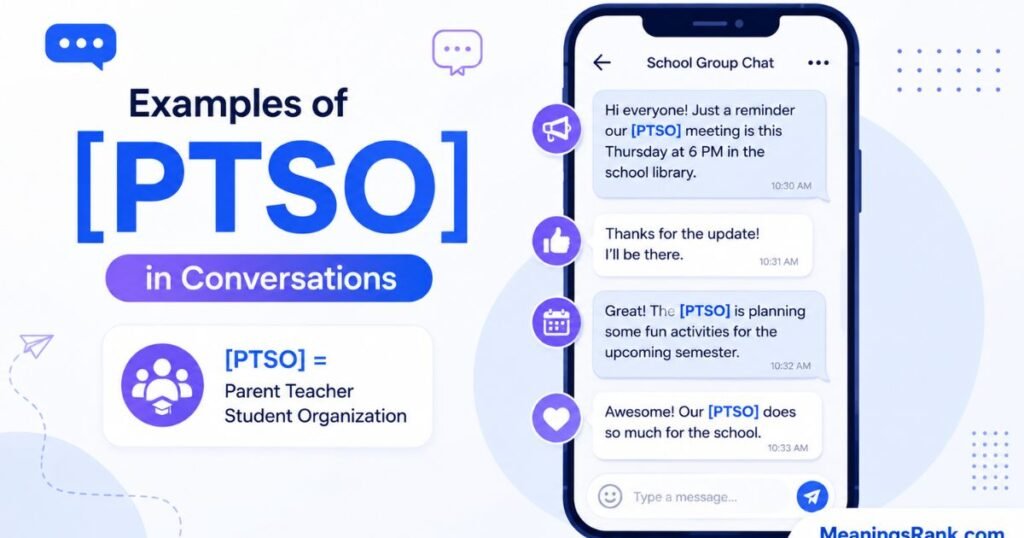
Text Message:
Person A: “Are you going to the PTSO meeting tonight?”
Person B: “Yeah, I want to hear about the spring fundraiser.”
WhatsApp Group Chat:
Person A: “PTSO needs volunteers for the book fair.”
Person B: “I can help Friday afternoon.”
Instagram Comment (school page):
“Thank you PTSO for organizing such a great event! 🎉”
Snapchat Caption:
“PTSO bake sale today, come grab a cupcake 🧁”
TikTok Comment:
“Our PTSO actually does so much for the school, more people should know.”
Gaming or Discord (student club server):
“Meeting reminder: PTSO discussion happening in the announcements channel.”
Workplace Chat (teacher-to-teacher):
“PTSO approved funding for new classroom supplies.”
Each of these examples shows PTSO functioning the same way referring to the organization, its members, or its activities. Whether it’s a quick text or a school-wide announcement, the meaning stays consistent and easy to recognize once you know what it stands for.
🔍 Similar or Related Terms
PTSO is often confused with a few similar school-related terms. Here’s how they compare:
| Term | Meaning | When to Use |
| PTSO | Parent Teacher Student Organization | Groups that include parent, teacher, and student members |
| PTA | Parent Teacher Association | Groups that include only parents and teachers, no student members |
| PTO | Parent Teacher Organization | Similar to PTA, focused on parent and teacher involvement |
| SGA | Student Government Association | Student-only leadership group, no parent or teacher members |
| PAC | Parent Advisory Council | Advisory group focused on parent input for school decisions |
PTSO vs PTA:
The biggest difference is student involvement. PTA typically excludes students as official members, while PTSO includes them directly.
PTSO vs SGA:
SGA is run entirely by students, without parent or teacher involvement, while PTSO combines all three groups.
PTSO vs PTO:
PTO functions almost identically to PTA, focusing mainly on parent and teacher collaboration rather than including students.
Understanding these differences helps avoid confusion, especially since school communications sometimes use these terms loosely or interchangeably, even though their structures aren’t exactly the same.
✅ How to Use PTSO Correctly
Using PTSO correctly mostly comes down to context. Since it refers to a specific type of school organization, it shouldn’t be used casually for unrelated groups.
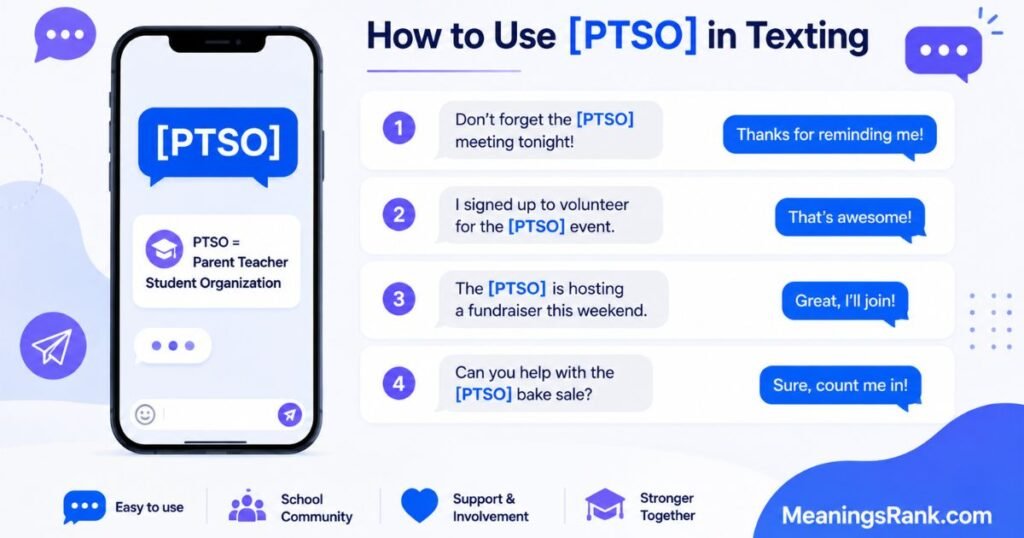
Correct Usage Examples:
- “PTSO is organizing a fundraiser next month.” ✅
- “I’m a PTSO member this year.” ✅
- “The PTSO meeting starts at 6 PM.” ✅
Incorrect or Confusing Usage:
- Using PTSO to refer to a group with no student involvement ❌
- Mixing up PTSO with PTA when describing an adult-only group ❌
- Using PTSO as a general term for “school event” rather than the organization itself ❌
Quick Tips for Correct Use:
- Always capitalize PTSO, since it’s an acronym for a formal title
- Use it specifically when students are officially involved, not just present
- Avoid using it interchangeably with PTA unless your school genuinely uses both terms for the same group
Here’s a helpful example distinguishing correct usage:
Person A: “Is your school’s group called PTSO or PTA?”
Person B: “PTSO, because students actually get to vote on decisions.”
This small distinction matters, especially in formal writing like newsletters, school websites, or resumes, where accuracy affects how clearly information is communicated.
⚠️ Common Mistakes or Misinterpretations
Even though PTSO is a fairly clear term, a few common mistakes and misunderstandings tend to come up.
Mistake 1:
Assuming PTSO and PTA Are Identical While similar, PTA does not typically include students as official members, which is the key difference between the two terms.
Mistake 2:
Thinking Only Parents Can Lead PTSO Many PTSOs offer leadership roles to students as well, not just parents or teachers.
Mistake 3:
Believing PTSO Only Handles Fundraising While fundraising is common, PTSOs also handle communication, event planning, and community building, not just money-related tasks.
Mistake 4:
Assuming Every School Has the Same PTSO Structure PTSO groups vary widely between schools, so assuming one experience applies everywhere can lead to confusion.
Mistake 5:
Thinking Membership Requires Special Qualifications In most cases, joining a PTSO simply requires interest and willingness to participate, not any specific skill or experience.
Clearing up these misunderstandings helps parents, teachers, and students engage with PTSO more confidently, especially when first getting involved or reading about it for the first time.
❓ FAQ: PTSO Meaning Explained
What does PTSO stand for in school?
PTSO stands for Parent Teacher Student Organization, a group involving parents, teachers, and students working together.
Is PTSO the same as PTA?
No, PTA usually excludes student members, while PTSO includes students as official participants.
Can any student join PTSO?
Yes, most schools allow any interested student to join, especially in middle and high school.
Do PTSO members get paid?
No, PTSO involvement is almost always voluntary, with no payment involved.
What does a PTSO actually do?
PTSO organizes events, fundraisers, and communication between parents, teachers, and students.
🏁 Conclusion
Understanding the PTSO meaning really comes down to one core idea: it’s a school organization that brings parents, teachers, and students together as equal contributors. Unlike older group models, PTSO gives students a real voice in shaping school events, communication, and community involvement.
We’ve covered what PTSO stands for, how it works in daily school life, who can join, and how it compares to similar groups like PTA and SGA. We’ve also looked at common mistakes people make when using or understanding the term.
The next time you see PTSO mentioned in a school newsletter or group chat, you’ll know exactly what it means and why it matters. Getting involved, whether as a parent, teacher, or student, can genuinely strengthen the school community for everyone.