

You are typing a school essay, a wedding toast, or a work email, and you pause. Does that word have an “a” or a second “e”? You are not alone. “Speach” is one of the most common misspellings in English, mostly because teach, reach, and beach train our eyes to expect “-each.”
The answer is clear: the correct spelling is speech. This guide explains the meaning, the logic behind the error, and the grammar rules around the word. A single typo can weaken an otherwise strong piece of writing, so getting this one right pays off every time.
Speach or Speech – Quick Answer

Speech is the only correct spelling. “Speach” is a common misspelling and does not appear in any standard dictionary or style guide. The word is spelled the same way in American and British English: s-p-e-e-c-h, with a double “e” in the middle.
| Spelling | Correct? | Part of Speech | Example |
| Speech | ✅ Yes | Noun | She gave a moving speech at the graduation. |
| Speach | ❌ No | Not a word | ~~She gave a moving speach.~~ |
What Does Speech Mean?
Speech is a noun with several related meanings. Each one connects to the idea of expressing thoughts through spoken language. Knowing these meanings helps you see why the word shows up so often in everyday writing.
1. The ability to speak.
This is the most basic sense. It refers to the human capacity to produce words and communicate with sound.
After the injury, it took him months to regain his speech.
2. A formal talk delivered to an audience.
This is probably the meaning you meet most often. Politicians, teachers, best men, and CEOs all give speeches.
The mayor’s speech lasted twenty minutes.
3. A manner of speaking.
Here, the word describes how a person talks, including accent, vocabulary, and tone.
Her speech had a gentle Southern lilt.
4. Spoken language in general.
Linguists use the term to contrast spoken communication with written text.
Speech and writing follow different syntax patterns.
5. In grammar, “direct speech” and “reported speech.”
These are two ways of presenting what someone said. Direct speech uses quotation marks and the speaker’s exact words. Reported speech (also called indirect speech) changes the clause structure and verb tense.
Direct: She said, “I am tired.” Reported: She said that she was tired.
Why Is “Speach” Incorrect?
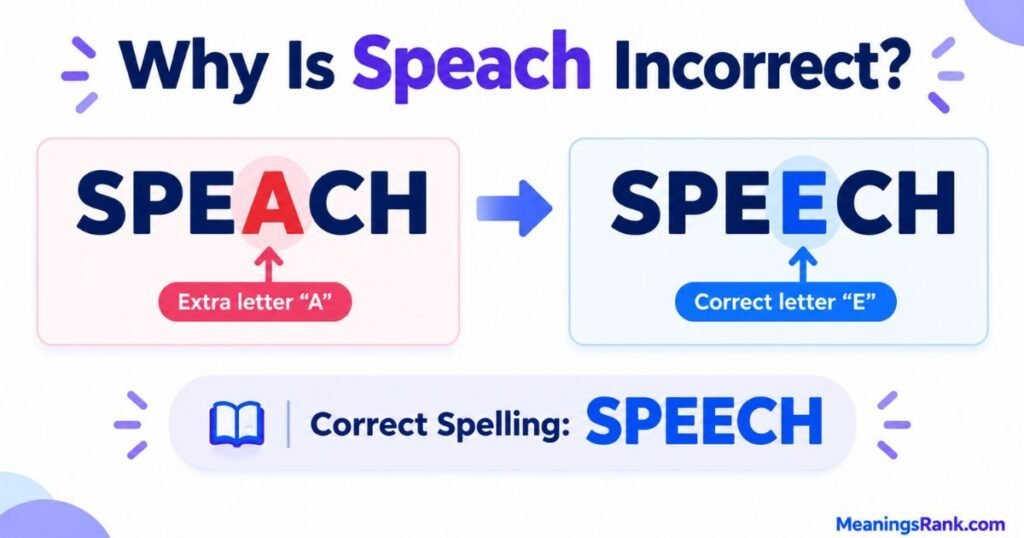
“Speach” looks believable. It seems to follow the same pattern as words like teach, reach, and beach, where “-each” makes a long “ee” sound. That is the trap.
The noun speech is built from the root speak, but the spelling changed over centuries. Here is what trips people up:
- The sound is identical. Both “speech” and “speach” are pronounced /spiːtʃ/. Spelling cannot be guessed from sound alone in English.
- The “-each” pattern is tempting. Common words such as teach, preach, and bleach use “-each,” so the brain generalizes the rule.
- The verb and noun differ. The verb is speak (with an “ea”), while the noun is speech (with an “ee”). Writers often carry the “ea” from speak into speech.
- Autocorrect is not always there. Handwriting, quick notes, and social media captions often skip spell check.
The rule is simple, even if the reasoning is messy: English spelling preserves history, not logic. Dictionaries such as Merriam-Webster, Oxford, and Cambridge list only speech. No major style guide, whether AP, Chicago, or MLA, accepts the alternative.
Read More: Meeting vs Meating: Key Differences, Correct Spelling & Real-Life Usage (2026)
Quick Memory Trick / Mnemonic Device
Try this: “Speech needs two E’s to Exercise Eloquence.”
Another quick method is to picture the double “e” as two eyes watching you at the podium. If you see two eyes, you spelled it right.
You can also link it to a word that already has the same pattern: speed, speech, sweet. Both speed and speech start with “spee-,” so if you can spell one, you can spell the other.
The Origin of Speech
The word speech traces back to Old English spǣc (also written sprǣc), meaning “the act of speaking, a talk, a language.” That form comes from the Proto-Germanic root associated with speaking, and it is related to the Old English verb sprecan, the ancestor of modern speak.
Over time, the pronunciation and spelling shifted. In Middle English, the word appeared in many forms, including speche and spech. By the early modern period, as printing standardized spelling, “speech” settled into the form we use today.
This history explains the oddity. The verb speak kept its “ea” spelling, while the noun speech ended up with “ee.” The two words come from the same family, but their spellings drifted apart. It is a good example of why English spelling can feel inconsistent: standardization froze forms in place long after pronunciation had changed.
British English vs American English Spelling
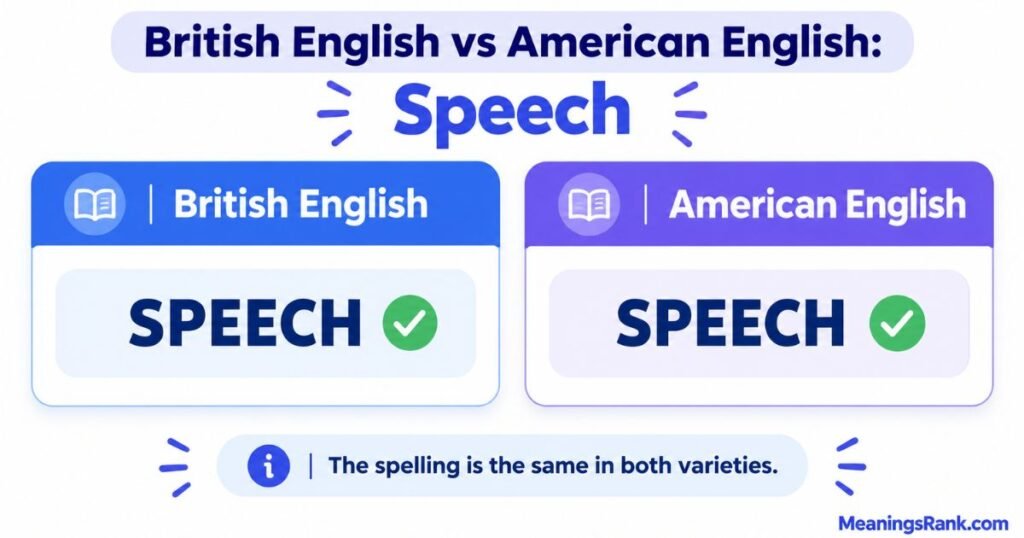
Many English words differ across regions. Color and colour, center and centre, and organize and organise are classic examples. So you might wonder whether “speach” could be a regional variant.
It is not. Speech is spelled identically in American, British, Canadian, Australian, and Indian English.
| Variety | Spelling | Notes |
| American English | speech | Standard |
| British English | speech | Standard |
| Canadian English | speech | Standard |
| Australian English | speech | Standard |
| Indian English | speech | Standard |
The only differences you may notice are in related phrases and punctuation conventions. For example, British writers often use single quotation marks for direct speech (‘I’m leaving,’ she said), while American writers use double quotation marks (“I’m leaving,” she said). That is a punctuation difference, not a spelling difference.
Which Spelling Should You Use?
Use speech every time. There is no context, region, or style guide where “speach” is acceptable.
Here is a practical decision guide:
- Academic writing: speech
- Business emails and reports: speech
- Blog posts and social media: speech
- Creative writing and dialogue: speech
- Legal or formal documents: speech
The only time “speach” might appear is in a quotation that deliberately reproduces someone’s error, and even then writers typically add [sic] to show the mistake was in the original.
Read More: Ironic vs Unironic: Key Differences, Definitions & Real-Life Examples
Common Mistakes with Speech
Spelling is not the only place writers stumble. Here are the most frequent errors involving this word.
1. Spelling it “speach:”
This is the headline mistake. Fix: double “e.”
2. Confusing the noun and the verb:
Speech is a noun. It cannot work as a verb.
| Incorrect | Correct |
| He will speech at the event. | He will speak at the event. |
| She speeched for an hour. | She spoke for an hour. |
3. Pluralizing incorrectly:
The plural is speeches, not “speechs” or “speechies.”
The candidates gave three speeches during the debate.
4. Mixing up “speech” and “speak” in subject-verb agreement:
When speech is the subject, treat it as singular unless you are using the plural form.
The speech was inspiring. (singular verb) The speeches were inspiring. (plural verb)
5. Misusing hyphenation:
Compound terms follow style guide rules. Speech-language pathologist takes a hyphen, while speechwriter is typically one word. When unsure, check your preferred style guide or dictionary.
Key Exceptions to Keep in Mind
A few exceptions matter with this word.
- “Speech” in the phrase “freedom of speech.” The word stays singular and uncountable here. You would not write “freedoms of speeches.”
- “Parts of speech.” In grammar, this phrase refers to categories like nouns, verbs, adjectives, and adverbs. The word speech stays singular even though the phrase is plural.
- “Figure of speech.” This refers to expressions such as metaphors and idioms. Again, speech remains singular.
- “Speech” in compounds. Words like speechless, speechwriter, and speechify all keep the double “e.” None of them take “speach” as a root.
- Pronunciation versus spelling. The “ch” in speech sounds like the “ch” in church. Do not add a “t” (“speetch”) or drop the “c” (“speeh”).
Speech in Everyday Examples

Here are examples across different situations.
Formal and professional use
- The CEO’s keynote speech opened the conference.
- Freedom of speech is protected under many national constitutions.
- The lawyer’s closing speech persuaded the jury.
Academic and grammatical use
- A noun is one of the eight parts of speech.
- Reported speech requires a shift in verb tense.
- The teacher explained the difference between direct speech and indirect speech.
Everyday conversation
- His speech was slurred after the long flight.
- She’s nervous about giving a wedding speech.
- That phrase is just a figure of speech.
Before and After: Transformations
| Incorrect Sentence | Corrected Sentence |
| The presidents speach moved the crowd. | The president’s speech moved the crowd. |
| I have to write a speach for class. | I have to write a speech for class. |
| Her speach therapy starts Monday. | Her speech therapy starts Monday. |
| That was a great figure of speach. | That was a great figure of speech. |
Interactive Practice Quiz
Fill in each blank with the correct spelling or word. Then check your answers at the bottom.
- The senator delivered a powerful ______ about climate policy.
- Freedom of ______ is a basic civil right.
- He is scheduled to ______ at the annual dinner. (speak / speech)
- The candidate gave several ______ during the campaign. (singular or plural?)
- “Metaphor” is a common ______ of speech. (figure / part)
Answer Key
- speech
- speech
- speak (the verb form is needed here)
- speeches (the plural form)
- figure (a metaphor is a figure of speech; “parts of speech” refers to grammatical categories such as nouns and verbs)
Speech vs. Speaking: What’s the Difference?
These two words are closely related, but they do different jobs in a sentence.
Speech is a noun. It names the ability, the act, or the product of talking.
Speaking is the present participle of the verb speak. It can act as a verb in a continuous tense or as a gerund (a verb form working as a noun).
| Feature | Speech | Speaking |
| Word class | Noun | Verb form (participle or gerund) |
| Focus | The result or the ability | The action or process |
| Countable? | Yes, when meaning “a talk” | Usually uncountable |
| Example | Her speech was brilliant. | Her speaking was brilliant. |
Notice how the meaning shifts slightly. “Her speech was brilliant” suggests the content or the talk itself. “Her speaking was brilliant” points to her delivery and skill.
In many sentences, the two cannot be swapped.
- ✅ The speech lasted an hour.
- ❌ The speaking lasted an hour. (Sounds incomplete without context.)
- ✅ Public speaking is a valuable skill.
- ❌ Public speech is a valuable skill. (Changes the meaning.)
Public speaking is the activity. A public speech is a single talk you deliver.
Read More: Good Morning or Goodmorning: Which Spelling Is Correct? (2026 Guide)
Comparison Table: Speech vs. Speach
| Criteria | Speech | Speach |
| Correct spelling? | Yes | No |
| Found in dictionaries? | Yes | No |
| Accepted by style guides? | Yes (AP, Chicago, MLA, APA) | No |
| Pronunciation | /spiːtʃ/ | Same sound, wrong spelling |
| Word class | Noun | None |
| Plural form | Speeches | Not applicable |
| Regional variation | None | None |
| Safe for professional use? | Always | Never |
| Memory aid | Double “e” like speed | Single “e” and “a” is the trap |
Speech – Google Trends & Usage Data
Search behavior gives helpful clues about how people think about this word. Spelling-related searches such as “speach or speech” usually spike during particular moments:
- School and exam seasons. Students writing essays, presentations, and oral assignments often double-check spelling.
- Major political events. Inaugurations, debates, and State of the Union addresses lead to more searches around speeches in general, and some of that traffic includes spelling checks.
- Graduations and wedding seasons. People preparing toasts and commencement remarks tend to search for related terms.
Search interest in the correct term, speech, is dramatically higher than interest in the misspelling. That pattern is typical for common words: the misspelling attracts queries mostly from people verifying themselves, not from people who believe it is a valid alternative.
For current numbers, you can explore Google Trends directly by comparing “speech” and “speach” over any time range or region. Trends shows relative interest, not exact search counts.
Frequently Asked Questions About Speech
Is it “speach” or “speech”?
The correct spelling is speech. “Speach” is a misspelling and does not appear in standard dictionaries.
Why do people spell speech as “speach”?
Many people spell it that way because of words like teach and reach, which use “-each.” The verb speak also contains “ea,” which can lead writers to carry that pattern into the noun.
Is “speach” correct in British English?
No. British English uses speech, the same as American English. The word has no regional spelling variants.
What is the plural of speech?
The plural is speeches. You add “-es” because the word ends in a “ch” sound, just like church becomes churches.
What is the difference between speech and speaking?
Speech is a noun that names a talk or the ability to talk. Speaking is a verb form that describes the action of talking. For example, you deliver a speech, and you practice public speaking.
Conclusion
The correct spelling is speech, and no dictionary, style guide, or regional variety of English accepts “speach.” Remember the double “e,” use the memory trick linked to speed, and watch for related errors like using speech as a verb or forming the wrong plural. With these quick checks, your writing will stay accurate, polished, and credible.