
You are typing a quick email: “Can we move the meet… meeting… meating?” You pause. Both versions look almost right, and that is exactly the problem.
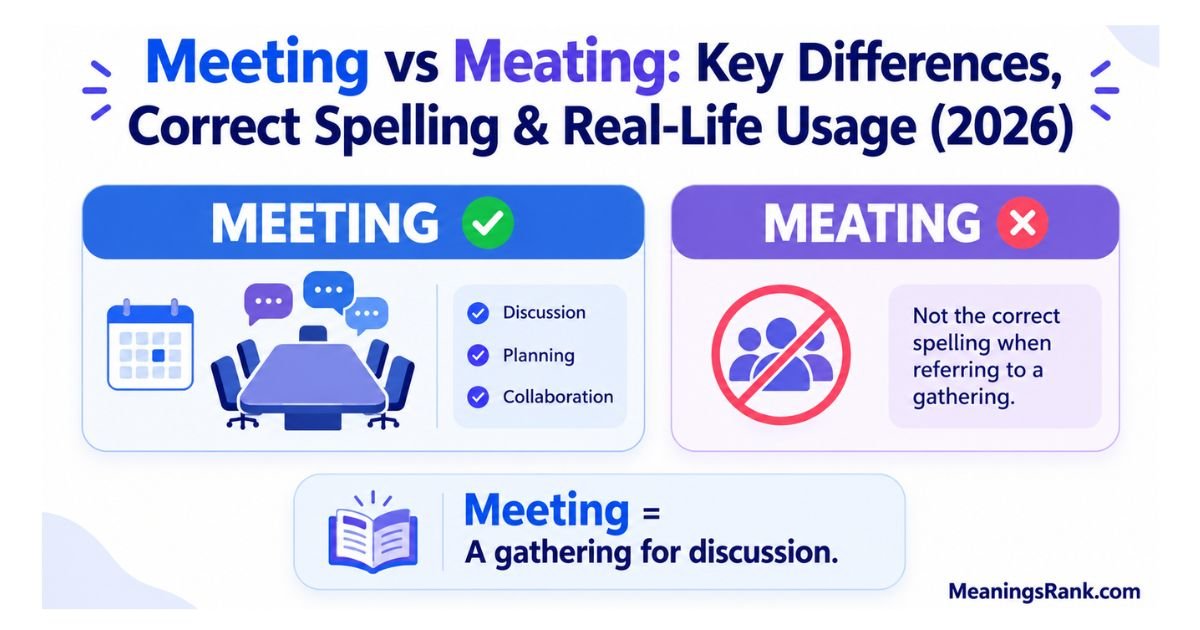
The dilemma is simple. “Meeting” and “meating” sound identical when spoken, yet only one of them is real English. “Meeting” is the correct word for a gathering or an encounter. “Meating” is a misspelling, one that spell-check sometimes misses and tired eyes miss even more often.
Why does it matter? Spelling is part of how readers judge your attention to detail. A stray “meating” in a work email, a school essay, or a job application can make an otherwise strong message look careless. The error also lands in a spot where readers expect a noun naming an event, so it disrupts the syntax of the whole sentence.
This guide explains where each word comes from, why the mix-up happens, how to spell and pronounce the correct form, and how it differs from look-alikes such as meet, meat, and meting. You will also find real-life examples, a memory trick, a short quiz, and answers to common questions.
Quick Answer: Meeting vs Meating
“Meeting” is the correct, standard spelling for a gathering of people, an encounter, or the act of coming together. “Meating” is not a standard English word. It is almost always a typo, a phonetic slip, or a playful coinage built on the noun “meat.”
| Meeting | Meating | |
| Standard English? | Yes | No (not listed in major dictionaries) |
| Part of speech | Noun / gerund / present participle | Not established |
| Core meaning | A gathering, encounter, or act of meeting | None in standard usage |
| Safe to use in formal writing? | Always | Never |
Rule of thumb: If you mean people getting together, write meeting. If you mean food, write meat.
Origins and Meanings of Meeting and Meating
Where “meeting” comes from
“Meeting” grows out of the verb meet, which traces back to Old English mētan, meaning “to come upon, encounter, or find.” The suffix -ing turns the verb into a noun (a gerund) or a present participle. The word has been part of English for roughly a thousand years, and its meaning has stayed remarkably stable.
Today, “meeting” carries several related senses:
- A formal or informal gathering of two or more people for discussion (“The board meeting starts at nine”).
- A single encounter (“Our first meeting was at a train station”).
- The act of coming together (“The meeting of the two rivers creates a wide delta”).
- A sporting or racing event, especially in British English (“a race meeting,” “an athletics meeting”).
- A religious gathering, such as a Quaker meeting.
Where “meating” comes from
“Meating” has no recognized etymology in standard English. It looks like the word “meat” plus -ing, and that is exactly how it tends to appear. Writers sometimes form it by instinct, treating “meat” as a verb the way they would treat “eat” or “cook.”
There is a faint historical footnote here. Older English did have a rare verb sense of meat, meaning “to supply with food.” You may find that sense in very old texts, but it has been obsolete in everyday writing for a long time. Modern style guides and dictionaries do not treat “meating” as correct, so for any practical purpose today, you should treat it as an error.
Meeting vs Meating: Side-by-Side Comparison
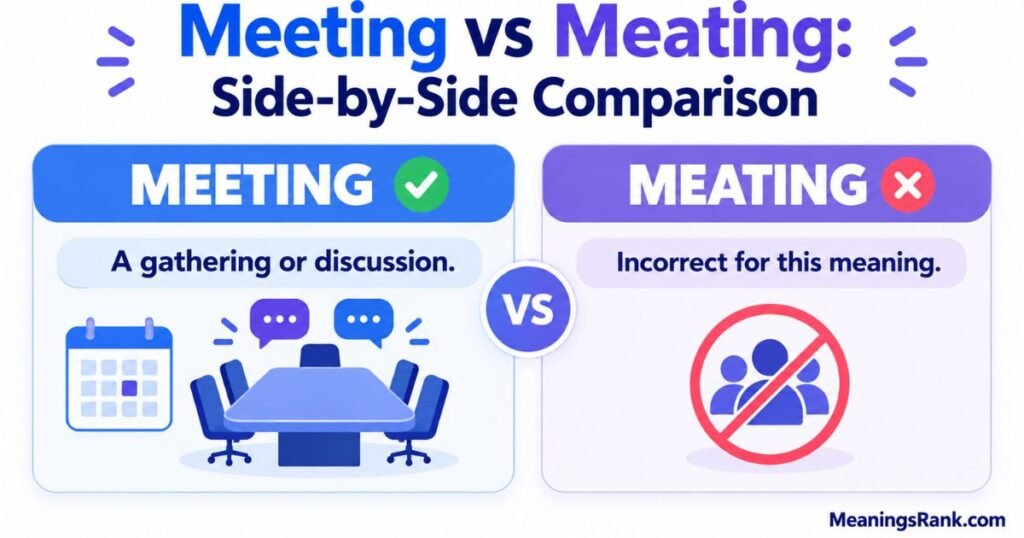
The table below puts the two forms next to each other so you can see the contrast at a glance.
| Feature | Meeting | Meating |
| Spelling status | Correct, listed in all major dictionaries | Nonstandard, not listed in major dictionaries |
| Root word | Meet (verb) | Meat (noun) |
| Typical function | Noun, gerund, or participle | Rarely appears; usually an error |
| Pronunciation | /ˈmiːtɪŋ/ | Would sound identical: /ˈmiːtɪŋ/ |
| Used in business writing? | Constantly | Never |
| Example | “The meeting ran long.” | ~~”The meating ran long.”~~ |
| Search or spell-check result | Passes | Flagged as a misspelling |
Notice the pronunciation row. The two forms sound exactly alike when spoken, which is the heart of the confusion. Spelling is the only thing that tells them apart.
Why Do People Confuse Meating and Meeting?
Three forces push writers toward the mistake.
1. They are homophones in practice:
Say “meeting” aloud, then say “meat-ing.” You will hear the same long ee sound followed by -ting. When two words (or a word and a nonword) share a sound, the brain has to rely on visual memory to pick the right spelling, and that memory is easy to scramble.
Read More: To Bad or Too Bad? Discover the Correct Spelling and Meaning
2. English offers two spellings for the same vowel sound:
The long ee sound appears as ee in meet, feet, and sleep, and as ea in meat, heat, and beat. Because both patterns are common, writers often guess. English spelling does not follow a single tidy rule here, so each word has to be learned individually.
3. Autocorrect and speech-to-text blur the line:
Dictation tools and fast typing on a phone can produce errors that look plausible. A word like “meating” may slip past a quick proofread because it resembles two real words at once.
There is also a smaller factor: people who think about “meat” as a verb (as in “meating up a recipe”) may stretch the pattern cook → cooking to meat → meating. That is creative, but it is not standard grammar.
Correct Spelling and Pronunciation
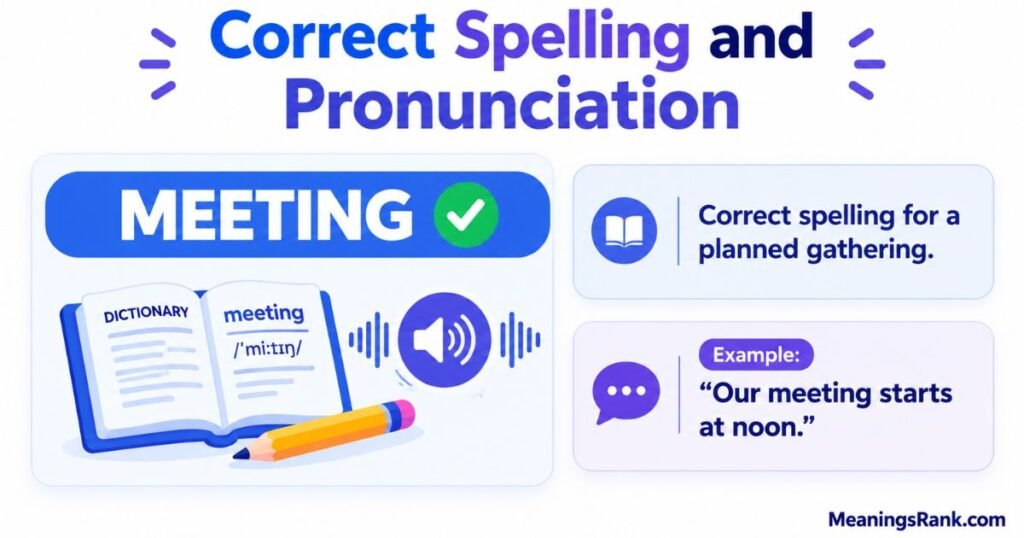
The correct spelling is m-e-e-t-i-n-g: two e‘s in the middle, one t, then -ing.
- Pronunciation (IPA): /ˈmiːtɪŋ/
- Syllables: meet-ing (two syllables, stress on the first)
- Plural: meetings
- Related forms: meet, meets, met, meeting
Here is a quick breakdown of how the word is built.
| Part | Role | Example |
| meet | Base verb | “I will meet you there.” |
| -ing | Suffix forming a gerund or participle | “Meeting new people is fun.” |
| meeting | Noun, countable | “We have three meetings today.” |
Because meeting ends in a single t after a long vowel, you do not double the consonant. Compare it to sit → sitting, where the short vowel triggers doubling. The long ee in meet keeps the t single.
Why “Meating” Is Usually Incorrect
Calling “meating” incorrect is not just a matter of taste. Several concrete reasons support the claim.
It is absent from standard references:
Mainstream dictionaries and professional style guides list meeting but not meating. When a word has no entry, editors and teachers mark it as an error.
It breaks syntax in most sentences:
“Meat” is a noun. English does not normally let a noun take -ing without a clear verb sense. In the sentence “We have a meating at noon,” the reader expects a noun that names an event, and “meating” fails to deliver one. The clause structure collapses.
It creates unintended humor or confusion:
In a workplace email, “Please join the meating” may look sloppy. It can also make a reader wonder whether you meant a barbecue.
It hurts credibility:
In formal writing, a single spelling slip can lower a reader’s trust. Resumes, cover letters, school essays, and professional emails are judged on details like this.
Is there any case where “meating” is acceptable?
Only in deliberate wordplay. A food blogger might coin “meating” as a joke, as in “Weekend meating at the grill.” A brand might use it as a pun. In those cases the writer is making a stylistic choice, and the context makes it obvious. Outside of intentional humor, do not use it.
Meeting vs. Meet, Meat, and Meting: How They Differ
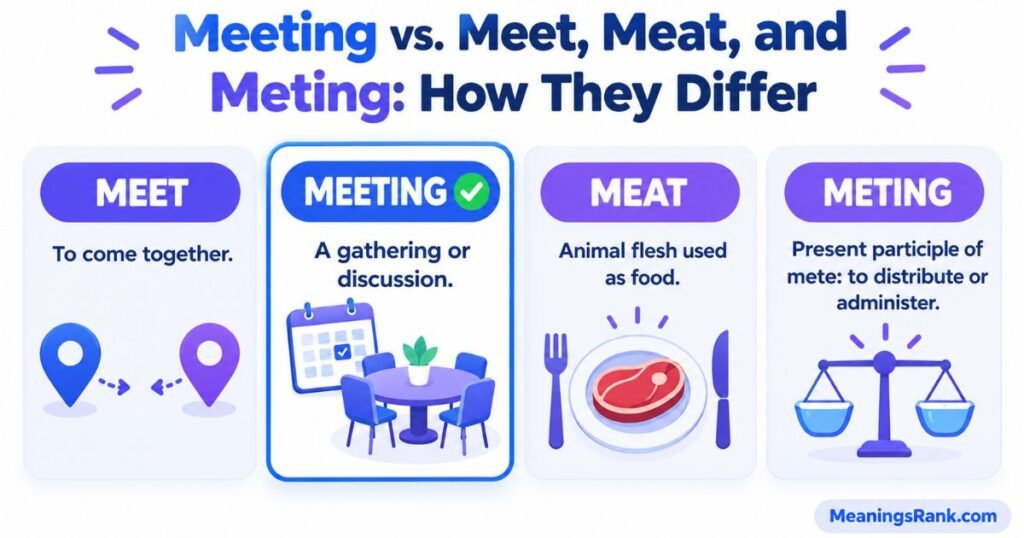
Four look-alike words cause most of the trouble. Learning how they differ clears up nearly every related mistake.
| Word | Part of speech | Meaning | Example |
| Meeting | Noun / gerund / participle | A gathering or encounter | “The meeting is at 3 p.m.” |
| Meet | Verb (also noun in sports) | To come together; to encounter | “Let’s meet for coffee.” |
| Meat | Noun | Animal flesh used as food; the substance of a matter | “The meat was grilled.” / “the meat of the argument” |
| Meting | Gerund of mete (verb) | Distributing or allotting, usually with “out” | “The judge is meting out penalties.” |
A closer look at each
Meet is the base verb. It also appears as a noun in sports, as in “a swim meet” or “a track meet,” and as an adjective in older, formal English meaning “fitting” (“it is meet and right”).
Read More: Batchelor vs Bachelor: Which Spelling Is Correct? Meaning & Examples (2026)
Meat is a noun. It usually refers to food, but it can also mean the core of something. “Let’s get to the meat of the issue” is a perfectly good idiom.
Meting is the rarest of the group. It comes from mete, meaning “to distribute or dole out,” and it almost always appears in the phrase mete out. Writers often mix it up with “meeting” because it sounds nearly the same. If you see “meting out justice,” that spelling is correct. If you see “a meting at noon,” it is not.
Meeting is the everyday word. When in doubt, ask whether you are describing people coming together. If yes, use meeting.
How to Use “Meeting” in Sentences
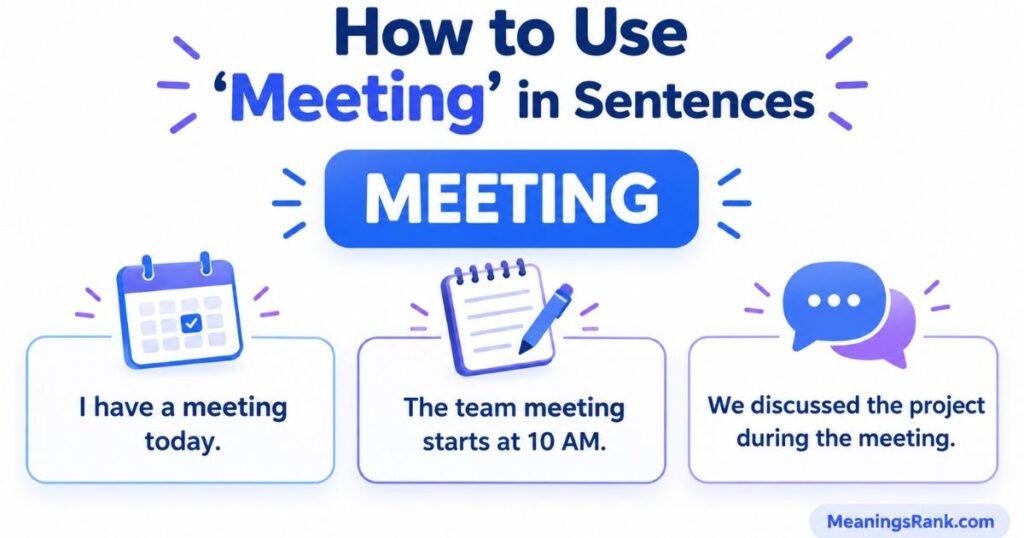
“Meeting” is flexible. It works as a noun, a gerund, and a present participle. Seeing each role helps you avoid errors in sentence construction.
As a noun (a gathering)
- “The meeting starts at 10 a.m.”
- “She scheduled a meeting with her manager.”
- “All team meetings are held on Mondays.”
As a gerund (the act of meeting)
A gerund is a verb form ending in -ing that works as a noun.
- “Meeting deadlines is part of the job.”
- “He enjoys meeting new people.”
As a present participle (an ongoing action)
- “We are meeting the client tomorrow.”
- “The two leaders, meeting for the first time, shook hands.”
Common collocations
Writers frequently pair “meeting” with certain verbs and nouns. Using these combinations will make your writing sound natural.
| Pattern | Example |
| hold / host / attend a meeting | “The principal will host a meeting for parents.” |
| call / schedule / postpone a meeting | “She had to postpone the meeting.” |
| meeting room / agenda / minutes | “Please read the minutes before the meeting.” |
| in a meeting / at a meeting | “I’m in a meeting right now.” |
| meeting of the minds | “The talks ended in a meeting of the minds.” |
A note on punctuation and style
When you list meeting details in a sentence, use commas to separate items in a series: “The meeting covers budgets, hiring, and timelines.” Many style guides also recommend lowercase for “meeting” unless it is part of an official title, such as “the Annual General Meeting.”
Real-Life Examples of Meeting vs Meating
Seeing the words in context makes the rule stick. The examples below show how the correct form looks in everyday writing, next to the common error.
Workplace emails
| Incorrect | Correct |
| ~~”Can we move the meating to Friday?”~~ | “Can we move the meeting to Friday?” |
| ~~”I’ll send the meating notes shortly.”~~ | “I’ll send the meeting notes shortly.” |
| ~~”Thanks for meating with me today.”~~ | “Thanks for meeting with me today.” |
School and academic writing
| Incorrect | Correct |
| ~~”The student council meating was postponed.”~~ | “The student council meeting was postponed.” |
| ~~”After meating the author, she wrote a review.”~~ | “After meeting the author, she wrote a review.” |
Everyday conversation and social media
| Incorrect | Correct |
| ~~”Meating my best friend for lunch!”~~ | “Meeting my best friend for lunch!” |
| ~~”Family meating at grandma’s house.”~~ | “Family meeting at grandma’s house.” |
When the food sense is really intended
Sometimes a writer wants a food-related word. In that case, the correct choice is meat, not “meating.”
- “We bought fresh meat for the barbecue.”
- “She is cutting back on red meat.”
- “He is cooking meat” (not “meating”).
Notice that the -ing form belongs to a verb like cooking, grilling, or eating. “Meat” itself does not take -ing.
Memory Trick to Remember the Difference
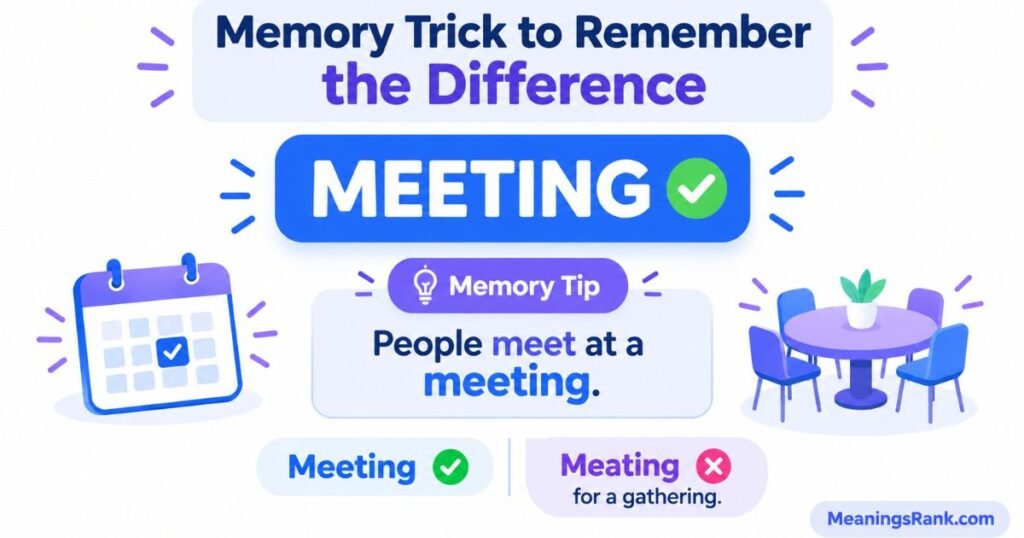
Here are three simple tricks that work for students, professionals, and ESL learners.
Trick 1: Count the E’s:
A meeting brings meeting people together. Two people, two e‘s. The word meeting has ee because people are meeting: one e for each person who shows up.
Trick 2: Think “EA” for “EAT”:
The letters ea in meat sit right next to eat. If the word relates to something you eat, use ea. If it relates to people gathering, use ee.
Trick 3: Picture the room:
Imagine a conference table. Every chair has a person in it, and that person is saying something. The two e‘s are two people sitting side by side. No a belongs there, because nobody is serving steak at your quarterly review.
If you remember only one thing, remember this: EE for people, EA for food.
Common Confusions and Spelling Mistakes
Even careful writers stumble over these errors. Here is where mistakes usually appear.
Mistake 1: Using “meating” as a verb form of “meet”
The present participle of meet is meeting, never “meating.”
- ~~”I’m meating her at noon.”~~ → “I’m meeting her at noon.”
Mistake 2: Confusing “meeting” with “meting”
Meting only works when you are distributing something, usually with “out.”
- ~~”We have a meting at 2.”~~ → “We have a meeting at 2.”
- “The coach is meting out punishments.” (correct)
Mistake 3: Using “meat” where “meet” belongs
- ~~”Nice to meat you.”~~ → “Nice to meet you.”
- ~~”Let’s meat at the cafe.”~~ → “Let’s meet at the cafe.”
Mistake 4: Writing “meetting” with a double t
Because sit becomes sitting and run becomes running, some writers double the final consonant by habit. Meet has a long vowel pair, so no doubling occurs.
- ~~”meetting”~~ → meeting
Read More: Studder vs Stutter: Correct Spelling, Meaning & Key Differences (2026)
Mistake 5: Subject-verb agreement slips with “meeting”
“Meeting” is a singular count noun, so it takes a singular verb. The plural is meetings.
- ~~”The meetings are cancelled” (when only one is meant)~~
- “The meeting is cancelled.”
- “The meetings are cancelled.” (when several are)
Key Exceptions to Keep in Mind
A few edge cases are worth knowing.
- British vs. American usage: In British English, a “race meeting” or “athletics meeting” refers to a sporting event. In American English, people more often say “track meet.”
- Capitalization: Treat “meeting” as a common noun in lowercase. Capitalize it only in proper names, such as the “Annual Shareholders Meeting.”
- “Meating” in brand names or jokes: A business or blogger may use it intentionally. Do not copy this in formal writing.
- Obsolete verb sense of “meat”: Very old texts may use meat as a verb. Modern writing does not.
Synonyms for “Meeting”
Variety keeps your writing fresh. Choose a synonym based on formality and context.
| Synonym | Best used for | Example |
| Gathering | Informal or social events | “A small gathering of friends.” |
| Conference | Large, structured professional events | “The annual medical conference.” |
| Assembly | Formal groups, schools, legislatures | “The school assembly begins at 9.” |
| Session | Working or scheduled periods | “A brainstorming session.” |
| Huddle | Short, informal team check-ins | “Let’s have a quick huddle.” |
| Appointment | One-on-one scheduled visits | “I have a dentist appointment.” |
| Summit | High-level leaders or officials | “The climate summit.” |
| Get-together | Casual social occasions | “A weekend get-together.” |
| Encounter | Chance or brief meetings | “A surprising encounter.” |
| Rendezvous | Planned, often private, meetups | “A rendezvous at the station.” |
Pick the word that fits your audience. “Huddle” suits a startup. “Assembly” suits a school. “Summit” suits world leaders.
Practice Quiz: Meeting vs Meating
Test yourself. Fill in each blank with the correct word: meeting, meet, meat, or meting. Scroll to the bottom for the answer key.
- The team has a quarterly budget ______ on Thursday.
- It was great to ______ you at the conference.
- The butcher sells fresh ______ every morning.
- The judge was ______ out harsh sentences to the offenders.
- I am ______ my old classmate for lunch tomorrow.
Bonus challenge: Find and fix the error in this sentence: “Please bring your notes to the meating room.”
Answer Key
- meeting (a noun naming a gathering)
- meet (base verb after “to”)
- meat (a noun meaning food)
- meting (from mete out, meaning to distribute)
- meeting (present participle in the present continuous tense)
Bonus answer: “meating room” should be “meeting room.”
Scoring: 5/5 means you have mastered it. 3-4 means you are close. Fewer than 3? Review the memory trick above and try again.
Frequently Asked Questions (FAQs)
Is “meating” a real word?
No. “Meating” is not a standard English word and does not appear in major dictionaries. It is nearly always a misspelling of “meeting.” The only exception is intentional wordplay or a rare, obsolete verb sense of “meat.”
What is the difference between “meeting” and “meating”?
“Meeting” means a gathering or encounter between people. “Meating” has no accepted meaning in standard English. If you are describing people getting together, use “meeting.” If you are talking about food, use “meat.”
How do you spell “meeting” correctly?
The correct spelling is m-e-e-t-i-n-g. It has two e‘s after the m and a single t before the -ing ending. Remember: two e‘s for two people coming together.
Do “meeting” and “meating” sound the same?
Yes. Both are pronounced /ˈmiːtɪŋ/. Because the sound is identical, you can only tell them apart in writing, which is why this error is so common in emails and texts.
What is the difference between “meeting” and “meting”?
“Meeting” refers to a gathering. “Meting” comes from the verb mete, meaning to distribute or allot, and it usually appears in “meting out” (as in “meting out justice”). They sound alike but carry different meanings.
Conclusion
“Meeting” is the only correct spelling when you mean a gathering, an encounter, or the act of coming together, and “meating” is a spelling error unless it is used as deliberate wordplay. Keep the memory trick handy: EE for people, EA for food. Double-check your emails, essays, and social posts before hitting send, and your writing will look sharper every time.