

You are typing a college application, a résumé, or a quick text to an old friend, and you stop mid-sentence. Is it “high school” or “highschool”? The word looks fine either way, and spell-check does not always complain. That small pause is exactly why this question gets searched thousands of times a month.
The answer is simple, and this guide gives it to you straight away. Then it goes further: where the confusion comes from, how the term behaves in American and British English, how to handle hyphens and capital letters, and how to avoid the slip in formal writing. By the end, you will never second-guess it again.
Quick Answer: High School or Highschool?
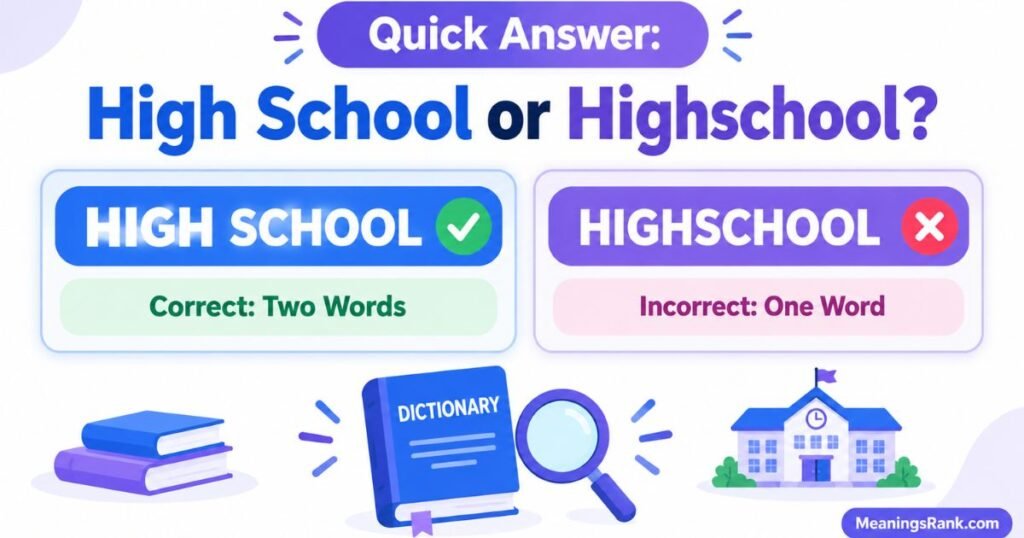
“High school” (two words) is the correct spelling. It is an open compound noun that names a school for students in roughly the ninth through twelfth grades in the United States, or an equivalent secondary school elsewhere. “Highschool” (one word) is not recognized as standard English by major dictionaries or style guides, so avoid it in formal, academic, and professional writing.
| Spelling | Status | Use it? |
| high school | Correct, standard | Yes, always |
| highschool | Nonstandard | No, except in usernames, hashtags, or brand names |
| high-school | Hyphenated only in rare, style-specific cases | Check your style guide |
What Does High School Mean?
A high school is a school that offers secondary education, usually after elementary school and middle school or junior high. In the United States, students typically attend from about age 14 to 18, covering grades 9 through 12. Completing the program earns a high school diploma, which is the standard credential for entering college, vocational training, or the workforce.
The term carries a few related meanings, depending on how it is used:
- The institution: “She teaches at the local high school.”
- The stage of life: “He played guitar in high school.”
- The educational level: “Most jobs here require a high school education.”
In each case, “high” does not describe height. It signals a higher level of study than primary or elementary schooling. That older sense of “high” meaning advanced is a clue to how the phrase was built, and it helps explain why the two words stay separate.
Read More: Aesthetic vs Esthetic: Meaning, Spelling Differences & US Usage (2026)
Why People Confuse High School and Highschool
The mix-up is understandable. English has thousands of compound words, and they follow three different patterns: open (two words, like “ice cream”), hyphenated (like “well-known”), and closed (one word, like “notebook”). Nothing in the sound of a word tells you which pattern it uses. You simply have to learn each one.
Several forces push writers toward “highschool”:
- Analogy with similar words. Closed compounds such as “classroom,” “schoolwork,” and “playground” look just like “highschool” on the page. The brain generalizes.
- Informal typing habits. Texting, social media handles, and hashtags reward short strings. #highschool is faster to type than #high school, which actually breaks in a hashtag.
- Language drift. English tends to close up compounds over time. “Web site” became “website.” “E-mail” became “email.” Writers sometimes assume “high school” is simply next in line.
- Spell-check gaps. Because “highschool” appears so often online, some software tools no longer flag it.
None of this makes the one-word form acceptable in print. It only explains why the error is so common.
High School vs. Highschool: Which Spelling Is Correct?
Dictionaries answer this question clearly. Merriam-Webster, Oxford, Cambridge, Collins, and Dictionary.com list the entry as two words: high school. None of them present “highschool” as a variant spelling.
Style guides agree. The Associated Press Stylebook, The Chicago Manual of Style, and the MLA and APA handbooks all treat “high school” as an open compound. Schools themselves follow the same rule in their formal names: “Roosevelt High School,” not “Roosevelt Highschool.”
So why do the two forms coexist online? Because the internet records what people type, not what editors approve. Frequency of use is not the same as correctness. A misspelling that appears a million times is still a misspelling.
Here is a simple way to think about it. A spelling becomes standard when dictionaries and professional editors adopt it. “Highschool” has not crossed that line, and there is no sign it will anytime soon.
Meaning and Usage Difference
Strictly speaking, there is no difference in meaning between the two forms. “Highschool” is not a separate word with its own definition. It is just a misspelling of “high school.” The real difference is in acceptability.
| Feature | high school | highschool |
| Dictionary entry | Yes | No |
| Accepted in academic writing | Yes | No |
| Accepted in business writing | Yes | No |
| Seen in usernames and hashtags | Sometimes | Common |
| Meaning | Secondary school | Same intended meaning, nonstandard spelling |
Where the difference does matter is in grammar. Because “high school” is a two-word noun phrase, it follows normal syntax. You can add articles (“a high school”), plurals (“high schools”), and possessives (“the high school’s gym”). When you write it as one word, readers may notice the error before they notice your message. In an essay or a cover letter, that small distraction can weaken your credibility.
How to Use High School Correctly
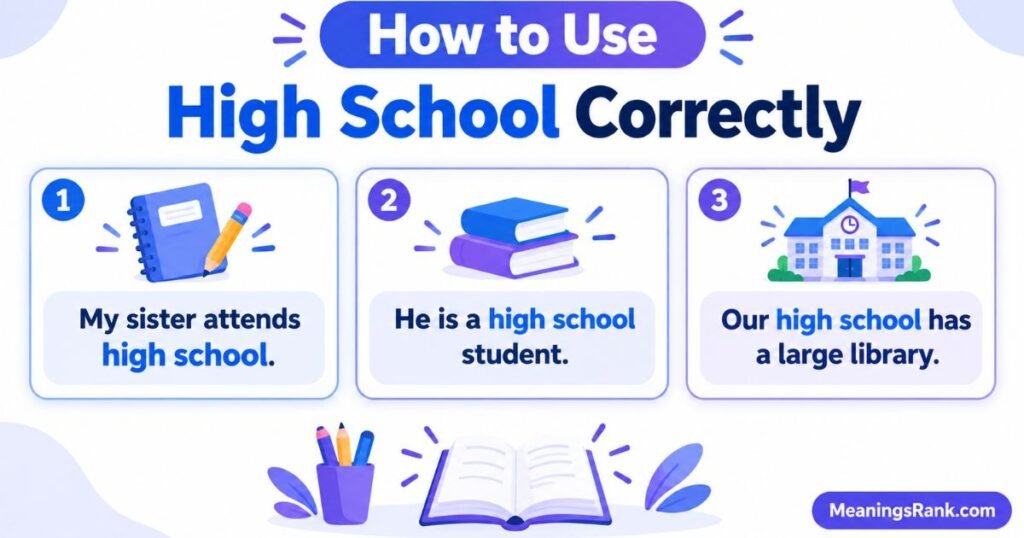
Using the term correctly comes down to four short rules.
Rule 1: Keep it as two words
Write “high school” with a space between the words in every standard context. This applies whether it is a noun or a modifier.
- Correct: “My high school offers three languages.”
- Correct: “A high school diploma is required.”
Rule 2: Do not capitalize it in general use
Treat “high school” as a common noun. Capitalize it only when it is part of a proper name.
- Lowercase: “She graduated from high school in June.”
- Capitalized: “She graduated from Lincoln High School.”
Rule 3: Skip the hyphen as a modifier in most styles
When “high school” modifies another noun, as in “high school student,” most major style guides leave it open. Some publications prefer “high-school” before a noun to prevent misreading. If you follow a house style, check it. If you do not, the open form is safest.
Rule 4: Mind plurals and possessives
The plural is “high schools.” The possessive singular is “high school’s,” and the possessive plural is “high schools’.”
- “Three high schools joined the debate league.”
- “The high school’s mascot is a hawk.”
- “Both high schools’ teams qualified.”
A related form, “high schooler,” names a student who attends one. Dictionaries record it as two words, not “highschooler.”
Read More: Emersion vs Immersion: Key Differences, Meanings & Correct Usage (2026)
Tone, Context, and Formality
Context decides how much the spelling matters, but the correct form never hurts.
Formal writing:
Academic papers, college essays, official letters, job applications, and published articles all require “high school.” A one-word version looks careless and can suggest weak proofreading.
Professional writing:
Emails, reports, résumés, and LinkedIn profiles also call for the standard form. Hiring managers read education sections closely, and “highschool” there is a visible slip.
Casual writing:
In texts and social posts, readers are forgiving. Still, there is no real benefit to the one-word form, so it is easy to default to the correct spelling.
Branding and digital identifiers:
Usernames, domain names, and hashtags are the one place where closed forms are sensible, since spaces are not allowed. That is a technical constraint, not a spelling rule.
A useful test: if your sentence would appear in a school, a newsroom, or a workplace, use two words.
Everyday Examples
Seeing the term in real sentences makes the pattern stick. Here are common situations, with the correct form in each.
| Context | Incorrect | Correct |
| Résumé | Highschool Diploma, 2022 | High School Diploma, 2022 |
| My highschool teacher recommended you. | My high school teacher recommended you. | |
| College essay | I led my highschool debate team. | I led my high school debate team. |
| News headline | Highschool Football Draws Record Crowd | High School Football Draws Record Crowd |
| Casual text | Remember our highschool prom? | Remember our high school prom? |
| Plural | Local highschools are merging. | Local high schools are merging. |
Notice that in every row, the fix is the same: add a space. No other grammatical change is needed. That consistency makes the rule easy to remember.
Common Mistakes and Quick Fixes
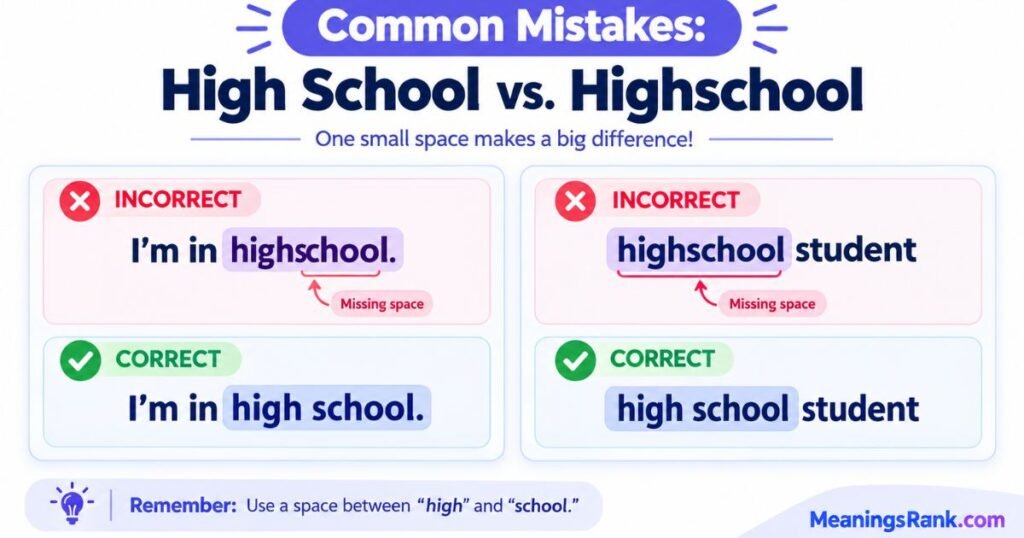
Even careful writers slip in a few predictable ways. Here are the most frequent errors and how to repair each one.
| Mistake | Why it happens | Quick fix |
| “highschool” as one word | Analogy with closed compounds | Insert a space |
| “High-school student” in a style that prefers open form | Over-hyphenating | Use “high school student” |
| “High School” capitalized mid-sentence | Treating it as a title | Lowercase unless part of a proper name |
| “highschooler” | Extending the one-word error | Write “high schooler” |
| “high schools'” for one school | Misplaced apostrophe | Use “high school’s” for a single school |
| “highschool’s” | Combining two errors | Write “high school’s” |
Quick Memory Trick
Think of the phrase as two steps on a staircase. The first step is “high” and the second step is “school.” You step up from elementary school to high school, and each step stays separate. If you ever picture the two words fused into one block, you have lost the staircase.
Another shortcut: compare it with its siblings. You would never write “elementaryschool” or “middleschool.” Since “high school” belongs to the same family, it follows the same two-word pattern.
When One Choice Sounds Wrong
Sometimes a writer insists that “highschool” feels right or that “high school” feels clumsy. Here is why that instinct is unreliable.
The pronunciation trap:
In speech, we say “HIGH school” with stress on the first word, which makes it sound like a single unit. Spoken stress patterns do not decide spelling, though. “Ice cream” sounds like one unit too, and it stays open.
The modifier trap:
In “high school students,” the phrase feels crowded, and some writers want to fuse or hyphenate it. Resist this. Readers parse it easily, and the open form is standard.
The proper-name trap:
In a school name like “Westfield High School,” writers may drop the capital H or merge the words. Official names follow the school’s own usage, so check the school’s website. In nearly every case, it is two words with capital letters.
The “everyone writes it that way” trap:
Popularity does not make a form standard. Trust the dictionary and your style guide, not the comment section.
When your ear says one thing and the dictionary says another, follow the dictionary.
Which One Should You Use?
Use “high school.” That is the only recommendation for essays, emails, reports, résumés, captions, headlines, and everyday messages. The one-word form has no formal standing, no dictionary support, and no real advantage.
The only exception involves technical limits, such as a URL, a username, or a hashtag. There, “highschool” appears because spaces are not allowed, not because it is a legitimate spelling.
Interactive Practice Quiz
Test yourself. Fill in each blank with the correct form: high school, high schools, high school’s, or High School.
- After graduating from ______, Maria joined the army.
- Several local ______ are adding robotics clubs this fall.
- The ______ gymnasium was renovated last year.
- She earned her diploma at Jefferson ______.
- His ______ teacher encouraged him to apply for the scholarship.
Answer Key
- high school (general noun, lowercase)
- high schools (plural noun)
- high school’s (singular possessive)
- High School (part of a proper name, so capitalized)
- high school (open compound modifying “teacher”)
Score 5 out of 5, and you have the rule mastered. If you missed one, reread the matching section above.
High School in American and British English
Both varieties spell the term the same way: two words. The difference is not spelling but how often the term is used and what it means.
American English:
“High school” is the standard name for secondary school for grades 9 to 12. It is part of everyday vocabulary and appears in phrases like “high school graduation,” “high school sports,” and “high school sweetheart.” The structure is typically elementary school, middle school or junior high, then high school.
British English:
In England and Wales, the usual term is secondary school. Pupils may then attend a sixth form or college for ages 16 to 18. “High school” does exist, though. Many schools are named “High School,” especially in Scotland, where it is a common name for state secondary schools. In England, some grammar schools and independent schools use the name too.
Other varieties:
Canada and Australia use “high school” widely. Ireland leans toward “secondary school.” In India, Pakistan, and many other countries, “high school” and “secondary school” both appear, depending on the board of education.
| Variety | Common term | Spelling of “high school” |
| American English | high school | two words |
| British English | secondary school (also “high school” as a name) | two words |
| Canadian English | high school | two words |
| Australian English | high school | two words |
So the spelling rule is universal. What changes from region to region is vocabulary, not orthography.
Dictionary-Style Word Details
Part of Speech
High school is a compound noun (an open compound, written with a space). It can also function as a noun adjunct (also called an attributive noun), which means it modifies another noun without changing form, as in “high school reunion” or “high school coach.”
Noun
- Singular: high school
- Plural: high schools
- Possessive singular: high school’s
- Possessive plural: high schools’
- Countable: yes (“three high schools”)
- Related form: high schooler (a student at a high school)
Definition: A school that provides secondary education, typically for students in grades 9 through 12 in the United States, following elementary or middle school.
Synonyms
Exact matches vary by country, so choose according to your audience.
- Secondary school (the closest general synonym, especially in British English)
- Senior high school (used in the U.S. and elsewhere)
- Upper school (common in independent schools)
- Senior school (used in the UK)
- Preparatory school (related, but implies college preparation specifically)
“Secondary school” is the safest substitute in writing for an international audience.
Read More: Anyone Has or Anyone Have? The Ultimate Guide to Correct Usage (2026)
Example Sentences
- She taught chemistry at the high school for twenty years.
- Applicants must hold a high school diploma or its equivalent.
- His high school friends still gather every summer.
- The district plans to build two new high schools by 2028.
- Our high school’s debate team won the state title.
- Enrollment at Parkview High School has grown steadily.
- Many high school students now take dual-enrollment college courses.
Word History
The word “school” comes from the Greek skholē, which originally meant leisure, and later study, through Latin schola. The word “high” has long carried the sense of advanced or superior, as in “high court” or “higher education.”
Scottish usage of “high school” appears in records from the sixteenth century, where it named institutions offering advanced instruction. In the United States, the idea took hold in the early nineteenth century. Boston’s English High School, opened in 1821, is widely recognized as the first public high school in the country. As public secondary education expanded across the twentieth century, “high school” settled into everyday American vocabulary.
Throughout this history, the term has been written as two words. The one-word variant is a recent product of informal typing, not an older or alternative form.
Common Phrases Containing “High School”
| Phrase | Meaning |
| high school diploma | The certificate awarded on completing high school |
| high school graduate | A person who has completed high school |
| high school dropout | A student who leaves before graduating |
| high school senior | A student in the final year (12th grade) |
| high school sweetheart | A romantic partner from one’s high school years |
| high school reunion | A gathering of former classmates |
| high school equivalency | A credential, such as the GED, that stands in for a diploma |
| junior high school | A school for early adolescent grades, often 7 to 9 |
| high school prom | A formal dance, usually held in the spring |
| high school sports | Athletic programs run by secondary schools |
Frequently Asked Questions
Is it “high school” or “highschool”?
It is “high school” (two words). “Highschool” is a common misspelling and does not appear in standard dictionaries. Use the two-word form in all formal and professional writing.
Is “highschool” ever correct?
Not as a standard English spelling. It may appear in usernames, domain names, or hashtags, where spaces are not allowed. Those uses are technical workarounds, not endorsements of the spelling.
Should “high school” be capitalized?
Only when it is part of a proper name, such as “Lincoln High School.” In general use, such as “She finished high school in 2020,” keep it lowercase.
Do I need a hyphen in “high school student”?
Usually not. Most major style guides, including AP and Chicago, leave “high school” open when it modifies a noun. A few publications prefer “high-school” for clarity, so follow your house style if you have one.
What is the difference between “high school” and “secondary school”?
They name the same general level of education. “High school” is the standard term in the United States and Canada, while “secondary school” is more common in the United Kingdom and Ireland. “Secondary school” works well for international readers.
Conclusion
“High school” is always two words, and “highschool” is a misspelling you can safely retire. Keep the term lowercase unless it is part of a proper name, skip the hyphen in most styles, and remember the staircase image if you ever doubt yourself. With these few rules, your writing will look polished in every setting, from a text message to a college application.