
You are typing a quick message to a colleague. You want to thank her for backing your proposal, and your fingers pause over the keyboard. Is she your ally or your Allie? The two words look like twins, sound almost the same, and show up in the same kinds of sentences, so even confident writers hesitate.
Here is the short answer. Ally is a common word for a supporter, a partner, or the act of joining forces. Allie is a capitalized given name, most often a short form of Alexandra, Alison, or Alice. One describes a role, and the other identifies a person.
Why does this small choice matter? Because a misspelled name can feel careless to the person who owns it, and a misused common word can make a polished sentence read as a typo. Mix them up in a résumé, a school essay, a cover letter, or a wedding invitation, and the mistake stands out at once.
This guide walks you through the meaning, origin, spelling, pronunciation, and grammar of both words. You will also find real-life examples, memory tricks, and a short practice quiz.
Ally vs Allie: Quick Answer
Ally is a common word. As a noun, it means a person, group, or country that supports or cooperates with another. As a verb, it means to join or unite with someone for a shared purpose. Allie is a proper noun: a given name, usually a short form of Alexandra, Alison, Alice, or Allison.
The quick test is simple. If you can replace the word with “supporter,” “partner,” or “to team up,” you need ally. If you are writing about a specific person and the word should start with a capital letter, you need Allie.
| Word | Part of Speech | Meaning | Capitalized? | Example |
| Ally | Noun / verb | A supporter, partner, or to unite with | Only at the start of a sentence | She is a loyal ally in every meeting. |
| Allie | Proper noun | A female (or occasionally unisex) given name | Always | Allie joined the debate team. |
The Core Difference Between Ally and Allie
The core difference is function. Ally does a job in a sentence: it names a role or describes an action. Allie points to a person by name. They are two separate words that happen to sound almost identical when spoken quickly.
Think about syntax for a moment. A common noun like ally can follow an article (“an ally,” “the ally”), take an adjective (“a trusted ally”), and form a plural (“allies”). A proper noun like Allie usually stands alone as the subject or object of a clause, and it does not take “a” or “the” unless you are making a special point, such as “the Allie I met yesterday.”
Here is the difference in action:
- Allie is my closest ally on the project. (Both words appear. One names the person, the other names her role.)
- The two countries decided to ally against the threat. (Verb use. Allie would make no sense here.)
- I invited Allie to dinner. (Name use. Ally would be wrong because no supporter is being described.)
Notice how each word fits only one slot. Once you see the grammatical role, the choice almost makes itself.
Read More: Grandad vs Granddad: Which Spelling Is Correct? (Meaning & Usage Guide)
What Does Ally Mean?
Ally is a word with real depth. It carries military, political, social, and personal meanings, and it has grown more common in recent decades. Let’s look at each layer.
Ally Definition
Ally (noun): a person, group, organization, or nation that cooperates with or supports another, especially in a struggle or shared effort.
Ally (verb): to unite or form a connection with another party for a particular purpose. In the verb form, the clause structure often uses “with” or “against”: to ally with a neighbor, to ally against a rival.
Pronunciation:
- Noun: AL-eye (/ˈælaɪ/), with stress on the first syllable.
- Verb: uh-LYE (/əˈlaɪ/), with stress on the second syllable.
Forms to know:
| Form | Example |
| ally (singular noun) | He is my ally in this debate. |
| allies (plural noun / third-person verb) | Their allies arrived early. / She allies herself with experts. |
| allied (past tense / adjective) | The two firms allied last year. |
| allying (present participle) | They are allying with local schools. |
| alliance (related noun) | The alliance lasted a decade. |
Notice the plural. To form the plural of the noun, change the y to i and add -es. This follows the standard spelling rule for words ending in a consonant plus y. The verb in the third person singular follows the same pattern: she allies.
Word Origin and History of Ally
The word ally came into English from Old French alier, meaning “to combine” or “to bind.” That French word traces back to Latin alligare, built from ad- (“to”) and ligare (“to bind, to tie”). The same Latin root gives us ligament, oblige, and liable. In other words, an ally is, at its root, someone you are tied to.
Middle English speakers used the verb form first, in the sense of joining families through marriage or joining states through treaty. The noun appeared as the idea of a “bound partner” became common in diplomacy and warfare. For centuries the word lived mostly in political and military writing. It was the vocabulary of treaties, coalitions, and shifting loyalties.
The twentieth century brought the capitalized “Allies,” used for the powers that fought together in the two World Wars. That usage still appears in history textbooks, and it follows a style guide rule: when a word names a specific historical group, capitalize it. So you write the Allies landed in Normandy, but our allies in the community garden.
Ally in Politics and Social Advocacy
In politics, an ally is a nation or group that shares strategic goals with another. NATO members, for example, are often described as allies. Journalists and diplomats rely on the word daily, and it works both as a noun (a close ally) and as an adjective in the form allied (allied forces).
In recent years, ally has taken on a strong social meaning. In advocacy and community work, an ally is a person who supports a group they do not belong to, using their influence, voice, or resources to help reduce unfair treatment. You will hear phrases like an ally to the LGBTQ+ community, an ally in the fight for accessible education, or a workplace ally. The related noun allyship describes the ongoing practice of that support.
Writers working in this area should keep a few points in mind:
- Lowercase. The word is not a proper noun in this sense, so keep it lowercase unless it begins a sentence.
- Preposition choice. Use ally to a group or ally of a group. Both are accepted. Use ally in a cause.
Ally Synonyms and Related Words
Good writers avoid repeating the same word. Here are useful alternatives, grouped by shade of meaning.
| Context | Synonyms |
| General support | supporter, backer, advocate, champion |
| Partnership | partner, associate, collaborator, colleague |
| Friendship | friend, confidant, companion, comrade |
| Politics and military | confederate, coalition member, cobelligerent, friendly nation |
| Verb forms | unite, join, team up, band together, cooperate, side with |
Antonyms include enemy, foe, and opponent.
One caution: synonyms are not always interchangeable. A colleague may simply work near you, while an ally actively supports your position. Pick the word that matches the real relationship.
What Does Allie Mean?
Now for the other word. Allie has nothing to do with support or cooperation. It belongs to the world of personal names, and that changes every rule you apply to it.
Allie Definition and Name Meaning
Allie is a given name, most often used for girls and women. It is generally a diminutive, which means a short and friendly form of a longer name. Because it is a proper noun, it is always capitalized, wherever it appears in a sentence.
The meaning of the name depends on the longer name it comes from. There is no single dictionary definition of Allie the way there is for ally. A few common sources:
- Alexandra: from the Greek alexein (“to defend”) and aner (“man”), often translated as “defender of mankind.”
- Alice / Alison / Allison: Alice comes from the Germanic Adalheidis, meaning “noble kind.” Alison began as a medieval pet form of Alice.
- Alyssa: often linked to the alyssum flower, with a Greek root suggesting “sane” or “rational.”
Some parents choose Allie as a full legal first name, with no longer form behind it. That is increasingly common, and it is perfectly valid.
Pronunciation: AL-ee (/ˈæli/). Both syllables are short, with stress on the first.
Is Allie a Nickname for Other Names?
Yes. Allie is one of the most flexible short forms in English. Many full names can produce it:
| Full Name | Short Form |
| Alexandra | Allie, Alex, Lexi, Sandra |
| Alexis | Allie, Lexi |
| Alison / Allison | Allie, Ali |
| Alice | Allie, Ali |
| Alyssa | Allie, Lyss |
| Allegra | Allie |
| Alina | Allie, Lina |
| Aliyah | Allie, Ali |
| Alicia | Allie, Lish |
This is why you will meet Allies who are named Alexandra on their passports and Allies who are simply Allie on every document. When you write to someone, the safest approach is to use the form they use themselves. Check how they sign an email or introduce themselves.
A short note on spelling variation: the same sound appears as Ally, Alley, Ali, and Alli. Ally is the most common alternative, and many people named Ally choose that spelling on purpose. That is a key reason for the confusion this article addresses. A woman named Ally is spelled like the common word, but she is still a person, so the name is capitalized. The reverse also holds: a person who spells her name Allie should never be “corrected” to Ally, because the spelling of a personal name belongs to the person.
Popularity of the Name Allie
Allie has been a steady, friendly choice in English-speaking countries for many decades. It rose in popularity as parents looked for names that felt warm and approachable, and it has stayed in use in the United States, Canada, the United Kingdom, and Australia. It sounds youthful and casual but also grows well with a person into adulthood.
Naming records show a pattern worth knowing. Long forms such as Alexandra, Alison, and Alyssa have ranked high at various times, and Allie often appears as the everyday version of those names. Exact rankings change from year to year and depend on whether a source counts the spelling as a standalone name or a nickname, so check a current national name database if you need a precise figure.
Read More: Parents’ or Parent’s: Which Spelling Is Correct? (Meaning & Usage Guide)
Allie as a Personal Name in Popular Culture
The name turns up often in books, film, music, and online media, which helps explain why readers meet it so frequently.
- Allie Hamilton is the heroine of The Notebook, the romance novel by Nicholas Sparks and its popular film adaptation. For many readers, this is the first Allie they ever met.
- Allie Brosh is the writer and illustrator behind the web comic and memoir Hyperbole and a Half.
You will also notice the Ally spelling for well-known people and characters, such as the title character of the television series Ally McBeal, or singer Ally Brooke. Those are names, so they take capital letters, even though they look like the common noun.
Ally vs Allie: Key Differences Compared
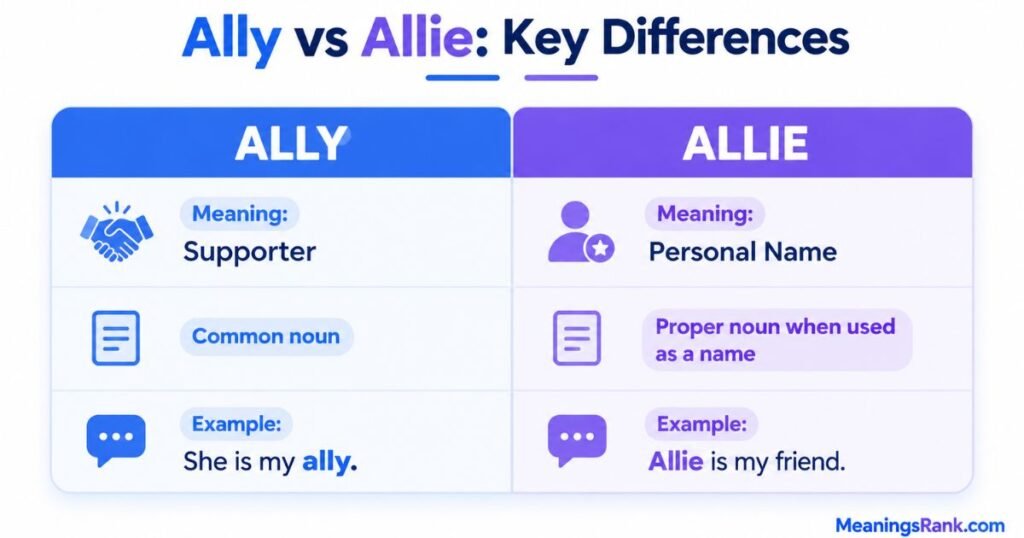
Now that both words have been defined, let’s compare them across four areas that matter to writers and readers.
Meaning and Definition
| Feature | Ally | Allie |
| Type of word | Common noun and verb | Proper noun (name) |
| Core idea | Support, cooperation, partnership | A person’s identity |
| Dictionary entry? | Yes | Usually in name dictionaries, not standard dictionaries |
| Has synonyms? | Yes (supporter, partner, backer) | No true synonyms |
| Opposite | Enemy, opponent | None |
Ally describes a relationship. Allie identifies a person.
Spelling and Grammar
The spelling difference is -y versus -ie. That tiny change carries large grammatical consequences.
| Grammar Point | Ally | Allie |
| Capitalization | Lowercase (except sentence start or “the Allies”) | Always capitalized |
| Plural | allies | Allies (when naming several people called Allie) |
| Possessive singular | ally’s (an ally’s support) | Allie’s (Allie’s notebook) |
| Possessive plural | allies’ (the allies’ plan) | Allies’ (the Allies’ party, rare) |
| Verb use | Yes (to ally, allied, allying) | No |
| Takes articles | Yes (an ally) | Rarely |
One tricky point: the plural allies is spelled the same for both words. “The allies met” could refer to supporters, and “the two Allies met” could refer to two women named Allie. Context and capitalization separate them. For the name, the plural is unusual, so most writers avoid it.
Pronunciation
Pronunciation is where the confusion starts.
- Ally (noun): AL-eye, with stress on the first syllable.
- Ally (verb): uh-LYE, with stress on the second syllable.
- Allie: AL-ee, with stress on the first syllable.
The noun ally and the name Allie share a beginning, AL-, but they end differently: -eye versus -ee. In fast speech, listeners sometimes blur the two. And here is the twist: the person named Ally (spelled with a y) is usually pronounced AL-ee, exactly like Allie, not AL-eye. So the spelling of a name does not predict its sound. When you are unsure, ask how the person says it.
Usage in Everyday English
You will meet ally in news reports, workplace policies, history lessons, and conversations about friendship or advocacy. It is a flexible, high-frequency word in both formal writing and casual speech.
You will meet Allie in emails, text messages, class lists, social media posts, and fiction. It is rarely used in formal prose except as someone’s name.
How to Use Ally in a Sentence
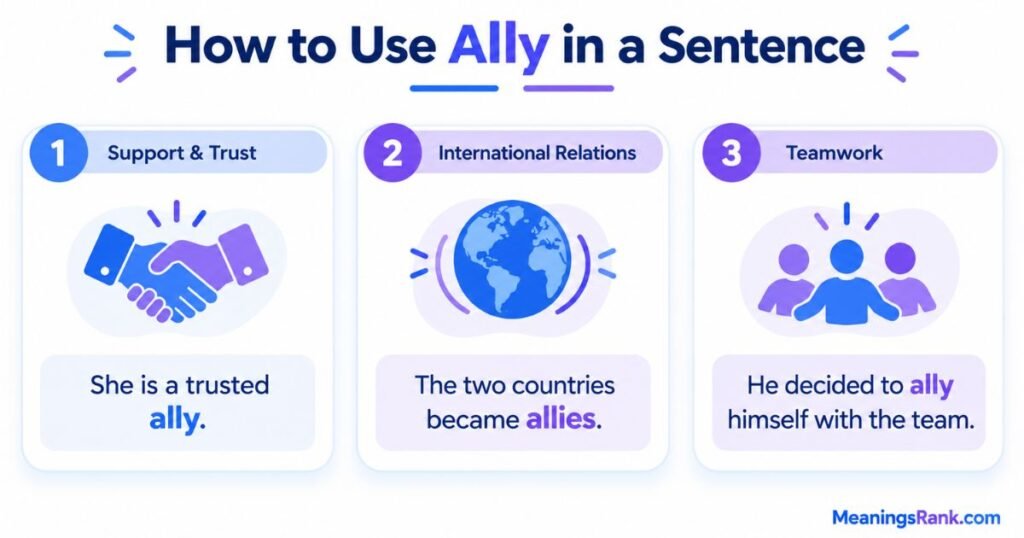
A good test of understanding is the ability to build your own sentences. Here are examples of ally in several grammatical positions.
As a noun (subject):
- An ally listens before she advises.
- Our strongest ally in the budget talks was the finance director.
As a noun (object):
- The senator found an unexpected ally in her rival.
- Every new teacher needs a mentor and an ally.
With adjectives:
- He remained a faithful ally throughout the dispute.
- The coach turned out to be a powerful ally.
As a verb:
- The smaller companies decided to ally with a larger partner.
- Several nations allied against the invasion.
- She has allied herself with the school’s reform group.
In the plural:
- The country’s allies pledged financial aid.
- Allies of the proposal spoke first at the meeting.
In the advocacy sense:
- As an ally, he made sure quieter voices were heard in meetings.
- Being an ally means showing up consistently, not only when it is easy.
How to Use Allie in a Sentence
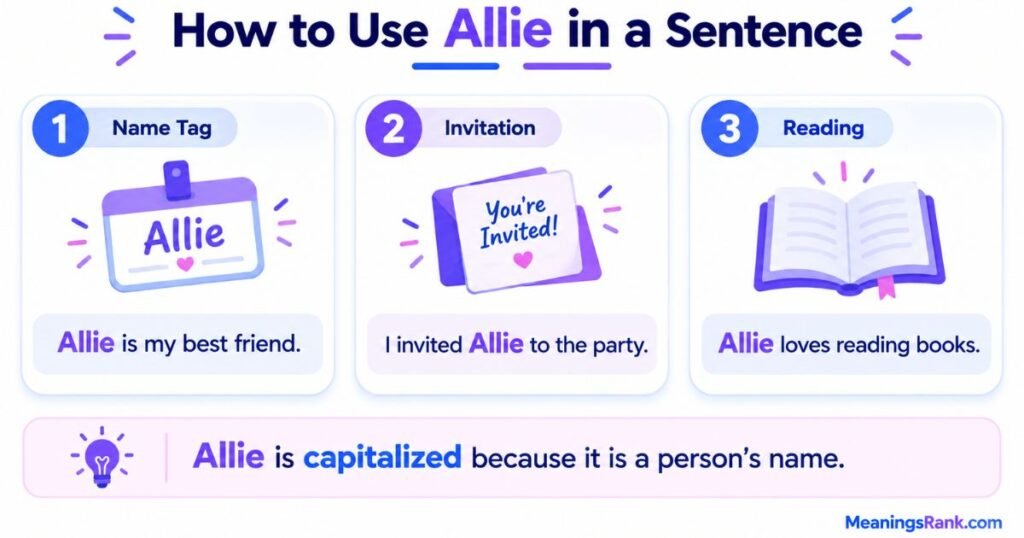
Allie behaves like any other personal name. It can serve as a subject, object, possessor, or someone being addressed.
As a subject:
- Allie wrote the first draft of the report.
- Allie and Marcus moved to Toronto in June.
As an object:
- The manager thanked Allie for her patience.
- Everyone invited Allie to the celebration.
Possessive:
- Allie’s presentation impressed the entire board.
- We borrowed Allie’s car for the weekend.
Direct address (with commas):
- Allie, could you send me the file?
- Thanks for your help, Allie.
In dialogue:
- “Where is Allie?” asked her mother.
- “I trust Allie more than anyone,” he said.
Punctuation tip: when you speak directly to someone, set off the name with commas, as in the examples above. A missing comma is one of the most common errors in emails. Compare Let’s eat Allie with Let’s eat, Allie. The comma changes the meaning completely.
Ally vs Allie Examples in Real-Life Sentences
Let’s look at both words working in real settings: workplace emails, school writing, news-style sentences, and social media.
| Setting | Correct Sentence | What It Shows |
| Workplace email | Allie has been a strong ally for our new hires. | Name plus role in one sentence |
| School essay | Britain and France were allies in the First World War. | Plural noun, lowercase |
| History textbook | The Allies launched the invasion in 1944. | Capitalized group name |
| News report | The president thanked his closest ally for its support. | Noun for a nation |
| Text message | Allie says she’ll be late. | Personal name |
| Social media | Proud to be an ally. Thanks, Allie, for the reminder. | Both words, correctly used |
| Business writing | The startup will ally with a logistics firm. | Verb use |
| Fiction | Allie looked across the room, unsure if she had found a friend or an ally. | Name and noun together |
Transformation examples (incorrect to correct):
| Incorrect | Correct | Reason |
| She is my best Allie. | She is my best ally. | Describes a role, so common noun |
| I met ally at the cafe. | I met Allie at the cafe. | Names a person, so capitalize and use -ie |
| The countries will allie with each other. | The countries will ally with each other. | Verb form has no “-ie” |
| Allies’s book was late. | Allie’s book was late. | Possessive of a singular name |
| Thank you, ally, for the gift. | Thank you, Allie, for the gift. | Direct address to a person |
Common Grammar and Spelling Mistakes
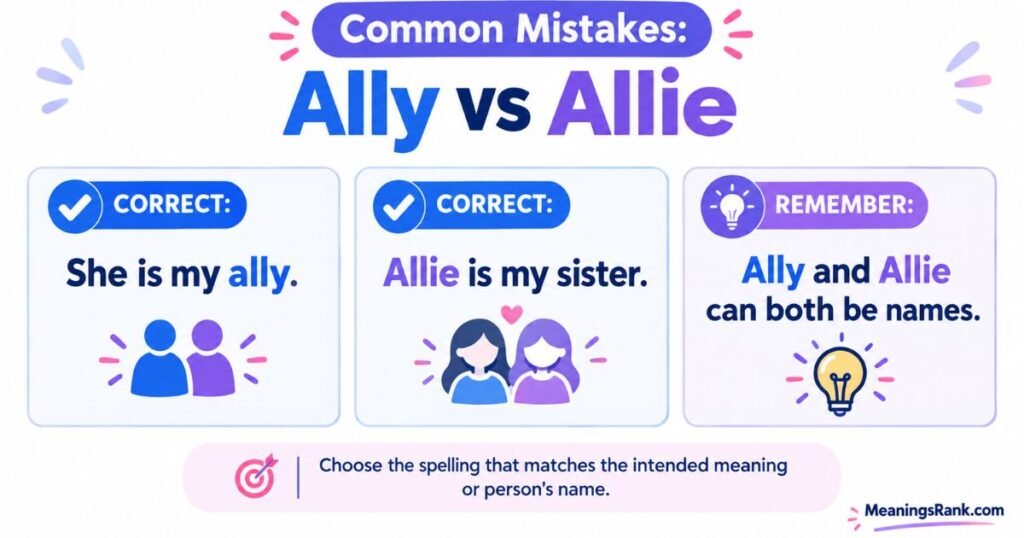
Even careful writers slip with these two words. Here are the most frequent errors, with fixes.
1. Using “Allie” as the common noun:
Wrong: Germany and Italy were allies in the war, and Japan was another Allie. Right: …and Japan was another ally. The name has no dictionary meaning of “supporter.”
2. Forgetting to capitalize the name:
Wrong: ally and I are going to the library. Right: Allie and I are going to the library. A proper noun starts with a capital letter. Writing it lowercase is a mechanical error, and it also invites the first mistake above.
3. Capitalizing “ally” for no reason:
Wrong: He is a strong Ally of the community. Right: He is a strong ally of the community. Only capitalize at the beginning of a sentence, in a title, or in the historical group name the Allies.
4. Using the wrong verb form:
Wrong: The two parties decided to allie. Right: The two parties decided to ally. There is no verb allie. The verb forms are ally, allies, allied, allying.
5. Confusing plural and possessive:
Wrong: The allies plan was approved. Right: The allies’ plan was approved. Wrong: Allies bag is here. Right: Allie’s bag is here. Plural nouns do not take an apostrophe, but possessives do. This is a punctuation and subject-verb agreement issue worth checking in every draft.
6. Correcting someone’s name:
If a person spells her name Ally, Allie, or Ali, use exactly that spelling. Do not auto-correct it. Treat it as a style guide rule for respectful writing.
Read More: Cocoon or Cacoon: Which Is the Correct Spelling? (2026)
Key Exceptions to Keep in Mind
A few edge cases rarely get attention, and they are where even strong writers stumble.
- A person named Ally. The spelling matches the common noun, yet it is still a name. Capitalize it, and do not treat it as a typo of Allie. Ally is organizing the fundraiser is correct if the person’s name is Ally.
- “The Allies.” In history, a capital letter marks a specific group (the Allied Powers of the World Wars). In general writing, use lowercase allies.
- Plural names. If two women named Allie attend a party, you might write the two Allies. This is correct but looks identical to the historical group name, so rephrase if clarity suffers: both women named Allie.
Quick Memory Trick / Mnemonic Device
Here are three easy tricks.
1. The “Y is for Your supporter” trick. Ally ends in y, like “supporter by your side.” If the word describes someone helping you, choose the y spelling.
2. The “IE is Individual Everyone knows” trick. Allie ends in ie, like a person’s name such as Katie, Josie, or Evie. Many short names end in -ie. If it fits that pattern, it is a name.
3. The “Replace it” test. Swap the word for “friend” or “partner.” If the sentence still works, use ally. If you swap in “Sarah” or “Maria” and the sentence still works, use Allie.
Why Do People Confuse Ally and Allie?
The confusion comes from several overlapping causes.
They sound similar:
The first syllable is identical, and in fast speech the endings blur together. Listeners who rely on sound often guess the spelling.
Autocorrect and predictive text:
Phones and word processors may change ally to Allie, or the other way round, depending on your contact list and typing history. If you have a friend named Allie in your contacts, your phone may start suggesting her name where you meant the common word.
Name spelling is flexible:
Because the same name appears as Ally, Allie, Alley, and Ali, people assume spellings are interchangeable across the board. For names, spelling choices belong to the individual. For common words, spelling is fixed by dictionaries.
Understanding the cause helps you catch the error. If you tend to write by ear, pause at these two words and check the sentence role before you finalize your draft.
When Should You Use Ally vs Allie?
Use this short decision guide.
Use ally when:
- You are describing someone who supports, helps, or cooperates with you or others.
- You need a verb meaning “to unite” or “to join forces.”
- You are writing about nations, organizations, or groups in a partnership.
- You are discussing advocacy or social support (an ally to colleagues).
- You need the plural allies for supporters or partners.
Use Allie when:
- You are naming a specific person.
- The word should be capitalized wherever it appears.
- You are addressing someone directly (Thanks, Allie).
- You are writing a character in fiction, a username, or a signature.
- The person has told you that this is the spelling of her name.
A three-step checklist:
- Ask: Does this word name a person or describe a role?
- Test: Can I replace it with “supporter” or “partner”? If yes, use ally.
- Verify: If it is a name, am I using the spelling the person prefers?
When two meanings appear together in one sentence, treat each word separately. Allie is an ally to every new student is a perfect sentence. The name does one job, the common noun does another.
Quick Reference Table: Ally vs Allie

| Feature | Ally | Allie |
| Part of speech | Noun and verb | Proper noun |
| Meaning | Supporter, partner; to unite | Given name (often a short form of Alexandra, Alison, Alice) |
| Capital letter? | No (except the Allies, or at the start of a sentence) | Always |
| Pronunciation | AL-eye (noun), uh-LYE (verb) | AL-ee |
| Plural | allies | Allies (rare) |
| Possessive | ally’s / allies’ | Allie’s |
| Verb forms | ally, allies, allied, allying | None |
| Synonyms | supporter, partner, backer, associate | None |
| Example | She is a loyal ally. | Allie is a loyal friend. |
| Origin | Old French alier, Latin alligare (“to bind to”) | Diminutive of various given names |
| Where you see it | News, history, workplaces, advocacy | Emails, fiction, social media, school lists |
Tips to Remember the Difference Between Ally and Allie
Memory works best when you attach a rule to a picture. Try these methods.
1. Link the letters to the meaning:
In ally, the final y looks like a person raising both arms, a gesture of support. Picture someone standing beside you with arms up in your defense.
2. Use the substitution test:
Put “supporter” in the sentence. If it works, write ally. Put a different name such as “Maya” in the sentence. If it works, write Allie.
Practice Quiz: Ally vs Allie
Choose ally, allies, allied, or Allie to complete each sentence. Cover the answer key at the bottom while you work.
1. My sister’s best friend, ________, is coming over for dinner tonight.
2. The two small nations decided to ________ with their larger neighbor.
3. A good teacher is a student’s biggest ________ in the classroom.
4. “Thanks for the ride home, ________,” said Marcus.
5. The history exam asked us to explain how the ________ coordinated their efforts in the war.
6. She has ________ herself with several local charities.
7. ________’s report was the clearest in the entire department.
Answer Key
- Allie. It names a specific person, so capitalize it.
- ally. This is the verb form, followed by with.
- ally. It describes a supporter, so use the common noun.
- Allie. Direct address to a person, set off with a comma.
- Allies. The capitalized historical group name for the World War powers. (Lowercase allies is accepted in general contexts, but the capital fits this exam setting.)
- allied. Past participle of the verb to ally, used with has.
- Allie. A person’s name used in the possessive form, so Allie’s.
Score yourself: 6 to 7 correct means you have mastered the difference. Fewer than 6? Review the Common Grammar and Spelling Mistakes section and retry tomorrow.
Frequently Asked Questions (FAQs)
What is the difference between ally and Allie?
Ally is a common word meaning a supporter or partner, and it can also be a verb meaning “to unite.” Allie is a proper noun used as a person’s name, often short for Alexandra, Alison, or Alice. One describes a role. The other identifies a person.
Is Allie ever the correct spelling for the word meaning supporter?
No. The standard spelling of the word meaning “supporter” or “partner” is ally. Using Allie in that sense is a spelling error. The only time Allie appears is when you mean the name.
Is Ally a name too, or only a common word?
Both. Ally is a common word, but it is also used as a given name, usually pronounced AL-ee. When it is a name, capitalize it and keep the spelling the person uses. Ally Brooke and the character Ally McBeal are examples of names spelled this way.
How do you pronounce ally and Allie?
The noun ally is pronounced AL-eye, with the stress on the first syllable. The verb ally is pronounced uh-LYE, with the stress on the second syllable. The name Allie is pronounced AL-ee. A person named Ally (spelled with a y) usually says her name AL-ee as well.
What is the plural of ally and Allie?
The plural of ally is allies: change the y to i and add -es. The plural of Allie is also Allies, but it is rare and appears only when you mean more than one person with that name. If the context is unclear, rephrase to avoid confusion.
Final Thoughts
Ally and Allie sound almost the same, but they do very different jobs. Ally is a common noun or verb that describes support and partnership, and Allie is a capitalized personal name. Check the sentence role, use the substitution test, and watch your capitalization, and you will choose correctly every time.
Keep the quick reference table nearby, practice with the quiz, and share the memory tricks with a friend who struggles with the same mix-up. Clear writing grows from small, careful choices, and this is one you can now make with confidence.