
You type a quick greeting, and your cursor hovers. Is it “good morning” or “goodmorning”? It looks like a tiny question, yet it trips up students, professionals, and bloggers every day.
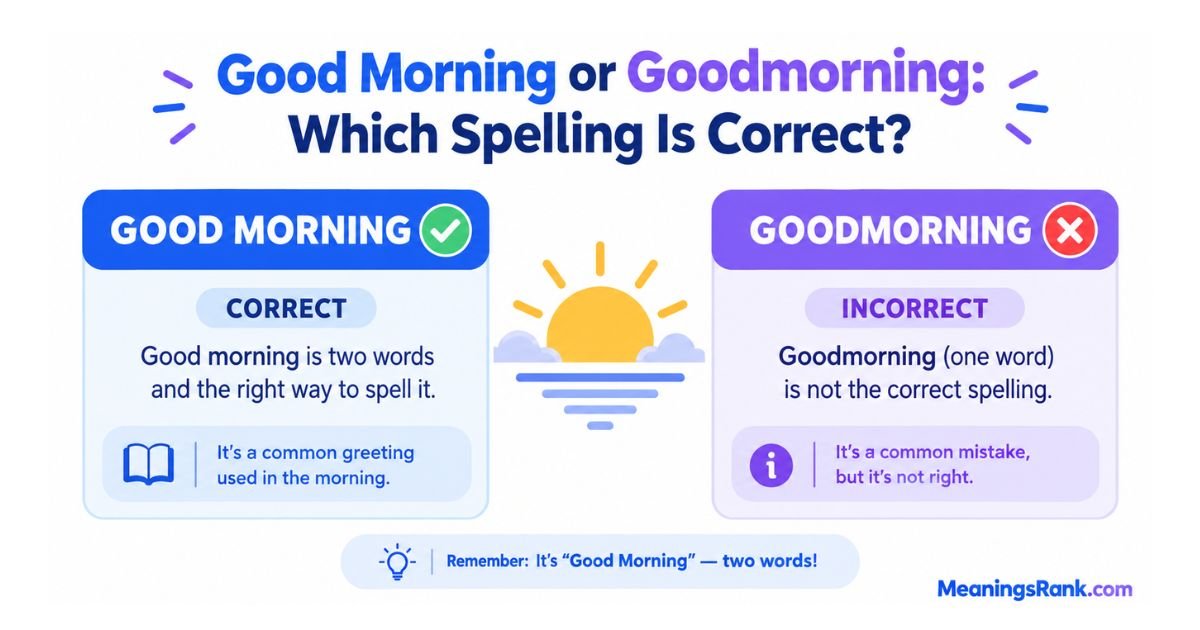
The answer is simple: write it as two words. The confusion comes from social media, where hashtags and usernames squash everything together, and from words like “goodbye” that really are one word. Getting this right matters. A single spacing slip in a cover letter, client email, or school assignment can make careful writing look careless. In this guide, you will learn the rule, the reasoning behind it, and the few cases where the one-word form is fine.
Quick Answer: Good Morning or Goodmorning?
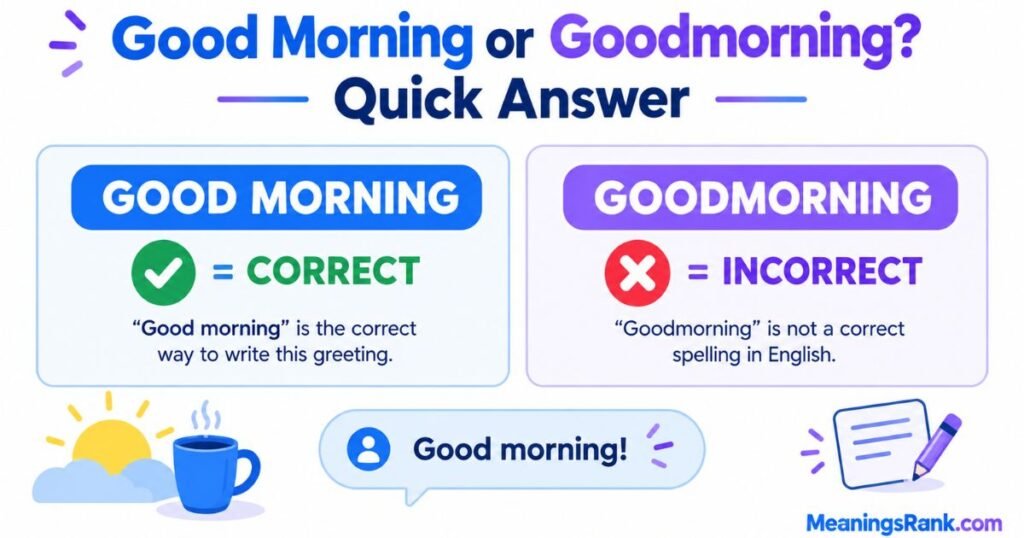
“Good morning” is the correct spelling. It is two separate words: the adjective good followed by the noun morning. “Goodmorning” as one word is not recognized by major dictionaries or style guides, so it counts as a spelling error in standard writing. The only time you will see it is in usernames, hashtags, and brand names, where spaces are not allowed.
| Form | Status | Use It In |
| Good morning | Correct | Everything: emails, essays, letters, texts, captions |
| Goodmorning | Incorrect in standard English | Only usernames, hashtags, or brand names |
| Good-morning | Correct (hyphenated) | As a compound modifier, e.g., “a good-morning hug” |
What Does “Good Morning” Actually Mean?
“Good morning” is a greeting used from the moment you wake up until roughly noon. When you say it, you are wishing the other person a pleasant start to the day. It is a short, polite way of saying, “I hope your morning goes well.”
Grammatically, it works as an interjection or a greeting formula. It stands apart from a full sentence. You do not need a subject or a verb to make it complete. Nobody says, “I wish you a good morning” anymore, but that longer sentence is exactly where the phrase came from. Over centuries, speakers trimmed the wish down to its two most important words.
The phrase can also work as a noun phrase in a sentence. Consider this example: She gave the whole office a cheerful good morning. Here, “good morning” is the object of the verb gave. It is still two words, and it still carries the same warm meaning.
Read More: Choosing vs Chosing: The Correct Spelling, Meaning & Examples
Why Is “Good Morning” Written as Two Words?
The answer comes down to syntax. English greetings built around the time of day follow a consistent pattern: an adjective plus a noun. You will notice it in good afternoon, good evening, good night, and good day. Each one is a modifier paired with a noun, and each one is written with a space.
English does merge some words into single units when they have fused over time and their meaning has shifted. Goodbye is the classic example. It began as the phrase “God be with ye,” and the pieces collapsed together until the original meaning faded. Dictionaries eventually listed it as one word.
“Good morning” never went through that fusion. Its two parts still mean exactly what they mean on their own. A morning is good, and you are wishing it on someone. Because the meaning is fully transparent, there is no linguistic reason to close the gap between the words.
Style guides back this up. Major references such as the Chicago Manual of Style, the AP Stylebook, and the Oxford and Merriam-Webster dictionaries all treat “good morning” as an open compound, meaning two words with a space. None of them lists “goodmorning” as an accepted variant.
Good Morning vs. Goodmorning: Key Differences
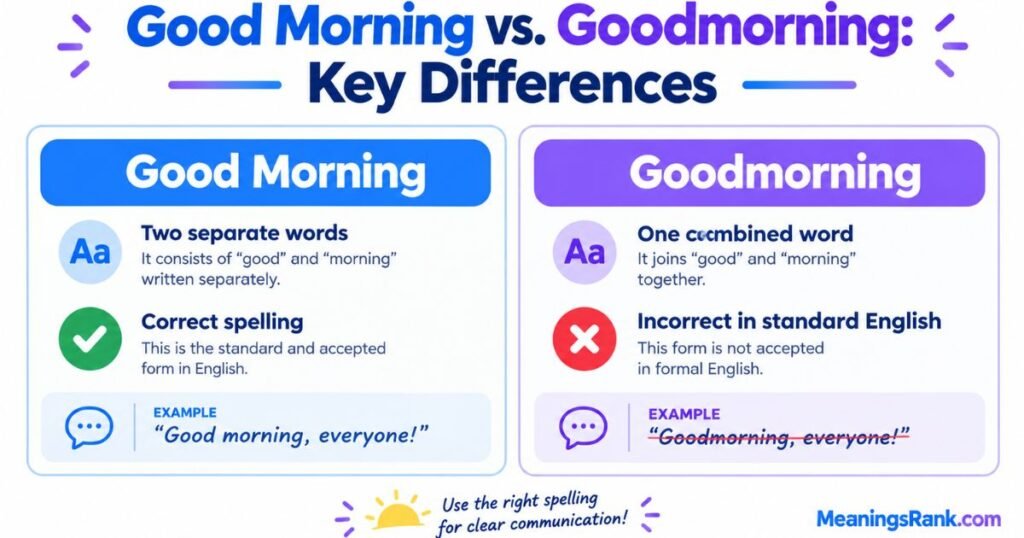
The differences are small on the page, but they matter for credibility. Here is a side-by-side comparison.
| Feature | Good Morning | Goodmorning |
| Spelling status | Standard, dictionary-approved | Non-standard |
| Word count | Two words | One word |
| Part of speech | Greeting / interjection | Not recognized |
| Appears in style guides | Yes | No |
| Accepted in formal writing | Yes | No |
| Typical setting | Speech, emails, letters, captions | Usernames, hashtags, informal typing |
| Autocorrect reaction | No flag | Usually flagged or split |
There is one more difference worth knowing: hyphenation. When “good morning” works as an adjective before a noun, many writers add a hyphen. He sent her a good-morning text. Here the two words team up to modify “text,” so the hyphen links them. This is standard punctuation for compound modifiers, and it is different from the one-word error.
Is “Goodmorning” Ever Acceptable?
Short answer: not in standard writing. But language lives in more places than textbooks, so let’s look at where “goodmorning” appears and whether it is acceptable there.
Usernames and handles:
Platforms often ban spaces. A person named after a morning show might pick “goodmorning” or “goodmorning_jess” because they have no choice. That is a technical constraint, not a grammar choice.
Hashtags:
Hashtags cannot contain spaces, so #goodmorning is perfectly functional. In this setting, the single-word format is the convention. Capitalizing each word, as in #GoodMorning, helps readability and screen readers.
Brand and product names:
A company can name a cereal, app, or newsletter “Goodmorning” on purpose. Brand names follow their own rules and are not judged as spelling errors.
The rule of thumb:
if a space is technically impossible, “goodmorning” is a reasonable workaround. If a space is possible, use it. In essays, business emails, school assignments, cover letters, and published content, always write two words.
“Good Morning” Across Different Writing Contexts
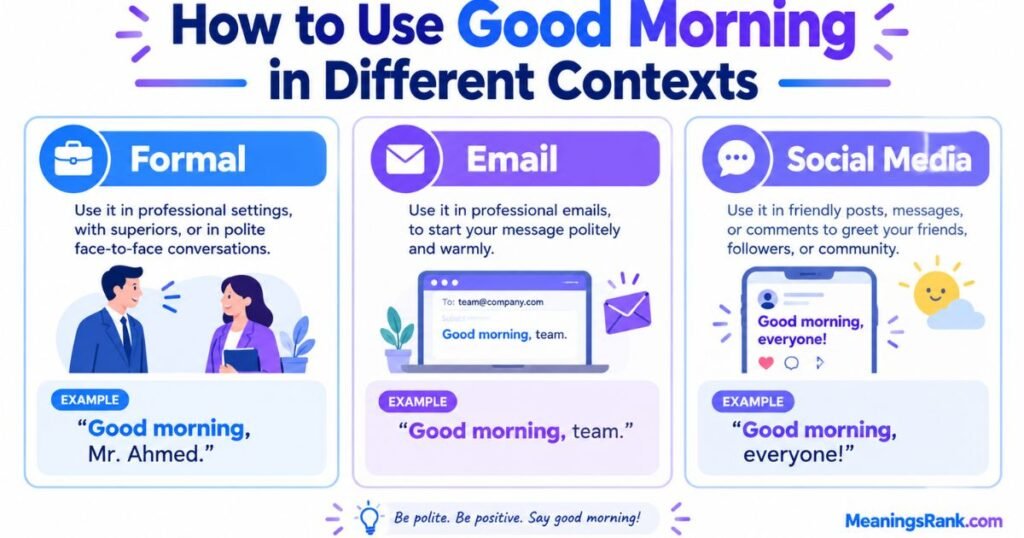
The spelling never changes, but punctuation, capitalization, and tone shift depending on where you write the phrase. Let’s walk through three common settings.
Good Morning in Formal Writing
In formal documents, the phrase usually appears in speeches, scripts, letters, and opening remarks. Capitalize “Good” when it begins a sentence or a salutation. Place a comma after the greeting when you address someone directly.
- Good morning, Dr. Rahman.
- Good morning, ladies and gentlemen.
- Good morning, Professor Lee. Thank you for meeting with me.
Never write “goodmorning” in an academic paper, press release, legal document, or professional report. Style guide rules leave no room for it.
Read More: Studder vs Stutter: Correct Spelling, Meaning & Key Differences (2026)
Good Morning in Emails and Messages
Emails sit in the middle ground. They are professional but conversational. Both of these patterns are correct:
- Good morning, Sara,
- Good morning Sara, (the comma is often dropped in casual email, though most style guides prefer it)
When you open an email with “Good morning,” capitalize only the first word. “Morning” stays lowercase unless it ends up at the start of a sentence. So Good Morning, Sara with both words capitalized is considered overcapitalized in standard usage, though you will see it in subject lines styled as titles.
In text messages and chat apps, a shortened “morning!” is natural and fine. It drops the “good” but keeps the meaning, much like saying “Evening!” at a party.
Good Morning in Social Media Posts
Social media is where spelling gets flexible. Captions, tweets, and stories often use casual forms:
- Good morning, everyone! Coffee first, then chaos.
- Good morning ☀️ New week, fresh start.
- #GoodMorning #MondayMotivation
The caption itself should still use two words. The hashtag is the single-word exception because it must be. If your brand cares about polish, keep the visible caption standard and let the hashtag carry the compressed form.
Good Morning or Goodmorning: Real-Life Examples
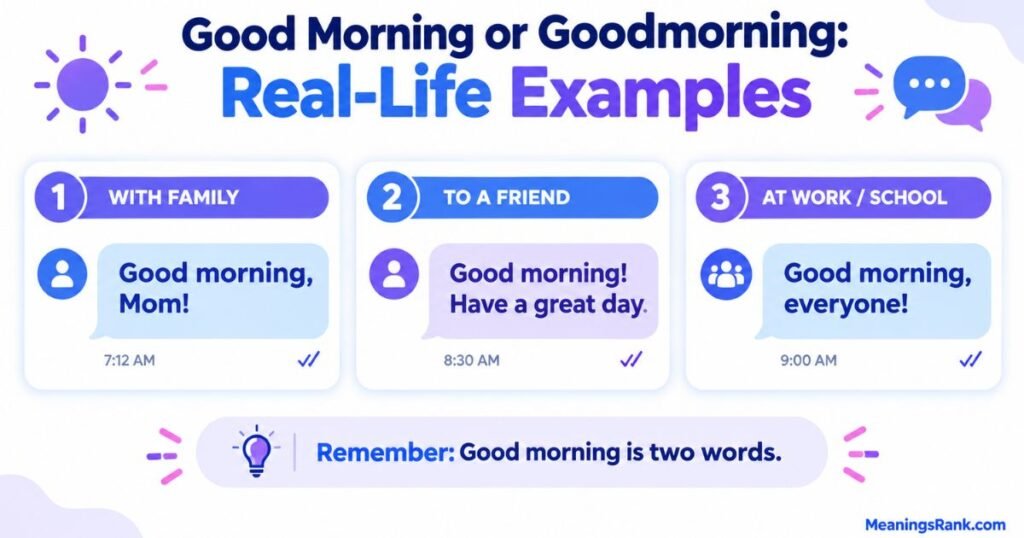
Seeing the phrase in context makes the rule stick. Here are correct and incorrect versions across typical situations.
| Situation | Correct | Incorrect |
| Classroom greeting | Good morning, class. | Goodmorning, class. |
| Email opener | Good morning, Ms. Ahmed, | Goodmorning Ms. Ahmed, |
| Speech opening | Good morning, everyone, and welcome. | Goodmorning everyone, and welcome. |
| Text to a friend | Good morning! Ready for today? | Goodmorning! Ready for today? |
| Phone call | “Good morning, this is Ali speaking.” | “Goodmorning, this is Ali speaking.” |
| Compound modifier | She sent a good-morning message. | She sent a goodmorning message. |
| Instagram caption | Good morning from the mountains! | Goodmorning from the mountains! |
| Hashtag | #GoodMorning | (Acceptable, because spaces are not allowed) |
Common Mistakes Writers Make with “Good Morning”
Even careful writers slip up. These are the errors that show up most often, along with the fix for each.
1. Writing it as one word. This is the headline mistake. The fix is easy: add the space.
2. Capitalizing “Morning” mid-sentence. Writers sometimes capitalize both words out of habit. In running text, only “Good” gets a capital, and only when it opens a sentence. I told her good morning. is correct. I told her Good Morning. is not.
3. Forgetting the comma in direct address. When you name the person you are greeting, a comma separates the greeting from the name. Good morning, Zara. beats Good morning Zara. in formal writing, because the name is a noun of direct address.
4. Confusing “good morning” with “good mourning.” This homophone mix-up is rare but it happens. Mourning means grieving. Morning is the part of the day. Spell checkers will not catch it, because both are real words.
5. Dropping the hyphen in compound modifiers. A good morning routine is fine, since “good” modifies “morning routine.” But a good-morning kiss needs the hyphen because the phrase works as a single descriptive unit. Hyphenation depends on meaning and structure, so read the sentence carefully.
Quick Memory Trick:
Picture a gap between a sunrise and a coffee mug. Good is the sunrise, morning is the mug, and there is always a gap between them. Or use this rule: “If you can say each word alone, keep the space.” You can say “good” alone and “morning” alone, so they stay separate. “Goodbye” is the odd one out, because its parts fused long ago and no longer mean what they once did.
Key Exception to Remember:
The only legitimate one-word forms are usernames, hashtags, domain names, and brand names. Everywhere else, two words.
Interactive Practice Quiz
Fill in each blank with the correct form. Choose between good morning, Good morning, good-morning, or goodmorning.
- The teacher walked in and said, “______, everyone.”
- She left a sweet ______ note on his desk.
- On Instagram, Maya used the hashtag #______ because spaces are not allowed.
- I wished my manager ______ before the meeting began.
- The email began, “______, Mr. Hussain,” followed by the main request.
Answer Key
- Good morning (capitalized at the start of the quoted sentence)
- good-morning (compound modifier before “note”)
- goodmorning or GoodMorning (hashtag exception)
- good morning (lowercase mid-sentence, two words)
- Good morning (capitalized as the opening of the email)
Read More: Hola vs Ola: Discover the Correct Spelling, Meaning & Usage (2026)
How Do Different Generations and Cultures Say Good Morning?
Greetings reflect age, region, and habit. The English spelling stays fixed, but the way people use it changes quite a bit.
Generational habits:
Older speakers tend to favor the full “Good morning,” often paired with a name or title. Millennials mix it with emoji and exclamation marks. Gen Z frequently shortens it to “morning” or “gm,” and many send it as a voice note or sticker instead of typing it. None of this changes the standard spelling. It only changes how often the full phrase appears.
Greetings around the world:
Many languages build their morning greetings from a similar “good + morning” pattern, which is part of why the English phrase feels so natural.
| Language | Morning Greeting | Literal Idea |
| Spanish | Buenos días | Good days |
| French | Bonjour | Good day |
| German | Guten Morgen | Good morning |
| Italian | Buongiorno | Good day |
| Arabic | Sabah al-khayr | Morning of goodness |
| Urdu | Subah bakhair | Morning with goodness |
| Hindi | Suprabhat | Good dawn |
| Japanese | Ohayō gozaimasu | It is early (polite) |
| Mandarin Chinese | Zǎo ān | Morning peace |
| Swahili | Habari ya asubuhi | News of the morning |
Notice that German “Guten Morgen” is written as two words, just like the English version. That is a helpful parallel for learners who speak both languages.
FAQs
Is it “good morning” or “goodmorning”? “
Good morning” is correct. It is two words, made of the adjective good and the noun morning. “Goodmorning” is non-standard and appears only in usernames, hashtags, and brand names.
Why isn’t “goodmorning” one word like “goodbye”? “
Goodbye” developed from “God be with ye,” and its parts fused until the original meaning disappeared. “Good morning” still means exactly what each word says, so it never merged into a closed compound.
Do you capitalize “morning” in “good morning”?
Only capitalize “Good” when the phrase begins a sentence or salutation. “Morning” stays lowercase. In the middle of a sentence, write both words in lowercase: I said good morning to her.
Should there be a comma after “good morning”?
Yes, when you address someone by name. Good morning, Aisha. The comma sets off the name as direct address. Without a name, no comma is needed: Good morning!
Is “good-morning” with a hyphen ever correct?
Yes. When the phrase acts as a compound modifier before a noun, a hyphen is appropriate. She received a good-morning text. Used as a plain greeting, it takes no hyphen.
Conclusion
The rule is simple: write “good morning” as two words every time. Save the single-word form for hashtags, usernames, and brand names, where a space is not possible. Check your capitalization, add a comma before a name, and use a hyphen only when the phrase modifies a noun. Follow these steps and your greetings will look polished in any email, essay, or post.