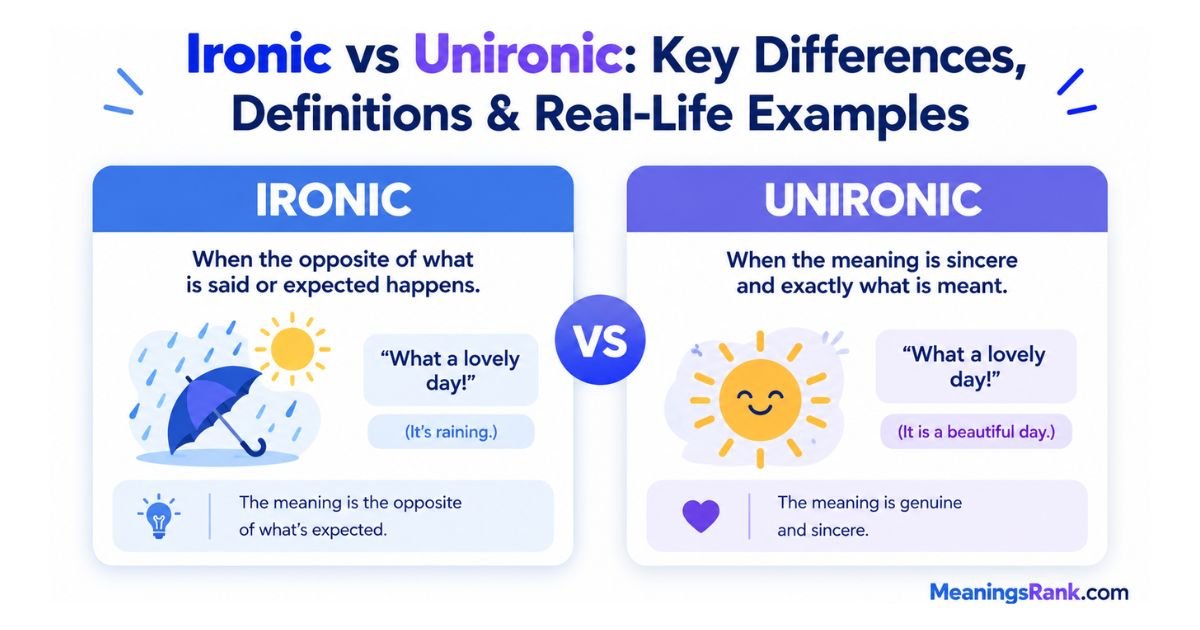

Few word pairs cause as much quiet confusion as ironic and unironic. One sounds sophisticated, the other sounds like it was invented on the internet, and both get used in ways that make grammar teachers wince. This guide sorts it all out. You will find plain definitions, side-by-side comparisons, real-life examples, a look at how the words behave in everyday speech and online, and a practice quiz at the end.
Ironic vs Unironic: Quick Answer
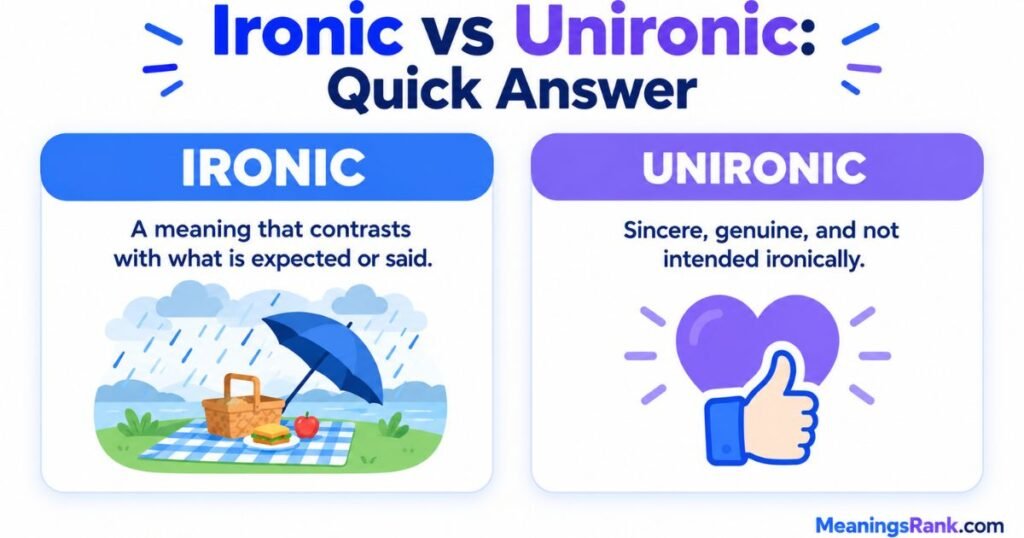
Ironic describes something that involves irony. That means one of two things: a situation where the outcome is the opposite of what anyone expected, or a statement where the speaker means something different from (usually the reverse of) the literal words.
Unironic describes something that lacks irony. It is sincere, straightforward, and means exactly what it says.
Here is the shortest possible demonstration:
- “Great weather,” she said, shivering in the freezing rain. (Ironic: the words say one thing, the meaning is the opposite.)
- “Great weather,” she said, smiling in the warm sunshine. (Unironic: the words and the meaning match.)
| Feature | Ironic | Unironic |
| Core idea | Meaning differs from the surface | Meaning matches the surface |
| Tone | Wry, playful, critical, or surprising | Sincere, earnest, literal |
| Typical use | Jokes, commentary, literature, observing a twist of fate | Honest praise, real feelings, plain statements |
| Opposite of | Sincere | Ironic |
If you only remember one thing, remember this: ironic means “there is a gap between what seems true and what is true,” and unironic means “no gap at all.”
What Does Ironic Mean?
Ironic is an adjective. It comes from the noun irony, which traces back through Latin to a Greek word for a person who pretended ignorance, often to make a point. That ancient root still explains the modern meaning well. Irony involves a distance between appearance and reality.
The Core Definition
Dictionaries generally describe ironic in two connected ways.
1. Expressing the opposite of what you mean. A person speaks in a way that signals one meaning on the surface and another underneath. If you watch a friend drop a full plate of food and say, “Smooth move,” the sentence is ironic. The words praise skill, but the meaning points to clumsiness.
2. Happening in a way that contradicts expectations. An event unfolds in a manner that is the reverse of what would be natural or fitting. A fire station burning down is ironic. A marriage counselor who files for divorce is ironic. A dentist who avoids dentists is ironic.
The common thread is incongruity. Something does not line up, and the mismatch carries meaning, humor, or a sting.
How Ironic Works in a Sentence
Because ironic is an adjective, it sits in typical adjective positions. It can come before a noun or after a linking verb.
- Her ironic smile told me she disagreed completely. (before a noun)
- It is ironic that the lifeguard needed rescuing. (after a linking verb, with a clause explaining the irony)
- His praise was ironic, not genuine. (predicate adjective)
Notice the second example. A very common pattern is “It is ironic that…” followed by a clause that states the twist. The adjective ironic works as the main predicate, and the that-clause supplies the content.
What Ironic Is Not
Three misunderstandings turn up again and again.
First, ironic does not simply mean “coincidental.” Two people with the same birthday meeting at a party is a coincidence. It becomes ironic only if there is some reversal or contradiction in the situation.
Second, ironic does not simply mean “unfortunate.” A flat tire is bad luck. A flat tire on the way to a tire-safety conference starts to look ironic.
Third, ironic does not simply mean “funny.” Irony can be funny, but it can also be tragic, bitter, or deeply serious. Some of the most famous ironic moments in literature are heartbreaking.
What Does Unironic Mean?
Unironic is the plain, negative counterpart. The prefix un- means “not,” so unironic literally means “not ironic.”
The Core Definition
An unironic statement, attitude, or action is sincere. The person means what they say or do, with no hidden second layer, no wink, and no performance of detachment. If someone says, “I love this song,” and they truly love the song, that remark is unironic.
The word works in two ways.
1. Describing sincerity in speech or behavior. Her unironic enthusiasm for tax law made the room smile. She is not joking. She is genuinely enthusiastic.
2. Describing something free of irony in its structure or design. The film is an unironic tribute to old westerns. It is not a parody and does not mock its source. It means its admiration sincerely.
Why a Word Like Unironic Even Exists
Plenty of English adjectives have no common negative form. So why did unironic take off? Part of the answer is cultural. In many modern settings, especially online, ironic detachment became the default tone. People joked, mocked, and exaggerated so often that sincerity started to need its own label. If everything might be a joke, you need a way to say, “No, this time I mean it.” Unironic fills that gap.
Unironic vs Nonironic
You may also see nonironic or non-ironic. These forms exist and appear in academic and technical writing, but unironic is more common in everyday English and in most style-conscious publishing. Choose one and stay consistent within a document.
Unironic Does Not Mean Boring
A common worry is that unironic writing sounds flat. It does not have to. Sincerity can be vivid, warm, and powerful. Think of a heartfelt thank-you note or an earnest speech at a wedding. The writer is not hiding behind a clever twist. They are standing in front of it.
Read More: Grately vs Greatly: The Ultimate Guide to Correct Spelling and Usage
Ironic vs Unironic: Key Differences
The two words are opposites, yet the practical differences show up in several distinct areas. Looking at each area separately makes the contrast easier to remember.
1. Meaning and Intent
An ironic statement carries two layers: what is said and what is meant. The listener must notice the gap. An unironic statement carries one layer. What you hear is what you get.
2. Tone and Delivery
Irony often leans on tone of voice, facial expression, context, or punctuation to signal the second meaning. A flat, deadpan delivery can make a remark ironic. Unironic speech usually arrives with an open, matching tone. The voice supports the words instead of undercutting them.
3. Relationship With the Audience
Irony is a shared secret. It asks the audience to be in on the joke or the critique. If they miss it, communication breaks down. Unironic speech makes no such demand. It works for anyone who understands the literal words.
4. Emotional Effect
Irony can create humor, distance, tension, or critique. Sincerity creates trust, warmth, and directness. Neither is better in every situation. The right choice depends on purpose and audience.
5. Risk of Misreading
Irony is more likely to be misunderstood, particularly in text, where voice and gesture vanish. A sincere remark is rarely misread as a joke, but in ironic-heavy spaces even honest words can be doubted.
6. Grammar and Word Behavior
Both words are adjectives, and each has an adverb form: ironically and unironically. Their syntax is identical. The difference lies in meaning, not in sentence structure. We will look closely at this in the grammar section below.
Ironic vs Unironic Side-by-Side Comparison
Use this table as a quick reference when you are editing or studying.
| Category | Ironic | Unironic |
| Part of speech | Adjective | Adjective |
| Adverb form | Ironically | Unironically |
| Noun form | Irony | (No standard noun; use sincerity or earnestness) |
| Basic meaning | Containing irony; meaning the opposite of what is said or expected | Without irony; sincere and literal |
| Layers of meaning | Two (surface and hidden) | One |
| Common tones | Wry, sarcastic, humorous, bitter, dramatic | Earnest, warm, direct, genuine |
| Needs shared context | Often yes | Rarely |
| Risk in text-only writing | Higher, because tone is invisible | Lower |
| Typical settings | Satire, literature, humor, social commentary | Reviews, thank-you notes, instructions, sincere opinions |
| Example sentence | “It was ironic that the fire station burned down.” | “She gave an unironic apology and meant every word.” |
| Related words | Sarcastic, wry, tongue-in-cheek, paradoxical | Sincere, earnest, genuine, straightforward |
| Opposite | Unironic, sincere | Ironic, sarcastic, mocking |
Ironic vs Unironic Examples
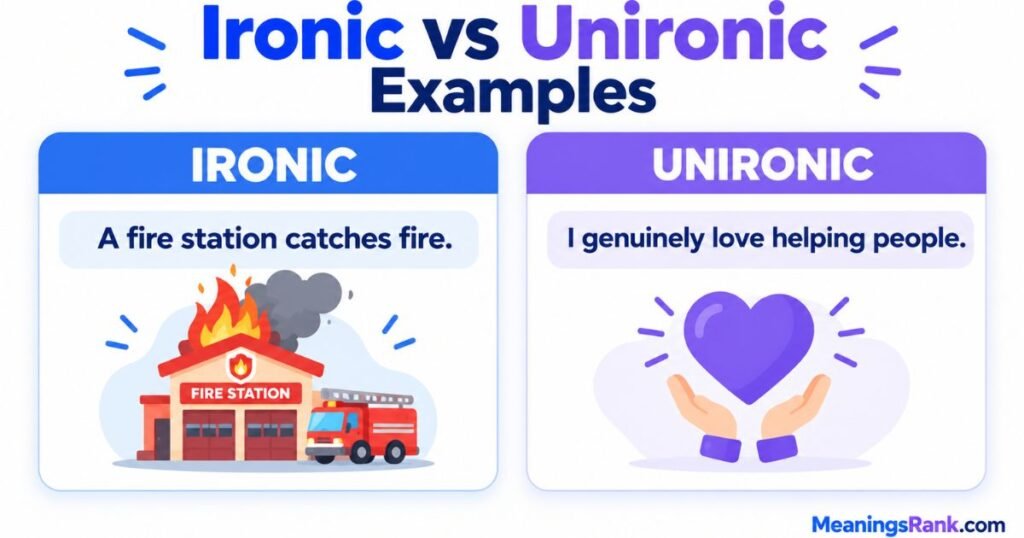
Examples teach faster than definitions. The groups below show each word in a range of settings.
Ironic Examples
Situational (outcome contradicts expectation)
- A famous sleep researcher falls asleep during her own keynote lecture. The very expert on rest cannot stay awake.
- A man buys an expensive security system, then locks himself out of his own house and has to call a locksmith.
- A bakery known for gluten-free bread wins an award for its wheat-based sourdough.
Verbal (speaker means the opposite)
- After a three-hour traffic jam, a driver mutters, “What a relaxing commute.”
- A coworker looks at a mountain of paperwork and says, “Oh good, I was hoping for more work.”
- A teacher hands back a messy essay and says, “Your handwriting is a masterpiece.”
Read More: Taught vs Tought: Discover the Correct Spelling, Meaning & Key Differences
Dramatic (the audience knows more than the character)
- In a film, a character cheerfully invites a stranger into her home. The audience already knows the stranger is the villain.
- A character in a play brags that nothing could ever go wrong, just before everything does.
Unironic Examples
- “I genuinely enjoyed that documentary, and I recommend it to everyone.” (Sincere recommendation.)
- The coach gave an unironic pep talk about teamwork, and the players left motivated.
- He wore the old band T-shirt unironically. He truly loved the band.
- Her unironic gratitude made the volunteers feel valued.
- The author wrote an unironic love letter to her hometown.
Same Sentence, Two Meanings
Context can flip a sentence from one category to the other. Compare these pairs.
| Sentence | Context | Reading |
| “Nice job.” | The player just scored the winning goal. | Unironic |
| “Nice job.” | The player just kicked the ball into his own net. | Ironic |
| “That’s brilliant.” | A student solves a hard proof. | Unironic |
| “That’s brilliant.” | A coworker spills coffee on the keyboard. | Ironic |
| “I love Mondays.” | A person who truly enjoys their job. | Unironic |
| “I love Mondays.” | A person dragging into the office with no sleep. | Ironic |
The words stay the same. The situation, tone, and audience knowledge decide the meaning. This is why punctuation, word choice, and surrounding clauses matter so much when you write.
Ironic vs Unironic in Everyday Conversations
Spoken English is where irony lives most comfortably. In face-to-face talk, we have a toolkit of signals: pitch, pace, eye contact, a raised eyebrow, a long pause. Those cues tell the listener when a sentence should be read as ironic.
How Irony Shows Up in Speech
Think about how you use irony without even planning it.
- You see a friend arrive an hour late and say, “Right on time!”
- A server delivers a tiny portion and you say, “Wow, that’s generous.”
- You walk out into a downpour right after the forecast promised sunshine and say, “Lovely day for a picnic.”
Each time, your voice probably shifts. It may slow down, flatten, or stretch certain syllables. Your listener hears the shift and decodes the real meaning.
How Unironic Speech Sounds
Unironic conversation is more direct. You say you are tired because you are tired. You say a meal was delicious because it was. There is no gap for the listener to bridge.
Many everyday exchanges carry no irony at all, and that is perfectly healthy. Direct communication reduces mistakes, especially in situations where clarity matters: giving directions, discussing health, handling money, or resolving conflict.
Switching Between the Two
Skilled speakers move between ironic and unironic registers in the same conversation. A manager might joke, “Another thrilling meeting,” as the team files in, then shift to a sincere tone: “Seriously, though, I appreciate everyone’s effort this quarter.” The contrast makes the sincere moment land harder.
When Irony Backfires in Conversation
Irony works best when the speaker and listener share background knowledge and trust. It tends to fail when:
- The listener is a stranger or someone from a different cultural background.
- The topic is emotionally sensitive.
- The setting is noisy, remote, or text-based.
- The listener is stressed or tired and takes words at face value.
A good rule: if a misunderstanding would cost something real, go unironic.
Ironic vs Unironic in Internet Culture
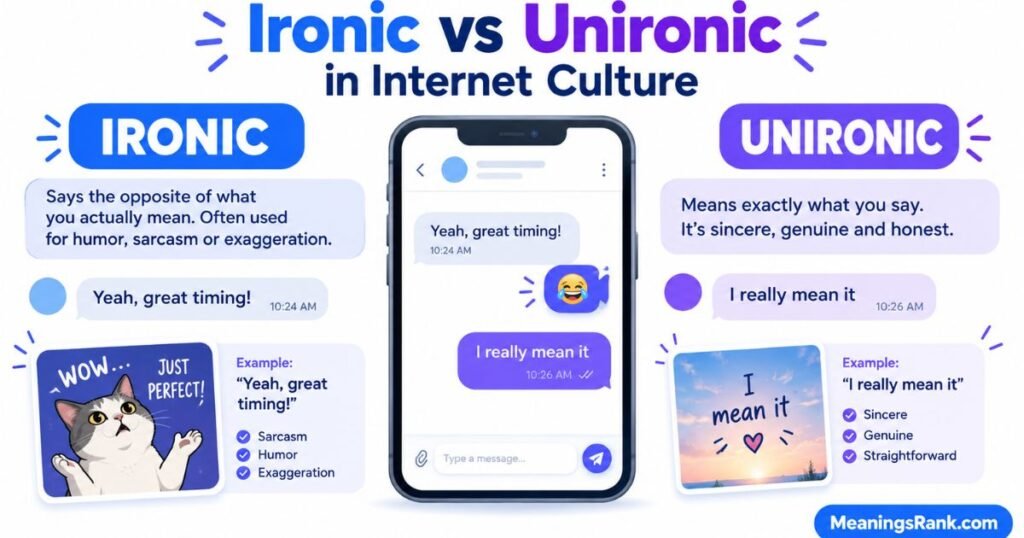
If you have spent time on social media, you have seen unironically far more often than unironic. Online language gave the pair a second life.
The Rise of Ironic Detachment
Online communities often prize humor built on exaggeration, mock enthusiasm, and layered jokes. People pretend to love things they find ridiculous, adopt silly personas, and post deliberately bad content. This habit is often called “ironic” behavior, although linguists and critics sometimes argue that it is closer to parody, in-joke humor, or playful pretense than to classical irony.
Enter “Unironically”
Because so much online talk is playful, a sincere statement needs a label. Hence the adverb:
- “I unironically love this cheesy song.”
- “He unironically believes pineapple belongs on pizza.”
- “She unironically wears a fanny pack every day.”
Here, unironically tells the reader to drop the joke frame. The speaker is not teasing. They mean it.
The Plot Twist: Layers Upon Layers
Things get confusing because unironically itself can be used ironically. A person may write, “I unironically think this is the greatest masterpiece ever made,” while clearly kidding. Internet users sometimes call this “post-irony” or “meta-irony”: a sincere-sounding statement used as part of a joke, which in turn may hide a real fondness.
For a language learner, the lesson is simple. Online, tone is slippery. The word unironically is a claim of sincerity, but readers decide whether to believe the claim based on context, the speaker’s history, and the community’s norms.
Ironic Fandom vs Unironic Fandom
A common pattern is “ironic enjoyment” of something, where a person claims to like a film or song because it is so bad it is entertaining. Over time, that enjoyment can turn into real affection. People then say they have moved from enjoying it ironically to enjoying it unironically. The phrase marks a shift from detached amusement to honest appreciation.
A Word of Caution for Writers
If you are writing for a broad audience, do not assume everyone understands internet-style unironically. For formal readers, the plain alternatives sincerely, genuinely, earnestly, or seriously are safer and clearer.
Ironic Expression vs Unironic Expression
An expression is any way of conveying meaning: a phrase, a sentence, a gesture, a facial look, even an emoji. So what separates an ironic expression from an unironic one?
Ironic Expressions
An ironic expression sends a message that differs from its literal form. Common examples include:
- Understatement: Describing a disaster as “a minor inconvenience.”
- Overstatement: Calling a small gift “the most extravagant present in history.”
- Mock praise: “What a genius idea,” said of an obviously bad one.
- Deadpan delivery: Stating something absurd in a perfectly neutral voice.
- Rhetorical questions: “Could this meeting be any longer?”
These expressions rely on the audience’s ability to compare what is said with what is known.
Unironic Expressions
An unironic expression is aligned with its meaning. Examples include:
- Direct statements: “I am proud of you.”
- Sincere questions: “Could you explain that step again?”
- Plain praise: “That was a thoughtful presentation.”
- Honest criticism: “The report needs more evidence.”
Facial and Written Expression
Facial expressions follow the same pattern. A smirk can add an ironic layer to a compliment. A warm, open smile supports a sincere one. In writing, the equivalents include quotation marks used to signal distance (“her ‘great’ idea”), italics for emphasis, and ellipses for a knowing pause.
Comparing Expressions Directly
| Intent | Ironic Expression | Unironic Expression |
| Praising a clumsy performance | “That was flawless.” | “That was a rough start, but you improved.” |
| Reacting to bad news | “Well, that’s just wonderful.” | “That is disappointing news.” |
| Commenting on a long wait | “I love waiting in lines.” | “I do not enjoy waiting, but I understand.” |
| Describing a cluttered room | “Very tidy, I see.” | “This room needs cleaning.” |
Pick the expression that fits your goal. If you want to entertain a friend, irony may land well. If you want to be understood by a customer, an unironic expression is almost always the better pick.
Ironic vs Unironic and the Difference Between Irony and Sarcasm
Readers often wonder whether ironic and sarcastic are the same thing. They overlap, but they are not identical, and the difference matters for anyone studying style or rhetoric.
What Sarcasm Is
Sarcasm is a pointed, often biting form of verbal irony aimed at a target. The word comes from a Greek root linked to tearing flesh, which hints at its sharp edge. Sarcasm usually mocks, criticizes, or wounds. “Oh, thanks for your help,” said to someone who did nothing, is sarcastic.
What Irony Is
Irony is the broader concept. It covers verbal irony, situational irony, and dramatic irony. It does not need a target and does not need to be unkind. A situation can be ironic without any person being mocked.
The Key Distinction
All sarcasm is a type of verbal irony, but not all irony is sarcasm. Sarcasm requires a speaker and a critical edge. Irony can exist in events, plots, and circumstances with no speaker at all.
| Feature | Irony | Sarcasm |
| Scope | Broad (situations, speech, drama) | Narrow (spoken or written remarks) |
| Needs a speaker | No | Yes |
| Intent to hurt or mock | Not necessarily | Usually |
| Example | A pilot afraid of heights | “Great landing,” said after a crash |
| Can be gentle | Yes | Rarely |
Where Unironic Fits
Unironic sits opposite both. An unironic remark is neither ironic nor sarcastic. It does not twist meaning and it does not mock. If a person says, “Thank you for helping me,” and means it, the statement is unironic.
A Quick Test
Ask two questions.
- Is there a gap between what is said or happens and what is true or expected? If yes, it is probably irony.
- Is that gap used to mock or cut someone down? If yes, it is probably sarcasm.
If the answer to both questions is no, you are likely looking at an unironic statement.
Three Main Types of Irony
Literary scholars and teachers usually sort irony into three main types. Knowing them sharpens your sense of when ironic is the right word.
1. Verbal Irony
In verbal irony, a speaker says one thing and means another, usually the opposite. Sarcasm belongs here, but so do gentler forms such as understatement.
- After watching his team lose 10–0, a fan says, “Well, that went great.”
- A hiker caught in a thunderstorm calls it “a light drizzle.”
The speaker controls the irony. They choose the gap between words and meaning on purpose.
2. Situational Irony
In situational irony, events turn out the opposite of what was expected or intended. No one has to speak. The universe, so to speak, does the joking.
- A city builds a new anti-theft billboard, and thieves steal the billboard.
- A medical conference on healthy habits runs out of fruit and serves only doughnuts.
- A student who spent weeks teaching classmates how to avoid procrastination turns in her own project a day late.
This is the type most often meant when people say, “That is so ironic.” It is also the type most often misused, because people apply it to simple bad luck.
3. Dramatic Irony
In dramatic irony, the audience knows something that a character does not. The gap is between the character’s understanding and the viewer’s or reader’s.
- In a mystery novel, the narrator reveals the culprit to the reader, while the detective keeps trusting the culprit.
- In a classic tragedy, a king vows to punish the guilty person, and the audience already knows the guilty person is the king himself.
Dramatic irony builds suspense, pity, and humor. It requires a story, so it appears mostly in plays, films, novels, and television.
Where Unironic Fits Among the Three
Unironic content avoids all three. An unironic speaker says what they mean. An unironic event is simply what it appears to be. An unironic story does not hold back key information to stage a gap between character and audience. That does not make unironic writing less skilled. It means the effect comes from clarity rather than contrast.
Quick Reference Table
| Type | Who creates the gap? | Key signal | Example |
| Verbal | The speaker | Words contradict meaning | “Perfect timing,” said to a latecomer |
| Situational | Events | Outcome contradicts expectation | A fire station catches fire |
| Dramatic | The storyteller | Audience knows more than the character | A character trusts the disguised villain |
Ironic vs Unironic Grammar and Word Forms
Grammar questions deserve their own space. Ironic and unironic follow regular patterns, but a few details trip writers up.
Word Families
The irony family
- Irony (noun): the quality or situation itself. The irony was lost on him.
- Ironic (adjective): describing something that has irony. an ironic twist
- Ironical (adjective): an older, less common variant. It is still correct but sounds formal or dated.
- Ironically (adverb): in an ironic way. Ironically, the expert got lost.
- Ironist (noun): a person who uses irony.
- Ironize (verb): to treat or express with irony. Rare.
The unironic family
- Unironic (adjective): without irony.
- Unironical (adjective): rare variant, seldom needed.
- Unironically (adverb): sincerely, without irony.
- Nonironic / non-ironic (adjective): a less common alternative.
Notice there is no everyday noun like “unirony.” When you need a noun, use sincerity, earnestness, candor, or genuineness.
Syntax: Where the Words Go
Both adjectives behave the same way.
| Position | Ironic | Unironic |
| Before a noun (attributive) | an ironic comment | an unironic compliment |
| After a linking verb (predicative) | The comment was ironic. | The compliment was unironic. |
| With it is… that | It is ironic that she forgot her own birthday. | It was clear that his praise was unironic; he truly loved the meal. |
| With degree words | very ironic, rather ironic | fully unironic, completely unironic |
Adverb Placement
Adverbs in -ly are flexible, but their position changes emphasis and meaning.
- Sentence adverb (start of sentence): Ironically, the author of the grammar guide made a typo. Here ironically comments on the whole clause. A comma usually follows.
- Mid-sentence adverb: She unironically loves old sitcoms. Here unironically modifies the verb loves and signals sincerity.
- End position: He praised the plan unironically. Possible, but less common.
Comparative and Superlative Forms
Both adjectives are gradable in theory, though real-life use is limited.
- more ironic, most ironic
- more unironic, most unironic (rare, but seen in casual commentary)
Writers sometimes object to gradable use of ironic, arguing irony is either present or absent. Still, English commonly accepts phrases like a deeply ironic moment or especially ironic.
Punctuation Notes
- Use a comma after a sentence-opening Ironically, or Unironically,.
- Do not hyphenate unironic. The prefix un- is usually attached directly.
- If you choose non-ironic, many style guides prefer the hyphen to prevent awkward double n or confusing letter strings.
- Quotation marks can mark an ironic use of a word (her “generous” tip was two cents), but overuse looks cluttered. Reserve scare quotes for moments that truly need them.
Subject-Verb Agreement and Clause Structure
Neither word changes subject-verb agreement. In It is ironic that the plumber’s sink leaks, the verb is agrees with the dummy subject it, and the that-clause is a noun clause carrying the content. In The comments were unironic, the plural subject comments takes the plural verb were. Keep these patterns in mind, and your sentences will stay grammatical regardless of tone.
Read More: Cocoon or Cacoon: Which Is the Correct Spelling? (2026)
When to Use Ironic and Unironic With Examples
Choosing a word is easier when you tie it to a purpose. Here are the main situations for each.
Use Ironic When…
1. You are describing a reversal or twist. It is ironic that the road-safety campaign caused a traffic jam.
2. You are naming a speaker’s double meaning. His ironic remark about “free time” made everyone laugh.
3. You are analyzing literature, film, or rhetoric. The poem’s ironic tone undercuts its cheerful title.
4. You are describing a tone of humor or detachment. She gave him an ironic bow after he finished the speech.
Use Unironic When…
1. You want to stress sincerity. He offered an unironic apology and meant every word.
2. You are describing a genuine preference that might sound like a joke. I own an unironic collection of garden gnomes.
3. You are contrasting a sincere work with a parody. Unlike the parody, the original film is wholly unironic.
4. You are writing about culture and tone. The band’s unironic love of power ballads won over critics.
Use Ironically and Unironically as Adverbs
- Ironically, the meteorologist forgot his umbrella.
- She unironically adores spreadsheets.
Sample Paragraph Showing Both
The café’s slogan promised “lightning-fast service.” Ironically, customers waited forty minutes for a sandwich. The owner, however, was unironic about wanting to fix the problem. He apologized sincerely, added staff, and offered free coffee to everyone in line.
In that paragraph, the first sentence sets up a twist, the second uses ironically to flag it, and the third turns to sincerity.
How to Choose Between Ironic and Unironic
When you are unsure, work through a short decision process. It takes about ten seconds.
A Four-Step Method
- Look for a gap. Is there a difference between what is said (or expected) and what is true? If yes, lean toward ironic.
- Check intent. Does the speaker mean the words literally? If yes, lean toward unironic.
- Consider your reader. Will they spot the gap? If not, either add a clarifying clause or choose plain language.
- Test a substitute. Replace the word with a synonym. If sincere fits, the word you need is unironic. If contradictory or opposite to expectation fits, the word you need is ironic.
Substitution Table
| If you can swap in… | Use |
| contrary to expectation, the reverse of what you’d expect | ironic |
| wryly meant, tongue-in-cheek | ironic |
| sincere, earnest, genuine | unironic |
| literal, straightforward | unironic |
Match Word Choice to Audience
- Friends and casual settings: Ironic humor is welcome. Unironic sincerity can be a pleasant surprise.
- Customers and clients: Prefer unironic clarity.
- Students and general readers: Define terms and avoid stacked irony.
- Literary analysis: Use ironic precisely and name the type.
Quick Memory Trick / Mnemonic Device
Try this: “Ironic has a twist; unironic has no tricks.”
Another approach is to focus on the un-: it is the “un-twist.” Just as unlock undoes a lock and undo reverses an action, unironic removes the twist. What remains is straight, honest speech.
For situational irony, use the phrase “Opposite of Plan”. If the result is the opposite of the plan, it is ironic. If the result simply fits the plan, or is merely unlucky, it is not.
Common Mistakes With Ironic and Unironic
Even confident writers stumble here. The slips below show up everywhere from student essays to news headlines.
Mistake 1: Using Ironic for Plain Coincidence
| Incorrect | Why | Better |
| “It’s ironic that we both wore blue.” | Just a coincidence | “It’s a coincidence that we both wore blue.” |
| “How ironic that it rained on Tuesday.” | Just weather | “It rained again on Tuesday.” |
Mistake 2: Using Ironic for Plain Bad Luck
A stolen bike is unlucky. A stolen bike outside a police station might be ironic. The twist must contradict an expectation or a purpose.
Mistake 3: Treating Ironic and Sarcastic as Interchangeable
Sarcasm is a sharp subtype of verbal irony. A gentle, affectionate ironic remark is not necessarily sarcastic. Equating them blurs a useful distinction.
Mistake 4: Using Unironic When You Mean Not Funny or Boring
Unironic describes sincerity, not a lack of humor. A sincere joke is still unironic, and a dull speech may be full of irony.
| Incorrect | Better |
| “The comedian’s unironic act had no jokes.” | “The comedian’s act was dull and had no jokes.” |
Mistake 5: Overusing Ironically as a Filler Adverb
Writers sometimes sprinkle ironically at the start of every surprising sentence. Reserve it for true reversals. If you can’t name the expectation that was contradicted, the word probably does not belong.
Mistake 6: Misplacing the Adverb
Ironically, he unironically praised the plan is grammatical but confusing. The reader must decode two layers at once. Simplify where possible.
Mistake 7: Assuming the Audience Gets It
Irony in text without tone cues is risky. Emails, product pages, and legal-style documents do not give readers a voice to hear. State the point plainly instead.
Key Exceptions to Keep in Mind
Exception 1: Popular usage is broader than strict definitions. Many dictionaries now record the looser sense of ironic as “unexpected” or “odd,” because speakers use it that way. Some usage guides accept it in casual writing, while others still advise against it in formal prose. When in doubt, go strict.
Exception 2: Unironic can describe genuine enjoyment of “uncool” things. In online talk, an unironic fan is someone who sincerely loves something that peers might expect them to mock. That sense is specific to modern informal English.
Exception 3: Irony and sincerity can coexist. A speaker can say something wryly but still mean the emotional core of it. For example, “I’m so thrilled to be doing taxes on my birthday” is ironic on the surface, yet it sincerely expresses frustration. Language is rarely a clean either/or.
Exception 4: Context beats vocabulary. A sentence is not ironic or unironic in isolation. Always check the situation, speaker, and audience before labeling it.
Exception 5: Self-referential irony. Sometimes a writer points out that they are being ironic, as in “Ironically, I’m now writing about irony.” This is playful and acceptable, but use it sparingly.
Ironic vs Unironic in Professional and Academic Writing
Formal writing has its own expectations. Both words can appear, but the surrounding rules tighten.
Academic Writing
In essays and research papers, ironic is a precise tool for literary and rhetorical analysis. You might write:
- The author’s ironic tone exposes the hypocrisy of the ruling class.
- The novel’s final scene is ironic: the hero’s victory destroys the very thing he fought to protect.
Support such claims with textual evidence. Name the type of irony (verbal, situational, or dramatic) and quote or cite the relevant passage. Vague statements such as “This is ironic” without explanation weaken your argument.
Unironic appears less often in academic prose, but it can be useful in cultural studies, media analysis, and linguistics, where researchers examine sincere versus ironic modes of communication. If you use it, define it. Readers from other fields may not know the specialized sense.
Professional Writing
In business emails, reports, and proposals, plain language wins. Irony can be misread across time zones, languages, and company cultures. A manager’s joking “Thanks for the early delivery” on a late package might be read as a real compliment by a non-native reader.
Guidelines for the workplace:
- Keep client-facing messages unironic.
- Reserve ironic humor for colleagues who know you well, and even then, avoid it in written records.
- Use ironic sparingly in reports. Replace it with a more precise description when possible: surprising, contradictory, unexpected.
- Never rely on irony in safety notices, contracts, or instructions.
Style Guide Considerations
Style guides rarely rule on ironic and unironic directly, but their general advice supports careful use:
- Prefer concise, specific wording.
- Avoid ambiguity, especially in terms that could mislead.
- Be consistent in how you treat variant spellings (nonironic vs. non-ironic).
- Use scare quotes lightly.
If your institution follows a particular style guide, check it for entries on usage notes and hyphenation.
Formal vs Informal Examples
| Informal | Formal |
| “It’s so ironic that the plumber’s house flooded.” | “It is ironic that the plumber’s own house flooded.” |
| “I unironically love this show.” | “I sincerely enjoy this show.” |
| “LOL, great job, genius.” | “That decision was unfortunate.” |
Ironic vs Unironic in American English
American English has shaped how both words circulate, partly through media, music, and online culture.
Everyday American Usage
In casual American speech, ironic is stretched wide. Many speakers use it for any funny or odd coincidence. A well-known pop song from the 1990s about “ironic” situations sparked decades of debate, because many of the examples in its lyrics were bad luck rather than true irony. That debate itself shows how contested the word remains.
Unironically has grown quickly in American informal usage, especially among younger speakers and online communities. Hearing “I unironically love that movie” in a coffee shop is now common.
Spelling and Variants
There is no spelling difference between American and British English for ironic, ironically, unironic, or unironically. The only variation worth knowing is the hyphenation choice for non-ironic.
Tone Differences
American speakers often use sarcasm and irony heavily in casual talk, and many Americans consider it a sign of wit. In other English-speaking communities, the balance may differ. Writers addressing international audiences should lean toward clarity.
Dictionary and Style Guidance
American dictionaries typically list the strict sense of ironic first and then note the looser sense in usage notes. American newsroom and academic style guides commonly advise using ironic with care and preferring words like coincidental, unexpected, or unfortunate when no real reversal exists. Check your preferred dictionary for the latest wording.
Quick Guide for American Writers
| Situation | Recommended choice |
| Journalism or academic essay | Strict ironic; define or explain the twist |
| Casual blog post | Both words fine; keep tone consistent |
| Social media | Unironically is widely understood |
| Customer communication | Avoid irony; write directly |
Practice Session: Ironic vs Unironic
Test yourself with the exercises below. Try each one before checking the answer key.
Part 1: Fill in the Blank
Choose ironic, ironically, unironic, or unironically for each sentence.
- The fire inspector’s house burned down last week. It is truly _______.
- Mia is a lifelong fan of polka music. She _______ owns every album ever made.
- “What a wonderful way to spend a Monday,” Sam muttered, staring at his broken laptop. His comment was clearly _______.
- _______, the grammar teacher made three spelling mistakes on the board.
- After the film, the director gave a heartfelt, _______ thank-you to his crew.
Part 2: Identify the Type
Label each as verbal, situational, or dramatic irony, or unironic.
- A lifeguard needs rescuing from a pool.
- In a play, the audience knows the letter is forged, but the hero believes it.
- “I’m thrilled to be stuck in traffic,” said a driver on the highway.
- A coach sincerely thanks her team for working hard.
Part 3: Fix the Sentence
Rewrite each sentence to fix the misuse.
- “It’s ironic that it snowed in December.”
- “The unironic comedian told no jokes all night.”
Answer Key
- ironic (situational irony: a fire inspector’s house burning).
- unironically (sincere, not a joke).
- ironic (verbal irony: the words contradict his real feelings).
- Ironically (sentence adverb flagging a reversal).
- unironic (sincere thanks).
- Situational irony.
- Dramatic irony.
- Verbal irony.
- Unironic.
- Snow in December is expected, so it is not ironic. Fix: “It snowed in December, as it often does.” Or, for a true twist: “It’s ironic that the town canceled its snow-removal contract just before the blizzard.”
- Unironic means sincere, not “joke-free.” Fix: “The comedian told no jokes all night.”
Scoring: 10 to 11 correct means you have mastered the pair. 7 to 9 means you are close; review the Common Mistakes section. Below 7, reread the definitions and try again tomorrow.
Frequently Asked Questions (FAQs)
What is the difference between ironic and unironic?
Ironic describes something with irony: a reversal of expectation, or words that mean the opposite of their surface. Unironic describes something sincere and literal, with no hidden meaning. One has a twist; the other does not.
Is “unironically” a real word?
Yes. Unironically is the standard adverb form of unironic. It means “in a sincere way, without irony.” It has become especially common in informal and online English, but it follows normal word-formation rules and appears in dictionaries.
Does “ironic” mean the same as “coincidental”?
No. A coincidence is two events happening together by chance. Irony requires a contradiction or reversal. Two friends bumping into each other abroad is a coincidence. A travel-safety expert getting robbed on holiday is ironic.
Is sarcasm the same as irony?
Not exactly. Sarcasm is a sharp, often hurtful form of verbal irony aimed at someone or something. Irony is the larger category and includes situational and dramatic types that involve no speaker and no mockery.
Can I use “unironic” in formal writing?
You can, but define the term and use it with care. In formal contexts, words like sincere, earnest, and genuine are usually clearer. Use unironic when the contrast with irony is the actual point, such as in media or cultural analysis.
Conclusion
Ironic signals a gap between what seems true and what is true, whether in a speaker’s words or in the way events unfold. Unironic signals sincerity: what you see is what is meant. Learn to spot the gap, name the type of irony when you can, and choose plain, unironic language whenever clarity matters most. Keep the four-step method and the memory trick close, and these two words will never trip you up again.