
You are typing a business email, a school essay, or a company bio. You reach the word and your fingers hesitate. Is it “encorporate” or “incorporate”?
That pause is normal. English is full of words that begin with “en-” and “in-” and sound almost identical when spoken. Think of enclose and include, or ensure and insure. The brain files them together, and spelling goes wrong.
This guide settles the question for good. You will see what “incorporate” means in plain language and in business, why “encorporate” is wrong, how to spell the word every time, and how it differs from near neighbors like include and integrate. A memory trick, a short quiz, and answers to the most searched questions are included too.
Encorporate vs Incorporate: Quick Answer
“Incorporate” is the correct spelling. “Encorporate” is a common misspelling and does not appear as a standard entry in major English dictionaries. Use “incorporate” whenever you mean to include something as part of a whole, or to legally form a company.
What Does “Incorporate” Mean in English?
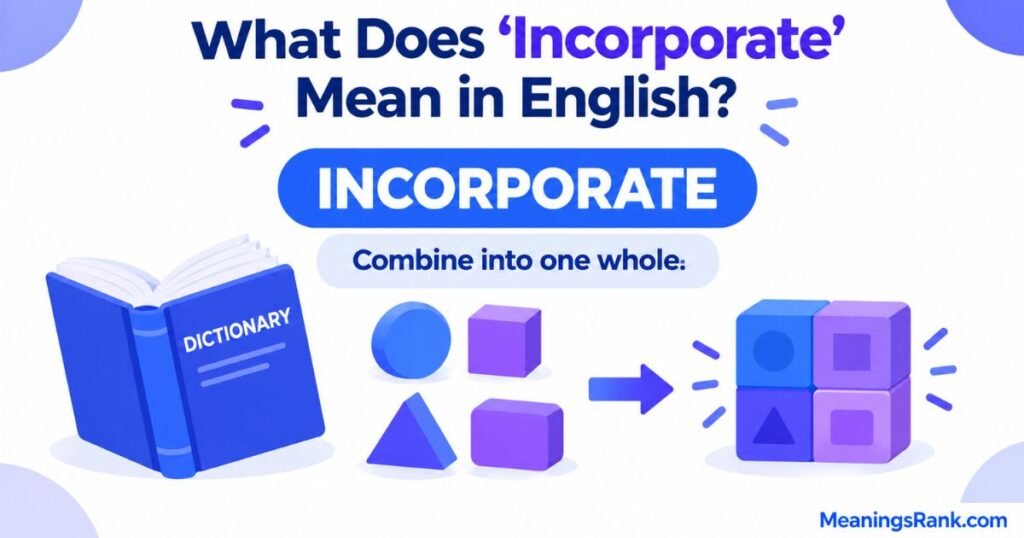
“Incorporate” is a verb. It means to take something and make it a part of a larger whole. The word comes from the Latin incorporare, built from in- (into) and corpus (body). Literally, you are taking something into the body of something else.
The standard pronunciation is /ɪnˈkɔːr.pə.reɪt/, with the stress on the second syllable: in-KOR-puh-rate.
It is a transitive verb, which means it needs a direct object. You incorporate something. Compare:
- She incorporated feedback into the final draft. (Correct: “feedback” is the object.)
- She incorporated. (Incomplete: incorporated what?)
Read More: Studder vs Stutter: Correct Spelling, Meaning & Key Differences (2026)
Incorporate Meaning in Simple Words
Strip away the formal tone and “incorporate” means to mix something in or to work something into a plan, recipe, or idea.
- A baker incorporates eggs into the batter.
- A teacher incorporates games into a lesson.
- A runner incorporates stretching into her morning routine.
If you can swap the word for “work in” or “build in” and the sentence still makes sense, you are using it correctly.
Incorporate Meaning in Business
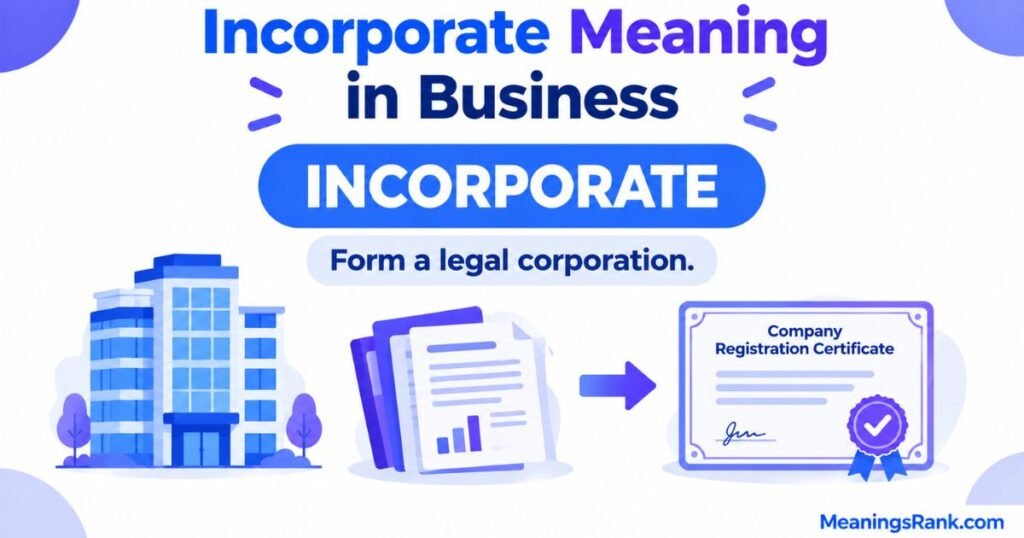
In business and law, “incorporate” has a second, more technical meaning: to legally form a corporation. When founders incorporate a company, they file paperwork with a government authority, and the business becomes a separate legal entity. That entity can own property, sign contracts, and be held liable apart from its owners.
- “The founders incorporated the startup in Delaware.”
- “We plan to incorporate before taking outside investment.”
This meaning explains the “corp” in the middle of the word. It also explains why business writers use the term so often, which raises the stakes for spelling it correctly.
What Is “Encorporate”? Meaning and Correct Usage
“Encorporate” has no accepted meaning in standard English. It is a spelling error, not a variant. When someone writes “encorporate,” they almost always intend “incorporate,” and the sentence should be corrected to match.
There is no correct usage of “encorporate” in formal writing. The only time you would type it on purpose is when you are quoting the error or writing a lesson about it, as this article does.
Is Encorporate a Real Word?
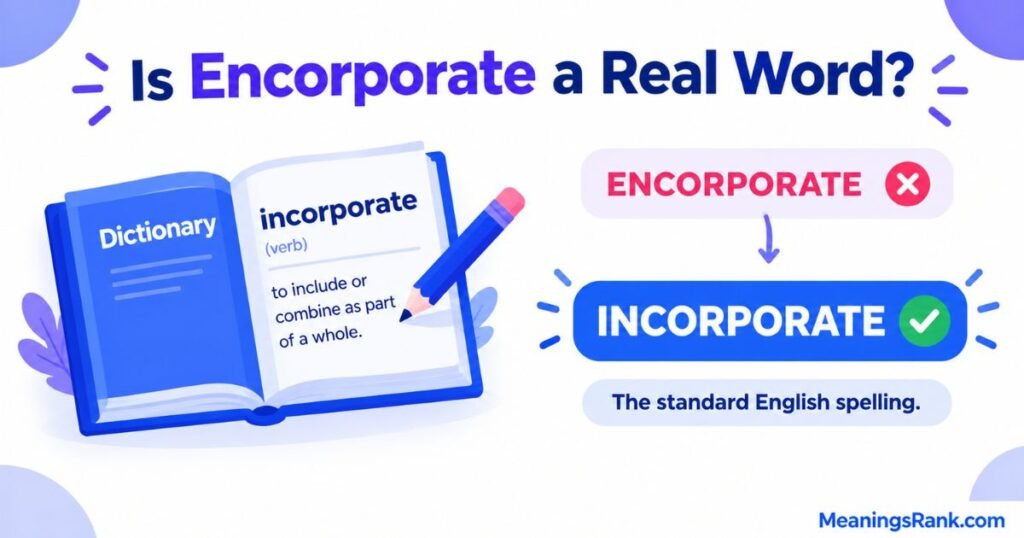
No. Major dictionaries and style guides used by editors and publishers do not list “encorporate” as a valid word. You may spot it online, in comment sections, or in rushed drafts, but frequency of use does not make a word correct. Spell-checkers flag it with a red underline for good reason.
Why Do People Confuse Encorporate and Incorporate?
Three forces push writers toward the wrong spelling.
- Sound-alike prefixes. In casual speech, “in-” before a consonant like c often sounds close to “en-.” The vowel softens, so the ear cannot reliably tell the two apart.
- Pattern matching with real “en-” words. English has many legitimate words that begin with “en-“: encourage, enclose, endorse, enrich, encode. Your brain looks for a familiar pattern and applies it by mistake.
- Spelling by sound. Writers who learned the word by hearing it, in meetings or on podcasts, rarely saw it written. They guess the spelling, and “encorporate” looks plausible.
History adds to the muddle. Older texts show enquire and inquire, or ensure and insure, used loosely. That makes the confusion feel reasonable, but the standard spelling of this particular word settled on “in-” long ago.
Easy memory trick:
IN-corporate means IN the body. The “in” at the start tells you the word is about putting something into a larger body, and the Latin corpus means body. Picture something moving in, and the “I” follows.
Difference Between Encorporate and Incorporate
| Feature | Incorporate | Encorporate |
| Valid English word | Yes | No |
| Part of speech | Verb (also adjective, rare) | None |
| Prefix | in- (into) | en- (incorrect) |
| Found in dictionaries | Yes | No |
| Accepted in formal writing | Yes | No |
| Business meaning | To form a legal corporation | None |
In short, one is a working verb with a clear history and two well-defined meanings. The other is a typo.
How to Spell Incorporate Correctly
Break it into syllables: in-cor-po-rate.
- in: the prefix meaning “into”
- cor: from corpus, “body”
- po
- rate
Spell it out: I-N-C-O-R-P-O-R-A-T-E. Eleven letters. It starts with “I,” never “E.”
A second trick: if the word has corp in it, the prefix before it is in. Corporation starts with c, but incorporate starts with in, so no stray “e” can sneak in. For the business meaning, remember that I-N-C is also the start of Inc., the abbreviation on many company names.
How to Use Incorporate in a Sentence
Use “incorporate” with a direct object, and usually pair it with the preposition into or in.
- “We incorporated her suggestions into the proposal.”
- “The new software incorporates several security features.”
- “He incorporated his business last spring.”
Notice the syntax. The subject comes first, the verb follows, and the object arrives right after. The prepositional phrase (“into the proposal”) tells the reader where the object ended up. Keep that clause structure clean and the sentence reads smoothly.
Read More: Accross vs Across: Discover the Correct Spelling, Meaning & Usage (2026)
Incorporate Usage in Everyday English and Formal Writing
“Incorporate” sits comfortably in both registers, though it leans slightly formal.
Everyday English:
- “I’m trying to incorporate more vegetables into my meals.”
- “Can we incorporate a coffee break into the schedule?”
Formal writing:
- “The revised policy incorporates recommendations from the review committee.”
- “The agreement incorporates by reference the terms of the master contract.”
In casual speech, people often choose “add” or “put in.” In academic papers, reports, and legal documents, “incorporate” is the preferred choice because it signals that something has been merged thoughtfully, not just tacked on.
| Informal | Formal |
| Let’s put some games in the lesson. | Let us incorporate educational games into the lesson. |
| They set up the company last year. | They incorporated the company last year. |
| We added your notes to the draft. | We incorporated your notes into the draft. |
Incorporate vs Include vs Integrate: Key Differences
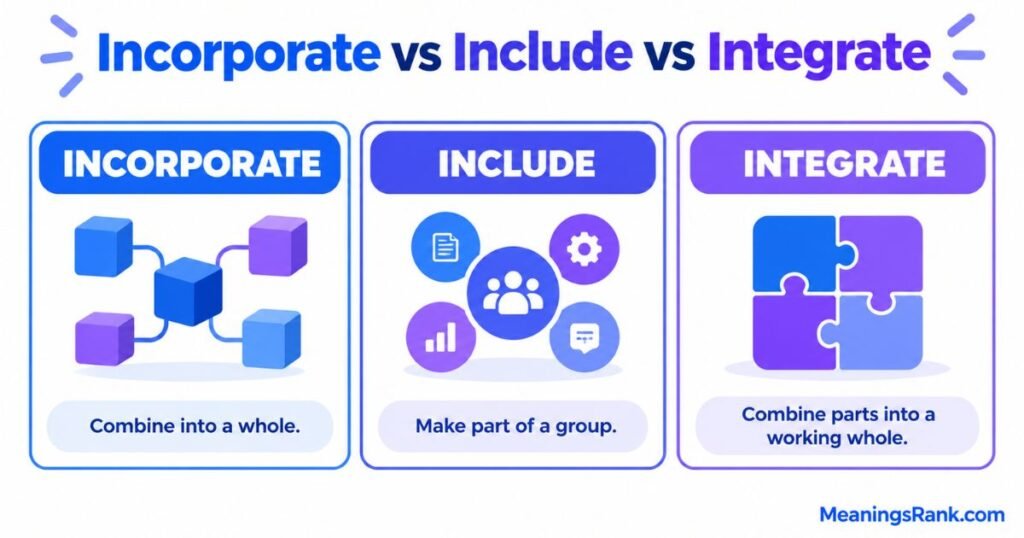
These three verbs overlap, yet each has its own job.
| Word | Core idea | Example |
| Include | Something is already part of a group or list | “The price includes tax.” |
| Incorporate | You add something into an existing whole, so it becomes part of it | “We incorporated the new data into the report.” |
| Integrate | You blend separate parts so they work together as one system | “The app integrates with your calendar.” |
A quick test: include describes what is already there, incorporate describes adding something in, and integrate describes making parts work together smoothly.
Incorporate Synonyms and Alternative Words
When you want variety, or when “incorporate” sounds too stiff, try these alternatives. Each carries a slightly different shade of meaning.
- Include: the simplest and most neutral choice
- Add: casual and direct
- Blend: suggests smooth mixing
- Merge: two things becoming one
- Absorb: taking something in completely
- Embed: fixing something deeply inside
- Integrate: parts working as a system
- Fold in: informal, popular in cooking and workplace talk
- Build in: practical and plain
For the business meaning, close alternatives include form a company, register a corporation, and establish a corporation.
Incorporate vs Incorporated: Meaning and Usage
“Incorporate” is the base form. “Incorporated” is the past tense and past participle, and it also works as an adjective.
- Present tense: “They incorporate customer feedback every quarter.”
- Past tense: “They incorporated customer feedback last quarter.”
- Past participle: “The feedback has been incorporated.”
- Adjective: “an incorporated business”
Other forms to know: incorporates (third-person singular), incorporating (present participle), and incorporation (the noun). Every one of them keeps the same “in-” opening.
Incorporated Meaning in Business
As a business term, “incorporated” describes a company that has been legally registered as a corporation. You see it abbreviated as Inc. at the end of company names: Acme Inc. or Brightline, Incorporated.
This label tells the public something important. The company is a distinct legal entity, and its owners usually enjoy limited liability, which means their personal assets are generally shielded from business debts. Rules vary by country and region, so founders should confirm details with a licensed attorney or the relevant registry.
Here the spelling carries real weight. A business card or website that says “Encorporated” would look careless to clients, lenders, and partners.
Common Spelling and Grammar Mistakes
Most errors with this word fall into predictable groups. Knowing them helps you catch mistakes before anyone else does.
- Writing “encorporate.” The most frequent error. The prefix is always “in-.”
- Writing “incorperate” or “incorparate.” The third syllable has an o, and the word ends in -rate. Think corpor-, as in corporation.
- Dropping the object. “We incorporated” needs something after it. Say what was incorporated.
- Using the wrong preposition. Prefer “incorporate into” or “incorporate in.” Use “with” mainly when forming something jointly.
- Mixing up “incorporate” and “corporate.” Corporate is an adjective about corporations (“corporate policy”). Incorporate is the verb of joining or forming.
- Misusing the company abbreviation. In US usage, “Inc.” takes a period and follows the company name.
Exceptions and edge cases worth knowing:
- Real “en-” words are a different matter. Enclose, encourage, encode, and endorse are all legitimate. Their existence does not make “encorporate” valid, because each word has its own history.
- “Incorporate” can be an adjective. In older or specialized usage it means “united into one body.” This is rare in modern writing.
- “Inc.” versus “Incorporated.” Both are correct. Follow the exact form in the company’s legal registration.
- “Incorporated by reference.” Lawyers use this phrase when a separate document counts as part of a contract without being copied in full. Spell it exactly.
- British and American English. The spelling does not change between them. Unlike color and colour, there is no regional variant.
Grammar Rules: Why “Incorporate” Is Correct
Three rules explain the spelling and the use.
Prefix rule:
The Latin prefix in- means “into” or “within.” It attaches to the root corpor-, “body.” English kept the original Latin prefix, and no “en-” version was ever adopted as standard.
Root family rule:
The word belongs to a family built on corpus: corporation, corporate, corporal, corps, corpse. Every member shares the -corp- core. Spelling it “encorporate” breaks the family resemblance.
Syntax rule:
As a transitive verb, “incorporate” requires a direct object and often takes an “into” phrase. The clause structure stays tidy: subject, verb, object, prepositional phrase.
Style guides and dictionaries agree on this point, and editors will correct the error without hesitation.
Examples of Incorporate in Different Contexts
Cooking:
“Gently incorporate the flour into the egg mixture so the batter stays light.”
Education:
“The curriculum incorporates project-based learning and peer review.”
Technology:
“The latest update incorporates two-factor authentication.”
Law and finance:
“The company incorporated in Nevada to take advantage of its corporate statutes.”
Design:
“The architect incorporated natural light into every room.”
Health and fitness:
“Doctors recommend incorporating short walks into a daily routine.”
Writing:
“The author incorporated three eyewitness accounts into the final chapter.”
Correct vs. incorrect, side by side:
| Incorrect | Correct |
| We need to encorporate the changes. | We need to incorporate the changes. |
| The company was encorporated in 2024. | The company was incorporated in 2024. |
| She encorporates music into her lessons. | She incorporates music into her lessons. |
| Encorporation papers were filed today. | Incorporation papers were filed today. |
| Please encorporate the edits. | Please incorporate the edits. |
Why “Encorporate” Is Considered Incorrect
“Encorporate” is considered incorrect for four practical reasons.
- It is absent from standard dictionaries.
- It breaks the established Latin root pattern.
- Spell-checkers, editors, and search engines treat it as a typo.
- In legal and business documents, a misspelled term can make the writer look careless, and in contracts, precision matters.
One more point deserves a plain statement: a mistake repeated by many people is still a mistake. Heavy search traffic for “encorporate” shows the confusion is common, not that the spelling is acceptable.
Read More: Nominator vs Nominee: Key Differences, Definitions & Examples (2026)
Quick Practice: Encorporate vs Incorporate
Test yourself. Choose the correct word for each blank, then check the answer key.
- The chef decided to ______ fresh herbs into the sauce. (incorporate / encorporate)
- Our firm was officially ______ in 2025. (incorporated / encorporated)
- Please make sure the final report ______ every reviewer’s comment. (incorporates / encorporates)
- The teacher is ______ more group work into the unit. (incorporating / encorporating)
- The listed price ______ shipping and taxes. (includes / incorporates) Choose the verb that best fits items already part of the price.
Answer Key
- incorporate: the “in-” spelling is the only valid form.
- incorporated: past tense, describing the company’s legal formation.
- incorporates: third-person singular present, matching the singular subject “report.”
- incorporating: present participle after “is.”
- includes: shipping and taxes are already part of the price, so “include” fits best.
Five out of five means the spelling is locked in. Three or four is solid, so reread the memory trick. Two or fewer, and it helps to revisit the sections on meaning and spelling.
Key Takeaways
- Incorporate is correct. Encorporate is not a real word.
- “Incorporate” means to make something part of a whole, or to legally form a corporation.
- The prefix is in-, from Latin, meaning “into.”
- Related forms: incorporates, incorporated, incorporating, incorporation.
- Use “include” for what is already there, “incorporate” for adding in, and “integrate” for making parts work together.
- “Inc.” on a company name signals a legally incorporated business.
Frequently Asked Questions (FAQs)
Is it “encorporate” or “incorporate”?
The correct spelling is incorporate. “Encorporate” is a misspelling and is not recognized in standard English dictionaries.
What does incorporate mean?
“Incorporate” means to include something as part of a larger whole, or to legally form a corporation. For example, you can incorporate feedback into an essay, or incorporate a business to create a separate legal entity.
Is “encorporate” a real word?
No. It does not appear in major dictionaries, and style guides do not accept it. It is a frequent typo caused by the similar sound of the prefixes “in-” and “en-.”
What is the difference between incorporate and incorporated?
“Incorporate” is the base verb form, used in the present tense. “Incorporated” is the past tense and past participle, and it can also be an adjective, as in “an incorporated company.”
How do you use incorporate in a sentence?
Place it after a subject and before a direct object, often followed by “into.” For example: “The designer incorporated recycled materials into the new collection.”
What is the difference between incorporate, include, and integrate?
“Include” describes something already part of a group. “Incorporate” means adding something into an existing whole. “Integrate” means combining separate parts so they work together as a system.
Final Thoughts
The correct spelling is incorporate, and “encorporate” is simply a mistake with no place in standard English. The word comes from the Latin in- (“into”) and corpus (“body”), so the prefix is always “in-.” It works as a verb meaning to add something into a larger whole, and in business it means to legally form a corporation. Remember the trick: IN-corporate means IN the body. Choose “include,” “incorporate,” and “integrate” with care, because each one does a different job in a sentence. Bookmark this guide, and you will never second-guess the spelling again.