
You are typing a quick message about the teacher who changed your life. You write “She tought me everything I know,” and then you stop. Something looks off. Is it taught? Is it tought? Your spell checker may be quiet, but your gut is not.
Your gut is right. “Taught” is the only correct spelling. “Tought” is not a word in standard English, and no dictionary or style guide recognizes it. It is simply a misspelling of the past tense and past participle of the verb teach.
This mix-up matters more than it seems. In an email, a cover letter, an essay, or a blog post, one misspelled verb can weaken an otherwise strong sentence. In this guide, you will learn what taught means, why the error is so common, how the verb behaves in a sentence, and how to avoid confusing it with look-alike words such as thought, tough, and taut. You will also get a memory trick, a practice quiz, and answers to the questions people ask most.
Taught vs Tought: Quick Answer
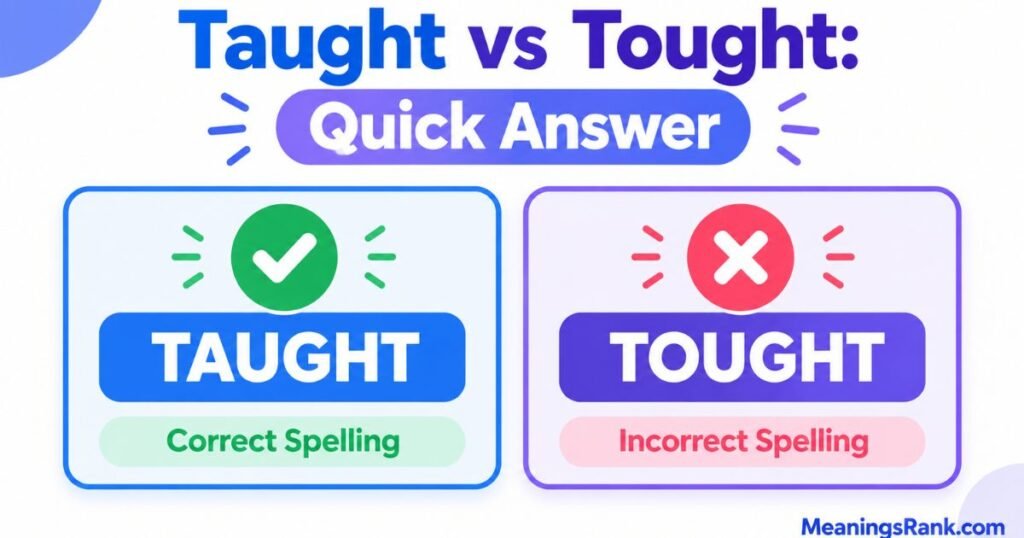
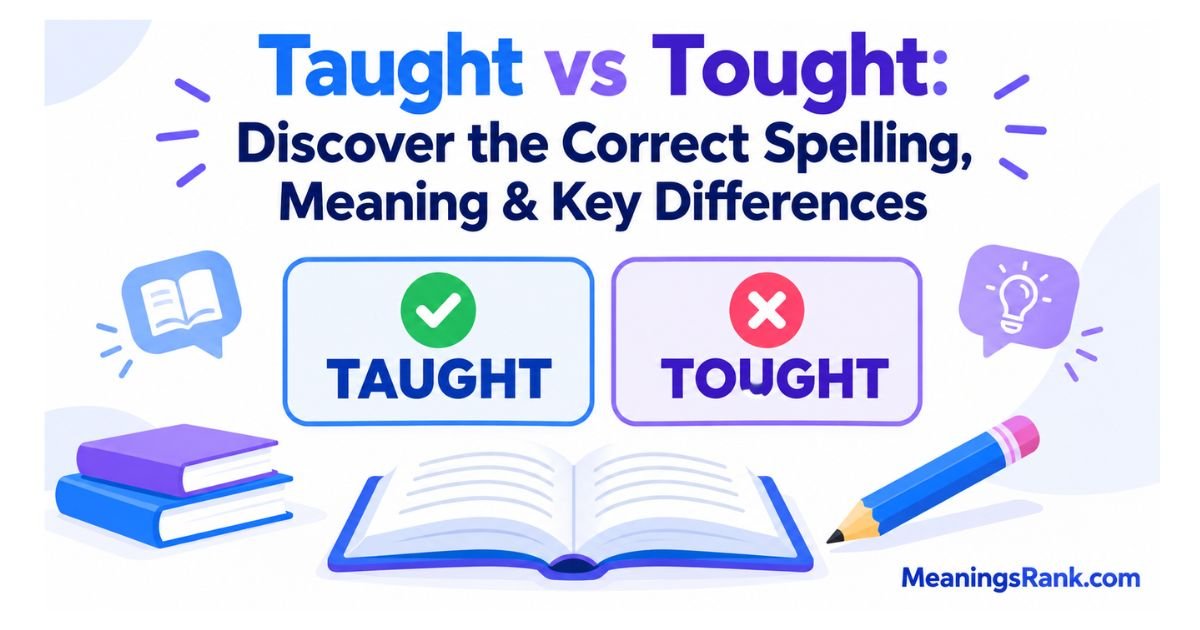
Taught is the correct spelling. It is the simple past tense and the past participle of the irregular verb teach. Tought is a common misspelling and should never be used.
| Taught | Tought | |
| Correct? | Yes | No |
| Part of speech | Verb (past tense / past participle) | Not a word |
| Base verb | Teach | None |
| Example | My aunt taught me to knit. | My aunt tought me to knit. ❌ |
If you remember only one thing, remember this: the pattern is teach, taught, taught. There is no “o” before the “ught.”
What Does “Taught” Mean in English?
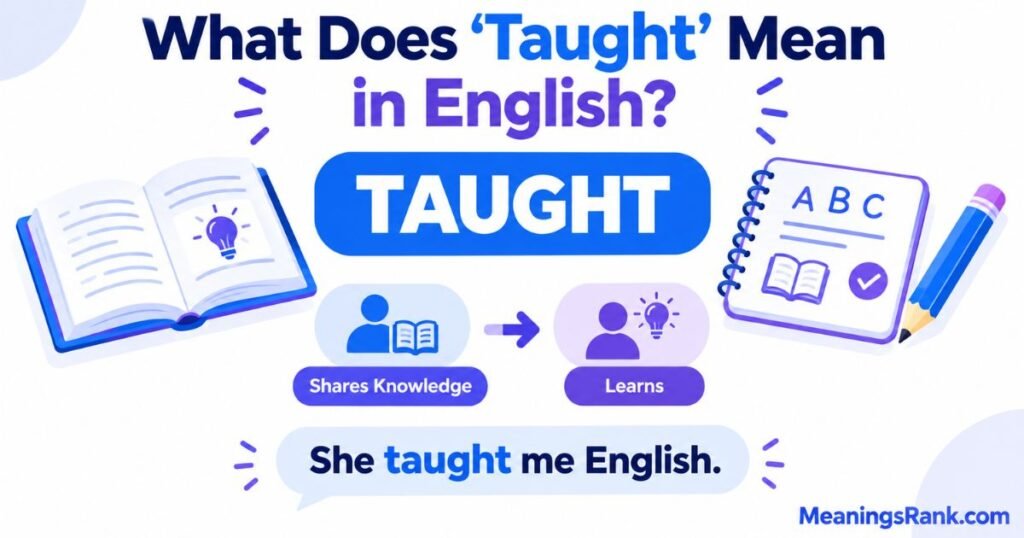
Taught means that someone gave instruction, shared knowledge, or showed another person how to do something. It describes a completed action in the past. When a person “taught” a lesson, the lesson has been delivered.
The word works in several settings:
- Formal education: Professor Hale taught organic chemistry for thirty years.
- Informal learning: My grandfather taught me how to fish.
- Life lessons: The experience taught her patience.
- Skills and habits: They taught the puppy to sit.
Notice that the thing doing the teaching does not have to be a person. An event, a failure, or a hardship can “teach” too, which is why you will often see sentences like “That mistake taught me a lot.” In each case, taught is a verb, and it needs a subject (who or what did the teaching) and usually an object (who or what received the lesson).
Taught also appears inside compound adjectives. A self-taught guitarist learned without a formal instructor. A well-taught class was delivered with skill. These hyphenated forms still use the correct spelling, which is another reason to lock it in.
Read More: Signer vs Signor: Meaning, Key Differences & Correct Usage
Why Do People Confuse Taught and Tought?
The confusion is understandable, and it is rarely about carelessness. Three forces work together.
1. English spelling does not follow its own sounds:
The word taught is pronounced with a vowel sound like the one in “caught” or “ought.” Many writers try to spell what they hear. Since “tot” and “tough” start with similar sounds, a stray “o” slips in.
2. The “ought/aught” spelling family is unpredictable:
English has a cluster of words that end in the same sound but are spelled in different ways: bought, brought, fought, sought, thought (with “ought”) and taught, caught, naughty, daughter (with “aught”). The brain tends to apply one pattern to the whole family. Since “ought” appears in more of these common verbs, it wins the vote, and “taught” gets mistakenly written as “tought.”
3. Spell checkers and autocorrect make us lazy:
On phones, autocorrect often fixes “tought” instantly, so writers never get the feedback that would teach them the correct form. Learners who read less and type more are especially prone to this.
There is also an influence from other languages. Speakers of languages with more regular spelling systems may expect each sound to have one written form, which makes English’s “aught/ought” split feel even more random. Once you understand that this is a spelling-history quirk rather than a personal flaw, the fix becomes much easier.
Why Is “Tought” an Incorrect Spelling?
“Tought” is incorrect for a simple reason: it does not exist in the English lexicon. No major dictionary lists it as a standard word, a variant spelling, or even an archaic form.
Here is the logic behind the rule. The verb teach changes its internal structure in the past tense, following an old Germanic pattern. Over centuries, the Old English form tǣcan produced the past form tāhte, which eventually settled into the modern spelling taught. The “augh” combination in that spelling reflects an older guttural sound that has since disappeared from speech but remains in writing.
So “tought” fails on every count:
- It does not match the dictionary entry for teach.
- It does not follow the historical spelling path of the word.
- It does not appear in any style guide, whether you follow the Chicago Manual of Style, AP Style, or the Oxford English Dictionary.
If you write “tought” in a school assignment, a job application, or published content, a careful reader or editor will mark it as an error. There is no gray area and no regional exception. American, British, Australian, and Canadian English all use taught.
What Is the Past Tense of Teach?
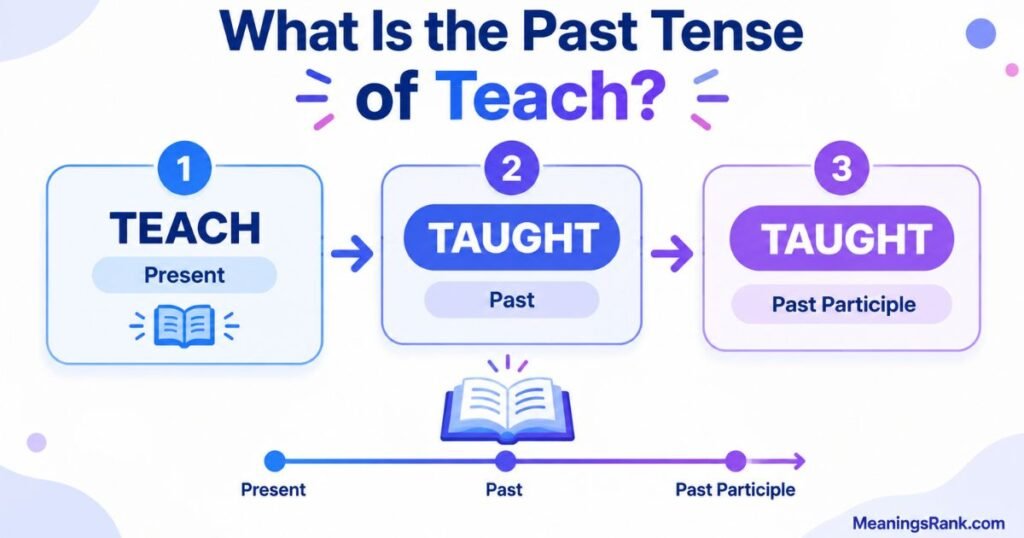
The past tense of teach is taught. The past participle is also taught. This means the verb uses the same form for both, which makes it easier to learn than verbs with three different forms.
| Base Form | Simple Past | Past Participle | -ing Form | Third-Person Singular |
| teach | taught | taught | teaching | teaches |
Here is how each form looks in a sentence:
- Base form: I teach grammar on weekends.
- Simple past: I taught grammar last year.
- Past participle (with have/has/had): I have taught grammar for a decade.
- Present participle: I am teaching grammar tonight.
- Third-person singular: She teaches grammar at the local college.
A frequent slip is adding “-ed” to make “teached.” That form does not exist either. Because teach is irregular, you cannot make its past tense by adding the usual ending.
How to Spell Taught Correctly
Spell it letter by letter: T-A-U-G-H-T. Six letters, one vowel pair (“au”), and a silent “gh.”
Break it into chunks to make it stick:
- T — the opening consonant.
- AU — the vowel pair, like in autumn and author.
- GH — a silent consonant pair (you do not pronounce it).
- T — the closing consonant.
The spelling starts with “ta,” just like teach starts with “te” and sounds close to its own family. Treat the “au” as a signature. If you can spell caught, you can spell taught, because they share the “aught” ending.
Check your typing against these common wrong versions:
- ❌ tought
- ❌ taugth
- ❌ tuaght
- ❌ thaught
- ❌ taughted
Only ✅ taught is right. Before you hit send, glance at the middle of the word and look for “au.”
Taught Grammar Rules: Why It Is an Irregular Verb
English verbs fall into two main groups. Regular verbs form the past tense by adding “-ed” (walk → walked). Irregular verbs break that pattern and change in other ways (teach → taught).
Teach belongs to a well-known subgroup of irregular verbs that turn into a past form ending in “-aught” or “-ought.” You can learn them as a set:
| Base | Past / Past Participle |
| teach | taught |
| catch | caught |
| buy | bought |
| bring | brought |
| think | thought |
| fight | fought |
| seek | sought |
Learning these verbs as a family reduces mistakes because the brain stores the pattern, not just seven separate words.
Grammar Notes Worth Knowing
Transitive use. Teach usually takes a direct object: She taught the class. It can also take an indirect object: She taught the class a new song.
Passive voice. Taught works well in the passive: The skill was taught at every school. Here, “was taught” is a passive verb phrase with the past participle.
Subject-verb agreement. In the past tense, taught does not change with the subject. I taught, he taught, they taught are all correct. Agreement only matters in the present tense: he teaches, they teach.
Teach vs. learn. Do not use “learn” when you mean “teach.” He learned me to drive is wrong. The correct sentence is He taught me to drive. The teacher teaches; the student learns.
Taught Pronunciation: How to Pronounce Taught
Taught is pronounced /tɔːt/ (or /tɑːt/ in many American accents). It rhymes with caught, bought, fought, and thought.
A simple way to say it: start with a “t” sound, open your mouth for the vowel “aw” (as in “law”), and finish with a crisp “t.” The “gh” is silent. Do not say it as “tow-t,” “tuff,” or “tawg-ht.”
| Word | Approximate Sound | Rhymes With |
| taught | “tawt” | caught, bought |
| thought | “thawt” | taught, fought |
| tough | “tuff” | rough, enough |
| taut | “tawt” | taught |
Here is a point that surprises many learners: taught and taut are homophones. They sound identical but have different meanings and spellings. That is one more reason spelling errors creep in, since sound alone cannot guide you.
When Should You Use Taught?
Use taught any time you need the past tense or past participle of “teach.” Ask yourself two quick questions:
- Am I describing instruction or lessons?
- Did it already happen, or does the sentence need a “have/has/had/was/were” helper?
If both answers are yes, taught is the word.
Read More: Grately vs Greatly: The Ultimate Guide to Correct Spelling and Usage
Use “taught” when:
- Describing a finished lesson or class: He taught the workshop on Monday.
- Using perfect tenses: She had taught English abroad before she moved home.
- Writing passive sentences: Reading was taught early in that district.
- Talking about lessons from life: Losing taught me to save.
Do not use “taught” when:
- The action is in the present. Say teach or teaches.
- The action is ongoing. Say teaching.
- You mean to describe something firm or hard. That is tough.
How to Use Taught in a Sentence: Examples
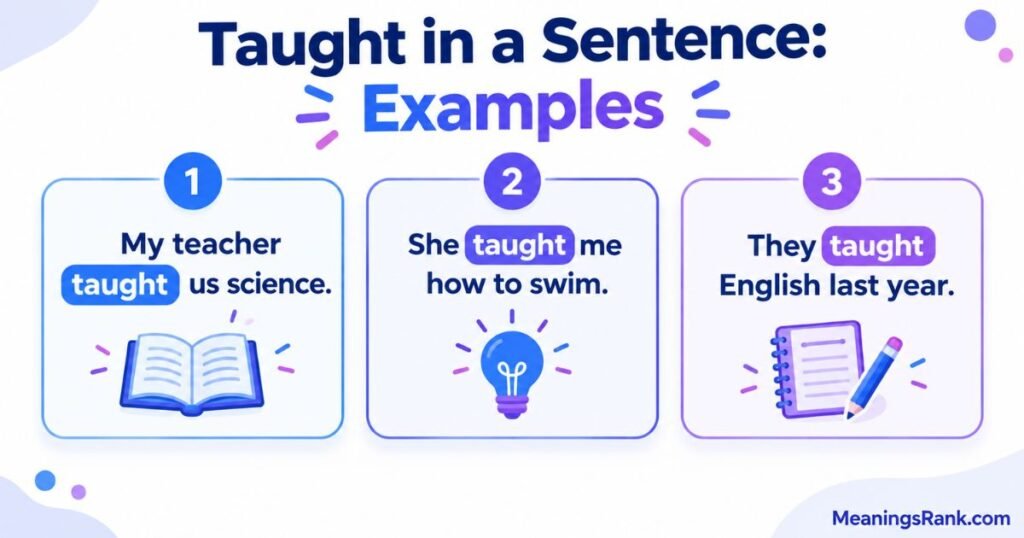
Seeing a word in context is the quickest way to absorb it. These examples show how taught behaves in different sentence structures and tones.
| Context | Example Sentence |
| Simple past | Ms. Rivera taught us how to write a thesis statement. |
| Present perfect | He has taught high school math since 2012. |
| Past perfect | She had taught herself to code before college. |
| Passive voice | The recipe was taught to her by her mother. |
| With “that” clause | My coach taught me that discipline beats talent. |
| With infinitive | They taught the children to swim. |
| Metaphorical | The storm taught the town how to prepare. |
| Compound adjective | He is a self-taught photographer. |
Correct vs. Incorrect Usage
| ❌ Incorrect | ✅ Correct |
| My mentor tought me how to negotiate. | My mentor taught me how to negotiate. |
| She teached the class yesterday. | She taught the class yesterday. |
| He has tought for years. | He has taught for years. |
| They was tought by experts. | They were taught by experts. |
| I learned him to cook. | I taught him to cook. |
Notice that fixing the spelling sometimes requires fixing the grammar around it, such as verb agreement in “they were taught.”
Taught vs Tought: Side-by-Side Comparison
| Feature | Taught | Tought |
| Recognized in dictionaries | Yes | No |
| Part of speech | Verb | None (misspelling) |
| Tense | Past and past participle of teach | Not applicable |
| Accepted in formal writing | Yes | No |
| Spelling pattern | t-a-u-g-h-t | t-o-u-g-h-t |
| Example | She taught me French. | She tought me French. ❌ |
| Verdict | Always correct | Always wrong |
The only difference on the page is a single vowel, yet it separates a correct sentence from an error.
Taught vs Thought: Meaning and Differences
Taught and thought look alike, sound alike, and share the same ending. They are also both irregular past forms. But they come from different verbs and carry different meanings.
- Taught = past tense of teach (to instruct).
- Thought = past tense of think (to use the mind), and also a noun meaning “an idea.”
| Taught | Thought | |
| Base verb | teach | think |
| Meaning | Gave instruction | Used the mind / an idea |
| Can be a noun? | No | Yes (a thought) |
| Example | He taught me chess. | I thought about chess. |
Here is where the “tought” error often comes from. Many writers blend the “th” of thought with the “ta” of taught and produce neither. Others swap the words entirely, as in “She thought me how to swim,” which means the speaker had an idea about me, not that she gave lessons.
Compare these two sentences:
- My uncle taught me to drive. (He gave driving lessons.)
- My uncle thought me to drive. ❌ (This is ungrammatical.)
A good test is substitution. If you can swap in “instructed,” use taught. If you can swap in “believed” or “considered,” use thought.
Taught vs Tough vs Taut: Key Differences
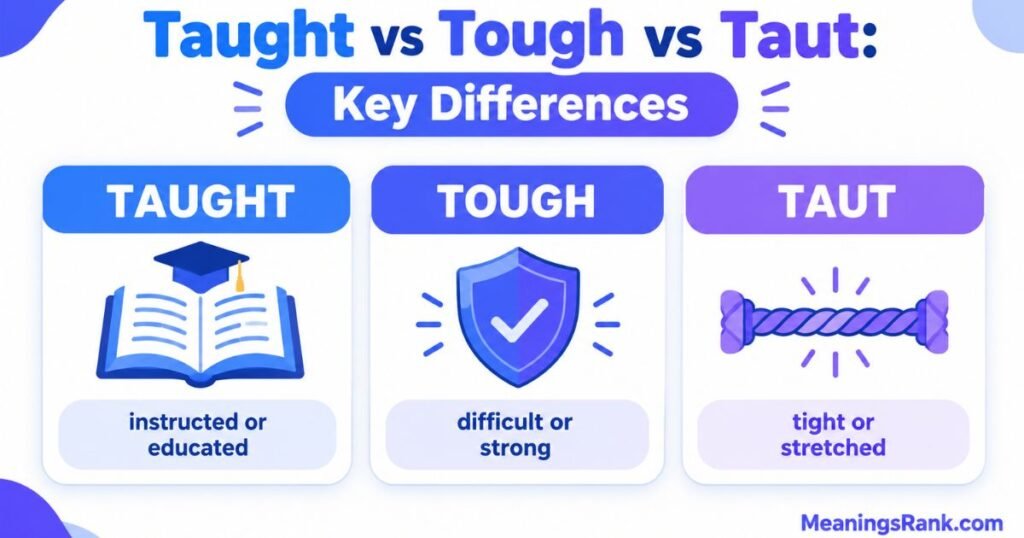
Three more look-alikes cause trouble, and each belongs to a different part of speech.
| Word | Part of Speech | Meaning | Pronunciation | Example |
| Taught | Verb | Gave instruction | /tɔːt/ | She taught biology. |
| Tough | Adjective | Strong, hard, difficult | /tʌf/ | It was a tough exam. |
| Taut | Adjective | Pulled tight, tense | /tɔːt/ | The rope was taut. |
Tough describes strength or difficulty. You can have a tough decision, a tough steak, or a tough personality. The “ough” ending here is pronounced “uff,” which is why people sometimes assume “tought” should sound like “tuff.” That logic leads them astray.
Taut describes something stretched tight. A taut wire, a taut expression, or a taut thriller (one with high tension) are all correct uses. Because it sounds just like taught, it is easy to mix up in writing. A reliable check is to ask whether the sentence is about lessons (taught) or tightness (taut).
One sentence that uses all three: The coach taught us that a tough season can leave a team’s nerves taut.
Taught Synonyms and Better Alternatives
Repeating the same verb in a long piece can make writing feel flat. Here are alternatives that fit different tones.
| Synonym | Best For | Example |
| Instructed | Formal or technical settings | The pilot instructed the cadets. |
| Educated | Academic or broad contexts | She educated thousands of students. |
| Trained | Skills and professions | He trained new nurses. |
| Coached | Sports, performance, careers | She coached the debate team. |
| Tutored | One-on-one help | He tutored me in algebra. |
| Mentored | Long-term guidance | Dr. Lee mentored young researchers. |
| Guided | Gentle, supportive direction | They guided me through the process. |
| Schooled | Informal, sometimes playful | My sister schooled me at chess. |
| Showed | Simple, everyday use | Dad showed me how to tie a tie. |
| Drilled | Repetition-based practice | The sergeant drilled the recruits. |
Choose a synonym only when it fits the situation. Taught is still the most natural option in everyday English, and swapping it out just for variety can make a sentence sound stiff. Use alternatives to add precision, not to avoid a word you already know.
What Does “Tuff” Mean?
Tuff is a different word altogether, and it adds one more layer to the spelling puzzle. It has two main uses.
1. Geology. In earth science, tuff is a type of rock formed from compacted volcanic ash. Ancient builders in Rome and Cappadocia carved homes and churches out of it. The cave dwellings were cut from soft volcanic tuff.
2. Slang or stylized spelling of “tough.” In casual writing, brand names, and social media, tuff appears as a playful variant meaning cool, impressive, or strong. That new jacket is tuff. This is informal and nonstandard, so keep it out of academic and professional work.
Notice that neither meaning has anything to do with teaching. Do not use tuff as a replacement for taught or tought. If you are writing a formal sentence about difficulty, use tough. If you are writing about volcanic rock, use tuff. If you are writing about instruction, use taught.
Common Spelling Mistakes Related to Taught
Writers tend to make the same handful of errors again and again. Here is a quick audit of the usual suspects.
| Mistake | Why It Happens | Fix |
| tought | Copying the “ough” from thought/bought | Use “augh”: taught |
| teached | Adding “-ed” to an irregular verb | Use taught |
| taugth | Swapping the final letters while typing | Finish with “-ght” |
| thaught | Mixing “th” from thought into the word | Start with “ta” |
| tuaght | Reversing the vowel pair | Keep “au” in order |
| taughted | Treating taught as a base form | It is already past tense |
| learned me | Confusing teach and learn | Say taught me |
Another subtle trap is tense stacking. Writers sometimes combine a past-tense helper with the past-tense verb: “She did taught us.” After “did,” the verb returns to its base form: She did teach us. Likewise, after “have” or “has,” use the participle taught, not “have teach.”
Finally, watch out for homophone swaps with taut. A sentence like “The cable was taught” is a spelling error even though it sounds correct when read aloud. Proofreading out loud will not catch it, so read slowly and check the meaning.
How to Remember the Spelling of Taught Easily
A good memory device turns a confusing spelling into something automatic. Try one of these.
Mnemonic 1:
“Teachers Are Ultimately Great Helpers, Too.” Each first letter spells T-A-U-G-H-T. Say it a few times, and the “au” will stick.
Mnemonic 2:
The “Au” in Author. Teachers share knowledge, and authors share stories. Both words have “au.” Link taught with author and the vowel pair is locked in.
Read More: Intention vs Intension: The Ultimate Guide to Meaning and Correct Usage
Mnemonic 3:
The Catch-and-Teach Rhyme. Catch becomes caught, and teach becomes taught. Both swap “ea/a” for “au.” If you can spell caught, you can spell taught.
Mnemonic 4:
Only “ought” Verbs Need an “o.” The “o” appears in verbs like bought and thought because the base words (buy, think) lack the “ea” or “a” vowels. Teach has “ea,” so its past has “au.”
Quick habit: Whenever you type taught, pause for one second and look for “au.” Within a week, the correct form will feel natural.
Practice Exercises: Taught vs Tought
Test your knowledge with these fill-in-the-blank sentences. Choose the correct word from the options in brackets. Write your answers before checking the key.
Part A: Choose the correct spelling.
- My grandmother _______ me how to bake bread. [taught / tought]
- Who _______ you to ride a bicycle? [taught / tought]
- He has _______ at the same school for twenty years. [taught / tought]
- The lesson was _______ by a visiting scientist. [taught / tought]
- She _______ herself to play the piano. [taught / tought]
Part B: Choose the right word from the look-alikes.
- The guitar string was pulled _______. [taught / taut / tough]
- I _______ about calling you yesterday. [taught / thought]
- That was a _______ interview. [taught / tough]
Part C: Fix the error.
- She teached us how to write essays.
- They was tought by an expert.
Answer Key
- taught
- taught
- taught
- taught
- taught
- taut (pulled tight)
- thought (an idea in the mind)
- tough (difficult)
- She taught us how to write essays.
- They were taught by an expert.
Scoring: 9–10 correct means you have mastered it. 6–8 means you are close, so review the comparison tables above. Below 6, reread the sections on irregular verbs and mnemonics and try again tomorrow.
Frequently Asked Questions (FAQs)
Is it “taught” or “tought”?
The correct spelling is taught. “Tought” is a misspelling and does not appear in standard English dictionaries.
What is the past tense of teach?
The past tense of teach is taught. The past participle is also taught, so you say “I taught,” “I have taught,” and “I had taught.”
Is “teached” a word?
No. Teach is an irregular verb, so it does not take the regular “-ed” ending. Use taught instead.
What is the difference between taught and thought?
Taught is the past tense of teach (to instruct), while thought is the past tense of think and also a noun meaning “an idea.” They sound similar but cannot replace each other.
Are “taught” and “taut” the same word?
No. They are homophones, meaning they sound alike but differ in meaning and spelling. Taught is a verb about instruction, and taut is an adjective meaning tight or tense.
Conclusion
Taught is the only correct spelling, and it serves as both the simple past tense and the past participle of the irregular verb teach. “Tought” has no place in standard English, and neither does “teached.” Keep the “au” in mind, link the word to caught and author, and check for look-alikes such as thought, tough, and taut whenever you proofread. With a little practice, you will spell it correctly every time and write with more confidence.