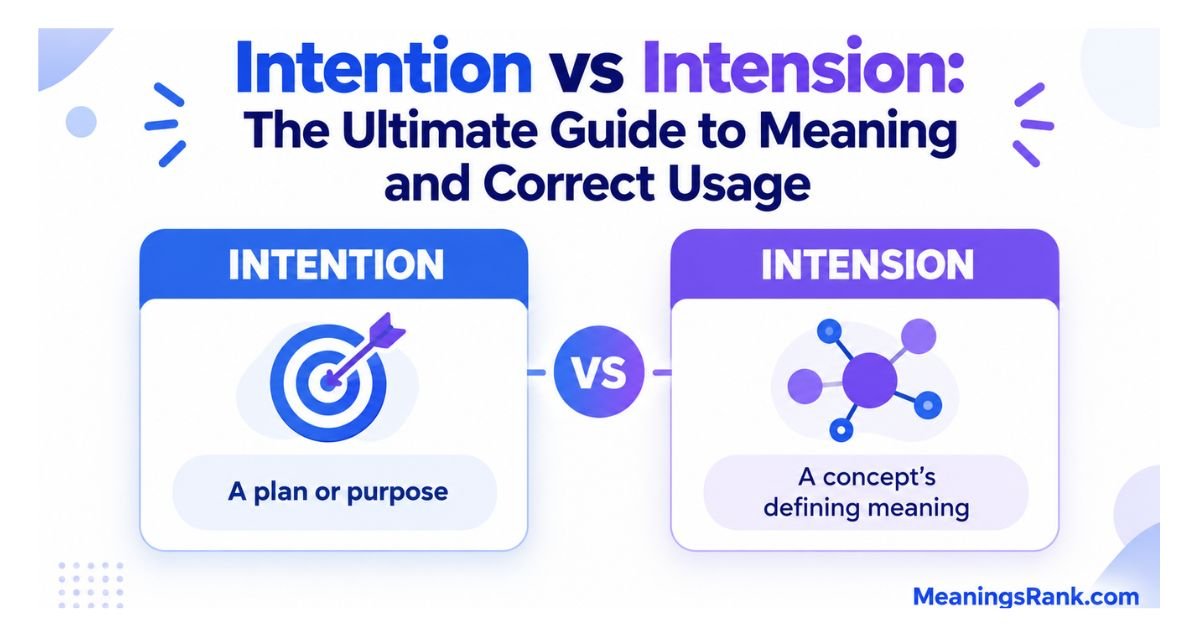

Quick Answer: Intention means a plan, purpose, or aim, as in “I have no intention of quitting.” Intension is a rare technical term from logic and linguistics that names the set of qualities defining a concept. In everyday writing, emails, essays, and exams, intention is almost always the word you need.
You are polishing a sentence, and your fingers hesitate. Is it “good intentions” or “good intensions”? The two words sound identical and differ by a single letter, so spell-check often shrugs and lets either one through.
Here is the short version. One of these words belongs in daily English. The other lives in philosophy textbooks and semantics lectures. Mixing them up is one of the quickest ways to make a careful piece of writing look careless. This guide gives you clear definitions, pronunciation notes, real examples, a comparison table, memory tricks, and a practice quiz, so the difference sticks for good.
Intention vs Intension: Quick Meaning Comparison
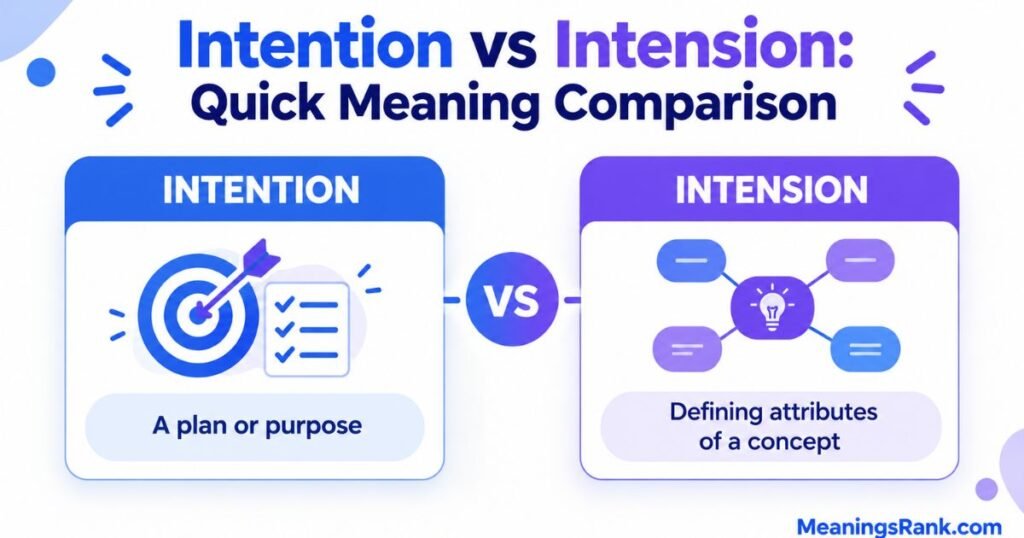
Both words trace back to the same Latin verb, which explains why they look so alike. Their modern jobs, however, are completely separate. Use this snapshot as a fast reference, then read on for the details.
| Feature | Intention | Intension |
| Part of speech | Noun | Noun |
| Core meaning | A plan, aim, or purpose | The set of properties that define a concept |
| Frequency | Extremely common | Very rare |
| Typical fields | Everyday speech, law, business, ethics | Logic, philosophy, semantics |
| Example | “Her intention was to help.” | “The intension of bachelor is unmarried adult man.” |
| Opposite or partner | Accident, result | Extension |
If you remember only one rule, make it this: when you are talking about what a person means to do, write intention.
What Does Intention Mean in Everyday English?
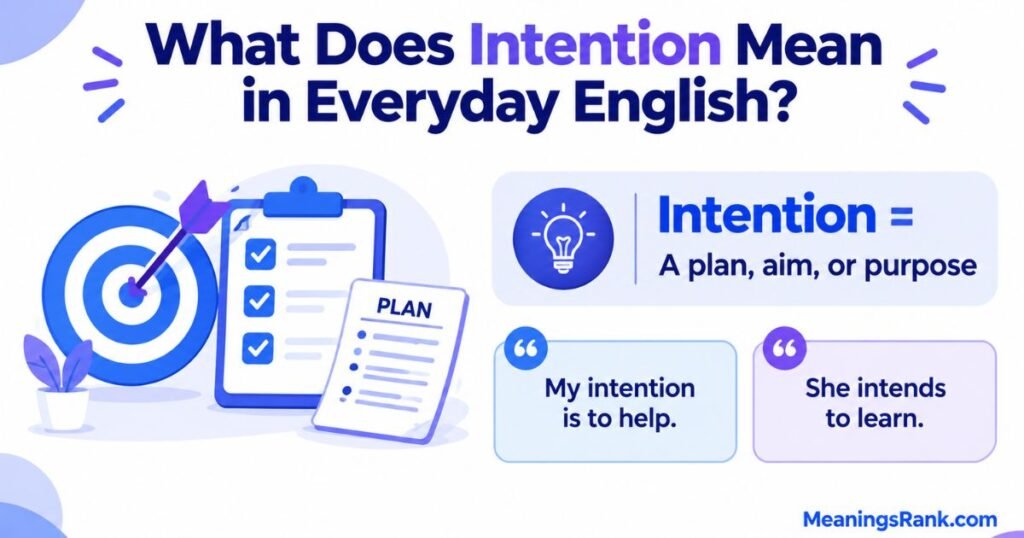
Intention is the word you reach for whenever you describe a goal held in the mind before or during an action. It answers the question, “What was the person trying to do?” You will meet it in conversations, news reports, contracts, school essays, and personal messages. It is a high-frequency word, and you will use it far more often than you realize.
Intention Definition and Word Origin
Intention (noun) means a thing intended, an aim or plan, or the act of having a purpose in mind. Most dictionaries also list a secondary sense: the meaning or purpose behind something, such as the intention of a law or a poem.
The word entered English in the Middle Ages through Old French entencion, which came from Latin intentio, meaning “a stretching out” or “a straining toward.” The Latin root is the verb intendere, built from in- (“toward”) and tendere (“to stretch”). Picture an archer drawing a bow and aiming at a target. Your intention is your mind stretching toward a goal.
That image is useful. It reminds you that an intention is directed. It points somewhere.
Intention Pronunciation and Word Structure
Intention is pronounced /ɪnˈtɛnʃən/, with the stress on the second syllable: in-TEN-shun. It has three syllables.
The structure is straightforward:
- Root: tent (from Latin tendere, “to stretch”)
- Prefix: in- (toward)
- Suffix: -tion (a noun-forming ending that turns an action into a thing or state)
That -tion ending is the clue you want. Words like attention, extension, and retention use the same pattern. Notice that intention contains the spelling “tent,” the same chunk you see in attention. If you can spell attention, you can spell intention.
The related forms are intend (verb), intentional (adjective), intentionally (adverb), and unintentional (adjective). Each of these keeps the “t” in the middle, which is a handy spelling anchor.
Read More: Signer vs Signor: Meaning, Key Differences & Correct Usage
How to Use Intention Correctly
Intention is a countable noun, so it can be singular or plural. It appears in several reliable patterns.
1. Intention + to + verb. This is the most common structure. “She announced her intention to resign.”
2. Intention of + gerund (-ing form). The preposition of needs a verb in its -ing form. “He had no intention of leaving early.”
3. With the verb “have.” English speakers often say someone has an intention. “I have every intention of finishing the report tonight.”
4. In the plural for general purposes. “Her intentions were honest, even if the result was messy.”
5. In fixed phrases. Common set expressions include good intentions, with the best of intentions, declaration of intent (note the shorter noun intent), intention to treat (a term in medical research), and the road to hell is paved with good intentions.
A small grammar point trips up many writers. After intention, you use the infinitive (to go) or of plus a gerund (of going). You do not use for going to express a plan. Write “my intention to go” or “my intention of going,” not “my intention for going.”
Intention Synonyms and Related Vocabulary
Good writers vary their vocabulary. Several words overlap with intention, but each carries its own shade of meaning.
| Word | Shade of meaning | Example |
| Aim | A specific target | “Her aim is to win the scholarship.” |
| Purpose | The reason behind an action | “The purpose of the meeting is clear.” |
| Goal | A desired end result | “His goal is fluency in Spanish.” |
| Objective | A measurable target, often formal | “The main objective is to cut costs.” |
| Plan | A worked-out method | “We have a plan for the move.” |
| Intent | Formal or legal sense of purpose | “She acted with criminal intent.” |
Intention in a Sentence: Everyday Examples
Seeing a word in context is the fastest way to absorb it. Here are examples across different situations.
- “My intention was never to hurt your feelings.”
- “The company announced its intention to expand into Asia.”
- “I have no intention of arguing about this.”
- “Despite her best intentions, the plan fell apart.”
- “What is the author’s intention in this paragraph?”
- “He bought the book with the intention of reading it on holiday.”
Notice how each sentence involves a person, group, or document with a purpose. That human or goal-driven quality is the signature of intention.
What Does Intension Mean?
Intension is a different animal. You will almost never use it in an email or a social media post. It belongs to specialist vocabulary, and when it appears, it appears with a very specific job.
Intension Meaning Explained Simply
In logic, philosophy, and linguistics, intension is the internal content of a term: the collection of qualities or conditions that something must have to count as an example of that term. In plain language, it is the definition-level meaning of a word.
Take the word triangle. Its intension is “a closed shape with three straight sides.” That description is what makes a shape a triangle. The intension tells you what the concept is, not which particular things happen to fit it.
A secondary, older sense of intension exists in some dictionaries. It means the act of straining or tightening, or a high degree of intensity. Because intension shares a root with intense, you may meet this meaning in older texts or in physics-style discussions of strength. Today it is uncommon and can come across as archaic, so most writers use intensity instead.
Is Intension a Real Word?
Yes. Intension is a genuine, dictionary-recognized English word. Major references such as Merriam-Webster, Oxford, and Collins list it. It is not a misspelling.
The confusion arises because it is so rare in ordinary life that most readers assume it must be a typo. A teacher, editor, or reader who sees “good intensions” will almost certainly assume you meant “good intentions.” In that situation, the “real word” argument will not rescue you. The sentence is still wrong, because intension does not mean “plan or purpose.”
So the honest answer has two parts. The word exists, and it is correctly used in technical writing. It is not a variant spelling of intention.
Read More: Grately vs Greatly: The Ultimate Guide to Correct Spelling and Usage
Intension Pronunciation and Word Structure
Intension is pronounced /ɪnˈtɛnʃən/, identical to intention in standard American and British English. The two words are homophones, meaning they sound the same but differ in spelling and meaning.
That shared pronunciation is the main reason the confusion persists. You cannot rely on your ear to separate them. You have to rely on your eyes and your understanding of context.
The word breaks down like this:
- Prefix: in- (toward, within)
- Root: tens (from Latin tendere, “to stretch,” through intensio)
- Suffix: -ion (a noun-forming ending)
Notice the “s” where intention has a “t.” The s links intension to words such as tension, intense, and intensity. Those relatives all share the idea of stretching or strength.
The adjective form is intensional (with an s), which is also a technical term. Do not confuse it with intentional (with a t), which means “done on purpose.” This pair causes just as many errors as the noun pair.
Intension Examples in Sentences
Because intension belongs to technical discussion, its example sentences sound academic. These show how it behaves in real contexts.
- “The intension of the term bachelor is an unmarried adult male.”
- “Logicians distinguish a word’s intension from its extension.”
- “Two terms can share an extension but differ in intension.”
- “Carnap used intension to describe the meaning of a predicate across possible worlds.”
None of these sentences describes someone’s plan. Each describes the content of a concept. If your sentence is about plans, goals, or purposes, you are in intention territory.
Intention vs Intension: Key Differences
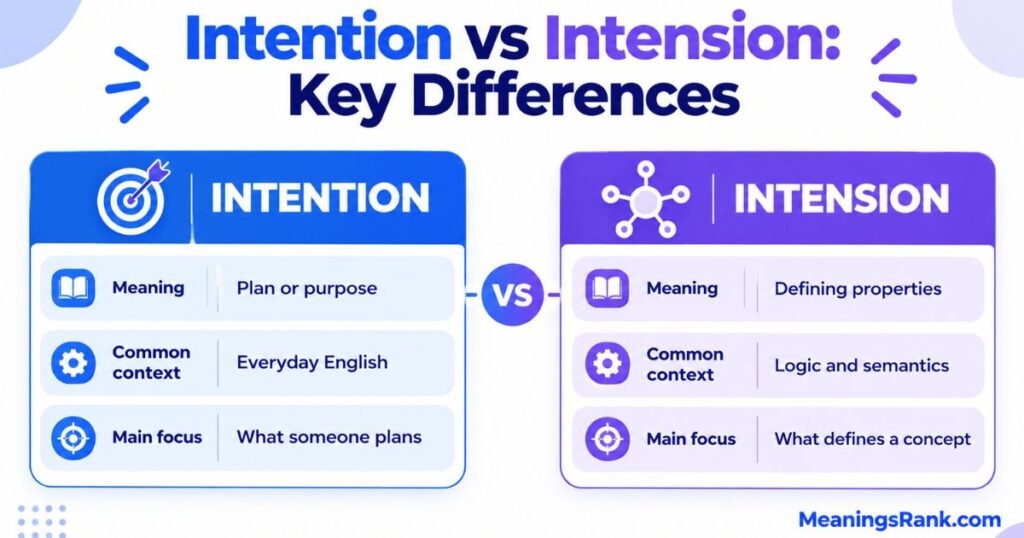
Now that each word has its own profile, you can place them side by side. The differences fall into meaning, grammar, and context.
Meaning and Definition Differences
The core split is simple. Intention is about purpose. Intension is about definition.
Intention looks forward. It concerns what someone wants to bring about. Intension looks inward at a concept. It concerns what features a term carries inside its meaning. One describes a mental state of a person; the other describes the content of an idea.
Think of it this way. If you ask, “What did she mean to do?” you are asking about intention. If you ask, “What does this word actually mean, and what qualities define it?” you are asking about intension.
Differences in Grammar and Usage
Both words are nouns, but they behave differently in a sentence.
Intention is countable and appears in singular and plural forms. It often takes an infinitive or of plus a gerund: intention to leave, intention of leaving. It pairs with verbs such as have, state, declare, announce, and fulfill. Its adjective is intentional, and its adverb is intentionally.
Intension is mostly used as an uncountable or abstract noun in technical prose, though intensions can appear when comparing several terms. It rarely takes an infinitive. Instead, it appears in phrases with of, such as the intension of a term. Its adjective is intensional, and it has no common adverb.
Syntax offers a quick test. If the noun is followed by to plus a verb (intention to apply), you almost certainly need intention. If the noun is followed by of plus a word or concept (the intension of “triangle”), and the context is academic, intension may be correct.
Intention vs Intension Examples in Everyday Contexts
The same scenarios can reveal which word fits.
Context: a job application. Correct: “I confirm my intention to accept the offer.” Incorrect: “I confirm my intension to accept the offer.”
Context: a friendship. Correct: “I had good intentions, but I handled it badly.” Incorrect: “I had good intensions, but I handled it badly.”
Context: a logic class. Correct: “The intension of prime number is a natural number greater than one with exactly two divisors.” Incorrect: “The intention of prime number is a natural number greater than one with exactly two divisors.”
Intention vs Intension Comparison Table
| Category | Intention | Intension |
| Definition | A plan, aim, or purpose | The set of attributes that define a concept |
| Pronunciation | /ɪnˈtɛnʃən/ | /ɪnˈtɛnʃən/ |
| Spelling clue | Contains “t” as in attention | Contains “s” as in tension |
| Adjective | Intentional (done on purpose) | Intensional (relating to intension) |
| Common structure | Intention to + verb | Intension of + term |
| Typical audience | General readers | Logicians, linguists, philosophers |
| Opposite or contrast | Accident | Extension |
| Frequency | Very high | Very low |
| Safe default in daily writing? | Yes | No |
Intension in Philosophy, Logic, and Linguistics
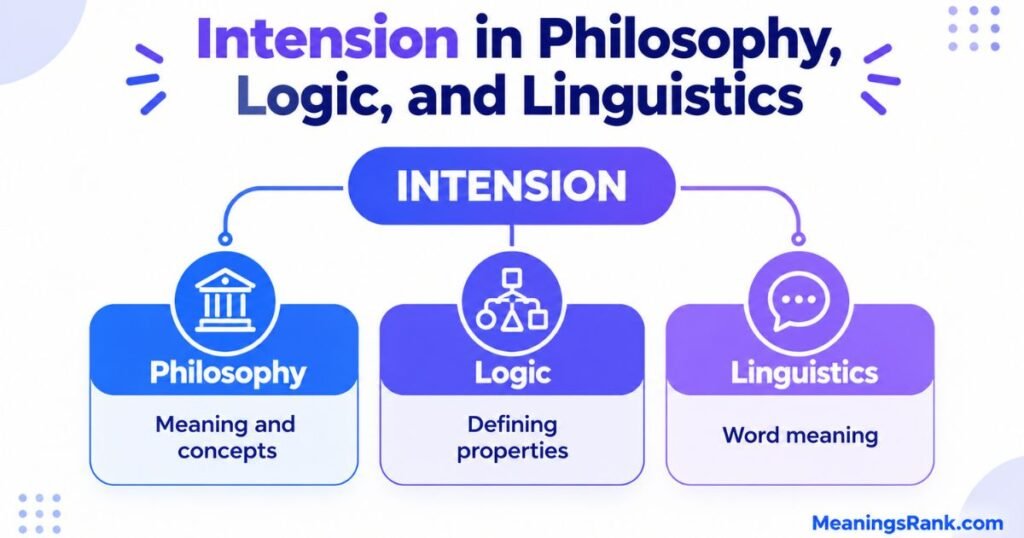
If you came here only to fix a sentence, you can skip ahead. If you study philosophy, linguistics, or computer science, this section matters, because intension is a foundational term in those fields.
Intension in Philosophy and Logic
In philosophy and logic, intension refers to the meaning of a term in terms of the properties it implies. Philosophers sometimes call it the sense or connotation of a word, in contrast to the actual objects the word picks out.
The idea has deep roots. Medieval logicians discussed it, and the modern treatment grew from the work of Gottlob Frege, who separated a term’s sense from its reference. Rudolf Carnap later gave the idea its formal vocabulary of intension and extension. In possible-worlds semantics, an intension is often described as a function that tells you what a term refers to in each possible situation.
Why does this matter? Because two expressions can point to the same thing while meaning different things. “The morning star” and “the evening star” both refer to the planet Venus, yet they carry different descriptive content. That difference is a difference in intension.
Intension in Linguistics and Semantics
Linguists use intension to study how words carry meaning beyond the objects they name. In formal semantics, the intension of a sentence is often treated as the proposition it expresses: the conditions under which it would be true.
This has practical consequences for syntax and meaning. Verbs such as believe, want, and seek create what are called intensional contexts. In such clauses, swapping one expression for another that refers to the same thing can change the truth of the sentence.
Consider this: “Lois believes Superman can fly” may be true while “Lois believes Clark Kent can fly” is false, even though Superman and Clark Kent are the same person. The clause structure after believes is sensitive to meaning, not just reference. Linguists call this feature intensionality, spelled with an s.
Notice the trap here. The linguistic term intensionality is easily mistaken for intentionality. The second one, with a t, is a different philosophical idea. It describes the “aboutness” of mental states, meaning how thoughts and beliefs are directed at things. The philosopher Franz Brentano revived this idea, and it ties back to the ordinary word intention. Two similar-looking terms, two separate ideas.
Intension vs Extension: What Is the Difference?
This pair is the heart of the technical meaning, and it is easier than it sounds.
- Intension is the defining qualities of a concept.
- Extension is the set of all things that fit the concept.
Take the term planet in our solar system.
- Its intension is “a large body that orbits the Sun and meets certain criteria.”
- Its extension is the actual list: Mercury, Venus, Earth, Mars, Jupiter, Saturn, Uranus, Neptune.
Here is a classic puzzle. The terms “creature with a heart” and “creature with kidneys” happen to have the same extension, since every animal with a heart also has kidneys. Yet their intensions differ, because having a heart and having kidneys are different properties. Same members, different meanings.
| Concept | Intension (defining qualities) | Extension (members) |
| Even number | A whole number divisible by 2 | 2, 4, 6, 8, and so on |
| Bachelor | An unmarried adult male | All unmarried adult men |
| Primary color | A color that cannot be made by mixing others | Red, yellow, blue (in traditional models) |
| Mammal | A warm-blooded vertebrate that nurses its young | Dogs, whales, humans, bats, and more |
Remember the pair as a mental picture: intension is the definition on the label, and extension is the contents of the box.
Why Are Intention and Intension Often Confused?
Three forces work together to cause the mix-up.
First, they are homophones. Spoken aloud, there is no difference. When you write quickly or from memory of how a word sounds, you may type the wrong letter without noticing.
Second, they look nearly identical. Only one letter separates them: the t in intention versus the s in intension. The eye slides over a single changed letter, especially in a long document.
Third, spell-checkers do not catch the error. Because intension is a valid word, software treats it as acceptable. A spell-checker checks whether a word exists, not whether it fits the sentence. Grammar tools sometimes flag it, but they miss many cases.
Common Grammar and Spelling Mistakes
Here are the errors that appear most often, with corrections.
| Incorrect | Correct | Why |
| “I have no intension of going.” | “I have no intention of going.” | The sentence expresses a plan. |
| “She had good intensions.” | “She had good intentions.” | Good intentions is the fixed idiom. |
| “It was an intensional insult.” | “It was an intentional insult.” | Intentional means done on purpose. |
| “His intension was to help.” | “His intention was to help.” | Purpose calls for intention. |
| “The intention of the term square is a four-sided shape.” | “The intension of the term square is a four-sided shape.” | This describes a concept’s definition. |
| “My intentions to leave early.” | “My intention to leave early.” | Singular fits the infinitive structure better here. |
| “Intention for going” | “Intention of going” or “intention to go” | Use of plus a gerund, or to plus a verb. |
Key exceptions to keep in mind:
A few edge cases keep the rule honest.
- Legal and medical phrases are fixed. Expressions like “intention to treat” in clinical trials always use intention. Do not alter them.
- Technical writing may use both words in one paragraph. A philosophy paper can discuss a person’s intention and a term’s intension side by side. Check each noun separately against its meaning.
- The obsolete “intensity” sense of intension. Rarely, you will see it in older prose. If you are not writing a historical analysis, avoid it.
Easy Tricks to Remember the Difference
Memory devices work because they give your brain a quick retrieval path. Try these.
Trick 1: The “t” for “target.” Intention has a t, and an intention has a target. Whenever you are aiming at something, use the word with the t.
Trick 2: The “attention” anchor. Intention and attention share the same ending. Both are common words, and both involve the mind turning toward something. If your word could be swapped with attention in spelling pattern, it is the everyday one.
Trick 3: The “s” for “semantics.” Intension has an s, and it shows up in semantics, sense, and set theory. If your sentence sits in a logic or linguistics textbook, the s word may fit.
Trick 4: The default rule. If you are not writing about logic, philosophy, or formal semantics, you do not need intension. Choose intention and move on.
A short mnemonic sums it up: “Intention has a target; intension has a definition.”
Read More: Choosing vs Chosing: The Correct Spelling, Meaning & Examples
How to Choose Between Intention and Intension
When you are unsure, run through this quick decision process.
Step 1: Ask what your sentence is about.
Is it about someone’s plan, aim, or reason for acting? Choose intention.
Step 2: Check the field.
Are you writing about logic, philosophy of language, or formal semantics? Only then should you consider intension.
Step 3: Look for the partner word.
If extension appears nearby, or you are contrasting a term’s meaning with the things it refers to, intension is likely correct.
Step 4: Test the structure.
If the noun is followed by to plus a verb, it is intention. If it follows the and is followed by of plus a term, ask whether you are defining a concept.
Step 5: Try a substitution.
Replace the word with purpose or aim. If the sentence still makes sense, use intention. Replace it with defining qualities. If that fits, you may need intension.
Practice Exercise: Intention vs Intension
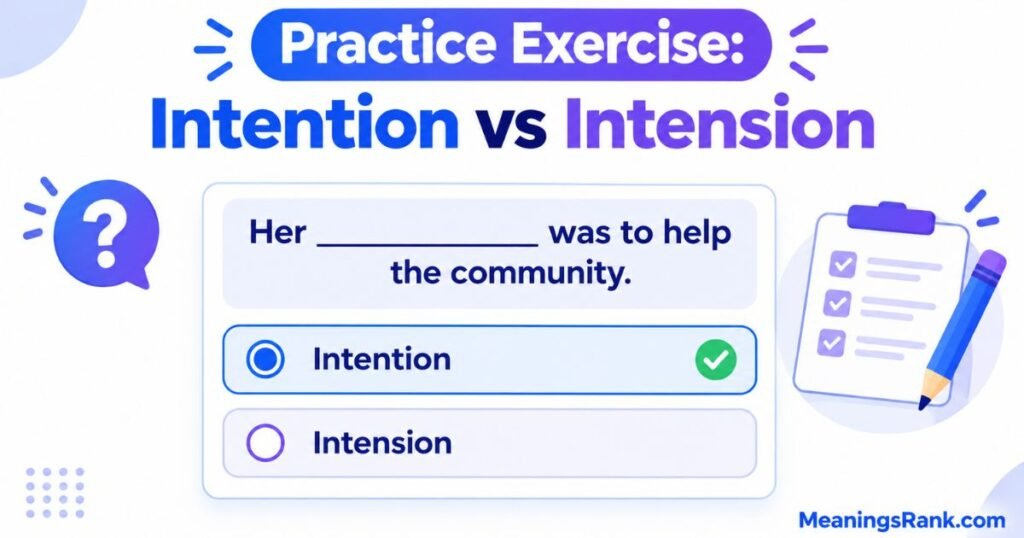
Test yourself. Fill in each blank with intention, intentions, intension, intentional, or intensional. Write your answers down before checking the key.
- She made her ________ clear: she planned to apply for the promotion.
- The ________ of the word rectangle is a four-sided shape with four right angles.
- I had no ________ of missing your birthday.
- The error was not ________; it was a simple typing slip.
- Logicians say that “believes” creates an ________ context.
Answer Key
- intention (a plan to apply is a purpose)
- intension (defining qualities of a concept)
- intention (used with of plus a gerund: of missing)
- intentional (done on purpose)
- intensional (a technical term in semantics)
Frequently Asked Questions (FAQs)
What is the difference between intention and intension?
Intention means a plan, aim, or purpose. Intension is a technical term in logic and linguistics for the set of qualities that define a concept. Choose intention in everyday writing.
Is intension a real word or a misspelling?
It is a real, dictionary-listed word, but it is not a spelling variant of intention. Writers misuse it constantly as a typo for intention, which is why editors treat it with suspicion outside technical contexts.
Are intention and intension pronounced the same way?
Yes. Both are pronounced /ɪnˈtɛnʃən/. They are homophones, so you must rely on spelling and context to pick the correct one.
What is the difference between intension and extension?
Intension is the set of defining properties of a term, while extension is the set of things that term applies to. For even number, the intension is “divisible by two,” and the extension is 2, 4, 6, and so on.
Is it “good intentions” or “good intensions”?
It is always good intentions. The phrase refers to honorable plans or motives. “Good intensions” is a spelling error.
Final Thoughts
The rule is easy to hold once you see it clearly. Use intention when you mean a plan, aim, or purpose, and save intension for logic, philosophy, and semantics, where it names the defining qualities of a concept. When you are unsure, remember the target in intention and the s in semantics, and apply the step-by-step check from this guide before you hit publish.