
Two words, one letter apart in sound and only a few letters apart on the page. It is easy to see why writers pause over signer and signor, especially when autocorrect or a quick typo turns one into the other.
Here is the answer up front. Signer is an everyday English noun that comes from the verb “to sign.” Signor is a borrowed Italian title, and it is capitalized when it precedes a name. If you are talking about someone who puts a signature on a page, you want signer. If you are addressing an Italian gentleman politely, you want Signor.
Why does it matter? Because the wrong choice changes your meaning completely. A line like “The signor must initial each page” in a lease agreement confuses the reader, while “Good evening, Signer Bianchi” sounds like a spelling slip at a dinner party. Mastering this pair protects your credibility in legal writing, fiction, travel writing, and plain old email.
This guide walks through the meanings, origins, grammar, and real-world use of both words. It also includes a practice quiz and a short FAQ so you can check your understanding.
Signer vs Signor: Meaning and Origins
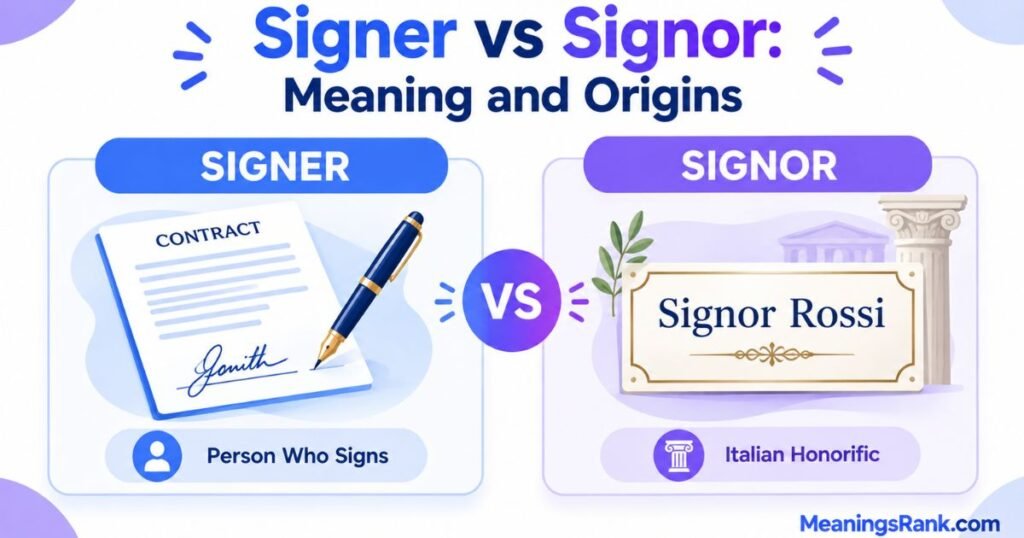
The two words have separate family trees, which explains why they behave so differently.
Signer traces back to the Latin signum, meaning “mark” or “sign.” It passed through Old French (signer, “to mark”) and settled into English as a verb. Adding the agent suffix -er (the same ending found in teacher, writer, and driver) produced the noun: one who signs.
Signor comes from Italian signore, which descends from Latin senior, meaning “older.” Over centuries, the word for an elder became a word for a lord, then a polite title for any respected man. Italian shortens signore to signor when it sits directly in front of a name. English borrowed that shortened form.
So the first is built from an English suffix attached to a verb. The second is a loanword that began as a comparative adjective. They share a few letters by coincidence, not by kinship.
What Does Signer Mean?
A signer is a person who signs something. That core sense covers several settings:
- Document signing. Anyone who puts a handwritten or electronic signature on a contract, lease, check, form, or letter is a signer.
- Formal agreements. The people who sign a treaty, declaration, or pledge are called signers. Historians refer to the “signers of the Declaration of Independence” in exactly this sense.
- Sign language. In the Deaf community and in linguistics, a signer is a person who communicates using a sign language such as American Sign Language (ASL) or British Sign Language (BSL).
The pronunciation is straightforward: SY-ner, rhyming with “diner.”
Dictionaries list signer as a countable common noun, so it takes articles and plurals: a signer, the signers, every signer. It is not capitalized unless it begins a sentence or appears in a title.
Read More: Nominator vs Nominee: Key Differences, Definitions & Examples (2026)
What Does Signor Mean?
A signor is an Italian courtesy title for a man, roughly equal to “Mr.” in English. It is used before a surname or full name and is normally capitalized.
- Signor Verdi will see you now.
- Buongiorno, Signor Conti.
The word signor is also used on its own in English to evoke an Italian setting or to refer to an Italian man in a respectful way. In Italian itself, the standalone form is usually signore (“sir” or “gentleman”), and signor appears when a name follows.
The pronunciation differs sharply from signer: SEE-nyor (or see-NYOR), with a soft “ny” sound in the middle, like the “ni” in “onion.”
Related Italian forms worth knowing:
| Form | Meaning | Example |
| Signor | Mr. / Sir (before a name) | Signor Rossi |
| Signore | Sir / gentleman (standalone) | Buonasera, signore. |
| Signora | Mrs. / Madam | Signora Lombardi |
| Signorina | Miss (young or unmarried woman) | Signorina Esposito |
| Signori | Gentlemen / Mr. and Mrs. (plural) | Signori, benvenuti. |
You may also run into signior, an older English spelling that appears in Elizabethan drama. It is now archaic.
Signer vs Signor: Key Differences (Clear Breakdown)
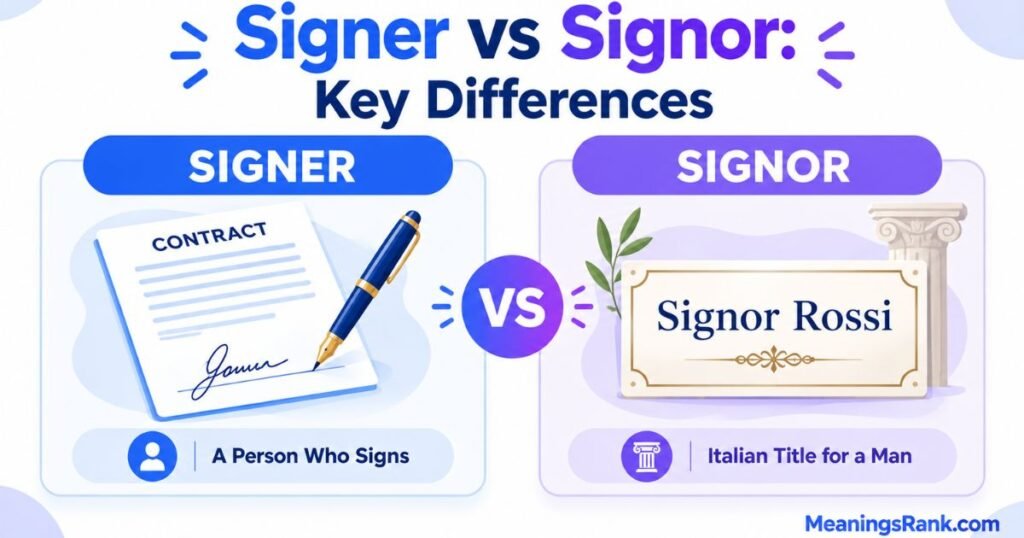
Here is a side-by-side snapshot.
| Feature | Signer | Signor |
| Part of speech | Common noun | Title / honorific (noun) |
| Language of origin | English (verb sign + -er) | Italian |
| Core meaning | A person who signs something | A courtesy title for a man, like “Mr.” |
| Capitalized? | Only at the start of a sentence | Yes, when used before a name |
| Pronunciation | SY-ner | SEE-nyor |
| Typical context | Law, finance, history, Deaf culture | Italian culture, fiction, travel, formal address |
| Has a plural? | Yes: signers | Italian plural: signori |
| Example | The signer initialed every page. | Signor Marino will join us. |
The simplest test: can you replace the word with “person who signs”? If so, use signer. Can you replace it with “Mr.” in an Italian setting? Then use Signor.
Signer vs Signor: Why Does This Confusion Happen?
Three forces drive the mix-up.
Visual similarity. Both words begin with sign- and end in -r. At reading speed, the eye fills in the shape and moves on.
Spelling-based guessing. English speakers know that -er marks a doer and that -or also marks a doer in words like actor, editor, and author. Since -or looks like an agent ending, some writers assume signor might be a variant spelling of signer, much as advisor and adviser are interchangeable. It is not.
Spellcheck and autocorrect. A rushed typo can flip one into the other, and software may not flag either because both are valid words.
Add the fact that signor is uncommon in everyday English, and many people never see it enough to build a firm mental image.
How to Use Signer and Signor in a Sentence
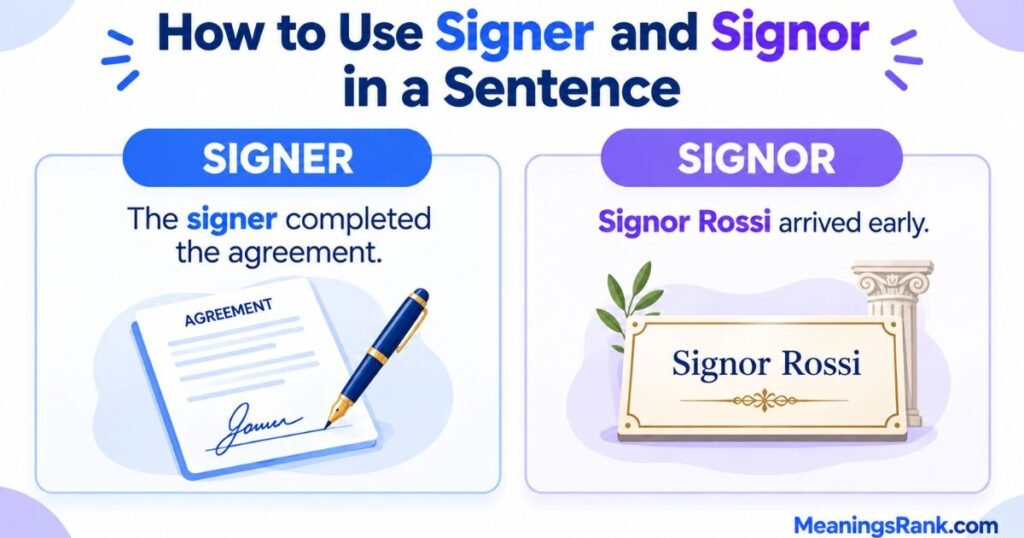
Seeing the words in a working clause structure makes the difference stick.
Signer in a sentence:
- Every signer must present a valid photo ID.
- The notary asked the signer to read the clause aloud.
- As a fluent signer, Maya interprets for her school’s Deaf students.
- The co-signer agreed to take responsibility if the loan went unpaid.
Signor in a sentence:
- “Signor Greco, your table is ready,” said the host.
- We were greeted at the villa by Signor and Signora Ferrari.
- The waiter bowed slightly and said, “Prego, Signor.”
- In the novel, Signor Alberti is a retired violin maker.
Notice that signer works like any other noun, with articles, adjectives, and plural forms. Signor behaves like a title: it usually sits directly before a proper name or serves as a respectful form of address.
Word Types and Grammatical Notes
A few grammar points help you handle both words with confidence.
- Signer is an agent noun. It follows the pattern verb + -er. It also forms compounds: co-signer, cosigner, authorized signer, primary signer, notary signer.
- Signer can be a gerund-adjacent concept, but it is not a verb. The verb is sign. You never “signer” a document.
- Signor is a title noun. Like Mr., Dr., or Madam, it attaches to a name and is capitalized in that position.
- Signor has no English verb or adjective form. There is no “signoring.”
- Subject-verb agreement. Both words are regular in this respect: The signer is ready. The signers are ready. Signor Rossi is here. The signori are here.
- Punctuation. In direct address, set off the title with a comma: “Thank you, Signor.” Unlike Mr., the Italian titles are not followed by a period because Signor is a full word rather than an abbreviation (though Sig. is the standard abbreviation).
- Style guide rules. Most style guides treat signor as a foreign-origin title that may be set in roman type, not italics, because it is established in English dictionaries. Italics are optional for stylistic emphasis in fiction.
Real-World Examples & Transformations
The following table shows how one idea can be expressed correctly and incorrectly.
| Incorrect | Correct | Why |
| The signor of the contract must be over 18. | The signer of the contract must be over 18. | A contract needs someone who signs, not a title. |
| Please welcome Signer Moretti. | Please welcome Signor Moretti. | Signor is the Italian title before a name. |
| Each signor must date the form. | Each signer must date the form. | The role is “person who signs.” |
| He addressed the chef as “signer.” | He addressed the chef as “signor.” | Respectful Italian address, not an agent noun. |
| Legal Signor Required Here | Legal Signer Required Here | Forms ask for the person who signs. |
Formal vs. neutral usage:
| Neutral / Everyday | Formal / Stylized |
| The person who signed the lease is Mr. Costa. | The signer of the lease is Signor Costa. |
| Ask the man in the white apron. | Ask Signor Bellini, the owner. |
The second row shows both words working happily in one sentence: The signer of the lease, Signor Costa, arrived early. Different jobs, no conflict.
Legal and Financial Applications of Signer
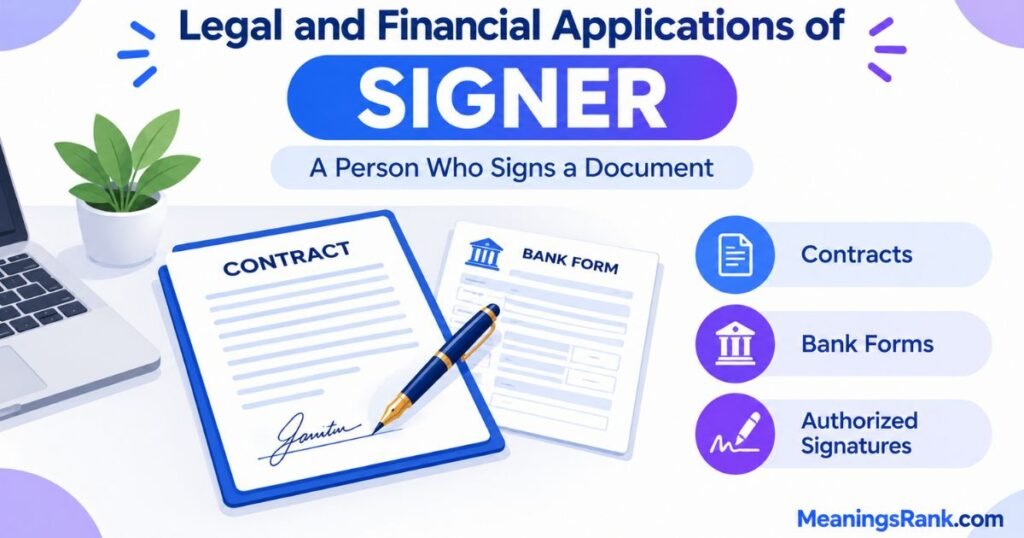
In business and law, signer is a precise working term. Getting it right matters because the signer carries obligations.
- Contracts and agreements. The signer is the party who legally commits by signing. Many contracts include a “signature block” that lists each signer’s printed name, title, and date.
- Banking. An authorized signer is a person permitted to sign checks or approve transactions on an account. This is different from an account owner, though one person can be both.
- Loans and leases. A co-signer takes shared responsibility for repayment. A guarantor is similar but often steps in only after the primary borrower defaults.
- Notarization. A notary public verifies the identity of the signer and witnesses the act of signing. The notary is not the signer.
- E-signatures. In digital platforms, a signer is the person assigned to sign an electronic document, often through an emailed link. Workflows usually distinguish signers from viewers or approvers.
- Public documents. Petitions, pledges, and treaties are described by their signers, who are sometimes called signatories in formal registers.
Practical tip: in legal drafting, use signer when the focus is the physical act of signing and signatory when the focus is being a party to an agreement. Many writers use them interchangeably, but a careful drafter keeps the nuance.
Also Read: Batchelor vs Bachelor: Which Spelling Is Correct? Meaning & Examples (2026)
Historical and Cultural Context of Signor
The word signor carries centuries of social history.
Because it descends from Latin senior, it began as a word for someone older or higher in rank. In medieval and Renaissance Italy, a signore was a lord, often the ruler of a city-state. Over time the term democratized. By the modern era, signor worked as an everyday courtesy, much like “Mr.” replaced “Master” in English.
English writers borrowed the word to flavor stories set in Italy and to portray Italian characters. You will find signor, and the older spelling signior, throughout Elizabethan and Jacobean drama, where it often signals a foreign gentleman or a fashionable traveler.
The family also includes the French seigneur and the English seignior, words for a feudal lord. Same Latin root, different roads.
Today the title remains alive in Italy, though usage has shifted. In casual speech, Italians often drop titles or use first names. In business, shops, hotels, and restaurants, Signor and Signora are still the polite default. Using them correctly when you travel is a small gesture that shows cultural awareness.
Synonyms and Related Terms
Synonyms and near-synonyms for signer:
- Signatory: a party who has signed an agreement, especially a formal one
- Subscriber (older legal sense): one who signs a document
- Undersigned: the person whose name appears below, as in “the undersigned agrees”
- Endorser: one who signs the back of a check or note
- Co-signer / cosigner: a second person who signs to share responsibility
- Witness: a person who signs to confirm that a signing took place (a different role, but often mentioned alongside signers)
Related terms for sign language users: Deaf signer, ASL user, interpreter (an interpreter conveys between a signed and a spoken language, so the two roles differ).
Synonyms and near-synonyms for signor:
- Mr. or Sir: the closest English equivalents
- Signore: the standalone Italian form
- Messer: an older Italian honorific
- Don: a title of respect in Italian (for clergy and some regions) and Spanish
- Monsieur, Herr, Señor: equivalent titles in other European languages
Antonyms and Contrasting Terms
Neither word has a perfect single-word opposite, but contrasts help sharpen meaning.
For signer:
- Non-signer or non-signatory: someone who is not a party to the signing
- Refuser (informal): one who declines to sign
- Witness or notary: people present at a signing but not signing as parties
- Unsigned party: a person or entity whose name is absent from the agreement
For signor:
- Signora (Mrs./Madam) and signorina (Miss) are gendered counterparts rather than true antonyms.
- In social-rank terms, historical contrasts include commoner, vassal, or servant, which opposed the lordly sense of signore in the Middle Ages.
- In grammar, a plain first-name address contrasts with the formal title.
Common Mistakes and How to Avoid Them
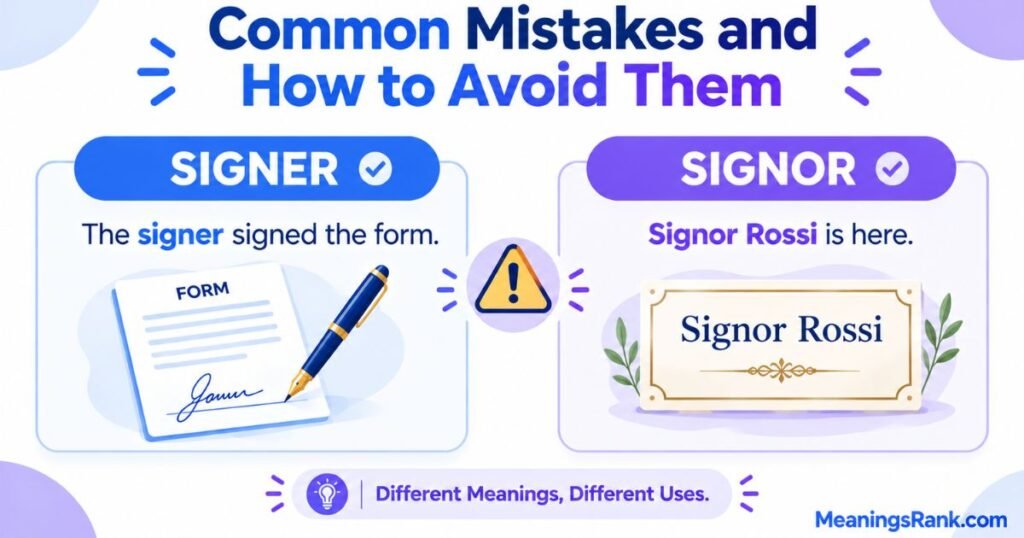
Most errors fall into a handful of patterns. Learn to spot them in your own drafts.
Mistake 1: Using signor as an agent noun. Wrong: The signor of the form must print his name. Right: The signer of the form must print his name.
Mistake 2: Writing Signer before an Italian name. Wrong: Signer Romano owns the bakery. Right: Signor Romano owns the bakery.
Mistake 3: Forgetting capitalization. Wrong: Please ask signor Lucca. Right: Please ask Signor Lucca.
Mistake 4: Treating signor as a spelling variant, like advisor/adviser. These are not alternate spellings. They are two unrelated words.
Mistake 5: Mixing gendered titles. Wrong: Signor Maria Costa. Right: Signora Maria Costa. (Use the feminine title for a woman.)
Mistake 6: Mispronouncing in speech. Saying “SY-ner” when you mean the Italian title, or “SEE-nyor” for a person who signs, will confuse listeners immediately.
Key Exceptions to Keep in Mind
- Sign language. Signer has a non-document meaning. A “fluent signer” has nothing to do with contracts.
- Archaic signior. You may see it in older texts or in deliberate period pastiche. Do not use it in modern general writing.
- Standalone Italian. In Italian, the bare form meaning “sir” is signore. English speakers still say “Yes, Signor,” and dictionaries accept it, but if you are writing in Italian itself, follow Italian grammar.
- Plural forms. The English plural of signer is signers. For Italian titles, the plural is signori (men, or a mixed group), and you should use it when addressing multiple Italian gentlemen or a married couple formally.
- Abbreviations. Sig. (Signor), Sig.ra (Signora), and Sig.na (Signorina) exist in Italian but are uncommon in English prose.
- Style guide choices. Some publishers italicize signor on first use in fiction and drop italics afterward. Follow your house style.
Quick Memory Trick / Mnemonic Device
Link each word to its job:
- signER has “e” and “r” like a doER. It does the signing. Think: sign + er = the one who signs.
- signOR has an “o” like the opening of Operabellissimo, or think: Old Italian Respect. It is a title of respect.
An even shorter version: “Signer signs. Signor salutes.” The signer puts ink on paper. The signor receives a polite greeting.
Practice Exercise: Signer vs Signor
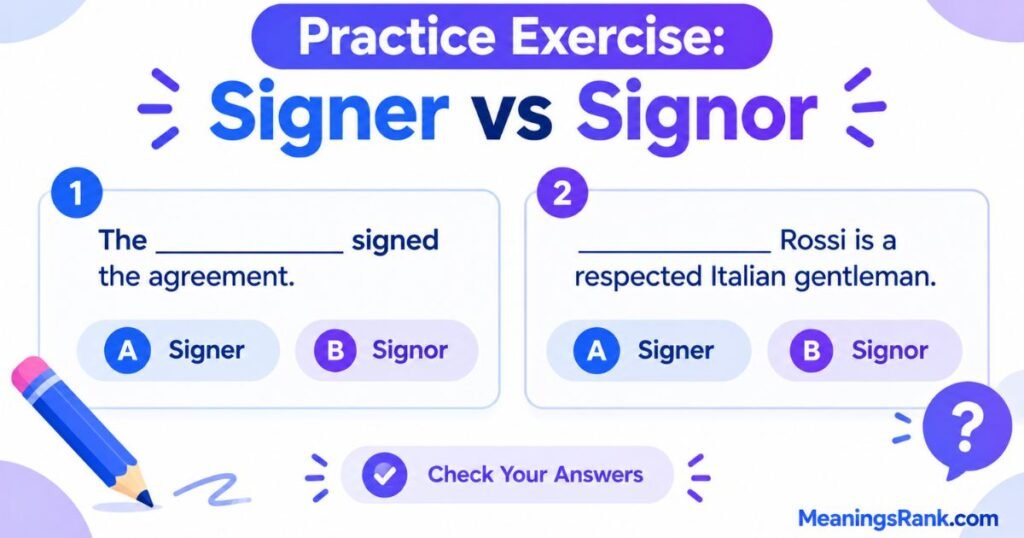
Fill in each blank with signer or Signor. Answers are at the bottom.
- The bank requires every ________ on the joint account to bring photo ID.
- “Buonasera, ________ Ricci,” said the waiter as we entered.
- Because she is a fluent ________, Lena volunteered to interpret at the assembly.
- The notary confirmed the identity of the ________ before witnessing the signature.
- In the opening chapter, ________ Fontana opens his small bookshop on a quiet Roman street.
Bonus challenge: Write one sentence that uses both words correctly. (Example: The signer of the deed, Signor Palmieri, arrived with his lawyer.)
Answer Key
- signer
- Signor
- signer (sign language user)
- signer
- Signor
Score guide: 5/5 means you have it down. 3-4 means review the mnemonic. Below 3? Reread the “Key Differences” table and try again.
Read More: Emersion vs Immersion: Key Differences, Meanings & Correct Usage (2026)
Key Takeaways: Signer vs Signor
- Signer = a person who signs a document or uses sign language.
- Signor = an Italian courtesy title for a man, like “Mr.”
- They have different origins: signer from Latin signum via French, signor from Latin senior via Italian.
- Pronunciation differs: SY-ner vs. SEE-nyor.
- Capitalize Signor before a name; do not capitalize signer mid-sentence.
- Signor is not an alternate spelling of signer.
- Use signora and signorina for women.
- In law and finance, signer, co-signer, and authorized signer are standard terms.
Frequently Asked Questions (FAQs)
Is it “signer” or “signor”?
It depends on meaning. Use signer for a person who signs something. Use Signor for the Italian title of respect before a man’s name.
Is “signor” a word in English?
Yes. Major dictionaries list signor as an English word borrowed from Italian. It is used as a title, usually capitalized, and often appears in writing about Italian people, places, or culture.
What is the difference between a signer and a signatory?
A signer is anyone who signs. A signatory is a party bound by an agreement they have signed, often in a formal or international context. Every signatory is a signer, but in careful legal writing the word signatory stresses the person’s status as a party.
How do you pronounce “signor”?
Say SEE-nyor, with the middle sound like the “ni” in “onion.” The stress can fall on the first or last syllable in English, though Italian speakers place it on the last. “Signer,” by contrast, sounds like SY-ner.
Conclusion
Signer and signor look like twins but live very different lives. A signer puts a name on a page or speaks in sign language. A Signor is an Italian gentleman addressed with courtesy. Keep the mnemonic close, “Signer signs, Signor salutes,” and check your pairing every time a form, contract, or Italian character shows up in your writing.