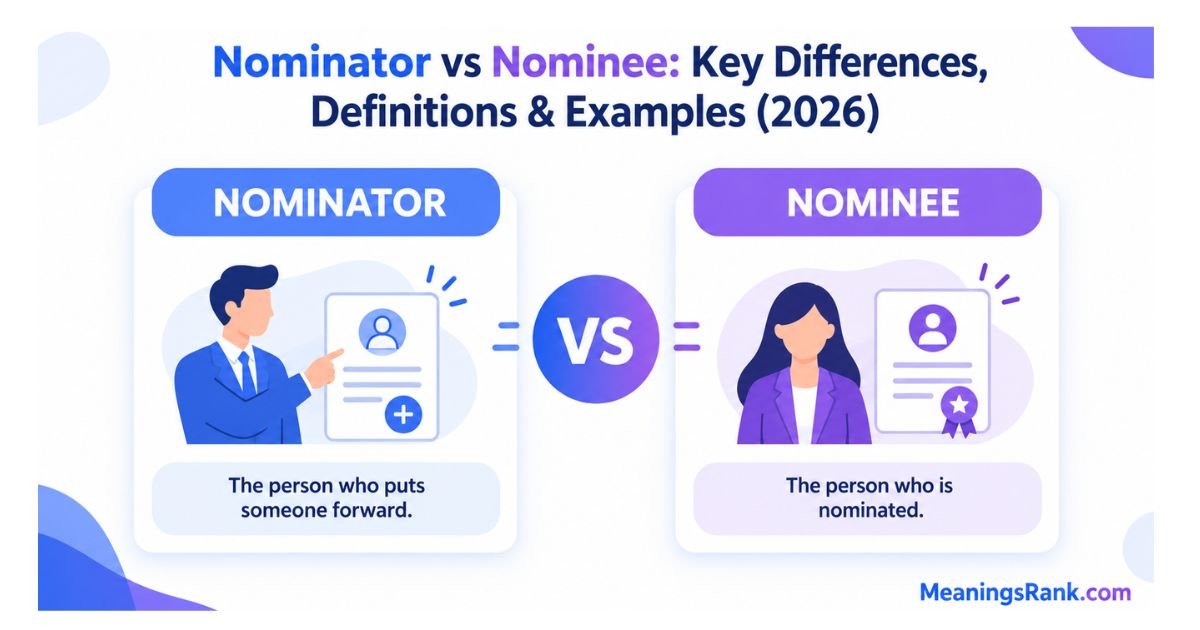

Quick Answer: A nominator is the person who proposes someone for an award, job, or office. A nominee is the person who is proposed. The nominator does the action, and the nominee receives it, just like employer and employee.
You have probably seen both words in the same news story: “The nominator submitted a glowing letter, and the nominee was shortlisted by Friday.” Two words, one process, and yet people swap them all the time.
The confusion is understandable. Both words grow from the Latin root nominare, meaning “to name.” Both sound formal, which makes writers nervous. But the mix-up has real costs. On an awards form, a bank account, or an insurance policy, using the wrong role can delay a payment, spoil a press release, or put the wrong name in a legal document.
This guide gives you the grammar rule, the real-world roles, plenty of examples, a memory trick, and a short quiz. By the end, you will choose the right word every time.
Nominator vs Nominee: The Core Difference
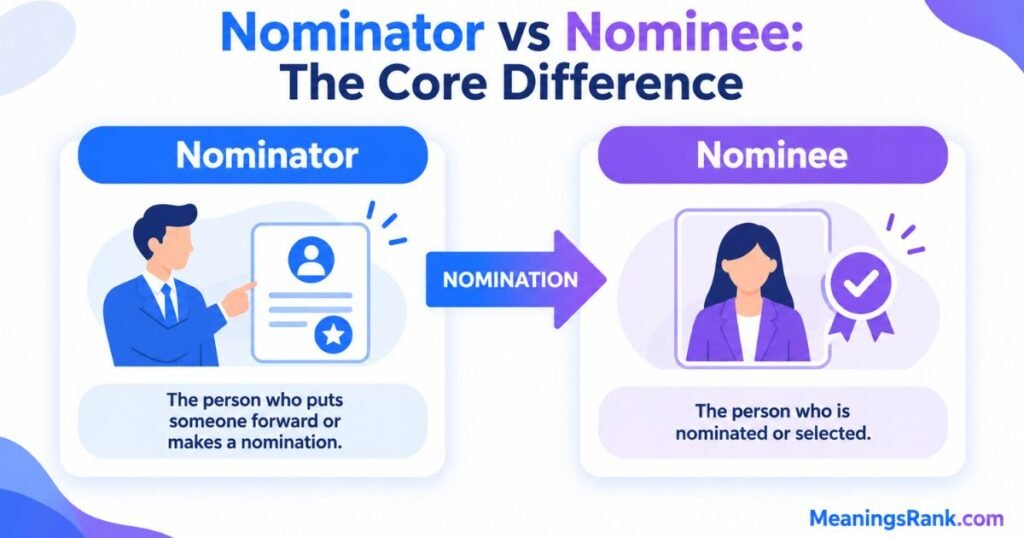
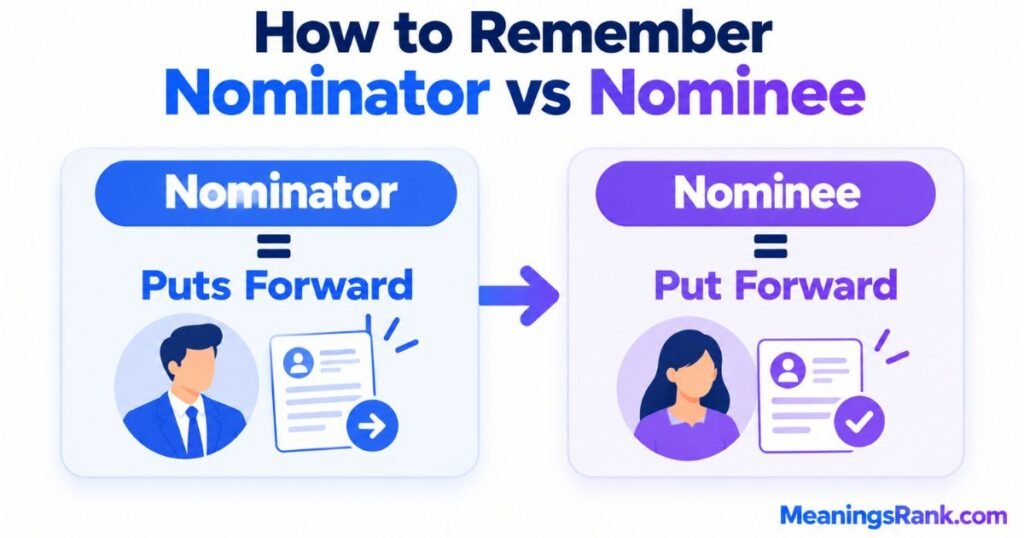
The difference comes down to direction. A nominator sends a name forward. A nominee is the name that gets sent.
In grammar, nominate is a transitive verb. It needs an object, because you always nominate someone. The subject of the clause is the nominator, and the object is the nominee.
The nominator nominated the nominee.
That one sentence holds the whole relationship. The nominator sits in the subject position. The nominee sits in the object position. If you can find the subject and the object in a sentence, you can find the two roles.
The suffixes confirm it:
- -or / -er marks an agent, a person who performs an action (director, creator, nominator).
- -ee marks a recipient, a person who receives or undergoes an action (employee, trainee, nominee).
The same pattern shows up in payer / payee, mortgagor / mortgagee, and interviewer / interviewee. Once you notice it, you will see it everywhere.
What Is a Nominator? Meaning, Definition & Role
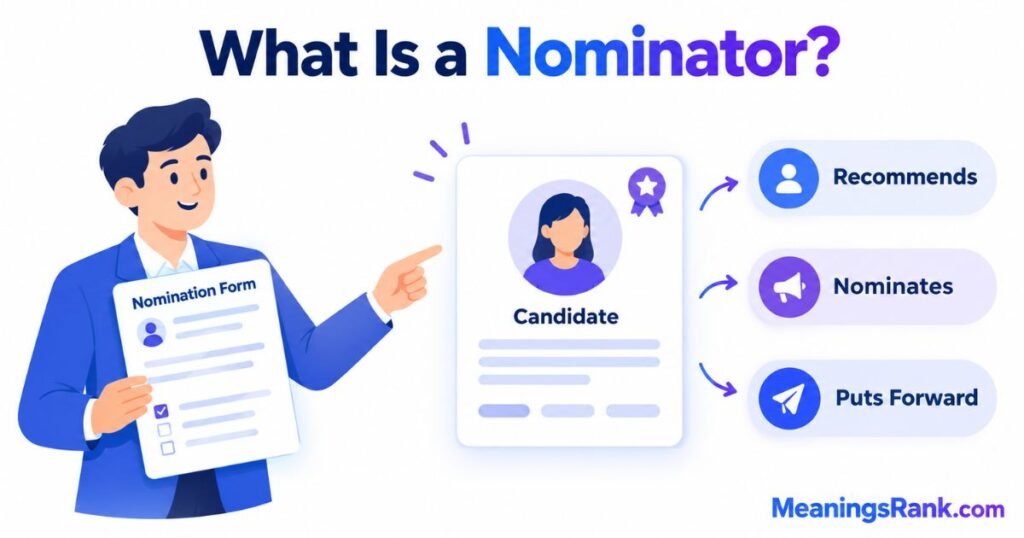
Definition: A nominator is a person or group that formally proposes someone as a candidate for a position, award, honor, or appointment.
Pronunciation: NOM-ih-nay-ter.
Part of speech: Noun (countable). The plural is nominators.
Read More: Batchelor vs Bachelor: Which Spelling Is Correct? Meaning & Examples (2026)
The nominator’s role is advocacy. They look at a person’s work, character, or qualifications and decide that the person deserves a place in the running. In many programs, the nominator is not just a name on a form. They must explain why the person deserves consideration, and their credibility can shape how seriously the nomination is taken.
A nominator can be:
- A single person, such as a teacher recommending a student for a scholarship.
- A group, such as a committee or a party delegation.
- An organization, such as a professional body putting forward a member for a lifetime achievement award.
- The candidate themselves, in systems that allow self-nomination. One person then holds both roles.
Responsibilities of a Nominator
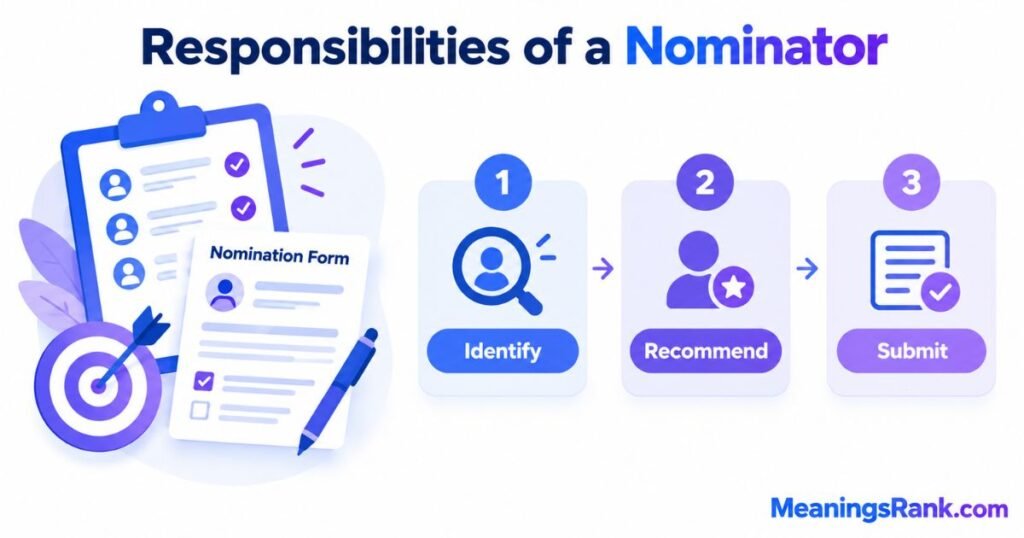
The exact duties depend on the program, but most nominators share the same core tasks.
- Check eligibility. Confirm that the person meets the stated criteria, such as age, profession, location, or years of service.
- Gather accurate information. Names, titles, dates, and achievements must be correct. A misspelled name on a nomination form is one of the most common and most avoidable errors.
- Write a persuasive statement. Most programs ask for a supporting statement or reference letter. Strong nominators use specific evidence, such as numbers, outcomes, and examples, instead of vague praise.
- Obtain consent when required. Some programs need the nominee’s agreement. Elections, for example, usually require the candidate’s signed acceptance.
- Meet the deadline. A brilliant nomination that arrives one day late is usually rejected.
- Stay honest and impartial. Many organizations ask nominators to disclose conflicts of interest, such as family ties or financial links.
A good nominator thinks like a defense lawyer and a fair witness at the same time: persuasive, but truthful.
What Is a Nominee? Meaning, Definition & Role
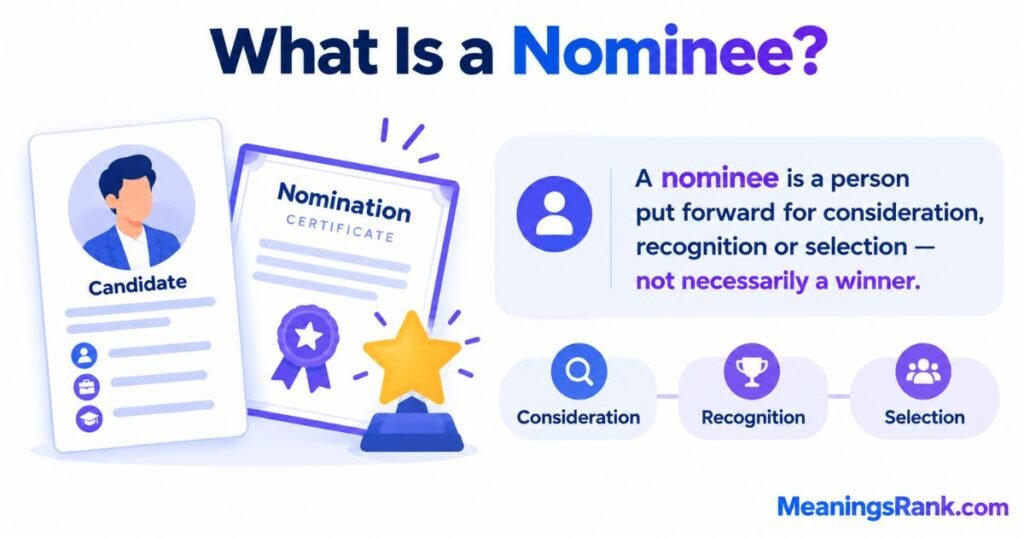
Definition: A nominee is a person who has been formally proposed for a position, award, honor, or office.
Pronunciation: nom-ih-NEE, with the stress on the final syllable.
Part of speech: Noun (countable). The plural is nominees.
A nominee holds a middle position. They are no longer just a possibility, but they have not yet won or been appointed. In competitive fields, being a nominee signals recognition and standing, and it can be a career milestone on its own. Film fans say it often: “Being an Oscar nominee changes how people see your work.”
Outside competitions, the word takes on specialized meanings. In banking and insurance, a nominee is the person named to receive money or benefits when the account holder or policyholder dies. In company law, a nominee director sits on a board on behalf of another party. Both uses are covered later in this article.
What Happens After Someone Becomes a Nominee?
Once a nomination is accepted, the nominee usually moves through a predictable sequence:
- Notification. The nominee is told, either privately or through a public announcement.
- Verification. The organization checks that the nominee meets the criteria and has no disqualifying issues.
- Review or campaign. Depending on the setting, a judging panel reviews the nominee’s work, or the nominee campaigns for votes.
- Decision. A vote, a panel ruling, or an appointment decides the outcome.
- Result. The nominee wins, is appointed, or is not selected. Even without a win, the person remains a nominee for that cycle, and many people list the honor on a resume.
One point trips people up: a nominee is not automatically a winner. “Nominee” describes the stage before the decision. After the decision, the right words are winner, recipient, or appointee.
Nominator vs Nominee: Key Differences at a Glance
| Feature | Nominator | Nominee |
| Role | Proposes or names someone | Is proposed or named |
| Grammatical position | Subject of nominate | Object of nominate |
| Suffix meaning | -or = the doer | -ee = the receiver |
| Pronunciation | NOM-ih-nay-ter | nom-ih-NEE |
| Typical action | Submits, recommends, supports | Accepts, is reviewed, may win |
| Typical document | Nomination form, reference letter | Candidate profile, acceptance form |
| In banking and insurance | Rarely used in forms | The person named to receive funds |
| Example | “The nominator wrote a detailed letter.” | “The nominee received the award.” |
The Nomination Process Explained

Each organization sets its own rules, but most nomination processes follow six stages.
- Call for nominations. The organization announces the opening, the criteria, and the deadline.
- Identification. A nominator identifies a person who fits the criteria.
- Submission. The nominator completes the form, supplies evidence, and submits it.
- Acceptance. The nominee agrees to be considered, where required.
- Evaluation. A committee, board, or voting body reviews all nominees.
- Selection. The final decision is announced.
Notice how the two roles hand off to each other. The nominator is busiest at stages two and three. The nominee takes center stage from stage four onward.
Nominator vs Nominee Examples in Real-Life Situations
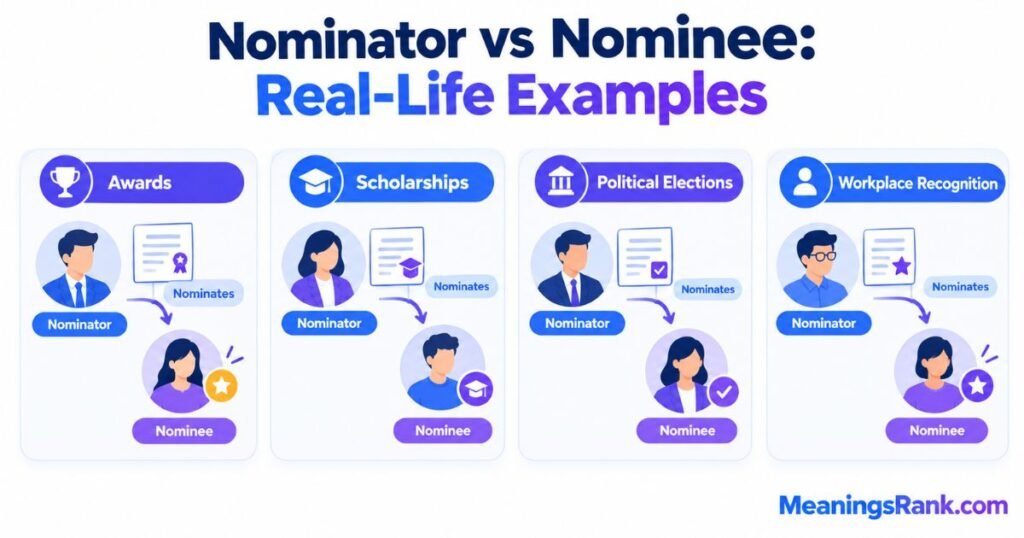
The same two roles appear in very different places. Seeing them in context is the fastest way to make the difference stick.
Awards and Recognition
In film, music, and literature, members of an academy or jury often act as nominators within their own category. The people whose work they name become nominees. A “Best Actor nominee” is the person on the shortlist, while the voters who put them there are nominators.
Local awards work the same way. A hospital employee who recommends a colleague for “Nurse of the Year” is the nominator, and the colleague is the nominee.
Read More: Accross vs Across: Discover the Correct Spelling, Meaning & Usage (2026)
Scholarship Programs
A high school teacher submits a student’s name to a merit scholarship program. The teacher is the nominator. The student is the nominee. The teacher writes a recommendation letter, and the student then completes an application and, in some programs, an interview.
Political Elections
In many countries, a candidate must be formally put forward before running. In some systems, the people who sign the paperwork are called proposers or seconders, which are specialized kinds of nominators. The candidate is the nominee. In the United States, a party’s presidential candidate is called the nominee once the party convention selects them.
Corporate Leadership
A board member proposes a respected executive for a seat on the board of directors. The board member is the nominator, and the executive is the nominee. Shareholders then vote. Many companies also run internal programs, such as “Employee of the Quarter,” where any coworker can act as a nominator.
Nominator vs Nominee in Banking
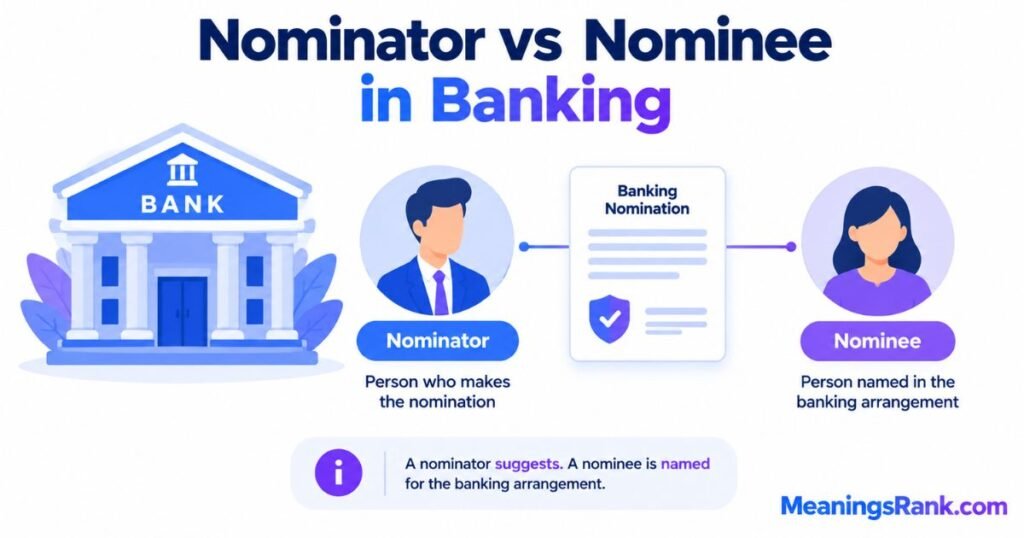
In banking, the word nominee has a specific meaning. When you open an account, many banks ask you to name a person who will be contacted and paid the balance if you die. That person is your nominee.
You, the account holder, make the nomination. In plain English, you are the nominator, although banking forms rarely use that word.
An important detail: in many jurisdictions, a bank nominee receives the money, but may not be its final legal owner. Succession laws and a will can still decide who is entitled to the funds. Check your local banking and inheritance rules, and ask a legal professional if a large sum is involved.
Nominator vs Nominee in Insurance

Insurance follows a similar pattern. The policyholder names a nominee, and that nominee collects the death benefit or claim amount if the policyholder passes away.
- Policyholder: the person making the nomination (the nominator in plain English).
- Nominee: the person named to receive the benefit.
Keep nominee details current. If you marry, divorce, or have a child, update the form. An outdated nominee is a common reason for claim delays and family disputes.
Nominator vs Nominee in Law
In legal writing, nominee often describes someone who holds an asset, a share, or a position on behalf of another party. Three common examples:
- Nominee shareholder: a person or company that holds shares in their own name while the real owner stays in the background.
- Nominee director: a person appointed to a company board who acts on instructions from another party.
- Nominee account: an account held in one name for the benefit of someone else.
Legal systems differ widely on what these arrangements allow and require, and disclosure rules have tightened in many countries. If you are dealing with a nominee arrangement for business or estate reasons, speak to a qualified solicitor or attorney.
Nominee in Politics: Meaning and Role
In politics, a nominee is a candidate officially selected by a party or authority to contest an office or fill a post. Two examples show the range:
- A party picks its presidential nominee at a national convention.
- A president selects a nominee for a court or cabinet post, and a legislative body must confirm that person.
In the second case, the president is effectively the nominator, and the legislature is the decision maker. A political nominee draws public attention, so their record, statements, and background are examined closely before the final decision.
Example Sentences Using Nominator
Notice how the nominator is always the one performing an action.
- The nominator submitted three letters of support before the deadline.
- As her nominator, Dr. Rahman described Amina’s research as exceptionally original.
- Each nominator must confirm that they have no financial link to the candidate.
- The committee contacted the nominator to clarify one detail on the form.
- Being a good nominator means gathering evidence, not just offering praise.
- The two nominators signed the candidate’s papers on Monday morning.
- A nominator who misses the deadline cannot resubmit the form.
- The award panel thanked every nominator for their thoughtful statements.
Example Sentences Using Nominee
Notice how the nominee is always the one being named, reviewed, or chosen.
- The nominee was surprised to learn that a former student had put her name forward.
- Five nominees were shortlisted for the lifetime achievement award.
- The party’s nominee will address delegates tonight.
- Although she was not the winner, the nominee received a standing ovation.
- The bank asked him to list a nominee for his savings account.
- The Senate will vote on the president’s nominee next week.
- Every nominee must submit a short biography by Friday.
- My uncle changed his insurance nominee after his daughter was born.
Common Mistakes When Using Nominator and Nominee
Most errors fall into a few patterns. Spotting them will sharpen both your writing and your proofreading.
| Incorrect | Correct | Why |
| The nominee wrote the recommendation letter for the nominator. | The nominator wrote the recommendation letter for the nominee. | The roles are reversed. The nominator writes the letter. |
| She was the nominator for the award last year. (meaning she was shortlisted) | She was the nominee for the award last year. | The shortlisted person is the nominee. |
| He is a nominator in the final round. (meaning he is a contender) | He is a nominee in the final round. | Contenders are nominees, not nominators. |
| The nominee won the trophy. (used after the result is announced, as a title) | The winner (or recipient) took home the trophy. | After the decision, the label changes. |
| The nominer list was published today. | The nominee list was published today. | “Nominer” is a misspelling. |
| The board will nominee a new chair. | The board will nominate a new chair. | Only nominate is a verb. |
| She was nominated at the award. | She was nominated for the award. | Use for an award, to a board, as a candidate. |
More mistakes to avoid:
- Assuming “-ee” sounds more formal. It does not. It simply marks the receiver of the action.
- Confusing “nominee” with “winner.” A nominee is on the shortlist. A winner is chosen from it.
- Dropping the hyphen in compound modifiers. Write “an Oscar-nominated film” and “a Grammy-nominated singer” when the phrase comes before the noun.
- Capitalizing by habit. Treat nominee and nominator as common nouns in mid-sentence. Capitalize only at the start of a sentence or inside an official title, following your style guide.
Four edge cases are worth knowing too:
- Self-nomination. Some programs let you nominate yourself. Write it plainly: “She acted as both nominator and nominee.”
- Banking and insurance. Here the nominee is a designated recipient, not a contender. No judging happens.
- Group nominators. A committee can be a nominator. British English often allows a plural verb (“The committee are the nominators”), while American English prefers the singular (“The committee is the nominator”). Pick one style and stay consistent.
- Proposer, seconder, sponsor. In formal elections and meetings, these terms often replace “nominator.” Use the term your rulebook uses.
Related Words and Similar Terms
These words sit close to our pair. Knowing them helps you choose the most precise term.
| Word | Meaning | How it differs |
| Nominate | To propose someone formally | The verb behind both nouns |
| Nomination | The act of proposing, or the proposal itself | The process, not a person |
| Nominal | Existing in name only, or very small (a “nominal fee”) | An adjective, unrelated to the roles |
| Candidate | A person seeking a position | Broader; may or may not be nominated |
| Finalist | A nominee who reaches the last round | A narrower, later stage |
| Appointee | A person selected for a post | The outcome, not the shortlist stage |
| Honoree | A person receiving an honor | The outcome, not the process |
| Proposer / Seconder | People who put a name forward in formal meetings | Specialized forms of nominator |
| Sponsor | A person who supports another’s application | Often broader and more involved |
| Beneficiary | A person who receives money or assets | In banking and insurance, closely tied to nominee |
| Designee | A person designated for a role or task | A near synonym for nominee in some contexts |
Pay special attention to nominal. It shares the root with nominee, but it describes size or status, not people in a nomination. “A nominal fee” has nothing to do with awards.
How to Remember the Difference Between Nominator and Nominee
Pick the trick that sticks best.
Trick 1: The “-or” does, the “-ee” gets. An act-or acts. A nominat-or nominates. An employ-ee is employed. A nomin-ee is nominated. If the ending is “-or,” the person acts. If it is “-ee,” the person receives.
Trick 2: The double E. Nominee ends with two E’s, like receive. The nominee receives the nomination.
Trick 3: Say it out loud. “The nominator names, and the nominee is named.” The repeated N sound makes the pairing easy to recall.
Run a quick test: “The ______ was announced at the ceremony.” If the blank is a person up for an award, the answer is nominee. If the blank is the person who wrote the proposal, the answer is nominator.
Read More: Emersion vs Immersion: Key Differences, Meanings & Correct Usage (2026)
Practice Quiz: Nominator vs Nominee
Fill in each blank with nominator or nominee. Cover the answer key until you have finished.
- The teacher acted as the ________ and sent three pages of evidence to the scholarship board.
- Every ________ on the shortlist was invited to the awards dinner.
- Please list a ________ on your insurance policy so the benefit can be paid quickly.
- The ________ must sign the form to confirm that the details are correct.
- After the convention, the party’s ________ began a tour of the swing states.
Answer Key
- nominator. The teacher proposes the student.
- nominee. Shortlisted people are nominees.
- nominee. In insurance, the nominee receives the benefit.
- nominator. The person who submits the form signs it.
- nominee. The candidate chosen by the party is its nominee.
Scoring: 5 out of 5 means you have mastered it. A score of 3 or 4 means you are close, so reread the memory tricks. A score of 2 or lower means a second pass through the definitions will help.
Frequently Asked Questions (FAQs)
What is the difference between a nominator and a nominee?
A nominator is the person who proposes someone for an award, job, or office. A nominee is the person who is proposed. The nominator takes the action, and the nominee receives it.
Can a person be both a nominator and a nominee?
Yes, in programs that allow self-nomination. The same person submits their own name and is also the candidate under review. Some competitions forbid this, so read the rules first.
What does nominee mean in banking and insurance?
In banking and insurance, a nominee is the person you name to receive your account balance or policy benefit after your death. The nominee is not always the final legal owner, because wills and succession laws can still apply. Review your local rules and update your nominee after major life events.
Is a nominee the same as a candidate?
Not exactly. A candidate is anyone seeking a position or prize. A nominee is a candidate who has been formally put forward. Every nominee is a candidate, but not every candidate has been nominated.
Does being a nominee mean you have won?
No. A nominee is on the shortlist and has not yet been chosen. Once a decision is made, the person becomes a winner, recipient, or appointee, while the others remain nominees for that cycle.
How do you pronounce nominator and nominee?
Nominator is pronounced NOM-ih-nay-ter, with the stress on the first syllable. Nominee is pronounced nom-ih-NEE, with the stress on the last syllable. The shifting stress helps separate the two words in speech.
Final Thoughts
A nominator proposes, and a nominee is proposed. That one-line rule solves almost every confusion between these two words. Remember the suffix pattern: “-or” marks the doer, and “-ee” marks the receiver, just like employer and employee. Keep in mind that banking, insurance, and law give nominee a special meaning, where the nominee is a named recipient rather than a contender. Check your prepositions, avoid the “nominer” spelling, and never use “nominee” as a verb. Return to the memory tricks and the quiz whenever you need a refresher, and your writing will stay clear, accurate, and professional throughout 2026 and beyond.