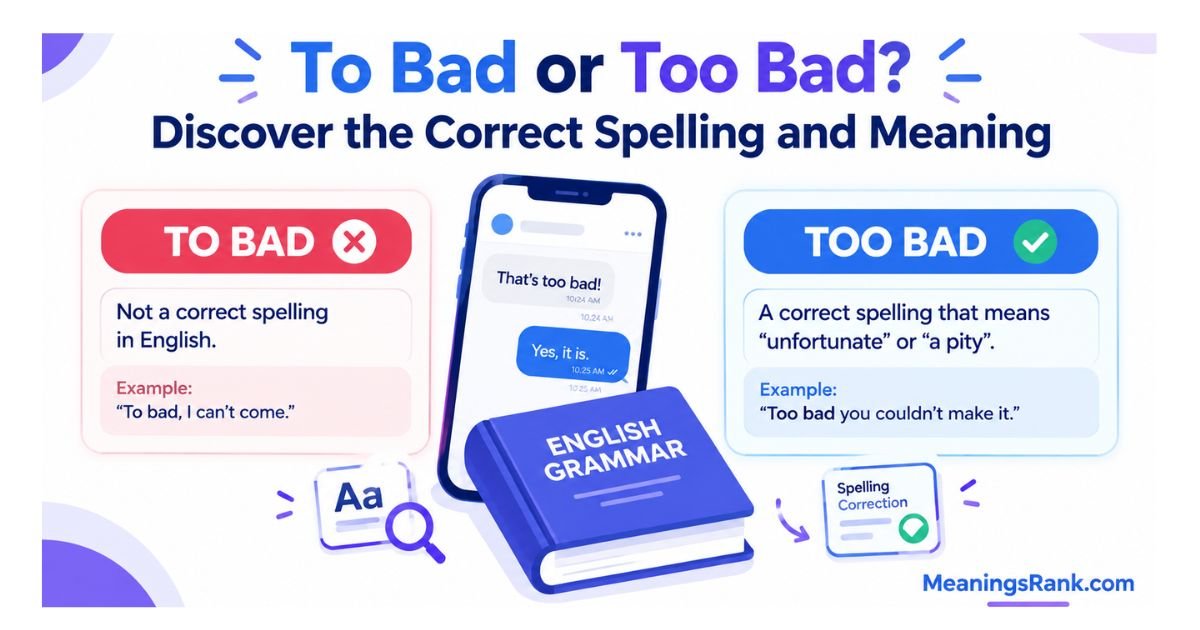

You are typing a quick message to a friend who just missed a train. You want to say how sorry you are, so you write, “To bad!” Then you pause. Something looks off.
That pause is worth trusting. The mix-up between “to bad” or “too bad” is one of the most common spelling slips in English, and it catches native speakers and learners alike. The answer is simple: “too bad” is correct, and “to bad” is not. The trouble is that “to,” “too,” and “two” sound identical, so your ear gives no warning.
This guide gives you more than the verdict. You will see why the spelling works, what the phrase means in different tones, how it differs from “not too bad,” and when “to bad” can legitimately appear in a sentence. Clear grammar builds trust with readers, whether you are writing an email, an essay, or a text message. Master this one pair of words, and you will sharpen your instinct for the whole to, too, and two family.
Quick Answer: To Bad vs Too Bad — Which Is Correct?
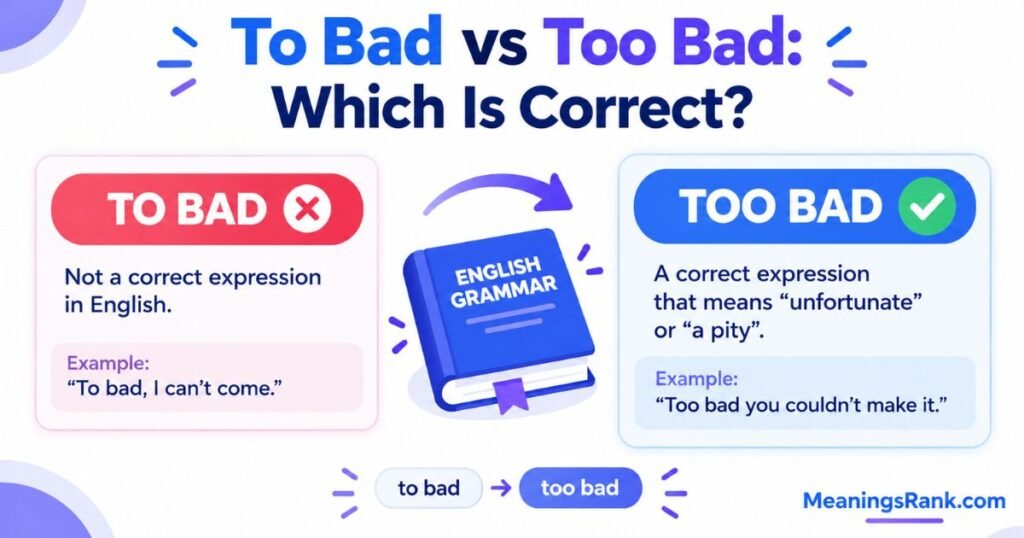
“Too bad” is the correct spelling. “To bad” is a mistake in almost every situation. The word “too” is an adverb that means “excessively,” “also,” or, in this expression, “unfortunate.” The word “to” is a preposition or an infinitive marker, and it cannot sit directly in front of “bad” to express regret.
| Verdict | Example | |
| Too bad | Correct | Too bad you missed the concert. |
| To bad | Incorrect | ~~To bad you missed the concert.~~ |
Quick reference: Use “too bad” when you want to say “that’s unfortunate” or “what a pity.” Use “not too bad” when you mean “fairly good.” If you are unsure, swap in the word “unfortunate.” If the sentence still makes sense, “too bad” is your spelling.
Why “Too Bad” Is Correct and “To Bad” Is Wrong
The reason comes down to parts of speech. In the phrase “too bad,” the word “too” is an adverb that modifies the adjective “bad.” Adverbs describe adjectives, verbs, and other adverbs, so this pairing is grammatically sound. It follows the same pattern as “too late,” “too cold,” and “too expensive.”
Now look at “to.” It is not an adverb. It works as a preposition (“to the store”) or as part of an infinitive verb (“to run”). Neither role fits when you place it before a bare adjective like “bad.” You cannot say “to late” or “to cold” for the same reason. “To bad” fails the syntax test.
Here is a simple way to see it. When you say “Too bad it rained,” you are shortening a fuller clause: “It is too bad that it rained.” The adverb “too” sits inside a complete predicate. The version with “to” breaks that structure and leaves the sentence without a working grammatical frame.
Style guides and dictionaries agree. Major references list “too bad” as a fixed idiomatic expression, and none of them record “to bad” as an accepted variant. That consistency is why teachers, editors, and professional proofreaders mark “to bad” as an error without hesitation.
Too Bad Meaning in English (A Complete Explanation)
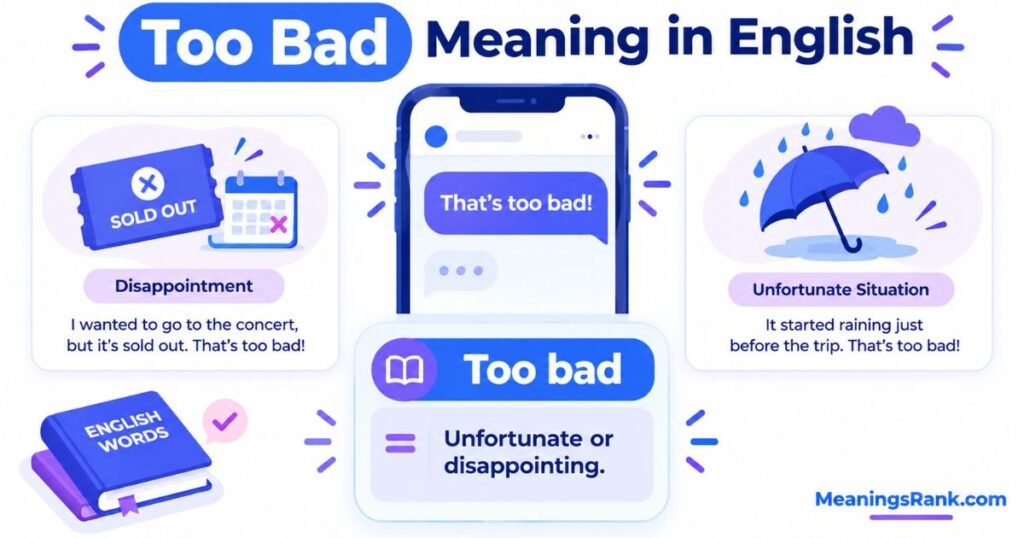
“Too bad” is an idiom, which means its meaning is larger than the sum of its parts. It has three main uses, and each one depends on tone and context.
1. Expressing sympathy or regret.
This is the most common meaning. It says, “That’s unfortunate.” Example: “Too bad you can’t join us tonight.” The speaker feels a mild sense of disappointment for the listener or for the situation.
2. Dismissing a complaint.
Here the phrase turns blunt, even sharp. It means, “That’s your problem, and I won’t change anything.” Example: “You don’t like the schedule? Too bad. It’s final.” The tone carries little sympathy and can sound cold.
3. Describing something that is excessively poor.
In this literal reading, “too” means “excessively” and “bad” keeps its basic meaning. Example: “The soup was too bad to eat.” The structure is adverb plus adjective, followed by an infinitive.
Notice how much meaning depends on delivery. A soft voice makes “too bad” kind. A flat voice makes it dismissive. In writing, punctuation and surrounding words do that job for you, which is why a comma or an exclamation mark can change the emotional temperature of the line.
Read More: Ironic vs Unironic: Key Differences, Definitions & Real-Life Examples
Grammar Rule for “Too” (An Important Foundation)
Before using “too bad” with confidence, it helps to understand the word “too” itself. It has three standard jobs.
Job one: “excessively.”
The adverb signals more than is wanted or needed. “This coffee is too hot.” Here “too” modifies the adjective “hot.”
Job two: “also” or “as well.”
The adverb adds information. “I’m going too.” It usually appears at the end of a clause, often after a comma in formal writing.
Job three: intensifier in idioms.
Expressions like “too bad,” “too good to be true,” and “only too happy” use “too” in a figurative way.
The golden rule is straightforward: “too” is an adverb; it needs something to modify or something to add. Place it before an adjective or adverb (“too fast,” “too slowly”), or at the end of a clause to mean “also.”
By contrast, “to” is a preposition that shows direction or relationship (“went to Lahore”) or the marker of an infinitive verb (“wants to learn”). It almost never touches an adjective directly. Once you hold on to this contrast, the confusion around “to bad” begins to fade. You are really sorting words by function, and function is the foundation of good syntax.
How to Use “Too Bad” Correctly (Structure Guide)
“Too bad” is flexible, but it follows a few predictable sentence patterns. Learn these and you will rarely slip.
Pattern 1: Standalone interjection.
“Too bad!” or “Oh, too bad.” The phrase works as a complete utterance in speech. In writing, follow it with an exclamation mark or a period.
Pattern 2: Too bad + clause.
“Too bad you didn’t call.” The clause that follows names the unfortunate event. The linking word “that” is optional: “Too bad that you didn’t call.”
Pattern 3: It’s too bad + that-clause.
“It’s too bad that the store closed.” This is the more formal version. It includes a subject (“it”), a linking verb (“is”), and a predicate adjective phrase (“too bad”).
Pattern 4: Too bad + about + noun.
“Too bad about the weather.” The preposition “about” introduces the topic of regret.
Pattern 5: Too + bad + to + verb.
“The road was too bad to drive on.” Here “too” and “to” appear together in the same sentence, each doing its own job. This is the pattern that confuses many learners most, and we will return to it later.
Punctuation tip:
When “too bad” opens a sentence as an interjection, a comma often separates it from the next clause in more formal writing: “Too bad, we missed the train.”
Too Bad in Sentences (Real-Life Usage Examples)
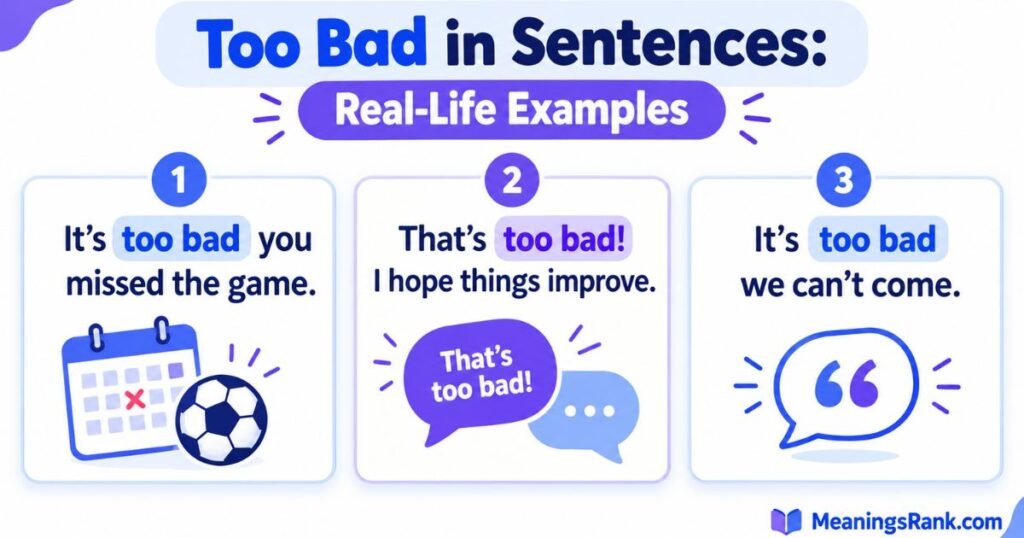
Seeing the phrase in context builds instinct faster than any rule. Here are examples grouped by purpose.
Sympathy and mild regret
- Too bad the museum is closed on Mondays.
- It’s too bad you won’t be here for the festival.
- Too bad about your laptop. Can I help you look at it?
Dismissive or firm tone
- If you forgot your homework, too bad. The deadline has passed.
- He wanted a refund, but the policy was clear. Too bad.
Literal meaning with “excessively bad”
- The connection was too bad to hold a video call.
- Her handwriting is too bad for anyone to read.
Workplace and formal writing
- It is too bad that the project timeline shifted, but we have a revised plan.
- Too bad the vendor missed the deadline; we will source another supplier.
Casual speech
- “I couldn’t get tickets.” “Aw, too bad.”
- Too bad it’s raining. We had such a good plan.
Notice that in every sentence, “too” is followed directly by “bad” and means the same thing as “unfortunate” or “excessively.” You will never find a natural example where “to” replaces it.
To Bad vs Too Bad: A Clear Comparison
The table below places the two forms side by side so you can see the difference at a glance.
| Feature | Too Bad | To Bad |
| Correct as an expression? | Yes | No |
| Part of speech | Adverb + adjective | Preposition + adjective (not a valid pair) |
| Meaning | Unfortunate; a pity; excessively poor | No standard meaning |
| Example | Too bad you can’t come. | ~~To bad you can’t come.~~ |
| Found in dictionaries? | Yes, as an idiom | No |
| Register | Informal to semi-formal | Always an error |
Correct vs. incorrect transformations
| Incorrect | Correct |
| To bad you lost the match. | Too bad you lost the match. |
| It’s to bad that he left. | It’s too bad that he left. |
| That is to bad to be true. | That is too bad to be true. (or better: “too good to be true”) |
| He felt to bad about it. | He felt too bad about it. (or “felt bad about it”) |
Formal vs. informal usage
| Informal | More Formal |
| Too bad! | That is unfortunate. |
| Too bad you can’t make it. | I regret that you are unable to attend. |
| Aw, too bad. | What a shame. |
The lesson: the spelling never changes, only the tone does.
Not Too Bad vs To Bad: Understanding the Difference
Here is where many writers get tangled. “Not too bad” is a separate expression, and it means almost the opposite of what “too bad” suggests.
“Not too bad” means “fairly good” or “better than expected.” Speakers use it as a modest, understated reply.
- “How was the movie?” “Not too bad, actually.”
- “How are you feeling?” “Not too bad, thanks.”
This is an example of litotes, a figure of speech that makes a positive point by denying its negative. The speaker uses a negative construction (“not … bad”) to deliver a mild compliment.
Now compare that with “to bad.” Writers sometimes create the error “not to bad” by dropping the second “o.” It looks small on the page, but it changes the grammar entirely, and the result still has no meaning.
| Expression | Meaning | Correct? |
| Too bad | Unfortunate | Yes |
| Not too bad | Fairly good | Yes |
| Not to bad | No meaning | No |
| To bad | No meaning | No |
Spot the nuance: “Too bad” signals disappointment. “Not too bad” signals mild approval. Mixing them up can change the whole message. Tell your friend “Too bad!” after hearing about their exam, and you are sympathizing. Tell them “Not too bad!” and you are saying the result was decent.
Too Bad as an Expression: Tone, Context, and Meaning
Because “too bad” is an idiom, tone matters as much as spelling. The same two words can comfort a friend or end an argument.
Warm tone:
In a supportive setting, “too bad” works like a verbal pat on the shoulder. A colleague tells you the printer broke before the big presentation, and you reply, “Oh, too bad. Let me find another one.” The phrase sounds gentle because it is paired with an offer.
Neutral tone:
In news writing or everyday reports, “too bad” states a mild regret without much emotion: “It’s too bad the festival was canceled.”
Cold or sarcastic tone:
Add a flat voice, a shrug, or a short follow-up, and the idiom turns sharp: “You wanted more time? Too bad.” Many speakers use this to close a discussion. In professional writing, you should use it with care because it can read as dismissive.
Context checklist
- With a friend, “too bad” usually reads as sympathetic.
- With a customer, it can sound rude unless softened.
- In a formal email, prefer “unfortunately” or “I regret to hear.”
- In a text message, it feels natural and relaxed.
If you remain unsure about tone, choose a longer alternative. “I’m sorry to hear that” always lands safely.
Read More: Cocoon or Cacoon: Which Is the Correct Spelling? (2026)
Too Bad Conversation Examples (Natural English)
Short dialogues show how “too bad” behaves in real speech. Read each one aloud and listen to the rhythm.
Dialogue 1: Sympathy between friends
Ayesha: I couldn’t go to the cricket match. My ticket never arrived.
Hamza: Oh, too bad! It was a great game.
Ayesha: I know. Maybe next season.
Dialogue 2: Office setting
Manager: The client moved the meeting to Friday.
Sara: That’s too bad. I had planned to travel on Thursday night.
Manager: Let’s see whether we can adjust the schedule.
Dialogue 3: Dismissive tone
Customer: Can I return this after sixty days?
Clerk: The policy says thirty. Too bad.
Customer: That seems harsh.
Dialogue 4: Understatement with “not too bad”
Teacher: How was your first week at the new school?
Student: Not too bad. I’ve made two friends already.
Each dialogue uses “too” with its correct function. In none of them would “to” make sense in the same spot.
Too Bad Synonyms and Alternative Expressions
Varied vocabulary makes your writing sound polished. The right alternative depends on tone and formality.
Sympathetic alternatives
- What a pity.
- What a shame.
- That’s unfortunate.
- I’m sorry to hear that.
- That’s a real shame.
Formal alternatives
- Unfortunately, …
- It is regrettable that …
- I regret that …
- It is a pity that …
Casual alternatives
- Bummer.
- Tough luck.
- That stinks.
- Oh well.
- Sorry about that.
| Tone | Best Choice | Example |
| Warm | What a shame | What a shame you missed the trip. |
| Formal | Unfortunately | Unfortunately, the seminar has ended. |
| Casual | Bummer | Bummer, the store is closed. |
| Blunt | Tough luck | Tough luck, the seats are gone. |
Pick the alternative that matches your audience. A formal report rarely welcomes “bummer,” and a quick message to a friend rarely needs “it is regrettable.”
Why People Confuse “To Bad” and “Too Bad”
The confusion is natural, and it comes from three main sources.
1. Homophones:
The words “to,” “too,” and “two” are pronounced identically in standard English. When you only hear a phrase, you cannot tell which spelling applies. Writers then rely on memory, and memory occasionally fails.
2. Fast typing and autocorrect habits:
Many people type quickly and skip the second “o.” Spellcheck rarely catches the slip because “to” is a valid word. The software sees “to bad” as two real words, and it does not flag an error even though the grammar is wrong.
3. Spoken English has no visible spelling:
In conversation, “too bad” is often shortened and run together. The “too” is unstressed, so it can sound like “to.” Learners who pick up English by listening may never see the written form.
4. Pattern interference from other phrases:
Expressions like “to be honest” and “to go bad” are real and common. They can make “to bad” feel familiar on the page, even though the structure is different.
Knowing the cause helps you build a defense. Slow down, read the phrase aloud as “excessively unfortunate,” and check the function of the small word before you hit send.
Common Mistakes with To, Too, and Two
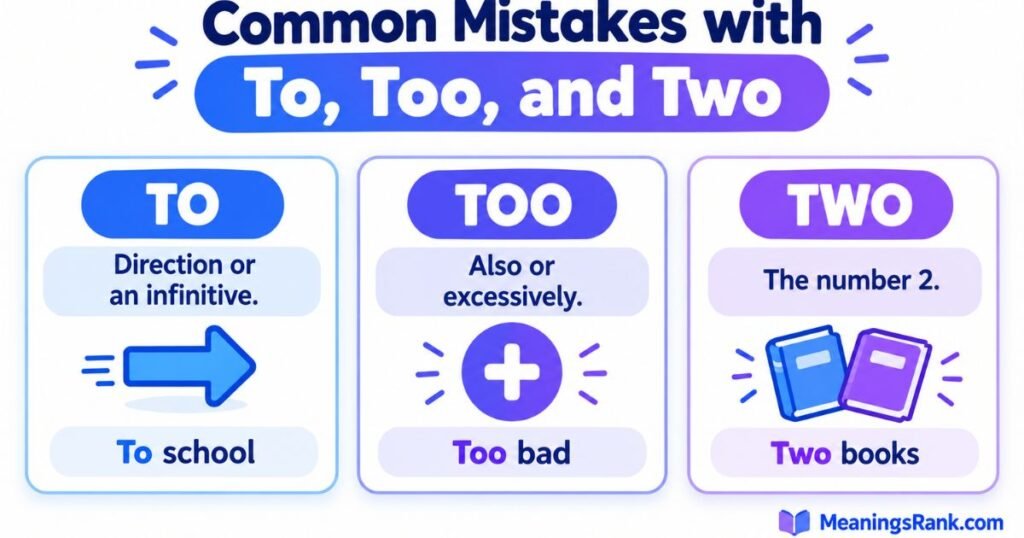
Mastering “too bad” opens the door to mastering all three homophones. Here is a compact guide.
| Word | Part of Speech | Meaning | Example |
| To | Preposition / infinitive marker | Direction, purpose, or the base form of a verb | She walked to school. I want to read. |
| Too | Adverb | Excessively; also | It’s too late. I’m coming too. |
| Two | Number | The number 2 | I have two brothers. |
Common errors
- ❌ I want to go to. → ✅ I want to go too.
- ❌ It’s to late. → ✅ It’s too late.
- ❌ There are too cats. → ✅ There are two cats.
- ❌ Too bad to hear that. → ✅ It’s too bad to hear that. or Too bad you heard that.
Edge case: when “to bad” can legitimately appear:
This is a point many competitors skip. The letters “to bad” can appear next to each other in a correct sentence when “to” is a preposition and “bad” modifies a noun that follows it. Examples:
- The crops were exposed to bad weather. (to + bad weather)
- She gave the dog to bad owners. (to + bad owners)
- The mood changed from good to bad. (to + bad as a noun-like complement)
In these sentences, “to” has a real job. It links a verb or noun to its object. The error occurs only when someone tries to use “to bad” as a standalone expression of regret.
Grammar Correction Tips for Using “Too Bad”
Use these quick checks when you edit your own work or help a student with a draft.
Tip 1: The “unfortunate” swap:
Replace the phrase with “unfortunate.” If “It’s unfortunate you left early” sounds right, then “It’s too bad you left early” is the correct form.
Tip 2: The “excessively” test:
If you mean “excessively,” try “excessively bad.” “The road was excessively bad” works, so “too bad” works.
Tip 3: Check what follows:
If a noun follows “bad” directly (“bad weather”), then “to” may be a preposition in front of that noun phrase. If a clause follows (“you left”), you want “too.”
Tip 4: Read it aloud and add emphasis:
Stress the word “too” and see whether it sounds like “also” or “very.” If it does, you have the right homophone.
Tip 5: Watch punctuation:
A comma helps when “too bad” begins a longer sentence: “Too bad, the team lost.”
Tip 6: Match the style guide:
Academic style guides often discourage idioms in formal prose. In a research paper, use “unfortunately” or “regrettably.”
Tip 7: Proofread for homophones last. Spellcheck can’t judge function, so give “to,” “too,” and “two” a dedicated final read.
Read More: Excited vs Exited: Discover the Correct Meaning, Spelling & Usage (2026)
Practice Session: To Bad vs Too Bad
Test yourself. Fill in each blank with to, too, or two. Write your answers before checking the key.
Quiz
- It’s ______ bad that the library closes early on Fridays.
- The storm was ______ bad ______ ignore, so we stayed home.
- “How was the exam?” “Not ______ bad, I think I passed.”
- She moved from a good school ______ bad conditions, and she struggled.
- We ordered ______ pizzas, but it was ______ much food.
- ______ bad you couldn’t make it to the wedding.
Answer Key
- too — “too bad” is the idiom meaning unfortunate.
- too / to — “too bad” means excessively bad, and “to ignore” is an infinitive.
- too — “not too bad” means fairly good.
- to — a preposition before “bad conditions.”
- two / too — “two pizzas” is a number, and “too much” means excessive.
- Too — “Too bad” opens the sentence as an expression of regret.
Score yourself: 6 correct means you’ve mastered the rule. 4 to 5 means you are close; review the section on to, too, and two. Below 4, read the grammar rule for “too” again and retry the quiz tomorrow.
Frequently Asked Questions (FAQs)
Is it “to bad” or “too bad”?
It is “too bad.” The word “too” is an adverb that modifies “bad,” and the phrase means “unfortunate.” “To bad” is incorrect as an expression of regret.
What does “too bad” mean?
“Too bad” means “that’s unfortunate” or “what a pity.” In some contexts, it dismisses a complaint (“Too bad, the answer is no”). In a literal sense, it can also mean “excessively poor,” as in “The signal was too bad to use.”
Is “not too bad” the same as “too bad”?
No. “Not too bad” means “fairly good” or “better than expected.” “Too bad” expresses regret. Their meanings are close to opposite, so be careful not to confuse them.
Can I use “too bad” in formal writing?
You can, but it is informal. In an academic paper, business letter, or formal email, replace it with “unfortunately,” “regrettably,” or “it is a pity that.” Keep “too bad” for casual messages and conversation.
Why does spellcheck not catch “to bad”?
Spellcheck checks whether a word exists, not whether it fits the grammar. Because “to” and “bad” are both real words, the tool sees nothing wrong. A careful proofread is the only reliable defense.
Conclusion
“Too bad” is the only correct spelling for the expression of regret, because “too” is an adverb and “to” is a preposition or infinitive marker. Remember the swap test: if “unfortunate” fits, write “too bad.” Keep practicing with the quiz and the correction tips above, and the to, too, and two confusion will become a habit you never think about again.