
You are typing an email invitation. The sentence reads: “Join us for an in person workshop.” You pause. Something looks off. Should there be a hyphen? Or is the hyphen just a fussy detail that only editors care about?
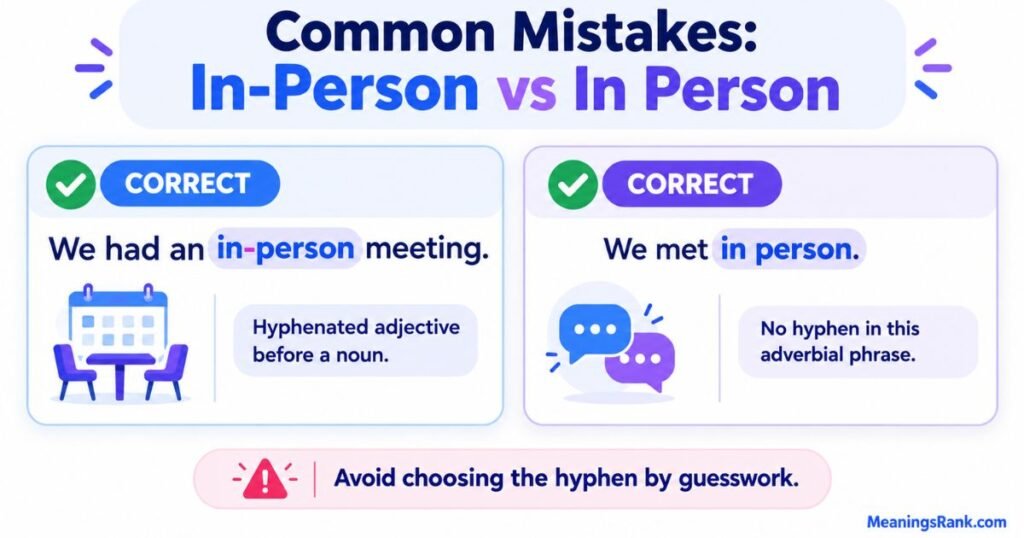
This tiny punctuation choice trips up students, marketers, HR teams, and journalists every single week. The short answer is simple. Write “in-person” with a hyphen when it describes a noun, and write “in person” without a hyphen when it tells how, or where, something happens. One form is an adjective. The other is an adverbial phrase.
At MeaningsRank, we treat grammar as a set of tools rather than a list of traps. Once you see the logic behind this pair, you will apply it without thinking. Your emails, résumés, job posts, school notices, and event pages will all look polished and consistent.
This guide covers the meaning, the syntax, the style guide positions, the exceptions, and a practice quiz at the end. Give it ten minutes, and the question will be settled for good.
Quick Answer: In-Person vs In Person
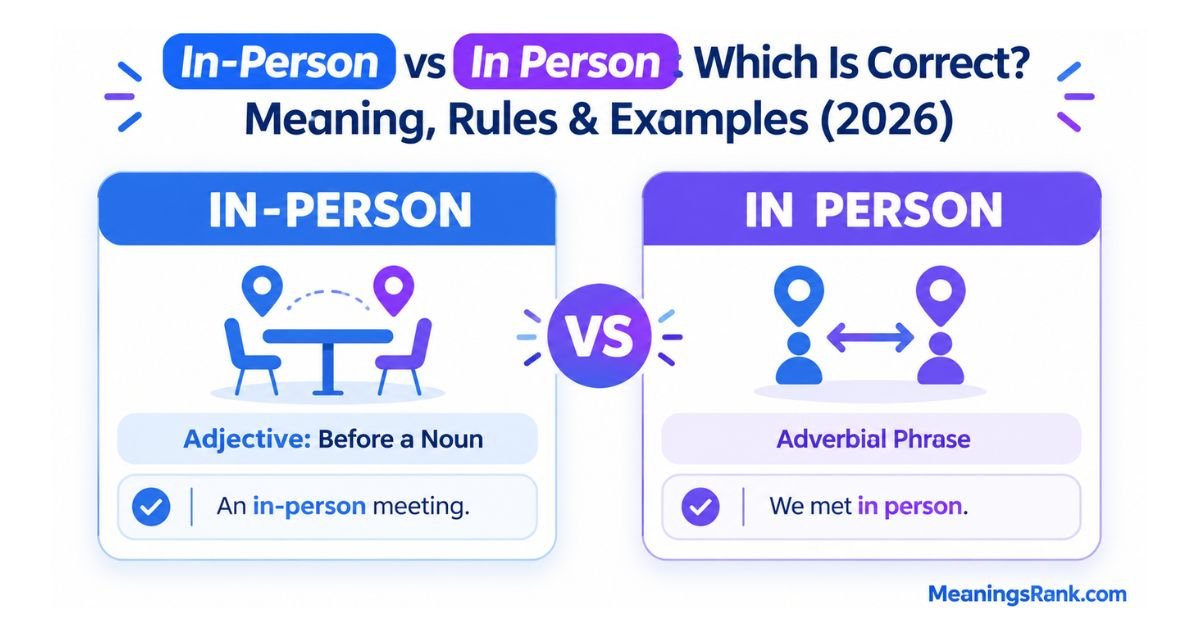
Use “in-person” (hyphenated) before a noun. Use “in person” (two words) after a verb. Both forms mean physically present, face to face, or not done remotely. Only the grammar job changes.
| Feature | In-Person | In Person |
| Part of speech | Adjective (compound modifier) | Adverbial phrase |
| Hyphen? | Yes | No |
| Typical position | Right before a noun | After a verb or at the end of a clause |
| What it answers | “What kind of meeting?” | “How did you attend?” |
| Correct example | We hosted an in-person meeting. | We met in person. |
The 5-second swap test: Replace the phrase with “physical” or “physically.” If “physical” fits before a noun, use the hyphen: a physical meeting becomes an in-person meeting. If “physically” fits after a verb, skip the hyphen: attend physically becomes attend in person.
Quick reference for featured-snippet seekers: “In-person” is an adjective and takes a hyphen before a noun (“an in-person interview”). “In person” is an adverbial phrase and stays open after a verb (“she applied in person”).
What Is the Difference Between In-Person vs In Person?
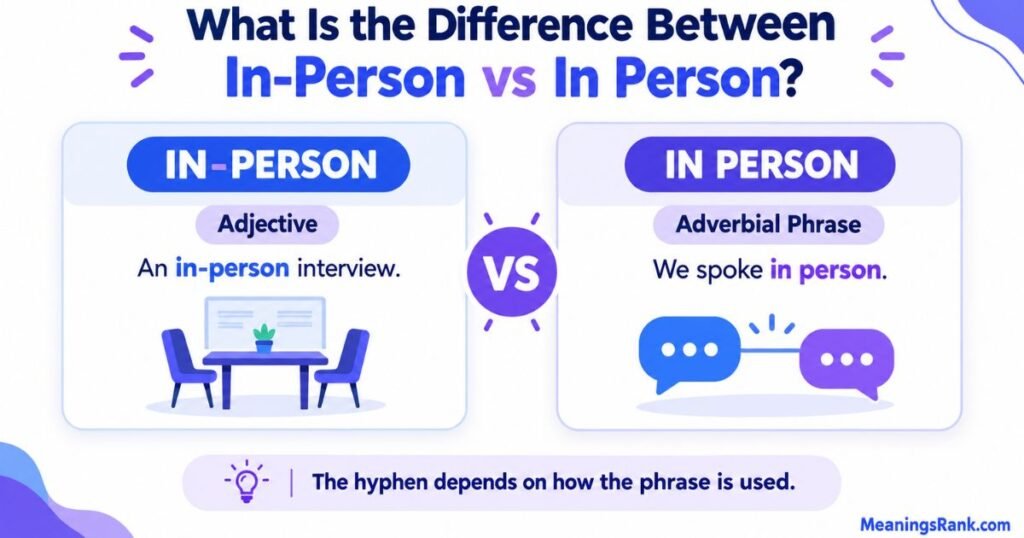
The meaning is the same. The difference lives entirely in grammar.
Both forms describe something that happens with people physically present in the same place. Neither one is more formal, more modern, or more British than the other. They simply do different jobs inside a sentence.
Think of it this way. An adjective sits next to a noun and describes it. An adverb (or adverbial phrase) sits near a verb and describes the action. “In-person” is built to describe a noun, so it needs the hyphen that glues its two words into one unit. “In person” describes how a verb happens, so it needs no glue.
Compare these pairs:
- We offer in-person classes. (Describes the noun classes.)
- Classes are taught in person. (Describes the verb taught.)
- She booked an in-person consultation. (Describes consultation.)
- She consulted the doctor in person. (Describes consulted.)
Why does the hyphen matter at all? Because it signals to the reader that the two words work together as a single modifier. This is the core idea behind every compound modifier rule in English. Without the hyphen, a reader may pause for a split second and wonder whether “person” is the start of a new noun phrase. In careful writing, that pause is exactly what a hyphen prevents.
So the difference is not about meaning, correctness in the abstract, or regional taste. It is about syntax: where the phrase sits and which word it modifies.
Read More: Meeting vs Meating: Key Differences, Correct Spelling & Real-Life Usage (2026)
Why Do People Confuse “In-Person” and “In Person”?
Several honest reasons explain the mix-up, and none of them reflect poorly on the writer.
1. Speech has no hyphens:
When you say “in-person meeting” and “meet in person,” the sounds are identical. Your ear gives you no clue. The distinction exists only on the page, so you have to learn it as a written convention.
2. The phrase exploded into everyday use:
Before 2020, many people rarely needed to contrast “in-person” with its opposite. When remote work and online school became widespread, the phrase moved into job posts, school newsletters, and medical offices overnight. Millions of people started writing it without ever having been taught the rule.
3. Software is inconsistent:
Spell checkers rarely flag “in person meeting” because every word is spelled correctly. A hyphen error is a punctuation matter, and basic tools often miss it. Writers assume that no red underline means no problem.
4. Style guides disagree on gray areas:
Most agree on the main rule, but they treat edge cases differently, especially when “in-person” follows a linking verb (“the event is in-person”). Conflicting advice leaves writers unsure.
5. Hyphen rules in general feel slippery:
English compound modifiers follow patterns, but those patterns come with exceptions. If you are not confident about “well-known author” versus “well known,” you will not be confident about this pair either.
6. Search behavior treats them as equals:
People search for both spellings, see both in print, and conclude that either is fine. Both do appear in print. Only one is correct in each specific position.
There is also a quieter cause: the phrase looks so ordinary that nobody thinks to question it. We stop and check the spelling of “necessary” or “separate” because those words have a reputation for being tricky. “In person” has no such reputation, so the error slides by unchallenged, and the more often a wrong version is seen, the more normal it begins to feel. Familiarity can quietly overrule grammar.
The good news: a single rule, one position check, solves all six problems.
What Does “In-Person” Mean?
“In-person” is an adjective meaning done with the people involved physically present, as opposed to remote, virtual, online, or by phone. It describes events, services, and interactions that take place face to face.
Merriam-Webster and most major dictionaries list “in-person” as an adjective and “in person” as an adverb or adverbial phrase. That split mirrors the grammar rule you are learning here.
The idea behind the word is old, even if the hyphenated adjective feels new. English speakers have long said that someone appeared “in person” to mean the real individual showed up, not a deputy or a letter. What changed is the need for a handy adjective. As soon as people wanted to talk about kinds of meetings, classes, and appointments, the phrase naturally stepped in front of nouns and picked up its hyphen. The adjective grew out of the adverbial phrase, which is exactly why the two look identical apart from a single mark.
Understanding the Grammar Behind “In-Person”
“In-person” is a compound modifier, sometimes called a phrasal adjective. It starts as a prepositional phrase (the preposition in plus the noun person). When that phrase moves in front of a noun to modify it, the two words fuse into a single adjective, and the hyphen records the fusion.
This follows a well-known punctuation principle from major style guides, including The Chicago Manual of Style and the AP Stylebook: hyphenate a compound modifier when it comes before the noun it describes. You see the same pattern in “up-to-date report,” “high-quality video,” and “full-time job.”
Notice what happens to the syntax. In “an in-person meeting,” the noun is meeting. The article an belongs to it. “In-person” slides between article and noun as a single adjective, exactly where adjectives live. The clause structure is clean: article + adjective + noun.
Two more grammar notes:
- It does not change form. There is no plural, no comparative, and no tense. “In-person” stays “in-person” everywhere.
- Adverbs can modify it. You can write “a fully in-person event” or “a mostly in-person program.” Since “fully” and “mostly” are modifying the whole adjective, they sit in front of it as separate words.
When to Use “In-Person”
Use the hyphenated form when the phrase sits directly in front of a noun and describes it. Typical situations include:
- Describing events: an in-person conference, an in-person reunion, an in-person ceremony.
- Describing services: in-person tutoring, in-person banking, in-person support.
- Describing activities: an in-person interview, an in-person exam, an in-person vote.
- Contrasting with remote options: “Students may choose in-person or online sections.” Here “in-person” modifies the understood noun sections, so the hyphen stays.
- Headlines, labels, and menu items: “In-Person Registration,” “In-Person Workshops.”
A useful trigger: if you can ask “what kind of ___?” and the answer is “in-person,” you need the hyphen. What kind of meeting? An in-person meeting.
The gray area. What about after a linking verb, as in “The training is in-person”? Many editors drop the hyphen here and write “The training is in person,” treating the phrase as adverbial. Others keep the hyphen because “in-person” works as a predicate adjective. Both versions appear in published writing. If your style guide is silent, choose one and apply it consistently across the document.
Common Patterns with “In-Person”
Most uses of “in-person” follow a few repeating patterns.
| Pattern | Examples |
| in-person + event noun | in-person meeting, in-person event, in-person workshop, in-person conference |
| in-person + service noun | in-person visit, in-person appointment, in-person training, in-person support |
| in-person + process noun | in-person interview, in-person registration, in-person verification, in-person payment |
| in-person + learning noun | in-person class, in-person instruction, in-person learning, in-person tutoring |
| adverb + in-person | fully in-person, entirely in-person, mostly in-person, strictly in-person |
| in-person vs. alternative | in-person vs. virtual, in-person or hybrid, in-person and online |
Notice that the noun follows in nearly every case. That is the signature of an attributive adjective, and it is your cue to reach for the hyphen.
What Does “In Person” Mean?
“In person” is an adverbial phrase with two closely related meanings.
- Physically present. You attend, appear, or participate yourself, rather than remotely. (“You must sign the form in person.”)
- Personally, by oneself. You do the thing directly rather than through a representative, assistant, or letter. (“The mayor thanked the volunteers in person.”)
Both meanings point to the same idea: the actual person, in actual presence. The phrase says nothing about being formal or informal. It simply states how the action happens.
Understanding the Grammar Behind “In Person”
“In person” is a prepositional phrase functioning as an adverb. The preposition in takes the noun person as its object, and the whole phrase answers “how?” or “in what manner?” about the verb.
Because it is an adverbial phrase and not a modifier of a noun, it needs no hyphen. There is nothing to glue. In the sentence “She met the director in person,” the verb is met, the object is the director, and “in person” tells us the manner of meeting.
Adverbial phrases are flexible about position. You will usually find “in person” at the end of a clause, but it can also move:
- “In person, she is much funnier than on television.” (Sentence-opening adverbial, followed by a comma.)
- “You can, in person or online, update your address.” (Interrupting adverbial, set off by commas.)
One more edge case: “in person” sometimes follows a noun directly, as in “the author in person” or “the CEO in person.” Here it works like a postpositive modifier, meaning “the real thing, herself.” It still takes no hyphen because it comes after the noun, and the hyphen rule applies only before.
Do not confuse this phrase with the separate idiom “in the person of,” as in “She found a mentor in the person of her old teacher.” That one is unrelated to the topic here.
When to Use “In Person”
Use the open, two-word form when the phrase describes how or where an action happens. Common situations include:
- After action verbs: attend in person, apply in person, vote in person, sign in person.
- After linking constructions or passive verbs: “The exam is held in person.” “Payment must be made in person.”
- At the start of a sentence: “In person, the sculpture looks even larger.”
- After a noun for emphasis: “I finally met the author in person.”
- Offering choices: “You can attend in person or join online.”
The trigger question here is different: ask “how?” or “in what way?” If the answer is “in person,” leave the hyphen out. How did you meet? In person.
Common Patterns with “In Person”
| Pattern | Examples |
| verb + in person | meet in person, speak in person, show up in person, pick up in person |
| be + past participle + in person | is held in person, must be signed in person, can be paid in person |
| in person + or/and + alternative | in person or online, in person and by phone, in person or by mail |
| in person + only / required | in person only, in person required, in person preferred |
| see/meet + someone + in person | see her in person, meet him in person, thank them in person |
| in person at + place | in person at the office, in person at the courthouse |
A reliable clue: in nearly all these patterns, “in person” comes after a verb. That position is your signal to leave the hyphen out.
In-Person vs In Person: Grammar Rules Explained
Here is the full rule set in one place. Learn these six, and you can handle nearly any sentence.
Rule 1: Hyphenate before a noun:
When the phrase directly modifies a noun that follows, use “in-person.” We scheduled an in-person review.
Rule 2: Keep it open after a verb:
When the phrase modifies a verb, use “in person.” We reviewed the contract in person.
Rule 3: Apply the swap test:
Try “physical” before the noun or “physically” after the verb. This test is fast and almost always reliable.
Rule 4: Be consistent in the predicate gray area:
After linking verbs such as is, was, or remains, “in person” (open) is the safer default because it reads as an adverbial phrase. If your publication prefers “in-person” there, apply that choice throughout.
Rule 5: Do not hyphenate after an -ly adverb, and do not add extra hyphens:
Write “a fully in-person course,” not “a fully-in-person course.” The hyphen belongs only inside the compound modifier itself.
Rule 6: Capitalize both parts in title case when hyphenated:
In a headline, Chicago style capitalizes both elements: “In-Person Registration Opens Monday.” For the open form: “Meet Your Mentor in Person.”
Here is a quick correctness table:
| Sentence | Verdict | Why |
| The in-person event starts at nine. | Correct | Adjective before the noun event |
| The in person event starts at nine. | Incorrect | Missing hyphen before a noun |
| He delivered the letter in person. | Correct | Adverbial phrase after the verb |
| He delivered the letter in-person. | Incorrect | Hyphen not needed after a verb |
| Choose in-person or online classes. | Correct | “In-person” modifies the understood noun classes |
| The workshop is in person. | Correct | Adverbial phrase after a linking verb |
Punctuation sits at the heart of all this. A single hyphen changes how the reader parses clause structure, which is why professional editors check it every time.
Why the rule is not arbitrary:
Compare “a man eating shark” with “a man-eating shark.” The first describes a person dining on a fish. The second describes a dangerous animal. The hyphen rescues the meaning. Our pair works the same way, only the stakes are lower. In “an in person meeting,” nothing breaks, but the reader’s eye still has to work a little harder to group the words correctly. A hyphen removes that effort. Good style is largely the art of removing small bits of effort for the reader.
A useful parallel. The same logic governs many phrases you already handle well:
| Before a noun (hyphen) | After a verb (open) |
| a full-time job | works full time |
| a face-to-face talk | talked face to face |
| an on-site inspection | inspected the building on site |
| a long-term plan | planned for the long term |
| an in-person class | taught in person |
If you already write “full-time job” and “works full time” without thinking, you already know this rule. “In-person” simply belongs to the same family.
In-Person vs In Person Examples
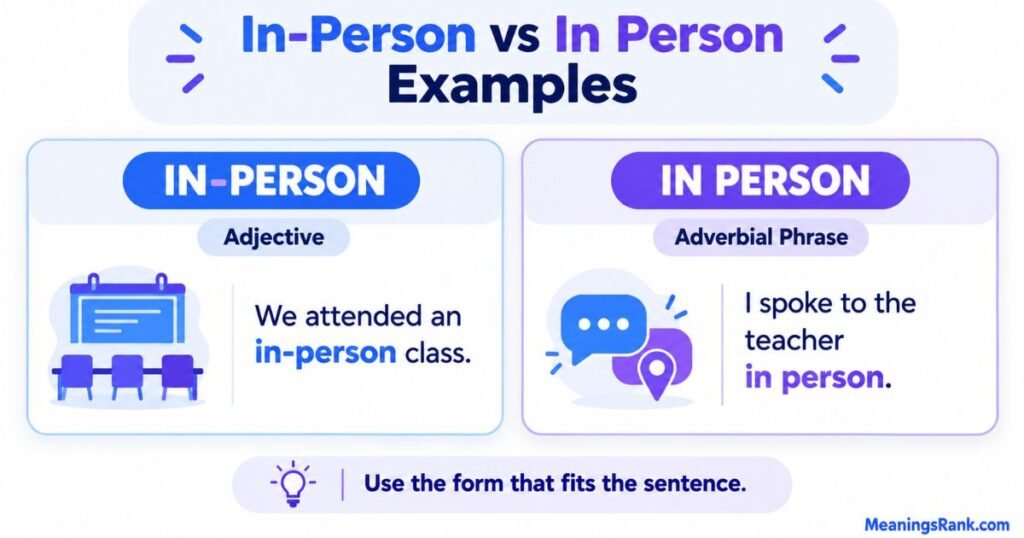
Seeing the rule in action beats memorizing it. Below are twenty example sentences, ten for each form, with a short note on why each one works.
Example Sentences Using “In-Person”
- The company requires an in-person interview for all finalists. (Adjective before the noun “interview.”)
- Our in-person workshops fill up fast. (Adjective before “workshops.”)
- She prefers in-person shopping to ordering online. (Adjective before the gerund-noun “shopping.”)
- The college resumed in-person instruction in September. (Adjective before “instruction.”)
- An in-person visit gives you a better sense of the campus. (Adjective before “visit.”)
- They held a fully in-person conference this year. (Adverb “fully” modifies the adjective.)
- Please bring identification to your in-person appointment. (Adjective before “appointment.”)
- The bank offers both in-person and online support. (Adjective before the understood noun “support.”)
- We are planning an in-person reunion for next summer. (Adjective before “reunion.”)
- His in-person presentation impressed the board far more than the slides did. (Adjective before “presentation.”)
Example Sentences Using “In Person”
- I finally met my pen pal in person. (Adverbial phrase after the verb “met” and its object.)
- You must register in person at the front desk. (Adverbial phrase after “register.”)
- The prize must be collected in person. (Adverbial phrase after a passive verb.)
- She thanked every volunteer in person. (Manner: personally, not by letter.)
- In person, he is much quieter than his online reputation suggests. (Sentence-opening adverbial.)
- Voters may cast ballots in person or by mail. (Adverbial phrase contrasted with another adverbial phrase.)
- The photograph does not do the painting justice; you have to see it in person. (After the verb phrase “see it.”)
- The exam will be held in person this semester. (After the passive verb “held.”)
- The author in person is even more charming than her books. (Postpositive use after a noun.)
- Our team can help you online, by phone, or in person. (Final item in a parallel series of adverbials.)
Read More: To Bad or Too Bad? Discover the Correct Spelling and Meaning
In-Person vs In Person: Real-Life Examples
Grammar rules only matter if they survive contact with real writing. Here is how the pair shows up in everyday situations.
Job postings:
Hiring managers write: “This role requires an in-person interview, and candidates should be ready to meet the team in person.” The first phrase modifies interview. The second modifies meet. The sentence uses both forms correctly, side by side.
School communication:
A principal’s newsletter might say: “Parent-teacher conferences will be in person this fall. Families who cannot attend an in-person session may request a phone call.” Same pattern, two jobs.
Healthcare:
Clinics often write: “Telehealth is available, but some procedures require an in-person visit. Please present your insurance card in person at check-in.”
Banking and government services:
“Notarized documents must be signed in person. For questions, visit our in-person help desk.”
Event marketing:
“Join us in person or online. In-person tickets include lunch.”
Retail and customer service:
“Returns can be made in person at any store. In-person returns are processed within minutes.”
Legal settings:
“The witness must testify in person. The court allows in-person testimony only when remote options are unavailable.” Notice how legal writing leans on the phrase because the difference between physical and remote presence carries real consequences.
Personal messages:
“Can’t wait to see you in person!” is warm and natural. “Let’s plan an in-person catch-up” is just as natural, because catch-up is the noun being described.
In every case, the position test works. Look at what the phrase touches: a noun means hyphen, a verb means open.
Transformations you can borrow:
Often you can rewrite a sentence to switch between the two forms without changing its meaning. This is a handy trick when you are unsure which one to use, because you can choose the construction you feel more confident about.
| Noun version (hyphen) | Verb version (no hyphen) |
| Please schedule an in-person visit. | Please visit us in person. |
| We prefer in-person interviews. | We prefer to interview candidates in person. |
| The in-person signing is required. | The document must be signed in person. |
| An in-person vote was held. | Members voted in person. |
| She enjoys in-person conversations. | She enjoys talking in person. |
Each pair says the same thing. Only the grammar scaffolding changes.
Common Expressions with “In-Person” and “In Person”
Certain word combinations appear again and again. Knowing them as chunks speeds up your writing.
| Expression | Form | Meaning |
| in-person meeting | adjective + noun | A meeting where participants are physically together |
| in-person event | adjective + noun | A gathering held at a physical location |
| in-person interview | adjective + noun | A hiring or admissions interview face to face |
| in-person learning | adjective + noun | Classroom-based instruction, as opposed to remote |
| in-person support | adjective + noun | Help given face to face |
| in-person visit | adjective + noun | A physical trip to a place or a person |
| in-person only | adjective + modifier | Available only face to face |
| apply in person | verb + adverbial | Submit an application by showing up yourself |
| appear in person | verb + adverbial | Be physically present, as in court |
| see someone in person | verb + adverbial | Meet or view someone directly, not through media |
| in person or online | adverbial + alternative | Offered both face to face and remotely |
| thank someone in person | verb + adverbial | Express gratitude directly |
A small note on “in-person only” versus “in person only.” If the phrase labels a noun (“in-person-only event”), hyphenate fully. If it follows a verb (“Registration is available in person only”), leave it open.
Related phrases that carry a similar meaning include “face to face,” “on-site,” “on location,” and “in the flesh.” They are not always interchangeable, but they live in the same neighborhood of meaning.
In-Person Meeting Meaning and Examples
An in-person meeting is a meeting in which participants gather in the same physical space. It stands in contrast to a virtual meeting (held on a video platform), a conference call (audio only), or a hybrid meeting (some attend physically, some remotely).
Grammatically, “in-person” is the adjective and “meeting” is the noun. That is why the hyphen appears.
Where you will see it:
- Calendar invitations: “Quarterly planning: in-person meeting, Room 4B.”
- Agendas: “The in-person meeting will be followed by a working lunch.”
- Policies: “Performance reviews should be conducted as in-person meetings whenever possible.”
Examples in context:
- “Our team switched from weekly video calls to a monthly in-person meeting.”
- “The negotiation went better once both sides agreed to an in-person meeting.”
- “We will hold an in-person meeting at the downtown office, with a dial-in option for remote staff.”
Verb version. When the sentence is built around the verb “meet,” the phrase changes form:
- “The two founders agreed to meet in person.”
- “We have only ever spoken online, so meeting in person will be a treat.”
Both sentences describe the same real-world event. The first describes it with a noun. The second describes it with a verb. The hyphen follows the grammar.
In-Person vs In Person in Modern Business Communication
Business writing has changed. Hybrid schedules, remote teams, and global clients mean that “in-person” and “in person” appear in subject lines, policies, contracts, and job ads every day. Getting them right signals attention to detail.
Email subject lines:
Short lines favor the adjective form: “In-Person Training Schedule Updated.” Title case capitalizes both halves.
Job descriptions:
A common pattern reads: “This is an in-person role with occasional remote flexibility.” Because role is a noun, the hyphen stays. A second line might read: “Candidates must be able to work in person four days a week.” After the verb work, no hyphen.
Meeting etiquette:
“Please attend in person unless you have a documented reason” is a verb construction. “Attendance at in-person sessions is mandatory” is a noun construction.
Internal style guides:
Many organizations add a line to their house style document so every department follows the same rule. If your team has no such note, consider adding one. It prevents the awkward inconsistency of “in-person” on one page and “in person” on the next when both are modifying nouns.
Choosing the right synonym:
Sometimes another word fits better than either spelling:
| Word or phrase | Best used when |
| in-person / in person | You are contrasting with remote or virtual |
| on-site | Work happens at a company location |
| face-to-face (before noun) / face to face (after verb) | Emphasizing direct interaction between people |
| live | Emphasizing real-time, regardless of location |
| hybrid | Mixing physical and remote participation |
Notice that “face-to-face” follows exactly the same hyphen rule as “in-person.” That is not a coincidence. It is the same compound modifier principle at work.
Clarity for event listings:
When you publish a schedule, label each session clearly so readers never have to guess. A tidy listing might read: “Session A (in person, Room 12),” “Session B (online),” and “Session C (hybrid).” Here the parenthetical phrase acts as an adverbial describing how the session runs, so it stays open. If you turn the label into a heading, such as “In-Person Sessions,” the phrase now describes a noun, so the hyphen returns. One page can legitimately contain both forms, and that is a sign of correct grammar, not inconsistency.
Contracts and policies:
Precision matters most in formal documents. A clause stating that a signature must be made “in person” leaves no room for an electronic substitute, while a clause requiring an “in-person verification” describes a specific type of check. Writers of legal and policy text should treat the hyphen as part of the meaning, because a later dispute may turn on exactly what was required.
Tone. “In person” has a warm, human feel. “In-person” tends to appear in logistics and policy. Both are neutral in register, so you can use either in a formal letter.
In-Person vs In Person in American and British English
This is one area where writers tend to expect a regional split. In truth, the core rule is shared across both varieties.
What is the same:
- Major dictionaries in both traditions treat “in person” as an adverbial phrase.
- Both varieties use “in-person” as a hyphenated adjective before nouns in careful writing.
- Spelling does not change. There is no “in-persone” or any alternate form.
Where tendencies differ:
American style guides, particularly Chicago and AP, are fairly systematic about hyphenating compound modifiers that come before nouns. This leads to consistent use of “in-person meeting” in American publications.
British writing often treats hyphens more lightly. You will find some British publishers who drop hyphens in compound modifiers when no ambiguity arises, so an unhyphenated “in person meeting” is slightly more likely to slip through. British writers also reach for “face to face” or “in the flesh” a little more often in conversational contexts.
The practical guidance:
| Situation | Recommendation |
| Writing for a US audience | Follow the hyphen rule strictly |
| Writing for a UK audience | Follow the rule, and check your publication’s style sheet |
| Writing for an international audience | Use the hyphen rule; it is understood everywhere |
| Academic writing in either variety | Follow the assigned style guide (APA, MLA, Chicago, Oxford) |
When in doubt, hyphenate before nouns. No major style guide will call that wrong, and your readers will never be confused.
Common Mistakes Writers Make
Even experienced writers slip. Here are the six mistakes we see most often, with fixes.
| Mistake | Correction | Reason |
| We are hosting an in person event. | We are hosting an in-person event. | Hyphen needed before a noun |
| Please come in-person to sign. | Please come in person to sign. | No hyphen after a verb |
| The meeting is fully-in-person. | The meeting is fully in person (or “a fully in-person meeting”). | Do not over-hyphenate |
| In-person, I find him funnier. | In person, I find him funnier. | Sentence-opening adverbial; no hyphen |
| Registration is in-person only. | Registration is in person only. | Adverbial use after a linking verb |
| Join us in-person or online! | Join us in person or online! | Adverbial phrase after a verb |
Mistake 1: Hyphenating everything.
Some writers learn the hyphen rule and apply it everywhere. The result is “attend in-person,” which is wrong. The hyphen belongs only when the phrase is acting as an adjective.
Mistake 2: Hyphenating nothing.
The opposite habit gives you “in person meetings” and “in person classes.” These lose the signal that the two words work together.
Mistake 3: Confusing “in person” with “in-person” in titles.
Title case does not change the rule. It only changes capitalization.
Mistake 4: Ignoring the contrast.
Some writers use “in-person” without a clear opposite in mind. In a world where almost everything can be done remotely, the word is only useful when the alternative is real. Make sure the contrast exists.
Mistake 5: Mixing styles in one document.
A flyer that says “in-person tickets” in one place and “in person tickets” in another looks careless. Decide the rule and stick with it.
Mistake 6: Treating them as different in meaning.
They are not. The only difference is syntactic.
A proofreading routine that works.
When you edit a document, use your search function to find every instance of “in person” and “in-person.” For each hit, ask one question: what word does this phrase touch? If the next word is a noun, check for the hyphen. If the previous word is a verb, check that the hyphen is absent. The whole audit takes about two minutes, and it catches nearly every error. Teams that publish a lot of event copy, such as schools, clinics, and conference organizers, can add this step to their standard editing checklist.
Key Exceptions to Keep in Mind
A few situations deserve extra attention.
- After linking verbs. As discussed earlier, “The event is in person” and “The event is in-person” both appear in print. The open form is the most defensible. If you choose the hyphen, be consistent.
- Coordinated modifiers. In “in-person and online classes,” the hyphen stays because “in-person” still modifies classes. Do not drop it just because “online” sits next to it.
- Suspended phrases. In “both in-person and virtual events,” the structure is parallel, and the hyphen is correct.
- Postpositive use. In “the author in person,” the phrase follows the noun. Leave it open.
- Quoted material. If you are quoting a source that uses a different style, keep the original and avoid silent edits.
- House style overrides. Some publications, such as certain newspapers and academic journals, have specific rules. House style outranks general advice.
Read More: Taught vs Tought: Discover the Correct Spelling, Meaning & Key Differences
In-Person vs In Person: Easy Memory Trick
Try the “Glue and Verb” trick.
If a noun follows, glue it. If a verb leads, let it be.
The hyphen is the glue. It holds the two words together so they can stand in front of a noun as a single adjective. When a verb leads, nothing needs gluing, because “in person” is just a normal prepositional phrase.
Another shortcut is the “Physical Swap”:
- Can you replace it with “physical” before a noun? Use in-person.
- Can you replace it with “physically” after a verb? Use in person.
A third visual cue: the hyphen hugs the noun. Picture the hyphen as a small arm reaching forward to grab the word that comes next. If there is no noun waiting, the arm has nothing to hold, and it drops away.
Try all three on this sentence: “We would love to see you at our in-person gathering, so please RSVP in person at the desk.” The first phrase has a noun waiting (gathering). The second follows a verb (RSVP). Glue first, no glue second.
In-Person vs In Person: Practice Exercises
Test yourself. Fill in the blank with in-person or in person. Then check the answer key at the bottom.
Part A: Fill in the Blank
- The conference will be an ________ event this year.
- You can pick up your badge ________ at the registration table.
- Our school offers both online and ________ classes.
- I have never met my cousin ________.
- The company requires an ________ interview before making an offer.
- The author signed copies ________ after the talk.
- She prefers ________ meetings over video calls.
Part B: Spot and Fix the Error
Each sentence contains one error. Rewrite it correctly.
- Please submit your application in-person.
- We are hosting an in person fundraiser on Friday.
- The CEO thanked the staff in-person.
Answer Key
- in-person (adjective before the noun event)
- in person (adverbial phrase after the verb pick up)
- in-person (modifies the understood noun classes)
- in person (adverbial phrase after the verb met)
- in-person (adjective before the noun interview)
- in person (adverbial phrase after the verb signed)
- in-person (adjective before the noun meetings)
- Please submit your application in person. (No hyphen after a verb.)
- We are hosting an in-person fundraiser on Friday. (Hyphen needed before the noun fundraiser.)
- The CEO thanked the staff in person. (No hyphen after a verb.)
Scoring: 9 to 10 correct means you have mastered it. 7 to 8 means one more read of the memory trick will lock it in. Below 7, revisit the grammar rules and try again tomorrow.
Frequently Asked Questions (FAQs)
Is it “in-person” or “in person”?
Both are correct, but in different positions. Use “in-person” with a hyphen when it comes before a noun (“an in-person meeting”). Use “in person” without a hyphen when it follows a verb (“we met in person”).
Do you hyphenate “in-person” in the middle of a sentence?
It depends on what the phrase modifies, not where it sits. In “We scheduled an in-person meeting,” the hyphen stays because meeting is a noun. In “We scheduled the meeting in person,” the hyphen disappears because the phrase now modifies the verb.
Is “in person” an adjective or an adverb?
“In person” is an adverbial phrase. “In-person” (hyphenated) is the adjective. The two forms share the same meaning but perform different grammatical functions.
Can I say “the meeting is in-person”?
You will see this in print, and some writers treat it as a predicate adjective. Most editors prefer “the meeting is in person,” because the phrase reads naturally as an adverbial phrase after a linking verb. Whichever form you choose, apply it consistently throughout your document.
What is the opposite of “in-person”?
Common opposites include “virtual,” “remote,” “online,” and “hybrid” (a mix of the two). For the adverbial form, the opposites are “remotely,” “online,” “virtually,” or “by phone.” Context decides which is best.
Conclusion
“In-person” and “in person” mean exactly the same thing; only their grammatical jobs differ. Hyphenate when the phrase sits before a noun, and leave it open when it follows a verb. Keep the Glue and Verb trick and the physical-swap test handy, and you will get this pair right in every email, job post, and essay you write.