
Got a text that just said “IDTS” and had no idea what your friend meant? You’re not alone. This short slang term pops up everywhere, from group chats to Instagram comments, and it can feel confusing if you’ve never seen it before. The IDTS meaning in text is simple once you know it, but the tone behind it can change everything.
This guide breaks down what IDTS means, where it came from, and how people actually use it in real conversations. We’ll cover WhatsApp, TikTok, Snapchat, gaming chats, and even workplace messages. By the end, you’ll know exactly how to use IDTS yourself and how to reply when someone sends it to you.
What Does IDTS Mean in Text & Chat?
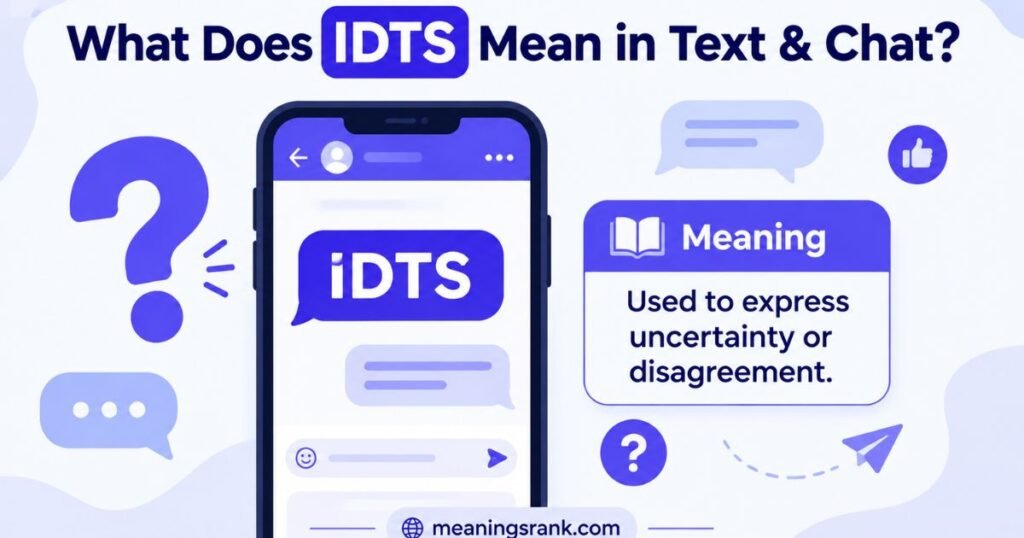
IDTS stands for “I Don’t Think So.” It’s a quick way to disagree with something someone just said, without typing out the whole phrase. People use it when they doubt a claim, question a plan, or simply want to say “no” in a casual way.
The beauty of IDTS meaning in text is its flexibility. It can sound playful, doubtful, or even a little sarcastic, depending on the context. If your friend texts, “It’s going to rain all weekend,” and you reply “idts,” you’re basically saying you doubt that forecast.
This abbreviation fits perfectly into fast-paced texting culture, where typing speed matters. Instead of writing four words, you type one short term and move on with the conversation.
IDTS Full Form, Stands For & Short Meaning
Here’s a quick breakdown of the term:
- Full Form: I Don’t Think So
- Short Meaning: Disagreement or doubt
- Tone: Can be casual, sarcastic, or genuine
- Common Use: Texting, social media comments, group chats
IDTS is part of a bigger family of texting shortcuts built to save time. Just like “IDK” means “I don’t know” and “IDC” means “I don’t care,” IDTS follows the same pattern of shrinking a common phrase into a few letters.
It’s worth noting that IDTS is not the same as “idc” or “idk.” While those show a lack of knowledge or interest, IDTS is specifically about disagreement or skepticism.
Origin, History & First Known Use of IDTS
Slang abbreviations like IDTS grew out of early SMS texting, back when phones charged per message and every character counted. Typing “I Don’t Think So” used up valuable space, so people naturally shortened it.
As instant messaging apps like AIM and MSN Messenger became popular in the early 2000s, users kept inventing short forms for common phrases. IDTS likely emerged during this era alongside other now-classic terms like “brb” and “lol.”
When smartphones and social media took over in the 2010s, this kind of shorthand didn’t disappear. Instead, it moved into Instagram comments, WhatsApp chats, and Twitter replies. Today, IDTS is a normal part of casual online language, especially among younger texters who grew up chatting on mobile apps.
There’s no single person or event credited with “inventing” IDTS. Like most internet slang, it developed organically as people looked for faster ways to express doubt in writing.
Psychological & Emotional Meaning of IDTS
Words carry emotional weight, even short ones like IDTS. When someone types this term, they’re often doing more than just disagreeing. They might be:
- Protecting themselves from committing to a plan they’re unsure about
- Softening a “no” so it doesn’t sound too harsh
- Expressing genuine confusion or disbelief about something said
Because text lacks tone of voice, IDTS can be read many different ways. A message that feels playful to the sender might come across as blunt or dismissive to the reader. This is why context and emojis often travel alongside IDTS to clarify the mood.
Psychologically, short disagreement phrases like this let people push back without starting a big debate. It’s a low-effort way to say “I’m not convinced,” which keeps the conversation moving instead of turning into an argument.
Also Read: RS Meaning in Text: The Ultimate Guide to Its Real Meaning in Chat & Social Media
Regional & Cultural Usage of IDTS
IDTS is mostly used in English-speaking texting culture, especially in the United States, United Kingdom, Canada, and Australia. However, thanks to global social media platforms, it has spread to English-speaking communities in Asia, Africa, and the Middle East as well.
Younger generations, particularly Gen Z and younger Millennials, use IDTS more often than older texters. It fits naturally into fast, informal chat styles that dominate platforms like Snapchat and Discord.
In some regions, IDTS gets combined with local slang or emojis to add extra flavor. For example, a British teen might type “idts tbh” (I don’t think so, to be honest), while an American teen might pair it with a skeptical emoji like 🤨.
How People Use IDTS in Daily Conversations
IDTS shows up in all kinds of everyday chats. Here are some common situations where you’ll spot it:
- Disagreeing with a friend’s prediction or opinion
- Doubting whether a plan will actually work out
- Responding to gossip or rumors with skepticism
- Pushing back gently during a debate
- Reacting to a bold claim someone made online
Example 1:
Friend: “I bet the concert tickets will sell out in an hour.” You: “idts, last time they were still available the next day.”
Example 2:
Group chat: “Should we go hiking even though it looks cloudy?” You: “idts, the weather app says storms later.”
Example 3 (Gaming):
Teammate: “We can win this round without healers.” You: “idts, we tried that last game and lost fast.”
These examples show how IDTS works as a quick, natural way to voice doubt without sounding overly formal or dramatic.
Positive, Neutral & Negative Uses of IDTS
Not every IDTS carries the same tone. Here’s how the meaning can shift:
| Tone | Example | Meaning |
| Positive/Playful | “idts lol, you’re just tired” | Light teasing, no real conflict |
| Neutral | “idts, maybe check the schedule again” | Simple correction or doubt |
| Negative | “idts. that’s not true at all.” | Firm disagreement or frustration |
The words around IDTS, along with punctuation and emojis, usually reveal the real tone. A period at the end can feel more serious, while “lol” or a laughing emoji softens it into a joke.
IDTS Meaning on WhatsApp, Instagram, TikTok & Snapchat
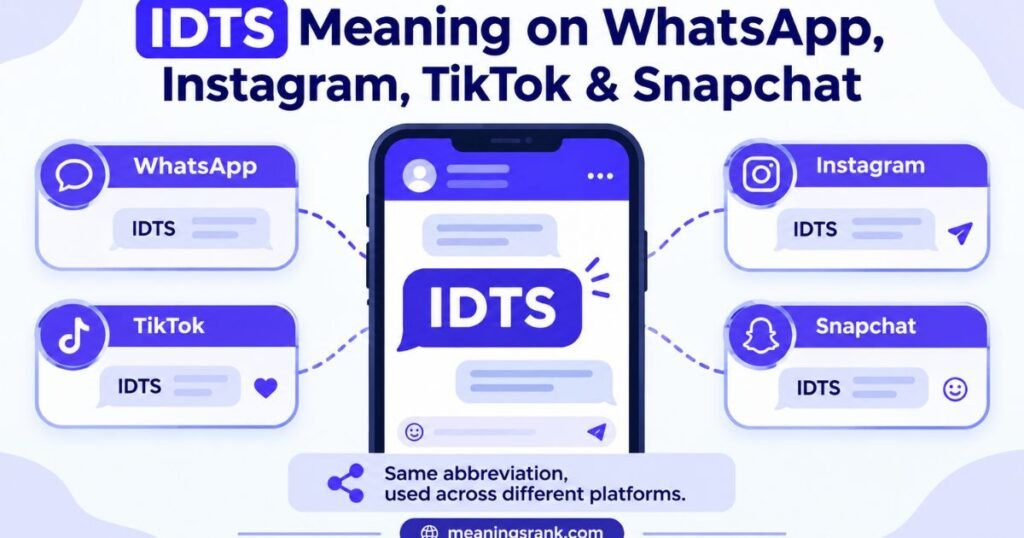
Each platform has its own texting culture, and IDTS adapts slightly depending on where it’s used.
WhatsApp:
Often used in family or friend group chats to disagree about plans, like dinner spots or trip dates. It usually appears in a friendly, casual tone.
Instagram:
Common in comment sections when someone doubts a caption or claim in a post. For example, replying “idts” under a post that says a celebrity is retiring.
TikTok:
Shows up frequently in comment threads reacting to viral claims, challenges, or “facts” shared in videos. Users type it fast to join ongoing debates in the comments.
Snapchat:
Used in quick chat replies, often paired with emojis since Snapchat conversations tend to be short and visual.
Across all these platforms, IDTS keeps its core meaning: doubt or disagreement, expressed quickly and casually.
Different Meanings of IDTS in Other Fields
While “I Don’t Think So” is the most common meaning, IDTS can stand for other things depending on context, especially outside of casual texting.
Technology:
Sometimes used as shorthand in internal team chats for “I Don’t Think So” regarding a bug or feature working as expected.
Education:
Occasionally appears in student group chats when discussing whether an answer or theory is correct.
Gaming Communities:
Used during strategy discussions to disagree with a suggested move or approach.
In almost every case, the core meaning stays connected to doubt or disagreement, just applied to different topics.
IDTS Meaning in Medical Terms
In medical and healthcare settings, IDTS is not a widely recognized standard abbreviation like BP or ECG. However, in informal clinical notes or internal team messaging, it can occasionally be used casually among staff to mean “I don’t think so” when discussing a diagnosis possibility or treatment plan in quick chat form.
It’s important to note that IDTS should never be used in official medical documentation or patient records, since formal healthcare communication requires clear, unambiguous language. If you see IDTS in a medical context, it’s almost certainly informal staff chatter rather than a recognized clinical term.
IDTS Meaning in Business
In workplace chats, especially on platforms like Slack or Microsoft Teams, IDTS keeps its texting meaning of “I don’t think so.” Employees might use it when responding quickly to a colleague’s idea or question.
Example:
Colleague: “Do you think the client will approve this budget increase?” You: “idts, they mentioned cutting costs last meeting.”
While IDTS works fine in casual internal chats, it’s best avoided in formal emails, client communication, or official reports. In professional writing, spelling out “I don’t think so” or using a more polished phrase like “I’m not sure that’s the case” comes across as more professional.
Also Read: IRL Meaning in Text: The Ultimate Guide to What It Stands for and How to Use It Online
Common Confusions, Mistakes & Wrong Interpretations of IDTS
People sometimes misread or misuse IDTS. Here are common mix-ups:
Confusing IDTS with IDC:
IDTS means disagreement; IDC means “I don’t care.” They’re not interchangeable.
Confusing IDTS with IDK:
IDK shows uncertainty or lack of knowledge, while IDTS shows doubt about a specific statement.
Reading it as rude:
Without emojis or friendly wording, IDTS can come across harsher than intended.
Using it in formal writing:
IDTS should stay in casual texting, not resumes, essays, or professional emails.
Being aware of these mix-ups helps avoid awkward misunderstandings in group chats or online comments.
Similar Terms, Alternatives & Related Slang
If you want to mix things up, here are some alternatives to IDTS with similar meaning:
| Term | Full Meaning |
| IDK | I Don’t Know |
| IDC | I Don’t Care |
| NAH | Casual “No” |
| DOUBT IT | Direct disbelief |
| IMO NO | In my opinion, no |
| SKEPTICAL | Formal way to express doubt |
Each of these fits slightly different situations, but IDTS remains one of the quickest ways to show polite disagreement in a text.
Examples of IDTS in Real Chat Situations
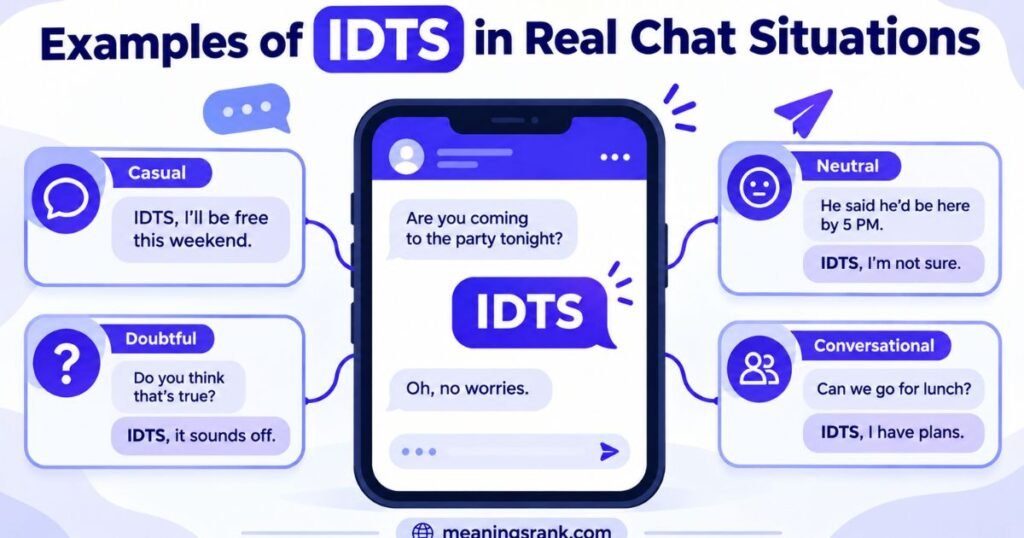
Discord (Gaming Chat):
Player: “This new update makes the game way more balanced.” You: “idts, the last patch broke matchmaking.”
Instagram DM:
Friend: “I think she unfollowed you on purpose.” You: “idts, she probably just cleaned her list.”
WhatsApp Family Group:
Cousin: “Grandma said dinner is at 6.” You: “idts, she told me 7 earlier.”
Workplace Slack:
Coworker: “I think the deadline got moved up.” You: “idts, nobody mentioned that in the meeting.”
Snapchat:
Friend: “Bet it snows tomorrow.” You: “idts 🤨 forecast says sunny.”
These real-world snippets show how naturally IDTS meaning in text fits into everyday digital conversations across different platforms.
How to Reply When Someone Says IDTS
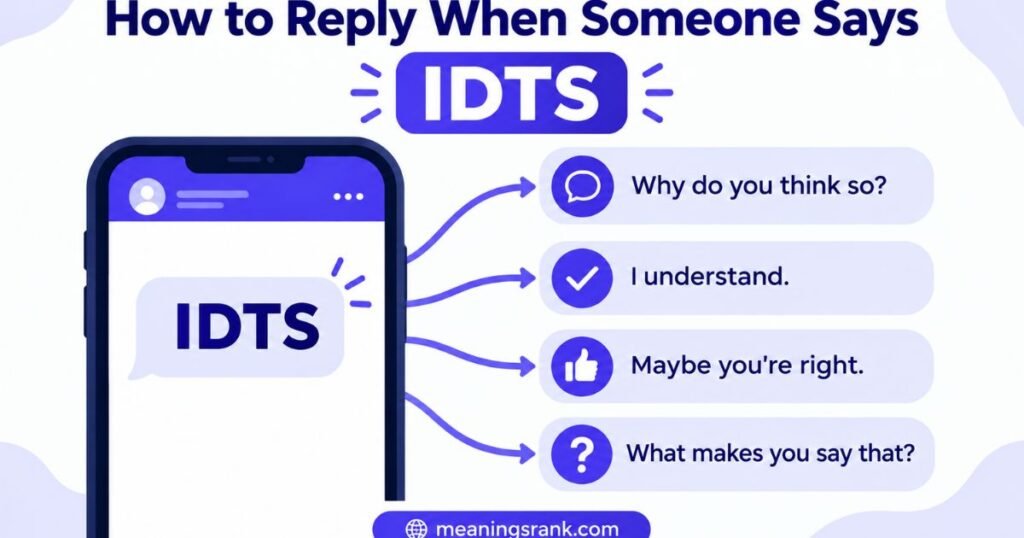
If someone sends you “idts,” here’s how you can respond depending on the situation:
Ask for clarification:
“Why not?” or “What makes you say that?”
Provide more context:
Share extra details to support your original point.
Agree to disagree:
“Fair enough, we’ll see!”
Add proof:
Send a link, screenshot, or fact to back up your claim.
Responding calmly keeps the conversation friendly, especially since IDTS can sometimes feel blunt without extra context.
Is IDTS Still Popular? Trends & Online Usage
IDTS remains a commonly used abbreviation, especially among younger texters on mobile apps. While it’s not as universally recognized as “lol” or “omg,” it holds steady usage in casual texting, comment sections, and group chats.
Search interest for terms like “IDTS meaning in text” tends to spike when the term appears in viral TikTok comments or trending Twitter threads, showing that curiosity about slang terms continues to grow alongside social media use.
As texting culture keeps evolving, short disagreement terms like IDTS are likely to stick around simply because they’re fast, casual, and easy to understand once explained.
Quick Facts About IDTS
- Full form: I Don’t Think So
- Common tone: Doubtful, casual, sometimes sarcastic
- Popular on: WhatsApp, Instagram, TikTok, Snapchat, Discord
- Opposite meaning: “Totally agree” or “Yes, for sure”
- Best avoided in: Formal emails, resumes, official documents
- Often paired with: Skeptical emojis like 🤨 or 😅
Also Read: FOMO Meaning in Text: What It Means, How People Use It & How to Reply (2026 Guide)
FAQs About IDTS Meaning
What does IDTS meaning in text message?
IDTS means “I Don’t Think So,” showing doubt or disagreement.
Is IDTS rude to use in chats?
Not usually, but tone and emojis affect how it feels.
Can IDTS be used in professional emails?
No, it’s too casual for formal or workplace emails.
What’s the difference between IDTS and IDK?
IDTS shows disagreement; IDK shows lack of knowledge.
Is IDTS common on Instagram and TikTok?
Yes, it’s frequently used in comment sections and DMs.
Does IDTS have other meanings outside texting?
Rarely, it mostly means “I Don’t Think So” everywhere.
Conclusion
At its core, the IDTS meaning in text is simple: it’s a quick way to say “I don’t think so.” Whether you spot it on WhatsApp, Instagram, TikTok, or in a workplace Slack message, the intent is usually the same, showing doubt or gentle disagreement without writing a full sentence.
Understanding the tone behind IDTS matters just as much as knowing what it stands for. A playful “idts lol” feels very different from a blunt “idts.” By paying attention to context, emojis, and the conversation flow, you’ll never misread this term again.
Now that you know the full meaning, origin, and real-life uses of IDTS, you can use it confidently in your own chats, or reply the right way when a friend sends it your way.