
You are typing a message to your class group chat. “Anyone has the notes from yesterday?” You pause. Something feels off. Should it be “anyone have” instead?
You are not alone. This tiny choice between has and have trips up native speakers and learners alike, and the confusion is understandable. The word “anyone” sounds like it could mean many people, yet it behaves like a single one. On top of that, everyday speech drops words, which makes both versions sound familiar.
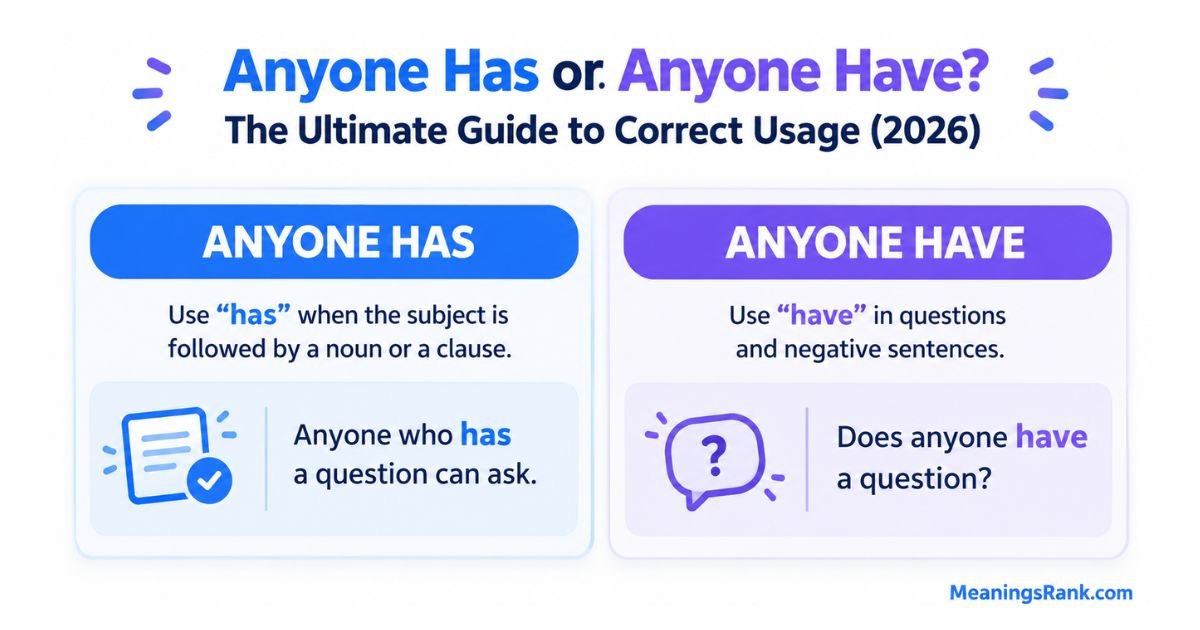
Here is the short version: “anyone” is singular, so standard English pairs it with “has” in statements and with “have” only after a helping verb such as “does” or “can.” Get this right and your emails, essays, and messages instantly read as more polished. Teachers notice it. Editors notice it. Hiring managers notice it too.
This guide walks you through the rule, the exceptions, and the reasons behind both, with plenty of examples and a short practice quiz at the end.
Quick Answer: Anyone Has or Anyone Have
Quick reference box
| Situation | Correct form | Example |
| Statement or embedded clause | anyone has | I wonder if anyone has seen my keys. |
| Question with “do/does” | Does anyone have | Does anyone have a charger? |
| After a modal verb (can, will, should) | anyone have | Can anyone have access to this file? |
| Negative with “not” | Doesn’t anyone have | Doesn’t anyone have an answer? |
The answer in three sentences: “Anyone” is a singular indefinite pronoun, so it takes “has” when “has” is the main verb. “Have” appears only when a helping verb (does, can, will, should) comes first, because that helping verb carries the agreement and the main verb returns to its base form. So “Anyone has a pen?” is informal shorthand, while “Does anyone have a pen?” is the fully correct question.
The Core Grammar Rule You Must Know
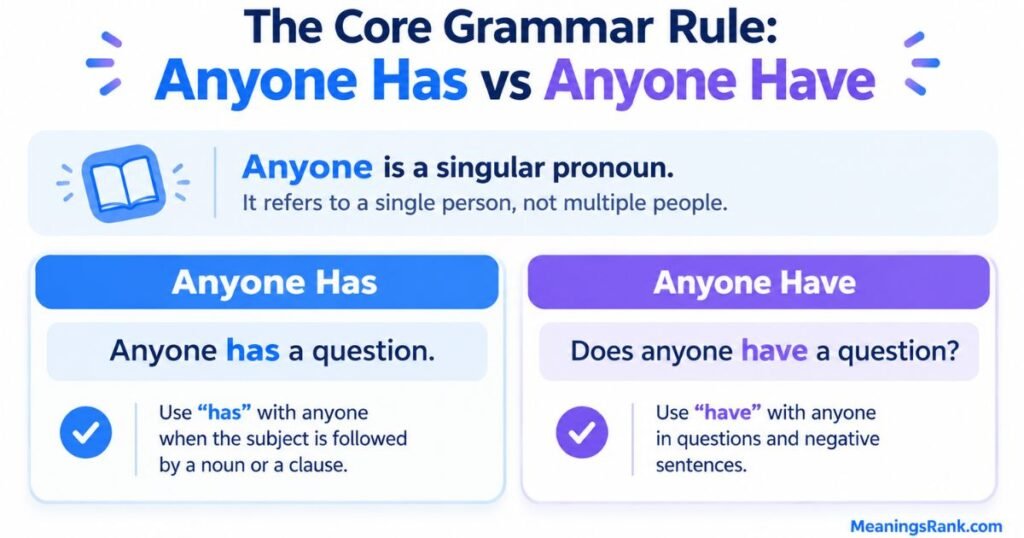
Every English sentence needs agreement between its subject and its verb. That is subject-verb agreement, and it is the engine behind this whole topic.
Singular subjects take singular verbs. Plural subjects take plural verbs. With the verb have, the third-person singular form is has, and every other form is have.
| Subject | Verb form |
| I | have |
| you | have |
| he / she / it | has |
| we / they | have |
| anyone | has |
Now comes the second half of the rule, the one most guides skip. When a sentence uses a helping verb (also called an auxiliary verb), the helping verb handles the agreement. The main verb then drops back to its base form.
- She has a car. (No helper, so the main verb agrees.)
- Does she have a car? (The helper “does” agrees, so “have” is the base form.)
Hold on to that pattern. It explains nearly every case in this article.
Read More: What Happen or What Happened? Discover the Correct Grammar and Usage (2026)
Why “Anyone” Takes a Singular Verb
“Anyone” belongs to a family called indefinite pronouns. They point to people or things without naming them. The group includes someone, everyone, no one, anybody, somebody, everybody, each, and either.
Grammatically, “anyone” means “any one person.” Even when the idea feels broad, the syntax treats it as one unit. Compare these sentences:
- Anyone is welcome to join.
- Everyone has a role to play.
- No one was late.
Notice that nobody writes “Anyone are welcome.” The singular verb feels natural there. The same logic applies to has.
Here is where the confusion starts. “Anyone” often appears in questions about groups: “Does anyone here speak French?” The scene involves many people, but the grammar stays singular. The meaning is plural-flavored; the structure is singular. Syntax wins every time.
A quick side note on pronouns that follow. Style guides now widely accept the singular “they” as a reference back to “anyone”: If anyone has lost their ticket, please see the desk. This is covered by major style guide rules and is preferred over the clunky “his or her.”
When “Anyone Has” Is Correct
Use “anyone has” whenever “has” is the main verb and there is no helping verb in front of it. In plain terms: statements, descriptions, and clauses that report something.
Examples of “Anyone Has” in Sentences
- Anyone who has finished the test may leave quietly.
- I doubt that anyone has noticed the typo.
- It is unusual that anyone has ever solved this puzzle.
- Anyone has the right to ask questions.
- Is it true that anyone has access to this library?
In each sentence, “anyone” is the subject, “has” is the main verb, and no auxiliary sits in between. The agreement is direct and clean.
Embedded Clauses and Indirect Speech
This is the spot where writers slip. When a question is tucked inside another sentence, it stops behaving like a question. The word order flips back to statement order, and the helping verb disappears.
| Direct question | Embedded version |
| Does anyone have the answer? | She asked whether anyone has the answer. |
| Has anyone seen Ravi? | I wonder if anyone has seen Ravi. |
| Does anyone have a spare pen? | He wants to know if anyone has a spare pen. |
The clause structure changes, so the verb form changes with it. “Does anyone have” becomes “if anyone has.” Writers who memorize only “have after does” often over-apply it and write “I wonder if anyone have the answer,” which is incorrect.
Formal and Written English
In essays, reports, emails to professors, and published writing, stick with the full, standard forms. Formal punctuation and syntax leave no room for dropped auxiliaries.
- Formal: Does anyone have any objections to the proposal?
- Formal: We need to confirm whether anyone has submitted the form.
- Too casual for formal writing: Anyone have any objections?
If you are drafting something a reader will judge, include the helping verb or use “has” in a proper statement.
When “Anyone Have” Is Correct
The phrase “anyone have” is not wrong in itself. It is wrong in the wrong position. It works when a helping verb or a dropped helping verb sits ahead of it.
Using “Anyone Have” in Direct Questions
In standard questions, English inserts “do” or “does” at the start. That helper takes the agreement, so the main verb stays in base form.
- Does anyone have a calculator?
- Does anyone here have experience with Excel?
- Doesn’t anyone have a better idea?
Say it with a statement and the pattern becomes clear: Anyone has a calculator is an odd sentence, but turning it into a question adds “does,” and “has” becomes “have.”
The casual shortcut. In speech and quick messages, people drop “Does” and keep the rest: “Anyone have a charger?” This is ellipsis, the omission of words that listeners can easily supply. It is common, widely understood, and perfectly fine in a text to friends. It does not belong in a formal essay.
Using “Anyone Have” with Helping Verbs
Modal and auxiliary verbs such as can, could, will, would, should, may, might, and must are always followed by the base form of the main verb.
- Can anyone have a second chance?
- Will anyone have time to review this?
- Should anyone have doubts, they can email me.
- No one may have been aware of the change. (Here the phrase is “may have been,” which is a different structure, not agreement with “anyone.”)
That last line shows why people get tangled. The word “have” appears often in English, but not always as a main verb. After a modal, it simply takes the base form.
Read More: Grandad vs Granddad: Which Spelling Is Correct? (Meaning & Usage Guide)
Anyone Has or Anyone Have in Negative Sentences
“Anyone” is a negative polarity word. It usually appears in questions, conditions, and negatives, but it takes some care.
Standard negative statements often pair “not” with “anyone” like this:
- There isn’t anyone who has the key.
- I don’t think anyone has called.
- I don’t know if anyone has the time.
When “do/does” is present, “have” returns:
- Doesn’t anyone have the manual?
- I didn’t hear anyone have a complaint. (Here “have” follows the perception verb “hear” with an object, so it is the base form.)
For a strong negative with no helper, English prefers “no one” or “nobody”:
- No one has called. (Correct.)
- Anyone has not called. (Awkward and rarely used.)
When you want to say the opposite of “someone has,” reach for “no one has.”
Anyone Has or Anyone Have in Conditional Sentences
Conditional sentences begin with if, unless, should, or in case. The verb form depends on the clause structure.
Real or likely conditions use the singular verb:
- If anyone has a question, please raise your hand.
- Unless anyone has a better idea, we’ll proceed.
Inverted conditions with “should” use the base form:
- Should anyone have a question, please raise your hand.
- Should anyone have concerns, contact HR.
Both versions mean nearly the same thing. The first sounds conversational. The second sounds more formal, and it follows the rule that modals take base-form verbs. Neither is a mistake. The error shows up when writers mix them: “If anyone have a question” and “Should anyone has a question” are both incorrect.
Anyone Has vs Anyone Have: Side-by-Side Comparison
| Feature | Anyone has | (Does/Can/Should) anyone have |
| Sentence type | Statement, embedded clause | Question, modal, inverted conditional |
| Helping verb present? | No | Yes |
| “Have” is… | not used | base form of main verb |
| Register | Standard, formal-friendly | Standard (with helper) |
| Example | I wonder if anyone has called. | Does anyone have the number? |
| Informal version | n/a | Anyone have the number? |
Quick test: Look at the word right before “anyone.” If it is a helping verb (does, can, will, should), use “have.” If it is not, and you need a main verb, use “has.”
Anyone vs Anybody: Is There a Difference?
Short answer: no meaningful difference in grammar. Both are singular indefinite pronouns, and both take “has.”
- Anyone has the right to vote.
- Anybody has the right to vote.
The differences are small and stylistic:
| Word | Tone | Typical use |
| anyone | slightly more formal | writing, announcements, professional emails |
| anybody | slightly more casual | speech, dialogue, relaxed writing |
Many style guides prefer “anyone” in formal prose, though neither is incorrect. Just do not confuse anyone (one word, meaning any person) with any one (two words, meaning one item out of a group): Any one of these answers is acceptable.
Common Grammar Mistakes and How to Fix Them
| Incorrect | Correct | Why |
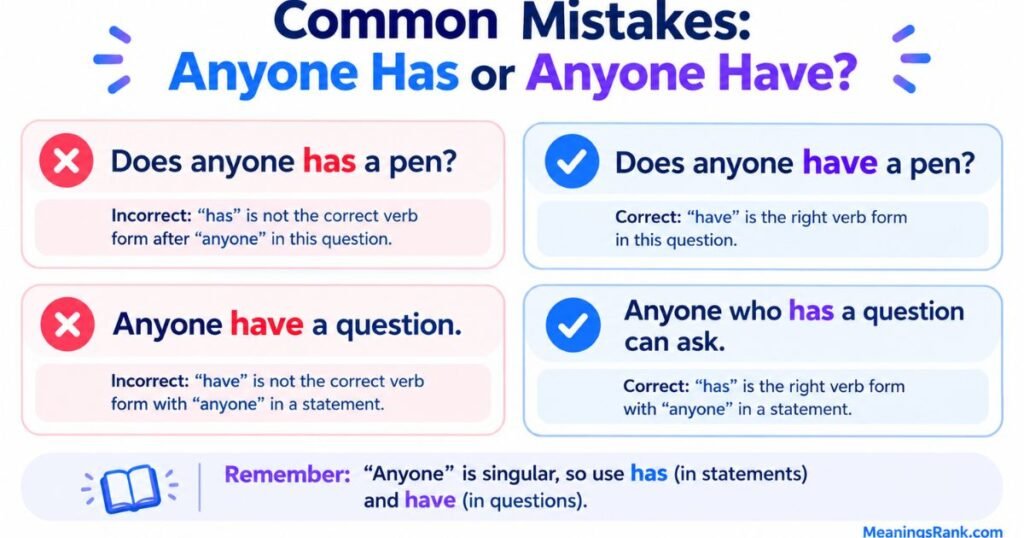
| Anyone have finished the test? | Has anyone finished the test? | The present perfect needs “has” with a singular subject. |
| Does anyone has a pen? | Does anyone have a pen? | After “does,” use the base form. |
| If anyone have a doubt, ask me. | If anyone has a doubt, ask me. | No helper; singular subject needs “has.” |
| I wonder if anyone have called. | I wonder if anyone has called. | Embedded clause returns to statement order. |
| Anyone who have lost their ID… | Anyone who has lost their ID… | The relative clause verb agrees with the singular “anyone.” |
| Can anyone has this? | Can anyone have this? | A modal is followed by the base form. |
Quick Memory Trick:
Remember “Helper? Have. No helper? Has.” If a helping verb comes first, “have” follows. If nothing helps, “anyone” gets “has.”
Tricky edge case: relative clauses:
In “Anyone who has finished,” the verb “has” agrees with “who,” and “who” refers back to the singular “anyone.” Writers often see the plural-sounding noun nearby and swap in “have.” Resist that. Track the true subject.
Tricky edge case: intervening phrases:
Anyone in the front rows has a better view. The phrase “in the front rows” is plural, but it only modifies the subject. It does not change it.
Why People Confuse “Anyone Has” and “Anyone Have”
Several forces push learners and native speakers toward errors:
- Plural meaning. “Anyone” refers to an open group of people, so it feels plural even though it is singular.
- Spoken English drops words. “Anyone have a pen?” is everywhere in speech, so the form feels normal and correct.
- The “does + have” habit. Many people memorize “have” after questions and then apply it everywhere.
- Influence of other languages. Some languages do not mark subject-verb agreement the same way, so singular-plural choices feel arbitrary.
- Autocorrect and predictive text. These tools sometimes suggest the wrong form based on frequency, not grammar.
Understanding the source of the confusion is half the fix. Once you spot the pattern, the rule stops feeling random.
Real-World Examples of Anyone Has vs Anyone Have
In emails
- Please let me know if anyone has dietary restrictions. ✔
- Does anyone have availability on Thursday? ✔
In school and academic writing
- The study asks whether anyone has experienced the same symptoms. ✔
- Few researchers believe that anyone has solved the problem fully. ✔
In workplace chat
- Anyone have the link to the doc? (informal and common) ✔
- Has anyone reviewed the draft? ✔
In public announcements
- If anyone has found a set of keys, please bring them to the front desk. ✔
- Should anyone have information, please contact the police. ✔
In customer service
- Does anyone have questions before we begin? ✔
Notice how each form fits its context. Formal writing uses full structures. Chat and speech lean on ellipsis.
Read More: Requester vs Requestor: Which Spelling Is Correct? Meaning & Usage (2026)
Quick Grammar Checklist
Before you hit send or publish, run through these five checks:
- [ ] Is “anyone” the subject? Treat it as singular.
- [ ] Is there a helping verb (do, does, can, will, should) before it? If yes, use have.
- [ ] Is it a statement or an embedded clause with no helper? If yes, use has.
- [ ] Is it a formal document? Include the helping verb, and avoid dropped auxiliaries.
- [ ] Do any pronouns later in the sentence match? “Their” is acceptable for “anyone.”
Interactive Practice Quiz.
Fill in each blank with has or have.
- Does anyone ______ a spare charger?
- I wonder whether anyone ______ seen my wallet.
- Should anyone ______ questions, please email me.
- Anyone who ______ finished may submit the form.
- Can anyone ______ access to the shared folder?
Answer Key
- have (after “does”)
- has (embedded clause, no helper)
- have (after “should”)
- has (the relative clause agrees with singular “anyone”)
- have (after “can”)
Score 5 of 5? You have this rule down. Score 3 or 4? Review the “Helper? Have. No helper? Has.” trick and try again in a week.
Frequently Asked Questions (FAQs)
Is it “anyone has” or “anyone have”?
Use “anyone has” when “has” is the main verb, as in statements and embedded clauses. Use “anyone have” only after a helping verb such as “does,” “can,” or “should.”
Is “Anyone have a pen?” grammatically correct?
It is an informal shortcut for “Does anyone have a pen?” with the helping verb dropped. It is common in speech and texts, but avoid it in formal writing.
Is “anyone” singular or plural?
“Anyone” is singular. It takes singular verbs such as “is,” “was,” and “has,” even though it often refers to a group of unspecified people.
Can I say “If anyone have a question”?
No. After “if,” with no helping verb, use “has”: If anyone has a question, let me know. The alternative “Should anyone have a question” is also correct.
Should I use “their” or “his or her” after “anyone”?
Both are grammatically acceptable, but “their” is widely recommended in modern style guides: If anyone has lost their book, see me. It is simpler and inclusive.
Final Takeaway
“Anyone” is singular, so it takes has when “has” is the main verb, and have only when a helping verb comes first. Check for the helper, match the verb, and keep formal writing complete. With that one habit, the question “anyone has or anyone have?” stops being a puzzle and becomes second nature.