
You have typed it a hundred times: “What’s the time frame?” Then you stop. Should that be one word or two?
This is one of the most common spelling doubts in English, and it shows up in emails, essays, reports, and job applications alike. The short answer is that “time frame” is the standard two-word form, while “timeframe” is an accepted one-word variant. Both mean the same thing.
Why bother learning the difference? Because small choices shape how professional your writing looks. This guide explains the rule, the exceptions, and the reasoning behind each, so you can choose with confidence every time.
Quick Answer: Time Frame vs Timeframe
“Time frame” (two words) is the safest, most widely accepted spelling in formal writing. “Timeframe” (one word) is a recognized variant that has grown common in business, finance, technology, and online writing. Neither spelling changes the meaning: both name a period of time during which something happens or is planned to happen.
| Question | Short Answer |
| Which spelling is standard in formal writing? | Time frame (two words) |
| Is “timeframe” a mistake? | No. It is an accepted variant, but less formal in many publications |
| Does the meaning change? | No |
| What matters most? | Pick one spelling and use it consistently throughout a document |
If you must pick one today, choose time frame. If your employer, publisher, or style guide prefers timeframe, follow that instead.
Time Frame or Timeframe?
You are finishing a report. The sentence reads, “We expect delivery within the agreed ___.” You type “timeframe,” pause, split it into two words, then change your mind again. Sound familiar?
This small spelling puzzle trips up students, editors, marketers, and professional writers every day. The reason is simple. English loves to join two nouns into one compound word over time, and it does so slowly and unevenly. A pair of words can sit in the “open” form (two words), move to the “hyphenated” form, and eventually settle as a “closed” compound (one word). Think of how “web site” became “website” and “e mail” became “email.” “Time frame” sits somewhere in the middle of that journey.
That is why you will see both forms in print. Newspapers, government documents, project plans, and academic papers all use them, sometimes within the same paragraph. Readers rarely stumble over either one. Editors, however, notice inconsistency right away, and inconsistency is the real problem to avoid.
Here is the short version of what this guide covers:
- Two words is the traditional, dictionary-preferred form.
- One word is a legitimate variant, especially in digital and business contexts.
- Consistency inside one piece of writing matters more than which form you choose.
- Context (your audience, your style guide, your publication) should make the final call.
Why does this matter in real-world writing? Because spelling choices signal care. A cover letter, a grant proposal, a legal summary, or a school essay is judged partly on polish. When you know which spelling suits which setting, you remove one small source of doubt from your readers’ minds. This guide gives you the rule, the reasoning behind it, and plenty of examples so you can apply it with confidence.
What Does Time Frame Mean?
A time frame is a limited period of time within which something occurs, is expected to occur, or must be completed. It works as a noun, and it answers the question “When, and for how long?”
Merriam-Webster and other major dictionaries define the term along these lines: a period of time, especially one in which something happens or is planned to happen. The word “frame” is doing quiet, useful work here. A frame has edges. It marks a boundary around a stretch of time, just as a picture frame marks a boundary around an image.
Consider these examples:
- “The contractor gave us a two-week time frame for the repairs.”
- “Within that time frame, the team must finish testing.”
- “Historians often study a narrow time frame to understand one event in detail.”
Notice the syntax. “Time frame” typically follows an article (“a,” “the”) or a possessive (“our,” “their”), and it often takes a descriptive modifier (“a short time frame,” “the original time frame”). It can also be the object of a preposition: “within the time frame,” “over this time frame,” “outside the time frame.”
The two-word spelling reflects the way the term is built. “Time” is a noun acting as a modifier, and “frame” is the head noun. In grammar terms, this is a noun-noun compound. The first noun narrows the meaning of the second. A time frame is a kind of frame, and the kind is “time.”
Read More: Steer vs Stear: Discover the Correct Word, Definition & Common Mistakes (2026 Guide)
What Does Timeframe Mean?
Timeframe means exactly the same thing. It is the closed (one-word) spelling of the same noun, and it carries the same definition: a period of time with a defined start, end, or scope.
So why does the one-word form exist at all? Language users tend to shorten and fuse frequently used pairs. When a two-word noun appears thousands of times in emails, spreadsheets, project dashboards, and search queries, writers begin to treat it as a single unit. Typing one word is faster. Reading one word feels smoother. Over time, the fused spelling spreads.
You will find “timeframe” most often in:
- Project management software and task trackers
- Financial and investment writing (“a long-term timeframe for returns”)
- Marketing, analytics, and technology documentation
- Informal workplace messages and chat platforms
- Web content written for fast scanning
Here are a few examples:
- “What timeframe are you working with for this launch?”
- “Select a timeframe from the dropdown menu to view your results.”
- “The investor chose a five-year timeframe.”
The meaning is identical to the two-word form in every one of these sentences. Only the spelling convention differs. Some readers consider “timeframe” slightly more casual or more modern, while others consider it perfectly standard. The perception depends heavily on the audience and the field.
Time Frame vs Timeframe: Is There Any Difference?
In meaning, no. In convention, yes, a little.
Meaning:
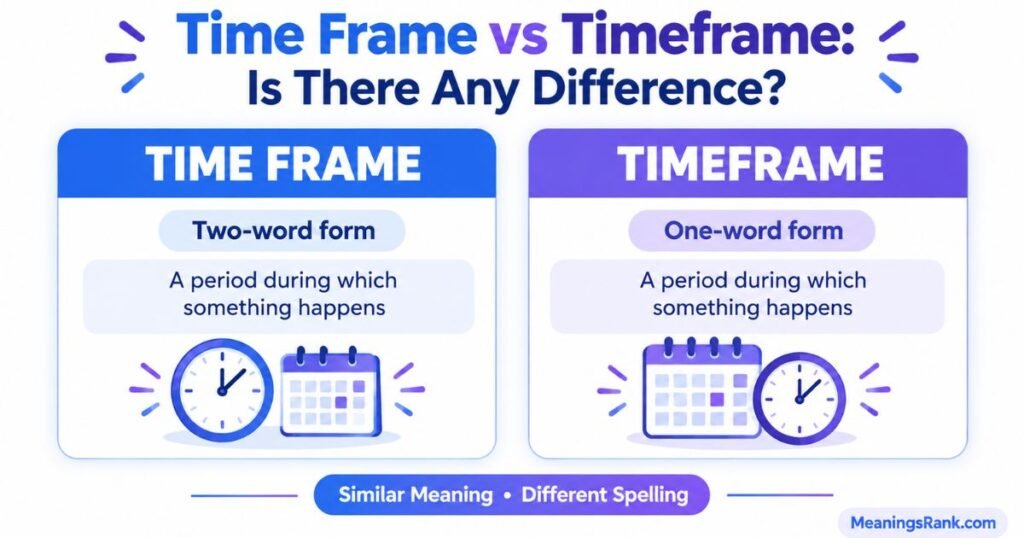
Both forms refer to a bounded period of time. You can swap one for the other in any sentence without changing the message, the tone of the idea, or the grammar of the sentence.
Convention:
The difference lies in how readers and editors perceive each spelling:
| Feature | Time Frame (open compound) | Timeframe (closed compound) |
| Meaning | A bounded period of time | A bounded period of time |
| Part of speech | Noun | Noun |
| Dictionary standing | Usually the main entry | Usually listed as a variant or accepted form |
| Formal writing | Preferred | Acceptable in many settings, risky in strict ones |
| Digital and business writing | Common | Very common |
| Risk of an editor changing it | Low | Moderate, depending on the style guide |
Think of it like the choice between “e-mail” and “email.” Nobody misunderstands either one, but a publication’s house style will favor one. The same logic applies here.
There is also a subtle point about register, meaning the level of formality in language. Two-word “time frame” reads as the more traditional, careful choice. One-word “timeframe” reads as brisk and contemporary. Neither impression is a flaw, but you should match the form to your audience. A university thesis leans traditional. A product blog may lean modern.
Finally, remember that language keeps moving. A form that looks like a variant today can become the standard form later. That has happened to many compounds, which is why this question is worth revisiting every few years, and why the 2026 picture is more relaxed than the picture twenty years ago.
Is Timeframe One Word or Two Words?
Both spellings exist, so the honest answer is: it can be either, but the two-word form is the one most dictionaries and formal style guides treat as primary.
To understand why, it helps to know how English handles compound nouns. Linguists describe three stages:
- Open compound: two separate words (“time frame,” “ice cream,” “post office”)
- Hyphenated compound: words joined by a hyphen (“long-term,” “check-in”)
- Closed compound: one solid word (“timeline,” “website,” “bookshelf”)
There is no single rule that predicts which stage a compound will reach or when. Stress patterns, frequency, and the pull of habit all play a role. Some pairs stay open for centuries (“high school”). Others fuse quickly (“email”). “Time frame” has remained mostly open in edited, formal writing while its closed twin keeps gaining ground in everyday and professional use.
So, is “timeframe” one word or two? Use this practical test:
- Writing for a publisher, teacher, journal, or formal audience? Use two words unless told otherwise.
- Writing for a company that already uses “timeframe” in its brand voice, product interface, or style sheet? Use one word and keep it consistent.
- Writing a casual email, text, or social post? Either works.
A short word of caution: never alternate within a single document. Writing “time frame” in paragraph one and “timeframe” in paragraph four looks careless, even though both are correct.
Time Frame or Timeframe in Major Dictionaries
Dictionaries are the first place most writers turn, and they are a reliable guide to standard usage. The pattern across major English dictionaries is fairly consistent: the two-word entry “time frame” is treated as the standard headword, while the one-word “timeframe” appears as an accepted variant or as a separate, cross-referenced entry. Some dictionaries list both side by side with the same definition.
Here is how that typically looks in practice:
| Dictionary Type | Typical Treatment |
| Merriam-Webster (American) | “Time frame” as the main entry, defined as a period of time, especially one in which something happens or is planned |
| Oxford and Cambridge (British and learner dictionaries) | Both forms recognized; the open form is commonly shown first, with the closed form noted as an alternative |
| Collins | Both forms recognized, often shown together |
| Learner and ESL dictionaries | Usually give example sentences with “time frame” and may note “timeframe” as a variant |
Dictionary entries are revised regularly, so the exact layout can change between editions and between the print and online versions. Before you submit an important document, check the current online entry of the dictionary your publication follows. It takes under a minute.
Two points are worth remembering. First, a dictionary listing a variant means the variant is recognized, not that it is a mistake. Second, a dictionary listing one form first usually reflects frequency in edited text at the time of editing, not a rule of grammar. Lexicographers describe how people write. They do not legislate.
That distinction explains why you can use “timeframe” in a professional setting and not be “wrong,” yet still see an editor change it. The editor is following a house style, which is a preference layered on top of what dictionaries record.
Time Frame vs Timeframe in American English
American English accepts both spellings, and usage in the United States shows a clear split by setting.
In formal and edited prose (newspapers, textbooks, academic journals, government publications), “time frame” remains the more common choice. American publishers often follow Merriam-Webster, and because that dictionary favors the open form, so do many copy desks.
In business and technology writing, “timeframe” has grown rapidly. Think of trading platforms with “timeframe” settings, analytics dashboards with “select a timeframe” menus, and workplace chat where speed beats formality. American tech culture tends to fuse compounds early, and this one is no exception.
A few typical American examples:
- “The committee set a 90-day time frame for public comment.”
- “Choose a timeframe to filter your sales report.”
- “What’s your timeframe for hiring a second analyst?”
If you are a student in an American classroom, default to time frame. Teachers who grade on conventional spelling will rarely mark it down, while the closed form occasionally draws a red pen. If you are a professional writer working for a company with its own style sheet, defer to that sheet.
A quick grammar note: whichever spelling you pick, American writing usually places the noun phrase in the same syntactic slot as any other time expression. It can serve as the subject (“The time frame is tight”), the object (“We extended the time frame”), or the object of a preposition (“within the time frame”).
Read More: Signer vs Signor: Meaning, Key Differences & Correct Usage
Time Frame or Timeframe in British English
British English also accepts both forms. The same pattern holds: the open form “time frame” reads as the traditional choice, and the closed form “timeframe” appears frequently in business, media, and online contexts.
British writing has a few habits that influence this choice. British publishers often follow the Oxford or Cambridge conventions and may follow in-house guides such as those used by major newspapers. These guides sometimes lean toward conservative spelling, which favors the two-word form in formal prose. At the same time, British corporate and financial writing has embraced “timeframe” widely, particularly in project plans and market commentary.
Some examples in a British register:
- “The council has outlined a realistic time frame for the road works.”
- “Within what timeframe can the supplier deliver?”
- “The inquiry will report within a three-month time frame.”
Unlike many other spelling differences between British and American English (such as “colour” and “color,” or “organise” and “organize”), the time frame question is not a regional split. You will not offend a British reader with either form, and an American reader will not blink at either. The choice comes down to formality, house style, and consistency rather than geography.
If your audience is international, “time frame” is the safer pick because it works well in every setting and requires no explanation.
Time Frame or Timeframe in Style Guides
Style guides exist to settle exactly this kind of question. They set a rule for a particular publication or profession so that writing looks consistent across many authors. Here is how the major ones tend to approach this term.
| Style Guide | General Approach |
| AP Stylebook | Follows its preferred dictionary approach and generally favors the two-word form “time frame” |
| Chicago Manual of Style | Defers to Merriam-Webster for compound spelling, which points to “time frame” |
| APA Publication Manual | Does not rule on this specific term; follow the dictionary and keep it consistent |
| MLA Handbook | Does not rule on this specific term; follow a standard dictionary and stay consistent |
| Corporate or in-house style sheets | Vary widely; many tech and finance companies prefer “timeframe” |
Style guide editions change, and some publishers add their own exceptions, so confirm the rule in the current edition you use. The principle that matters is this: when a style guide is silent, follow the dictionary your guide names, and then be consistent.
For practical purposes:
- Academic writers should check the department’s or journal’s preferred guide and fall back on “time frame.”
- Journalists should check the newsroom stylebook before filing.
- Content marketers and technical writers should check the brand voice document. If none exists, create a one-line rule and apply it everywhere.
- Freelancers should ask the client which form they prefer, then record it.
A useful rule of thumb: the more public and permanent the document, the more closely you should follow a published guide. A printed book or journal article stays on the record for years, so convention matters. A short-lived internal message has far more freedom, and readers care far less.
One underrated habit of experienced editors is keeping a style sheet for each project: a short list of decisions about spelling, hyphenation, and capitalization. “Time frame” or “timeframe” belongs on that list the first time it appears. That single line saves hours during revision.
Time Frame and Timeframe: Examples in Sentences
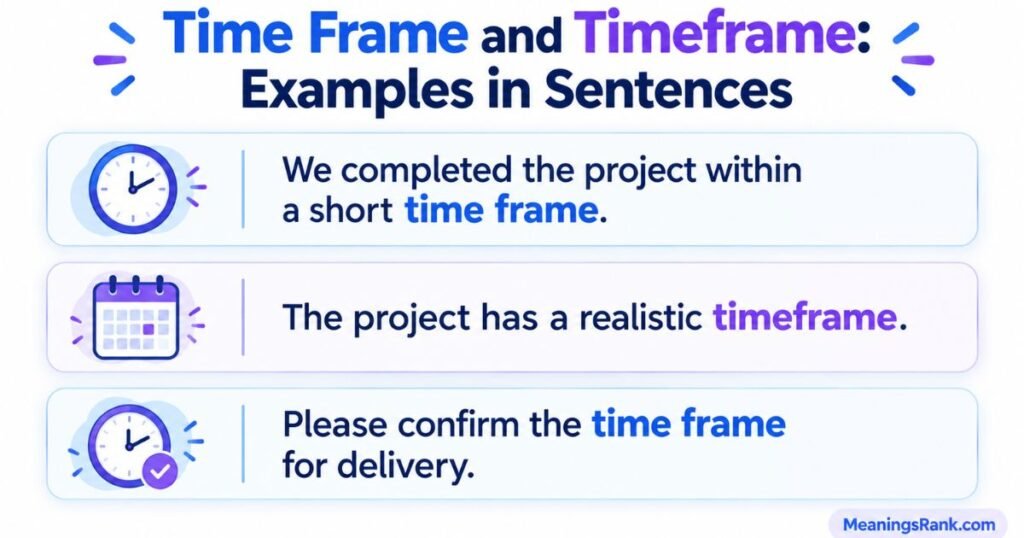
Seeing the word in context is the fastest way to build instinct. The examples below use both spellings. Remember that every sentence works with either form, as long as you stay consistent within your own document.
Everyday Examples
- “What time frame did the doctor give you for recovery?”
- “We have a tight timeframe to pack before the movers arrive.”
- “The class meets within a narrow time frame each week.”
- “Is that timeframe realistic for a beginner?”
Professional Examples
- “The proposal outlines a six-month time frame for implementation.”
- “Please confirm your preferred timeframe for the audit.”
- “The vendor missed the agreed time frame by three days.”
- “Our timeframe for the product release has shifted to the fourth quarter.”
Academic Examples
- “The study examines changes in literacy rates across a fifty-year time frame.”
- “Researchers limited the sample to a specific timeframe to reduce variables.”
- “The essay should address the time frame of the Industrial Revolution.”
Before-and-After Transformations
Rewriting weak sentences is the best way to practice. Each row below shows a common slip and a cleaner version.
| Before | After | What Changed |
| “Time-frame for the task is two weeks.” | “The time frame for the task is two weeks.” | Removed the hyphen and added the article |
| “We need a three week timeframe.” | “We need a three-week time frame.” | Hyphenated the modifier and used the formal spelling |
| “Give me the time frames period.” | “Give me the time frame.” | Removed the redundant word “period” and fixed the form |
| “The project will time frame in June.” | “The project will take place within a June time frame.” | Replaced the incorrect verb use with a noun phrase |
| “Our timeframe and time frame are different.” | “Our timeframe and yours are different.” | Removed the mixed spellings in one sentence |
Correct vs. Incorrect Usage
| Sentence | Verdict | Why |
| “The project has a six-month time frame.” | Correct | Standard open compound with a hyphenated modifier |
| “The project has a six-month timeframe.” | Correct | Accepted closed variant |
| “The project has a six-month time-frame.” | Incorrect | A hyphen does not belong inside this compound |
| “The project has a six month time frame.” | Incorrect | The number-plus-unit modifier needs a hyphen before the noun |
| “Time frame is tight, so hurry.” | Incorrect | Missing article: should be “The time frame is tight” |
| “The deadline’s timeframe is Friday.” | Awkward | A deadline is a point in time, not a time frame |
Study the pattern in the last four rows. Most real mistakes with this term have nothing to do with one word versus two. They come from stray hyphens, missing hyphens in modifiers, dropped articles, and word-choice confusion.
Time Frame vs Timeframe in Business, Academic, and Everyday Writing
Context shapes spelling choices more than any rule does. Here is how the two forms tend to behave across three broad writing situations.
Business Writing
Business writing values speed and clarity. Many companies use “timeframe” in internal tools, dashboards, and messages because it looks compact. Finance and trading content leans heavily on the closed form, since traders speak of “chart timeframes” (one-minute, hourly, daily). Contracts, legal agreements, and formal proposals, on the other hand, tend to prefer “time frame” because they follow conservative editing practices.
Practical advice:
Use whatever your company style sheet specifies. If none exists, use “time frame” in external, formal documents (contracts, reports, press releases) and either form in internal chat, as long as you remain consistent in each document.
Academic Writing
Academic writing rewards precision and convention. Instructors and journal editors usually expect standard dictionary spellings, which points to “time frame.” In scholarly prose, the phrase often appears in research design sections (“the time frame of the study”), historical analysis, and methodology descriptions.
Practical advice:
Use “time frame” in essays, theses, and papers. If a professor or journal specifies another form, follow their instruction.
Everyday Writing
In emails, texts, social posts, and personal notes, either spelling works. Readers focus on your message, not on the compound. Still, a habit of using the standard form means you will never need to second-guess yourself when the stakes rise.
Practical advice:
Choose whichever feels natural, but if you are unsure, use “time frame.”
The takeaway across all three settings is that formality pushes toward the two-word form, speed pushes toward the one-word form, and consistency is non-negotiable in both.
Time Frame Grammar: Hyphens, Plurals, and Verb Forms
Beyond the spelling debate, a handful of grammar points govern how “time frame” behaves in a sentence. Getting these right separates polished writing from merely acceptable writing.
Hyphens
“Time frame” itself is not hyphenated. You should not write “time-frame” as a noun. The hyphen belongs elsewhere, in the modifier that describes the time frame.
When a number and a unit of time combine to modify a noun, they form a compound modifier, and it takes a hyphen when it comes before the noun:
- Correct: “a three-week time frame”
- Incorrect: “a three week time frame”
- Correct: “The time frame is three weeks.” (no hyphen, because the phrase follows the noun and is not a compound modifier)
Other compound modifiers behave the same way: “a short-term time frame,” “a long-term timeframe,” “a month-long time frame.”
Plurals
Form the plural the regular way, by adding -s to the final word:
- time frames
- timeframes
Examples: “The two projects have different time frames.” “Compare the timeframes in the table below.” Do not write “times frames,” which is an error.
Verb Forms and Agreement
“Time frame” is a singular countable noun, so it takes a singular verb: “The time frame is short.” “Our timeframe has changed.” In the plural, it takes a plural verb: “The time frames are different.”
Pay attention to subject-verb agreement when a modifier sits between the subject and the verb. In “The time frame for the three projects is unclear,” the verb agrees with “time frame,” not with “projects.”
“Time frame” is not normally used as a verb. Avoid constructions such as “We need to time frame this task.” Say instead, “We need to set a time frame for this task” or “We need to schedule this task.”
Prepositions That Pair Well
- within a time frame (“within a two-week time frame”)
- in a time frame (“in this time frame”)
- over a time frame (“over a five-year time frame”)
- for a time frame (“a time frame for completion”)
- during a time frame (“during that time frame”)
Common Mistakes With Time Frame and Timeframe
Most errors involving this term are small, but they appear constantly. Here are the ones editors correct most often.
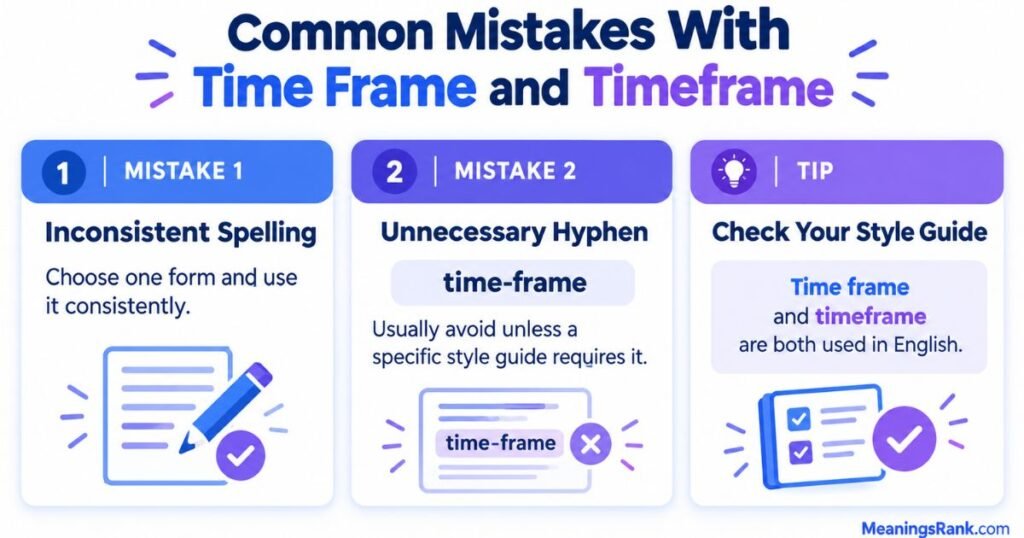
Mistake 1: Inconsistent spelling in one document.
Switching between “time frame” and “timeframe” is the number-one issue. Both are acceptable, and mixing them is not. Run a quick search-and-replace before you finalize any document.
Mistake 2: Hyphenating the noun.
“Time-frame” is not standard. Reserve hyphens for compound modifiers such as “a two-week time frame.”
Mistake 3: Forgetting the hyphen in the modifier.
“A six month timeframe” is missing a hyphen. Write “a six-month timeframe.”
Mistake 4: Writing “time-frames” or “times frames.”
The plural is “time frames” or “timeframes.” The hyphen and the extra -s on “times” do not belong.
Mistake 5: Dropping the article.
“Time frame is short” should read “The time frame is short.” Singular countable nouns normally need a determiner.
Mistake 6: Using “time frame” for a single moment.
A time frame is a period, not a point. If you mean a specific date or hour, use “deadline,” “date,” or “time.”
Mistake 7: Redundant phrasing.
“Within the time frame period of two weeks” repeats the idea of a period. Say “within a two-week time frame.”
Mistake 8: Treating it as a verb.
“To time frame a project” is not standard English. Use “schedule,” “plan,” or “set a time frame for.”
Mistake 9: Confusing it with “timeline” or “timescale.”
These words overlap but are not interchangeable. The next section explains the differences.
Mistake 10: Thinking one spelling is “wrong” and correcting a colleague.
Both are accepted. Correct the inconsistency, not the variant, unless a style guide says otherwise.
Key Exceptions to Keep in Mind
Rules about compounds always have edge cases. These are the ones worth knowing.
Exception 1: House style overrides general preference.
If your employer’s style sheet says “timeframe,” then “timeframe” is correct for that employer, whatever a dictionary lists first.
Exception 2: Quoted material stays as written.
If you quote a source that uses “timeframe,” keep the original spelling inside the quotation marks, even if your own text uses “time frame.” Altering a quotation changes the record.
Read More: Accross vs Across: Discover the Correct Spelling, Meaning & Usage (2026)
Exception 3: Product names, interface labels, and code.
A software menu might read “Timeframe,” and a variable in code might be written timeframe. When you refer to the actual label or code, match it exactly.
Exception 4: “Frame of time” and “time-frame” in older texts.
Older writing sometimes shows hyphenated or alternate arrangements. These reflect historical habits and should be left alone in citations and reprints.
Exception 5: Proper nouns and titles.
A book, report, or organization with “Timeframe” in its name keeps its official spelling.
Exception 6: Related compounds do not all behave alike.
“Timeline” is a closed compound in standard usage, while “time frame” is usually open. Do not assume that because one fused, the other must follow. English does not work by analogy that tidily.
Time Frame vs Timeline, Timespan, Timescale, Duration, and Deadline
Several time-related nouns sit close together in meaning, and writers swap them carelessly. Each has its own job. Knowing the difference makes your writing sharper and your project documents clearer.
| Term | Core Meaning | Example |
| Time frame / timeframe | A bounded period within which something happens or must happen | “We have a two-week time frame to finish the draft.” |
| Timeline | A sequence of events arranged in order, often shown visually; also used for a schedule | “The timeline shows five milestones from January to June.” |
| Timespan / time span | The length of time between two points; the extent of a period | “The timespan between the two discoveries was forty years.” |
| Timescale / time scale | The scale or magnitude at which time is measured or events unfold | “Geological changes occur on a timescale of millions of years.” |
| Duration | How long something lasts | “The duration of the meeting was ninety minutes.” |
| Deadline | A specific point in time by which something must be done | “The deadline is Friday at noon.” |
How to Choose the Right Word
Time frame emphasizes the boundaries. It tells you the window in which something must or will occur. When you say “within a three-month time frame,” you are drawing a box around three months.
Timeline emphasizes sequence. It lists what happens and in what order. A project can have a three-month time frame and a timeline with eight milestones inside it. The first is the container. The second is the plan inside the container.
Timespan and duration both describe length. “Duration” is the more common word for how long a single event lasts. “Timespan” often describes the stretch between two reference points or the full range covered by a study.
Timescale deals with scale. Scientists use it to compare processes that unfold at very different speeds: seconds, years, or millennia.
Deadline marks an endpoint. It is a single moment, not a period.
Side-by-Side Example
Read the following sentence and notice how each word contributes something different:
“The time frame for the renovation is eight weeks. The timeline lists demolition, wiring, and painting in order. The duration of the painting phase is five days, and the final deadline is March 30.”
Replace “timeline” with “deadline” in that passage and the sentence breaks. That is a good test: if swapping two words changes the meaning, they are not synonyms in that context.
Related Terms and Common Variations
Writers often search for neighboring phrases when they are unsure about a compound. Here are the ones that come up most, with quick guidance for each.
Common Phrases Using “Time Frame”
- Time frame for completion: the period allowed to finish a task
- Short time frame / long time frame: a brief or extended period
- Tight time frame: a limited period that leaves little room for delay
- Specific time frame: a clearly defined period
- Within the given time frame: inside the agreed boundaries
- Time frame of reference: the period against which events are judged (common in analysis and discussion of causation)
Similar Terms and Near-Synonyms
- Time window: a period when something is possible or available (“a two-hour time window”)
- Time period: a stretch of time, often used in history and science
- Time limit: a maximum allowed amount of time
- Time slot: a set position in a schedule
- Schedule: a plan listing when tasks will happen
- Turnaround time: the time needed to complete a task and return the result
- Lead time: the interval between starting a process and its completion
Variations Writers Ask About
| Variation | Is It Standard? | Note |
| time frame | Yes | Preferred in formal writing |
| timeframe | Yes (accepted variant) | Common in business and digital writing |
| time-frame | No | Hyphen is unnecessary for the noun |
| time frames / timeframes | Yes | Regular plurals |
| frame of time | Yes, but wordy | Rarely needed; “time frame” is shorter |
| timeframe-based | Informal | Works as a compound modifier in technical writing |
| time-framed | Rare | Better to rephrase with “scheduled” or “limited” |
When you are unsure about a related compound, apply the same three-step approach: check a current dictionary, check your style guide, and choose one form to use consistently.
Time Frame and Timeframe in Modern Digital Writing
Digital writing has pushed the one-word spelling forward. Three forces explain it.
1. Software and interfaces.
Menus, filters, and settings often use compact labels. A button reading “Timeframe” takes less space than one reading “Time frame,” so designers prefer the fused form. Users see it dozens of times a day, and the closed spelling becomes familiar.
2. Search behavior.
People type fast and often skip spaces. Search engines are forgiving and treat “time frame” and “timeframe” as close variants, so neither spelling is penalized in ranking. For writers who care about search visibility, the practical advice is to use the natural spelling in headings and body text, and to avoid awkward repetition of both forms just to catch both queries. Readers notice when text feels stuffed.
3. Informal channels.
Chat apps, social platforms, and collaboration tools reward brevity. In these spaces, “timeframe” often appears without a second thought.
What does this mean for you as a writer?
- For web content: Choose one form for the whole site and record it in your style guide. Consistency helps readers and strengthens your brand voice.
- For accessibility: Both spellings are read aloud correctly by screen readers, so neither creates a barrier.
- For voice search and AI assistants: Spoken queries do not show the spelling at all. The assistant interprets meaning, not spacing.
- For headlines and meta titles: Use the form that matches the language your audience types and says. If you are unsure, test both in your analytics.
Digital habits are also feeding back into print. As more edited publications adopt “timeframe,” lexicographers record it with greater confidence. That is how language change works: usage first, recognition later, and formal rules last.
Origin and Evolution of Time Frame and Timeframe
The word “frame” comes from Old English roots meaning to benefit, to further, or to construct. Over centuries it developed the sense of a structure that supports or encloses something, as in the frame of a house or a window frame. From there it took on figurative meanings: a “frame of mind,” a “frame of reference,” a “framework” of ideas. In each case, a frame provides boundaries and structure.
“Time frame” applies that figurative idea to time. The phrase became common in English in the middle of the twentieth century, as business, government, and military writing began to describe planned periods with more precision. Postwar planning language loved terms that sounded exact, and “time frame” fit neatly. Exact first-use dates vary by source, so if you need a citation, consult the historical notes in a large dictionary such as the Oxford English Dictionary or Merriam-Webster’s etymology entries.
For decades, the phrase appeared almost entirely in its open, two-word form. The closed spelling “timeframe” began to show up more often as computers, email, and the web changed how people wrote. Three changes helped:
- Typing and screen habits rewarded shorter, fused forms.
- Specialized fields such as finance, analytics, and software adopted the compound as technical vocabulary.
- Global English brought in many writers who treat compounds more flexibly than traditional editors do.
This pattern is not unusual. “Website” was “web site” in the 1990s. “Online” was “on-line.” “Email” was “e-mail.” In each case, the open or hyphenated form dominated in careful writing first, then the closed form took over. Whether “time frame” will follow the same path is unknown. It may settle as “timeframe” in a few decades, or the two forms may live side by side indefinitely, as many English pairs do.
The lesson for writers is practical. Language is a record of what people actually do, and recognized standards shift slowly. Use the form your audience expects today, and expect the picture to change gradually.
How to Remember the Correct Spelling
You do not need to memorize a rulebook. A few simple tricks will keep the choice automatic.
Quick Memory Trick / Mnemonic Device
“Frame it formally: two words for the page, one word for the screen.”
Here is how to use it:
- Think of a picture frame. A frame is a separate object with its own edges. In the same way, “frame” is a full word in its own right, so the traditional spelling keeps it apart from “time.” Write time frame when you want the form a formal reader expects.
- Think of a screen. Dashboards, chat boxes, and product menus favor compact labels. When you see a button or a filter, the fused timeframe is common. Picture the word squeezed into a small space.
- Never add a bridge. A hyphen works like a tiny bridge between two words. The noun “time frame” needs no bridge, so “time-frame” is out.
- Run a consistency check. Before you hit send, search the document for “time” and read every hit. One form only.
A Three-Question Checklist
- Does my style guide or client specify a form? If yes, follow it.
- Is the audience formal or academic? If yes, use “time frame.”
- Am I writing casually or for a digital product? If yes, use either form and stay consistent.
Interactive Practice Quiz
Fill in each blank with the correct choice. Choose the best answer for formal, standard writing. Answers are at the bottom.
- The manager asked the team to finish the audit within a ______ (two-week time frame / two week time-frame).
- Choose the correct sentence for a formal essay: (a) “We set a three month time frame.” (b) “We set a three-month time frame.”
- Which sentence is correct?
- (a) “Time frame is tight, so hurry.”
- (b) “The time frame is tight, so hurry.”
- Fill in the blank with the correct plural: “The two research projects have different ______.” (time frames / times frames)
- The word that means “the specific point in time by which a task must be finished” is a ______. (deadline / time frame)
Answer Key
- two-week time frame. The number-plus-unit modifier takes a hyphen before the noun, and the noun itself stays open and unhyphenated.
- (b) The number and unit form a compound modifier before the noun, so they need a hyphen: “three-month.”
- (b) The singular countable noun needs the article “the.”
- time frames. Form the plural by adding -s to the final word.
- deadline. A deadline is a point in time. A time frame is a period.
Score yourself: 5 out of 5 means you have it down. 3 or 4 means a quick re-read of the grammar section will lock it in. Fewer than 3 means bookmark this page and try again tomorrow.
Which Spelling Should You Use?
Here is a plain, decision-ready answer.
Use “time frame” (two words) when:
- You are writing an essay, thesis, research paper, or journal article.
- You are drafting a contract, formal proposal, or legal summary.
- You are publishing in a newspaper, magazine, or book that follows a dictionary-based style guide.
- You write for an international audience and want the form that is understood everywhere.
- You have no other instructions.
Use “timeframe” (one word) when:
- Your company, client, or publication style guide specifies it.
- You are labeling an interface, writing product documentation, or matching a software term.
- You write in finance or analytics, where “timeframe” is the common term of art.
- You are writing informally in emails, chat, or social posts.
In every case:
- Be consistent. Choose one form and use it across the whole document, website, or project.
- Do not hyphenate the noun. Save hyphens for modifiers such as “a three-month time frame.”
- Match quoted material. Leave a source’s spelling as written inside quotation marks.
- Record your decision. A single line in a style sheet prevents debates later.
A Worked Example
Imagine you are an editor preparing a quarterly report for a software company. The company style sheet is silent on this term. Your draft contains “time frame” four times and “timeframe” twice. What do you do?
First, check the audience. The report goes to investors, who expect a formal tone, so “time frame” fits. Second, run a search for both spellings and change the two outliers. Third, check the compound modifiers, such as “a twelve month time frame,” and add the missing hyphen. Finally, write a one-line entry in the style sheet: “time frame (two words, no hyphen).” The whole job takes five minutes, and the next editor who touches the document will know exactly what to do.
If you want a one-line rule to carry with you: default to “time frame,” follow the style guide when one exists, and never mix the two.
FAQs
Is it “time frame” or “timeframe”?
Both are correct. “Time frame” (two words) is the traditional and more widely accepted form in formal writing, and “timeframe” (one word) is an accepted variant that is especially common in business, technology, and digital contexts. Choose one and use it consistently.
Is “timeframe” a real word?
Yes. Major dictionaries recognize “timeframe” as a variant spelling of “time frame,” and it appears widely in edited publications, business documents, and software. Some formal style guides still prefer the two-word form, so check the guide you follow.
Is “time frame” one word or two words?
The standard, dictionary-preferred form is two words. The one-word spelling “timeframe” is a recognized variant. Both have the same meaning, and neither is considered a spelling error, although inconsistent use in the same document is.
Do I need a hyphen in “time frame”?
No. Do not hyphenate the noun itself. Use a hyphen only in a compound modifier before a noun, such as “a six-week time frame.” When the phrase follows the noun, drop the hyphen: “The time frame is six weeks.”
What is the difference between a time frame and a timeline?
A time frame is the bounded period in which something happens, such as a two-month window. A timeline is the ordered sequence of events or milestones within, or across, that period. The time frame is the container, and the timeline is the plan laid out inside it.
Conclusion
“Time frame” is the standard two-word spelling and the safest choice for formal, academic, and international writing, while “timeframe” is a well-established variant that thrives in business and digital contexts. The meaning is identical, so your job is simply to follow your style guide, avoid stray hyphens, and keep one spelling throughout each document. Master that small habit, and this tiny compound will never slow you down again.