
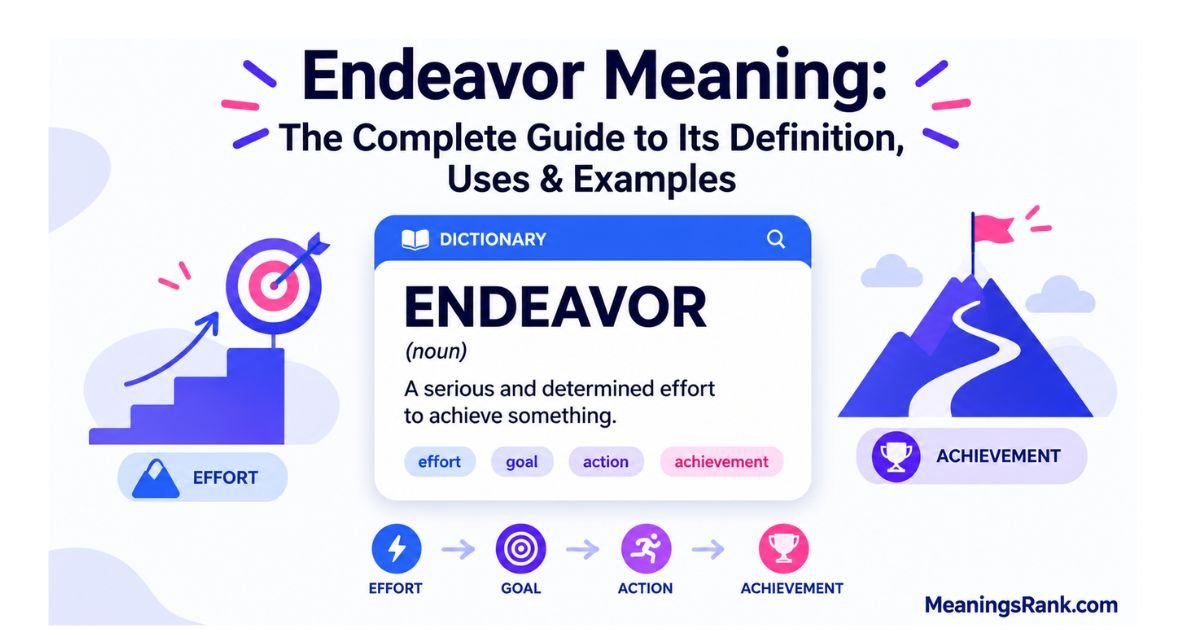

If you’ve ever seen the word “endeavor” pop up in a text, an email, or even a movie title, you might have paused for a second wondering what it really means. It sounds fancy, almost old-fashioned, but people still use it today in texts, work chats, and social media captions. This guide breaks down the endeavor meaning in plain, simple English, so you never have to second-guess it again.
We’ll cover how it’s used as a noun and a verb, where it fits in casual conversation, and where it feels out of place. By the end, you’ll know exactly when to use it and when to skip it.
What Does Endeavor Mean?
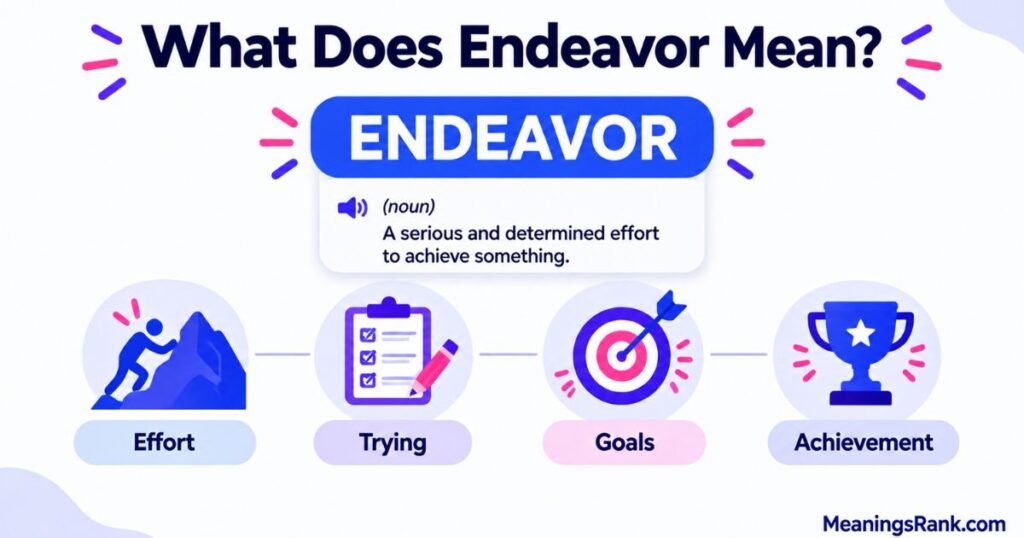
At its core, endeavor means to try hard to do something, especially something that takes effort, time, or skill. It can also refer to the attempt itself a project, mission, or goal someone is working toward.
Think of it as a more polished way of saying “try” or “attempt.” If your friend says, “I’ll endeavor to finish this project by Friday,” they’re basically saying, “I’ll really try my best to get this done by Friday.” The word adds a bit of weight and seriousness to whatever effort is being described.
Here’s the quick breakdown:
- As a verb: to make a serious attempt or effort
- As a noun: a serious attempt, project, or undertaking
Both versions point to the same idea putting real effort into something that matters.
Endeavor Meaning in Detail
The word “endeavor” carries a sense of dedication. It’s not just about trying something once and giving up. It suggests persistence, purpose, and a bit of ambition behind the effort.
For example, saying “I endeavored to learn a new language” means more than just dabbling with an app for a week. It implies you committed to the process, even when it got hard.
This is why “endeavor” often shows up in:
- Business and career goals
- Personal growth stories
- Mission statements
- Formal speeches or writing
- Motivational content
The word carries emotional weight too. It’s often tied to challenges worth overcoming. You wouldn’t say you “endeavored” to make a sandwich that’s too small a task for a word this serious. But you might say you’re endeavoring to start a business, finish a degree, or repair a relationship.
The Core Idea Behind Endeavor
If you strip away the formal tone, the heart of “endeavor” is simple: genuine effort toward something meaningful. It’s less about the outcome and more about the commitment behind the attempt.
Endeavor Focuses on Effort, Not Just Results
One thing that sets “endeavor” apart from words like “achieve” or “succeed” is that it doesn’t guarantee a win. You can endeavor to do something and still fall short the word only promises that you gave it real, honest effort. This is part of why it feels encouraging rather than pressuring. Saying “I endeavored to fix it” still sounds respectable even if the fix didn’t fully work, because the focus is on the attempt, not the outcome.
Is Endeavor a Slang Word?
No, “endeavor” is not slang. It’s a standard English word with a long history in formal and literary writing. You won’t find it trending on TikTok as a new term, and it doesn’t carry any hidden or coded meaning like internet slang usually does.
That said, it does occasionally show up in online spaces in a semi-ironic or exaggerated way. Someone might jokingly say, “I shall endeavor to survive Monday,” using the formal tone for humor. This playful usage borrows the word’s seriousness to make a mundane situation sound dramatic.
So while “endeavor” itself isn’t slang, its use in casual online humor is a modern twist worth knowing about.
Endeavor as a Noun and Verb
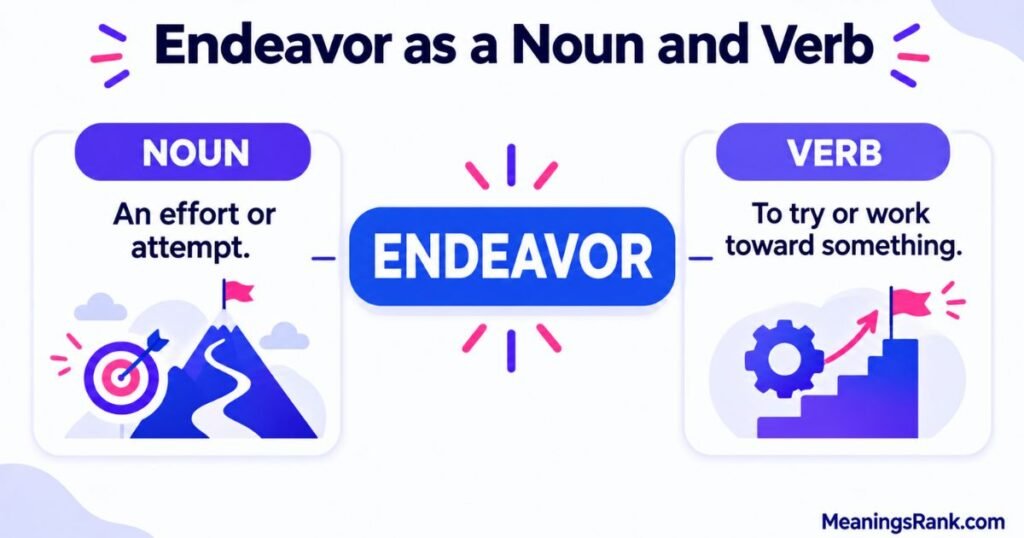
Understanding both forms helps you use the word correctly in any sentence.
Endeavor as a Verb
When used as a verb, “endeavor” means to try or attempt something with real effort.
Examples:
- “I will endeavor to reply to every email by tonight.”
- “She endeavored to keep the team motivated during a tough project.”
- “We endeavor to provide the best customer service possible.”
Notice the pattern: “endeavor to [do something].” This is the most common verb structure.
Endeavor as a Noun
As a noun, “endeavor” refers to the attempt, project, or mission itself.
Examples:
- “Starting this business was a risky endeavor.”
- “Their charitable endeavor raised thousands of dollars.”
- “This research endeavor took over three years to complete.”
In noun form, it’s often paired with adjectives like “risky,” “creative,” “noble,” or “joint” to describe the type of effort being made.
Quick Comparison Table
| Form | Meaning | Example Sentence |
| Verb | To try hard or make an effort | “I’ll endeavor to arrive on time.” |
| Noun | A serious attempt or project | “Their new endeavor is a small bakery.” |
How Context Changes the Meaning of Endeavor
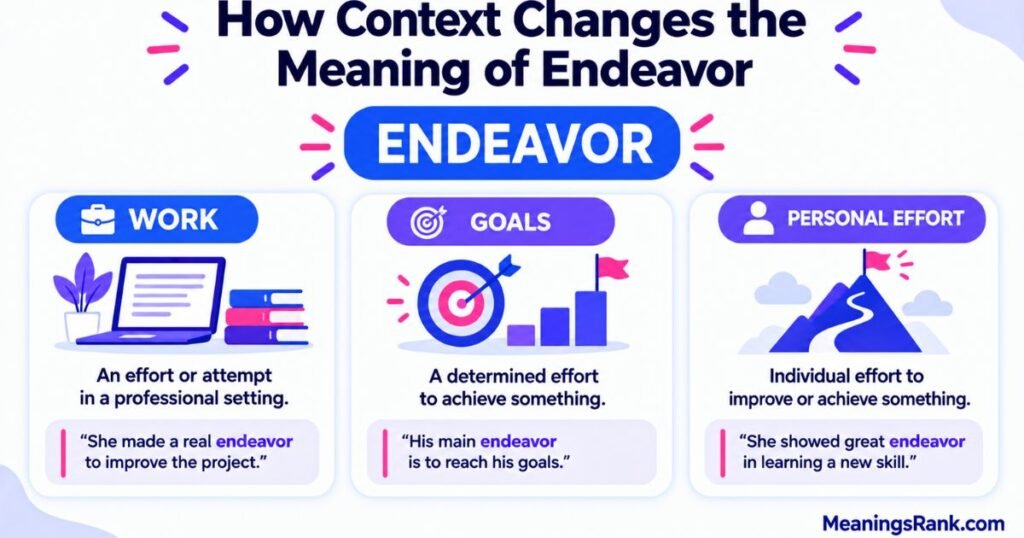
Like many words, “endeavor” meaning shifts slightly depending on where and how it’s used. The core meaning stays the same, but the tone and weight can change.
In a workplace email, it signals professionalism and commitment: “We will endeavor to resolve this issue promptly.”
In a personal conversation, it can sound a bit stiff unless used playfully: “I’m endeavoring to eat healthier this month” comes off as lightly humorous or self-aware.
In a motivational or inspirational context, it adds emotional depth: “Every great endeavor starts with a single step.”
In sarcastic or joking texts, it exaggerates a small task to sound grand: “I shall endeavor to do the dishes eventually.”
The context tells you whether the word is meant to be taken seriously, professionally, or with a wink of humor.
Reading the Room Before You Use It
Before dropping “endeavor” into a message, it helps to think about who’s reading it. A coworker or client will likely take it at face value as polite and professional. A close friend might read it as a joke, especially if the topic is something small like cleaning your room or finishing a Netflix series. Neither reaction is wrong it just shows how flexible the word really is once you understand its formal roots.
Also Read: Elope Meaning: The Complete Guide to What It Means to Elope
Endeavor in Text, Chat, and Everyday Communication
You won’t see “endeavor” meaning used often in quick, casual texting it’s simply too formal for most everyday chats. But it does show up in specific situations across different platforms.
WhatsApp and Text Messages
People sometimes use “endeavor” in longer, more thoughtful texts, especially when discussing goals or plans.
- “I’ll endeavor to call you back before 6 pm, promise.”
Instagram Captions
The word fits well in caption form, especially for posts about personal growth, business launches, or achievements.
- “New endeavor, new energy. Let’s go. 🚀”
Snapchat and TikTok
On these platforms, “endeavor” often appears in a joking or ironic tone, poking fun at how serious the word sounds for something small.
- “My latest endeavor: surviving finals week without crying.”
Discord and Gaming Chats
Gamers sometimes use it humorously to describe a difficult in-game mission or grind.
- “This raid is truly a noble endeavor. Wish me luck.”
Workplace Chats and Emails
This is where “endeavor” feels most natural and professional.
- “We endeavor to have the report ready by end of day.”
- “This is a company-wide endeavor, so every department’s input matters.”
Real Conversation Examples of Endeavor
Seeing the word in real dialogue makes its meaning click faster. Here are a few realistic exchanges.
Text Message Example:
Sam: Are you still trying to learn guitar?
Alex: Yep, endeavoring to practice every night lol
Instagram DM Example:
Jess: Loved your new page for the bakery!
Mia: Thank you! Been my biggest endeavor this year 🍰
Workplace Slack Example:
Manager: Can we get this fixed before the client call? Employee: We’ll endeavor to have it patched within the hour.
Discord Gaming Example:
Player1: This boss fight is brutal.
Player2: A true endeavor. Let’s try one more run.
Group Chat Example:
Friend 1: New Year, new me, right?
Friend 2: Lol same. My endeavor is finally organizing my closet.
What Tone Does Endeavor Have?
“Endeavor” naturally carries a formal, respectful, and slightly elevated tone. It sounds thoughtful and intentional rather than casual or offhand.
Depending on how it’s used, the tone can shift between:
- Serious and professional → in business or academic writing
- Inspirational and motivational → in personal growth content
- Playfully exaggerated → in casual texts or jokes about small tasks
The word rarely sounds negative or harsh. Even when used sarcastically, it stays light-hearted rather than mean.
Is Endeavor Rude or Formal?
“Endeavor” is not rude at all in fact, it’s the opposite. It’s a polite, formal word that shows respect and effort, especially in professional or written communication.
It leans heavily toward formal, which is why it feels a bit out of place in super casual texting unless used for comedic effect. Using it in a serious tone during a light chat might come across as overly stiff, but it will never sound disrespectful or offensive.
If you’re writing a resignation letter, a business proposal, or a heartfelt goal-related caption, “endeavor” fits right in.
Also Read: Skibidi Meaning in Slang: The Complete Guide to This Viral Internet Term
When to Use the Word Endeavor
Here are situations where “endeavor” works well:
- Writing professional emails or reports
- Describing a personal or business goal
- Motivational speeches or captions
- Academic or formal essays
- Mission statements or company values
- Adding a touch of humor to a small task in texts
Example: “As part of our endeavor to improve customer satisfaction, we’ve updated our support system.”
When to Avoid Endeavor
There are also moments where “endeavor” just doesn’t fit:
- Quick, casual texts about simple plans
- Everyday small talk
- Situations where a simpler word like “try” or “attempt” works better
- Conversations where sounding too formal feels awkward
Example to avoid: “I’ll endeavor to grab milk from the store.” (Just say “I’ll try to grab milk” instead it sounds more natural.)
Common Mistakes With Endeavor
Even though “endeavor” is a fairly simple word once you understand it, people still trip up on a few things.
- Misspelling it as “endevor” or “endeavour” (note: “endeavour” is the correct British spelling, not a mistake, just a regional variation)
- Using it for tiny, everyday tasks, which can sound overly dramatic
- Confusing it with “endeavor” as only a noun, forgetting it also works as a verb
- Overusing it in casual writing, making the tone feel stiff or unnatural
- Pairing it with the wrong preposition it should be “endeavor to,” not “endeavor for” or “endeavor on”
Endeavor vs. Similar Words
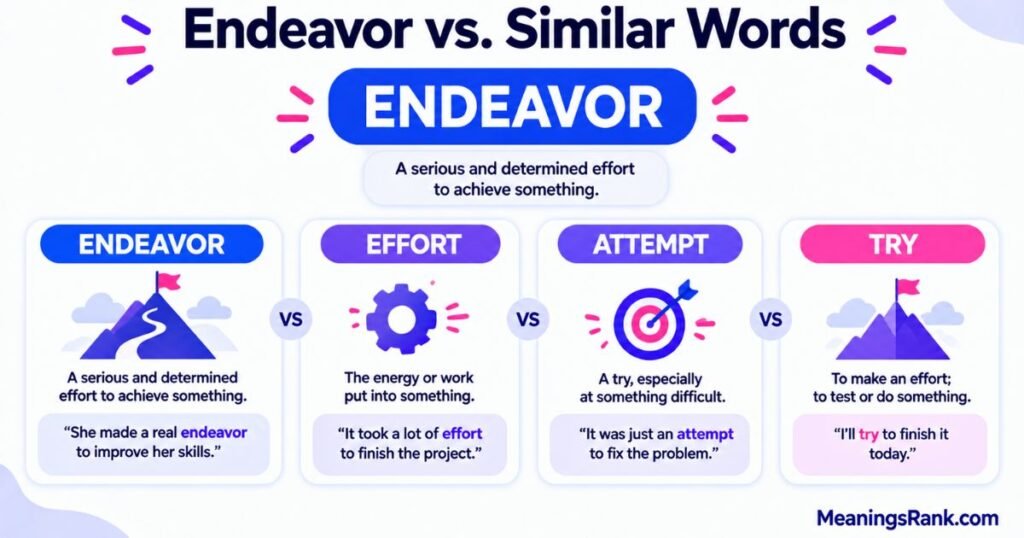
Understanding how “endeavor” compares to similar words helps you choose the right one for the right moment.
| Word | Meaning | Tone | Best Used For |
|---|---|---|---|
| Endeavor | Serious, dedicated effort or attempt | Formal | Big goals, projects, professional writing |
| Try | General effort, no strong weight | Casual | Everyday tasks, texting |
| Attempt | A single effort, may or may not succeed | Neutral | Formal or academic writing |
| Strive | Continuous effort toward a goal | Formal, motivational | Long-term goals, personal growth |
| Pursue | Actively working toward something | Formal | Careers, goals, ambitions |
Simple way to remember it: “Try” is casual, “attempt” is neutral, and “endeavor” is the dressed-up version of both — used when the effort really matters.
Quick Tips for Choosing the Right Word
- Use “try” for anything small, quick, or low-stakes.
- Use “attempt” when you want a neutral, factual tone, like in reports.
- Use “endeavor” when the effort involves real dedication or a bigger goal.
- Use “strive” when the effort is ongoing, not a one-time thing.
- Use “pursue” when you’re talking about chasing a long-term ambition, like a career.
Keeping these differences in mind makes your writing sound more precise, whether you’re texting a friend or drafting a work email.
Origin and History of Endeavor
The word “endeavor” has roots in Middle English, coming from the phrase “put oneself in devoir,” where “devoir” meant “duty” in Old French, which itself came from Latin “debere,” meaning “to owe.”
Basically, the original idea was about doing your duty or fulfilling an obligation through effort. Over time, the phrase shortened and evolved into the single word “endeavor,” keeping that same sense of committed effort.
This history explains why the word still feels a bit formal and duty-driven today. It’s not just about trying it’s about trying because it matters.
Interestingly, “Endeavour” was also the name of Captain James Cook’s famous ship in the 1700s, which added a sense of exploration and ambition to the word’s legacy. NASA later used the name “Endeavour” for one of its space shuttles, reinforcing the word’s connection to big, meaningful missions.
Endeavor Meaning in American and British English
The meaning of “endeavor” stays exactly the same in both American and British English. The only real difference is spelling.
| Region | Spelling | Example |
| American English | Endeavor | “We endeavor to meet every deadline.” |
| British English | Endeavour | “We endeavour to meet every deadline.” |
That extra “u” in British English is the only change. Pronunciation stays nearly identical too, so you don’t need to worry about mixing up meanings just be consistent with spelling based on your audience.
Quick Recap
- Endeavor means to try hard or make a serious effort toward something meaningful.
- It works as both a verb (to endeavor) and a noun (an endeavor).
- It’s not slang, though it’s sometimes used humorously online.
- The tone is formal and respectful, never rude.
- It fits best in professional, motivational, or goal-related contexts.
- Avoid using it for small, everyday tasks it can sound overly dramatic.
- British English spells it “endeavour,” but the meaning is identical.
Frequently Asked Questions
What does endeavor mean in simple words?
It means to try hard at something important or meaningful.
Is endeavor the same as try?
Similar, but endeavor sounds more formal and serious than try.
Can endeavor be used as a noun?
Yes, it means a serious attempt, project, or mission.
Is endeavor a formal or casual word?
It’s formal, best suited for professional or serious writing.
What’s the British spelling of endeavor?
The British spelling is “endeavour,” with an extra “u.”
Is it okay to use endeavor in texts?
Yes, but it often sounds playful or exaggerated in casual chats.
Final Thoughts
The word “endeavor” might sound a little old-school, but it still holds real value in modern communication. Whether you’re writing a professional email, describing a personal goal, or adding a witty touch to a text about doing laundry, understanding the true endeavor meaning helps you use it with confidence. It’s a word built around effort, purpose, and commitment not just trying, but trying because something genuinely matters.
Use it when you want to sound intentional and sincere, and save the casual “try” or “attempt” for smaller, everyday moments. Now that you know how it works as both a noun and a verb, where it fits best, and how its tone shifts across different platforms, you’re ready to use “endeavor” the right way, wherever the conversation takes you.