
You’ve probably seen the word “elope” pop up in a text, a TikTok caption, or maybe even in a conversation with your best friend about her wedding plans. But what does it actually mean? Is it just running off to get married, or is there more to it? This guide breaks down the elope meaning in plain, simple English.
We’ll cover how people use the word in real texts, on Instagram and Snapchat, at work, and in everyday conversation. By the end, you’ll know exactly when to use “elope,” when to avoid it, and how to reply if someone tells you they’re eloping.
What Does Elope Mean?
At its core, “elope” means to run away, usually to get married, without a big wedding, family involvement, or a formal announcement. It’s a verb that describes a quiet, quick, and often private decision to tie the knot.
The word carries a sense of spontaneity. When two people elope, they skip the guest list, the venue, the dress fittings, and the seating charts. Instead, they might drive to a courthouse, fly to a beach, or hike up a mountain with just a witness or two.
Here’s a simple breakdown:
- Elope (verb): To leave secretly, especially to get married without telling family or friends beforehand.
- Elopement (noun): The act of eloping, or the event itself.
- Eloper (noun): A person who elopes.
What Is the Main Elope Meaning?
The main elope meaning, in modern usage, is this: getting married in a small, private, and often unannounced way, usually without a traditional ceremony or a large guest list.
This is the meaning most people think of first. It doesn’t always mean the couple is hiding from their parents or sneaking around in secret. Today, eloping is often a lifestyle choice. Couples choose it because they want something intimate, low-stress, and budget-friendly instead of a big, expensive wedding.
So while the word still holds its old-school “running away” flavor, the modern elope meaning leans more toward “choosing a small, private wedding” rather than “escaping in secret.”
Does Elope Always Mean Getting Married Secretly?
No, not anymore. This is one of the biggest misunderstandings about the word.
Historically, eloping meant running away in secret, often because parents disapproved of the marriage, or because the couple didn’t have enough time or money for a formal wedding. That old meaning still exists and is still used sometimes.
But in today’s world, especially online, eloping has taken on a new, more relaxed meaning:
- Some couples elope and tell their families right after.
- Some couples even elope with a few close family members present.
- Some post their elopement photos on Instagram the same day.
- Some plan their elopement for months, just like a normal wedding, but keep the guest list tiny.
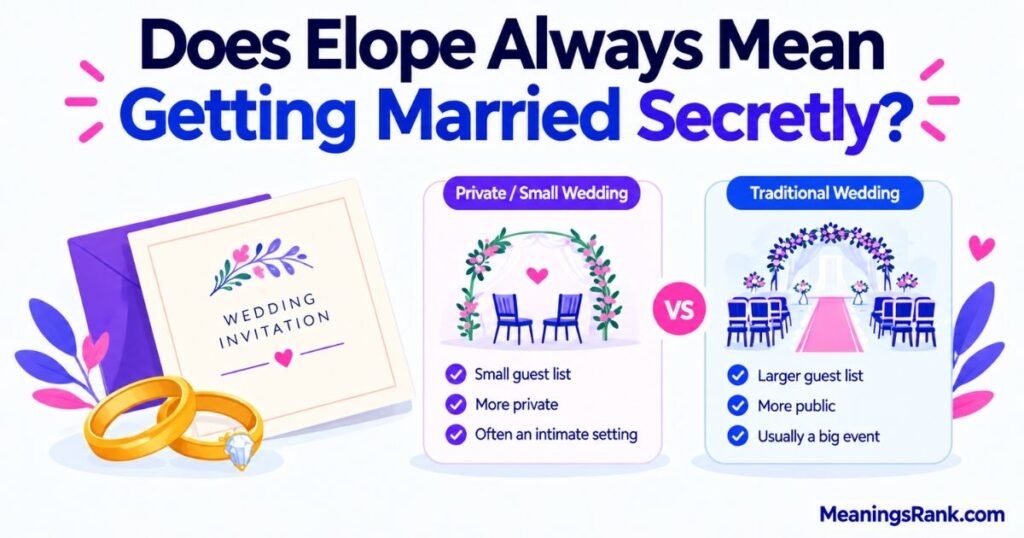
So the short answer is: eloping today is more about scale and privacy, not necessarily secrecy. The couple isn’t always hiding anything. They’re just choosing a smaller, quieter way to get married.
How Context Changes the Meaning of Elope
Like a lot of English words, “elope” shifts meaning depending on how and where it’s used. Context is everything.
Elope in a Romantic Context
When used romantically, “elope” usually means a couple decided to get married quietly and quickly, often because they wanted to skip the stress of wedding planning. This is the most common way you’ll see the word used today.
Elope in a Family Drama Context
In older stories, movies, or family conversations, “elope” often means a couple ran away because their families didn’t approve. This version carries more tension and drama.
Also Read: Skibidi Meaning in Slang: The Complete Guide to This Viral Internet Term
Elope as a Joke or Exaggeration
Online, people sometimes use “elope” jokingly, even when marriage isn’t really involved. For example, a friend might text “let’s just elope” after a stressful day of wedding planning, just to express how tired they are of the process. It’s not always literal.
Elope in a Business or Career Sense (Rare)
Occasionally, people stretch the word to mean quietly leaving a situation, like a job, without much notice. This usage is uncommon and mostly used humorously, like “I want to elope from this meeting.”
Elope Meaning in Text and Chat
When you see “elope” meaning in a text message, it almost always relates to marriage. Texting tends to keep the word close to its real meaning, but the tone can vary a lot depending on who’s texting.
Here are some common ways it shows up in texts:
- “We’re thinking about eloping instead of a big wedding.” This usually means the couple wants something small and simple.
- “OMG did you hear? They eloped!!” This is often surprise or excitement, especially if it was unexpected.
- “Honestly, I just want to elope at this point.” This is often said by someone stressed out from wedding planning, not always a literal plan.
- “We eloped last weekend, will tell everyone soon.” This shows the couple got married privately and plans to share the news later.
In casual texting, the tone is usually light, happy, or a little dramatic, not secretive or scandalous like it might have been decades ago.
Elope Meaning on TikTok, Instagram, and Snapchat
Social media has completely changed how people talk about eloping. It’s become a trend, almost a wedding style of its own.
Elope on TikTok
TikTok is full of “elopement” content. Couples post their private wedding videos with captions like “we eloped and it was the best decision ever” or “POV: we eloped instead of having a wedding.” These videos usually show:
- A small, scenic location (mountains, beaches, forests)
- Just the couple, maybe a photographer
- Simple outfits instead of a full wedding gown and tux
- Captions explaining why they chose to elope
Elope on Instagram
On Instagram, “elope” is often used in captions and hashtags like #welope, #elopementphotographer, or #intimatewedding. Couples use it to describe their wedding style, almost like a badge that says “we did things our own way.”
Elope on Snapchat
On Snapchat, the word is used more casually, often in quick messages or stories. Someone might snap a picture of a courthouse and caption it “eloping today 😂💍” as a fun, spontaneous update to close friends.
Real Conversation Examples
Seeing the word in action helps make the meaning click. Here are some real-style examples across different platforms.
WhatsApp (between close friends):
Friend 1: “Guess what… we eloped last night 😭💍” Friend 2: “WHAT?! No way, tell me everything!”
Instagram DM:
“We’re planning to elope in Bali next spring, just the two of us and a photographer.”
Discord (gaming group chat, joking tone):
“Bro I’m so done with this raid, let’s just elope and quit gaming forever 😂”
Workplace Slack/Teams Chat:
“Congrats on the wedding news! Wait, did you guys elope or have a full ceremony?”
Text message (family group chat):
“Just wanted to let you all know… we eloped this weekend. We’ll share photos soon!”
Snapchat caption:
“Eloping > Big weddings, no cap 💍✨”
These examples show how flexible the word has become, from serious family announcements to playful jokes among friends.
Is Elope Rude or Romantic? Understanding the Context
This is a common question, and the answer really depends on the relationship and the situation.
When Eloping Feels Romantic
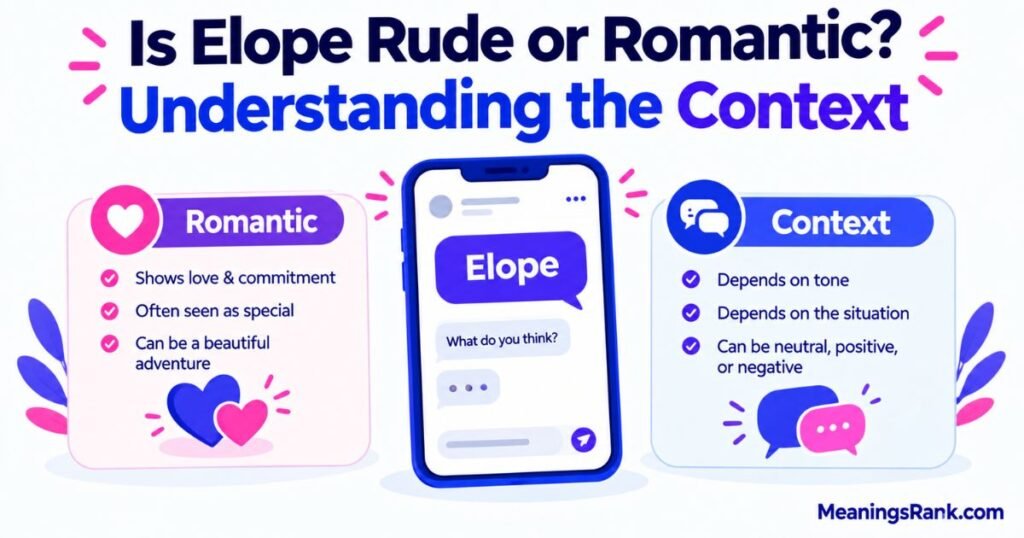
Most people today see eloping as romantic. It suggests the couple values their relationship over outside pressure, expensive parties, or family expectations. It feels personal, intimate, and meaningful.
When Eloping Feels Rude or Hurtful
Eloping can feel rude or hurtful in certain situations, especially if:
- Family members were expecting to be part of the wedding
- Parents find out after the fact instead of being told directly
- The couple avoided telling people on purpose to dodge conflict
In these cases, it’s not the word itself that’s rude, it’s how the situation was handled. The act of eloping isn’t inherently disrespectful, but the way people are (or aren’t) informed can affect how it’s received.
How to Reply to Elope
If someone tells you they eloped or are planning to, how you respond matters. Here are some simple, natural ways to reply depending on the context.
- If they just told you they got married: “Congratulations! I’m so happy for you both!”
- If they’re planning to elope soon: “That sounds amazing, I love that you’re doing it your way.”
- If you’re a close friend and want more details: “Tell me everything, when and where did you decide to do it?”
- If you’re a parent who wasn’t included: “I wish I could’ve been there, but I’m truly happy for you.”
- In a casual chat where someone jokes about eloping: “Haha, honestly that sounds easier than planning a whole wedding.”
The key is to keep your reply warm and supportive, even if you’re a little surprised.
When to Use the Word Elope
Use “elope” when you want to describe:
- A couple getting married privately, without a big ceremony
- A spontaneous or quickly planned wedding
- A wedding style choice, even if it was planned for months
- A joking exaggeration about wanting to skip a stressful event (used casually)
Example sentence:
“After months of wedding stress, they decided to elope in the mountains instead.”
When to Avoid the Word Elope
You should avoid using “elope” when:
- Talking about a full, traditional wedding with a large guest list, since that’s the opposite meaning
- Referring to a couple who just moved in together (that’s not eloping)
- Using it in a formal or professional document, since it’s a casual, conversational term
- Describing a breakup or separation, since “elope” has nothing to do with ending a relationship
Example of misuse:
“They eloped and had 200 guests.” (This doesn’t make sense, since eloping means small and private.)
Common Mistakes About Elope
Many people misunderstand or misuse the word. Here are the most common mistakes.
| Mistake | Why It’s Wrong | Correct Understanding |
| Thinking elope always means secret marriage | Modern eloping is often announced or shared later | Eloping today is more about small scale than secrecy |
| Using elope for any small gathering | Elope specifically relates to marriage | It only applies to weddings, not other events |
| Assuming eloping means no family is ever told | Many couples tell family right after | Families are often informed, just not always present |
| Believing eloping is disrespectful | It depends on communication, not the act itself | Respectful eloping still involves honesty with loved ones |
| Confusing elope with elopement ceremony styles | Elope is the verb, elopement describes the event or style | Use “elope” for the action, “elopement” for the noun |
Elope vs. Run Away to Get Married
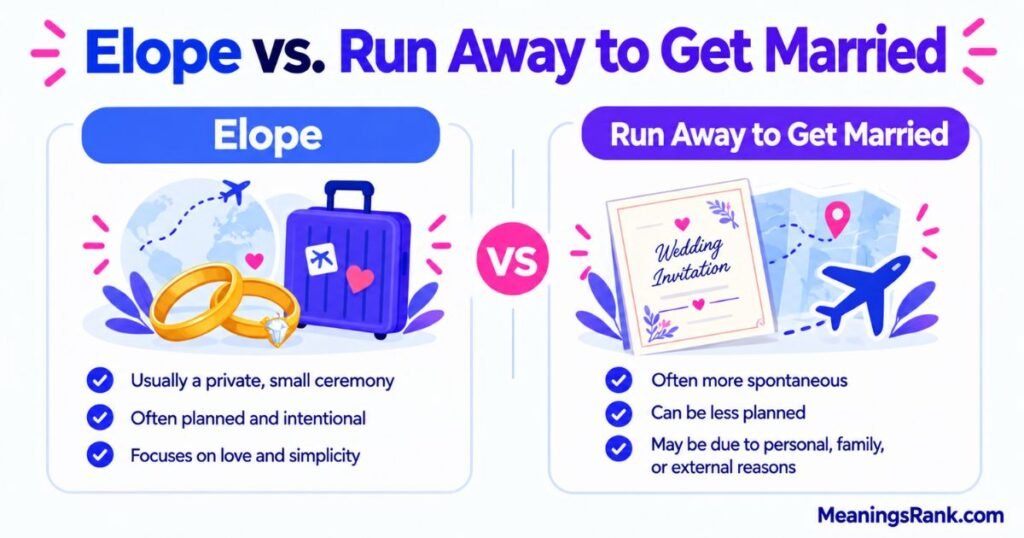
These phrases sound similar, but they carry slightly different tones.
| Term | Meaning | Tone |
| Elope | To marry privately and quietly, often skipping tradition | Neutral to romantic, modern and accepted |
| Run away to get married | To secretly leave home to marry, often against family wishes | Dramatic, sometimes rebellious or scandalous |
“Elope” is the more common, socially accepted term today. “Run away to get married” sounds more old-fashioned and implies conflict or secrecy, almost like something out of a movie plot.
Is Eloping Different From a Traditional Wedding?
Yes, very different. Here’s a simple comparison to make it clear.
| Feature | Traditional Wedding | Eloping |
| Guest list | Large, often 50–300+ people | Small, sometimes just the couple |
| Planning time | Months to over a year | Days to a few months |
| Cost | Usually expensive | Usually low-cost |
| Location | Banquet halls, churches, venues | Courthouses, beaches, mountains, anywhere |
| Formality | Formal attire, structured ceremony | Casual to semi-formal, flexible |
| Family involvement | High, family often helps plan | Low to none, sometimes told after |
Eloping strips the wedding down to its core meaning: two people committing to each other. Everything else, the decorations, the guest list, the reception, becomes optional.
Similar Terms to Elope
If you’re trying to understand elope better, it helps to compare it with related words and phrases.
- Intimate wedding: A small wedding with close family and friends, but still somewhat planned and announced beforehand.
- Micro wedding: A trendy term for a very small, styled wedding, often under 50 guests, similar to eloping but sometimes more formal.
- Courthouse wedding: A simple, legal wedding held at a courthouse, often part of eloping.
- Destination elopement: Eloping in a special location, like a beach, forest, or another country.
- Secret marriage: Similar to the older meaning of elope, but used more generally, not always related to running away.
Origin and Usage of Elope
The word “elope” has roots in old French and Anglo-Norman legal language, originally referring to a wife running away from her husband. Over time, the meaning shifted in English to describe a couple running away together to marry, especially without parental consent.
By the 20th century, “elope” had become closely tied to romantic stories, often involving young couples defying their families. In modern usage, especially over the last decade, the word has softened. It’s now widely used as a positive, even trendy, term to describe intentional, low-key weddings.
Today, wedding blogs, photographers, and couples themselves use “elope” and “elopement” as marketing and lifestyle terms, not just descriptions of secrecy. This shift reflects a broader cultural move toward simpler, more personal celebrations over large, expensive events.
Also Read: Sigma Meaning Slang: The Ultimate Guide to This Viral Internet Term
Quick Recap
- Elope meaning: To marry privately and quietly, often without a big ceremony or guest list.
- It doesn’t always mean secrecy anymore, many couples announce it later.
- Context changes the tone, from romantic to dramatic to joking.
- It’s commonly used in texts, Instagram captions, TikTok videos, and casual chats.
- Eloping is different from running away to marry, which sounds more dramatic and old-fashioned.
- Traditional weddings and elopements differ mainly in size, cost, and formality.
Frequently Asked Questions
Does elope always mean getting married without telling anyone?
No, many couples tell family and friends soon after eloping.
Is eloping considered disrespectful to parents?
Not inherently, it depends on how it’s communicated to loved ones.
Can elope be used for something other than marriage?
Rarely, and only in joking or exaggerated, non-literal contexts.
What’s the difference between eloping and a micro wedding?
Eloping is smaller and more private than a planned micro wedding.
Is eloping cheaper than a traditional wedding?
Yes, eloping is usually far less expensive than a full wedding.
Do people still elope in modern times?
Yes, eloping has become a popular, trendy wedding choice today.
Final Thoughts
The elope meaning has changed a lot over the years. What once meant sneaking away in secret now often means choosing a smaller, more personal way to get married. It’s less about hiding and more about intention, couples wanting a wedding that feels true to them instead of shaped by outside expectations.
Whether you see the word in a text from a friend, a TikTok caption, or an Instagram post, the core idea stays the same: two people deciding to commit to each other without all the extra noise. Understanding this shift helps you respond appropriately, whether that’s celebrating a friend’s surprise announcement or simply understanding a trend you keep seeing online.
At the end of the day, eloping isn’t rude, dramatic, or secretive by default. It’s just another way people choose to say “I do.”