
You just got an invite, and it says “RSVP by Friday.” But what does that actually mean, and what are you supposed to do about it? RSVP meaning trips up a lot of people, especially when it shows up in a text message, an Instagram event, or a fancy wedding card. The truth is, RSVP is a simple French phrase turned into an everyday English habit. It’s basically a polite way of asking, “Are you coming or not?” In this guide, we’ll break down exactly what RSVP means, where it came from, how to respond to one, and how to avoid the awkward mistakes most people make. By the end, you’ll never second-guess an RSVP request again.
What makes RSVP interesting is how it’s managed to survive across completely different eras of communication. It started on hand-written reply cards tucked inside formal envelopes, and now it shows up in Discord servers, WhatsApp group chats, TikTok captions, and Snapchat messages between friends. The wording has changed, the platforms have changed, but the core purpose hasn’t budged an inch.
In this guide, we’ll break down exactly what RSVP means, where it came from, how to respond to one properly, how to cancel or change your answer without causing drama, and how to avoid the awkward mistakes most people make on both sides of the invitation. We’ll also walk through real examples from texts, social media, gaming communities, and workplace chats, so you can see exactly how RSVP shows up in everyday life. By the end, you’ll never second-guess an RSVP request again, no matter where or how it lands in front of you.
Quick Answer
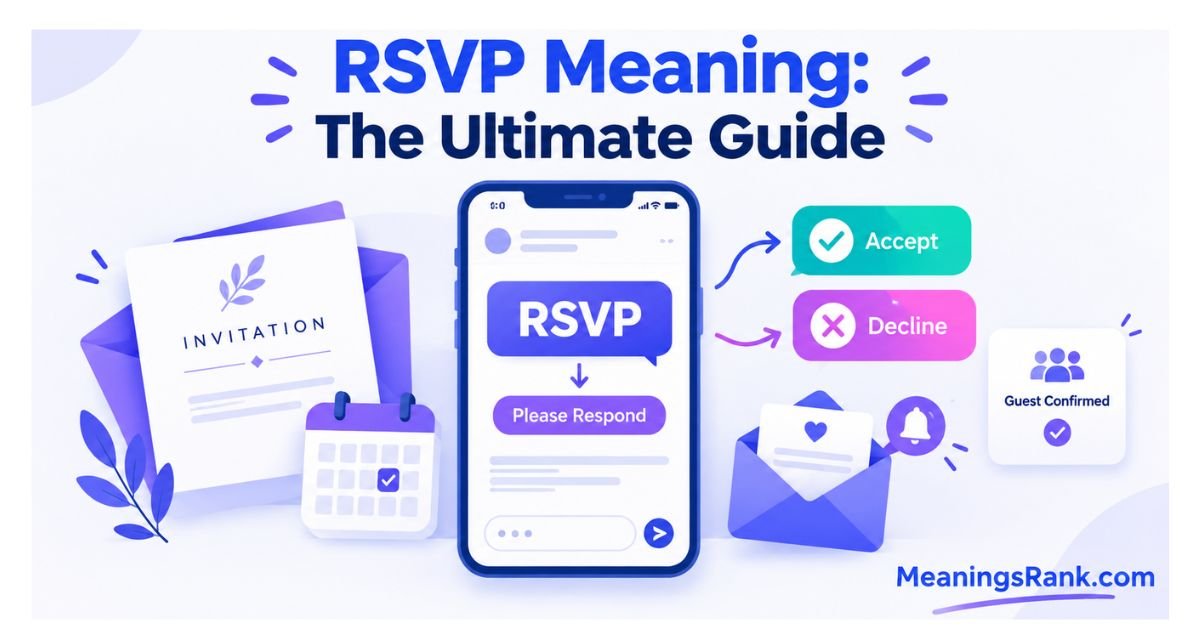
RSVP stands for the French phrase “Répondez s’il vous plaît,” which translates to “please respond” in English.
It’s used on invitations to ask guests to confirm whether they’ll attend an event. When you see “RSVP” on a wedding card, party invite, or even a text message, it simply means the sender wants to know your attendance answer yes, no, or maybe usually by a specific date.
In short: RSVP = a polite request to reply and confirm your plans.
What Does RSVP Mean?

RSVP isn’t an English word at all. It’s an abbreviation borrowed from French, and it’s been part of English etiquette for well over a century. The full phrase is “Répondez s’il vous plaît,” which breaks down like this:
- Répondez = respond
- s’il vous plaît = please (literally “if it pleases you”)
Put together, it means “please respond.” That’s it. There’s no hidden meaning or complicated rule behind it. When someone writes RSVP on an invitation, they’re asking you to let them know if you’re attending.
Where the Phrase Comes From
The reason this French phrase stuck around in English is mostly tradition. Formal invitations, especially in Britain and the United States, borrowed a lot of etiquette language from French in the 18th and 19th centuries. French was the language of diplomacy and high society back then, so wealthy and noble families used French phrases on their invitations to sound polished and proper. RSVP became the standard shorthand for “let us know your plans,” and it never really went away even in casual texting today, hundreds of years later.
It’s a little funny when you think about it. Most people who type “rsvp asap” in a group chat have no idea they’re technically using two abbreviations from two different languages back to back. But that’s how language works phrases stick around long after people forget where they came from.
Why It’s Written in Capital Letters
You’ll notice RSVP is almost always written in capital letters. That’s because it’s an initialism (an abbreviation pronounced letter by letter, like FBI or ASAP), not an acronym that’s said as a word like NASA or SCUBA. Each letter is said individually: R-S-V-P. Some style guides now accept lowercase “rsvp” in casual writing, especially in texts and social captions, but the capitalized version remains the standard in formal invitations.
Is RSVP Still Relevant Today?
Some people assume RSVP is an old-fashioned, stuffy term that only shows up on wedding invites written in cursive. That’s not true anymore. RSVP has actually become more common thanks to digital event platforms, group chats, and social media. Every time you tap “Going” on a Facebook event or react with a checkmark in a Discord server, you’re technically RSVPing the tradition just moved online.
Full Definition of RSVP
Here’s a more detailed breakdown of the term so you understand it from every angle:
| Element | Detail |
|---|---|
| Full form | Répondez s’il vous plaît |
| Language of origin | French |
| Literal translation | “Respond, please” |
| Common usage | Requesting confirmation of attendance |
| Part of speech | Can be used as a noun (“Send your RSVP”) or a verb (“Please RSVP by Monday”) |
| First widespread use | 18th–19th century formal invitations |
| Modern usage | Weddings, parties, work events, texts, online event pages |
RSVP as a Noun
As a noun, RSVP refers to the actual response itself: “I got 40 RSVPs for the party.” In this form, it works just like any countable noun you can have one RSVP, several RSVPs, or a pile of RSVPs sitting in your inbox waiting to be counted.
RSVP as a Verb
As a verb, it means the act of responding: “Don’t forget to RSVP by Friday.” You can conjugate it loosely too, like “RSVPing” or “RSVP’d,” even though it’s technically not a real English verb by grammar rules. Language evolves, and RSVP has clearly earned verb status through everyday use.
Both uses are completely normal in modern English, and native speakers switch between them without even thinking about it. If you’re ever unsure which form to use, just remember: if you’re talking about the reply itself, it’s a noun. If you’re talking about the action of replying, it’s a verb.
Also Read: LFG Meaning in Text: The Ultimate Guide to Its Meaning, Uses & Examples
Context and Usage of RSVP
RSVP shows up in more places than just wedding invitations these days. Understanding the context helps you know exactly what’s expected of you.
Formal Contexts
- Wedding invitations
- Corporate galas and conferences
- Graduation ceremonies
- Award dinners
- Government or diplomatic events
- Charity fundraisers and black-tie dinners
In these settings, RSVP usually comes with a strict deadline, dress code expectations, and sometimes a formal reply card that needs to be mailed back. Missing the deadline in a formal setting can actually cause real problems for the host, especially with catering costs already locked in.
Casual Contexts
- Birthday party invites sent over text
- Facebook or Instagram event pages
- WhatsApp group invites for a get-together
- Discord server events for gaming nights
- Office happy hours or team lunches
- Neighborhood block parties or potlucks
In casual settings, it might just be a quick line like “RSVP so I know how much pizza to order.” There’s usually more flexibility here, and hosts are generally more forgiving if your answer changes closer to the date.
The Core Idea Stays the Same
Whether it’s formal or casual, the core idea never changes: someone is planning something, and they need a headcount before it happens. RSVP exists to remove guesswork from event planning, no matter how big or small the event is.
Different Types of RSVPs
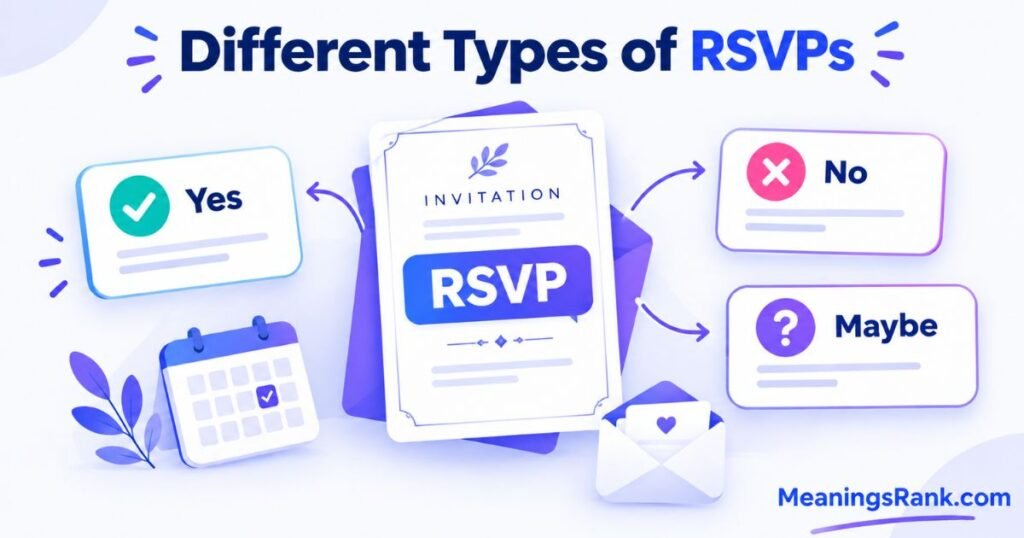
Not every RSVP looks the same. Depending on the event and how it’s sent, you’ll see a few common variations.
Traditional Mail RSVP
This is the classic version a small response card included with a wedding or formal invitation. You check a box for “Accepts” or “Declines” and mail it back, usually in a pre-addressed, pre-stamped envelope the host included for convenience.
Digital RSVP
Common with platforms like Evite, The Knot, or Google Forms. You click a link and select yes, no, or maybe. Digital RSVPs are popular because hosts can track responses automatically instead of counting reply cards by hand.
Text or Chat RSVP
Someone sends a message like “Coming Saturday? Lmk by Thursday” no formal wording needed, but it’s still technically an RSVP request. This is by far the most common type of RSVP among friends and family today.
Social Media RSVP
Facebook and Instagram events let you tap “Interested” or “Going.” This counts as a modern digital RSVP, even though it doesn’t use the actual word “RSVP” anywhere on the screen.
Phone RSVP
Some invitations, especially formal ones, ask you to call and confirm your attendance directly. This is less common now but still shows up for very traditional events or older generations who prefer talking over texting.
In-App Event RSVP
Apps like Discord, Partiful, or Luma now build RSVP buttons right into event pages, letting people respond instantly with one tap. These apps often show a live guest list, so everyone can see who’s already confirmed.
How to Respond to an RSVP
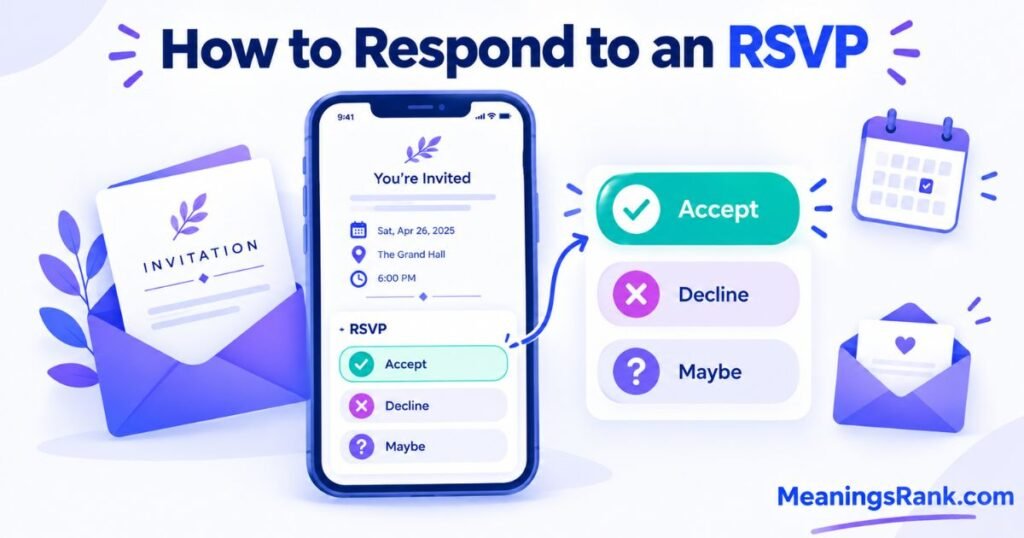
Responding to an RSVP is simple, but the tone should match the event. Here’s how to handle it properly.
Step-by-Step Guide to Responding
- Read the invitation carefully. Check the date, time, location, and whether it says “regrets only” (meaning you only need to respond if you’re NOT coming).
- Decide your answer. Yes, no, or maybe but try to avoid “maybe” if you can help it, since it makes planning harder for the host.
- Respond before the deadline. Don’t wait until the last minute; hosts need time to plan food, seating, or space.
- Use the requested method. If they ask for a reply card, don’t just text them. If they gave a phone number, use it.
- Include extra details if needed. Mention dietary restrictions, plus-ones, or kids attending if the invite allows it.
- Keep it polite and clear. A short, friendly reply works fine you don’t need to overexplain.
Example Replies for Different Situations
- Formal: “Thank you for the invitation. I am pleased to accept and look forward to celebrating with you.”
- Casual text: “Yesss I’ll be there 🙌 count me in!”
- Declining politely: “So sorry, I can’t make it this time, but I hope it’s amazing! 💕”
- Declining formally: “Thank you so much for including me. Unfortunately, I won’t be able to attend, but I wish you all the best.”
- Replying with a plus-one: “I’d love to come, and I’ll be bringing my partner if that’s alright!”
What to Do If You’re Genuinely Unsure
Sometimes life gets complicated and you really don’t know if you can make it. In that case, it’s better to be honest with the host rather than ignore the invite. Try something like: “I really want to come, but I’m not 100% sure yet because of work. Can I confirm by Wednesday?” Most hosts appreciate the honesty far more than silence.
How to Cancel or Change an RSVP
Plans change, and that’s normal. But how you cancel matters just as much as how you originally responded.
Best Practices for Changing Your RSVP
- Tell the host as soon as possible. The earlier they know, the easier it is for them to adjust.
- Apologize briefly, but don’t over-explain. A short reason is enough.
- Offer a solution if it helps. For example, if you can’t make a dinner, offer to send a gift or visit another time.
- Confirm they received your update. Especially for big events like weddings, follow up to make sure they saw your message.
Also Read: IYKYK Meaning in Text: The Complete Guide to This Popular Internet Slang
Example Cancellation Message
“Hi! I’m so sorry, but something came up and I won’t be able to make it Saturday. I hope you all have a wonderful time — let me know if there’s anything I can help with beforehand!”
Switching from a No to a Yes
Changing your RSVP the other way around from declining to attending can also cause problems if it happens too late. Venues and catering often have fixed headcounts a few days before an event, so if your plans open up last minute, always ask the host first instead of just showing up. A quick message like “Hey, turns out I can actually make it now is there still room?” avoids any awkward surprises at the door.
Canceling last-minute should be reserved for real emergencies. If you’re just not feeling like going, try to be honest earlier rather than ghosting the invite entirely.
RSVP Etiquette for Guests
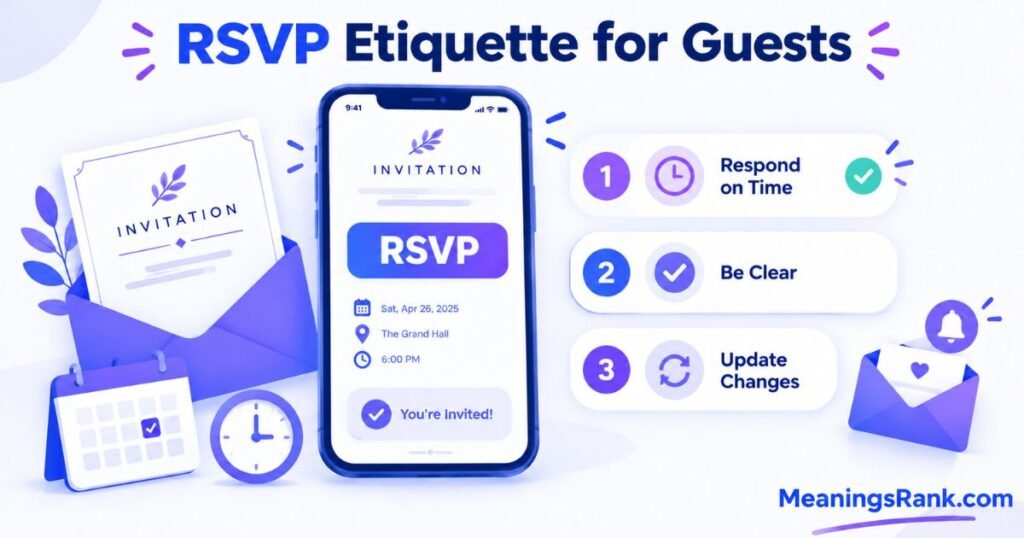
Good etiquette isn’t about being stiff or overly formal it’s about being considerate. Here are the unwritten rules most hosts expect guests to follow.
General Etiquette Rules
- Respond even if you’re declining. Silence is confusing and makes planning harder.
- Don’t assume you can bring a guest unless the invitation specifically says “plus one.”
- Reply by the deadline, not after.
- Don’t change your answer more than once unless absolutely necessary.
- If children aren’t mentioned, assume it’s adults only.
- Be honest about dietary needs early, not the day of the event.
- Say thank you when you respond a small touch that goes a long way.
Etiquette for Group RSVPs
When an invite covers an entire family or group, it’s usually your job to respond for everyone, not just yourself. If some family members can come and others can’t, list names clearly instead of sending a vague “some of us will be there.” Hosts need exact numbers, not estimates.
Etiquette in Digital Spaces
Online RSVPs come with their own small rules too. Tapping “Interested” on Facebook isn’t the same as confirming you’re going hosts often can’t tell the difference, so it’s better to actually message them directly if you plan on attending. The same goes for reacting with an emoji in a group chat; a thumbs-up might get lost in a busy conversation, so a clear written reply is always safer.
Following these small rules shows respect for the time and effort a host puts into planning.
Usage Tips for Hosts
If you’re the one sending invitations, wording your RSVP request clearly saves you a lot of back-and-forth.
Writing a Clear RSVP Request
- Set a clear deadline. “RSVP by June 5th” is much better than just “RSVP.”
- Give multiple response options (text, call, or link) if possible.
- Use “regrets only” if you only want responses from people who can’t come.
- Send a gentle reminder a few days before the deadline for anyone who hasn’t replied.
- Keep a simple tracking list, even a basic spreadsheet, so you don’t lose track of headcounts.
- Be specific about plus-ones or kids so guests don’t have to guess.
Sample Host Wording
For formal events: “Kindly RSVP by May 20th to confirm your attendance.”
For casual events: “Let me know by Thursday if you’re coming just need a rough count!”
For work events: “Please RSVP through the calendar invite so we can finalize the headcount for catering.”
Handling Late or Missing Responses
If a guest hasn’t responded close to your deadline, a friendly nudge usually works better than silence. Something like “Hey! Just checking if you saw the invite would love to know if you can make it” tends to get better results than assuming they’re ignoring you. Some guests genuinely forget, especially with busy group chats where messages get buried fast.
A clear RSVP request almost always gets a faster, more accurate response.
Real-Life Examples of RSVP
Seeing RSVP in action across different chat apps makes it easier to understand how flexible the term really is.
Text Message Example
“Hey! Throwing a small bonfire Saturday night 🔥 RSVP by Thursday so I know how many hot dogs to grab!”
WhatsApp Group Chat Example
“Family reunion is set for July 12th. Please RSVP in this chat by June 30th so Aunt Lisa can finalize catering.”
Instagram Event Caption Example
“Rooftop party 🌆 Tap ‘Going’ to RSVP limited spots!”
Snapchat Example
“yo bday bash sat, u coming?? rsvp asap lol”
TikTok Comment Example
“RSVP link in bio 🎟️ don’t sleep on this one!”
Discord Gaming Server Example
“Clan tournament this Friday 8PM EST. React with ✅ in #events to RSVP need 10 confirmed players.”
Workplace Slack/Teams Example
“Reminder: please RSVP for the Q3 all-hands meeting by Wednesday so we can arrange seating and catering.”
Across every platform, the core meaning stays exactly the same confirm if you’re showing up.
RSVP Meaning Across Different Platforms
While the meaning of RSVP doesn’t change, the way it’s used shifts slightly depending on the platform.
| Platform | How RSVP Appears | Typical Tone |
|---|---|---|
| Group chat messages or broadcast lists | Casual to semi-formal | |
| Event posts, story stickers, “Going” button | Casual, visual | |
| Snapchat | Direct messages, quick plans | Very casual, abbreviated |
| TikTok | Event promo captions, comment sections | Trendy, short |
| Discord | Event tabs, reaction-based RSVPs | Community-driven, gaming-focused |
| Email/Workplace | Formal meeting or event invites | Professional |
| Event pages with Going/Interested/Not Going | Semi-formal |
Why Platform Matters
The platform you’re using often shapes how strict or relaxed the RSVP feels. A Discord reaction-based RSVP for a gaming tournament is quick and low-pressure, while an email RSVP for a work conference usually needs a full sentence and a professional tone. Knowing your platform helps you match the right level of formality without overthinking it.
Gen Z and Texting Culture
Younger users have shortened RSVP even further in everyday texting, often dropping capital letters entirely or combining it with other slang, like “rsvp fr fr” or “rsvp or ur missing out.” While it looks different from the traditional wedding-card version, the underlying meaning hasn’t changed one bit it’s still just asking for a reply.
Regardless of platform, RSVP always signals the same core action: confirm your attendance.
Alternative Meanings and Variations of RSVP
While the etiquette meaning is by far the most common, RSVP has picked up a few other, less common uses over time.
Business and Product Uses
- RSVP (business/legal) → In some contexts, it can informally stand in for “response requested,” used loosely in emails unrelated to events.
- RSVP as a brand or product name → Some companies and apps use “RSVP” as their name since it instantly signals event planning or invitations.
Academic and Survey Uses
- RSVP in academic or survey contexts → Occasionally used to request a response to a questionnaire or form, not just an event.
Slang and Texting Uses
- Slang shorthand “rsvp asap” → In texting culture, it’s often used loosely to mean “just tell me yes or no quickly,” even outside actual event planning.
These variations are far less common, but worth knowing if you come across RSVP outside the usual invitation context.
Related Terms and NLP Variations
People often search for RSVP using slightly different phrasing. Here are related terms and questions that mean roughly the same thing:
- What does RSVP mean in texting
- RSVP full form
- RSVP meaning in a sentence
- How to RSVP to a wedding
- RSVP asap meaning
- No RSVP meaning
- RSVP regrets only meaning
- What is RSVP in an invitation
Other Related Etiquette Terms
- “Regrets only” → only respond if you can’t attend.
- “Kindly RSVP” → a slightly more formal way of asking for a response.
- “Please respond” → the plain English version of RSVP.
- “Save the date” → an early heads-up before the formal invite (not the same as RSVP).
- “By invitation only” → a phrase that limits attendance to those who received a direct invite.
Also Read: RP Meaning in Text: The Ultimate Guide to What “RP” Means
Misinterpretations and Common RSVP Mistakes
Even though RSVP is simple, people mess it up more often than you’d think. Here are the most common mistakes.
Language Mistakes
- Saying “RSVP back”: This is redundant since “respond” is already built into RSVP. Just say “RSVP” or “please RSVP.”
- Confusing “RSVP” with “save the date”: A save-the-date is not a request for a response; it’s just a heads-up.
Behavior Mistakes
- Not responding at all: Assuming silence means “no” is one of the most frustrating habits for hosts.
- Bringing uninvited guests: Showing up with extra people who weren’t approved.
- Replying after the deadline: This defeats the purpose of setting one in the first place.
- Assuming “maybe” is a full answer: Hosts usually need a firm yes or no eventually.
- Ignoring “regrets only” invites: If it says regrets only and you’re coming, you don’t need to reply at all replying anyway can actually create confusion.
Why These Mistakes Matter
Small mistakes like these might seem harmless from the guest’s side, but they add up quickly for a host managing dozens or even hundreds of responses. A single unexpected plus-one can throw off a seating chart, and a handful of no-shows can waste a significant amount of money on food that was already ordered.
When NOT to Use RSVP
RSVP isn’t the right word for every situation. Here’s when to skip it:
- When there’s no event or gathering involved. RSVP is specifically for attendance confirmation, not general replies to questions.
- When asking someone to reply to a business email unrelated to an event. “Please respond” or “kindly reply” works better.
- When the invite is open and doesn’t require a headcount, like a casual “drop by anytime” gathering.
- When you’re asking for feedback, not attendance. Use “please share your thoughts” instead.
A Quick Rule of Thumb
If you’re not asking someone to confirm whether they’ll physically show up somewhere, RSVP probably isn’t the right word. It’s tempting to use it as a catch-all for “please reply,” but sticking to its actual meaning keeps your writing clearer and more accurate.
Using RSVP correctly (and knowing when not to use it) keeps your messages clear and avoids confusing whoever’s reading them.
The Importance of RSVP in Event Planning
RSVP might seem like a small detail, but it plays a huge role in making events run smoothly. Hosts rely on accurate headcounts for almost everything:
Practical Reasons RSVPs Matter
- Catering and food quantities → Too little food embarrasses a host; too much wastes money.
- Seating arrangements → Especially important for weddings, dinners, and formal events.
- Venue capacity → Some venues have legal limits on how many people can attend.
- Budgeting → Costs per guest can add up fast, so accurate numbers matter.
- Logistics like transportation or parking → Larger events often need this planned in advance.
The Bigger Picture
Beyond logistics, RSVPs also help hosts gauge excitement and manage stress. Watching confirmations roll in gives a host reassurance that people actually want to be there, and it takes a huge mental load off their shoulders during an already busy planning process. On the flip side, a wave of unanswered invites close to the deadline can create real anxiety for someone trying to pull off an important event.
Without reliable RSVPs, event planning becomes guesswork. That’s why responding on time isn’t just polite it genuinely helps the person hosting avoid unnecessary stress.
RSVP and Budget Planning
Money is often the biggest reason RSVPs matter so much. Most venues and caterers charge per person, so a host who orders food for 100 guests but only gets 70 confirmed attendees ends up either overspending or scrambling to adjust the order at the last minute. On the other hand, underestimating numbers can mean running out of food, chairs, or drinks halfway through the event. A steady stream of on-time RSVPs lets hosts lock in accurate numbers with vendors early, which usually saves money too, since many venues charge extra for last-minute headcount changes.
RSVP for Small vs. Large Events
The stakes look different depending on event size. For a small backyard hangout with ten friends, a missed RSVP is a minor inconvenience maybe there’s an extra burger left over. For a 200-person wedding or a corporate conference, a handful of no-shows or unexpected extra guests can throw off an entire budget and seating plan. That’s part of why formal events tend to be stricter about RSVP deadlines, while casual gatherings stay more relaxed about it.
Frequently Asked Questions
What does RSVP stand for exactly?
It stands for the French phrase “Répondez s’il vous plaît,” meaning “please respond.”
Is RSVP only used for weddings?
No, it’s used for any event needing attendance confirmation, from parties to meetings.
What happens if I don’t RSVP at all?
Hosts may assume you’re not coming, which can affect planning and headcounts.
Can I say “RSVP” in a casual text message?
Yes, it’s commonly used casually in texts, DMs, and social media invites.
What does “RSVP regrets only” mean?
It means you only need to reply if you cannot attend the event.
Is “RSVP back” grammatically correct?
No, it’s redundant since “respond” is already part of the RSVP phrase itself.
Conclusion
RSVP might look like a fancy abbreviation, but it really just means “please respond.” Whether it shows up on a formal wedding invite, a WhatsApp group chat, or a Discord gaming event, the purpose stays the same someone needs to know if you’re showing up. It’s a small word with a long history, borrowed from French centuries ago, yet it fits just as naturally into a casual TikTok caption today as it once did on a hand-written wedding card.
Whether you’re a guest replying to an invite or a host sending one out, using RSVP correctly makes everything run smoother for everyone involved. It’s a tiny detail that carries a lot of weight in how events come together. Now that you know exactly what RSVP stands for, where it came from, and how to use it properly across every situation and platform, you’ll never be confused by that little four-letter word again and you’ll probably notice it showing up in more places than you ever expected.