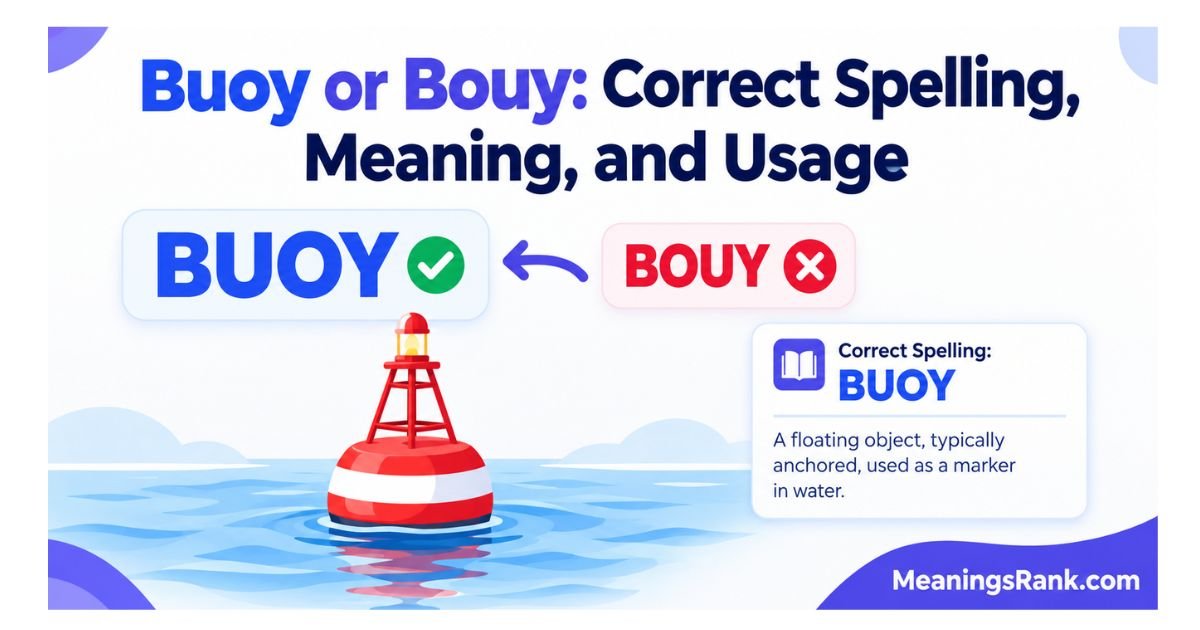

Quick answer: The correct spelling is buoy. “Bouy” is a common misspelling and is not a word in any standard English dictionary. In buoy, the letter u comes before the o, and the word works as both a noun (a floating marker) and a verb (to lift or keep afloat).
You are typing a sentence about a harbor, a swimming race, or a company’s rising stock price, and suddenly you freeze. Is it B-O-U-Y or B-U-O-Y? Your spell checker may underline one version in red, but it helps to understand why, so you never second-guess yourself again.
Getting it right matters. A misspelled word in a résumé, a news article, a school essay, or a product description can quietly weaken your credibility, even when the rest of your writing is excellent.
In this guide, you will learn the correct spelling, both meanings of the word, how to pronounce it, how its forms change, and the phrases where it appears most often. You will also find examples, a memory trick, and a short practice quiz at the end of the article. By the time you finish, you will never mix up buoy and bouy again.
Buoy vs Bouy at a Glance
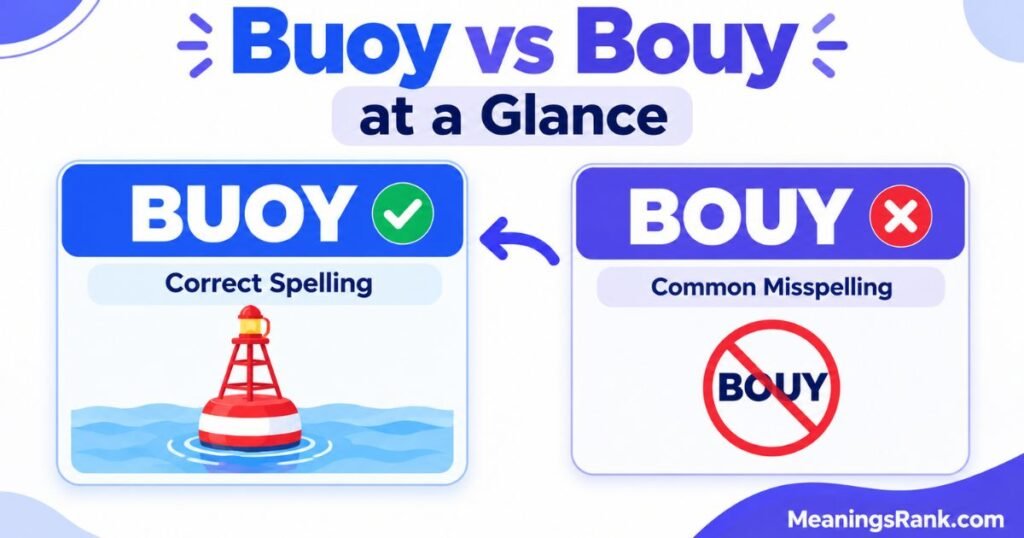
Here is the whole story in one place. If you need a fast reference, this table gives you everything essential.
| Feature | Buoy | Bouy |
| Spelling status | Correct | Incorrect |
| Letter order | B-U-O-Y | B-O-U-Y |
| Found in dictionaries | Yes | No |
| Part of speech | Noun and verb | None (not a word) |
| Noun meaning | A floating object used as a marker or safety device | No meaning |
| Verb meaning | To keep afloat, or to lift someone’s spirits or support something | No meaning |
| Pronunciation | BOO-ee (US) or BOY (UK) | Not applicable |
| Example | The sailors steered around the red buoy. | ❌ The sailors steered around the red bouy. |
The takeaway: Always write buoy. If you ever see “bouy” in a draft, treat it as a typo and fix it immediately.
Is It Buoy or Bouy? The Correct Spelling Explained
The correct spelling is buoy: B, U, O, Y. Every major dictionary, including Merriam-Webster, Oxford, Cambridge, and Collins, lists this form and only this form. Style guides such as the AP Stylebook, the Chicago Manual of Style, and the Oxford style conventions also use “buoy” without any alternative spelling.
There is no regional split here, either. Some English words change between American and British spelling, such as color and colour, or center and centre. Buoy does not behave that way. Writers in the United States, the United Kingdom, Canada, Australia, and India all spell it the same way. Only the pronunciation differs, and we will cover that shortly.
So why does the wrong version look so convincing? Part of the answer lies in how English spells vowel sounds. The “oy” ending in boy, toy, and joy is familiar, and the letters “bo” at the start of a word often lead to a familiar pattern such as bounce, bounty, or bough. Your brain sees “bou-” and expects something similar. It is a classic case of pattern recognition working against you.
Here is a useful way to think about it: bu (as in bus) + oy (as in boy) = buoy.
If you take only one rule from this section, make it this: the u always comes first.
What Does Buoy Mean?
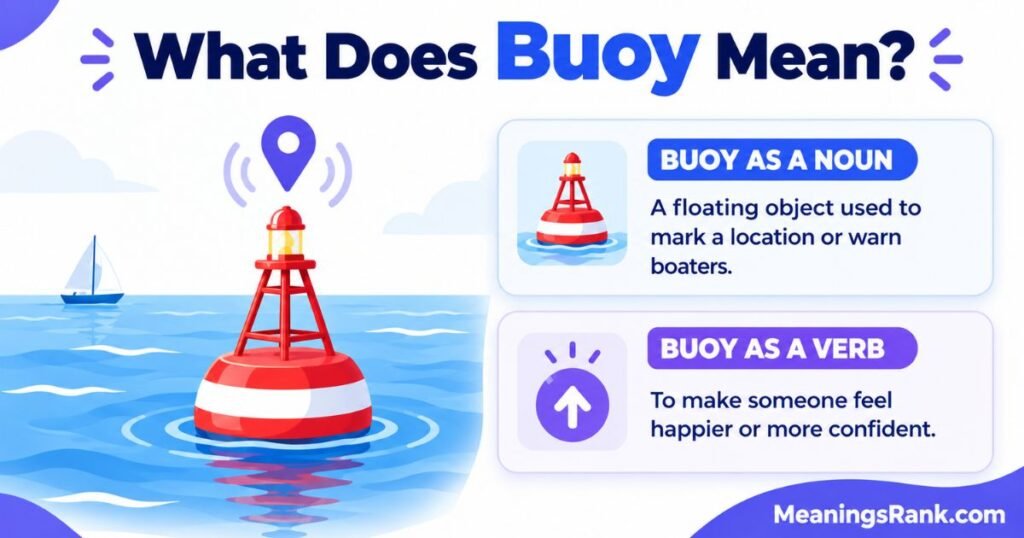
Buoy has two main jobs in English. As a noun, it names a physical object that floats on water. As a verb, it describes the act of keeping something afloat or lifting something up, either literally or figuratively. The two meanings are connected, because a buoy keeps a marker above the surface, and to buoy something up is to hold it above a low point.
Buoy as a Noun
As a noun, a buoy is a floating object anchored in the water. It serves one of several purposes:
- Navigation: Marker buoys show boats where channels, hazards, or safe routes lie. Different colors and shapes carry specific meanings under international maritime rules.
- Safety: A life buoy (also called a lifebuoy) is a ring or float thrown to a person in the water to keep them from sinking.
- Mooring: Boats tie up to a mooring buoy instead of dropping their own anchor.
- Data collection: Scientists place weather or ocean buoys to measure wave height, water temperature, and wind speed.
- Swimming and racing: Course buoys mark the turns in open-water swim races and sailing regattas.
In a grammatical sense, buoy is a countable common noun. You can have one buoy or three buoys. It usually takes an article or determiner in a sentence: a buoy, the buoy, that buoy, several buoys.
Here is the noun in action: The coast guard replaced the damaged buoy before the storm season began.
Read More: Putting vs Puting: The Ultimate Guide to Spelling, Meaning & Usage (2026)
Buoy as a Verb
As a verb, to buoy means to keep something afloat, or to lift, support, or encourage something. This meaning is common in news writing, business reporting, and everyday conversation.
The verb has two flavors:
- Literal: To keep something floating on the surface of water. The inflatable vest buoyed the hiker as the current pulled her downstream.
- Figurative: To raise someone’s mood, confidence, or the strength of something. The good news buoyed her spirits. Strong exports buoyed the economy.
Buoy is a transitive verb, which means it needs a direct object. You buoy something or someone. Notice the clause structure in these examples: the subject performs the action, and the object receives it. “The team buoyed the crowd” works, while “The team buoyed” leaves the reader asking, “Buoyed what?”
You will often see the verb paired with the particle up, as in buoy up. The meaning stays the same, and the extra word simply adds emphasis. Both versions are correct.
Why Is Bouy Incorrect?
“Bouy” is incorrect for a simple reason: it does not exist in standard English. No dictionary lists it as a variant, no style guide accepts it, and no historical form of English spelling supports it as a legitimate alternative. It is a mistake of letter order, known as a transposition error, where two adjacent letters swap places.
The word’s history helps explain the correct form. Buoy entered English in the Middle Ages, most likely through Middle Dutch or Old French words used by sailors and traders for a marker or float. Over the centuries, the spelling settled into the shape we use today, and the u-o pair stuck even though pronunciation drifted.
Here are two direct reasons why bouy fails the test:
- It breaks dictionary standards. Spell checkers in Microsoft Word, Google Docs, and Grammarly all flag it.
- It undermines trust. In professional, academic, or journalistic writing, one visible typo can lower a reader’s confidence in everything else on the page.
Think of it this way: “bouy” is not a second spelling. It is simply buoy with its letters in the wrong order, like typing teh instead of the.
How to Pronounce Buoy
Here is where buoy gets interesting. The word has two accepted pronunciations, and which one you use depends largely on where you live.
| Region | Pronunciation | Sounds like | IPA |
| United States | BOO-ee | “boo” + “ee” | /ˈbuːi/ |
| United Kingdom and many Commonwealth countries | BOY | Identical to the word “boy” | /bɔɪ/ |
Both are correct. In American English, the word has two syllables and the u is clearly heard. In British English, the word usually has one syllable and sounds exactly like boy. In fact, a British speaker might say “boy” for both the floating marker and the young male, and listeners understand from context.
This dual pronunciation is a big reason people misspell the word. When you hear “BOY” and then try to write it down, your brain goes for the familiar shape of b-o-y and tries to fit the extra letter in somewhere. The result is often “bouy.”
Pronunciation tips: Choose the pronunciation that matches your dialect and use it consistently. Note that buoyant is usually said as BOY-ant in the United States, even when speakers say BOO-ee for the noun.
Pronunciation does not change the spelling. Whether you say “boo-ee” or “boy,” the word is still written b-u-o-y.
Common Forms of Buoy
Buoy changes form depending on its role in a sentence. Knowing these forms helps you apply correct subject-verb agreement and verb tense in your writing.
| Form | Spelling | Part of speech | Example |
| Base form | buoy | Noun / verb | The captain spotted a buoy. |
| Plural | buoys | Noun | Three buoys marked the channel. |
| Third-person singular | buoys | Verb | Good news buoys the market. |
| Past tense | buoyed | Verb | The speech buoyed the team. |
| Past participle | buoyed | Verb | The team was buoyed by the speech. |
| Present participle / gerund | buoying | Verb | Buoying morale is part of leadership. |
| Adjective | buoyant | Adjective | She felt buoyant after the news. |
| Noun (quality) | buoyancy | Noun | Salt water increases buoyancy. |
| Adverb | buoyantly | Adverb | He walked buoyantly into the room. |
A few spelling notes will save you trouble:
- Plural: Buoy is a regular noun, so you simply add s. There is no change to the y, because the letter before it is a vowel (o), not a consonant.
- Past tense: Add -ed, not -d: buoyed. Writers sometimes forget the e and produce “buoyd,” which is wrong.
- Derived words: Every form keeps the u-o order. You will never see a correct spelling like “bouyant” or “bouyancy.”
If you remember that the root always starts with buo-, all of these related words fall into place.
Read More: High School or Highschool: Discover the Correct Spelling & Meaning (2026)
Common Phrases With Buoy
Buoy appears in a range of fixed expressions and collocations. Learning them makes your writing sound more natural and helps you spot correct usage quickly.
Literal and nautical phrases
- Life buoy (or lifebuoy): A ring-shaped float used for rescue.
- Marker buoy: A floating sign that shows a route or hazard.
- Bell buoy: A buoy with a bell that rings as the waves move it.
- Mooring buoy: A float to which a boat can be tied.
- Weather buoy: A floating station that records ocean and weather data.
- Buoy tender: A ship that maintains and replaces navigation buoys.
Figurative phrases (verb use)
- Buoy up: To lift or support. The news buoyed up the whole office.
- Buoy someone’s spirits: To raise a person’s mood. A visit from her friends buoyed her spirits.
- Buoy confidence: To strengthen belief or trust. Early wins buoyed the team’s confidence.
- Buoy the economy: To support economic growth. Tourism buoyed the local economy.
- Buoyed by: Encouraged or supported by something. She was buoyed by the positive feedback.
Related adjective phrases
- Buoyant market: A stock market or economy with rising prices and strong activity.
- Buoyant mood: A cheerful, light-hearted state of mind.
These phrases give you a ready-made vocabulary for both everyday and professional writing, and each one reinforces the correct spelling.
How to Use Buoy in a Sentence
Using buoy correctly comes down to choosing the right part of speech and keeping your syntax clean. Follow these steps.
Step 1: Decide whether you need a noun or a verb. If you are naming a floating object, you need the noun. If you are describing the act of lifting or supporting, you need the verb.
Step 2: Check your sentence structure.
- For the noun, pair it with an article or determiner: The buoy bobbed in the waves.
- For the verb, make sure it has a direct object: The rally buoyed investor confidence.
Step 3: Match the verb form to the tense.
- Present: The coach buoys the team after every loss.
- Past: The coach buoyed the team after the loss.
- Continuous: The coach is buoying the team right now.
Step 4: Use a preposition when it adds clarity.
After the passive form, “by” introduces the cause: The team was buoyed by their coach’s words. With the particle “up,” the object can come before or after it: The coach buoyed up the team or The coach buoyed the team up.
Step 5: Proofread the spelling.
Look for the u-o order every time. A quick final check takes two seconds and prevents the mistake.
Examples of Buoy in Sentences
Seeing the word in context is the fastest way to lock in its meaning. These examples are grouped by use.
Buoy as a noun
- The red buoy marked the edge of the safe channel.
- Swimmers rounded the second buoy and headed back to the shore.
- A rescuer threw a life buoy to the struggling kayaker.
- The research team anchored a weather buoy ten miles offshore.
- The fishing boat tied up to a mooring buoy for the night.
Buoy as a verb (literal)
- The life jacket buoyed him until help arrived.
- Air trapped inside the bag buoyed the equipment on the surface.
Buoy as a verb (figurative)
- A surprise promotion buoyed her mood for the entire week.
- Falling fuel prices buoyed consumer spending.
- The coach’s speech buoyed the team before the final.
- Strong earnings buoyed the company’s share price.
- Letters from home buoyed the soldiers during the long winter.
Correct vs. incorrect usage
| Correct | Incorrect | Why it matters |
| The boat passed the buoy. | The boat passed the bouy. | Wrong letter order. |
| Her smile buoyed my spirits. | Her smile bouyed my spirits. | Past tense must keep u-o. |
| The market felt buoyant. | The market felt bouyant. | Adjective keeps the same root. |
| Salt water increases buoyancy. | Salt water increases bouyancy. | Related noun follows the same rule. |
| Two buoys floated nearby. | Two bouys floated nearby. | Plural adds only -s. |
Notice that the incorrect column fails the same way every time. The root is the problem, not the ending.
When to Use Buoy
Use buoy whenever you need either the floating-marker noun or the lifting-and-supporting verb. It fits naturally in several kinds of writing.
Use it in nautical, travel, and safety writing. If you describe harbors, sailing, diving, swimming events, or coastal weather, buoy is the standard term. No other word carries the same technical meaning.
Use it in business and financial reporting. Journalists often write that a product launch, interest rate cut, or strong quarter “buoyed” a stock or economy. It is concise and vivid, and it tells readers that something provided upward support.
Use it in motivational and personal writing. To buoy someone’s spirits is a gentle, warm phrase that works well in essays, speeches, and letters.
Use it in scientific writing. Oceanographers, meteorologists, and engineers refer to data buoys, and physics students encounter buoyancy when studying why objects float.
When not to use it: Avoid the verb when the object is not something that can be lifted or supported, either literally or figuratively. “The rain buoyed the road” does not make sense, because roads are not kept afloat or boosted in any natural reading. Also avoid using it in very casual speech when “boost” or “lift” would sound more natural to your audience.
Why Do People Misspell Buoy as Bouy?
Misspellings rarely happen at random. They follow patterns, and understanding those patterns is the best way to stop repeating the mistake.
1. The pronunciation does not match the spelling. In British English, buoy sounds like “boy,” so writers expect a spelling with a simple o-y ending and an extra letter slipped in. In American English, “boo-ee” suggests the letters might run b-o-u-, as in boot or bounce. Either way, sound is a poor guide.
2. Vowel pairs are tricky in English. Words like queue, build, guard, guess, and buoy all carry a silent or unusual u that confuses learners and native speakers alike. These are sometimes called “irregular vowel clusters,” and they do not follow predictable phonics rules.
3. Typing speed and familiar patterns. Fast typists often swap two neighboring letters, which is how form becomes from and buoy becomes bouy. Common “bou-” words such as bounce, bounty, and boulder make the wrong shape feel familiar.
Quick Memory Trick / Mnemonic Device
Try this line: “U and I float on a buoy.” The U comes first, and the O and Y follow it. Another way to picture it: a letter U looks like a small boat riding on the water, so the U sits right after the B, ready to float.
Choose the trick that sticks and repeat it three times. Memory devices work through repetition, and one practice session is often enough.
Read More: Taught vs Tought: Discover the Correct Spelling, Meaning & Key Differences
Synonyms for Buoy
Different synonyms apply depending on whether you use the noun or the verb. Choosing the right alternative keeps your writing varied without changing meaning.
Synonyms for the noun
| Synonym | Best used when |
| Float | You mean any object that stays on the water’s surface |
| Marker | You mean a sign showing a route or boundary |
| Beacon | You mean a signal that guides or warns |
| Signal | You focus on communication to boats |
| Lifebelt / lifebuoy | You mean a rescue ring |
Synonyms for the verb
| Synonym | Example |
| Lift | The victory lifted the team’s morale. |
| Boost | New orders boosted the company’s output. |
| Uplift | The music uplifted the audience. |
| Cheer | The kind note cheered her up. |
| Encourage | Her mentor encouraged her to keep going. |
| Support | Government grants supported small businesses. |
| Sustain | Donations sustained the program for another year. |
| Keep afloat | The pump kept the boat afloat. |
A word of caution: synonyms do not always carry the same tone. Boost is casual and direct. Hearten and uplift sound more formal and emotional. Buoy sits comfortably in the middle and works in both news reports and personal essays, which is one reason it remains popular.
Common Spelling Mistakes and Quick Fixes
Even careful writers stumble on this word. Here are the most frequent errors and how to correct them in seconds.
| Mistake | Correct spelling | Quick fix |
| bouy | buoy | Put the u before the o |
| bouys | buoys | Fix the root, then add -s |
| bouyed | buoyed | Keep buo- and add -ed |
| bouying | buoying | Keep buo- and add -ing |
| bouyant | buoyant | The adjective shares the same root |
| bouyancy | buoyancy | The noun shares the same root |
| buoyd | buoyed | Do not drop the e |
| booy | buoy | Do not replace u with another o |
| boy (when you mean the marker) | buoy | Check meaning: a boy is a young male |
Two habits that prevent the error: Run a final “Find” search for “bouy” before publishing, and learn the family, not the single word. If buoyant and buoyancy share the root, one memory protects them all.
Interactive Practice Quiz
Fill in the blank with the correct word or form. Choose from: buoy, buoys, buoyed, buoyant, buoyancy. The answer key is at the bottom.
- The sailor steered carefully around the red ______ near the harbor entrance.
- The good news ______ the whole team before the final match.
- Salt water increases ______, which makes floating easier.
- Three yellow ______ marked the swimming course.
- After the promotion, she felt ______ and full of energy.
Scroll down slightly for the answers.
Answer Key
- buoy (a singular noun after “the red”)
- buoyed (past tense verb with the object “the whole team”)
- buoyancy (a noun naming the quality of floating)
- buoys (a plural noun after “Three yellow”)
- buoyant (an adjective describing her mood)
How did you do? If you got four or five correct, you have mastered the word. If you missed a few, go back to the table of forms and read it once more.
Frequently Asked Questions About Buoy vs Bouy
Is it spelled buoy or bouy?
It is spelled buoy. The letter u comes before o. “Bouy” is a misspelling and does not appear in standard dictionaries.
How do you pronounce buoy?
In American English, it is pronounced BOO-ee. In British English, it is typically pronounced BOY. Both are accepted, and the spelling is the same for both.
What is the difference between a buoy and a boy?
A buoy is a floating marker in water, and it can also be a verb meaning to lift or support. A boy is a young male person. They sound identical in many British accents, so spelling and context are the only way to tell them apart in writing.
Can buoy be used as a verb?
Yes. To buoy means to keep afloat or to lift and support. It is common in phrases like buoy someone’s spirits and buoy the economy. Its forms are buoys, buoyed, and buoying.
Is buoyant spelled bouyant?
No. The correct spelling is buoyant. All words built from this root, including buoyancy and buoyantly, keep the same u-o order.
Final Answer: Buoy or Bouy?
The correct spelling is buoy, never “bouy.” Remember the order b-u-o-y, practice the memory trick, and remember that the whole word family, from buoyed to buoyant to buoyancy, follows the same pattern. With that single rule in mind, you can write about boats, spirits, and economies with confidence.