
You hear it every day: “What’s that thing called?” Then someone answers, “It’s called a spatula.” Simple enough. But when you write the phrase, a tiny apostrophe can change everything. “what is it called” and “it’s called” look almost identical, yet they do completely different jobs. One names something. The other describes something doing an action.
Mixing them up is a quiet mistake, the kind that slips past spellcheck and makes a sentence read strangely. This guide explains the meaning, the grammar rules, and the real-world usage of both forms, so you can pick the right one every time. Whether you write emails, essays, or blog posts, this one small rule will sharpen your syntax.
Quick Answer: “It’s Called” vs “It Called”
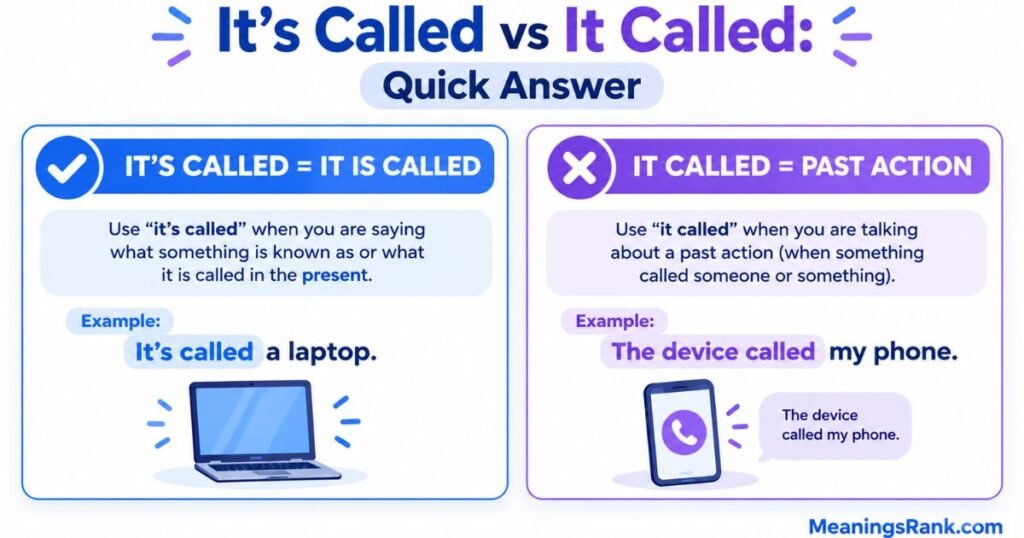
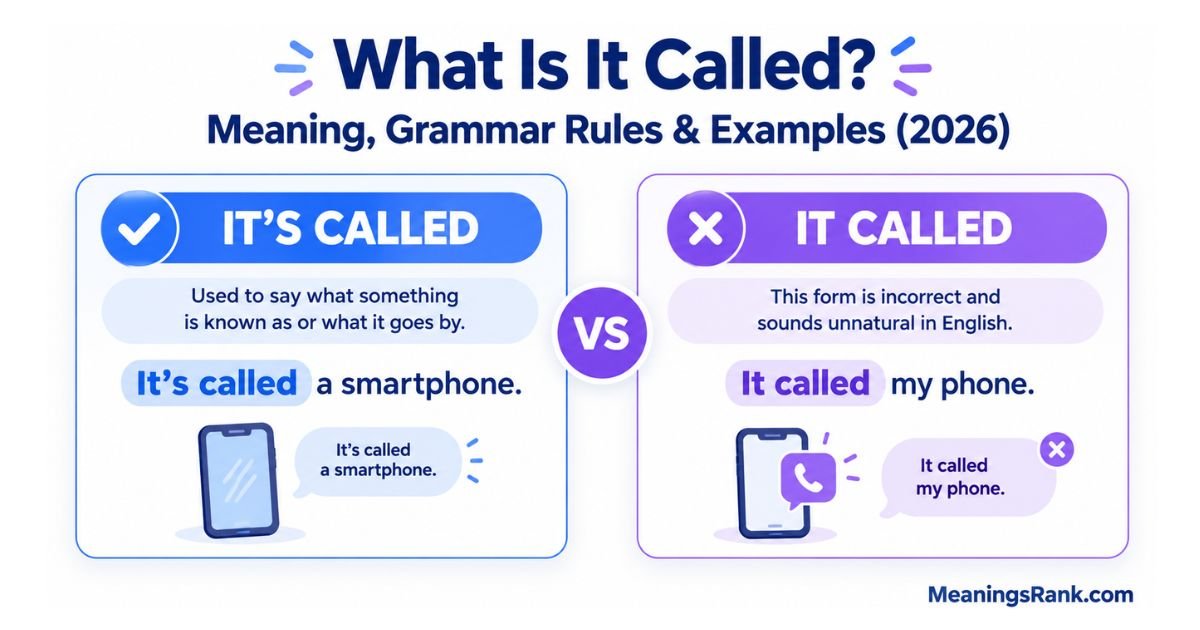
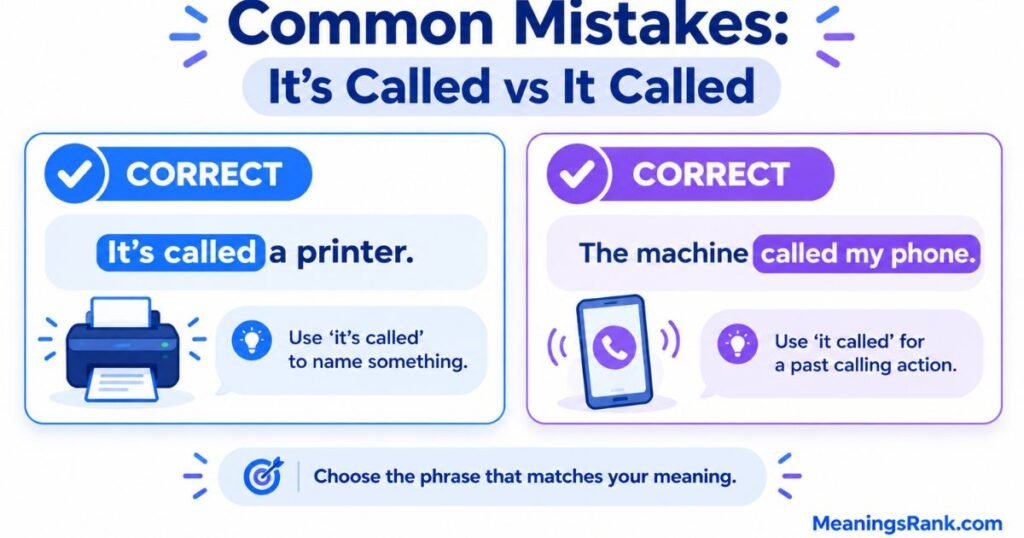
“It’s called” is a contraction of “it is called.” Use it to give the name of something: It’s called a gazebo.
“It called” is the simple past tense of the verb call, with “it” as the subject. Use it when something performed the action of calling: The owl called from the roof.
Fast test: Replace “it’s” with “it is.” If the sentence still works, use it’s called. If it breaks, you probably need it called.
What Does “It’s Called” Mean?
“It’s called” means “it is named” or “it is known as.” The word it’s is a contraction of it is, and called works here as a past participle inside a passive construction. The structure is simple: it + is + called + name.
You use it to introduce a label, title, term, or nickname.
- It’s called photosynthesis.
- The restaurant on the corner is great. It’s called Saffron House.
- That punctuation mark is called an interrobang.
Notice that the sentence points at the thing being named and then supplies the name. There’s no action performed by “it.” The subject is simply receiving a label. That’s why “it’s called” is the go-to phrase for definitions, introductions, and explanations.
There is one wrinkle. In rare cases, it’s can also contract it has, as in It’s called twice already (meaning it has called twice). Context usually settles the matter, and we’ll return to this edge case later.
Read More: Requester vs Requestor: Which Spelling Is Correct? Meaning & Usage (2026)
What Does “It Called” Mean?
“It called” is a plain subject-plus-verb pair. The pronoun it is the subject, and called is a past tense verb. Something did the calling.
The verb call has several meanings, which gives “it called” a wide range:
- To shout or cry out: The bird called at dawn.
- To phone or contact: The airline said it called me yesterday.
- To summon or demand: The situation called for patience.
- To address by a name (with an object): The committee called itself a task force.
In every case, “it” is doing something. There’s no apostrophe because nothing is being contracted. The clause structure is active: subject, verb, and often an object or prepositional phrase.
Here the thing to watch is whether the sentence makes sense with “it is.” The bird is called at dawn sounds odd and changes the meaning. That oddness is your signal to drop the apostrophe.
The Key Difference Between “It’s Called” and “It Called”
The difference comes down to voice and function.
| Feature | It’s called | It called |
| Structure | Contraction (it is) + past participle | Pronoun + past tense verb |
| Voice | Passive | Active |
| Job | Names or labels something | Describes an action |
| Apostrophe | Yes | No |
| Typical follow-up | A name or title | An object, preposition, or time |
| Example | It’s called Python. | It called the server. |
Think of it this way. “It’s called” answers the question What is its name? “It called” answers the question What did it do?
Same letters, different grammar. One is a label. The other is an event.
Grammar Rules Behind “It’s Called” and “It Called”
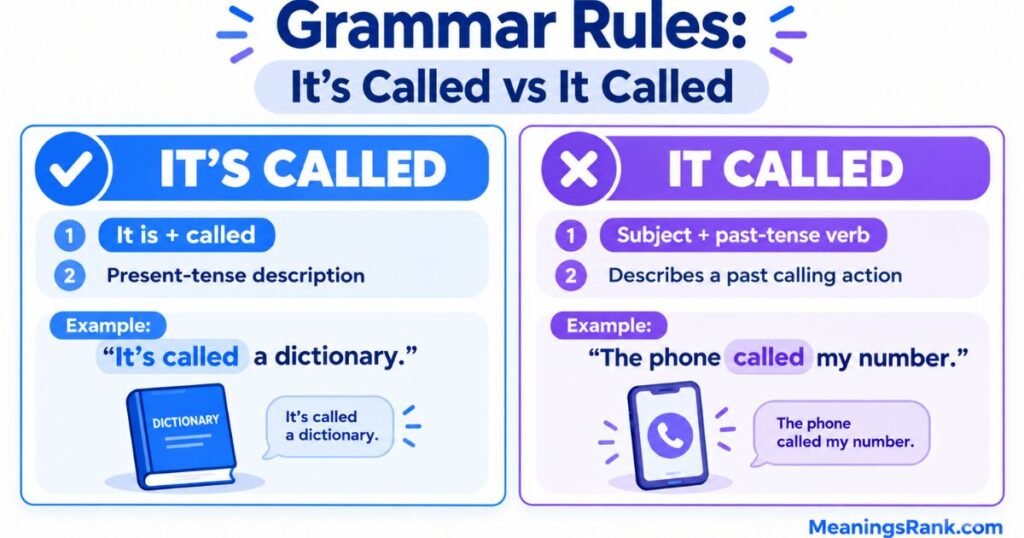
Four rules explain nearly everything about these phrases.
Rule 1: The apostrophe marks a missing letter, not possession.
In it’s, the apostrophe replaces the i in is (or the ha in has). Possessive its, as in its color, never takes an apostrophe. This is one of the most common punctuation errors in English, and it explains why the two phrases get confused.
Rule 2: “It’s called” uses the passive voice.
The structure is be + past participle. The doer of the naming is unknown or unimportant, so the focus stays on the thing named.
Rule 3: “It called” uses the simple past.
Regular verbs form the past tense with -ed, so call becomes called. The subject performs the action directly, which keeps subject-verb agreement straightforward (it takes a singular verb form).
Rule 4: “Called” is a participle in one phrase and a finite verb in the other.
In “it’s called,” the participle depends on the helping verb is. In “it called,” the verb stands on its own and carries the tense.
Most style guide rules agree on contractions, too. In formal academic or legal writing, many editors prefer the full form it is called. In blogs, emails, and conversation, it’s called is perfectly standard.
Read More: Anyone Has or Anyone Have? The Ultimate Guide to Correct Usage (2026)
When to Use “It’s Called” vs “It Called”
Use it’s called when you want to:
- Introduce a name or term (It’s called a colophon.)
- Explain what something is known as (In Spain, it’s called a tortilla.)
- Give a title for a book, film, or product (It’s called Dune.)
- Define vocabulary in teaching (When water turns to vapor, it’s called evaporation.)
Use it called when you want to:
- Report a phone call or message (The clinic said it called twice.)
- Describe a sound or cry (The cuckoo called from the hedge.)
- Show that something demanded a response (The moment called for courage.)
- Describe a program or system calling a function (The script called the API.)
When unsure, run the substitution test. Say the sentence with it is called. If the meaning holds, go with the contraction.
Real-Life Examples of “It’s Called” vs “It Called”
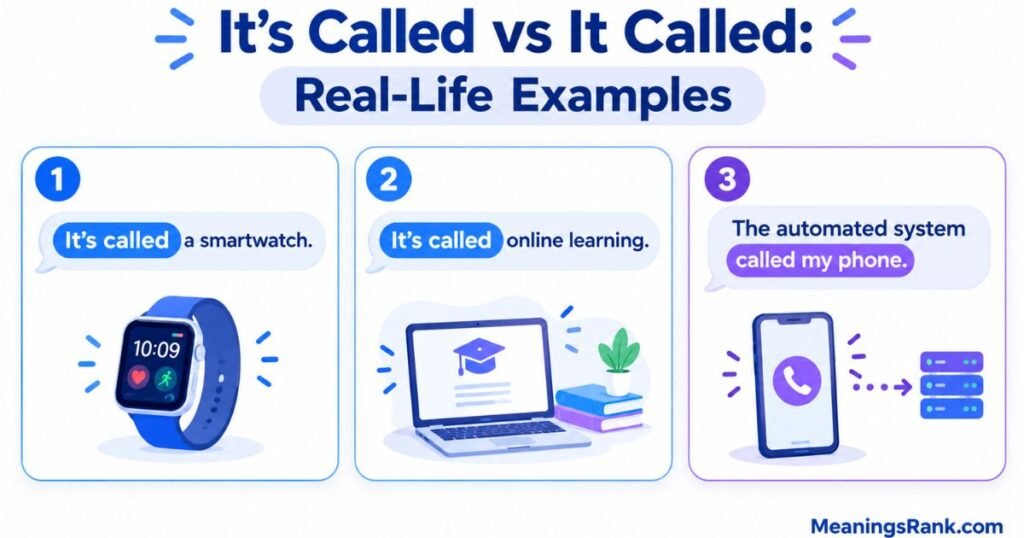
Seeing both forms in context makes the pattern stick.
Everyday conversation
- What do you call that tool? It’s called a mandoline.
- The delivery company swore it called me, but my phone never rang.
Academic writing
- When a word imitates a sound, it’s called onomatopoeia.
- The committee called for revisions after the first draft.
Technology and work
- This feature is called dark mode, and it’s called the same on every platform.
- The app called the server, but no response came back.
Formal vs. informal usage
| Informal | Formal |
| It’s called a pivot table. | It is called a pivot table. |
| The bank said it called me. | The bank stated that it had telephoned me. |
Quick Comparison Table
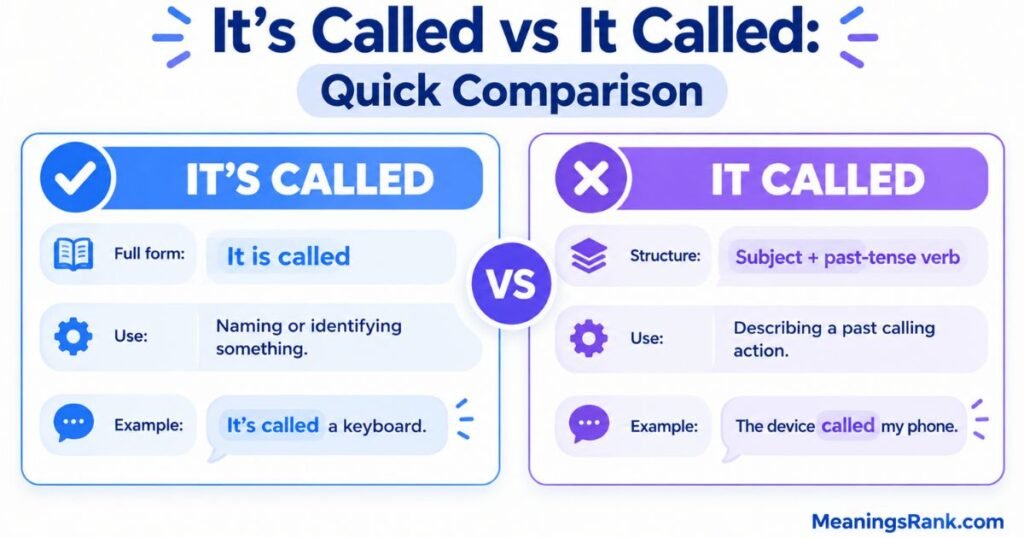
| Sentence | Correct? | Why |
| It’s called a sonnet. | ✅ | Names a poem form |
| It called a sonnet. | ❌ | Missing apostrophe; meaning breaks |
| The dog called out. | ✅ | Past tense action |
| The dog’s called out. | ❌ | Wrong contraction here |
| It called me last night. | ✅ | Action: phoned |
| It’s called me last night. | ❌ | Tense clash |
Related Structures and Similar Expressions
Some phrases sit close to “it’s called” and “it called.” A few do the same job. Others only look alike. Sorting them into two groups makes the pattern easy to spot.
Expressions That Name Something
These are alternatives to “it’s called.” Each follows the pattern thing + is/are + phrase + name.
| Expression | Tone | Example |
|---|---|---|
| Is called / are called | Neutral | These birds are called warblers. |
| Is known as | Descriptive | It’s known as the Big Apple. |
| Is named | Formal | The cat is named Biscuit. |
| Is referred to as | Academic | This effect is referred to as inflation. |
| What do you call…? | Question form | What do you call a baby goat? |
Look-Alikes That Cause Confusion
These resemble the main phrases but work differently.
- “Has called”: the present perfect, which describes an action. It has called three times. Since it’s can also contract it has, it’s called three times describes an action, not a name.
- “Was called”: the past version of naming. Long ago, it was called Persia. Never write “it called Persia” for this meaning.
- “It’s” vs. “its”: it’s means it is or it has, while its shows ownership. Its name is Persia takes no apostrophe.
Each of these shares one idea: an apostrophe signals a contraction, while a bare called signals an action. Once you know the naming family and the look-alike traps, you can apply the same logic to sentences you haven’t seen before.
Common Mistakes to Avoid
1. Dropping the apostrophe in a naming sentence:
❌ It called a croissant. → ✅ It’s called a croissant.
2. Adding an apostrophe to an action:
❌ The manager said it’s called yesterday. → ✅ The manager said it called yesterday.
3. Confusing “its” and “it’s:”
❌ Its called a sundial. → ✅ It’s called a sundial.
4. Using “it called” to mean “is named:”
❌ The new policy it called Project Blue. → ✅ The new policy is called Project Blue.
5. Overusing contractions in formal writing:
A research paper or legal document usually reads better with it is called.
Key Exceptions to Keep in Mind
- The “it has” trap. It’s called twice today can mean it has called twice today. Look for a time expression like twice or already. These point to an action, not a name.
- Passive “it was called.” Past naming uses it was called, not it called. Long ago, it was called Persia.
- Reflexive use. It called itself a startup is correct because itself is the object. Here the subject names itself, so no apostrophe appears.
- Software language. In programming, it called the function is normal past tense, even though it sounds like a naming sentence.
Read More: Choosing vs Chosing: The Correct Spelling, Meaning & Examples
Tips for Choosing the Correct Phrase
- Use the “it is” swap. If it is called fits, write it’s called.
- Check the follow-up word. A name or title usually follows it’s called. An object or preposition usually follows it called.
- Ask the right question. What is it named? means it’s called. What did it do? means it called.
- Read it aloud. Passive naming sounds like a label. Active calling sounds like an event.
- Match your audience. Contract in casual writing; expand in formal writing.
Quick Memory Trick
“Apostrophe = Appellation.” An appellation is a name. If the sentence gives a name, keep the apostrophe. If it describes something acting, drop it.
Practice Quiz
Fill in each blank with it’s called or it called.
- The tiny dot above a lowercase i ______ a tittle.
- The hospital confirmed ______ me this morning.
- In British English, ______ a lorry, not a truck.
- The cuckoo clock ______ every hour on the hour.
- My grandmother says the dish ______ khichdi.
Answer Key
- It’s called (naming a term)
- it called (past action: phoned)
- it’s called (naming)
- it called (action: sounded)
- it’s called (naming)
FAQs
Is “it’s called” grammatically correct?
Yes. It is the contracted form of “it is called” and is correct in everyday and semi-formal writing. In strict academic or legal prose, many style guides prefer the full phrase.
What is the difference between “it’s called” and “it called”?
“It’s called” names something and uses the passive voice. “It called” is an active past tense verb showing that something made a call, sound, or demand.
Can “it’s called” mean “it has called”?
Occasionally. It’s can contract it has, so It’s called twice already means it has called twice. A time word or a following object usually signals this meaning.
Is it “what’s it called” or “what is it called”?
Both are correct. “What’s it called?” is the natural spoken form, while “What is it called?” suits formal writing or emphasis.
How do I know whether to use “its” or “it’s” in these phrases?
Test with it is. If it fits, use it’s. If you mean possession, as in its name, use its with no apostrophe.
Conclusion
“It’s called” gives something a name, while “it called” shows something taking action. The first is a contraction built on the passive voice. The second is a simple past tense verb with “it” as its subject. Once you see that split, the confusion disappears.
Remember the swap test: if it is called works, keep the apostrophe. Watch for the rare “it has called” exception, and don’t let its and it’s trade places. In formal writing, spell out it is called to match most style guide rules.
With these habits, your punctuation, clause structure, and meaning will stay clear and confident. Practice the quiz again in a few days, and the right choice will soon feel automatic.