
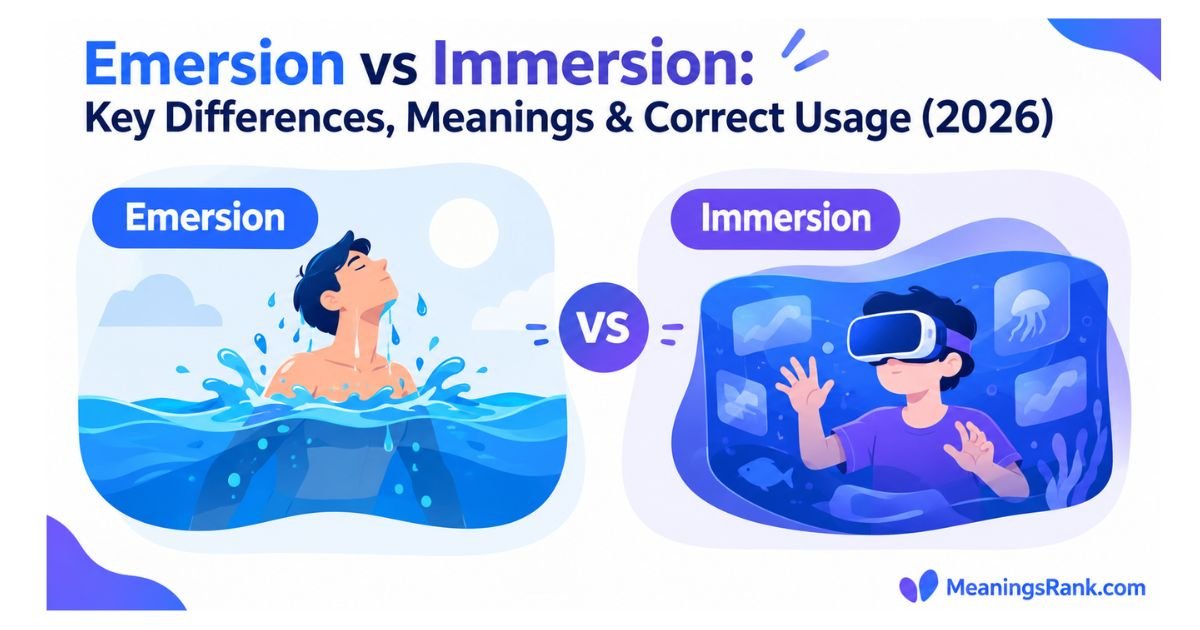

Two words. One tiny prefix. A completely opposite meaning. Emersion and immersion look almost identical on the page, and spell-checkers rarely flag the wrong one because both are real English words. That is exactly why writers mix them up. This guide gives you the definitions, the Latin roots, the scientific and everyday uses, and a simple memory trick so you can pick the right word every time.
Emersion vs Immersion: A Quick Comparison
Quick answer: Emersion means the act of coming out of something, such as a planet reappearing after an eclipse or land rising out of water. Immersion means the act of going into something, such as dipping an object into liquid or becoming fully absorbed in an activity. One letter changes the direction: e- means “out,” and im- means “in.”
| Feature | Emersion | Immersion |
| Direction | Out of / reappearing | Into / surrounded by |
| Prefix meaning | e- = out | im- = in |
| Latin root | emergere | immergere |
| Typical fields | Astronomy, geology, biology | Education, technology, psychology, cooking, religion |
| Register | Formal, technical | Everyday and technical |
| Frequency | Rare | Very common |
| Adjective / verb form | emergent / emerge | immersive / immerse |
What Is the Difference Between Emersion and Immersion?
The difference is direction. Both words come from the Latin root mergere, “to plunge,” and the prefix decides which way you are moving.
- Use emersion when the focus is on coming out of or reappearing from something.
- Use immersion when the focus is on going into or being surrounded by something.
- Both are nouns. Their related forms are emerge/emergent and immerse/immersive.
Here is the same contrast in action:
| Context | Correct | Incorrect |
| Astronomy | The emersion of the moon from Earth’s shadow took several minutes. | The immersion of the moon from Earth’s shadow took several minutes. |
| Language learning | She joined a Spanish immersion program. | She joined a Spanish emersion program. |
| Cooking | Total immersion in boiling water cooks the pasta evenly. | Total emersion in boiling water cooks the pasta evenly. |
| Geology | Coastal emersion exposed old sea terraces. | Coastal immersion exposed old sea terraces. |
One practical note on register: if you are writing for a general audience and mean “coming out,” emergence is usually the safer and more familiar word. Reserve emersion for technical contexts where it is the established term.
Emersion Meaning, Definition and Scientific Context
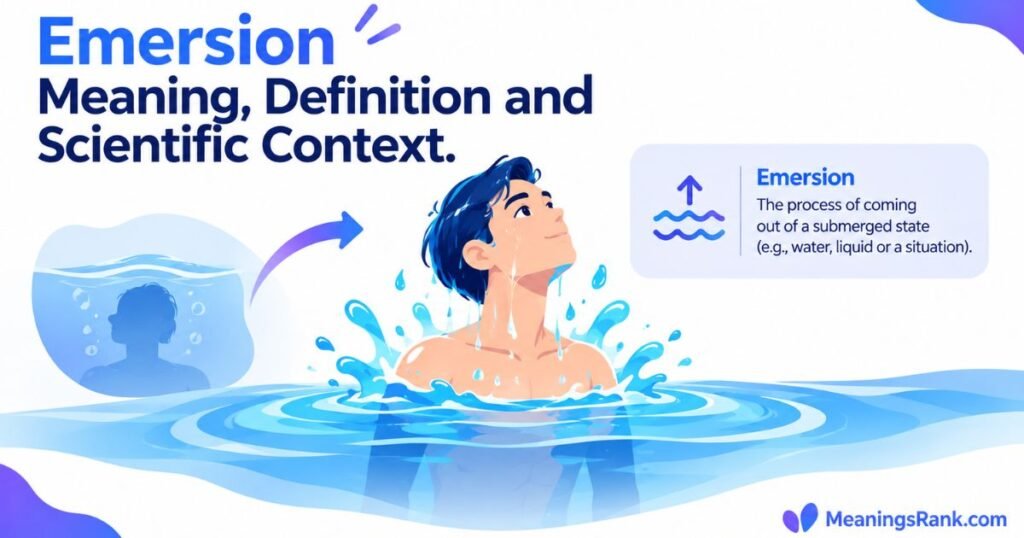
Emersion (noun) is the act or process of emerging, rising out, or reappearing after being hidden or covered. It describes the exit, not the hiding. Think of a diver breaking the surface, or a star slipping out from behind the moon.
In scientific writing, emersion is a precise term that marks the end of a covered or obscured state. The syntax is simple: the emersion of [thing] from [covering]. Because it is a technical noun, it usually appears in formal registers such as research papers, observatory logs, and textbooks.
Scientific Fields Where Emersion Is Used
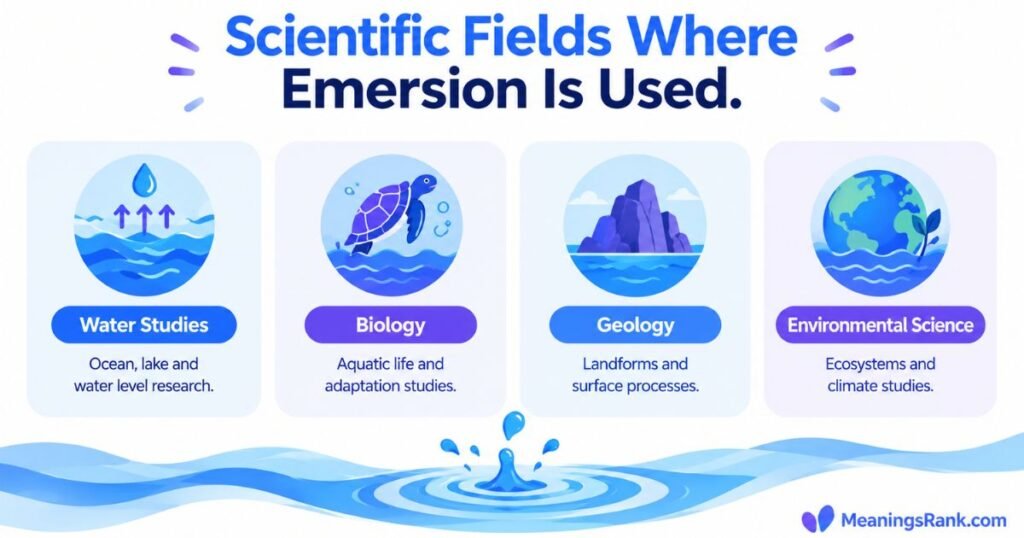
- Astronomy: Emersion is the reappearance of a celestial body after an eclipse or occultation. When a star passes behind the moon, immersion is the moment it disappears and emersion is the moment it returns. Observers time both events, so astronomy uses the two words as a matched pair.
- Geology and coastal science: It describes land rising relative to sea level, exposing shorelines, reefs, or sediments that were previously underwater.
- Biology and botany: It can describe plants or organs that rise above the water surface. Related terms such as emergent vegetation are more common today.
- Physics and optics: Light leaving a medium is sometimes described with the related adjective emergent, as in “emergent ray.”
Read More: Poirot Meaning: The Ultimate Guide to Its Definition, Origin & Usage
Origin and Etymology of Emersion
Emersion comes from the Latin emersio, from emergere, meaning “to rise out.” That verb combines e- (a form of ex-, “out”) with mergere (“to dip or plunge”). The English word emerge comes from the same root.
Immersion follows the same pattern with a different prefix. It comes from Late Latin immersio, from immergere, built from in- (“into”) plus mergere. The prefix assimilates to im- before the “m.”
A spelling reminder: the philosopher Ralph Waldo Emerson is a name, not a variant of emersion.
Emersion in Literature and Metaphorical Use
Writers sometimes use emersion figuratively for coming out of a difficult state: grief, isolation, confusion, or obscurity. A sentence like “Her slow emersion from months of silence surprised everyone” paints a clear image of someone surfacing.
That said, most modern authors reach for emergence in these cases. Emersion has a slightly literary, old-fashioned flavor. Use it deliberately, when you want the image of surfacing from water or shadow, and not as a default. Many style guides also prefer emergence in general prose, so check your publication’s preference.
Here is a second example with a clearer sense of place: “After weeks of fog, the village’s emersion into sunlight felt like a small miracle.” The sentence works because the image is physical. Something was covered, and now it is visible again. If your sentence has no such image of covering and uncovering, emergence will read more naturally.
Immersion Definition and Meaning
Immersion has two main senses.
- Literal: the act of dipping or submerging something in a liquid. The immersion of the metal in cold water hardened it.
- Figurative: deep mental involvement or absorption in an activity, subject, or environment. Her immersion in the novel made her miss her train stop.
Both senses keep the same idea: being surrounded and taken in.
Types of Immersion and Their Common Uses
| Type | What It Means | Example |
| Physical immersion | Submerging an object or body in liquid | Cold-water immersion after a workout |
| Religious immersion | Full-body submersion in ritual practice | Baptism by immersion |
| Language immersion | Learning a language by living or studying entirely in it | A French immersion school |
| Cultural immersion | Living within another culture’s daily life | A homestay in Japan |
| Oil immersion (microscopy) | Placing oil between lens and slide for higher resolution | Oil immersion objective lens |
| Technical immersion | Appliances that heat or blend while submerged | An immersion heater or blender |
| Digital immersion | Feeling present inside a virtual or interactive world | Virtual reality gaming |
| Mathematical immersion | A smooth map between manifolds in geometry | Immersion of a surface in 3D space |
Immersion in Technology and Digital Environments
In technology, immersion is about presence. A system is immersive when it makes you forget the screen. Virtual reality headsets, spatial audio, and open-world games all aim for this effect. Designers talk about “breaking immersion” when a glitch, a pop-up, or poor sound pulls the user out of the experience.
Emersion rarely appears in this field. When it does, it is a loose metaphor for leaving a virtual environment. Most professionals simply say “exiting” or “disengaging.”
The same logic applies to marketing and user-experience writing. A product page might promise “deep immersion” in a game world, a museum might advertise an “immersive exhibit,” and a software team might track how long users stay immersed before they drop off. In every one of these cases, the word points inward. The reader is being drawn into something, never out of it.
Emersion vs Immersion: Key Differences
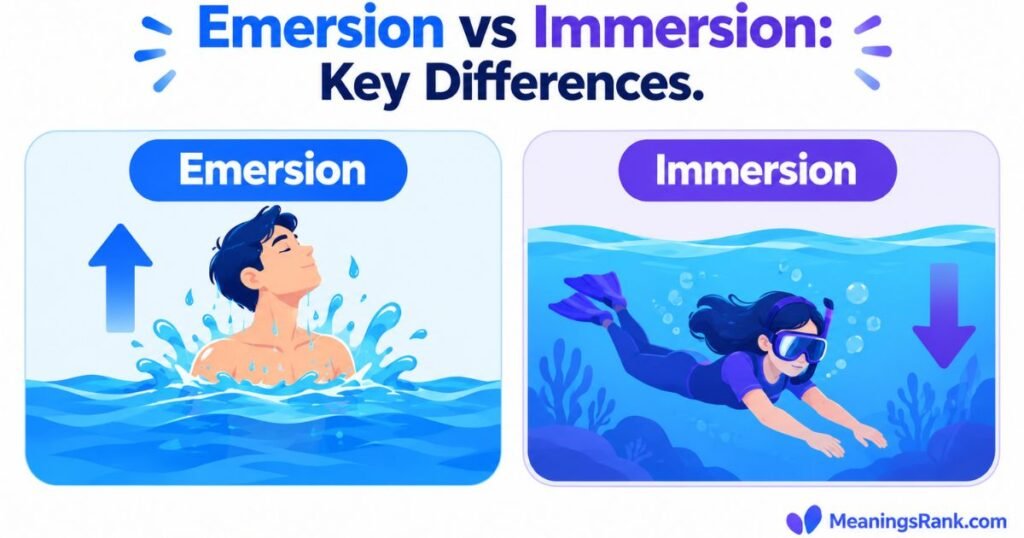
| Difference | Emersion | Immersion |
| Movement | Rising out, reappearing | Going in, being absorbed |
| Starting point | Hidden, covered, or submerged | Open, exposed, or outside |
| Endpoint | Visible and free | Covered, surrounded, or engaged |
| Everyday use | Uncommon | Very common |
| Adjective form | emergent | immersive |
| Verb form | emerge | immerse |
| Tone | Technical, literary | Neutral, versatile |
Emersion vs Immersion in Education
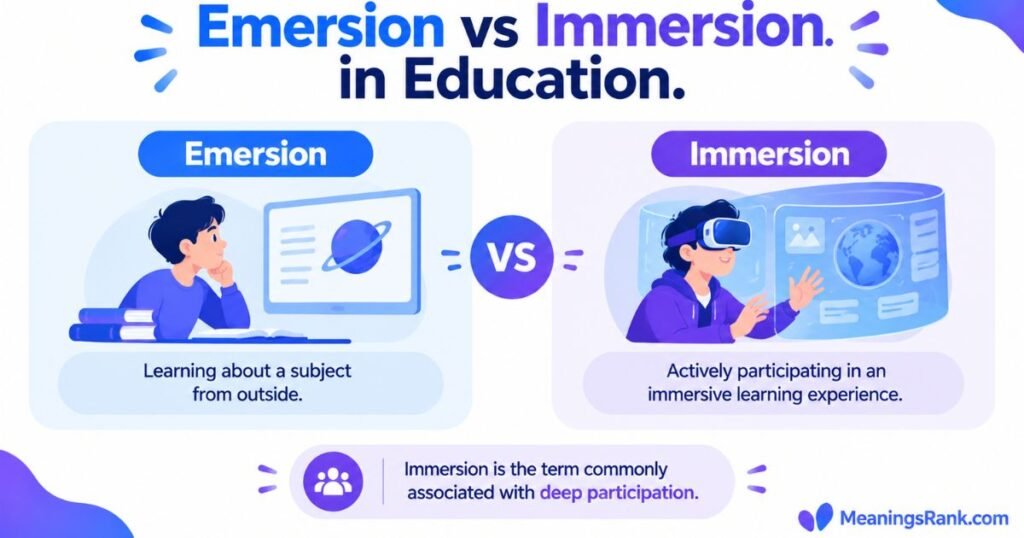
In education, immersion is the established term. Teachers and administrators use it for programs that surround students with a subject or language. A science immersion week, a full-immersion classroom, and an immersive learning lab all follow the same logic: learning sticks when students are surrounded by it.
Emersion has no standard role in curriculum language. If you see it in a school document, check whether the writer meant immersion or emergence, as in “emergent literacy” (the early stage of learning to read and write).
The practical lesson for teachers and parents is simple. When a brochure promises “immersion,” ask how much of the day actually happens in the target language or subject. A true immersion model keeps the student surrounded for most of the school day, while a lighter model might offer only a weekly session. The word describes the depth of exposure, and the depth varies widely from program to program.
Emersion vs Immersion in Language Learning
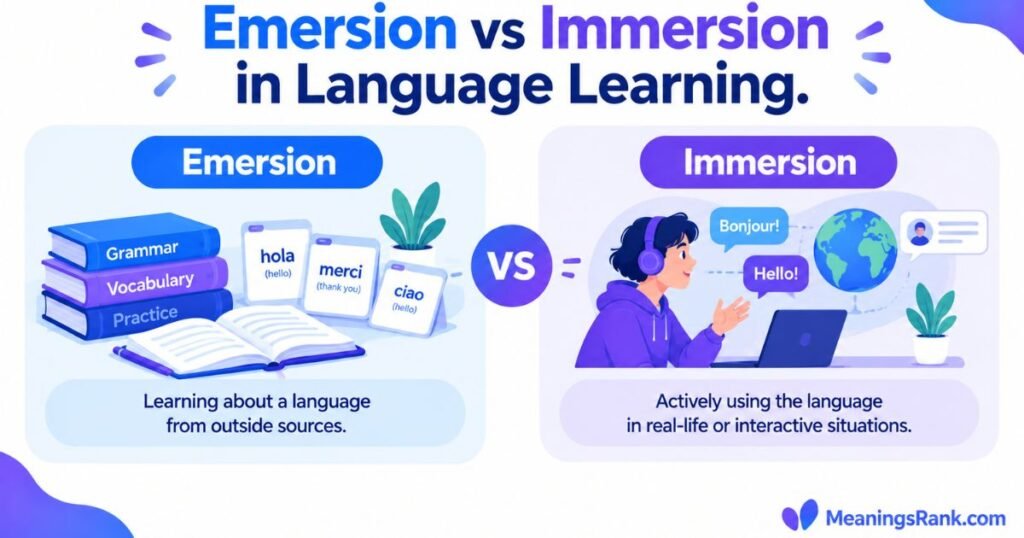
Language immersion comes in several forms:
- Total (full) immersion: all instruction happens in the target language.
- Partial immersion: part of the day uses the target language, part uses the native language.
- Two-way immersion: native speakers of two languages learn together.
- Self-directed immersion: learners surround themselves with media, conversation, and daily practice in the language.
Emersion is not a recognized term in applied linguistics. Some learners use it informally to describe the moment they “come out” of the learning phase and start thinking in the new language. That is a personal metaphor, not an academic definition. In formal writing, use immersion for the method and fluency for the result.
Emersion vs Immersion in Psychology
Psychology borrows immersion in two ways. First, it describes absorption or “flow,” the deep focus people feel during a challenging, enjoyable task. Second, it appears in clinical settings, such as exposure-based therapy, where a person gradually faces a feared situation.
Emersion is not a standard clinical term. You may find it used loosely for the stage after intense absorption, when a person re-enters ordinary awareness, or when someone returns home after living abroad and readjusts. Treat that usage as descriptive, not diagnostic. If you want a recognized term, use re-entry or reverse culture shock.
The concept of flow is a good way to remember the difference. Flow is immersion in its purest psychological form: time seems to vanish, distractions fade, and the task fills your attention. When the activity ends and you notice the room again, you have surfaced. That surfacing is the experience people sometimes label emersion vs immersion, although the standard vocabulary in research papers is simpler, such as “disengagement” or “return to baseline attention.”
Emersion vs Immersion: Examples in Sentences
Emersion examples:
- Astronomers recorded the exact time of the star’s emersion from behind the moon.
- The emersion of the island after the earthquake changed the harbor map.
- Her emersion from the lake was slow and graceful.
- The report tracked the emersion of reef flats during low tide.
- His emersion from years of obscurity began with a single viral essay.
Immersion examples:
- The school offers a full Mandarin immersion program.
- A brief immersion in ice water can reduce muscle soreness.
- The film’s sound design creates powerful immersion.
- Cultural immersion helped her understand local customs faster than any textbook.
- The baptism took place by full immersion in the river.
Both words in one sentence:
- The star’s immersion behind the moon lasted four minutes, and its emersion was captured on camera.
Read More: Demisexual Meaning: The Ultimate Guide to Its Definition, Signs & Usage
Common Mistakes When Using Emersion and Immersion
Most errors fall into four patterns.
- Swapping the prefix by accident. Writers type emersion when they mean immersion, especially in “language emersion” or “cultural emersion.” These are almost always wrong.
- Using emersion where emergence is better. “The emersion of new technologies” sounds strange. Emergence is the standard word for new developments appearing.
- Misspelling immersion. Common typos include immersian, emmersion, and immerssion. The correct spelling has a double m and a single s before the “ion.”
- Trusting the spell-checker. Because both words are valid, automatic tools almost never flag the wrong choice. Read the sentence aloud and ask one question: is something going in, or coming out? If the answer is “in,” the word you want is immersion. This habit takes five seconds and catches most errors before an editor does.
Key Exceptions to Keep in Mind
- Astronomy uses both words as a pair. The star’s disappearance is immersion. Its reappearance is emersion. Both are correct, and they describe opposite moments.
- Emersion has a formal register. In casual writing, emergence or coming out is clearer.
- Immersion is not limited to learning. It also means dipping, in religion and cooking.
- Names are separate words. Emerson has no i and is unrelated in meaning.
Cultural Immersion Through Travel

Cultural immersion means living inside another culture instead of observing it from the outside. A tourist photographs a market. An immersed traveler learns to haggle, eats what locals eat, and picks up phrases from the stall owner.
Ways to build real cultural immersion:
- Stay in a homestay or local guesthouse instead of an international chain.
- Learn at least 50 survival phrases before you arrive.
- Use public transport and local markets.
- Join a class, workshop, or volunteer project.
- Slow down. Two weeks in one town teaches more than six towns in six days.
When you return home, you may notice a shift in perspective as you readjust to familiar routines. Some writers call that phase emersion. The standard term is re-entry, but the image fits: you come back up for air, changed.
Memory Trick for Emersion vs Immersion
Focus on the first letters.
- Emersion = Exit. You are coming out.
- IMmersion = IN and Merged. You are going in.
Another trick: immersion starts with im, like immerse into. Emersion starts with e, like exit.
Quick Practice Quiz
Fill in each blank with emersion or immersion. Answers are at the bottom.
- The students joined a Korean language ______ camp over the summer.
- Astronomers noted the exact time of the planet’s ______ from behind the moon.
- Cold-water ______ is popular with athletes for muscle recovery.
- The slow ______ of the reef at low tide exposed hundreds of tiny crabs.
- Total ______ in the story’s world made it hard to put the book down.
Answer Key: 1. immersion · 2. emersion · 3. immersion · 4. emersion · 5. immersion
Frequently Asked Questions (FAQs)
What is the difference between emersion and immersion?
Emersion is the act of coming out or reappearing, while immersion is the act of going into or being surrounded by something. The prefixes show the direction: e- means “out” and im- means “in.”
Is emersion a real word?
Yes. Emersion is a real English noun, found in standard dictionaries. It is rare and mostly used in astronomy, geology, and biology, or in literary writing about rising out of something.
What does emersion mean in astronomy?
In astronomy, emersion is the reappearance of a celestial body after an eclipse or occultation. A star that passes behind the moon undergoes immersion when it disappears and emersion when it comes back into view.
Is it “language immersion” or “language emersion”?
It is always language immersion. The term describes learning a language by being surrounded by it. Language emersion is a spelling mistake.
What is the opposite of immersion?
In the literal sense, the closest opposite is emersion, meaning coming out. In figurative contexts, antonyms include detachment, disengagement, or withdrawal, depending on the situation.
Can I use emersion instead of emergence?
Sometimes, but it is not always natural. Emergence is the common word for something appearing or developing, as in “the emergence of new technology.” Use emersion only when you want the specific sense of rising out of water, shadow, or a covered state.
Final Thoughts
Emersion and immersion share the same Latin root, mergere, but the prefix reverses their meaning. Emersion means coming out or reappearing, and immersion means going in or being surrounded. Immersion is the far more common word, used in education, technology, psychology, religion, and everyday life. Emersion is a formal, technical term best kept for astronomy, geology, and deliberate literary use. When in doubt, remember the mnemonic: Emersion is the Exit, and IMmersion is IN. Check your sentence against that simple rule, and you will pick the right word every time.