
Your friend hasn’t replied in two days. Your teammate vanished in the middle of a match. Someone in the group chat types, “Where’s Jake? He went AWOL.” If you’ve ever paused to figure out the AWOL meaning, you’re in good company. This short word shows up in texts, memes, work chats, and gaming lobbies all the time.
AWOL stands for “absent without leave.” It began in the military, but today it means someone has disappeared without telling anyone where they went or why. In this guide, you’ll learn what AWOL means in text, where it came from, and how to use it the right way. You’ll also see real examples from WhatsApp, Discord, TikTok, and more, plus easy ways to reply when someone says it about you.
What Does AWOL Mean?
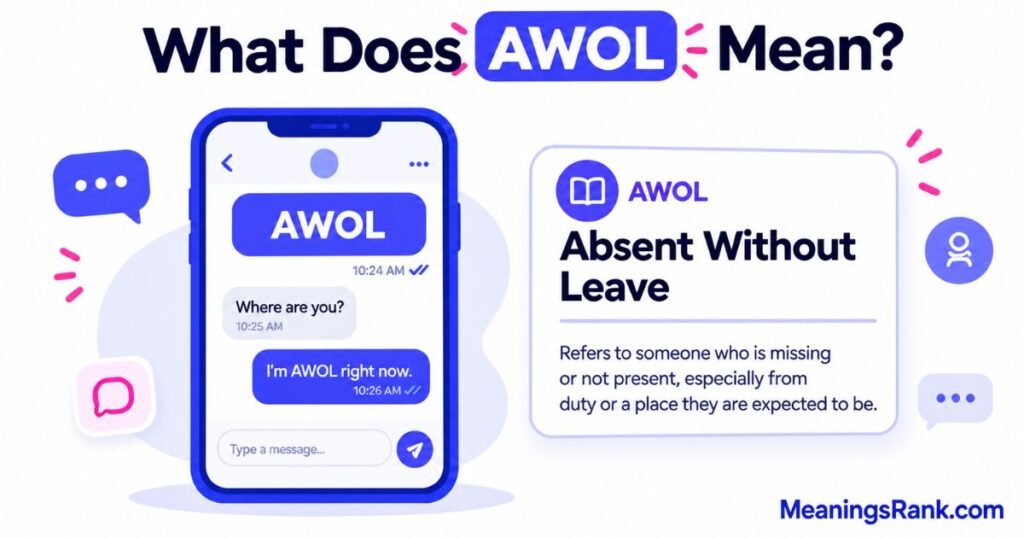
AWOL means “absent without leave.” In everyday chat, it describes a person who is missing, out of reach, or not showing up, and who didn’t warn anyone first.
The Short Answer
Here’s the quick version you can remember: AWOL = missing without telling anyone.
The word “leave” in the phrase means permission. So “absent without leave” simply means “gone without permission.” Most people today drop the “permission” part and use AWOL to mean “gone and silent.”
How to Pronounce AWOL
Say it like “AY-wall.” Two quick beats. Some people spell out each letter (A-W-O-L), especially in older or military settings, but the word-style pronunciation is far more common now.
Is AWOL an Acronym?
Yes. The first letters of “absent without leave” form a new word. Because people say it as a word, you’ll hear things like “He’s AWOL” and “She went AWOL.”
What Is the AWOL Meaning in Text?
In text messages and online chats, AWOL usually means someone has stopped replying, stopped showing up, or dropped out of contact without any heads-up. It’s a casual way to say, “Where did they go?”
Common Ways People Use AWOL in Texting
You’ll see AWOL used in a few main ways:
- Describing someone who isn’t answering: “Mia’s been AWOL since Friday.”
- Asking where someone is: “Has anyone seen Dan? He’s totally AWOL.”
- Joking about yourself: “Sorry I went AWOL, my phone died and I forgot to charge it.”
- Calling out a friend playfully: “Look who finally came back from being AWOL!”
The Tone Behind It
AWOL usually sounds light. Most of the time, it’s a joke or a gentle nudge. But tone changes with context. Said to a friend with a laughing emoji, it feels warm. Said in a serious work message, it can sound like a complaint. We’ll cover that in more detail later.
What Does “Go AWOL” Mean?
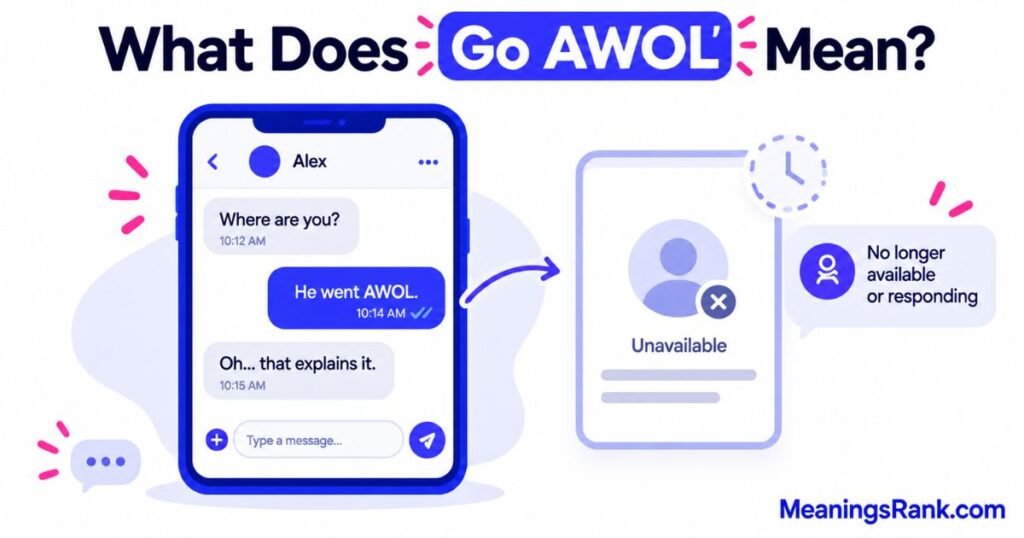
“Go AWOL” means to disappear or leave suddenly without telling anyone. It’s the most common way people use the word today.
Going AWOL vs. Being AWOL
The two phrases are close, but they aren’t identical.
- “Go AWOL” describes the act of vanishing. “He went AWOL during the group project.”
- “Be AWOL” describes the state of being gone. “She’s AWOL right now.”
Both point to the same thing: someone isn’t where they’re expected to be, and nobody knows why.
Things Can Go AWOL Too
People also use the phrase for objects, plans, or even feelings. This is a playful stretch of the meaning.
- “My charger went AWOL again.”
- “My motivation has gone AWOL this week.”
- “The Wi-Fi went AWOL right before the meeting.”
In these cases, nothing is being disloyal. The word just adds humor to something that has vanished.
Also Read: Mashallah Meaning: The Complete Guide to Its Meaning in Text & Chat
Where Did AWOL Come From?
AWOL comes from military language. It began as an official term for a soldier who was away from duty without permission.
Military Roots
The phrase “absent without leave” has been used in armed forces for a long time. Military records needed a clear way to describe a service member who wasn’t where they were supposed to be. The shortened form “AWOL” became common in the early 1900s, around the time of World War I.
In the military, being AWOL is different from desertion. AWOL meaning generally means a person is away without permission, but they may plan to return. Desertion usually means the person left with no plan to come back. Military rules treat these differently, and both can carry real consequences.
How It Reached Everyday Slang
Soldiers came home and brought their language with them. Over the years, “AWOL” moved into everyday talk. People started using it for a friend who skipped a party, a coworker who missed a meeting, or a student who stopped showing up to class.
Then texting and social media gave it a second life. Because it’s short, easy to type, and gets the point across fast, AWOL fit perfectly into chat culture. Today, most people who use it have never served in the military at all.
How Context Changes the AWOL Meaning
The core idea stays the same, but the feeling of AWOL shifts depending on who says it and where. Here’s how.
Among Friends
With friends, AWOL is usually playful. It says, “We missed you, where did you go?” There’s rarely any real anger behind it.
At Work or School
In a workplace or classroom, AWOL can sound more serious. If a manager says, “He went AWOL on Monday,” it may mean the person missed work without notice. That can be a real problem, so the tone matters.
In a Relationship or Dating
In dating, AWOL meaning often means someone has gone quiet. It might be a busy week, or it might be a sign of losing interest. People sometimes use AWOL as a softer word for being ignored.
In Gaming
In games, AWOL means a teammate disappeared mid-match, left their post, or stopped helping. It can feel frustrating, especially in team-based games where everyone depends on each other.
Quick Context Guide
| Context | What AWOL Usually Means | Typical Tone |
| Friends | Missing or slow to reply | Playful |
| Family | Someone hasn’t checked in | Caring or teasing |
| Work | Missed work or meetings without notice | Serious |
| School | Skipped class or group work | Mild to serious |
| Dating | Went quiet with no explanation | Hurt or confused |
| Gaming | Left a match or stopped playing | Annoyed |
| Military | Absent from duty without permission | Formal and serious |
AWOL Meaning in Text, Chat & Social Media
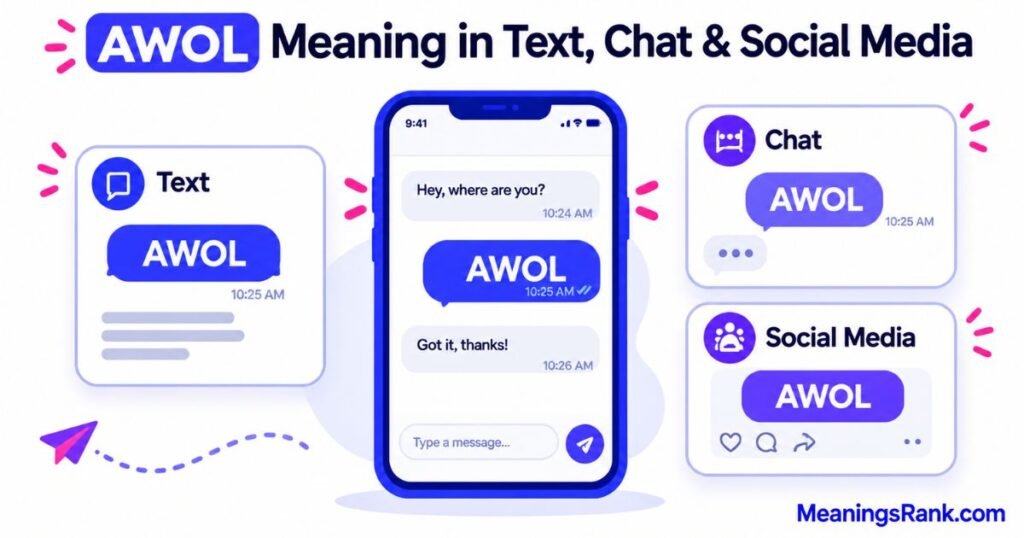
Every app has its own style. Here’s how AWOL meaning tends to show up on the platforms people use most.
WhatsApp and iMessage
On messaging apps, AWOL is mostly used in group chats. Someone notices a friend hasn’t replied and calls it out with a joke. It’s also common for people to apologize with it: “Sorry, I went AWOL this weekend.”
On Instagram, AWOL appears in captions, comments, and DMs. People use it when they haven’t posted in a while. A caption like “Back after going AWOL for a month” is very common. In comments, friends might write “Finally! You’ve been AWOL!”
Snapchat
Snapchat is fast and casual, so AWOL fits right in. People say it when a friend hasn’t opened Snaps or replied to a streak. “You’ve been AWOL on our streak” is a typical line.
TikTok
On TikTok, creators use AWOL in captions and voiceovers to explain a break from posting. Viewers also use it in comments when a favorite creator disappears. You’ll often see it in lines like “Creator went AWOL and we’re all waiting.”
Discord
On Discord, AWOL is common in server chats and voice channels. Mods might say, “Our admin went AWOL, so I’m covering.” Members also use it for friends who stop joining game nights.
Gaming Chats
In game lobbies and squad chats, AWOL usually points to a teammate who left mid-game or stopped responding on voice. It can sound frustrated: “Our tank went AWOL in the second round.”
Workplace Chats (Slack, Teams, Email)
At work, people use AWOL more carefully. It’s fine as a light joke between close teammates. But in messages to managers or clients, most people choose clearer phrases like “unavailable” or “out of contact.”
Real Conversation Examples
Seeing AWOL in action makes it easier to understand. Here are some realistic chats.
Friend Group Chat
Sam: Has anyone heard from Priya? She’s been AWOL since Thursday.
Leo: Same. I think she’s studying for finals.
Sam: Ha, fair. Somebody send her snacks.
Also Read: Endeavor Meaning: The Complete Guide to Its Definition, Uses & Examples
Texting a Friend Directly
Nina: Hey stranger! You went totally AWOL on me 😄
Chris: I know, I know. My phone broke and I just got a new one. So sorry!
Nina: No stress. Glad you’re back.
Workplace Chat
Manager: Do you know where Alex is? He didn’t show up for the client call.
Coworker: He’s been AWOL since yesterday. I’ll try calling him.
Manager: Thanks. Let me know as soon as you hear something.
Discord or Gaming Chat
Rex: Where’s Kai? We need a fourth player.
Mo: He went AWOL mid-match again lol.
Rex: Every single time. I’ll invite someone else.
Dating Chat
Jordan: I don’t want to sound dramatic, but you kind of went AWOL this week.
Taylor: You’re right, and I’m sorry. Work got crazy. Can I call you tonight?
Jordan: Yes, I’d like that.
Is AWOL Rude or Offensive?
Not usually. In most casual chats, AWOL is a mild and even friendly word. But how it lands depends on the situation.
It’s Usually Harmless
Between friends and family, AWOL is a light joke. It doesn’t contain any bad language, and it isn’t aimed at a group or identity. Most people won’t think twice about it.
When It Can Sting
AWOL can feel rude if it’s used to blame someone who had a good reason. Imagine calling a friend “AWOL” when they were sick or dealing with a family emergency. It can sound like you’re judging them. If you’re unsure, add a friendly tone or an emoji, or simply ask, “Hey, is everything okay?”
A Note on Military Meaning
In the military, going AWOL is a real offense with real consequences. Because of that, some people who have served may not find it funny when it’s used casually. If you’re talking with veterans or active service members, be a little thoughtful about how you use it.
How to Reply to AWOL
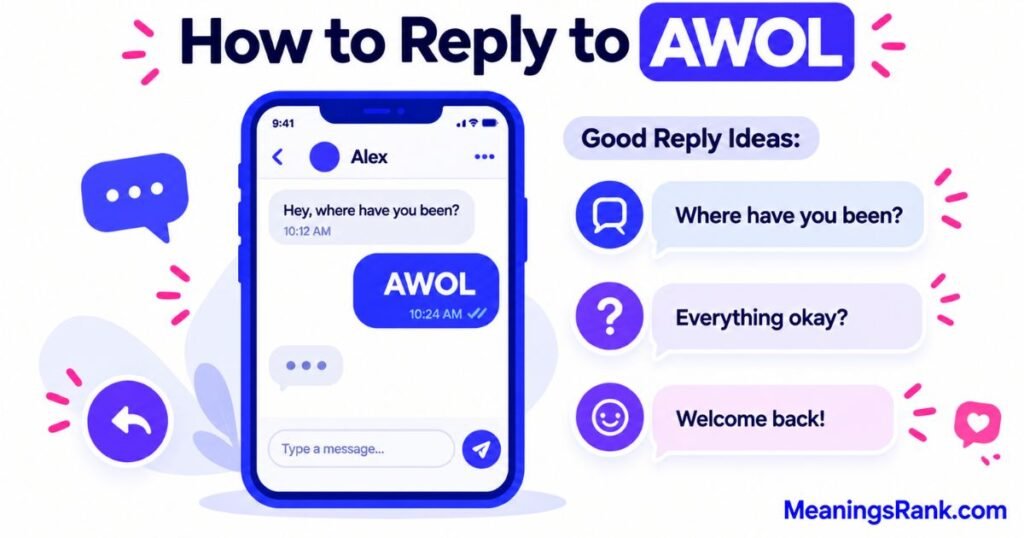
Someone just told you that you’ve gone AWOL. What do you say? The best reply depends on why you were gone and how close you are to the person.
A Friendly, Casual Reply
- “Ha, sorry! I’m back now.”
- “Guilty! Life got busy.”
- “I didn’t mean to vanish. What did I miss?”
An Honest Apology
If you truly left someone hanging, a short, sincere message works best.
- “You’re right, and I’m sorry I didn’t say anything. I should have let you know.”
- “I went quiet because I was overwhelmed. I’m sorry for leaving you in the dark.”
A Professional Reply
At work, keep it clear and calm.
- “Apologies for the lack of contact. I was out sick and should have informed you sooner.”
- “Thanks for checking in. I’m back online and will catch up on everything today.”
A Playful Reply
- “Reporting for duty, sir! 🫡”
- “The missing person has been found.”
- “Miss me? 😄”
When to Use AWOL
AWOL works best in relaxed, low-pressure situations. Here are good times to use it:
- Joking with close friends: Who haven’t replied in a while.
- Describing your own break: “I’ve been AWOL from social media lately.”
- Talking about lost items: “My keys went AWOL again.”
- Group chats and casual servers: Where the vibe is light.
- Captions and posts: Explaining a short absence.
- Informal work chats: With teammates you know well.
A helpful rule: if you’d be comfortable saying it out loud with a smile, it’s probably fine to use.
When to Avoid AWOL
Some moments call for a different word. It’s wise to skip AWOL when:
- Someone may be in real trouble. If a person is missing or unsafe, be direct and caring instead of joking.
- You’re writing to a boss, client, or teacher and need a formal, respectful tone.
- Grief or health issues are involved. A person who is sick or mourning doesn’t need a “you went AWOL” comment.
- You’re writing official documents like HR notes, reports, or emails where plain words are better.
- You’re talking with military members who may take the term more seriously.
- You want to be kind. Sometimes “Hey, I’ve been thinking of you, hope you’re okay” lands far better.
Common Mistakes About AWOL
A few small misunderstandings come up again and again. Here they are, along with quick fixes.
Mistake 1: Thinking AWOL Means Desertion
They’re not the same. AWOL means someone is away without permission. Desertion means leaving with no plan to return. In everyday chat, people use AWOL to mean “missing for a while,” not “gone forever.”
Mistake 2: Assuming It Always Sounds Angry
Many people think AWOL is always an accusation. In reality, it’s often just teasing. Look at the tone, emojis, and who’s speaking before you decide how to feel.
Mistake 3: Confusing AWOL With Ghosting
Ghosting is when someone cuts off contact on purpose, usually in dating or friendships, and never returns. AWOL is usually temporary. The person is missing, but they might pop back up any moment.
Mistake 4: Spelling It Wrong
The correct spelling is AWOL, either in all capitals or, less often, lowercase “awol.” You’ll also see “A.W.O.L.” in formal or older writing. Avoid odd spellings like “awal” or “aywol.”
AWOL vs. Similar Terms
Several slang words sound close to AWOL. Here’s how they differ.
| Term | Meaning | Is It Temporary? | Tone |
| AWOL | Missing without telling anyone | Usually yes | Casual to serious |
| MIA | Missing in action; unaccounted for | Often | Light or serious |
| Ghosting | Ending contact on purpose with no explanation | Usually no | Negative |
| AFK | Away from keyboard; briefly gone | Yes | Neutral |
| BRB | Be right back | Yes | Neutral |
| No-show | Didn’t appear at an event or appointment | One-time | Mild to negative |
| Flaking | Canceling or not showing up, again and again | Repeated | Negative |
| Desertion | Leaving a duty with no plan to return | No | Very serious |
| Offline | Not connected to the internet or app | Yes | Neutral |
AWOL vs. Ghosting
AWOL says, “You vanished, where are you?” Ghosting says, “You cut me off on purpose.” Ghosting also carries hurt feelings and a sense of rejection. AWOL tends to be lighter and more open to a comeback.
AWOL vs. MIA
MIA is short for “missing in action.” Friends use it in almost the same playful way as AWOL. The main difference is history: MIA comes from wartime language about people who could not be found, while AWOL is about someone who left without permission.
AWOL vs. AFK
AFK is short and clear. It means you’re stepping away from your keyboard or screen, usually for a few minutes. If you tell people you’re AFK, you’re not AWOL, because you gave notice. That’s the key difference: AWOL means no warning.
Also Read: HBS Meaning in Text: What Does HBS Mean in Chat & Social Media? (2026)
Quick Recap
- AWOL stands for “absent without leave.”
- In texting, it means someone disappeared or went silent without warning.
- “Go AWOL” means to vanish suddenly, often for a short time.
- The term comes from the military and spread into everyday slang.
- It’s usually playful with friends and more serious at work or in the military.
- It’s not rude by default, but tone and situation matter.
- Reply with a quick, honest message, and match the other person’s tone.
- Skip AWOL when someone may be in real trouble or when you need a formal voice.
- AWOL is different from ghosting, MIA, AFK, and desertion.
Frequently Asked Questions
What does AWOL stand for in texting and chat?
AWOL stands for “absent without leave.” In texting, it means someone has gone missing or stopped replying without letting anyone know. People usually say it in a casual or joking way, like “He’s been AWOL all week.”
Is going AWOL the same as ghosting someone online?
No. Ghosting means cutting off contact on purpose and usually not coming back. Going AWOL usually means disappearing for a while without notice. The person often returns, and the tone is generally lighter.
Is AWOL a rude word to use with friends?
Usually not. Most friends take it as a joke or a sign that they were missed. It can feel unkind if the person had a serious reason for being gone, so check the mood before using it.
How do you pronounce AWOL when saying it out loud?
Most people say “AY-wall,” as one word. Some people, especially in military settings, say each letter: A-W-O-L. Both are understood, but “AY-wall” is far more common in everyday conversation.
Can you go AWOL from a job or school?
Yes. People use it when someone misses work, class, or a shift without any notice. In a job, it can be a serious issue and may lead to discipline, so it’s better to always let someone know.
Where does the word AWOL originally come from?
AWOL comes from the military phrase “absent without leave,” used for service members who were away from duty without permission. The short form became popular in the early 1900s and later moved into everyday slang.
Final Thoughts
Now you know the full AWOL meaning. It stands for “absent without leave,” and in chat it describes someone who has vanished without a word. It started in the military, but today you’ll hear it in group chats, comment sections, Discord servers, and even office messages.
The best part about AWOL is how flexible it is. You can use it to tease a friend, explain your own quiet week, or joke about a missing charger. Just remember that tone is everything. With close friends, it’s light and friendly. At work, or when someone may be dealing with something hard, a kinder or more direct message is usually better.
If someone says you went AWOL, don’t panic. A short, honest reply is enough. And if you’re the one waiting on a message, a gentle check-in often works better than a label. Keep it simple, keep it kind, and use AWOL where it fits. For more slang breakdowns and text meanings, keep exploring MeaningsRank.