
You are typing a sentence, you reach the word, and your fingers hesitate. Putting or puting? One looks right, the other looks suspiciously like a word you have seen in a hurried text message. That small flicker of doubt is common, even among confident writers, and it deserves a clear, final answer.
This guide gives you that answer in the first few lines, then explains the grammar behind it so you never have to second-guess yourself again. Along the way you will find tables, memory tricks, a short quiz, and plenty of real sentences.
Quick Answer
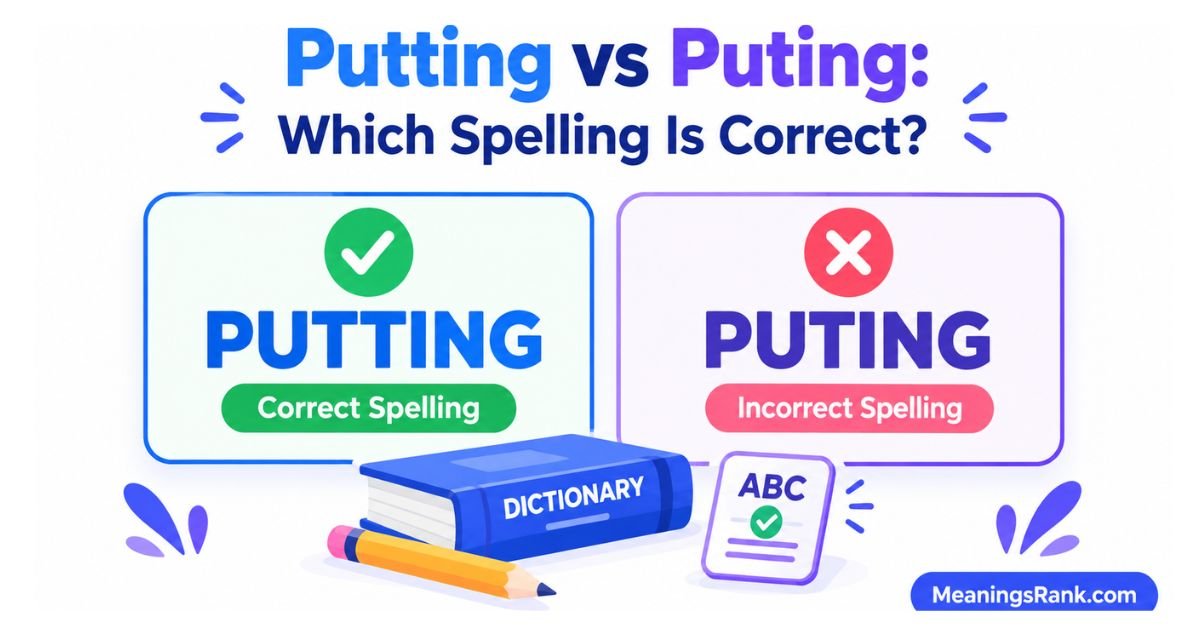
Putting is the only correct spelling. Puting is a misspelling and does not appear in standard English dictionaries.
Putting is the present participle and gerund of the verb put. Because put is a short word that ends in a single consonant after a single vowel, English doubles the final t before adding -ing. That gives you p-u-t-t-i-n-g, never p-u-t-i-n-g.
| Word | Status | Example |
| Putting | Correct | She is putting the books on the shelf. |
| Puting | Incorrect | ~~She is puting the books on the shelf.~~ |
Putting vs Puting: Key Differences at a Glance
The quickest way to see the difference is to place the two forms side by side. Only one of them is a real English word, so the comparison is less about meaning and more about spelling accuracy.
| Feature | Putting | Puting |
| Correct spelling? | Yes | No |
| Part of speech | Verb form (present participle), gerund, noun in golf | None; not a recognized word |
| Base verb | put | None |
| Number of T’s | Two | One |
| Found in dictionaries? | Yes, as a form of put and putt | No |
| Typical pronunciation | /ˈpʊtɪŋ/ (PUT-ing, short “oo”) | Readers would likely say “PYOO-ting” |
| Safe in formal writing? | Yes | Never |
Notice the last two rows. Spelling is not a cosmetic issue here. A missing letter changes how a reader hears the word in their head, and a misspelling can cost you credibility in an email, a résumé, or an essay.
What Does Putting Mean?
Putting is the -ing form of the verb put, which is one of the most flexible verbs in English. At its core, put means to place something in a particular position or condition. From that simple root, it branches into dozens of senses.
Here are the main meanings you will meet:
- To place or position something: He is putting the keys on the table.
- To cause someone or something to be in a state: The news is putting everyone in a good mood.
- To express or phrase something: She has a talent for putting complicated ideas simply.
- To apply or add something: They are putting a new coat of paint on the fence.
- To submit or propose: The chair is putting the motion to a vote.
- To strike a golf ball gently on the green (spelled putt, with the -ing form also putting): He spent the morning putting on the practice green.
Because put is an irregular verb, its past tense and past participle are identical to the base form: put, put, put. Only the present participle changes, and that is where the double t appears.
Why People Confuse Putting and Puting
The confusion is easy to explain once you look at how English handles suffixes. Several overlapping habits push writers toward the single-t version.
The silent-e pattern:
Many verbs end in a silent e, and writers drop that e before adding -ing. Hope becomes hoping, write becomes writing, and use becomes using. The brain learns “just add -ing and drop the e,” then applies it to words that never had an e in the first place.
Typing speed:
Double letters are easy to skip. In fast typing, a repeated key press can register once, especially on mobile keyboards.
Autopilot spelling:
A word like put looks complete on its own. Adding -ing feels like it should change very little, so the writer adds the suffix and moves on.
None of these causes means the writer is careless. They are normal side effects of a spelling system with plenty of exceptions.
Why Putting Has Two T’s
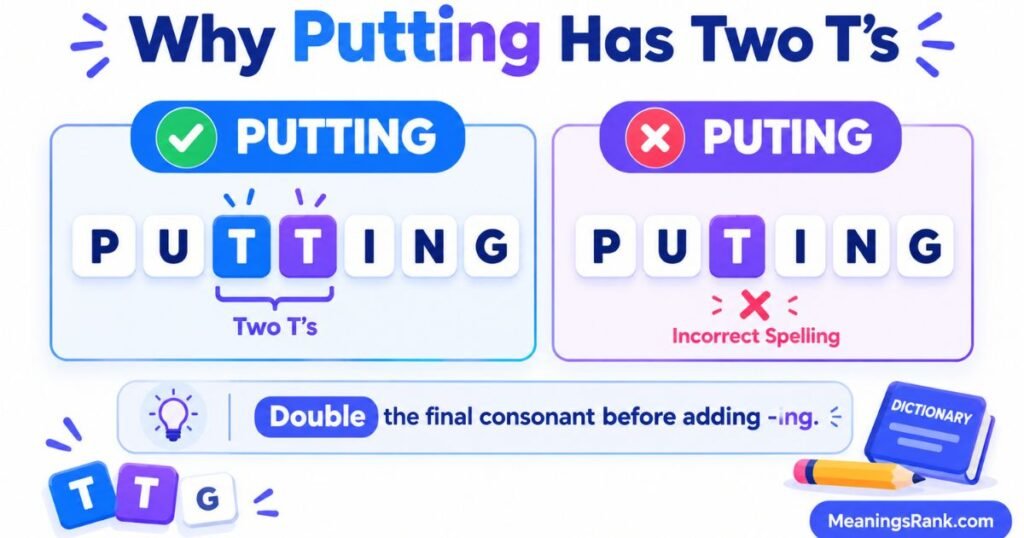
The double t is not random. It follows a reliable spelling rule that grammarians sometimes call the doubling rule or the 1-1-1 rule.
The rule: When a one-syllable word ends in one consonant that follows one vowel, double the final consonant before adding a suffix that begins with a vowel, such as -ing or -ed.
Apply it to put:
- Put has one syllable.
- It ends in one consonant: t.
- That consonant follows one vowel: u.
- The suffix -ing begins with a vowel.
- So the t doubles: putting.
Here is the same rule at work in other familiar words:
| Base word | Add -ing | Why it doubles |
| put | putting | one vowel + one consonant |
| cut | cutting | one vowel + one consonant |
| run | running | one vowel + one consonant |
| sit | sitting | one vowel + one consonant |
| hop | hopping | one vowel + one consonant |
| stop | stopping | one vowel + one consonant |
The doubling serves a real purpose. It protects the vowel sound. A single t after u would suggest a long vowel, as in cute, mute, or brute. The double t tells the reader that the u is short, as in foot and cut.
Quick Memory Trick / Mnemonic Device
Use this short sentence: “Put a double T in putting, or the word goes puting.”
Better still, remember the pair of contrasts below. A silent e gives you one consonant, while no silent e gives you two:
- hope → hoping (there is a silent e, so one p)
- hop → hopping (no silent e, so two ps)
- tape → taping / tap → tapping
- mute → muting / put → putting
If the base word has no e at the end, the -ing form needs a doubled consonant. Put has no e, so it needs two ts.
Is Puting Ever a Correct Spelling?
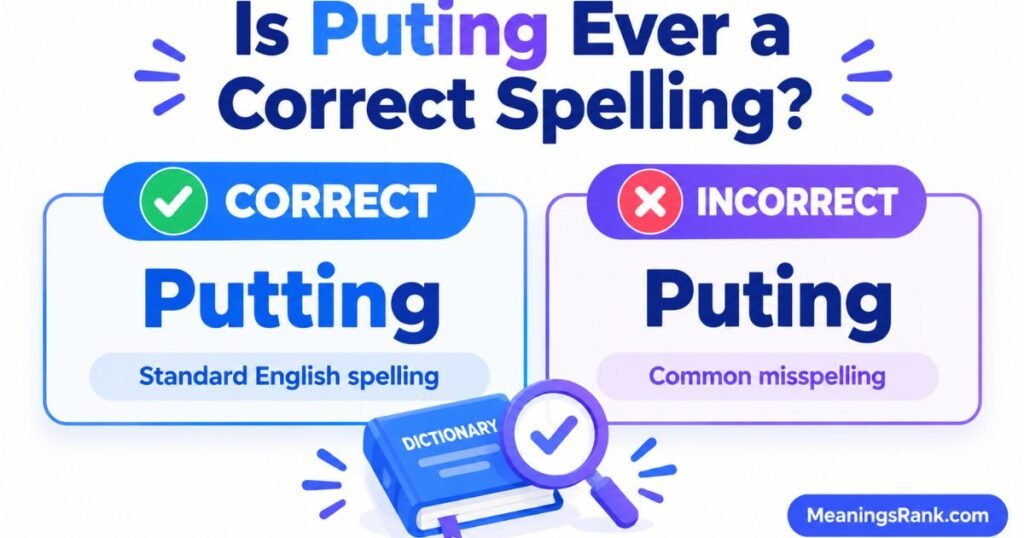
In standard English, no. You will not find puting as an entry in major dictionaries such as Merriam-Webster, Oxford, or Cambridge, and no mainstream style guide treats it as an acceptable variant. There is no regional spelling, whether British, American, Canadian, or Australian, that makes puting correct as a form of put.
Key Exceptions to Keep in Mind
A few situations can make puting appear on a page without being a grammar error in the strict sense:
- Proper names and brand names. A surname, place name, or product might be spelled with one t. In that case the spelling is part of a name, not a form of the verb put. Always copy a name exactly as its owner writes it.
- Words in other languages. Some languages use similar letter combinations in their own vocabulary. Those words belong to a different language and do not affect English spelling.
- Look-alike words. Putin, putting, and putty are different words. Check which one you actually mean.
For essays, business writing, academic work, and anything you publish, treat puting as an error every time.
Read More: Studder vs Stutter: Correct Spelling, Meaning & Key Differences (2026)
Meaning and Usage Difference
Strictly speaking, there is no meaning difference between putting and puting, because only one of them is a real word. The “difference” is entirely a matter of correctness.
Think of it this way. If someone writes “I am puting the cake in the oven,” every reader understands the intended meaning. The problem is not comprehension; it is polish. Readers notice the error, and in professional or educational writing, that distraction weakens your message.
The usage of putting itself is broad:
- Progressive tenses: I am putting, she was putting, they will be putting.
- Gerunds (verb acting as noun): Putting off your homework rarely helps.
- Participial phrases: Putting down his pen, he stood up.
- After prepositions: She is good at putting people at ease.
Each of these uses requires the double t. The spelling stays the same whether putting acts as a verb, a noun, or a modifier.
Pronunciation Note
Putting is pronounced /ˈpʊtɪŋ/, roughly “PUT-ing.” The vowel sound matches the oo in foot and good, not the oo in food or the yoo sound in cute.
Here is why that matters for spelling. If the word were written puting, an English reader would likely pronounce it “PYOO-ting,” following the same pattern as muting or cuter. The double t in putting signals the short vowel and prevents that misreading.
How to Use Putting Correctly in a Sentence
Putting almost always appears alongside a form of the verb to be (in progressive tenses) or on its own as a gerund or participle. Follow these steps for correct usage.
Step 1: Choose the right helping verb for the progressive tense.
- Present: am/is/are putting
- Past: was/were putting
- Future: will be putting
Step 2: Check subject-verb agreement.
The helping verb must match the subject, not the word putting.
- The students are putting their phones away.
- The teacher is putting the schedule on the board.
Step 3: Add the object or phrase that completes the action.
Put usually needs an object and a location.
- She is putting the laptop in her bag.
Step 4: Use it as a gerund when the action acts as a noun.
- Putting a budget together takes patience.
Step 5: Place a comma after an introductory participial phrase.
- Putting the finishing touches on the report, Maria checked every figure twice.
In that last sentence, the participial phrase Putting the finishing touches on the report modifies the subject, Maria. A good style guide rule is to make sure the phrase sits next to the person doing the action. Otherwise you create a dangling modifier.
Which One Should You Use?
Use putting. Every time. There is no context, genre, or audience for which puting is the better choice.
If you ever feel unsure, run the quick test: Does the base word end in a silent e? For put, the answer is no. That means the t must double.
When Puting Looks Wrong
Readers can spot a misspelling even when they cannot explain the rule. Here is why puting feels off to experienced readers:
- It breaks the visual pattern of the base word. Put is a three-letter word that readers recognize instantly. A single t before -ing makes the stem look unfamiliar.
- It suggests a different sound. As covered above, a single consonant between vowels implies a long u, so the word reads as “PYOO-ting.”
- It clashes with similar verbs. Cut/cutting, sit/sitting, and run/running all double. Puting stands out as the odd one.
- It looks like a typo. Spell checkers underline it with a red line for good reason.
Search engines, autocorrect tools, and grammar checkers all treat puting as an error. In professional settings, a spelling slip in a common word can raise doubts about the rest of your writing.
Common Mistakes and Quick Fixes
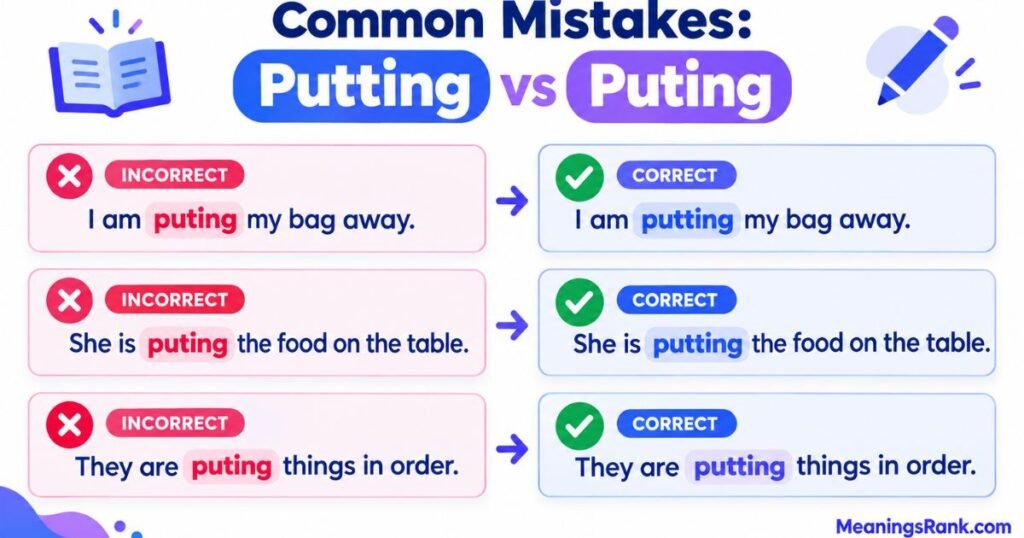
Beyond the puting error itself, writers make several related slips. Here is a quick-fix table you can bookmark.
| Mistake | Problem | Fix |
| She is puting on her coat. | Missing double t | She is putting on her coat. |
| He putted the box away. | Wrong past tense for the “place” meaning | He put the box away. |
| I have putted it there. | Wrong past participle | I have put it there. |
| Putting, off the meeting was wise. | Comma splits a phrasal verb | Putting off the meeting was wise. |
| They are puting up with noise. | Missing double t | They are putting up with noise. |
| Having put it, he left. | Awkward phrasing | Having put it down, he left. |
A note on putted:
The verb put (to place) never becomes putted. However, the golf verb putt does: He putted the ball across the green. The two verbs share an -ing form, putting, which is why the confusion sometimes happens.
Quick fix routine:
Before you publish, scan for every -ing word. For each one, find the base verb and ask whether the 1-1-1 rule applies. This takes seconds and catches most doubling errors, including stoping, runing, and cuting.
Read More: Time Frame vs Timeframe: Which Spelling Is Correct? (2026 Guide)
Everyday Examples of Putting
Seeing the word in natural settings helps the spelling stick. Here are examples from daily life:
- At home: I am putting the groceries away.
- At school: The teacher is putting the grades online tonight.
- At work: We are putting the finishing touches on the proposal.
- In conversation: You are putting me in a difficult position.
- In sports: She practices putting every Saturday morning.
- Online: Thanks for putting this tutorial together.
- In the kitchen: He is putting too much salt in the soup.
Each sentence shows putting doing a different job, yet the spelling never changes.
Putting as a Verb
As a verb form, putting is the present participle of put. It works in three main ways.
1. Progressive tenses. These show an action in progress.
- The workers are putting up a new sign.
- He was putting the final touches on his speech when the phone rang.
- By next week, we will be putting the plan into action.
2. Participial phrases. These add detail before or after the main clause.
- Putting her coat on, she hurried out the door.
- The manager, putting the report aside, turned to the next task.
3. After certain verbs and prepositions. Gerunds and participles follow words like keep, stop, avoid, by, and without.
- Stop putting things off.
- She improved her grades by putting in extra hours.
Clause structure note:
In Putting her coat on, she hurried out the door, the first part is a dependent participial clause and the second is the main clause. The comma separates them. If the subject of the participle differs from the subject of the main clause, readers will be confused, so keep them aligned.
Putting as a Noun
When putting works as a noun, grammarians call it a gerund or, in some cases, a verbal noun. It names the act itself.
- Putting a clear plan on paper saves time. (gerund as subject)
- Her main strength is putting people at ease. (gerund as complement)
- I appreciate your putting in the extra effort. (gerund after a possessive)
Putting in golf. In golf, putting names the skill of rolling the ball on the green with a putter. It is a noun in sentences such as:
- His putting was the difference between winning and losing.
- Putting requires touch and a steady nerve.
- The club has a large putting green behind the clubhouse.
In this sense, putting comes from the verb putt, which already has a double t. That gives golf writers two different routes to the same spelling.
Putting — Synonyms and Related Words
Because put carries so many meanings, its synonyms depend on context. Here is a guide to choosing alternatives.
| Meaning of putting | Synonyms |
| Placing | placing, setting, laying, positioning, resting |
| Expressing | phrasing, stating, wording, framing, voicing |
| Submitting | proposing, presenting, tabling, submitting, advancing |
| Causing a state | placing, bringing, leaving, rendering |
| Adding | applying, attaching, adding, fixing, installing |
| Golf | rolling, stroking, sinking (a putt) |
Using synonyms can sharpen your writing. Try placing when you mean physical position and phrasing when you mean wording.
Example Sentences Using Putting
The sentences below are grouped by function so you can see the range.
Simple physical action
- She is putting the plates on the table.
- The children are putting their shoes by the door.
- I am putting my phone on silent.
Abstract or figurative use 4. You are putting too much pressure on yourself. 5. The new law is putting small businesses at risk. 6. He has a gift for putting people at ease.
Phrasal verbs 7. They are putting off the trip until spring. 8. We keep putting up with the same delays. 9. The company is putting forward a new proposal.
Word History and Origin
The verb put is very old. It traces back to Old English, where scholars reconstruct a form like putian, meaning “to push or thrust.” The word moved into Middle English as putten and settled into its modern shape as the language simplified its endings.
Over the centuries, put expanded from physical pushing into the huge range of senses we use today: placing, expressing, proposing, and causing. That flexibility is one reason it appears in so many idioms and phrasal verbs.
The -ing ending is also ancient. It comes from Old English suffixes that formed nouns from verbs and later merged with the participle ending. English later developed spelling conventions to mark short and long vowels, and the doubling rule emerged as part of that system. When the -ing form of put is written putting, it reflects centuries of spelling habits that keep the short u sound intact.
The golf term putt appeared in Scots usage in the 1700s as a variant of put, and the two words have overlapped in spelling ever since. That shared history is why putting sits comfortably in both everyday English and the vocabulary of sport.
Read More: High School or Highschool: Discover the Correct Spelling & Meaning (2026)
Common Phrases Containing Putting
Putting shows up in many fixed expressions. Learning them helps you use the word naturally.
| Phrase | Meaning | Example |
| putting off | delaying | Stop putting off your assignment. |
| putting up with | tolerating | I am tired of putting up with the noise. |
| putting on | wearing, or pretending | She is putting on a brave face. |
| putting down | placing down, or insulting | He kept putting down his own ideas. |
| putting forward | proposing | They are putting forward a new plan. |
| putting together | assembling | We are putting together a team. |
| putting aside | saving, or setting apart | I am putting aside money each month. |
| putting green | golf practice area | Meet me at the putting green. |
| putting the cart before the horse | doing things in the wrong order | Buying furniture before the lease is signed is putting the cart before the horse. |
| putting your foot in your mouth | saying something embarrassing | I keep putting my foot in my mouth. |
| putting your best foot forward | making a good impression | She is putting her best foot forward at the interview. |
| putting two and two together | drawing a conclusion | He finally started putting two and two together. |
| putting pen to paper | starting to write | The author is putting pen to paper at last. |
In every one of these expressions, the spelling is putting. A single-t version would be an error in any of them.
Correct vs Incorrect Examples
Study these pairs, then try the practice quiz that follows.
| Incorrect | Correct |
| I am puting the files in the folder. | I am putting the files in the folder. |
| She kept puting off the decision. | She kept putting off the decision. |
| Puting a smile on his face, he walked in. | Putting a smile on his face, he walked in. |
| They are puting up a tent. | They are putting up a tent. |
| His puting needs work. | His putting needs work. |
| We were puting our heads together. | We were putting our heads together. |
| Are you puting me on? | Are you putting me on? |
Interactive Practice Quiz
Fill in each blank with putting or puting. Cover the answer key until you have finished.
- She is ______ the groceries into the car.
- ______ your ideas on paper is the first step.
- The team is ______ in extra hours before the deadline.
- His ______ on the green won him the tournament.
- Stop ______ off your homework until midnight.
Bonus challenge: Write one sentence of your own that uses putting as a gerund and one that uses it as a participle.
Answer Key
- putting. This is the present participle in a progressive tense.
- Putting. This is a gerund acting as the subject.
- putting. This is the present participle with “is.”
- putting. This is a noun from golf.
- putting. This is a gerund after the verb “stop.”
Every answer is putting, because puting is never correct. If you scored five out of five, you have this rule down.
Frequently Asked Questions (FAQs)
Is it putting or puting?
It is putting. The word puting is a misspelling. The verb put follows the doubling rule, so the final t is repeated before the -ing ending.
Why does putting have two T’s?
Put is a one-syllable word that ends in a single consonant after a single vowel. English doubles that consonant before adding a vowel-based suffix like -ing. The extra t keeps the u short, so the word is read as “PUT-ing” and not “PYOO-ting.”
Is puting a word in any dictionary?
No. Standard dictionaries do not list puting as a form of put. Any appearance of the letters p-u-t-i-n-g in a text is either a typo or part of a name or a word from another language.
What is the past tense of put?
The past tense of put is put. The past participle is also put. For example: Yesterday I put the keys on the shelf, and I have put the keys on the shelf. The form putted belongs only to the golf verb putt.
Is putting a noun or a verb?
It can be both. Putting is a verb form (present participle) in sentences like She is putting on her coat. It is a noun (gerund) in sentences like Putting in the work pays off, and a plain noun in golf, as in His putting was excellent.
Conclusion
The correct spelling is putting, with two ts, and puting is always a mistake. The doubling rule explains why: a short word with one vowel and one final consonant doubles that consonant before -ing. Keep the mnemonic close, check any -ing word that looks suspicious, and you will spell putting correctly every time you write.