
You are halfway through an email, a school essay, or a social media post. You need the word for guiding a car, a boat, or a conversation, and your fingers pause. Steer or stear? Both look believable on the screen, and that moment of doubt is more common than most writers admit.
The grammatical question is a spelling one, and the answer is short: steer is correct, and “stear” is a typo. Still, the mix-up is not random. English spells the same vowel sound in many ways, as in deer, clear, and here, so the wrong choice can feel right.
Mastering this word matters more than it seems. A misspelling in a résumé, a cover letter, or a headline can weaken a reader’s trust before they reach your argument. Search engines also treat “stear” as a probable error, which can hurt the visibility of a page that uses it.
This guide explains what each spelling means, why people confuse them, how the rule works in American and British English, and how to remember it. You will also find real examples, a memory trick, and a short practice quiz.
Steer vs Stear – Quick Answer

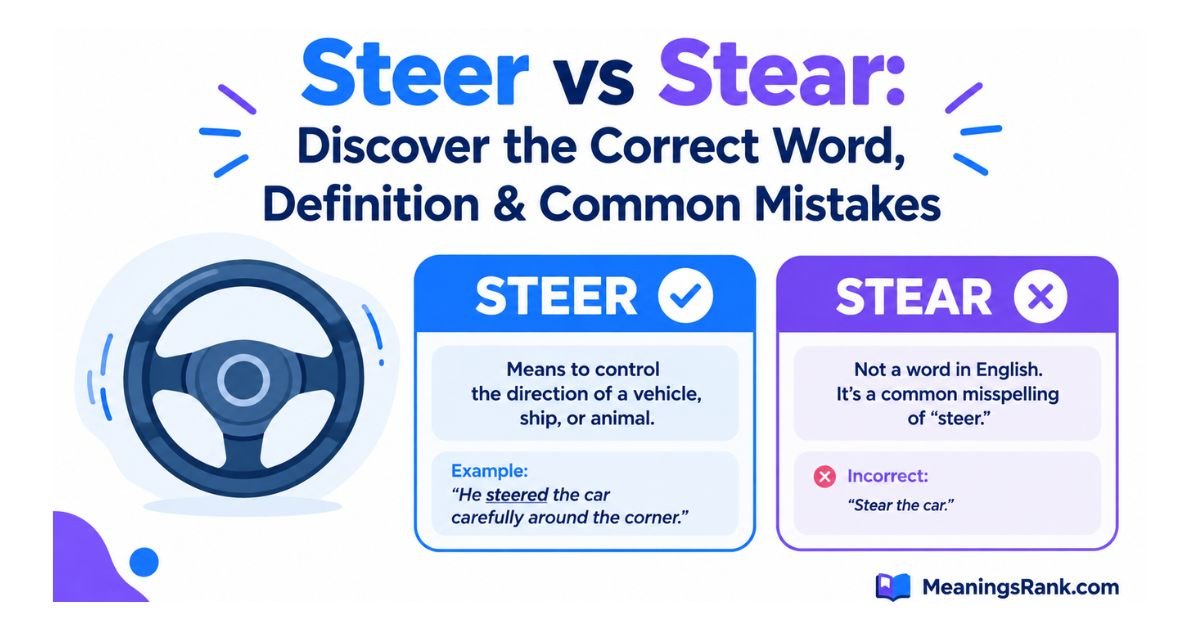
“Steer” is the correct spelling. It is a standard English verb and noun meaning to guide a vehicle, direct a conversation, or point someone toward a goal. “Stear” is not an English word on its own. It shows up only as a typo or as a fragment inside scientific terms such as stearic acid.
| Word | Standard English? | Meaning | Example |
| Steer | Yes | To guide or direct; also a young male cow | “Steer the boat away from the rocks.” |
| Stear | No | Not a standalone word | Always a misspelling of steer |
If you are writing a sentence and need the word, type s-t-e-e-r. That settles it.
Steer vs Stear: Which Spelling Is Correct?
Only steer is correct. Every major dictionary, including Merriam-Webster, Oxford, and Collins, lists “steer” as the verb for directing movement or course. None of them lists “stear” as an independent entry.
The same holds in headlines, captions, and page titles, where a typo is most visible. Proofread those first, because a single wrong letter in a heading is easy for readers and search engines to spot.
What Does “Steer” Mean?

“Steer” is a versatile word with both literal and figurative uses. It works as a verb and as a noun.
As a verb, “steer” means:
- To guide a vehicle or vessel. “She steered the car around the pothole.”
- To direct the course of something abstract. “He steered the meeting back to the budget.”
- To influence someone’s choices. “The counselor steered her toward a nursing career.”
- To follow a particular path. “The ship steered north.”
Read More: Accross vs Across: Discover the Correct Spelling, Meaning & Usage (2026)
As a noun, “steer” has two main senses:
- A young male bovine that has been castrated and is raised for beef. “The rancher sold twelve steers at auction.”
- A piece of advice or direction, mostly in informal or British usage. “Can you give me a steer on which laptop to buy?”
Verb forms of steer
“Steer” is a regular verb, so its forms follow a predictable pattern:
| Form | Example |
| Base form | steer |
| Third-person singular | steers |
| Present participle | steering |
| Past tense / past participle | steered |
Common phrases with steer
- Steer clear of means to avoid. “Steer clear of that shortcut at rush hour.”
- A bum steer is bad advice or misleading information.
- Steer the ship means to lead an organization or project.
- Steering wheel, steering committee, and steerage all come from the same root.
The word traces back to Old English stēoran, meaning to guide or direct, and it is related to the German steuern and the Dutch sturen. That long history is one reason the spelling has stayed stable.
What Does “Stear” Mean?
On its own, “stear” means nothing in standard English. It is not a verb, a noun, or an adjective. If you see it in a sentence about driving or guiding, it is a spelling error.
There is one edge case worth knowing. The letters stear- do appear as a combining form in chemistry and biology. The form comes from the Greek word for fat or tallow, and it gives us terms like:
- Stearic acid, a saturated fatty acid found in animal fats and cocoa butter
- Stearin, the solid component of certain fats, used in candles and soap
- Stearate, a salt or ester of stearic acid
In those words, stear- is a building block, not a free-standing word. It has nothing to do with guiding or directing, and it is not pronounced like “steer.” Chemistry students typically say STEE-uh-rik for stearic.
So when you wonder whether “stear” might mean something, the honest answer is this: only inside scientific compounds. In ordinary writing, it is a typo.
Steer vs Stear: The Main Differences
Here is a side-by-side look at how the two compare across the features that matter most.
| Feature | Steer | Stear |
| Part of speech | Verb and noun | None (combining form only) |
| Listed in standard dictionaries | Yes, as a headword | Only as part of compounds like stearic |
| Pronunciation | /stɪr/ (rhymes with deer) | Not applicable as a word |
| Core meaning | Guide, direct, or a young male bovine | Relates to fat or tallow in scientific terms |
| Used in everyday writing | Very common | Never correct on its own |
| Verb forms | steers, steered, steering | None |
The takeaway is clear. One is a working word with a full set of grammatical forms. The other is not a word at all outside the laboratory.
Why Do People Confuse Steer and Stear?
The mix-up has several understandable causes.
1. English spelling is inconsistent:
The letter pattern ea is pronounced at least four ways. Compare bear, hear, heart, and bread. When readers see ear in “hear” and “clear,” they may assume the same pattern fits “steer.” The sound /ɪr/ can be spelled ear (fear, near), eer (deer, cheer), or ere (here). With that many options, a wrong guess feels reasonable.
2. Look-alike words create false patterns:
“Steak,” “steal,” “steam,” and “stead” all begin with stea-. Your brain may blend them and reach for a spelling that feels familiar.
Read More: Speach or Speech: Discover the Correct Spelling and Common Mistake (2026)
3. Autocorrect and fast typing:
On a phone, the e and a keys sit close together on some layouts, and a quick thumb can slip. A misspelling that autocorrect does not catch tends to survive into the final draft.
4. Learning by ear:
Many people first meet “steer” in speech, such as “steer clear” or “steering wheel,” long before they see it in print. Without a visual memory of the word, they spell it by sound, and sound alone does not reveal the double e.
5. The existence of stearic:
Students who have seen stearic acid in a science class may carry the stear- spelling into other contexts.
Knowing why the error happens makes it easier to fix. You are not careless; you are working with a spelling system that offers many options for the same sound.
Steer vs Stear Examples in Everyday English

Seeing the word in context is the fastest way to lock in the spelling. Below are correct sentences across different settings, followed by a comparison of correct and incorrect usage.
Driving and transport
- “Please steer the cart toward the exit.”
- “He was steering with one hand.”
Business and leadership
- “The new CEO steered the company through a difficult year.”
- “A steering committee will review the proposal.”
Everyday advice
- “I’d steer clear of that restaurant.”
- “Thanks for the steer on the best route.”
Farming
- “The ranch raises cattle, including a few prize steers.”
Correct vs. incorrect usage
| Incorrect | Correct |
| She tried to stear the bike. | She tried to steer the bike. |
| We should stear clear of that topic. | We should steer clear of that topic. |
| He was stearing the conversation. | He was steering the conversation. |
| The captain steared the ship home. | The captain steered the ship home. |
| That was a bum stear. | That was a bum steer. |
Notice that every correct version keeps the double e, whatever the tense or suffix.
Steer, Stear, or Stere: Which One Is Correct?
A third spelling adds to the puzzle: “stere.” Unlike “stear,” this one is a real word, though a rare one.
A stere is a metric unit of volume equal to one cubic meter. It is used mainly in forestry and the timber trade to measure stacked firewood. You will rarely meet it outside specialized texts, and it is pronounced /stɪr/, just like “steer.” That shared sound explains why it sometimes gets swapped in by mistake.
| Spelling | Real word? | Meaning | Use it when… |
| Steer | Yes | Guide or direct; a young male bovine | You mean to direct something or refer to cattle |
| Stere | Yes (rare) | A cubic meter, used for stacked wood | You are writing about timber measurement |
| Stear | No | Not a standalone word | Never |
For about 99 percent of writing situations, steer is the only one you need. If you are not writing about forestry measurements, “stere” is almost certainly wrong. Treat it as a homophone that exists in technical vocabulary, not a general alternative.
Is There Any Difference in American and British English?
No. The spelling of “steer” is identical in American and British English. Unlike color/colour or center/centre, there is no regional variant to worry about. Canadian, Australian, and Indian English also use “steer.”
There is, however, a small difference in usage. The noun sense meaning “a piece of advice” is more common in British English. A Briton might say, “Give me a steer on this,” while an American is more likely to say, “Give me a recommendation” or “Point me in the right direction.” The word is still understood in American English, but it sounds a bit more informal and a little less common.
Style guides such as the AP Stylebook, the Chicago Manual of Style, and the Oxford style guide all agree on the spelling. Whichever one your school or employer follows, the answer does not change.
Read More: Aesthetic vs Esthetic: Meaning, Spelling Differences & US Usage (2026)
Common Spelling Mistakes to Avoid
Even writers who know the right spelling slip up in certain situations. Watch for these errors.
1. Dropping the double e when adding endings.
The base word keeps both letters in every form: steers, steered, steering. Writers sometimes produce “steared” or “stearing” because they spelled the base wrong in the first place.
2. Mixing up “steer” and “stir.”
These two sound similar in some accents, but they are different words. Stir means to mix, as in “stir the soup.” Steer means to guide. “Stir clear of trouble” is incorrect; the idiom is “steer clear.”
3. Writing “steer clean.”
The phrase is “steer clear of,” meaning to keep a safe distance.
4. Misspelling “steerage.”
The correct form has the double e, not “stearage” or “steerige.”
5. Using “stear” in headlines and titles.
A typo in a heading is more visible than one in body text, so proofread those first.
Key Exceptions to Keep in Mind
Language has edge cases, and a few apply here.
- Stearic and its relatives are correct. Do not “fix” stearic acid to “steeric acid.” The scientific spelling is intentional.
- “Stere” is real. If a forestry text uses it, do not correct it to “steer.”
- Brand names and surnames. Names are exempt from standard spelling rules. If a company spells its name unusually, follow the company’s version.
- Verb irregularity is not an issue. Some learners expect “steer” to behave like swear or bear, but it is regular. The past tense is simply steered.
How to Remember the Correct Spelling of Steer
A good memory trick turns a guess into a habit. Try one of these.
Quick Memory Trick / Mnemonic Device
Two eyes on the road. The double ee in “steer” looks like a pair of eyes. When you steer, you keep both eyes on the road. No a gets a seat in the car.
Other tricks that work:
- Rhyme family. Steer rhymes with deer, cheer, beer, and peer. All of them use eer. If it rhymes with deer, it takes two e’s.
- Ban the a. The letter a belongs in steak, steal, and steam. Remind yourself that “steer” has no a because nothing in it is edible or heated.
Interactive Practice Quiz
Fill in each blank with steer, steered, steering, or stere. Try each question before checking the answer key.
- The pilot carefully ______ the plane through the storm.
- If you want to avoid delays, ______ clear of the main highway.
- The ______ committee meets every Thursday to review progress.
- The rancher bought a young ______ at the county fair.
- The forestry report measured the firewood in ______ units, with one equal to a cubic meter.
Answer Key
- steered (past tense of the verb)
- steer (base form in the phrase “steer clear”)
- steering (participle used as an adjective before “committee”)
- steer (noun meaning a young male bovine)
- stere (the rare metric unit of volume)
Scored 5 out of 5? Excellent. If you missed one, reread the matching section and try again tomorrow. Repetition across a few days is what builds long-term spelling memory.
Frequently Asked Questions
Is it steer or stear?
It is steer. “Stear” is not a standard English word. It is a common misspelling that appears when people spell by sound rather than by pattern.
What does “steer clear” mean?
“Steer clear” means to deliberately avoid someone or something. The phrase comes from sailing, where steering clear of rocks or other ships keeps a vessel safe. It is always spelled with a double e.
Is “stear” ever a correct spelling?
Only inside scientific compounds. Stearic acid, stearin, and stearate all begin with stear-, which comes from a Greek word for fat. As a standalone word in ordinary writing, “stear” is always incorrect.
What is the past tense of steer?
The past tense and past participle are both steered. For example, “She steered the boat to shore” and “The boat was steered to shore.” The present participle is steering.
Is “steer” spelled differently in British English?
No. American and British English share the same spelling. The only difference is that “a steer,” meaning a piece of advice, is more common in British speech.
Final Thoughts
The correct spelling is steer, with two e’s and no a. Remember the pair of eyes on the road, the deer and cheer rhyme family, and the fact that stear- lives only inside scientific words like stearic. With those three anchors, you can write the word confidently in emails, essays, and headlines, and steer clear of this common error for good.