
You are typing a caption, a design brief, or a clinic web page, and you pause. Does that silent a belong in the word, or has it been dropped for good? Spell-checkers rarely flag either version, so the doubt lingers.
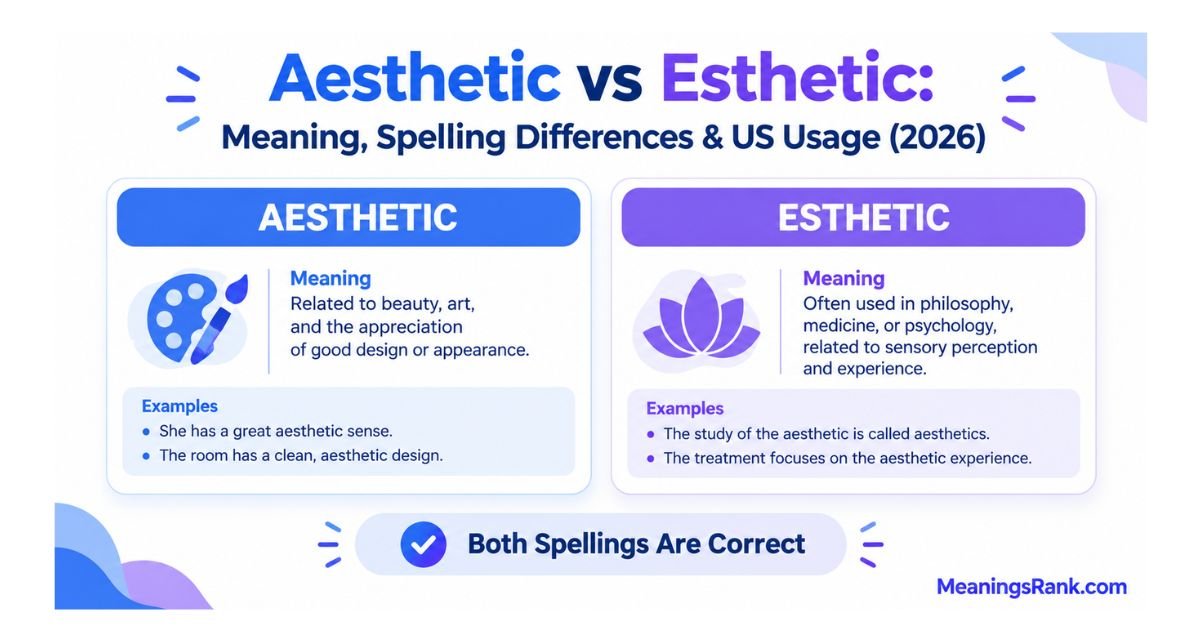
That small hesitation is the heart of this guide. Aesthetic and esthetic are not two words with two meanings. They are two spellings of a single word, and the real question is which one suits your reader. The answer, in short, is aesthetic. It works in the United States, the United Kingdom, Canada, and Australia, while esthetic belongs to a narrower set of American contexts.
Why does this matter? Spelling is part of your credibility. A writer who mixes both forms in one document looks inconsistent. A writer who uses esthetic for a British audience may look careless. And in fields such as skincare, medicine, and design, the right form can affect how clients find and trust you.
In the sections below, you will learn what the word means, where each spelling came from, how Gen Z has stretched its grammar, and how to handle tricky cases like job titles and Botox clinics. You will also find examples, common mistakes, a memory trick, and a short quiz so the rule sticks.
Quick Answer: Aesthetic vs Esthetic
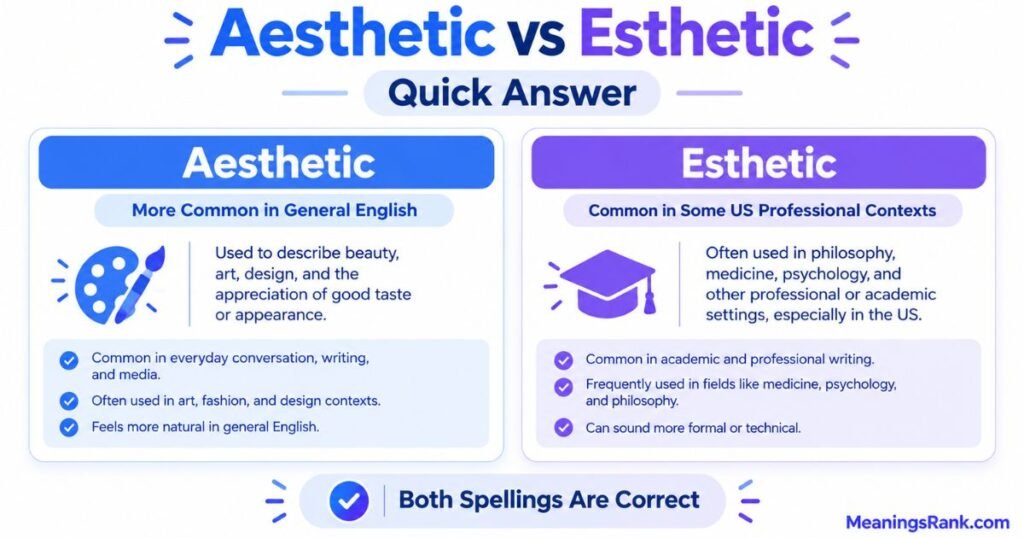
“Aesthetic” is the standard spelling in American and British English alike. “Esthetic” is a rarer, simplified American variant with the same meaning. Both words describe beauty, visual style, or the appreciation of art. If you want one safe choice that no editor will question, use aesthetic.
| Question | Short Answer |
| Are they two different words? | No. They are two spellings of one word. |
| Which is more common in the US? | Aesthetic, by a wide margin. |
| Which is correct in the UK? | Aesthetic only. |
| Which should you choose? | Aesthetic, unless a style guide tells you otherwise. |
Is It Spelled Esthetic or Aesthetic?
Both spellings exist in dictionaries, but only one is the default. Aesthetic is the main entry in Merriam-Webster, Oxford, Cambridge, and Collins. Esthetic appears as a variant, usually labeled as chiefly American or simply “also.”
Here is the quick history. The word comes from the Greek aisthētikos, meaning “perceptive” or “relating to sensation.” German philosopher Alexander Baumgarten borrowed it in the eighteenth century to name the study of sensory experience and beauty. English picked it up in the late 1700s, and the Latin-style ae spelling came along with it.
Later, American spelling reformers, most famously Noah Webster, pushed to simplify words by dropping unneeded letters. Colour became color. Centre became center. Words with the ae digraph, such as anaesthesia and paediatric, were trimmed to anesthesia and pediatric. In that wave, aesthetic produced the variant esthetic.
The twist is that aesthetic never fell. Unlike anesthesia, where the American form took over completely, aesthetic kept its ae in the United States. Writers, publishers, designers, and universities overwhelmingly stayed with the longer spelling. So today the simplified form survives mostly in older texts, certain professional titles, and a few style-conscious publications.
Practical rule: If you see esthetic in a modern article, it is not wrong. It is just unusual. If you see aesthetic, nobody will blink.
Read More: Batchelor vs Bachelor: Which Spelling Is Correct? Meaning & Examples (2026)
What Do Aesthetic and Esthetic Mean?
Since the two spellings are one word, they share meanings. The word works as an adjective and as a noun, and each role has a few shades.
As an adjective
- Relating to beauty or art. An aesthetic judgment is a judgment about how something looks, sounds, or feels in terms of beauty. The museum’s aesthetic appeal drew thousands of visitors.
- Pleasing in appearance. The kitchen is both functional and aesthetic. Here the word leans toward “attractive.”
- Concerned with appearance rather than function. The changes were purely aesthetic; the engine stayed the same.
As a noun
- A set of principles behind a style. The film has a gritty, handheld aesthetic. This is the sense most people use today.
- The branch of philosophy that studies beauty and taste. Philosophers often use the plural form aesthetics for this field. She is taking a course in aesthetics.
- A named visual trend or mood. Cottagecore, minimalism, and dark academia are popular aesthetics. This sense exploded through social media.
Related word forms
- Aesthetics / esthetics (noun, usually plural in form but singular in construction when naming the field): Aesthetics is a branch of philosophy.
- Aesthetically / esthetically (adverb): an aesthetically pleasing layout.
- Aesthete / esthete (noun): a person who cares deeply about beauty.
- Aesthetician / esthetician (noun): a licensed skincare professional in the United States.
Notice something helpful. Every form of the word follows the same pattern. If you choose the ae spelling in one place, keep it everywhere in the same document.
Key Differences at a Glance
The differences are small, and they live in spelling, region, and frequency rather than meaning.
| Feature | Aesthetic | Esthetic |
| Spelling | Includes ae | Drops the a |
| Meaning | Beauty, style, art appreciation | Identical |
| Part of speech | Adjective and noun | Adjective and noun |
| US usage | Dominant | Rare variant |
| UK, Canada, Australia | Standard and nearly exclusive | Seen as an error or Americanism |
| Frequency in print | Very high | Low |
| Formal writing | Fully accepted | Accepted but may look unusual |
| Professional titles | Aesthetician common in medical spas | Esthetician official in many US state licenses |
| Safe for global audiences | Yes | Not recommended |
A good summary: the word is the same, the audience is different. Aesthetic speaks to everyone. Esthetic speaks to a narrower slice of American readers.
Meaning and Usage Differences
Because the spellings are interchangeable, you will not find a case where aesthetic means one thing and esthetic means another. The real differences are in habits and conventions.
Differences in convention
In the United States, some fields developed their own habits. Licensing boards for skincare use esthetician. Some dental and medical offices write esthetic dentistry. Meanwhile, plastic surgery societies, art museums, and design schools almost always write aesthetic.
These habits are not rules of grammar. They are conventions of professional style, much like a company choosing email over e-mail. Grammar, syntax, and clause structure do not change. The word still functions the same way in a sentence, whether it modifies a noun or serves as one.
Adjective versus noun in practice
Many readers stumble not over spelling but over part of speech. Compare these two sentences:
- Her aesthetic sense is remarkable. (adjective modifying “sense”)
- Her aesthetic is soft, vintage, and warm. (noun, the subject of the verb “is”)
In the first sentence, you could swap in artistic and keep the grammar. In the second, you could swap in style or look. That swap test tells you which role the word is playing.
Singular, plural, and agreement
The noun aesthetic can take a plural: two competing aesthetics. But aesthetics as a field of study takes singular agreement, like economics or physics.
- Correct: Aesthetics is a core part of philosophy.
- Awkward: Aesthetics are a core part of philosophy. (Fine only if you mean multiple styles.)
Subject-verb agreement here depends on meaning. If you mean the academic field, use a singular verb. If you mean several visual styles, use a plural verb.
Countable use in design and branding
In design writing, an aesthetic is countable and specific: The brand adopted a clean Scandinavian aesthetic. In casual speech, people also say the aesthetic as a vague compliment: That cafe has the aesthetic. The second example is informal and works best in conversation, captions, and creative writing.
American English vs British English: Which Spelling Is Preferred?
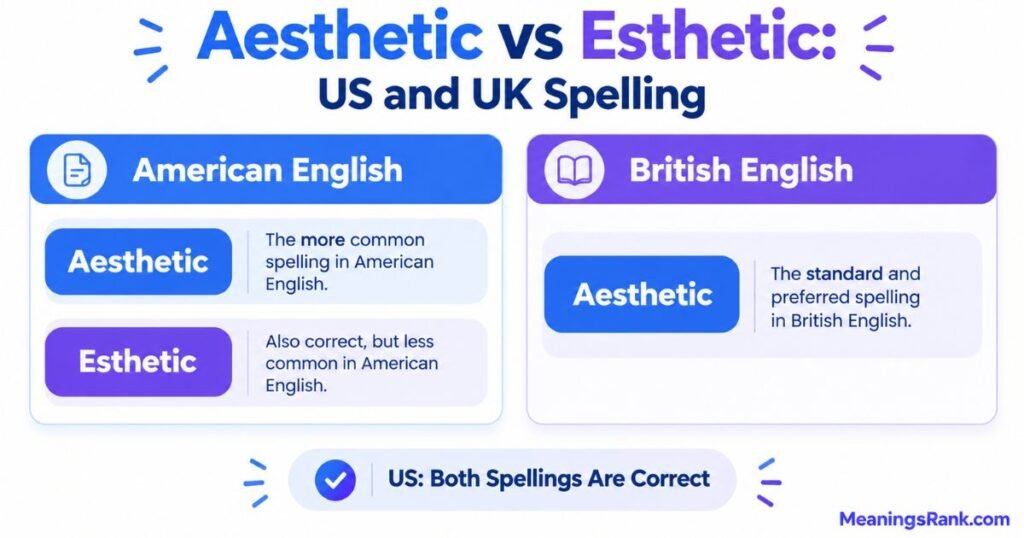
Both varieties prefer aesthetic. That surprises many learners, because they expect American English to simplify every ae word.
What the major style guides say
- British publishers (Oxford, Cambridge, Guardian style) use aesthetic without exception.
- American dictionaries list aesthetic first and esthetic second.
- US newspaper and academic style guides overwhelmingly print aesthetic in practice. Your own house style may differ, so check it before publishing.
Why the pattern is inconsistent
English spelling is not governed by one authority. Webster’s reforms succeeded for some words and failed for others. Compare the family of ae words:
| Word with ae | Common US form | Common UK form |
| Anaesthetic | Anesthetic | Anaesthetic |
| Paediatric | Pediatric | Paediatric |
| Encyclopaedia | Encyclopedia | Encyclopaedia (often encyclopedia now) |
| Archaeology | Archaeology | Archaeology |
| Aesthetic | Aesthetic | Aesthetic |
| Mediaeval | Medieval | Medieval |
Notice the odd mix. Archaeology and aesthetic kept their spelling in America, while anesthetic and pediatric did not. Spelling follows usage and habit, not logic.
A note on 2026 usage
By 2026, the gap is even wider online. Search results, style blogs, and product listings in the US use aesthetic heavily. The simplified variant appears mainly in specific professional contexts, such as state cosmetology boards. If your audience spans the globe, aesthetic is the only reliable option.
Why Does Gen Z Say “Aesthetic”?
If you scroll through TikTok, Pinterest, or Instagram, you will see aesthetic used in a way your grandparents never did. It shows up as a standalone noun, a hashtag, and even a one-word reaction.
The grammatical shift
Traditionally, aesthetic was an adjective (an aesthetic quality) or a formal noun (a modernist aesthetic). Gen Z stretched it into several informal patterns:
- Noun for a mood or vibe: My room has a cozy aesthetic.
- Adjective meaning “stylish” or “pretty”: That outfit is so aesthetic.
- Trend label: She’s into the Y2K aesthetic.
- Exclamation: Aesthetic! (said of a photo or scene)
The second pattern is the one prescriptivists question. Traditional usage says something is aesthetically pleasing, not simply aesthetic. In a formal essay, stay with the traditional form. In a caption or a text, the slangy form is understood instantly.
Why it caught on
Social media is visual. People curate feeds, rooms, outfits, and playlists around a consistent look, and they needed a short word to name that look. Aesthetic fit perfectly. It is compact, it sounds slightly intellectual, and it carries a sense of intentional taste.
Do Gen Z writers use “esthetic”?
Almost never. The spelling aesthetic is the one in hashtags, search bars, and trend names. Using esthetic in a social caption would look like a typo to most followers.
The takeaway for writers
Language changes through use, and linguists treat this shift as normal semantic broadening. If your readers are young and your tone is casual, the slang use is fine. For academic, legal, or professional writing, stick with the formal definitions, and add a modifier when you need to: visually appealing, aesthetically pleasing, or stylish.
What Is the Difference Between Aesthetic and Beautiful?
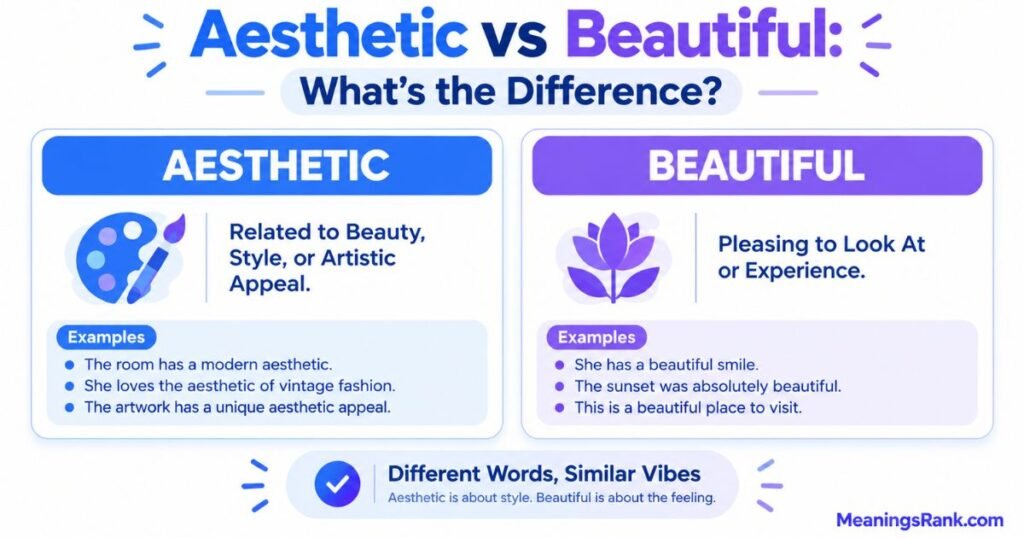
These words overlap, but they are not synonyms.
Beautiful describes a quality
Beautiful says that something is pleasing to the senses or the mind. It is a verdict: The sunset was beautiful.
Aesthetic describes a way of looking
Aesthetic is broader. It refers to the study, principles, or style behind how something looks or feels. An aesthetic can be beautiful, but it can also be stark, eerie, chaotic, or deliberately ugly.
Think about brutalist architecture. Many people do not find a concrete tower beautiful. Yet no one would deny it has a strong, coherent aesthetic.
Comparison table
| Sentence | Works? | Why |
| The painting is beautiful. | Yes | Gives a direct judgment. |
| The painting has a beautiful aesthetic. | Yes | Combines both ideas. |
| The painting has a gritty aesthetic. | Yes | Describes style, not beauty. |
| The painting is gritty beautiful. | No | Faulty syntax; needs “grittily beautiful” or a rewrite. |
| The aesthetic of the painting is beautiful. | Yes, but wordy | Understandable, though “the painting is beautiful” is tighter. |
A useful test
Ask yourself: Am I judging quality, or describing style? If you are judging quality, use beautiful, stunning, or lovely. If you are describing a look, mood, or design philosophy, use aesthetic.
Why the difference matters in real writing
Product copy, design briefs, and reviews get muddy when the two words blur. “This sofa has a beautiful aesthetic” tells a reader more than “This sofa is aesthetic,” which feels incomplete. Pairing the noun with a descriptive adjective (warm, minimalist, retro) gives the reader something to picture.
Is It Aesthetic or Esthetics When Talking About Botox?
This is where the confusion gets personal, because people search for clinics and treatments and run into both spellings in the same results.
The short answer
In medical and cosmetic contexts, “aesthetic” is the standard term: aesthetic medicine, aesthetic treatments, aesthetic clinic, aesthetic plastic surgery. Botox, filler, and laser services are commonly grouped under “aesthetic medicine” because they aim to change or improve appearance.
Where “esthetics” appears
In the United States, “esthetics” often names the skincare field licensed through state cosmetology or barbering boards. A professional who provides facials, waxing, and skin analysis is typically called an esthetician. Many practitioners prefer aesthetician in branding, and both spellings circulate.
A practical breakdown
| Term | Typical meaning | Who uses it |
| Aesthetic medicine | Injectables, lasers, and non-surgical cosmetic treatments | Doctors, nurses, med spas |
| Aesthetic plastic surgery | Surgery for appearance | Surgeons, hospitals |
| Esthetician | Licensed skincare specialist (facials, waxing) | US state boards, spas |
| Aesthetician | Same role, alternate spelling | Spas and clinics |
| Esthetics (field) | The study or practice of skincare and beauty | Beauty schools |
Which spelling for Botox pages?
If you run a clinic website or write health content for a US audience, use “aesthetic” in headings and treatment names. It matches what patients search for. Use “esthetician” only if your state license or job title uses that exact form.
A fair caution: this is a descriptive guide to spelling, not medical advice. For decisions about treatments, a licensed healthcare professional is the right source.
Why this matters for SEO and trust
Search engines understand that the spellings are connected, but consistency still helps readers. Switching between aesthetician and esthetician on one page can look careless. Choose one, apply it throughout, and keep your terms aligned with your local licensing language.
Why People Confuse Aesthetic and Esthetic
Three forces cause the mix-up, and none of them are about carelessness.
1. The silent “a”
In aesthetic, the ae produces a single sound, usually pronounced “es-THET-ik” in the US (or “ees-THET-ik” in some British accents). Because the a is not heard, writers wonder whether it belongs.
2. Inconsistent American spelling reform
Learners notice that anesthesia drops the a while aesthetic does not. That seems illogical, and it is. Spelling in English evolved by accident as much as by design.
3. Job titles and signage
Walk past a spa and you might see “Esthetician” on one window and “Aesthetics Studio” on the next. Repeated exposure to both forms blurs which is “standard.”
Quick Memory Trick / Mnemonic Device
Use this short phrase: “A for All.”
Aesthetic begins with A, and it is the spelling Accepted by All English-speaking regions. If you need one spelling that works everywhere, start with the A.
A second trick for the ending: “Aesthetic Adds an A, Always Acceptable.” It is silly, and silly is memorable.
For skincare pros, add: “Esthetician = Every State uses it on the license.” That is not true in every state, but it reminds you that this form lives mainly in US licensing.
Read More: Good Morning or Goodmorning: Which Spelling Is Correct? (2026 Guide)
Tone, Context, and Formality
The spelling you choose sends a quiet signal about your audience and your style.
Formal writing
Academic papers, journalism, legal documents, and business reports should use aesthetic. It is the form your readers expect, and it avoids any impression of inconsistency.
Casual writing
In texts, captions, and blog posts, aesthetic is still the natural choice. Casual writers also use it with relaxed grammar: It’s giving cozy aesthetic. The word stays the same, but the syntax gets looser.
Technical and professional writing
- Design and art: aesthetic is standard.
- Medicine and cosmetic surgery: aesthetic is standard.
- Skincare licensing: esthetician may be required by local rules.
- Dentistry: both appear; follow your professional association’s usage.
Creative writing
Authors sometimes pick esthetic on purpose to evoke a vintage or Americana feel, or to match a character’s voice. This is a stylistic decision and should be consistent. A novel that uses esthetic on page ten and aesthetic on page two will confuse readers and annoy copyeditors.
Quick formality guide
| Context | Recommended spelling |
| Academic essay | Aesthetic |
| News article | Aesthetic |
| Social media caption | Aesthetic |
| Marketing copy (global) | Aesthetic |
| US skincare license title | Esthetician (check local rules) |
| Historical quotation | Match the original |
Which One Should You Use?
For nearly every situation, use aesthetic.
Choose “aesthetic” when
- You write for an international audience.
- You write for American readers in general.
- You publish on a website that wants broad search visibility.
- You teach English or write educational content.
- You are unsure.
Choose “esthetic” only when
- A style guide or client explicitly requires it.
- You quote a source that uses it.
- A licensing or professional title requires esthetician.
- You are intentionally mimicking older American typography.
A simple decision flow
- Does a style guide specify? Follow it.
- Is the word part of a quoted title or license? Match it.
- Is your audience global or mixed? Use aesthetic.
- Still unsure? Use aesthetic.
Consistency beats cleverness. Pick one form and keep it from the title to the last sentence.
When Does One Spelling Sound Wrong?
Spelling is visual, but it also shapes how a reader hears your writing in their head.
When “esthetic” looks wrong
- In British, Canadian, or Australian contexts. Readers there will likely read it as a spelling error.
- In design, fashion, and art writing. Professionals in these fields almost always write aesthetic, so the shorter form looks out of place.
- In social media hashtags. Trend tags use aesthetic; the other spelling gets lost.
When “aesthetic” looks wrong
It rarely does, but there is one case. If you are writing in a US setting where the job title is officially esthetician, printing aesthetician on a license-related document may not match the official wording. Even then, the mismatch is minor.
Sound versus spelling
Both spellings are pronounced the same in American English: /es-THET-ik/. British speakers may say /ees-THET-ik/ or /es-THET-ik/. The difference is in the vowel sound of the first syllable, not in the spelling. That is why switching spellings does not change how a word is spoken in the US.
A practical test
Read your sentence aloud and ask: Does this spelling match the voice and region of my audience? If it does not, switch to aesthetic.
Common Mistakes (And Quick Fixes)
Here are the errors that appear most often, with direct fixes.
| Mistake | Why it is wrong | Fix |
| The esthetic of the room was lovely. (in a UK article) | Regional mismatch | The aesthetic of the room was lovely. |
| Aesthetic and esthetic mixed in one document | Inconsistent style | Choose one and apply it everywhere. |
| Aesthetics are a branch of philosophy. | Agreement error | Aesthetics is a branch of philosophy. |
| The aesthetician spelled it esthetician on the sign. | Mixed forms in the same text | Pick one form for professional titles. |
| It’s very aesthetic and beautiful. (formal essay) | Slang adjective plus redundancy | It is visually striking. |
| an aesthetic vs a aesthetic | Article error | an aesthetic (use “an” before a vowel sound). |
| Aesthetical | Archaic or unnecessary form | Aesthetic |
| Asthetic or aesthetik | Misspelling | Aesthetic |
Fixing the “an aesthetic” trap
Because aesthetic begins with a vowel sound, it takes an: an aesthetic choice. The silent a does not change the rule. Choose the article by sound, not by the letter.
Fixing the “aesthetic as an adjective” slang in formal writing
In casual writing, That room is so aesthetic is understood. In formal work, expand it:
- That room is visually appealing.
- That room has a cohesive aesthetic.
- That room is aesthetically pleasing.
Key Exceptions to Keep in Mind
- Quoted material. If a historical text says esthetic, keep it inside the quotation.
- Proper names. Organization names (for example, an “Esthetics Academy”) keep their official spelling.
- Licensing language. Follow your state or country’s official job title.
- Translated terms. Some translations of philosophy texts, especially older American ones, use esthetics. Match the edition you are citing.
- Brand voice. A brand that has used esthetic for years may keep it. Consistency within the brand is the goal.
Read More: Speach or Speech: Discover the Correct Spelling and Common Mistake (2026)
Aesthetic vs Esthetic: Everyday Examples
Seeing the word in context is the fastest way to lock in the rule. These sentences use aesthetic as the default form, with notes where the variant appears.
Everyday sentences
Design and home
- The apartment has a calm, minimalist aesthetic.
- She chose the lamp for its aesthetic appeal, not its brightness.
- The renovation was purely aesthetic; the plumbing stayed the same.
Art and culture
- The director’s aesthetic is dreamy and slow.
- He studied aesthetics at university.
- The exhibit explores the aesthetic of protest posters.
Social media
- Her feed has a soft pastel aesthetic.
- That café is so aesthetic. (informal)
- I’m planning my room around a dark academia aesthetic.
Professional and medical
- The clinic offers aesthetic treatments such as injectables and laser therapy.
- She trained as an esthetician and now runs a skincare studio. (US licensing form)
- The surgeon specializes in aesthetic reconstruction.
Correct vs. incorrect examples
| Context | Correct | Incorrect or risky |
| UK essay | Aesthetic | Esthetic |
| Global brand page | Aesthetic | Mixing both forms |
| US skincare license | Esthetician | Asthetician |
| Formal review | The film has a striking aesthetic. | The film is very aesthetic. |
| Philosophy paper | Aesthetics is a field of study. | Aesthetics are a field of study. |
Interactive Practice Quiz
Fill in each blank with the best choice. Answers are at the bottom.
- The magazine is known for its clean, minimalist ______. (aesthetic / esthetic)
- In a British university paper, the correct spelling is ______. (aesthetic / esthetic)
- ______ is the philosophical study of beauty and taste. (Aesthetics are / Aesthetics is)
- Her job title on her state license reads ______. (aesthetician / esthetician)
- Choose the correct article: She made ___ aesthetic choice. (a / an)
Answer Key
- aesthetic (safe, standard spelling in every region)
- aesthetic (British English does not use esthetic)
- Aesthetics is (a field of study takes a singular verb)
- esthetician (this is a licensing example; follow your actual license wording)
- an (it is chosen by the vowel sound)
Scoring: 5/5 means you are ready to publish. 3-4 means a quick re-read of the “Common Mistakes” section will sharpen you up. Below 3? Review the “Key Differences at a Glance” table and try again.
Dictionary-Style Word Details
aesthetic
Pronunciation (US): /es-ˈthe-tik/
Pronunciation (UK): /iːs-ˈθet-ɪk/ or /es-ˈθet-ɪk/
Part of speech: adjective, noun
Origin: Greek aisthētikos (“perceptive”), via German Ästhetik, popularized in English from the late eighteenth century.
Definitions:
- (adj.) Relating to beauty or the appreciation of beauty.
- (adj.) Pleasing in appearance.
- (adj.) Concerned with look rather than function.
- (n.) A set of principles or a visual style associated with a person, movement, or work.
- (n., informal) A curated mood or look, especially on social media.
Example: The studio’s aesthetic is warm, handmade, and earthy.
Related forms: aesthetically (adv.), aesthetics (n.), aesthete (n.), aesthetician (n.)
esthetic
Pronunciation: /es-ˈthe-tik/
Part of speech: adjective, noun
Status: Chiefly American variant of aesthetic.
Meaning: Same as aesthetic in every sense.
Example: The esthetic of the old poster surprised him. (valid, though uncommon)
Related forms: esthetically, esthetics, esthete, esthetician
Synonyms and near-synonyms
- Visual style, look, design sense, artistic quality, appearance, vibe (informal)
Common collocations
- aesthetic appeal, aesthetic value, aesthetic judgment, minimalist aesthetic, retro aesthetic, aesthetic treatment
Frequently Asked Questions
Is it “aesthetic” or “esthetic” in American English?
Both spellings are accepted, but “aesthetic” is far more common and is the standard form in dictionaries and publications. “Esthetic” is a minor American variant. Choose aesthetic unless a style guide or license title says otherwise.
Do “aesthetic” and “esthetic” mean the same thing?
Yes. They are two spellings of one word, and the meanings are identical: relating to beauty, art, and visual style. The choice affects spelling and audience, not definition.
Why do some people write “esthetician” instead of “aesthetician”?
In the United States, many state cosmetology boards use “esthetician” as the official title for a licensed skincare specialist. Many spas and clinics still prefer “aesthetician” in marketing. Both refer to the same profession.
Is “aesthetic” an adjective or a noun?
It is both. As an adjective, it describes things related to beauty (an aesthetic decision). As a noun, it names a style or set of principles (a retro aesthetic). The plural noun aesthetics names the philosophical field and takes a singular verb.
Which spelling should I use for Botox and cosmetic services?
Use “aesthetic” for treatment categories such as aesthetic medicine and aesthetic clinic. Use “esthetician” only when it matches an official job title or license. Always keep the spelling consistent on a page.
Conclusion
Aesthetic and esthetic mean exactly the same thing, but aesthetic is the spelling nearly every reader, editor, and search engine expects. Reserve esthetic and esthetician for places where a quotation, a style guide, or a license demands them, and keep your choice consistent from start to finish. Remember the rule “A for All,” and you will never second-guess the spelling again.