
You are filling out a form, and the line reads “Requestor.” Two paragraphs later, a colleague’s email says “requester.” Both look right, and neither looks like a typo. So which one is correct?
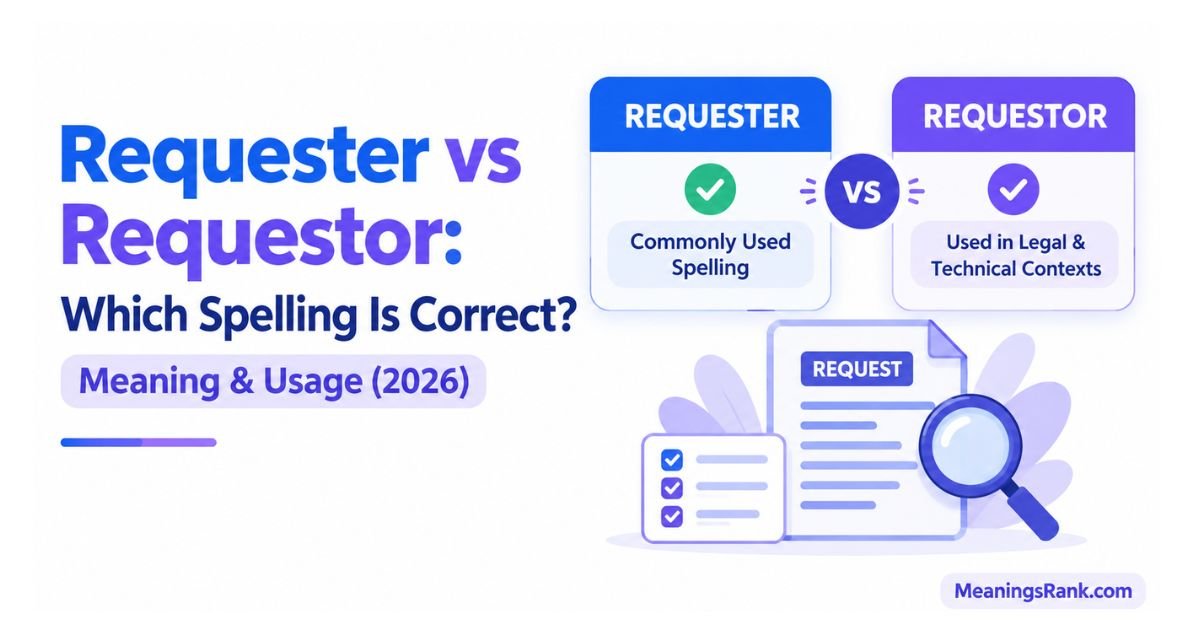
That is the dilemma: two spellings, one meaning, and no obvious winner at first glance. The short answer is that requester is the standard spelling, while requestor is an accepted variant that thrives in legal and technical writing.
Why does it matter? Because small spelling choices signal care. An inconsistent term in a contract, a help article, or a job application can make a reader wonder what else slipped through. This guide explains what each word means, where each one fits, and how to choose with confidence.
Requester vs. Requestor: Quick Answer
Both spellings are accepted, but requester is the standard, preferred form in general English. Requestor is a recognized variant, most often seen in legal forms, government paperwork, and software documentation.
| Requester | Requestor | |
| Status | Standard spelling | Accepted variant |
| Meaning | A person or party who makes a request | Same meaning |
| Best for | General writing, journalism, academic work | Legal, technical, or organizational contexts that already use it |
Rule of thumb: use requester unless a legal template, API specification, or house style guide tells you otherwise. Whatever you pick, stay consistent within one document.
What Do Requester and Requestor Mean?
Here is the dilemma in one sentence: two spellings, one meaning, and no obvious winner at first glance. Both words are agent nouns. They name the person, group, or system that performs the action of the verb request. If you submit a records request, you are the requester. If a server sends a request to another server, the sending machine is the requester.
The only real difference is the suffix. One word ends in -er, the other in -or. English uses both endings to build agent nouns, and no single rule predicts which one a given verb will take.
Requester: Meaning and Usage
Requester means “a person or entity that makes a request.” It follows the most common pattern in English for turning a verb into a noun: add -er to the base verb. Think of teacher, reader, and writer.
Most major dictionaries and style-conscious publishers treat requester as the main entry. You will see it in news writing, academic papers, customer service scripts, and everyday business email.
- The requester must sign the form before the library releases the archive.
- As the requester, you can cancel the order within 24 hours.
Read More: Parents’ or Parent’s: Which Spelling Is Correct? (Meaning & Usage Guide)
Requestor: Meaning and Usage
Requestor carries exactly the same meaning. It swaps the Germanic -er ending for the Latin-flavored -or ending. That suffix shows up in words like creator and investor, and in many legal terms such as grantor, lessor, and assignor.
Because legal and administrative writing leans heavily on -or words, requestor felt natural to many form designers and software teams. It spread through contracts, compliance forms, and technical specifications.
- The requestor shall provide written authorization within ten business days.
- The system logs the IP address of every requestor.
Key Differences Between Requester and Requestor
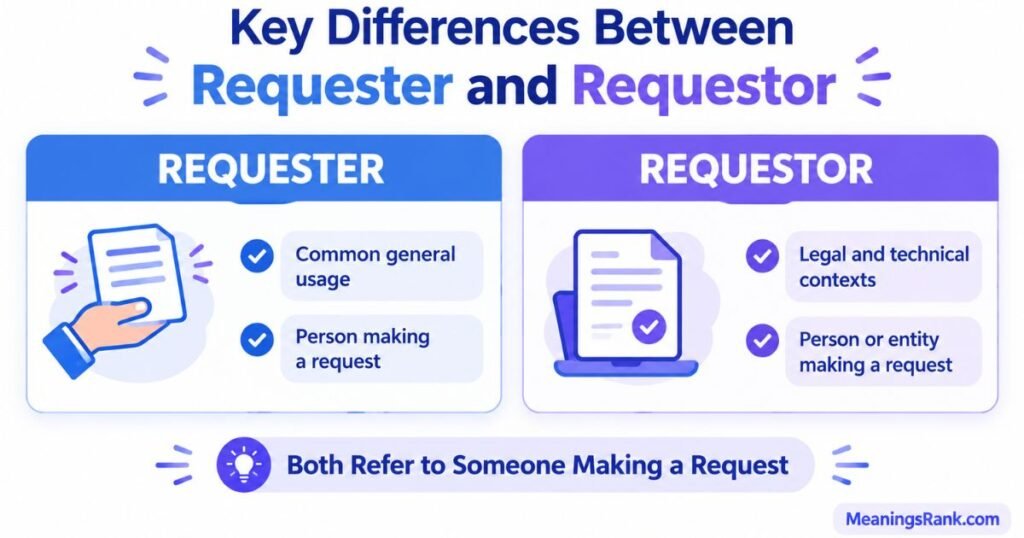
Since the meaning is identical, the differences are about convention, tone, and audience. Think of them as style differences rather than grammar errors.
| Feature | Requester | Requestor |
| Suffix origin | Germanic -er | Latin -or |
| Dictionary standing | Primary, standard entry | Variant spelling |
| Typical register | Neutral, everyday, editorial | Formal, legal, or technical |
| Risk of looking “wrong” | Very low | Low, but some editors will change it |
| Pronunciation | /rɪˈkwɛstər/ | /rɪˈkwɛstər/ (identical) |
Both words sound the same in speech, so the choice only matters on the page. No clause structure, punctuation rule, or subject-verb agreement pattern changes with the suffix. Both are singular countable nouns, and both form the plural the same way: requesters and requestors.
Requester vs. Requestor: Which Spelling Is More Common?
In published general-interest English, requester appears more often. Large text collections and dictionary usage notes consistently show the -er form leading in books, newspapers, and academic writing.
Requestor is far from rare, though. It has a strong foothold in specialized fields, where documents follow their own internal conventions.
- General audience writing: requester wins.
- Legal and compliance documents: mixed, with many organizations favoring requestor.
- Technical documentation: mixed, depending on the platform or company.
- Official US forms: both appear. The IRS, for example, uses requester on Form W-9.
Frequency is not the same as correctness, but it shapes reader expectations. A reader who sees the familiar spelling will not pause. A reader who sees the variant may pause for half a second, and that pause is a small cost to your clarity.
Requester in American English
American English strongly favors requester in standard prose. Newsroom guides generally default to the -er spelling for agent nouns built from ordinary verbs, and requester fits that habit.
You will meet it in schools, hospitals, public agencies, and customer support. Freedom of Information Act (FOIA) guidance from US agencies routinely discusses the “FOIA requester,” which shows how normal the -er form is in official American writing.
Examples of Requester in American English
- The FOIA requester received the documents within thirty days.
- The IT help desk contacts the requester before closing a ticket.
- The bank verified the identity of the requester before sharing account details.
Each sentence uses a simple subject-verb-object pattern, which makes requester easy to place in almost any syntax.
Requestor in Legal and Technical Contexts
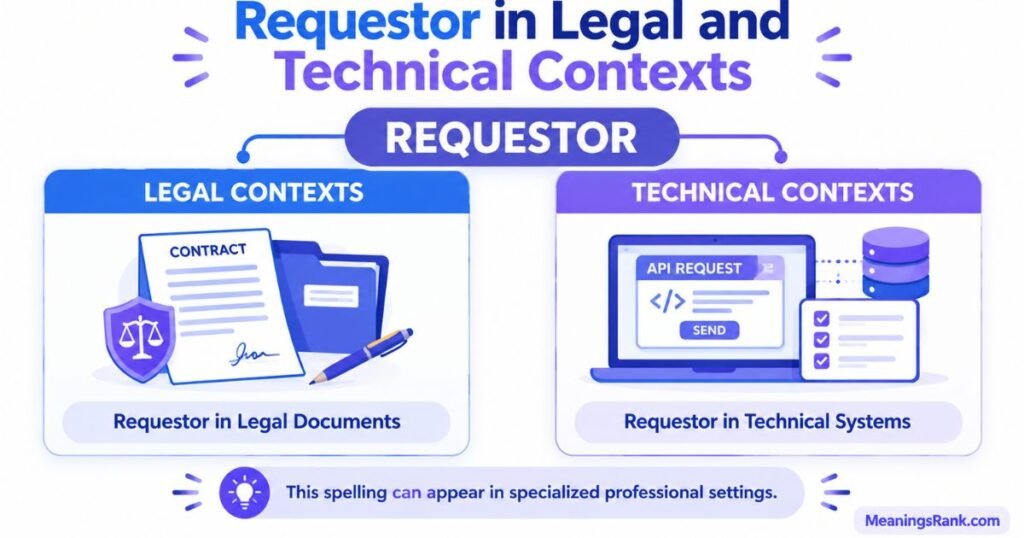
Requestor thrives where precision and repetition matter. Contracts and specifications often define a party once, then use that label dozens of times. The -or ending gives the term a formal feel that matches other defined parties such as licensor and lessor.
Requestor in Legal Documents
In contracts, data-sharing agreements, and privacy notices, you will often see a defined term such as “Requestor” with a capital R. Capitalization signals that the word has a specific meaning in that agreement.
“The Requestor shall submit a written statement identifying the records sought.” (illustrative clause)
If you draft or review legal text, follow the spelling already used in the template. Changing Requestor to Requester halfway through a contract creates inconsistency, and inconsistency in a legal document can invite ambiguity.
Read More: Ironic vs Unironic: Key Differences, Definitions & Real-Life Examples
Requestor in Technical Systems and Software
In software, networking, and workflow tools, the requester (or requestor) is the component that initiates a call. In a client-server model, the client sends a request and the server responds. Some documentation labels the initiating side “requestor,” particularly in older specifications and enterprise systems.
- The API returns an error if the requestor lacks permission.
- Workflow software routes the approval to a manager once the requestor submits the form.
Technical writers should match the naming used in field labels and user interfaces. If the screen says “Requestor,” your help article should too.
Requester vs. Requestor in British English
British English accepts both spellings, and the pattern mirrors American usage. Requester is the safer choice in everyday prose, while requestor appears in legal, procurement, and technical settings.
This matters because many learners assume one form is “American” and the other “British,” as with color and colour. That is not the case here. The split is by field and house style, not by country. If you write for a UK audience, follow your publication’s style guide. If none exists, requester is the dependable option.
Requester vs. Requestor: Examples in Everyday Language
Real-life writing rarely announces which spelling to use. Here are common settings and the form most readers expect.
| Situation | Typical choice | Example |
| Library or archive form | Requester | “The requester will receive a scanned copy.” |
| Customer support ticket | Requester | “Reply directly to the requester.” |
| Insurance or HR paperwork | Either | “Requestor signature required.” |
| Software approval workflow | Either | “Requestor: Maria Chen” |
| News or academic writing | Requester | “Each requester completed the survey.” |
Notice how often “either” appears. In practice, the best answer depends on the document you are working in, not on an abstract rule.
How to Use Requester and Requestor in Sentences
Both words behave like any regular count noun. They can serve as the subject, object, or complement, and they take articles, possessives, and modifiers in the usual way.
- Subject: The requester completed the form online. / The requestor completed the form online.
- Object: The agency notified the requester. / The agency notified the requestor.
- Singular possessive: The requester’s signature is required.
- Plural possessive: The requesters’ signatures are required.
| Correct | Incorrect | Why |
| Each requester must sign. | Each requesters must sign. | Each takes a singular noun. |
| The requestor’s name is blank. | The requestors name is blank. | The possessive needs an apostrophe. |
| Both requesters agreed. | Both requester agreed. | Both needs a plural noun. |
Is Requestor Incorrect, or Is It an Accepted Variant?
Requestor is not incorrect. It is an accepted variant spelling, listed in major dictionaries as an alternative to requester. A word does not become wrong simply because another form is more common.
That said, a few editors avoid requestor in general prose. Their reasoning is practical: -er is the default agent suffix for everyday verbs, so the -or form can look like a typo to readers outside law or technology.
So the question is less “right or wrong” and more “appropriate or inappropriate for this audience.” If your readers are lawyers, engineers, or compliance officers, requestor may feel completely natural. If your readers are students or the general public, requester will read more smoothly.
Common Mistakes When Using Requester and Requestor
Even careful writers slip on this pair. Watch for these patterns.
- Mixing both spellings in one document. Using requester in paragraph one and requestor in paragraph six looks careless. Choose one and apply it throughout.
- Assuming one spelling is American and the other British. The divide is by genre and house style, not geography.
- “Correcting” someone else’s defined term. In contracts and software interfaces, the spelling may be deliberate. Changing it can break a definition or mismatch a screen label.
- Forgetting the apostrophe in possessives. The requesters name should be the requester’s name. Punctuation errors do more damage than the choice of suffix.
- Confusing the person with the thing. Request is the base verb and noun. The requester is the person asking, not the item requested.
- Inventing new spellings. Forms like requestar do not exist. Run a spell-check, then read your draft aloud.
Etymology and Evolution of Requester and Requestor
Both words grow from request, which English borrowed from Old French requeste, tracing back to the Latin verb requirere, meaning “to seek” or “to ask for.”
Agent nouns formed in two ways. The Germanic -er suffix attached to ordinary English verbs: baker, singer, requester. The Latin -or suffix arrived through French and Latin: actor, director, requestor.
Over time, English speakers often applied -er to everyday words and kept -or for words with clear Latin heritage or legal weight. Request has a Latin-French background, so an -or form felt plausible. Yet the verb behaves like a regular English verb, which supports -er. Both pressures coexisted, and both spellings survived.
Legal English, which kept many Latin-style agent nouns, helped requestor persist. Technical writing later adopted the form, partly by copying legal and standards language. General writing drifted toward requester as the default.
How to Choose Between Requester and Requestor
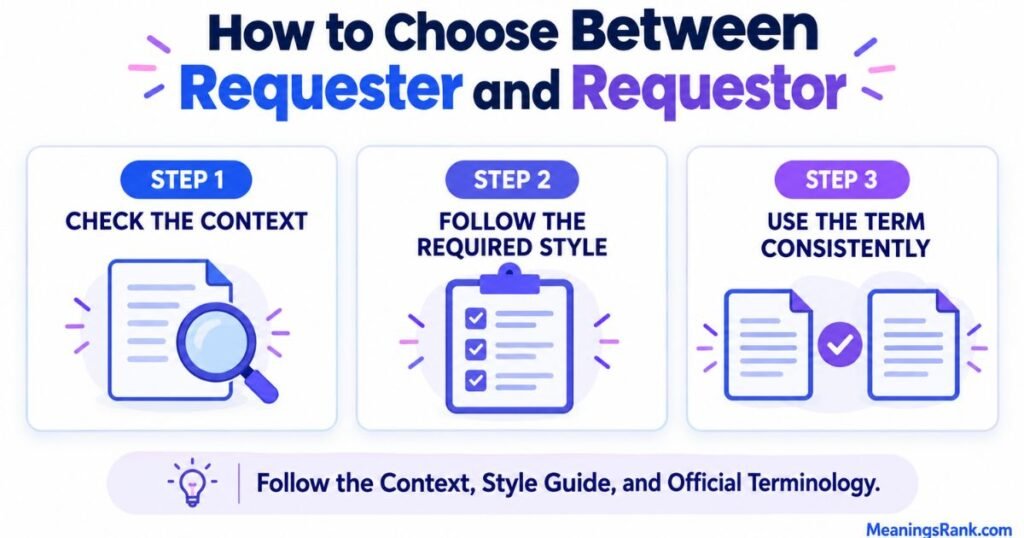
Use this simple decision process.
- Check the document’s existing spelling. If a template, contract, or interface already uses one form, match it.
- Check your style guide. Corporate, academic, and publishing guides often settle the question in one line.
- Consider your audience. General readers expect requester. Specialist readers may expect requestor.
- When in doubt, choose requester. It is the standard spelling and the least likely to be questioned.
- Stay consistent. Search your final draft for the other spelling and unify it.
Quick Memory Trick / Mnemonic Device
Remember: “ER is the Everyday Request.”
The -er ending matches the plain, everyday verb, just as teacher and reader do. Link requester to ordinary writing, and save requestor for situations where the paperwork or platform already says so. You can also picture the -or as standing for official records.
Interactive Practice Quiz
Fill in each blank with requester or requestor. Assume general, standard writing unless the sentence says otherwise.
- The library asked the ________ to show a photo ID before releasing the manuscript.
- In this legal template, the defined term is capitalized: “The ________ shall submit all documents in writing.” (The template uses the -or spelling.)
- Every ________’s name appears on the approval email. (Standard spelling, singular possessive.)
- Two ________ submitted identical applications on the same day. (Standard spelling, plural.)
- Our software form has a field labeled “________,” so the help article must match it. (The interface uses the -or spelling.)
Answer Key
- requester (standard spelling in general writing)
- Requestor (matches the template’s defined term)
- requester’s (apostrophe before the s)
- requesters (plural of the standard spelling)
- Requestor (matches the interface label)
Read More: Accross vs Across: Discover the Correct Spelling, Meaning & Usage (2026)
Frequently Asked Questions (FAQs)
Is it requester or requestor?
Both are correct, but requester is the standard spelling and the safer choice in general writing. Requestor is an accepted variant often used in legal and technical documents.
Is requestor a real word?
Yes. Requestor is listed as a variant spelling of requester in major dictionaries. It means exactly the same thing: a person or entity that makes a request.
Which spelling do American and British English prefer?
Both dialects prefer requester in everyday prose. Neither treats requestor as a regional spelling, so the choice depends on document type and house style rather than country.
Can I use requestor in a formal or academic paper?
You can, if your style guide or field allows it, but requester is usually the better fit for academic writing. Follow your institution’s or journal’s rules, and stay consistent.
What is the plural of requester and requestor?
Add an s to either word: requesters and requestors. For the plural possessive, place the apostrophe after the s: requesters’ and requestors’.
Conclusion
Requester and requestor mean the same thing, and neither is a grammatical error, but requester is the standard, reader-friendly default. Reserve requestor for legal templates, technical systems, or style guides that call for it, and keep your choice consistent from the first line to the last. When you are unsure, pick requester, check your possessives and plurals, and your writing will read clean and confident.